Writing Styles for
Educational Materials
Dr.Hafiz Kosar
Writing Styles for Educational
Materials
Writing styles for educational materials can
vary depending on the audience, subject
matter, and educational objectives.
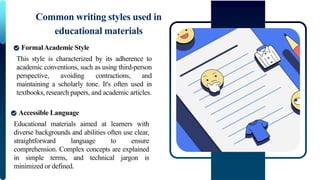
This style is characterized by its adherence to
academic conventions, such as using third-person
perspective, avoiding contractions, and
maintaining a scholarly tone. It's often used in
textbooks, research papers, and academic articles.
Common writing styles used in
educational materials
FormalAcademic Style
Educational materials aimed at learners with
diverse backgrounds and abilities often use clear,
straightforward language to ensure
comprehension. Complex concepts are explained
in simple terms, and technical jargon is
minimized or defined.
Accessible Language
Especially in materials for younger learners or
online education platforms, an engaging and
interactive writing style is employed. This can
include asking questions, incorporating anecdotes
or stories, and prompting readers to participate in
activities or discussions.
Common writing styles used in
educational materials
Engaging and Interactive
Clarity is paramount in educational writing.
Instructions for assignments, experiments, or
exercises need to be concise, precise, and easy to
follow. Step-by-step guides are common,
particularly in subjects like science or
mathematics.
Instructional Clarity
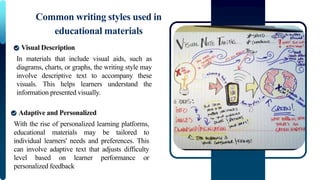
In materials that include visual aids, such as
diagrams, charts, or graphs, the writing style may
involve descriptive text to accompany these
visuals. This helps learners understand the
information presented visually.
Common writing styles used in
educational materials
Visual Description
With the rise of personalized learning platforms,
educational materials may be tailored to
individual learners' needs and preferences. This
can involve adaptive text that adjusts difficulty
level based on learner performance or
personalized feedback
Adaptive and Personalized
Especially in self-help or personal development
materials, an inspirational writing style can be
effective. This involves using motivational
language, sharing success stories, and
encouraging readers to set and achieve their
goals.
Common writing styles used in
educational materials
Motivational and Inspirational:
Writing styles in educational materials often
involve thorough explanations and descriptions
of concepts, theories, or processes. This is
particularly important in subjects like history,
literature, or geography, where context and
background information are crucial for
understanding.
Explanatory and Descriptive
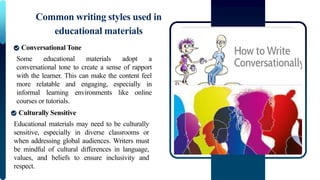
Some educational materials adopt a
conversational tone to create a sense of rapport
with the learner. This can make the content feel
more relatable and engaging, especially in
informal learning environments like online
courses or tutorials.
Common writing styles used in
educational materials
Conversational Tone
Educational materials may need to be culturally
sensitive, especially in diverse classrooms or
when addressing global audiences. Writers must
be mindful of cultural differences in language,
values, and beliefs to ensure inclusivity and
respect.
Culturally Sensitive
Effective writing styles for educational
materials:
Clarity:
Use clear and concise language to explain concepts.
Avoid jargon or overly complex language that may
confuse learners. Break down complex ideas into
simpler, digestible parts.
Engagement:
Keep the content interesting and engaging to maintain
the reader's attention. Use examples, anecdotes, and real-
life scenarios to illustrate key points and make the
material relatable.
Effective writing styles for educational
materials:
Structure:
Organize the material in a logical and coherent manner.
Use headings, subheadings, and bullet points to break up
the text and make it easier to follow. Provide a clear
roadmap of what the learner can expect to learn.
.
Active Voice:
Write in the active voice to make the material more
dynamic and engaging. This helps keep the reader
focused and makes the content easier to understand.
Effective writing styles for educational
materials:
VisualAids:
Incorporate visuals such as diagrams, charts, and
illustrations to supplement the text and reinforce key
concepts. Visual aids can help visual learners better
understand the material and make it more accessible to
all learners.
.
Interactivity:
If possible, incorporate interactive elements such as
quizzes, exercises, and activities to actively engage
learners and reinforce learning. This helps make the
material more interactive and facilitates active learning.
Effective writing styles for educational
materials:
Consistency:
Maintain consistency in writing style, formatting, and
terminology throughout the educational materials. This
helps create a cohesive learning experience and reduces
confusion for the learner.
Accessibility:
Ensure that the material is accessible to all learners,
including those with disabilities. Use plain language,
provide alternative text for images, and consider other
accessibility features to make the material inclusive.
Selection of Learning MaterialAccording
to Age Groups
Selecting appropriate learning materials according to age
groups is crucial for effective learning and development.
Some general guideline for selecting learning materials
based on different age groups:
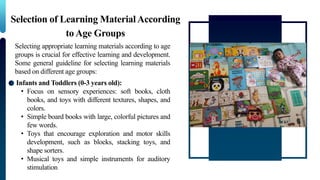
Infants and Toddlers (0-3 years old):
• Focus on sensory experiences: soft books, cloth
books, and toys with different textures, shapes, and
colors.
• Simple board books with large, colorful pictures and
few words.
• Toys that encourage exploration and motor skills
development, such as blocks, stacking toys, and
shape sorters.
• Musical toys and simple instruments for auditory
stimulation
Selection of Learning MaterialAccording
to Age Groups
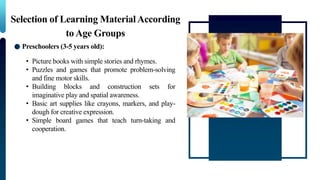
Preschoolers (3-5 years old):
• Picture books with simple stories and rhymes.
• Puzzles and games that promote problem-solving
and fine motor skills.
• Building blocks and construction sets for
imaginative play and spatial awareness.
• Basic art supplies like crayons, markers, and play-
dough for creative expression.
• Simple board games that teach turn-taking and
cooperation.
Selection of Learning MaterialAccording
to Age Groups
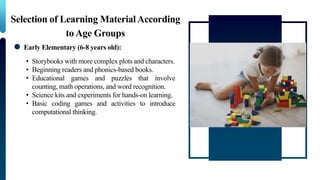
Early Elementary (6-8 years old):
• Storybooks with more complex plots and characters.
• Beginning readers and phonics-based books.
• Educational games and puzzles that involve
counting, math operations, and word recognition.
• Science kits and experiments for hands-on learning.
• Basic coding games and activities to introduce
computational thinking.
Selection of Learning MaterialAccording
to Age Groups
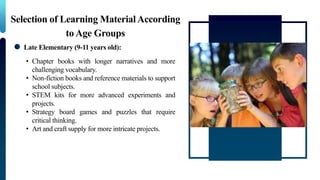
Late Elementary (9-11 years old):
• Chapter books with longer narratives and more
challenging vocabulary.
• Non-fiction books and reference materials to support
school subjects.
• STEM kits for more advanced experiments and
projects.
• Strategy board games and puzzles that require
critical thinking.
• Art and craft supply for more intricate projects.
Selection of Learning MaterialAccording
to Age Groups
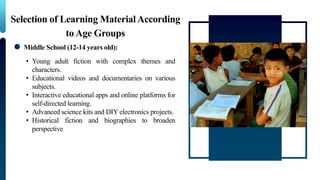
Middle School (12-14 years old):
• Young adult fiction with complex themes and
characters.
• Educational videos and documentaries on various
subjects.
• Interactive educational apps and online platforms for
self-directed learning.
• Advanced science kits and DIY electronics projects.
• Historical fiction and biographies to broaden
perspective
Selection of Learning MaterialAccording
to Age Groups
High School (15-18 years old):
• Classic literature and literary analysis guides.
• Advanced textbooks and resources for specific
subjects.
• Online courses and tutorials for academic
enrichment and skill development.
• SAT/ACT prep books and materials for college
readiness.
• Career exploration resources and internships
opportunities.
When selecting learning materials, it's important to consider the individual interests,
learning styles, and developmental stages of the children or teenagers. Additionally,
materials should be challenging enough to promote growth but not so difficult as to
cause frustration. Flexibility and adaptability in material selection are key to supporting
diverse learning needs
92-314-3205571
Thank You
www.facebook.com/kausar0791
Email
hafeezkausar.hashmi@gmail.com
https://www.linkedin.com/in/dr-hafiz-kosar-
284484186/

Writing Styles for Educational Materials.pptx

  • 1.
    Writing Styles for EducationalMaterials Dr.Hafiz Kosar
  • 2.
    Writing Styles forEducational Materials Writing styles for educational materials can vary depending on the audience, subject matter, and educational objectives.
  • 3.
    This style ischaracterized by its adherence to academic conventions, such as using third-person perspective, avoiding contractions, and maintaining a scholarly tone. It's often used in textbooks, research papers, and academic articles. Common writing styles used in educational materials FormalAcademic Style Educational materials aimed at learners with diverse backgrounds and abilities often use clear, straightforward language to ensure comprehension. Complex concepts are explained in simple terms, and technical jargon is minimized or defined. Accessible Language
  • 4.
    Especially in materialsfor younger learners or online education platforms, an engaging and interactive writing style is employed. This can include asking questions, incorporating anecdotes or stories, and prompting readers to participate in activities or discussions. Common writing styles used in educational materials Engaging and Interactive Clarity is paramount in educational writing. Instructions for assignments, experiments, or exercises need to be concise, precise, and easy to follow. Step-by-step guides are common, particularly in subjects like science or mathematics. Instructional Clarity
  • 5.
    In materials thatinclude visual aids, such as diagrams, charts, or graphs, the writing style may involve descriptive text to accompany these visuals. This helps learners understand the information presented visually. Common writing styles used in educational materials Visual Description With the rise of personalized learning platforms, educational materials may be tailored to individual learners' needs and preferences. This can involve adaptive text that adjusts difficulty level based on learner performance or personalized feedback Adaptive and Personalized
  • 6.
    Especially in self-helpor personal development materials, an inspirational writing style can be effective. This involves using motivational language, sharing success stories, and encouraging readers to set and achieve their goals. Common writing styles used in educational materials Motivational and Inspirational: Writing styles in educational materials often involve thorough explanations and descriptions of concepts, theories, or processes. This is particularly important in subjects like history, literature, or geography, where context and background information are crucial for understanding. Explanatory and Descriptive
  • 7.
    Some educational materialsadopt a conversational tone to create a sense of rapport with the learner. This can make the content feel more relatable and engaging, especially in informal learning environments like online courses or tutorials. Common writing styles used in educational materials Conversational Tone Educational materials may need to be culturally sensitive, especially in diverse classrooms or when addressing global audiences. Writers must be mindful of cultural differences in language, values, and beliefs to ensure inclusivity and respect. Culturally Sensitive
  • 8.
    Effective writing stylesfor educational materials: Clarity: Use clear and concise language to explain concepts. Avoid jargon or overly complex language that may confuse learners. Break down complex ideas into simpler, digestible parts. Engagement: Keep the content interesting and engaging to maintain the reader's attention. Use examples, anecdotes, and real- life scenarios to illustrate key points and make the material relatable.
  • 9.
    Effective writing stylesfor educational materials: Structure: Organize the material in a logical and coherent manner. Use headings, subheadings, and bullet points to break up the text and make it easier to follow. Provide a clear roadmap of what the learner can expect to learn. . Active Voice: Write in the active voice to make the material more dynamic and engaging. This helps keep the reader focused and makes the content easier to understand.
  • 10.
    Effective writing stylesfor educational materials: VisualAids: Incorporate visuals such as diagrams, charts, and illustrations to supplement the text and reinforce key concepts. Visual aids can help visual learners better understand the material and make it more accessible to all learners. . Interactivity: If possible, incorporate interactive elements such as quizzes, exercises, and activities to actively engage learners and reinforce learning. This helps make the material more interactive and facilitates active learning.
  • 11.
    Effective writing stylesfor educational materials: Consistency: Maintain consistency in writing style, formatting, and terminology throughout the educational materials. This helps create a cohesive learning experience and reduces confusion for the learner. Accessibility: Ensure that the material is accessible to all learners, including those with disabilities. Use plain language, provide alternative text for images, and consider other accessibility features to make the material inclusive.
  • 12.
    Selection of LearningMaterialAccording to Age Groups Selecting appropriate learning materials according to age groups is crucial for effective learning and development. Some general guideline for selecting learning materials based on different age groups: Infants and Toddlers (0-3 years old): • Focus on sensory experiences: soft books, cloth books, and toys with different textures, shapes, and colors. • Simple board books with large, colorful pictures and few words. • Toys that encourage exploration and motor skills development, such as blocks, stacking toys, and shape sorters. • Musical toys and simple instruments for auditory stimulation
  • 13.
    Selection of LearningMaterialAccording to Age Groups Preschoolers (3-5 years old): • Picture books with simple stories and rhymes. • Puzzles and games that promote problem-solving and fine motor skills. • Building blocks and construction sets for imaginative play and spatial awareness. • Basic art supplies like crayons, markers, and play- dough for creative expression. • Simple board games that teach turn-taking and cooperation.
  • 14.
    Selection of LearningMaterialAccording to Age Groups Early Elementary (6-8 years old): • Storybooks with more complex plots and characters. • Beginning readers and phonics-based books. • Educational games and puzzles that involve counting, math operations, and word recognition. • Science kits and experiments for hands-on learning. • Basic coding games and activities to introduce computational thinking.
  • 15.
    Selection of LearningMaterialAccording to Age Groups Late Elementary (9-11 years old): • Chapter books with longer narratives and more challenging vocabulary. • Non-fiction books and reference materials to support school subjects. • STEM kits for more advanced experiments and projects. • Strategy board games and puzzles that require critical thinking. • Art and craft supply for more intricate projects.
  • 16.
    Selection of LearningMaterialAccording to Age Groups Middle School (12-14 years old): • Young adult fiction with complex themes and characters. • Educational videos and documentaries on various subjects. • Interactive educational apps and online platforms for self-directed learning. • Advanced science kits and DIY electronics projects. • Historical fiction and biographies to broaden perspective
  • 17.
    Selection of LearningMaterialAccording to Age Groups High School (15-18 years old): • Classic literature and literary analysis guides. • Advanced textbooks and resources for specific subjects. • Online courses and tutorials for academic enrichment and skill development. • SAT/ACT prep books and materials for college readiness. • Career exploration resources and internships opportunities.
  • 18.
    When selecting learningmaterials, it's important to consider the individual interests, learning styles, and developmental stages of the children or teenagers. Additionally, materials should be challenging enough to promote growth but not so difficult as to cause frustration. Flexibility and adaptability in material selection are key to supporting diverse learning needs
  • 19.