Lean Agile Value
Streams
M.Maris Prabhakaran
2
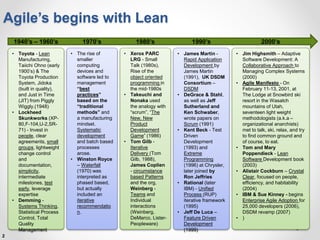
Agile’s begins with Lean
• Toyota - Lean
Manufacturing,
Taiichi Ohno (early
1900’s) & The
Toyota Production
System, Jidoka
(built in quality),
and Just in Time
(JIT) from Piggly
Wiggly.(1948)
• Lockheed
Skunkworks (XP-
80,F-104,U-2,SR-
71) - Invest in
people, clear
agreements, small
groups, lightweight
change control
and
documentation,
simplicity,
intermediate
milestones, test
early, leverage
expertise
• Demming -
Systems Thinking,
Statistical Process
Control, Total
Quality
Management
• The rise of
smaller
computing
devices and
software led to
management
“best
practices”
based on the
“traditional
methods” and
a manufacturing
mindset.
Systematic
development
and batch based
processes
arose.
• Winston Royce
– Waterfall
(1970) was
interpreted as
phased based,
but actually
included an
iterative
recommendatio
n.
• Xerox PARC
LRG - Small
Talk (1980s),
Rise of the
object oriented
programming in
the mid-1980s
• Takeuchi and
Nonaka used
the analogy with
“scrum”, “The
New, New
Product
Development
Game” (1986)
• Tom Gilb -
Iterative
Delivery (Tom
Gilb, 1988),
James Coplien
- circumstance
based Patterns
and the org,
Weinberg -
Teams and
Individual
interactions
(Weinberg,
DeMarco, Lister-
Peopleware)
• James Martin -
Rapid Application
Development by
James Martin
(1991), UK DSDM
Consortium –
DSDM
• DeGrace & Stahl,
as well as Jeff
Sutherland and
Ken Schwaber,
wrote papers on
Scrum (1991)
• Kent Beck - Test
Driven
Development
(1993) and
Extreme
Programming
(1996) at Chrysler,
later joined by
Ron Jeffries
• Rational (later
IBM) - Unified
Process (RUP)
iterative framework
(1995)
• Jeff De Luca –
Feature Driven
Development
(1999)
• Jim Highsmith – Adaptive
Software Development: A
Collaborative Approach to
Managing Complex Systems
(2000)
• Agile Manifesto - On
February 11-13, 2001, at
The Lodge at Snowbird ski
resort in the Wasatch
mountains of Utah,
seventeen light weight
methodologists (a.k.a –
organizational anarchists)
met to talk, ski, relax, and try
to find common ground and
of course, to eat.
• Tom and Mary
Poppendieck - Lean
Software Development book
(2003)
• Alistair Cockburn – Crystal
Clear, focused on people,
efficiency, and habitability
(2004)
• IBM & Sue Kinney - begins
Enterprise Agile Adoption for
25,000 developers (2006),
DSDM revamp (2007)
• )
1940’s – 1960’s 1970’s 1980’s 1990’s 2000’s
3
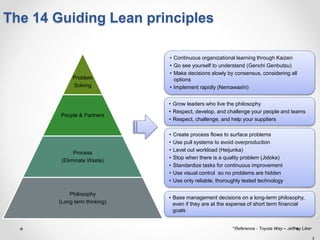
The 14 Guiding Lean principles
• Continuous organizational learning through Kaizen
• Go see yourself to understand (Genchi Genbutsu)
• Make decisions slowly by consensus, considering all
options
• Implement rapidly (Nemawashi)
• Grow leaders who live the philosophy
• Respect, develop, and challenge your people and teams
• Respect, challenge, and help your suppliers
• Create process flows to surface problems
• Use pull systems to avoid overproduction
• Level out workload (Heijunka)
• Stop when there is a quality problem (Jidoka)
• Standardize tasks for continuous improvement
• Use visual control so no problems are hidden
• Use only reliable, thoroughly tested technology
• Base management decisions on a long-term philosophy,
even if they are at the expense of short term financial
goals
Problem
Solving
People & Partners
Process
(Eliminate Waste)
Philosophy
(Long term thinking)
*Reference - Toyota Way – Jeffrey Liker
4
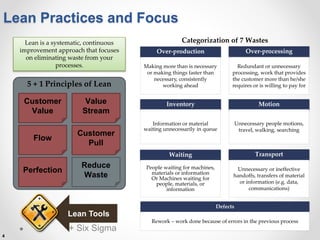
Lean Practices and Focus
Inventory
Waiting
Over-production
Motion
Transport
Defects
Over-processing
Categorization of 7 Wastes
Customer
Value
Value
Stream
Flow
Customer
Pull
Perfection
Making more than is necessary
or making things faster than
necessary, consistently
working ahead
Redundant or unnecessary
processing, work that provides
the customer more than he/she
requires or is willing to pay for
Information or material
waiting unnecessarily in queue
Unnecessary people motions,
travel, walking, searching
People waiting for machines,
materials or information
Or Machines waiting for
people, materials, or
information
Unnecessary or ineffective
handoffs, transfers of material
or information (e.g. data,
communications)
Rework – work done because of errors in the previous process
Lean is a systematic, continuous
improvement approach that focuses
on eliminating waste from your
processes.
5 + 1 Principles of Lean
Lean Tools
Reduce
Waste
+ Six Sigma
55
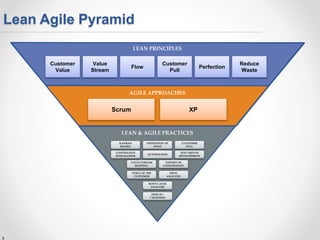
Lean Agile Pyramid
Customer
Value
Value
Stream
Flow
Customer
Pull
Perfection
Reduce
Waste
LEAN PRINCIPLES
Scrum XP
AGILE APPROACHES
DEFINITION OF
DONE
VOICE OF THE
CUSTOMER
TEST DRIVEN
DEVELOPMENT
AUTOMATION
VALUE STREAM
MAPPING
CONTINUOUS
INTEGEATION
DSM/ 5S /
7 WASTESS
ROOT CAUSE
ANALYSIS
SIPOC
ANALYSIS
KANBAN
BOARD
CUSTOMER
PULL
THEORY OF
CONSTRAINTS
LEAN & AGILE PRACTICES
66
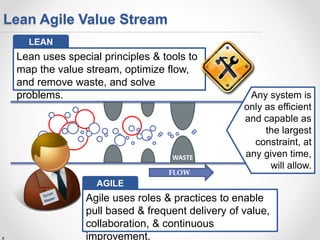
Lean Agile Value Stream
FLOW
Lean uses special principles & tools to
map the value stream, optimize flow,
and remove waste, and solve
problems.
Agile uses roles & practices to enable
pull based & frequent delivery of value,
collaboration, & continuous
improvement.
LEAN
AGILE
Any system is
only as efficient
and capable as
the largest
constraint, at
any given time,
will allow.
WASTE
7
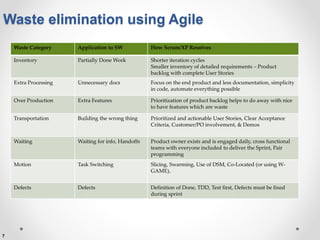
Waste elimination using Agile
Waste Category Application to SW How Scrum/XP Resolves
Inventory Partially Done Work Shorter iteration cycles
Smaller inventory of detailed requirements – Product
backlog with complete User Stories
Extra Processing Unnecessary docs Focus on the end product and less documentation, simplicity
in code, automate everything possible
Over Production Extra Features Prioritization of product backlog helps to do away with nice
to have features which are waste
Transportation Building the wrong thing Prioritized and actionable User Stories, Clear Acceptance
Criteria, Customer/PO involvement, & Demos
Waiting Waiting for info, Handoffs Product owner exists and is engaged daily, cross functional
teams with everyone included to deliver the Sprint, Pair
programming
Motion Task Switching Slicing, Swarming, Use of DSM, Co-Located (or using W-
GAME),
Defects Defects Definition of Done, TDD, Test first, Defects must be fixed
during sprint
88
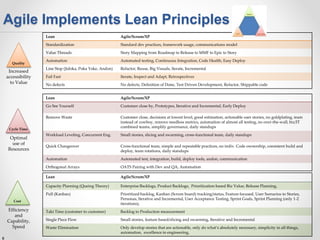
Agile Implements Lean Principles
Lean Agile/Scrum/XP
Capacity Planning (Queing Theory) Enterprise Backlogs, Product Backlogs, Prioritization based Biz Value, Release Planning,
Pull (Kanban) Prioritized backlog, Kanban (Scrum board) tracking/status, Feature focused, User Scenarios to Stories,
Personas, Iterative and Incremental, User Acceptance Testing, Sprint Goals, Sprint Planning (only 1-2
iterations),
Takt Time (customer to customer) Backlog to Production measurement
Single Piece Flow Small stories, feature based/slicing and swarming, Iterative and Incremental
Waste Elimination Only develop stories that are actionable, only do what’s absolutely necessary, simplicity in all things,
automation, excellence in engineering,
Lean Agile/Scrum/XP
Standardization Standard dev practices, framework usage, communications model
Value Threads Story Mapping from Roadmap to Release to MMF to Epic to Story
Automation Automated testing, Continuous Integration, Code Health, Easy Deploy
Line Stop (Jidoka, Poka Yoke, Andon) Refactor, Reuse, Big Visuals, Iterate, Incremental
Fail Fast Iterate, Inspect and Adapt, Retrospectives
No defects No defects, Definition of Done, Test Driven Development, Refactor, Shippable code
Lean Agile/Scrum/XP
Go See Yourself Customer close by, Prototypes, Iterative and Incremental, Early Deploy
Remove Waste Customer close, decisions at lowest level, good estimation, actionable user stories, no goldplating, team
instead of cowboy, remove needless metrics, automation of almost all testing, no over-the-wall, biz/IT
combined teams, simplify governance, daily standups
Workload Leveling, Concurrent Eng. Small stories, slicing and swarming, cross-functional team, daily standups
Quick Changeover Cross-functional team, simple and repeatable practices, no indiv. Code ownership, consistent build and
deploy, team rotations, daily standups
Automation Automated test, integration, build, deploy tools, andon, communication
Orthogonal Arrays OATS Pairing with Dev and QA, Automation
Increased
accessibility
to Value
Optimal
use of
Resources
Efficiency
and
Capability,
Speed
Cycle Time
Cost
Quality
99
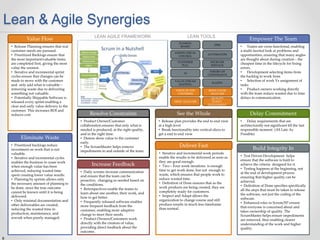
• Release Planning ensures that real
customer needs are pursued.
• Prioritized Backlogs ensure that
the most important/valuable items
are completed first, giving the most
value the soonest.
• Iterative and incremental sprint
cycles ensure that changes can be
made to move with the customer
and only add what is valuable –
removing waste due to delivering
something not valuable.
• Potentially Shippable Software is
released every sprint enabling a
clear and early value delivery to the
customer. This increases ROI and
reduces cost.
Value Flow
• Prioritized backlogs reduce
investment on work that is not
valuable.
• Iterative and incremental cycles
enables the business to cease work
when enough value has been
achieved, reducing wasted time
spent creating lower value results.
• Planning by sprints allows only
the necessary amount of planning to
be done, since the true outcome
cannot be known until it is being
delivered.
• Only minimal documentation and
other deliverables are created,
reducing the wasted time in
production, maintenance, and
rework when poorly managed.
Eliminate Waste
• Daily scrums increase communication
and ensure that the team can be
proactive, changing as needed based on
the conditions.
• Retrospectives enable the teams to
learn about one another, their work, and
how to get better.
• Frequently released software enables
more frequent feedback from the
customer, enabling more adaptive
change to meet their needs.
• Product Owners/Customers work
directly with the creators of value,
providing direct feedback about the
outcome.
Increase Feedback
• Iterative and incremental work periods
enable the results to be delivered as soon as
they are good enough.
• Two – Four week iterations is enough
time to get work done, but not enough to
waste, which ensures that people work to
reduce wasted time.
• Definition of Done ensures that as the
work products are being created, they are
completely ready for customers.
• Inspect and Adapt allows the
organization to change course and still
produce results in much less timeframe
than normal.
Deliver Fast
• Test Driven Development helps
ensure that the software is built to
achieve the criteria designed for it.
• Testing happens at the beginning, not
at the end of development process
ensuring that higher quality can be
achieved.
• Definition of Done specifies specifically
all the steps that must be taken to release
the software, not just the coding of the
software.
• Enhanced roles in Scrum/XP ensure
that everyone is concerned about and
takes ownership of quality. The
ScrumMaster helps ensure impediments
are removed, thus enabling clearer
understanding of the work and higher
quality.
Build Integrity In
• Teams are cross-functional, enabling
a multi-faceted look at problems and
opportunities, ensuring that many angles
are thought about during creation – the
cheapest time in the lifecycle for fixing
errors.
• Development selecting items from
the backlog to work from
• Selection of work Vs assignment of
tasks
• Product owners working directly
with the team reduce wasted due to time
delays in communication.
Empower The Team
• Delay requirements that are
architecturally not significant till the last
responsible moment (AS Late As
Possible)
Delay Commitment
• Product Owner/Customer
collaboration ensures that only what is
needed is produced, at the right quality,
and in the right time.
• Demos show value to the customer
early.
• The ScrumMaster helps remove
impediments in and outside of the team.
Resolve Constraints
• Release plan provides the end to end view
at a high level
• Break functionality into vertical slices to
get a end to end view
See the Whole
Lean & Agile Synergies
DSM
VOICE OF THE
CUSTOMER
INCREASE
FEEDACK
5S
AUTOMATION
VALUE STREAM
MAPPING
ANDON VISUAL
CONTROL
QUALITY
FUNCT.
DEPLOYMENT
ROOT CAUSE
ANALYSIS
SIPOC ANALYSIS
KANBAN
BOARD
CUSTOMER
PULL
THEORY OF
CONSTRAINTS
KAIZEN
LEAN AGILE FRAMEWORK LEAN TOOLS

Lean & Agile Value Streams

  • 1.
  • 2.
    2 Agile’s begins withLean • Toyota - Lean Manufacturing, Taiichi Ohno (early 1900’s) & The Toyota Production System, Jidoka (built in quality), and Just in Time (JIT) from Piggly Wiggly.(1948) • Lockheed Skunkworks (XP- 80,F-104,U-2,SR- 71) - Invest in people, clear agreements, small groups, lightweight change control and documentation, simplicity, intermediate milestones, test early, leverage expertise • Demming - Systems Thinking, Statistical Process Control, Total Quality Management • The rise of smaller computing devices and software led to management “best practices” based on the “traditional methods” and a manufacturing mindset. Systematic development and batch based processes arose. • Winston Royce – Waterfall (1970) was interpreted as phased based, but actually included an iterative recommendatio n. • Xerox PARC LRG - Small Talk (1980s), Rise of the object oriented programming in the mid-1980s • Takeuchi and Nonaka used the analogy with “scrum”, “The New, New Product Development Game” (1986) • Tom Gilb - Iterative Delivery (Tom Gilb, 1988), James Coplien - circumstance based Patterns and the org, Weinberg - Teams and Individual interactions (Weinberg, DeMarco, Lister- Peopleware) • James Martin - Rapid Application Development by James Martin (1991), UK DSDM Consortium – DSDM • DeGrace & Stahl, as well as Jeff Sutherland and Ken Schwaber, wrote papers on Scrum (1991) • Kent Beck - Test Driven Development (1993) and Extreme Programming (1996) at Chrysler, later joined by Ron Jeffries • Rational (later IBM) - Unified Process (RUP) iterative framework (1995) • Jeff De Luca – Feature Driven Development (1999) • Jim Highsmith – Adaptive Software Development: A Collaborative Approach to Managing Complex Systems (2000) • Agile Manifesto - On February 11-13, 2001, at The Lodge at Snowbird ski resort in the Wasatch mountains of Utah, seventeen light weight methodologists (a.k.a – organizational anarchists) met to talk, ski, relax, and try to find common ground and of course, to eat. • Tom and Mary Poppendieck - Lean Software Development book (2003) • Alistair Cockburn – Crystal Clear, focused on people, efficiency, and habitability (2004) • IBM & Sue Kinney - begins Enterprise Agile Adoption for 25,000 developers (2006), DSDM revamp (2007) • ) 1940’s – 1960’s 1970’s 1980’s 1990’s 2000’s
  • 3.
    3 The 14 GuidingLean principles • Continuous organizational learning through Kaizen • Go see yourself to understand (Genchi Genbutsu) • Make decisions slowly by consensus, considering all options • Implement rapidly (Nemawashi) • Grow leaders who live the philosophy • Respect, develop, and challenge your people and teams • Respect, challenge, and help your suppliers • Create process flows to surface problems • Use pull systems to avoid overproduction • Level out workload (Heijunka) • Stop when there is a quality problem (Jidoka) • Standardize tasks for continuous improvement • Use visual control so no problems are hidden • Use only reliable, thoroughly tested technology • Base management decisions on a long-term philosophy, even if they are at the expense of short term financial goals Problem Solving People & Partners Process (Eliminate Waste) Philosophy (Long term thinking) *Reference - Toyota Way – Jeffrey Liker
  • 4.
    4 Lean Practices andFocus Inventory Waiting Over-production Motion Transport Defects Over-processing Categorization of 7 Wastes Customer Value Value Stream Flow Customer Pull Perfection Making more than is necessary or making things faster than necessary, consistently working ahead Redundant or unnecessary processing, work that provides the customer more than he/she requires or is willing to pay for Information or material waiting unnecessarily in queue Unnecessary people motions, travel, walking, searching People waiting for machines, materials or information Or Machines waiting for people, materials, or information Unnecessary or ineffective handoffs, transfers of material or information (e.g. data, communications) Rework – work done because of errors in the previous process Lean is a systematic, continuous improvement approach that focuses on eliminating waste from your processes. 5 + 1 Principles of Lean Lean Tools Reduce Waste + Six Sigma
  • 5.
    55 Lean Agile Pyramid Customer Value Value Stream Flow Customer Pull Perfection Reduce Waste LEANPRINCIPLES Scrum XP AGILE APPROACHES DEFINITION OF DONE VOICE OF THE CUSTOMER TEST DRIVEN DEVELOPMENT AUTOMATION VALUE STREAM MAPPING CONTINUOUS INTEGEATION DSM/ 5S / 7 WASTESS ROOT CAUSE ANALYSIS SIPOC ANALYSIS KANBAN BOARD CUSTOMER PULL THEORY OF CONSTRAINTS LEAN & AGILE PRACTICES
  • 6.
    66 Lean Agile ValueStream FLOW Lean uses special principles & tools to map the value stream, optimize flow, and remove waste, and solve problems. Agile uses roles & practices to enable pull based & frequent delivery of value, collaboration, & continuous improvement. LEAN AGILE Any system is only as efficient and capable as the largest constraint, at any given time, will allow. WASTE
  • 7.
    7 Waste elimination usingAgile Waste Category Application to SW How Scrum/XP Resolves Inventory Partially Done Work Shorter iteration cycles Smaller inventory of detailed requirements – Product backlog with complete User Stories Extra Processing Unnecessary docs Focus on the end product and less documentation, simplicity in code, automate everything possible Over Production Extra Features Prioritization of product backlog helps to do away with nice to have features which are waste Transportation Building the wrong thing Prioritized and actionable User Stories, Clear Acceptance Criteria, Customer/PO involvement, & Demos Waiting Waiting for info, Handoffs Product owner exists and is engaged daily, cross functional teams with everyone included to deliver the Sprint, Pair programming Motion Task Switching Slicing, Swarming, Use of DSM, Co-Located (or using W- GAME), Defects Defects Definition of Done, TDD, Test first, Defects must be fixed during sprint
  • 8.
    88 Agile Implements LeanPrinciples Lean Agile/Scrum/XP Capacity Planning (Queing Theory) Enterprise Backlogs, Product Backlogs, Prioritization based Biz Value, Release Planning, Pull (Kanban) Prioritized backlog, Kanban (Scrum board) tracking/status, Feature focused, User Scenarios to Stories, Personas, Iterative and Incremental, User Acceptance Testing, Sprint Goals, Sprint Planning (only 1-2 iterations), Takt Time (customer to customer) Backlog to Production measurement Single Piece Flow Small stories, feature based/slicing and swarming, Iterative and Incremental Waste Elimination Only develop stories that are actionable, only do what’s absolutely necessary, simplicity in all things, automation, excellence in engineering, Lean Agile/Scrum/XP Standardization Standard dev practices, framework usage, communications model Value Threads Story Mapping from Roadmap to Release to MMF to Epic to Story Automation Automated testing, Continuous Integration, Code Health, Easy Deploy Line Stop (Jidoka, Poka Yoke, Andon) Refactor, Reuse, Big Visuals, Iterate, Incremental Fail Fast Iterate, Inspect and Adapt, Retrospectives No defects No defects, Definition of Done, Test Driven Development, Refactor, Shippable code Lean Agile/Scrum/XP Go See Yourself Customer close by, Prototypes, Iterative and Incremental, Early Deploy Remove Waste Customer close, decisions at lowest level, good estimation, actionable user stories, no goldplating, team instead of cowboy, remove needless metrics, automation of almost all testing, no over-the-wall, biz/IT combined teams, simplify governance, daily standups Workload Leveling, Concurrent Eng. Small stories, slicing and swarming, cross-functional team, daily standups Quick Changeover Cross-functional team, simple and repeatable practices, no indiv. Code ownership, consistent build and deploy, team rotations, daily standups Automation Automated test, integration, build, deploy tools, andon, communication Orthogonal Arrays OATS Pairing with Dev and QA, Automation Increased accessibility to Value Optimal use of Resources Efficiency and Capability, Speed Cycle Time Cost Quality
  • 9.
    99 • Release Planningensures that real customer needs are pursued. • Prioritized Backlogs ensure that the most important/valuable items are completed first, giving the most value the soonest. • Iterative and incremental sprint cycles ensure that changes can be made to move with the customer and only add what is valuable – removing waste due to delivering something not valuable. • Potentially Shippable Software is released every sprint enabling a clear and early value delivery to the customer. This increases ROI and reduces cost. Value Flow • Prioritized backlogs reduce investment on work that is not valuable. • Iterative and incremental cycles enables the business to cease work when enough value has been achieved, reducing wasted time spent creating lower value results. • Planning by sprints allows only the necessary amount of planning to be done, since the true outcome cannot be known until it is being delivered. • Only minimal documentation and other deliverables are created, reducing the wasted time in production, maintenance, and rework when poorly managed. Eliminate Waste • Daily scrums increase communication and ensure that the team can be proactive, changing as needed based on the conditions. • Retrospectives enable the teams to learn about one another, their work, and how to get better. • Frequently released software enables more frequent feedback from the customer, enabling more adaptive change to meet their needs. • Product Owners/Customers work directly with the creators of value, providing direct feedback about the outcome. Increase Feedback • Iterative and incremental work periods enable the results to be delivered as soon as they are good enough. • Two – Four week iterations is enough time to get work done, but not enough to waste, which ensures that people work to reduce wasted time. • Definition of Done ensures that as the work products are being created, they are completely ready for customers. • Inspect and Adapt allows the organization to change course and still produce results in much less timeframe than normal. Deliver Fast • Test Driven Development helps ensure that the software is built to achieve the criteria designed for it. • Testing happens at the beginning, not at the end of development process ensuring that higher quality can be achieved. • Definition of Done specifies specifically all the steps that must be taken to release the software, not just the coding of the software. • Enhanced roles in Scrum/XP ensure that everyone is concerned about and takes ownership of quality. The ScrumMaster helps ensure impediments are removed, thus enabling clearer understanding of the work and higher quality. Build Integrity In • Teams are cross-functional, enabling a multi-faceted look at problems and opportunities, ensuring that many angles are thought about during creation – the cheapest time in the lifecycle for fixing errors. • Development selecting items from the backlog to work from • Selection of work Vs assignment of tasks • Product owners working directly with the team reduce wasted due to time delays in communication. Empower The Team • Delay requirements that are architecturally not significant till the last responsible moment (AS Late As Possible) Delay Commitment • Product Owner/Customer collaboration ensures that only what is needed is produced, at the right quality, and in the right time. • Demos show value to the customer early. • The ScrumMaster helps remove impediments in and outside of the team. Resolve Constraints • Release plan provides the end to end view at a high level • Break functionality into vertical slices to get a end to end view See the Whole Lean & Agile Synergies DSM VOICE OF THE CUSTOMER INCREASE FEEDACK 5S AUTOMATION VALUE STREAM MAPPING ANDON VISUAL CONTROL QUALITY FUNCT. DEPLOYMENT ROOT CAUSE ANALYSIS SIPOC ANALYSIS KANBAN BOARD CUSTOMER PULL THEORY OF CONSTRAINTS KAIZEN LEAN AGILE FRAMEWORK LEAN TOOLS