We Are TeamRock! We are a new company that brings together
the people that ran Classic Rock, Metal Hammer, Prog and Blues
with other experienced rock music media professionals - people
who brought you Rock Radio amongst other things.
Everyone involved is a rock and metal fan and we are determined
to give this tremendous global community a shared home to enjoy
the music and lifestyle you love - somewhere to Belong.
Scott Rowley, our Editorial Director (formerly Editor of Classic
Rock) summed it up brilliantly at 2013's Classic Rock Roll of
Honour Awards by saying ‘We've left a label that didn't really get
us and arrived at one that understands us completely'.
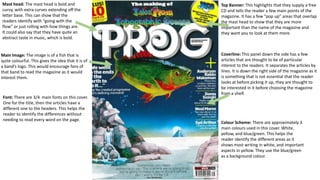
Mast head: The mast head is bold and
curvy, with extra curves extending off the
letter base. This can show that the
readers identify with “going with the
flow” or just rolling with how things are.
It could also say that they have quite an
abstract taste in music, which is bold.
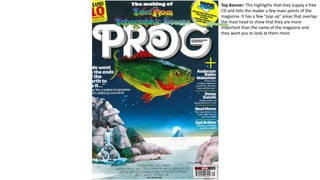
Top Banner: This highlights that they supply a free
CD and tells the reader a few main points of the
magazine. It has a few “pop up” areas that overlap
the mast head to show that they are more
important than the name of the magazine and
they want you to look at them more.
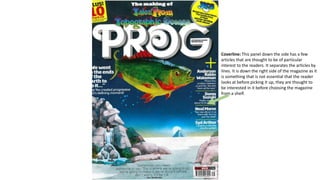
Coverline: This panel down the side has a few
articles that are thought to be of particular
interest to the readers. It separates the articles by
lines. It is down the right side of the magazine as it
is something that is not essential that the reader
looks at before picking it up, they are thought to
be interested in it before choosing the magazine
from a shelf.
Main Image: The image is of a fish that is
quite colourful. This gives the idea that it is of
a band’s logo. This would encourage fans of
that band to read the magazine as it would
interest them.
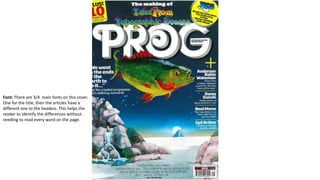
Font: There are 3/4 main fonts on this cover.
One for the title, then the articles have a
different one to the headers. This helps the
reader to identify the differences without
needing to read every word on the page.
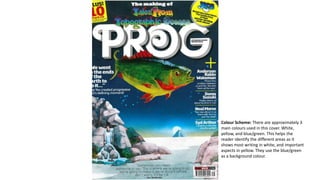
Colour Scheme: There are approximately 3
main colours used in this cover. White,
yellow, and blue/green. This helps the
reader identify the different areas as it
shows most writing in white, and important
aspects in yellow. They use the blue/green
as a background colour.
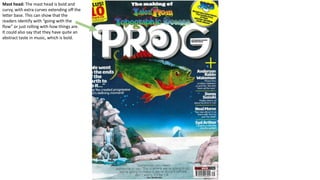
Mast head: The mast head is bold and
curvy, with extra curves extending off the
letter base. This can show that the
readers identify with “going with the
flow” or just rolling with how things are.
It could also say that they have quite an
abstract taste in music, which is bold.
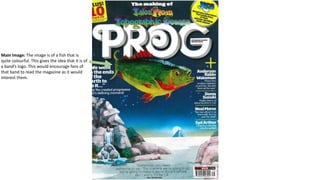
Main Image: The image is of a fish that is
quite colourful. This gives the idea that it is of
a band’s logo. This would encourage fans of
that band to read the magazine as it would
interest them.
Font: There are 3/4 main fonts on this cover.
One for the title, then the articles have a
different one to the headers. This helps the
reader to identify the differences without
needing to read every word on the page.
Top Banner: This highlights that they supply a free
CD and tells the reader a few main points of the
magazine. It has a few “pop up” areas that overlap
the mast head to show that they are more
important than the name of the magazine and
they want you to look at them more.
Coverline: This panel down the side has a few
articles that are thought to be of particular
interest to the readers. It separates the articles by
lines. It is down the right side of the magazine as it
is something that is not essential that the reader
looks at before picking it up, they are thought to
be interested in it before choosing the magazine
from a shelf.
Colour Scheme: There are approximately 3
main colours used in this cover. White,
yellow, and blue/green. This helps the
reader identify the different areas as it
shows most writing in white, and important
aspects in yellow. They use the blue/green
as a background colour.
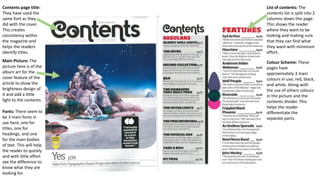
Contents page title:
They have used the
same font as they
did with the cover.
This creates
consistency within
the magazine and
helps the readers
identify titles.
Main Picture: The
picture here is of the
album art for the
cover feature of the
article to show the
brightness design of
it and add a little
light to the contents.
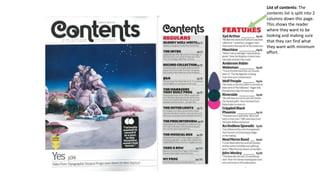
List of contents: The
contents list is split into 2
columns down this page.
This shows the reader
where they want to be
looking and making sure
that they can find what
they want with minimum
effort.
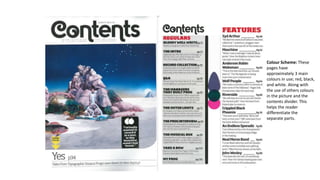
Colour Scheme: These
pages have
approximately 3 main
colours in use; red, black,
and white. Along with
the use of others colours
in the picture and the
contents divider. This
helps the reader
differentiate the
separate parts.
Fonts: There seem to
be 3 main fonts in
use here, one for
titles, one for
headings, and one
for the main bodies
of text. This will help
the reader to quickly
and with little effort
see the difference to
know what they are
looking for.
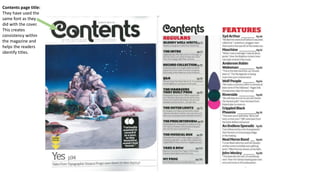
Contents page title:
They have used the
same font as they
did with the cover.
This creates
consistency within
the magazine and
helps the readers
identify titles.
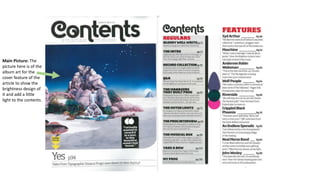
Main Picture: The
picture here is of the
album art for the
cover feature of the
article to show the
brightness design of
it and add a little
light to the contents.
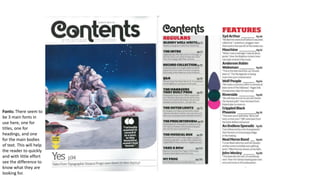
Fonts: There seem to
be 3 main fonts in
use here, one for
titles, one for
headings, and one
for the main bodies
of text. This will help
the reader to quickly
and with little effort
see the difference to
know what they are
looking for.
List of contents: The
contents list is split into 2
columns down this page.
This shows the reader
where they want to be
looking and making sure
that they can find what
they want with minimum
effort.
Colour Scheme: These
pages have
approximately 3 main
colours in use; red, black,
and white. Along with
the use of others colours
in the picture and the
contents divider. This
helps the reader
differentiate the
separate parts.
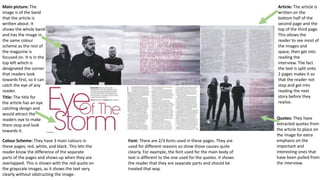
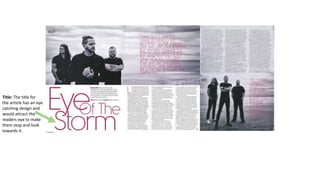
Main picture: The
image is of the band
that the article is
written about. It
shows the whole band
and has the image in
the same colour
scheme as the rest of
the magazine is
focused on. It is in the
top left which is
designated the corner
that readers look
towards first, so it can
catch the eye of any
reader.
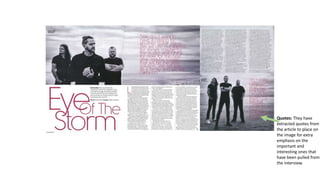
Title: The title for
the article has an eye
catching design and
would attract the
readers eye to make
them stop and look
towards it.
Quotes: They have
extracted quotes from
the article to place on
the image for extra
emphasis on the
important and
interesting ones that
have been pulled from
the interview.
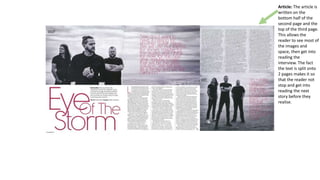
Article: The article is
written on the
bottom half of the
second page and the
top of the third page.
This allows the
reader to see most of
the images and
space, then get into
reading the
interview. The fact
the text is split onto
2 pages makes it so
that the reader not
stop and get into
reading the next
story before they
realise.
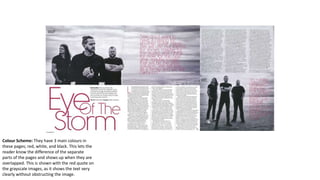
Colour Scheme: They have 3 main colours in
these pages; red, white, and black. This lets the
reader know the difference of the separate
parts of the pages and shows up when they are
overlapped. This is shown with the red quote on
the grayscale images, as it shows the text very
clearly without obstructing the image.
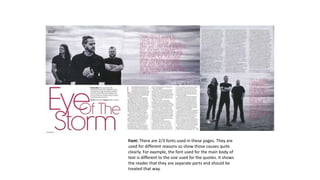
Font: There are 2/3 fonts used in these pages. They are
used for different reasons so show those causes quite
clearly. For example, the font used for the main body of
text is different to the one used for the quotes. It shows
the reader that they are separate parts and should be
treated that way.
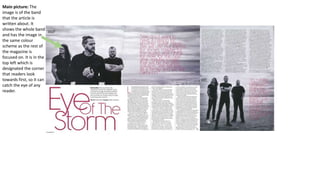
Main picture: The
image is of the band
that the article is
written about. It
shows the whole band
and has the image in
the same colour
scheme as the rest of
the magazine is
focused on. It is in the
top left which is
designated the corner
that readers look
towards first, so it can
catch the eye of any
reader.
Title: The title for
the article has an eye
catching design and
would attract the
readers eye to make
them stop and look
towards it.
Colour Scheme: They have 3 main colours in
these pages; red, white, and black. This lets the
reader know the difference of the separate
parts of the pages and shows up when they are
overlapped. This is shown with the red quote on
the grayscale images, as it shows the text very
clearly without obstructing the image.
Font: There are 2/3 fonts used in these pages. They are
used for different reasons so show those causes quite
clearly. For example, the font used for the main body of
text is different to the one used for the quotes. It shows
the reader that they are separate parts and should be
treated that way.
Article: The article is
written on the
bottom half of the
second page and the
top of the third page.
This allows the
reader to see most of
the images and
space, then get into
reading the
interview. The fact
the text is split onto
2 pages makes it so
that the reader not
stop and get into
reading the next
story before they
realise.
Quotes: They have
extracted quotes from
the article to place on
the image for extra
emphasis on the
important and
interesting ones that
have been pulled from
the interview.

Prog

  • 1.
    We Are TeamRock!We are a new company that brings together the people that ran Classic Rock, Metal Hammer, Prog and Blues with other experienced rock music media professionals - people who brought you Rock Radio amongst other things. Everyone involved is a rock and metal fan and we are determined to give this tremendous global community a shared home to enjoy the music and lifestyle you love - somewhere to Belong. Scott Rowley, our Editorial Director (formerly Editor of Classic Rock) summed it up brilliantly at 2013's Classic Rock Roll of Honour Awards by saying ‘We've left a label that didn't really get us and arrived at one that understands us completely'.
  • 2.
    Mast head: Themast head is bold and curvy, with extra curves extending off the letter base. This can show that the readers identify with “going with the flow” or just rolling with how things are. It could also say that they have quite an abstract taste in music, which is bold. Top Banner: This highlights that they supply a free CD and tells the reader a few main points of the magazine. It has a few “pop up” areas that overlap the mast head to show that they are more important than the name of the magazine and they want you to look at them more. Coverline: This panel down the side has a few articles that are thought to be of particular interest to the readers. It separates the articles by lines. It is down the right side of the magazine as it is something that is not essential that the reader looks at before picking it up, they are thought to be interested in it before choosing the magazine from a shelf. Main Image: The image is of a fish that is quite colourful. This gives the idea that it is of a band’s logo. This would encourage fans of that band to read the magazine as it would interest them. Font: There are 3/4 main fonts on this cover. One for the title, then the articles have a different one to the headers. This helps the reader to identify the differences without needing to read every word on the page. Colour Scheme: There are approximately 3 main colours used in this cover. White, yellow, and blue/green. This helps the reader identify the different areas as it shows most writing in white, and important aspects in yellow. They use the blue/green as a background colour.
  • 3.
    Mast head: Themast head is bold and curvy, with extra curves extending off the letter base. This can show that the readers identify with “going with the flow” or just rolling with how things are. It could also say that they have quite an abstract taste in music, which is bold.
  • 4.
    Main Image: Theimage is of a fish that is quite colourful. This gives the idea that it is of a band’s logo. This would encourage fans of that band to read the magazine as it would interest them.
  • 5.
    Font: There are3/4 main fonts on this cover. One for the title, then the articles have a different one to the headers. This helps the reader to identify the differences without needing to read every word on the page.
  • 6.
    Top Banner: Thishighlights that they supply a free CD and tells the reader a few main points of the magazine. It has a few “pop up” areas that overlap the mast head to show that they are more important than the name of the magazine and they want you to look at them more.
  • 7.
    Coverline: This paneldown the side has a few articles that are thought to be of particular interest to the readers. It separates the articles by lines. It is down the right side of the magazine as it is something that is not essential that the reader looks at before picking it up, they are thought to be interested in it before choosing the magazine from a shelf.
  • 8.
    Colour Scheme: Thereare approximately 3 main colours used in this cover. White, yellow, and blue/green. This helps the reader identify the different areas as it shows most writing in white, and important aspects in yellow. They use the blue/green as a background colour.
  • 9.
    Contents page title: Theyhave used the same font as they did with the cover. This creates consistency within the magazine and helps the readers identify titles. Main Picture: The picture here is of the album art for the cover feature of the article to show the brightness design of it and add a little light to the contents. List of contents: The contents list is split into 2 columns down this page. This shows the reader where they want to be looking and making sure that they can find what they want with minimum effort. Colour Scheme: These pages have approximately 3 main colours in use; red, black, and white. Along with the use of others colours in the picture and the contents divider. This helps the reader differentiate the separate parts. Fonts: There seem to be 3 main fonts in use here, one for titles, one for headings, and one for the main bodies of text. This will help the reader to quickly and with little effort see the difference to know what they are looking for.
  • 10.
    Contents page title: Theyhave used the same font as they did with the cover. This creates consistency within the magazine and helps the readers identify titles.
  • 11.
    Main Picture: The picturehere is of the album art for the cover feature of the article to show the brightness design of it and add a little light to the contents.
  • 12.
    Fonts: There seemto be 3 main fonts in use here, one for titles, one for headings, and one for the main bodies of text. This will help the reader to quickly and with little effort see the difference to know what they are looking for.
  • 13.
    List of contents:The contents list is split into 2 columns down this page. This shows the reader where they want to be looking and making sure that they can find what they want with minimum effort.
  • 14.
    Colour Scheme: These pageshave approximately 3 main colours in use; red, black, and white. Along with the use of others colours in the picture and the contents divider. This helps the reader differentiate the separate parts.
  • 15.
    Main picture: The imageis of the band that the article is written about. It shows the whole band and has the image in the same colour scheme as the rest of the magazine is focused on. It is in the top left which is designated the corner that readers look towards first, so it can catch the eye of any reader. Title: The title for the article has an eye catching design and would attract the readers eye to make them stop and look towards it. Quotes: They have extracted quotes from the article to place on the image for extra emphasis on the important and interesting ones that have been pulled from the interview. Article: The article is written on the bottom half of the second page and the top of the third page. This allows the reader to see most of the images and space, then get into reading the interview. The fact the text is split onto 2 pages makes it so that the reader not stop and get into reading the next story before they realise. Colour Scheme: They have 3 main colours in these pages; red, white, and black. This lets the reader know the difference of the separate parts of the pages and shows up when they are overlapped. This is shown with the red quote on the grayscale images, as it shows the text very clearly without obstructing the image. Font: There are 2/3 fonts used in these pages. They are used for different reasons so show those causes quite clearly. For example, the font used for the main body of text is different to the one used for the quotes. It shows the reader that they are separate parts and should be treated that way.
  • 16.
    Main picture: The imageis of the band that the article is written about. It shows the whole band and has the image in the same colour scheme as the rest of the magazine is focused on. It is in the top left which is designated the corner that readers look towards first, so it can catch the eye of any reader.
  • 17.
    Title: The titlefor the article has an eye catching design and would attract the readers eye to make them stop and look towards it.
  • 18.
    Colour Scheme: Theyhave 3 main colours in these pages; red, white, and black. This lets the reader know the difference of the separate parts of the pages and shows up when they are overlapped. This is shown with the red quote on the grayscale images, as it shows the text very clearly without obstructing the image.
  • 19.
    Font: There are2/3 fonts used in these pages. They are used for different reasons so show those causes quite clearly. For example, the font used for the main body of text is different to the one used for the quotes. It shows the reader that they are separate parts and should be treated that way.
  • 20.
    Article: The articleis written on the bottom half of the second page and the top of the third page. This allows the reader to see most of the images and space, then get into reading the interview. The fact the text is split onto 2 pages makes it so that the reader not stop and get into reading the next story before they realise.
  • 21.
    Quotes: They have extractedquotes from the article to place on the image for extra emphasis on the important and interesting ones that have been pulled from the interview.