Profiling food insecurity and rural diets in Myanmar
Livelihoods, agroecological zoning and seasonality
Jose Luis Vivero-Pol, WFP MyanmarOctober 2019
Background information and methodology
Food Security and Poverty Estimation (FSP) Surveys:
• Questionnaire focused on household characteristics, food consumption, coping strategies, expenditures
and livelihoods
• 2 stages random cluster sampling: 50 villages in each area, 12 HH per village (1,024 in total)
• 4 waves from June 2013 to July 2015 (Sample size: 12,663 households)
Food Security and Market Price Information System (FSMPIS) Surveys:
• Regular food security monitoring in 110 rural townships
• 2 stages random cluster sampling: 7 village per townships, 6 households per village
• Twice per year (2013-2017) (Sample size: 14,485 households)
• Monthly prices of 11 commodities monitored in73 townships (6 regions)
Dataset: +27,000 households (2013-2017)
Project: Improved Food Security and Market Price
Information System (Feb 2012 – Feb 2017)
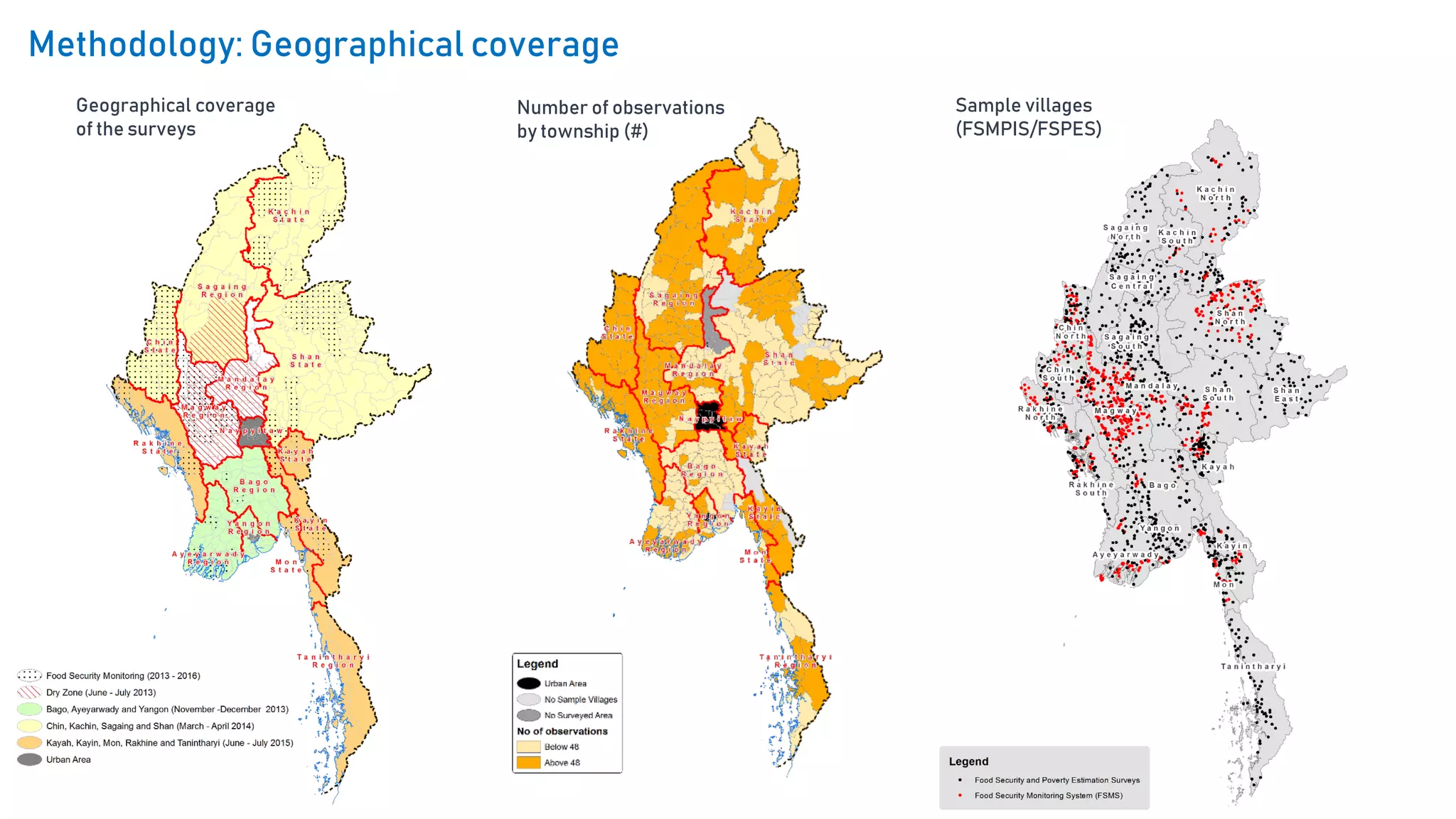
Number of observations
by township (#)
Sample villages
(FSMPIS/FSPES)
Methodology: Geographical coverage
Geographical coverage
of the surveys
Consultationswith
stakeholders
Secondary Data Analysis
Are nutritious foods available, accessible
and chosen for consumption?
• Information about Food Systems
• Databases, reports, peer-reviewed
articles, grey literature
Cost of the Diet
What does a nutritious diet cost and is it
affordable?
• Food prices, household expenditure
• Data sources:
- CPI and MPLCS 2015-16
Fill the Nutrient Gap (FNG) Analysis Process
Identify possible interventions and
entry points
Estimate minimum cost nutritious
diet and economic accessibility
Intervention modelling by state/region2018-2019
AGRICULTURE IS STILL HIGHLY RELEVANT
Malnutrition is still high
Stunting
27%
Wasting
7%
Anaemia
36%
Overweight/obesity
30%
Anaemia
30%
Children
under 5
Women of
reproductive age
MMFCS 2017-18
Stunting and wasting are reducing,
while overweight/obesity is on the rise
16
3030
41
27
11
7
0
10
20
30
40
50
2000 2002 2004 2006 2008 2010 2012 2014 2016
Prevalence(%)
Stunting
(Under 5)
MMFCS 2017-18
Wasting
(Under 5)
CotD 2019
A nutritious diet costs more than twice as much as an
energy only diet
10% of households
COULD NOT afford
60% of households
COULD NOT affordK1963
Per day
K4358
Per day
Energy Only Diet Nutritious Diet
National averages
Cost of a nutritious diet is a primary driver of non-affordability Highest
in hilly/mountainous and coastal areas
CotD 2019
Daily household
cost of a
nutritious diet
(kyat)
Non-affordability of a
nutritious diet (%)
Agriculture
Development Strategy
(ADS)
Multi-sectoral National
Action Plan for
Nutrition
(MS-NPAN)
Linking NUTRITION and AGRICULTURE in MYANMAR
Food
Insecure
Households
and Poor
Dietary
Diversity
Multi-year
strategy (from
farm to plate)
BUT food
security is small
component
Oblivious of
nutritional
impact
Multi-sectoral
(5 Ministries)
Originally led by
Health but now
balancing the
weights
Where do food insecure populations live? Share VS absolute numbers in FCS
FCS indicator (%)
Householdswith
inadequate diet
1. Higher % in mountains
2. Differences exist within
state/regions. Need of
disaggregated analysis
3. Inland-coastal plains account for
two thirds of total food-
insecure rural population
4. Seasonality (to date a non-issue
in policy making) arises as an
important factor (i.e. casual
labour, food gaps, food prices,
epidemic diseases). Lack of
regular data prevent further
analysis
Number of
households
with an
inadequate diet
the week prior
Three typologies to better profiling food insecurity
and dietary deficiencies
1. LIVELIHOOD PROFILES
2. AGRO-ECOLOGICAL ZONES
3. SEASONALITY
Source: Myanmar Food Security Atlas (WFP –
MoALI,, 2019)
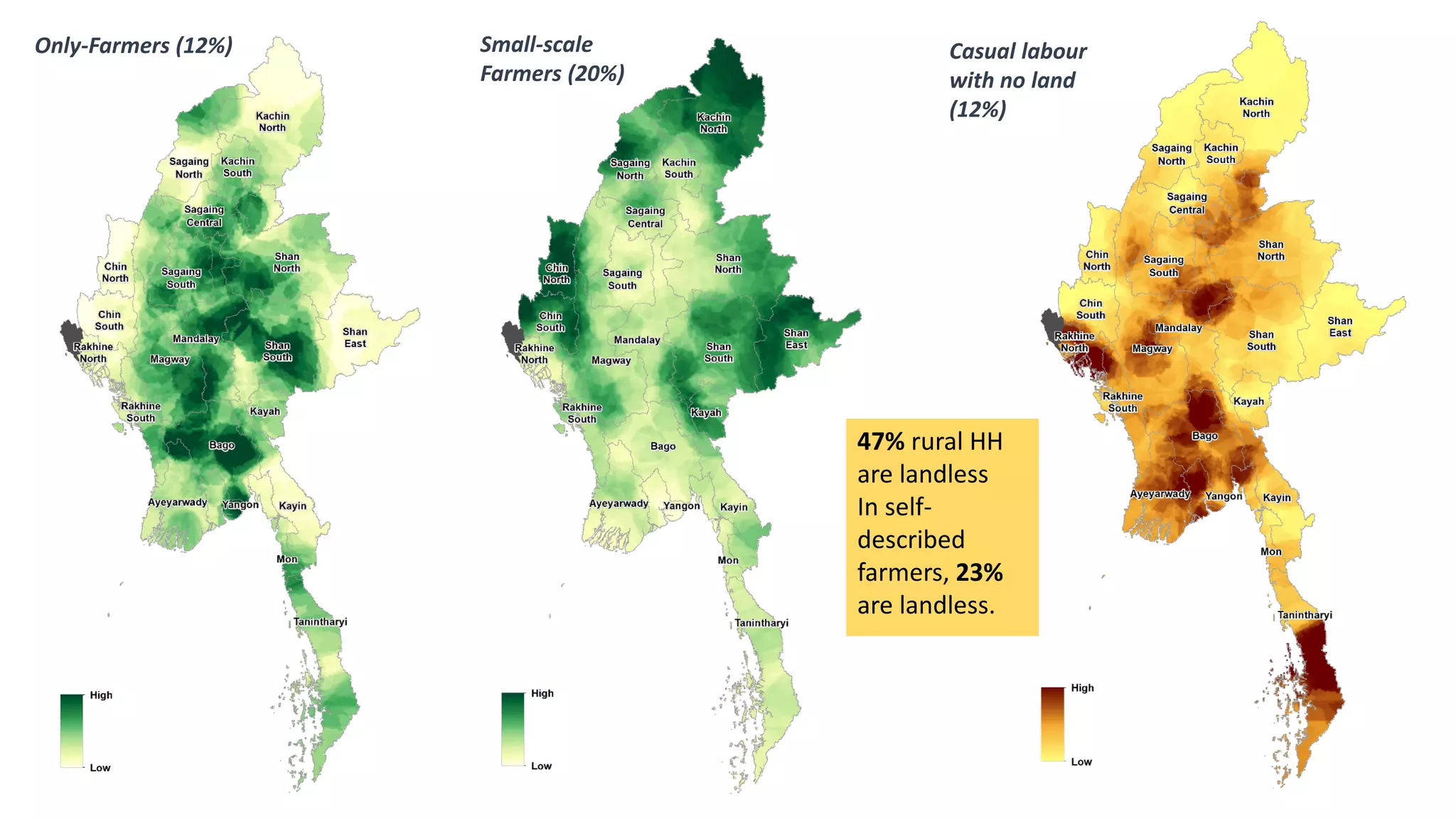
Rural Livelihoods Groups: First Typology Households were clustered into
“livelihood groups” based on
(a) sources of income,
(b) self-reported profession of
household head
(c) (c) land ownership (the most
relevant asset in rural areas).
Only-Farmers (12%) Small-scale
Farmers (20%)
Casual labour
with no land
(12%)
47% rural HH
are landless
In self-
described
farmers, 23%
are landless.
0.0%
5.0%
10.0%
15.0%
20.0%
25.0%
30.0%
35.0%
40.0%
Inadequate food consumption (FCS) per livelihood profile
Inadequate food consumption
Food Security Atlas, 2019
• No self-production, livestock or assets
to sell
• Depend on day labour for income
• Rely on credit to purchase food ~70%
of average household borrowing
Landless workers who rely on credit to purchase food
often fall into cycles of poverty and debt
Shan
North
Shan
EastShan
South
Kachin
North
Kachin
South
Sagaing
Up
Sagaing
Central
Sagaing
Low
Mandalay
Magway
Bago
Yangon
Kayin
Mon
Tanintharyi
Ayeyarwady
Rakhine
Chin
Kayah
Food Security Atlas, 2019
Smallholder farmers in the mountains have the
poorest dietary diversity in Myanmar
Percentage of
households
with inadequate
dietary diversity
<20%
20-40%
40-60%
>60%
• Lowest consumption of protein-rich
foods
• Depend on markets for staples during
rainy season
• ~60% don’t sell any of their production
Key features of Myanmar Agro-ecological zones
Myanmar agro-
ecological
zones
Mountainous areas
(above 1000 m)
Hilly areas
(300 – 1000 m)
Inland Plains
(100 – 270 m)
Coastal Plains
(Low or below the sea
elevations)
Regions/States Chin State (except
Paletwa), Northern
Sagaing, Northern
Kachin, Kayah, Kayin
(Eastern), Shan
Rakhine South, Magway
(Eastern), Sagaing
Central/South, Kachin
North, Shan, Kayah,
Kayin (Eastern),
Tanintharyi (Eastern)
Bago, Magway,
Mandalay, Sagaing,
Kachin South
Northern Rakhine,
Ayeyarwady, Yangon,
Bago (Eastern), Mon,
Tanintharyi (West)
Rainy season Mid May to mid-October Mid May to mid-
October
Mid May to mid-
October
Annual rainfall
Rainfall
Annual rainfall
(average 1981 -
2016)
2200 mm 2200 mm 1600 mm 1700 – 4700 mm
Topography High mountains, rugged,
poor communications
Transitional areas,
forest-covered,
between plains &
mountains
Flat topography, dry
& semi-dry climate
Coastal regions where
influence of humid
monsoon is high, delta
regions
Land use for
agriculture
Shift cultivation in hilly
areas, multiple crops,
small land plots
Crops in valleys Paddy cultivation by
irrigation, rainfed in
some areas. Pulses
also important
Paddy mono culture in
large land plots, fishing,
aquaculture, many
landless households
Major crops Millet, maize, vegetables Rice, vegetables,
livestock
Rice pulses Rice,
groundnut, sesame,
pulses, oil seeds
Rice (60% of total rice
production), rubber, oil
palm, pulses
Constraints Forest land degraded by
permanent cultivation
High seasonality
Landslides, isolation
Poor infrastructure
(roads, energy, schools)
Soil erosion, high
seasonality
Few fertile land, low
potential for cash
crops
Poor irrigation
schemes and
maintenance canals
Erratic rains
Recurrent floods
Meagre livelihood
options outside fishing,
high landlessness
Average Household
Size
5.2 4.9 4.7 4.2
Dependent
household
members
41.9 percent 39 percent 36.2 percent 37.7 percent
Households with
under 5 children
47.1 percent 40.1 percent 34.2 percent 34.3 percent
Livelihood Groups Small scale farmers,
Landless diversified
casual workers
Small scale farmers,
Landless diversified
casual workers
Only-farmers,
Small-scale farmers,
Landless casual
workers
Landless casual
workers, Commercial
farmers with
diversification, Small-
scale farmers, only
farmers
Agro-
Ecological
Zones:
second typology
Highest food insecurity in Mountains and Coast
Mountains
(above 1000 m)
Hilly areas
(300 – 1000 m)
Inland Plains
(100 – 270 m)
Coastal Plains
(0 – 100 m)
National
Average
HHs with low Dietary Diversity (24 h) 56.5% 43.5% 23% 27.6% 26%
HHs with inadequate Food Consumption
(7 days)
60% 48% 26% 21% 25.4%
Food from self-production 32% 25% 16% 10% 13.5%
HHs with self-reported hunger (last 30
days)
13.2% 8.6% 8.8% 11.3% 11.4%
HHs using Consumption Coping
Mechanisms (last 30 days)
26% 23% 21% 28% 27.3%
HHs reporting food gaps (last 12 months) 74% 65% 54% 51% 53.2%
Average number of months (food gap) 2.5 2.0 1.7 1.5 1.5
Food poverty (MOPF and World Bank,
2017b)
16% 16% 7% 19% 10%
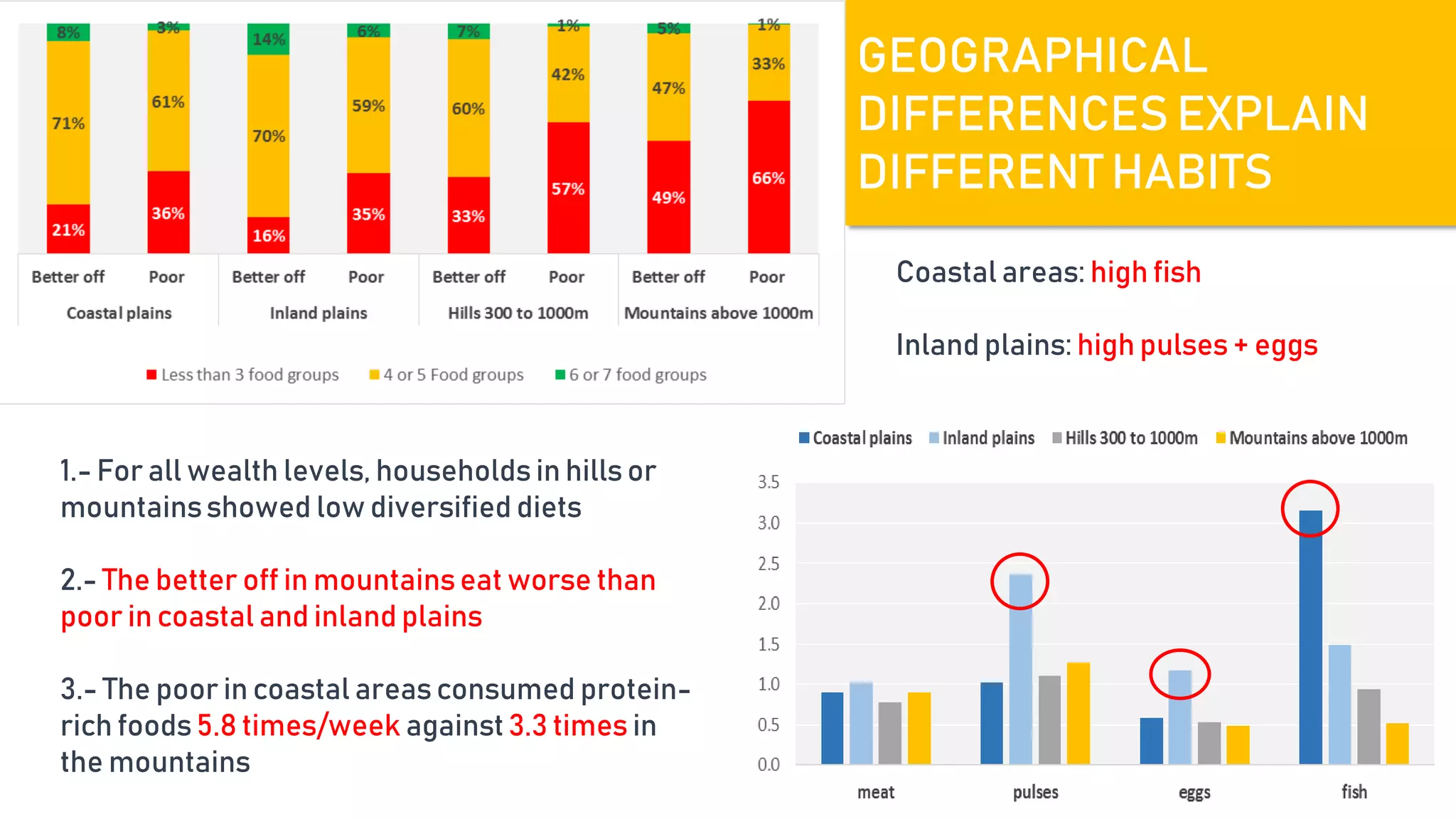
Coastal areas: high fish
Inland plains: high pulses + eggs
1.- For all wealth levels, households in hills or
mountains showed low diversified diets
2.- The better off in mountains eat worse than
poor in coastal and inland plains
3.- The poor in coastal areas consumed protein-
rich foods 5.8 times/week against 3.3 times in
the mountains
GEOGRAPHICAL
DIFFERENCES EXPLAIN
DIFFERENT HABITS
EGGS
• Eggs are highly nutritious but infrequently
consumed in Myanmar, especially by women and
children.
• More than 100 eggs available/pp/yr in Myanmar
• Cheap, available, and consumed by children in
wealthy countries; but expensive, scarce, and rarely
consumed in Africa and South Asia (Morris et al., 2019).
• Among women, egg consumption is strongly related
to socio‐economic status
• Cultural factors play a role during pregnancy,
lactation, and early childhood Lutter et al. (2018).
https://doi.org/10.1111/mcn.12678
Special issue on Eggs. Maternal & Child Nutrition 2018.
https://onlinelibrary.wiley.com/toc/17408709/2018/14/S3
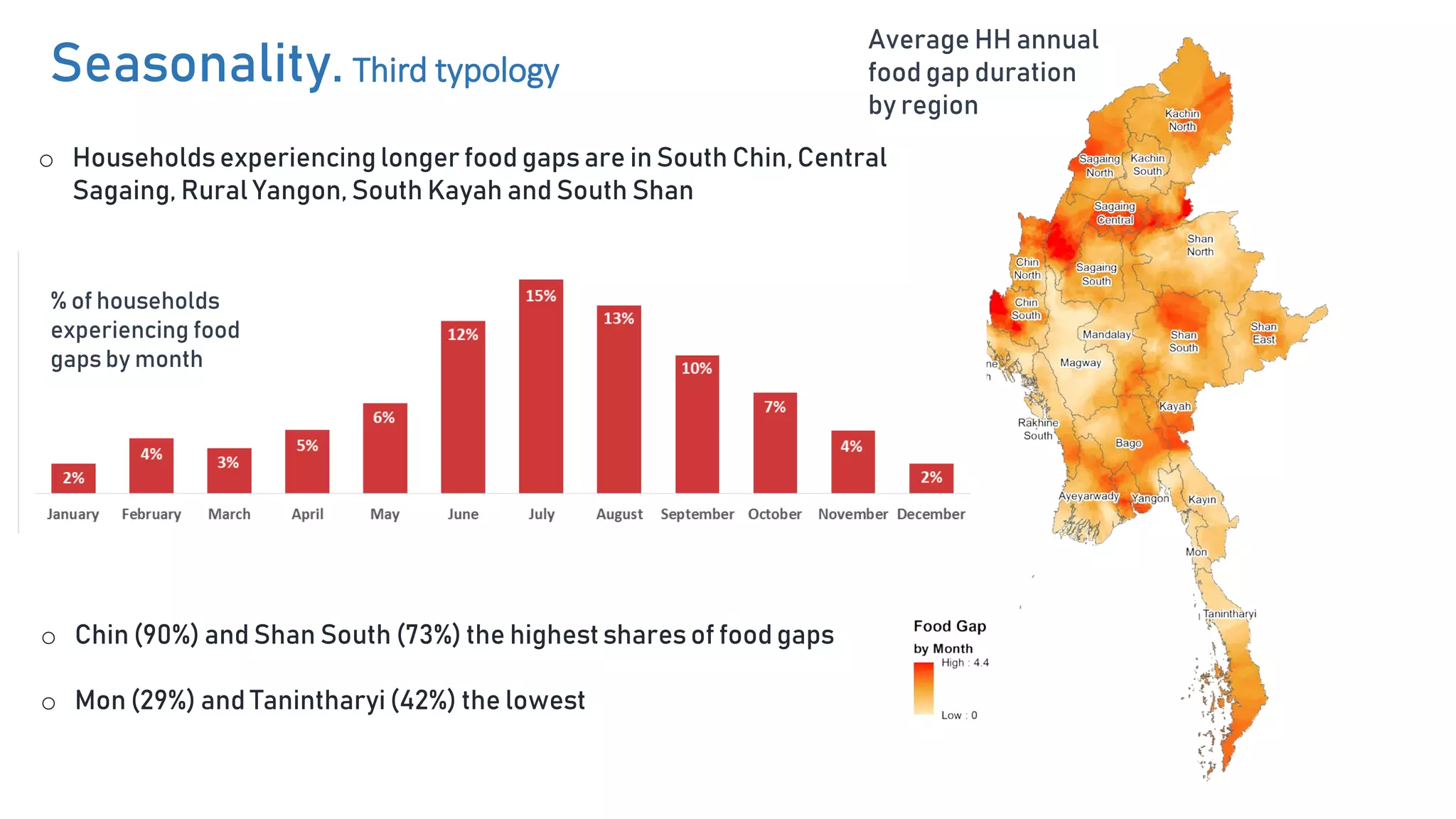
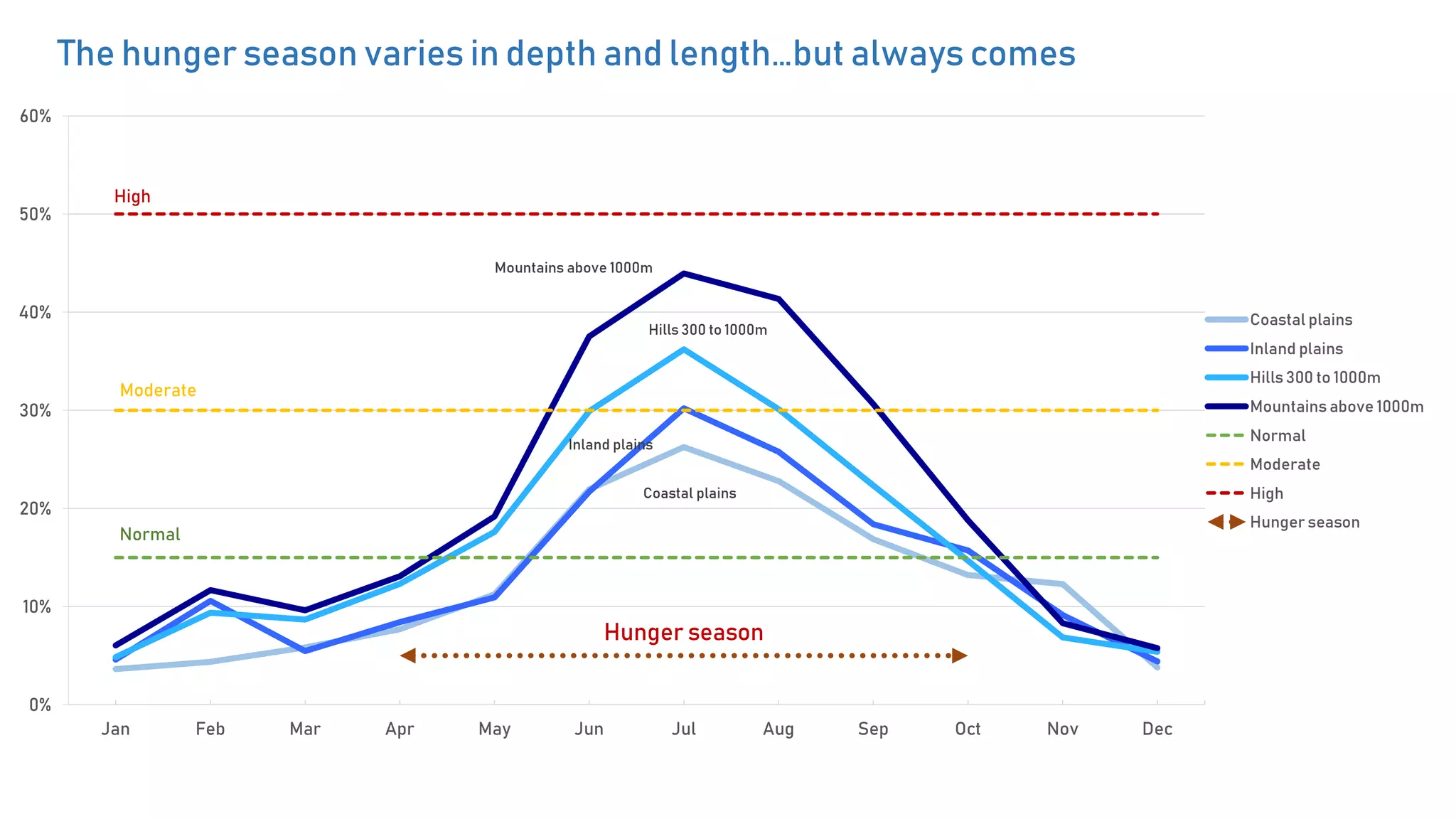
Seasonality. Third typology
Average HH annual
food gap duration
by region
o Households experiencing longer food gaps are in South Chin, Central
Sagaing, Rural Yangon, South Kayah and South Shan
% of households
experiencing food
gaps by month
o Chin (90%) and Shan South (73%) the highest shares of food gaps
o Mon (29%) and Tanintharyi (42%) the lowest
The hunger season varies in depth and length…but always comes
Coastal plains
Inland plains
Hills 300 to 1000m
Mountains above 1000m
Normal
Moderate
High
Hunger season
0%
10%
20%
30%
40%
50%
60%
Jan Feb Mar Apr May Jun Jul Aug Sep Oct Nov Dec
Coastal plains
Inland plains
Hills 300 to 1000m
Mountains above 1000m
Normal
Moderate
High
Hunger season
Evidence-based policy recommendations (one example)
Conclusions
• “New Typologies” help explaining food insecurity, livelihoods and dietary
patterns. Useful for evidence-based policy making and programming
• Further research merging the three typologies is needed at lower
administrative level (township).
• Intra-state differences on FNS issues are important (i.e. Sagain North &
South, Bago West & East, Chin Mountains & Lowlands)
• The Fringe Borders are more food insecure than central dry inlands (more
resilient and self-sufficient + less presence of State infrastructure)
• Land is the key determinant of vulnerable livelihoods
• Casual labour and seasonality are essential levers of vulnerability and food
insecurity and so far under-developed
• 25% rural households with inadequate food consumption (60% in
mountains, 21% in coastal plains)
THANK YOU!!!

Profiling Food Insecurity and Rural Diets in Myanmar

  • 1.
    Profiling food insecurityand rural diets in Myanmar Livelihoods, agroecological zoning and seasonality Jose Luis Vivero-Pol, WFP MyanmarOctober 2019
  • 2.
    Background information andmethodology Food Security and Poverty Estimation (FSP) Surveys: • Questionnaire focused on household characteristics, food consumption, coping strategies, expenditures and livelihoods • 2 stages random cluster sampling: 50 villages in each area, 12 HH per village (1,024 in total) • 4 waves from June 2013 to July 2015 (Sample size: 12,663 households) Food Security and Market Price Information System (FSMPIS) Surveys: • Regular food security monitoring in 110 rural townships • 2 stages random cluster sampling: 7 village per townships, 6 households per village • Twice per year (2013-2017) (Sample size: 14,485 households) • Monthly prices of 11 commodities monitored in73 townships (6 regions) Dataset: +27,000 households (2013-2017) Project: Improved Food Security and Market Price Information System (Feb 2012 – Feb 2017)
  • 3.
    Number of observations bytownship (#) Sample villages (FSMPIS/FSPES) Methodology: Geographical coverage Geographical coverage of the surveys
  • 4.
    Consultationswith stakeholders Secondary Data Analysis Arenutritious foods available, accessible and chosen for consumption? • Information about Food Systems • Databases, reports, peer-reviewed articles, grey literature Cost of the Diet What does a nutritious diet cost and is it affordable? • Food prices, household expenditure • Data sources: - CPI and MPLCS 2015-16 Fill the Nutrient Gap (FNG) Analysis Process Identify possible interventions and entry points Estimate minimum cost nutritious diet and economic accessibility Intervention modelling by state/region2018-2019
  • 5.
    AGRICULTURE IS STILLHIGHLY RELEVANT
  • 6.
    Malnutrition is stillhigh Stunting 27% Wasting 7% Anaemia 36% Overweight/obesity 30% Anaemia 30% Children under 5 Women of reproductive age MMFCS 2017-18
  • 7.
    Stunting and wastingare reducing, while overweight/obesity is on the rise 16 3030 41 27 11 7 0 10 20 30 40 50 2000 2002 2004 2006 2008 2010 2012 2014 2016 Prevalence(%) Stunting (Under 5) MMFCS 2017-18 Wasting (Under 5)
  • 8.
    CotD 2019 A nutritiousdiet costs more than twice as much as an energy only diet 10% of households COULD NOT afford 60% of households COULD NOT affordK1963 Per day K4358 Per day Energy Only Diet Nutritious Diet National averages
  • 9.
    Cost of anutritious diet is a primary driver of non-affordability Highest in hilly/mountainous and coastal areas CotD 2019 Daily household cost of a nutritious diet (kyat) Non-affordability of a nutritious diet (%)
  • 10.
    Agriculture Development Strategy (ADS) Multi-sectoral National ActionPlan for Nutrition (MS-NPAN) Linking NUTRITION and AGRICULTURE in MYANMAR Food Insecure Households and Poor Dietary Diversity Multi-year strategy (from farm to plate) BUT food security is small component Oblivious of nutritional impact Multi-sectoral (5 Ministries) Originally led by Health but now balancing the weights
  • 11.
    Where do foodinsecure populations live? Share VS absolute numbers in FCS FCS indicator (%) Householdswith inadequate diet 1. Higher % in mountains 2. Differences exist within state/regions. Need of disaggregated analysis 3. Inland-coastal plains account for two thirds of total food- insecure rural population 4. Seasonality (to date a non-issue in policy making) arises as an important factor (i.e. casual labour, food gaps, food prices, epidemic diseases). Lack of regular data prevent further analysis Number of households with an inadequate diet the week prior
  • 12.
    Three typologies tobetter profiling food insecurity and dietary deficiencies 1. LIVELIHOOD PROFILES 2. AGRO-ECOLOGICAL ZONES 3. SEASONALITY
  • 13.
    Source: Myanmar FoodSecurity Atlas (WFP – MoALI,, 2019) Rural Livelihoods Groups: First Typology Households were clustered into “livelihood groups” based on (a) sources of income, (b) self-reported profession of household head (c) (c) land ownership (the most relevant asset in rural areas).
  • 14.
    Only-Farmers (12%) Small-scale Farmers(20%) Casual labour with no land (12%) 47% rural HH are landless In self- described farmers, 23% are landless.
  • 15.
    0.0% 5.0% 10.0% 15.0% 20.0% 25.0% 30.0% 35.0% 40.0% Inadequate food consumption(FCS) per livelihood profile Inadequate food consumption
  • 16.
    Food Security Atlas,2019 • No self-production, livestock or assets to sell • Depend on day labour for income • Rely on credit to purchase food ~70% of average household borrowing Landless workers who rely on credit to purchase food often fall into cycles of poverty and debt
  • 17.
    Shan North Shan EastShan South Kachin North Kachin South Sagaing Up Sagaing Central Sagaing Low Mandalay Magway Bago Yangon Kayin Mon Tanintharyi Ayeyarwady Rakhine Chin Kayah Food Security Atlas,2019 Smallholder farmers in the mountains have the poorest dietary diversity in Myanmar Percentage of households with inadequate dietary diversity <20% 20-40% 40-60% >60% • Lowest consumption of protein-rich foods • Depend on markets for staples during rainy season • ~60% don’t sell any of their production
  • 18.
    Key features ofMyanmar Agro-ecological zones Myanmar agro- ecological zones Mountainous areas (above 1000 m) Hilly areas (300 – 1000 m) Inland Plains (100 – 270 m) Coastal Plains (Low or below the sea elevations) Regions/States Chin State (except Paletwa), Northern Sagaing, Northern Kachin, Kayah, Kayin (Eastern), Shan Rakhine South, Magway (Eastern), Sagaing Central/South, Kachin North, Shan, Kayah, Kayin (Eastern), Tanintharyi (Eastern) Bago, Magway, Mandalay, Sagaing, Kachin South Northern Rakhine, Ayeyarwady, Yangon, Bago (Eastern), Mon, Tanintharyi (West) Rainy season Mid May to mid-October Mid May to mid- October Mid May to mid- October Annual rainfall Rainfall Annual rainfall (average 1981 - 2016) 2200 mm 2200 mm 1600 mm 1700 – 4700 mm Topography High mountains, rugged, poor communications Transitional areas, forest-covered, between plains & mountains Flat topography, dry & semi-dry climate Coastal regions where influence of humid monsoon is high, delta regions Land use for agriculture Shift cultivation in hilly areas, multiple crops, small land plots Crops in valleys Paddy cultivation by irrigation, rainfed in some areas. Pulses also important Paddy mono culture in large land plots, fishing, aquaculture, many landless households Major crops Millet, maize, vegetables Rice, vegetables, livestock Rice pulses Rice, groundnut, sesame, pulses, oil seeds Rice (60% of total rice production), rubber, oil palm, pulses Constraints Forest land degraded by permanent cultivation High seasonality Landslides, isolation Poor infrastructure (roads, energy, schools) Soil erosion, high seasonality Few fertile land, low potential for cash crops Poor irrigation schemes and maintenance canals Erratic rains Recurrent floods Meagre livelihood options outside fishing, high landlessness Average Household Size 5.2 4.9 4.7 4.2 Dependent household members 41.9 percent 39 percent 36.2 percent 37.7 percent Households with under 5 children 47.1 percent 40.1 percent 34.2 percent 34.3 percent Livelihood Groups Small scale farmers, Landless diversified casual workers Small scale farmers, Landless diversified casual workers Only-farmers, Small-scale farmers, Landless casual workers Landless casual workers, Commercial farmers with diversification, Small- scale farmers, only farmers Agro- Ecological Zones: second typology
  • 19.
    Highest food insecurityin Mountains and Coast Mountains (above 1000 m) Hilly areas (300 – 1000 m) Inland Plains (100 – 270 m) Coastal Plains (0 – 100 m) National Average HHs with low Dietary Diversity (24 h) 56.5% 43.5% 23% 27.6% 26% HHs with inadequate Food Consumption (7 days) 60% 48% 26% 21% 25.4% Food from self-production 32% 25% 16% 10% 13.5% HHs with self-reported hunger (last 30 days) 13.2% 8.6% 8.8% 11.3% 11.4% HHs using Consumption Coping Mechanisms (last 30 days) 26% 23% 21% 28% 27.3% HHs reporting food gaps (last 12 months) 74% 65% 54% 51% 53.2% Average number of months (food gap) 2.5 2.0 1.7 1.5 1.5 Food poverty (MOPF and World Bank, 2017b) 16% 16% 7% 19% 10%
  • 20.
    Coastal areas: highfish Inland plains: high pulses + eggs 1.- For all wealth levels, households in hills or mountains showed low diversified diets 2.- The better off in mountains eat worse than poor in coastal and inland plains 3.- The poor in coastal areas consumed protein- rich foods 5.8 times/week against 3.3 times in the mountains GEOGRAPHICAL DIFFERENCES EXPLAIN DIFFERENT HABITS
  • 21.
    EGGS • Eggs arehighly nutritious but infrequently consumed in Myanmar, especially by women and children. • More than 100 eggs available/pp/yr in Myanmar • Cheap, available, and consumed by children in wealthy countries; but expensive, scarce, and rarely consumed in Africa and South Asia (Morris et al., 2019). • Among women, egg consumption is strongly related to socio‐economic status • Cultural factors play a role during pregnancy, lactation, and early childhood Lutter et al. (2018). https://doi.org/10.1111/mcn.12678 Special issue on Eggs. Maternal & Child Nutrition 2018. https://onlinelibrary.wiley.com/toc/17408709/2018/14/S3
  • 22.
    Seasonality. Third typology AverageHH annual food gap duration by region o Households experiencing longer food gaps are in South Chin, Central Sagaing, Rural Yangon, South Kayah and South Shan % of households experiencing food gaps by month o Chin (90%) and Shan South (73%) the highest shares of food gaps o Mon (29%) and Tanintharyi (42%) the lowest
  • 23.
    The hunger seasonvaries in depth and length…but always comes Coastal plains Inland plains Hills 300 to 1000m Mountains above 1000m Normal Moderate High Hunger season 0% 10% 20% 30% 40% 50% 60% Jan Feb Mar Apr May Jun Jul Aug Sep Oct Nov Dec Coastal plains Inland plains Hills 300 to 1000m Mountains above 1000m Normal Moderate High Hunger season
  • 24.
  • 25.
    Conclusions • “New Typologies”help explaining food insecurity, livelihoods and dietary patterns. Useful for evidence-based policy making and programming • Further research merging the three typologies is needed at lower administrative level (township). • Intra-state differences on FNS issues are important (i.e. Sagain North & South, Bago West & East, Chin Mountains & Lowlands) • The Fringe Borders are more food insecure than central dry inlands (more resilient and self-sufficient + less presence of State infrastructure) • Land is the key determinant of vulnerable livelihoods • Casual labour and seasonality are essential levers of vulnerability and food insecurity and so far under-developed • 25% rural households with inadequate food consumption (60% in mountains, 21% in coastal plains)
  • 26.