In
Workplace
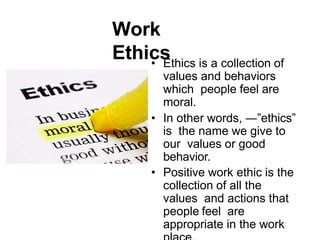
Work
Ethics
• Ethics is a collection of
values and behaviors
which people feel are
moral.
• In other words, ―”ethics”
is the name we give to
our values or good
behavior.
• Positive work ethic is the
collection of all the
values and actions that
people feel are
appropriate in the work
WORK
ETHICS
PERFORMAN
CE
STANDARDS
• STANDARDS To be successful in a career
you must possess both strong occupational
skills and good work ethics.
• The following are ten areas of work ethic
traits and performance standards you will be
presented and expected to exhibit in the
workplace:
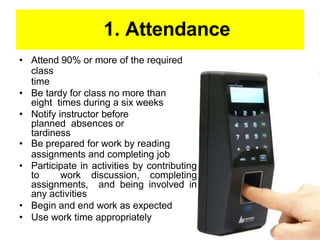
1. Attendance
• Attend 90% or more of the required
class
time
• Be tardy for class no more than
eight times during a six weeks
• Notify instructor before
planned absences or
tardiness
• Be prepared for work by reading
assignments and completing job
• Participate in activities by contributing
to work discussion, completing
assignments, and being involved in
any activities
• Begin and end work as expected
• Use work time appropriately
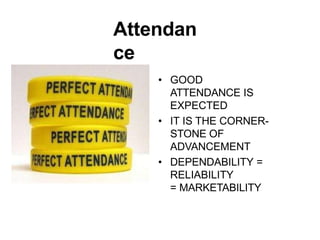
Attendan
ce
• GOOD
ATTENDANCE IS
EXPECTED
• IT IS THE CORNER-
STONE OF
ADVANCEMENT
• DEPENDABILITY =
RELIABILITY
= MARKETABILITY
2. Character
• Display a high level of
effort and commitment to
performing and
completing work
• Be honest in all situations
• Demonstrate
trustworthiness
and responsible
behavior
• Displays loyalty,
dependability, reliability,
initiative, and self-
discipline
LOYAL
TY
• In return for salary and benefits,
the firm expects loyalty.
• With loyalty comes a sense of pride.
• All employees are goodwill
ambassadors and salespeople for
their company.
• Employees must keep company
―”secrets”.
• The more the company succeeds
the more you will succeed.
• If you can not feel faithfulness and
allegiance to your company, you
should seek a job eleswhere.
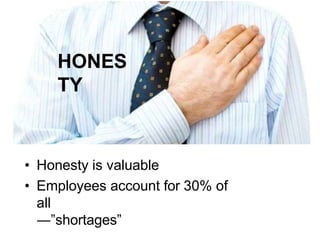
HONES
TY
• Honesty is valuable
• Employees account for 30% of
all
―”shortages”
HONES
TY
• Being honest is more than just
not taking ―”things”
• In an 8 hour day --- how much
time should be spent on task?
• Using the company telephone
for personal calls, checking
email, or texting is actually
stealing from the company!!!
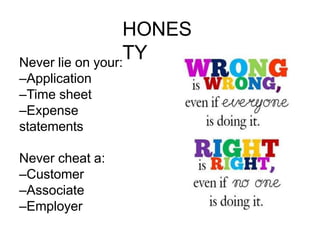
HONES
TY
Never lie on your:
–Application
–Time sheet
–Expense
statements
Never cheat a:
–Customer
–Associate
–Employer
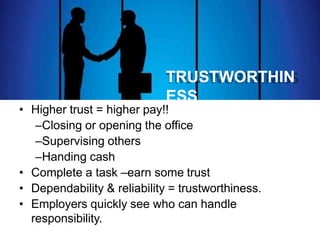
TRUSTWORTHIN
ESS
• Higher trust = higher pay!!
–Closing or opening the office
–Supervising others
–Handing cash
• Complete a task –earn some trust
• Dependability & reliability = trustworthiness.
• Employers quickly see who can handle
responsibility.
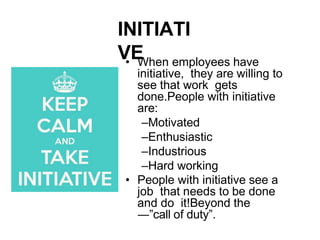
INITIATI
VE
• When employees have
initiative, they are willing to
see that work gets
done.People with initiative
are:
–Motivated
–Enthusiastic
–Industrious
–Hard working
• People with initiative see a
job that needs to be done
and do it!Beyond the
―”call of duty”.
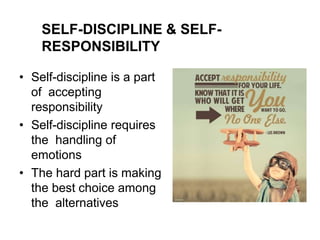
SELF-DISCIPLINE & SELF-
RESPONSIBILITY
• Self-discipline is a part
of accepting
responsibility
• Self-discipline requires
the handling of
emotions
• The hard part is making
the best choice among
the alternatives
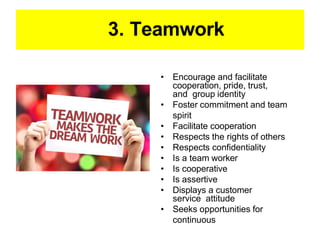
3. Teamwork
• Encourage and facilitate
cooperation, pride, trust,
and group identity
• Foster commitment and team
spirit
• Facilitate cooperation
• Respects the rights of others
• Respects confidentiality
• Is a team worker
• Is cooperative
• Is assertive
• Displays a customer
service attitude
• Seeks opportunities for
continuous
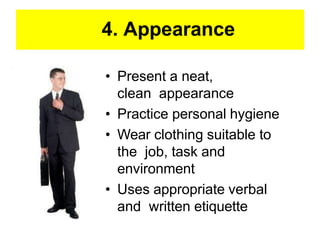
4. Appearance
• Present a neat,
clean appearance
• Practice personal hygiene
• Wear clothing suitable to
the job, task and
environment
• Uses appropriate verbal
and written etiquette
Appearan
ce
• Appearance deals with every aspect of how we perceive an
individual. In an instant, we form opinions about a person
based on:
–Appearance,
–Smell,
–Cleanliness,
–Mannerisms.
• Depending on the career, acceptable appearances will vary.
• Regardless of the job, there is no excuse for not being
groomed
correctly.
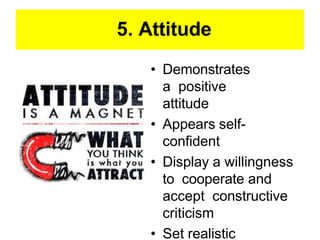
5. Attitude
• Demonstrates
a positive
attitude
• Appears self-
confident
• Display a willingness
to cooperate and
accept constructive
criticism
• Set realistic
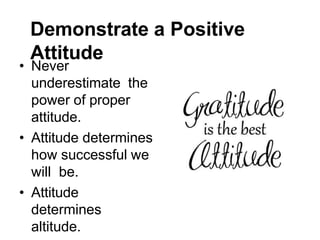
Demonstrate a Positive
Attitude
• Never
underestimate the
power of proper
attitude.
• Attitude determines
how successful we
will be.
• Attitude
determines
altitude.
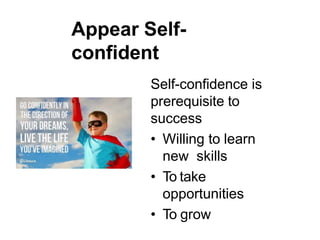
Appear Self-
confident
Self-confidence is
prerequisite to
success
• Willing to learn
new skills
• To take
opportunities
• To grow
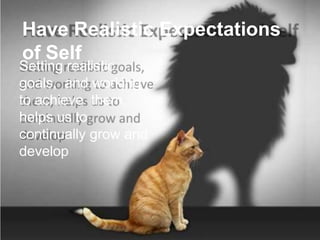
Have Realistic Expectations
of Self
Setting realistic
goals, and working
to achieve them,
helps us to
continually grow and
develop
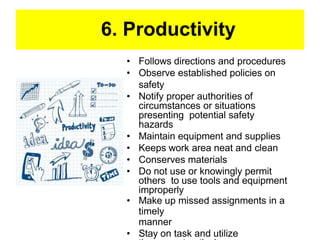
6. Productivity
• Follows directions and procedures
• Observe established policies on
safety
• Notify proper authorities of
circumstances or situations
presenting potential safety
hazards
• Maintain equipment and supplies
• Keeps work area neat and clean
• Conserves materials
• Do not use or knowingly permit
others to use tools and equipment
improperly
• Make up missed assignments in a
timely
manner
• Stay on task and utilize
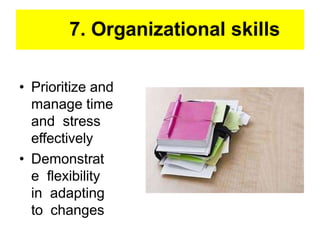
7. Organizational skills
• Prioritize and
manage time
and stress
effectively
• Demonstrat
e flexibility
in adapting
to changes
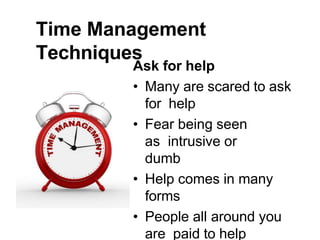
Time Management
Techniques
Ask for help
• Many are scared to ask
for help
• Fear being seen
as intrusive or
dumb
• Help comes in many
forms
• People all around you
are paid to help
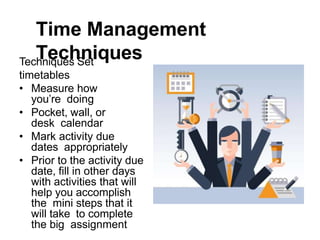
Time Management
Techniques
Techniques Set
timetables
• Measure how
you’re doing
• Pocket, wall, or
desk calendar
• Mark activity due
dates appropriately
• Prior to the activity due
date, fill in other days
with activities that will
help you accomplish
the mini steps that it
will take to complete
the big assignment
8. Communication
• Communicate accurate
information to others in a
professional and
courteous manner
• Displays appropriate
nonverbal (eye contact, body
language) and oral (listening,
telephone etiquette,
grammar) skills
• Listen attentively to others
• Good technology etiquette
Communicati
on
The worst assumption a
sender of a message can
make is that the message will
be received as intended
Language it self can be a
barrier
• Unclear wording
• Slang
• Jargon
• Tone
Another barrier is body
language
9. Cooperation
• Convey a willingness to assist
others
• Work to resolve conflicts and to
identify solutions in which all
parties benefit
• Demonstrate concern for treating
people fairly and equitably
• Follow the chain of command
in resolving conflicts
• Displays leadership skills
• Appropriately handles criticism,
conflicts, and complaints
• Demonstrates problem-
solving capability
• Maintains appropriate
relationships with supervisors
and peers
10. Respect
• Treat instructors, staff
and fellow students
with respect, courtesy,
and tact
• Do not engage in
harassment of any
kind
• Know the legal
definitions of sexual
harassment

ethicsinworkplace.pptx

  • 1.
  • 4.
    Work Ethics • Ethics isa collection of values and behaviors which people feel are moral. • In other words, ―”ethics” is the name we give to our values or good behavior. • Positive work ethic is the collection of all the values and actions that people feel are appropriate in the work
  • 5.
    WORK ETHICS PERFORMAN CE STANDARDS • STANDARDS Tobe successful in a career you must possess both strong occupational skills and good work ethics. • The following are ten areas of work ethic traits and performance standards you will be presented and expected to exhibit in the workplace:
  • 6.
    1. Attendance • Attend90% or more of the required class time • Be tardy for class no more than eight times during a six weeks • Notify instructor before planned absences or tardiness • Be prepared for work by reading assignments and completing job • Participate in activities by contributing to work discussion, completing assignments, and being involved in any activities • Begin and end work as expected • Use work time appropriately
  • 7.
    Attendan ce • GOOD ATTENDANCE IS EXPECTED •IT IS THE CORNER- STONE OF ADVANCEMENT • DEPENDABILITY = RELIABILITY = MARKETABILITY
  • 8.
    2. Character • Displaya high level of effort and commitment to performing and completing work • Be honest in all situations • Demonstrate trustworthiness and responsible behavior • Displays loyalty, dependability, reliability, initiative, and self- discipline
  • 9.
    LOYAL TY • In returnfor salary and benefits, the firm expects loyalty. • With loyalty comes a sense of pride. • All employees are goodwill ambassadors and salespeople for their company. • Employees must keep company ―”secrets”. • The more the company succeeds the more you will succeed. • If you can not feel faithfulness and allegiance to your company, you should seek a job eleswhere.
  • 11.
    HONES TY • Honesty isvaluable • Employees account for 30% of all ―”shortages”
  • 12.
    HONES TY • Being honestis more than just not taking ―”things” • In an 8 hour day --- how much time should be spent on task? • Using the company telephone for personal calls, checking email, or texting is actually stealing from the company!!!
  • 13.
    HONES TY Never lie onyour: –Application –Time sheet –Expense statements Never cheat a: –Customer –Associate –Employer
  • 14.
    TRUSTWORTHIN ESS • Higher trust= higher pay!! –Closing or opening the office –Supervising others –Handing cash • Complete a task –earn some trust • Dependability & reliability = trustworthiness. • Employers quickly see who can handle responsibility.
  • 15.
    INITIATI VE • When employeeshave initiative, they are willing to see that work gets done.People with initiative are: –Motivated –Enthusiastic –Industrious –Hard working • People with initiative see a job that needs to be done and do it!Beyond the ―”call of duty”.
  • 16.
    SELF-DISCIPLINE & SELF- RESPONSIBILITY •Self-discipline is a part of accepting responsibility • Self-discipline requires the handling of emotions • The hard part is making the best choice among the alternatives
  • 17.
    3. Teamwork • Encourageand facilitate cooperation, pride, trust, and group identity • Foster commitment and team spirit • Facilitate cooperation • Respects the rights of others • Respects confidentiality • Is a team worker • Is cooperative • Is assertive • Displays a customer service attitude • Seeks opportunities for continuous
  • 18.
    4. Appearance • Presenta neat, clean appearance • Practice personal hygiene • Wear clothing suitable to the job, task and environment • Uses appropriate verbal and written etiquette
  • 19.
    Appearan ce • Appearance dealswith every aspect of how we perceive an individual. In an instant, we form opinions about a person based on: –Appearance, –Smell, –Cleanliness, –Mannerisms. • Depending on the career, acceptable appearances will vary. • Regardless of the job, there is no excuse for not being groomed correctly.
  • 20.
    5. Attitude • Demonstrates apositive attitude • Appears self- confident • Display a willingness to cooperate and accept constructive criticism • Set realistic
  • 21.
    Demonstrate a Positive Attitude •Never underestimate the power of proper attitude. • Attitude determines how successful we will be. • Attitude determines altitude.
  • 22.
    Appear Self- confident Self-confidence is prerequisiteto success • Willing to learn new skills • To take opportunities • To grow
  • 23.
    Have Realistic Expectations ofSelf Setting realistic goals, and working to achieve them, helps us to continually grow and develop
  • 24.
    6. Productivity • Followsdirections and procedures • Observe established policies on safety • Notify proper authorities of circumstances or situations presenting potential safety hazards • Maintain equipment and supplies • Keeps work area neat and clean • Conserves materials • Do not use or knowingly permit others to use tools and equipment improperly • Make up missed assignments in a timely manner • Stay on task and utilize
  • 25.
    7. Organizational skills •Prioritize and manage time and stress effectively • Demonstrat e flexibility in adapting to changes
  • 26.
    Time Management Techniques Ask forhelp • Many are scared to ask for help • Fear being seen as intrusive or dumb • Help comes in many forms • People all around you are paid to help
  • 27.
    Time Management Techniques Techniques Set timetables •Measure how you’re doing • Pocket, wall, or desk calendar • Mark activity due dates appropriately • Prior to the activity due date, fill in other days with activities that will help you accomplish the mini steps that it will take to complete the big assignment
  • 28.
    8. Communication • Communicateaccurate information to others in a professional and courteous manner • Displays appropriate nonverbal (eye contact, body language) and oral (listening, telephone etiquette, grammar) skills • Listen attentively to others • Good technology etiquette
  • 29.
    Communicati on The worst assumptiona sender of a message can make is that the message will be received as intended Language it self can be a barrier • Unclear wording • Slang • Jargon • Tone Another barrier is body language
  • 30.
    9. Cooperation • Conveya willingness to assist others • Work to resolve conflicts and to identify solutions in which all parties benefit • Demonstrate concern for treating people fairly and equitably • Follow the chain of command in resolving conflicts • Displays leadership skills • Appropriately handles criticism, conflicts, and complaints • Demonstrates problem- solving capability • Maintains appropriate relationships with supervisors and peers
  • 31.
    10. Respect • Treatinstructors, staff and fellow students with respect, courtesy, and tact • Do not engage in harassment of any kind • Know the legal definitions of sexual harassment