CLICK TO EDIT SUB HEADLINE
UNIVERSITY OF IDAHO EXTENSION
PROFESSIONALISM IN THE
WORKPLACE
“SKILLS TO PAY THE BILLS”
BARBARA D. PETTY
ASSOCIATE DEAN/DIRECTOR OF EXTENSION
WHAT IS PROFESSIONALISM?
PROFESSIONALISM
Conforming to a set of rules that dictate what is appropriate
behavior at work, which includes rules that are:
 Job Specific – policies and procedures at a particular work
place, such as following the right chain of command.
 Environmental – rules that contribute to healthy, positive
productive work environments, that often focus on
attitudes and communication styles.
 Personal – rules that dictate personal behaviors such as
dress, attendance, tardiness, etc.
https://youtu.be/7dPWVjQSad4
PROFESSIONALISM IN
THE WORKPLACE STUDY
York College –Center for Professional Excellence
 Annual study starting in 2009.
 Online survey – email invitation from
President of York College.
 2013 – Workplace Report
study included a nationwide random 401
human resource professionals.
 2014 – Career Development Report
 2015 – Recent College Graduates
QUALITIES
An employee who is described as a professional possesses these
 Interpersonal skills
 Work Ethic
 Appearance
 Communication Skills
 Time management
1. INTERPERSONAL SKILLS
 Listening and hearing that moves you to a response.
 The signals you send to others – not what you say,
but how you say it. “I didn’t say Joe was incompetent!”
 Body language – facial expressions, eye contact,
posture, personal space.
 Stress management – frustration management.
 Connecting to people – small talk – move the
conversation along with asking for examples, clarity and
understanding.
 See the other side and build a bridge.
2. WORK ETHIC
 Integrity – trusting relationships and high moral standards –
refrains from gossip/complaining – honesty.
 Sense of responsibility – put in right time and effort – completes
the task.
 Emphasis on quality – do their best work to create great work,
more than “good enough” – your productivity improves the quality
of the university and the community in which you live.
 Personal disciplines – commitment to finish task - lifelong learner
- continuing to develop skills and knowledge base - what you do
when no one is looking.
• Sense of team work – respect others- helps others meet their
goals – “Pull your own weight.”
3. APPEARANCE
First impression
3. APPEARANCE
3. APPEARANCE
3. APPEARANCE
 Be clean and neat – dress appropriately for the
event – change tie, scarf or jacket
 Cleavage is not to be seen in the workplace –
front or back
 Wear appropriate shoes
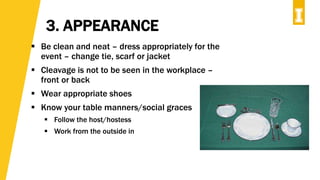
 Know your table manners/social graces
 Follow the host/hostess
 Work from the outside in
https://youtu.be/-vk-99seC_I
4. COMMUNICATION SKILL
 Communicate clearly – remember the power of the
spoken word.
 Keep confidences.
 Use appropriate grammar.
 Don’t bite the hand that signs your paycheck.
 “Any fool can criticize, condemn and complain –
and most fools do.” - Dale Carnegie
https://youtu.be/X0voPlW2pSs
PHONE ETIQUETTE
 “Smile” through the phone
 Use greeting to identify office and your name
 Put your colleague in the best light
 Return phone calls
 Update your message
EMAIL
 Be concise -- Use no more than four or five words in subject
line.
 Avoid using large font and all capitals - shouting
 Don’t send an email when emotional or angry.
 Email is not private – be careful - what you put in print can
be subject to public records request
 Check the thread you are forwarding
 Proofread, Proofread, Proofread!
 Respond within 24 hours if possible
 Words alone can be misinterpreted but limit emojis 
ELECTRONIC MISTAKES
 Your cell phone becomes your top priority.
 Those around you can and will read your laptop
screen.
 Ineffective voice mail greeting – not keeping it
current.
 Grammatical errors in email.
 Attaching working copy instead of final copy.
 Inappropriate posting on social media – keep it
generic.
5. TIME MANAGEMENT
 Be on time.
 Learn to work smarter not harder.
 Be honest to your employer with your time.
 Effective calendar management multiplies your
time.
 “I am already booked.”
 Manage your energy.
UNPROFESSIONAL QUALITIES
 Inappropriate appearance
 Poor work ethic
 Unfocused
 Apathetic
 Sense of entitlement
 Disrespectful and rude
 Lack of time management
LACK OF FOCUS
 Attendance
 Text messaging at inappropriate times
 Inappropriate use of internet
 Excessive cell phone usage for personal calls
 Excessive tweeting/Facebook
TEN SECRETS OF SUCCESS
1. Keep your temper to yourself.
2. Give your enthusiasm to everyone.
3. Make others feel important.
4. Stamp out self-pity.
5. Put your smile to work.
TEN SECRETS OF SUCCESS (CON’T)
6. Keep trying.
7. Give a good start to everything you do.
8. Forgive yourself….. if you fail.
9. Overwhelm people with charm, not power.
10.Keep promises.
PROFESSIONALISM
U.S. Department of Labor
Employers want workers to be responsible,
ethical, team oriented, and to possess strong
communication, interpersonal and problem solving
skills. Wrap these skills up all together and you
have professionalism.
https://www.dol.gov/odep/topics/youth/softskills/
professionalism-in-the-workplace.pptxhhh

professionalism-in-the-workplace.pptxhhh

  • 2.
    CLICK TO EDITSUB HEADLINE UNIVERSITY OF IDAHO EXTENSION PROFESSIONALISM IN THE WORKPLACE “SKILLS TO PAY THE BILLS” BARBARA D. PETTY ASSOCIATE DEAN/DIRECTOR OF EXTENSION
  • 3.
  • 4.
    PROFESSIONALISM Conforming to aset of rules that dictate what is appropriate behavior at work, which includes rules that are:  Job Specific – policies and procedures at a particular work place, such as following the right chain of command.  Environmental – rules that contribute to healthy, positive productive work environments, that often focus on attitudes and communication styles.  Personal – rules that dictate personal behaviors such as dress, attendance, tardiness, etc.
  • 5.
  • 6.
    PROFESSIONALISM IN THE WORKPLACESTUDY York College –Center for Professional Excellence  Annual study starting in 2009.  Online survey – email invitation from President of York College.  2013 – Workplace Report study included a nationwide random 401 human resource professionals.  2014 – Career Development Report  2015 – Recent College Graduates
  • 7.
    QUALITIES An employee whois described as a professional possesses these  Interpersonal skills  Work Ethic  Appearance  Communication Skills  Time management
  • 8.
    1. INTERPERSONAL SKILLS Listening and hearing that moves you to a response.  The signals you send to others – not what you say, but how you say it. “I didn’t say Joe was incompetent!”  Body language – facial expressions, eye contact, posture, personal space.  Stress management – frustration management.  Connecting to people – small talk – move the conversation along with asking for examples, clarity and understanding.  See the other side and build a bridge.
  • 9.
    2. WORK ETHIC Integrity – trusting relationships and high moral standards – refrains from gossip/complaining – honesty.  Sense of responsibility – put in right time and effort – completes the task.  Emphasis on quality – do their best work to create great work, more than “good enough” – your productivity improves the quality of the university and the community in which you live.  Personal disciplines – commitment to finish task - lifelong learner - continuing to develop skills and knowledge base - what you do when no one is looking. • Sense of team work – respect others- helps others meet their goals – “Pull your own weight.”
  • 10.
  • 11.
  • 12.
  • 13.
    3. APPEARANCE  Beclean and neat – dress appropriately for the event – change tie, scarf or jacket  Cleavage is not to be seen in the workplace – front or back  Wear appropriate shoes  Know your table manners/social graces  Follow the host/hostess  Work from the outside in
  • 14.
  • 15.
    4. COMMUNICATION SKILL Communicate clearly – remember the power of the spoken word.  Keep confidences.  Use appropriate grammar.  Don’t bite the hand that signs your paycheck.  “Any fool can criticize, condemn and complain – and most fools do.” - Dale Carnegie
  • 16.
  • 17.
    PHONE ETIQUETTE  “Smile”through the phone  Use greeting to identify office and your name  Put your colleague in the best light  Return phone calls  Update your message
  • 18.
    EMAIL  Be concise-- Use no more than four or five words in subject line.  Avoid using large font and all capitals - shouting  Don’t send an email when emotional or angry.  Email is not private – be careful - what you put in print can be subject to public records request  Check the thread you are forwarding  Proofread, Proofread, Proofread!  Respond within 24 hours if possible  Words alone can be misinterpreted but limit emojis 
  • 19.
    ELECTRONIC MISTAKES  Yourcell phone becomes your top priority.  Those around you can and will read your laptop screen.  Ineffective voice mail greeting – not keeping it current.  Grammatical errors in email.  Attaching working copy instead of final copy.  Inappropriate posting on social media – keep it generic.
  • 20.
    5. TIME MANAGEMENT Be on time.  Learn to work smarter not harder.  Be honest to your employer with your time.  Effective calendar management multiplies your time.  “I am already booked.”  Manage your energy.
  • 21.
    UNPROFESSIONAL QUALITIES  Inappropriateappearance  Poor work ethic  Unfocused  Apathetic  Sense of entitlement  Disrespectful and rude  Lack of time management
  • 22.
    LACK OF FOCUS Attendance  Text messaging at inappropriate times  Inappropriate use of internet  Excessive cell phone usage for personal calls  Excessive tweeting/Facebook
  • 23.
    TEN SECRETS OFSUCCESS 1. Keep your temper to yourself. 2. Give your enthusiasm to everyone. 3. Make others feel important. 4. Stamp out self-pity. 5. Put your smile to work.
  • 24.
    TEN SECRETS OFSUCCESS (CON’T) 6. Keep trying. 7. Give a good start to everything you do. 8. Forgive yourself….. if you fail. 9. Overwhelm people with charm, not power. 10.Keep promises.
  • 25.
    PROFESSIONALISM U.S. Department ofLabor Employers want workers to be responsible, ethical, team oriented, and to possess strong communication, interpersonal and problem solving skills. Wrap these skills up all together and you have professionalism. https://www.dol.gov/odep/topics/youth/softskills/