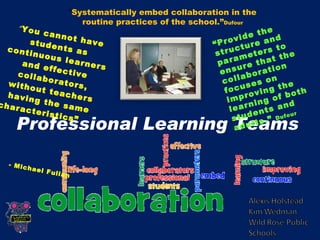
Professional Learning Teams “ You cannot have students as continuous learners and effective collaborators, without teachers having the same characteristics”  - Michael Fullan “ Systematically embed collaboration in the routine practices of the school.” Dufour “ Provide the structure and parameters to ensure that the collaboration focuses on improving the learning of both students and adults.”  Dufour
Opening Activity A/B Partners- model Individually, choose a picture that reflects your vision of what a PLC is 3 reasons why this picture reflects your vision ****Think, Pair, Share*****
Objectives for Session Participants will be able to:   Understand  how our vision of PLC/PLT has changed through a three year cultural shift in our PLCs at Lochearn from an "add on" to "way of being". Define  collaboration and how it is accomplished in their place of work- what is important and what makes it successful. Appreciate  how embedded Professional Learning Team time has enhanced our school culture and improved student achievement. Reflect  on where their staff is in the PLC cycle and their vision of PLC in their division/building.
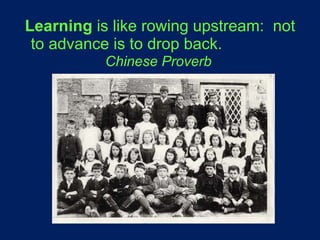
Learning  is like rowing upstream:  not to advance is to drop back.   Chinese Proverb
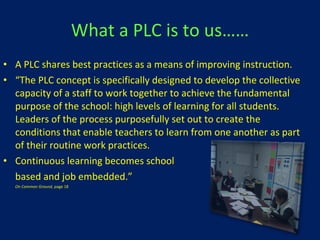
What a PLC is to us…… A PLC shares best practices as a means of improving instruction. “ The PLC concept is specifically designed to develop the collective capacity of a staff to work together to achieve the fundamental purpose of the school: high levels of learning for all students.  Leaders of the process purposefully set out to create the conditions that enable teachers to learn from one another as part of their routine work practices.  Continuous learning becomes school  based and job embedded.” On Common Ground , page 18
Resistance Assume good intentions recognize that the resistance is to change Express a need for resisters to articulate their concerns / assumptions Need to build shared knowledge Shifting from being the “sage on the stage to the “guide by the side” modeling that it is “okay” not to know all the answers…..
 
We have learned that : A PLC is not: a program to be implemented a meeting a step-by-step recipe for change a sure-fire system borrowed from another school one more thing to add to an already cluttered school agenda A PLC IS A  PROCESS  THAT WILL CHANGE A SCHOOL’S CULTURE!  It is not EASY and takes TIME
 
Why . . . Moving from being an add on that we have to do to a way of being………. We started as: One hour per week added on the end of a workday … Focus was on DuFour’s  questions:
5. What will be the next steps once students have learned? 1. What do we want our students to learn?  Essential Learnings Through collaborative unit planning Through collaborative alignment of curriculum   3. How will we know students have learned?   Common Assessments Through using assessment for learning strategies Through the creation and use of common assessments 4. What will we do if students do not learn? Use Differentiated Instruction Interventions   Use Instructional Technology Interventions Dufour’s Questions 2. How do we want students to learn? By using Differentiated Instruction Strategies By using Instructional Technology Strategies
 
But ……… ->  we need more in order to grow in our learning as educators ->  not enough “deep conversations”
A mind once stretched by a new idea never regains its original dimensions.  Anonymous
What’s Important and Why  A/B Partner talk  Question:  How do teachers in your school collaborate? What is important and what makes it effective? Discussion
Concerns . . . How do we as administrators take an instructional leadership role that improves student learning? How do we encourage discussions that are based on research…..that relate to how students are doing and what we are doing to improve student learning? How do we ensure  collaborative reflection  time that is more than preparing strategies for classroom delivery? How do we allow for individual concerns to be raised?
Leading the process - Where do we as administrators want to focus our energy? Isolation is the enemy of learning.  Principals who support the learning of adults in their school  organize teachers schedules  to   provide opportunities for teachers to work, plan, and think together.” NAESP,  Leading Learning Communities: Standards for What Principals Should Know and Be Able to Do
Who dares to teach must never cease to learn.    John Cotton Dana
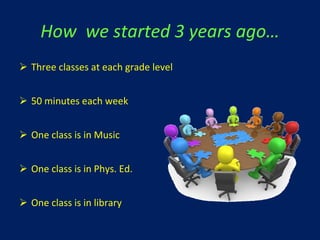
How  we started 3 years ago… Three classes at each grade level 50 minutes each week One class is in Music One class is in Phys. Ed. One class is in library
What . . .process Started As: Issue driven / walk throughs: positives and concerns.  In Math, started with what are we supposed to be teaching? Looking at the Math curriculum, discussing “I Can” statements, teaching strategies and class organization. Who is learning? . . .  Who is not learning?
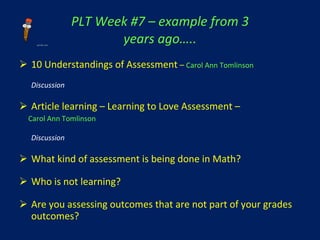
PLT Week #7 – example from 3 years ago….. 10 Understandings of Assessment  –   Carol Ann Tomlinson Discussion Article learning – Learning to Love Assessment – Carol Ann Tomlinson Discussion What kind of assessment is being done in Math? Who is not learning? Are you assessing outcomes that are not part of your grades outcomes?
Moved to… Best practice/research discussions, facilitated by AISI coach driven by division, school, and grade team goals Works as “guide by the side” to assist teams through best practices discussions Still focusing on Dufour’s questions Works to focus teams and stretch thought to new areas  Funnel to team work time at end of day
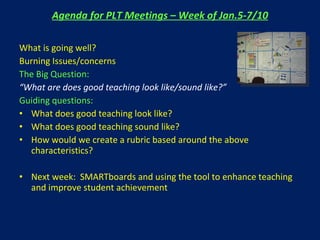
Agenda for PLT Meetings – Week of Jan.5-7/10 What is going well?  Burning Issues/concerns The Big Question: “ What are does good teaching look like/sound like?” Guiding questions: What does good teaching look like? What does good teaching sound like? How would we create a rubric based around the above characteristics?  Next week:  SMARTboards and using the tool to enhance teaching  and improve student achievement
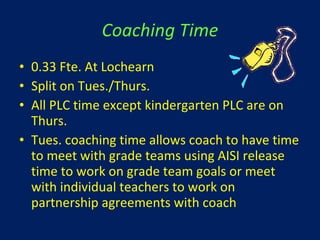
Coaching Time 0.33 Fte. At Lochearn Split on Tues./Thurs. All PLC time except kindergarten PLC are on Thurs. Tues. coaching time allows coach to have time to meet with grade teams using AISI release time to work on grade team goals or meet with individual teachers to work on partnership agreements with coach
 
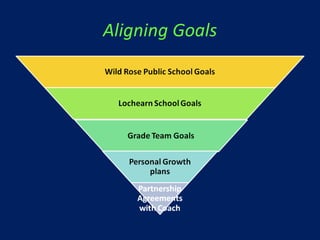
Aligning Goals
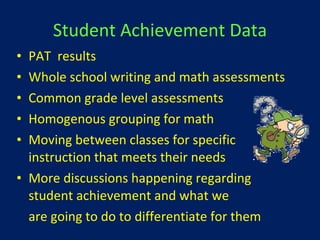
Student Achievement Data PAT  results Whole school writing and math assessments Common grade level assessments Homogenous grouping for math Moving between classes for specific instruction that meets their needs More discussions happening regarding student achievement and what we  are going to do to differentiate for them
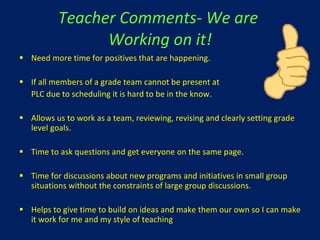
Teacher Comments- We are  Working on it! Need more time for positives that are happening. If all members of a grade team cannot be present at  PLC due to scheduling it is hard to be in the know. Allows us to work as a team, reviewing, revising and clearly setting grade level goals. Time to ask questions and get everyone on the same page. Time for discussions about new programs and initiatives in small group situations without the constraints of large group discussions. Helps to give time to build on ideas and make them our own so I can make it work for me and my style of teaching
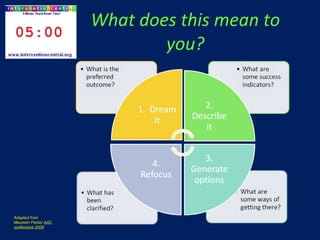
What does this mean to you? Adapted from  Maureen Parker  AAC conference 2009
A final thought……
Questions/comments Evaluation Website for presentation: http://www.wrsd.ca/lochearn/index.html   click on links, ourPLT
Resources Clipart : http://school.discoveryeducation.com/clipart/ http://www.mydorchester.org/node/5563 http://www.deskscape.com/products_project_management_pg3.html http://www.artie.com/ Barth,R., DuFour,R., Eaker,R., and Eason-Watkins,B.(2005).On Common Ground: The Power of Professional Learning Communities. Solution Tree. -Leadership to set structure and purpose in collaborative learning -Power of collective learning  DuFour,R. & Eaker,R.(1998).Professional learning communities at work: Best practices for enhancing student achievement. -Cultural shift to embedded professional learning for teachers and improved student achievement  Killion,J. & Harrison,C.(2006).Taking the Lead: New Roles for Teachers and School-Based Coaches.  NSDC. -Facilitating Coaching roles in schools -Collaboration of teams of teachers -Best practices in teaching

Professional Learning Teams Powerpoint 1a

  • 1.
  • 2.
    Professional Learning Teams“ You cannot have students as continuous learners and effective collaborators, without teachers having the same characteristics” - Michael Fullan “ Systematically embed collaboration in the routine practices of the school.” Dufour “ Provide the structure and parameters to ensure that the collaboration focuses on improving the learning of both students and adults.” Dufour
  • 3.
    Opening Activity A/BPartners- model Individually, choose a picture that reflects your vision of what a PLC is 3 reasons why this picture reflects your vision ****Think, Pair, Share*****
  • 4.
    Objectives for SessionParticipants will be able to:   Understand how our vision of PLC/PLT has changed through a three year cultural shift in our PLCs at Lochearn from an "add on" to "way of being". Define collaboration and how it is accomplished in their place of work- what is important and what makes it successful. Appreciate how embedded Professional Learning Team time has enhanced our school culture and improved student achievement. Reflect on where their staff is in the PLC cycle and their vision of PLC in their division/building.
  • 5.
    Learning islike rowing upstream:  not to advance is to drop back. Chinese Proverb
  • 6.
    What a PLCis to us…… A PLC shares best practices as a means of improving instruction. “ The PLC concept is specifically designed to develop the collective capacity of a staff to work together to achieve the fundamental purpose of the school: high levels of learning for all students. Leaders of the process purposefully set out to create the conditions that enable teachers to learn from one another as part of their routine work practices. Continuous learning becomes school based and job embedded.” On Common Ground , page 18
  • 7.
    Resistance Assume goodintentions recognize that the resistance is to change Express a need for resisters to articulate their concerns / assumptions Need to build shared knowledge Shifting from being the “sage on the stage to the “guide by the side” modeling that it is “okay” not to know all the answers…..
  • 8.
  • 9.
    We have learnedthat : A PLC is not: a program to be implemented a meeting a step-by-step recipe for change a sure-fire system borrowed from another school one more thing to add to an already cluttered school agenda A PLC IS A PROCESS THAT WILL CHANGE A SCHOOL’S CULTURE! It is not EASY and takes TIME
  • 10.
  • 11.
    Why . .. Moving from being an add on that we have to do to a way of being………. We started as: One hour per week added on the end of a workday … Focus was on DuFour’s questions:
  • 12.
    5. What willbe the next steps once students have learned? 1. What do we want our students to learn? Essential Learnings Through collaborative unit planning Through collaborative alignment of curriculum 3. How will we know students have learned? Common Assessments Through using assessment for learning strategies Through the creation and use of common assessments 4. What will we do if students do not learn? Use Differentiated Instruction Interventions Use Instructional Technology Interventions Dufour’s Questions 2. How do we want students to learn? By using Differentiated Instruction Strategies By using Instructional Technology Strategies
  • 13.
  • 14.
    But ……… -> we need more in order to grow in our learning as educators -> not enough “deep conversations”
  • 15.
    A mind oncestretched by a new idea never regains its original dimensions. Anonymous
  • 16.
    What’s Important andWhy A/B Partner talk Question: How do teachers in your school collaborate? What is important and what makes it effective? Discussion
  • 17.
    Concerns . .. How do we as administrators take an instructional leadership role that improves student learning? How do we encourage discussions that are based on research…..that relate to how students are doing and what we are doing to improve student learning? How do we ensure collaborative reflection time that is more than preparing strategies for classroom delivery? How do we allow for individual concerns to be raised?
  • 18.
    Leading the process- Where do we as administrators want to focus our energy? Isolation is the enemy of learning. Principals who support the learning of adults in their school organize teachers schedules to provide opportunities for teachers to work, plan, and think together.” NAESP, Leading Learning Communities: Standards for What Principals Should Know and Be Able to Do
  • 19.
    Who dares toteach must never cease to learn. John Cotton Dana
  • 20.
    How westarted 3 years ago… Three classes at each grade level 50 minutes each week One class is in Music One class is in Phys. Ed. One class is in library
  • 21.
    What . ..process Started As: Issue driven / walk throughs: positives and concerns. In Math, started with what are we supposed to be teaching? Looking at the Math curriculum, discussing “I Can” statements, teaching strategies and class organization. Who is learning? . . . Who is not learning?
  • 22.
    PLT Week #7– example from 3 years ago….. 10 Understandings of Assessment – Carol Ann Tomlinson Discussion Article learning – Learning to Love Assessment – Carol Ann Tomlinson Discussion What kind of assessment is being done in Math? Who is not learning? Are you assessing outcomes that are not part of your grades outcomes?
  • 23.
    Moved to… Bestpractice/research discussions, facilitated by AISI coach driven by division, school, and grade team goals Works as “guide by the side” to assist teams through best practices discussions Still focusing on Dufour’s questions Works to focus teams and stretch thought to new areas Funnel to team work time at end of day
  • 24.
    Agenda for PLTMeetings – Week of Jan.5-7/10 What is going well? Burning Issues/concerns The Big Question: “ What are does good teaching look like/sound like?” Guiding questions: What does good teaching look like? What does good teaching sound like? How would we create a rubric based around the above characteristics? Next week: SMARTboards and using the tool to enhance teaching and improve student achievement
  • 25.
    Coaching Time 0.33Fte. At Lochearn Split on Tues./Thurs. All PLC time except kindergarten PLC are on Thurs. Tues. coaching time allows coach to have time to meet with grade teams using AISI release time to work on grade team goals or meet with individual teachers to work on partnership agreements with coach
  • 26.
  • 27.
  • 28.
    Student Achievement DataPAT results Whole school writing and math assessments Common grade level assessments Homogenous grouping for math Moving between classes for specific instruction that meets their needs More discussions happening regarding student achievement and what we are going to do to differentiate for them
  • 29.
    Teacher Comments- Weare Working on it! Need more time for positives that are happening. If all members of a grade team cannot be present at PLC due to scheduling it is hard to be in the know. Allows us to work as a team, reviewing, revising and clearly setting grade level goals. Time to ask questions and get everyone on the same page. Time for discussions about new programs and initiatives in small group situations without the constraints of large group discussions. Helps to give time to build on ideas and make them our own so I can make it work for me and my style of teaching
  • 30.
    What does thismean to you? Adapted from Maureen Parker AAC conference 2009
  • 31.
  • 32.
    Questions/comments Evaluation Websitefor presentation: http://www.wrsd.ca/lochearn/index.html click on links, ourPLT
  • 33.
    Resources Clipart :http://school.discoveryeducation.com/clipart/ http://www.mydorchester.org/node/5563 http://www.deskscape.com/products_project_management_pg3.html http://www.artie.com/ Barth,R., DuFour,R., Eaker,R., and Eason-Watkins,B.(2005).On Common Ground: The Power of Professional Learning Communities. Solution Tree. -Leadership to set structure and purpose in collaborative learning -Power of collective learning DuFour,R. & Eaker,R.(1998).Professional learning communities at work: Best practices for enhancing student achievement. -Cultural shift to embedded professional learning for teachers and improved student achievement Killion,J. & Harrison,C.(2006).Taking the Lead: New Roles for Teachers and School-Based Coaches. NSDC. -Facilitating Coaching roles in schools -Collaboration of teams of teachers -Best practices in teaching