Topic
Presented by:
 Syed Talha Mansoor (0028)
University of Central Punjab
Ethics?
Statements of what is right or wrong.
Code of Ethics:
 Written list of values & standards of
conduct of a group
 Framework for decision-making
 Normally general statements
 Do not give specific answers to every
problem
History of computer ethics :
 In the mid-1970s, Walter Maner began
to use the term computer ethics to refer
to the field of inquiry dealing with ethical
problems.
 Maner generated computer ethics
courses with varieties of workshops and
lectures at computer science
conferences across United States of
America.
History continued…
 In 1980s due to disasters caused by
computer failures and invasions of
privacy via computer databases,
computer ethics became a separate
academic discipline.
What is IEEE?
 The Institute of Electrical and
Electronics Engineers
 An international non-profit, professional
organization
 Formed in 1963 as a merger of AIEE
(American Institute of Electrical
Engineers) and IRA (Institute of Radio
Engineers)
IEEE continued…
 Worlds largest technical organization works
for advancement of technology
 IEEE membership requires follow IEEE
code of ethics
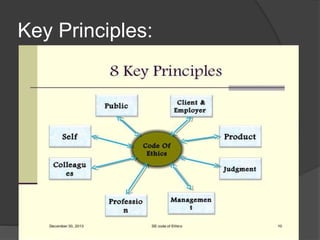
Key Principles:
Public:
Software engineers shall act consistently
with the public interest.
1. Accept responsibility for your own work.
2. Interests should be public good.
3. Only approve software based on well
founded belief on its safety.
4. Be fair and avoid dishonesty in all
statements.
Client and Employer:
Software engineers shall act in a manner that
is in the best interests of their client and
employer, consistent with the public interest.
 Provides service in area of competence.
 Don’t use illegal and unethical software.
 Use property that is within owner’s knowledge and
authorized.
 Update clients about the problems you are facing.
 Accept no outside work that is harmful for your employer.
 Promote no interest harmful to your employer or client,
unless higher ethical concern exists.
Product:
Software engineers shall ensure that things
related to software development are following
the respective standards.
 Strive for high quality, acceptable cost, and
reasonable schedule.
 Use appropriate methods.
 Follow professional standards.
 Understand requirements properly.
 Ensure adequate testing.
 Ensure adequate documentation.
Judgment:
Software engineers shall maintain integrity
and independence in their professional
judgment
 Displeasure yourself for public interest.
 Review document before taking any
judgment.
 Be fair in decision making.
 Do not engage in misleading financial
practices.
 Disclose conflicts of interest.
Management
Software engineering managers and leaders
should use ethical approach to the management
of software development and maintenance
 Ensure good management practices.
 Assign work by education and experience
levels.
 Ensure realistic quantitative estimates of cost.
 Describe position accurately and fully when
hiring.
 Stop others to violate Code of conduct.
Profession
Software engineers shall maintain the
reputation of the profession consistent with
the public interest
 Participate in professional organizations, meetings, and
publications.
 Support other SW engineers to follow this Code.
 Do not promote your own interests.
 Don’t violate the code of conduct.
 Report violations.
 Take responsibility for errors
Colleagues
Software engineers shall be fair and
supportive of their colleagues
 Encourage colleagues to follow Code.
 Guide them in professional
development.
 Fully credit the work of others.
 Review other’s work honestly.
 Do not unfairly with someone career.
Self
Software engineers shall participate in
lifelong learning regarding the practice of their
profession
 Improve your SW development knowledge.
 Improve your SW development skills.
 Improve your documentation skills.
 Improve your knowledge of standards.
 Improve knowledge of this Code.
 Treat others fairly, not biased.
Ethics and computing profession

Ethics and computing profession

  • 1.
  • 2.
    Presented by:  SyedTalha Mansoor (0028) University of Central Punjab
  • 3.
    Ethics? Statements of whatis right or wrong.
  • 4.
    Code of Ethics: Written list of values & standards of conduct of a group  Framework for decision-making  Normally general statements  Do not give specific answers to every problem
  • 5.
    History of computerethics :  In the mid-1970s, Walter Maner began to use the term computer ethics to refer to the field of inquiry dealing with ethical problems.  Maner generated computer ethics courses with varieties of workshops and lectures at computer science conferences across United States of America.
  • 6.
    History continued…  In1980s due to disasters caused by computer failures and invasions of privacy via computer databases, computer ethics became a separate academic discipline.
  • 7.
    What is IEEE? The Institute of Electrical and Electronics Engineers  An international non-profit, professional organization  Formed in 1963 as a merger of AIEE (American Institute of Electrical Engineers) and IRA (Institute of Radio Engineers)
  • 8.
    IEEE continued…  Worldslargest technical organization works for advancement of technology  IEEE membership requires follow IEEE code of ethics
  • 9.
  • 10.
    Public: Software engineers shallact consistently with the public interest. 1. Accept responsibility for your own work. 2. Interests should be public good. 3. Only approve software based on well founded belief on its safety. 4. Be fair and avoid dishonesty in all statements.
  • 11.
    Client and Employer: Softwareengineers shall act in a manner that is in the best interests of their client and employer, consistent with the public interest.  Provides service in area of competence.  Don’t use illegal and unethical software.  Use property that is within owner’s knowledge and authorized.  Update clients about the problems you are facing.  Accept no outside work that is harmful for your employer.  Promote no interest harmful to your employer or client, unless higher ethical concern exists.
  • 12.
    Product: Software engineers shallensure that things related to software development are following the respective standards.  Strive for high quality, acceptable cost, and reasonable schedule.  Use appropriate methods.  Follow professional standards.  Understand requirements properly.  Ensure adequate testing.  Ensure adequate documentation.
  • 13.
    Judgment: Software engineers shallmaintain integrity and independence in their professional judgment  Displeasure yourself for public interest.  Review document before taking any judgment.  Be fair in decision making.  Do not engage in misleading financial practices.  Disclose conflicts of interest.
  • 14.
    Management Software engineering managersand leaders should use ethical approach to the management of software development and maintenance  Ensure good management practices.  Assign work by education and experience levels.  Ensure realistic quantitative estimates of cost.  Describe position accurately and fully when hiring.  Stop others to violate Code of conduct.
  • 15.
    Profession Software engineers shallmaintain the reputation of the profession consistent with the public interest  Participate in professional organizations, meetings, and publications.  Support other SW engineers to follow this Code.  Do not promote your own interests.  Don’t violate the code of conduct.  Report violations.  Take responsibility for errors
  • 16.
    Colleagues Software engineers shallbe fair and supportive of their colleagues  Encourage colleagues to follow Code.  Guide them in professional development.  Fully credit the work of others.  Review other’s work honestly.  Do not unfairly with someone career.
  • 17.
    Self Software engineers shallparticipate in lifelong learning regarding the practice of their profession  Improve your SW development knowledge.  Improve your SW development skills.  Improve your documentation skills.  Improve your knowledge of standards.  Improve knowledge of this Code.  Treat others fairly, not biased.