Moral Decision-Making
Marna S. Barrett, Ph.D.
Department of Psychiatry
University of Pennsylvania School of Medicine
Moral Decision-Making
• What is decision-making?
• How is moral decision-making different?
• Why do we need a model specific to
ethics and mental health?
Moral Decision-Making
• What is decision-making?
– identifying and choosing alternatives
based on values and preferences.
– process of sufficiently reducing
uncertainty and doubt about alternatives
to allow a reasonable choice to be made.
Moral Decision-Making
• How is moral decision-making
different?
– process for dealing with moral
uncertainties
– introduces a degree of rationality and
rigor into our moral deliberations
Moral Decision-Making
• Why do we need a model specific to
ethics and mental health?
– ethical problems require examination
through filters (organizational, social,
personal, legal)
– mental health has unique issues (authority
over others, determine social policy, legal
influence)
Organizing Principles of Ethics
 Autonomy: right to noninterference, self-determination
 Beneficence: mercy, kindness, charity to others
 Empathy: experience the experience of others
 Fidelity: faithfulness to duties or obligations
 Justice: benefits, risks, costs distributed fairly
 Nonmaleficience: avoid harm or risk of harm
 Universalizability: all moral principles/judgments have
universal applicability
Moral Decision-Making
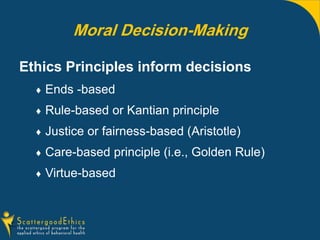
Ethics Principles inform decisions
♦ Ends -based
♦ Rule-based or Kantian principle
♦ Justice or fairness-based (Aristotle)
♦ Care-based principle (i.e., Golden Rule)
♦ Virtue-based
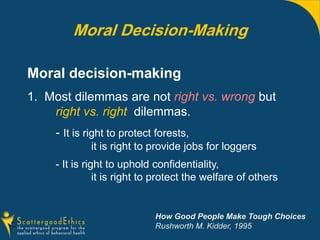
Moral decision-making
1. Most dilemmas are not right vs. wrong but
right vs. right dilemmas.
- It is right to protect forests,
it is right to provide jobs for loggers
- It is right to uphold confidentiality,
it is right to protect the welfare of others
How Good People Make Tough Choices
Rushworth M. Kidder, 1995
Moral Decision-Making
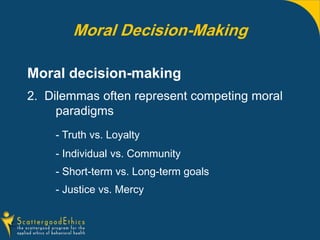
Moral decision-making
2. Dilemmas often represent competing moral
paradigms
- Truth vs. Loyalty
- Individual vs. Community
- Short-term vs. Long-term goals
- Justice vs. Mercy
Moral Decision-Making
I. Standards-based model
Based on the assumption that rules, laws, &
policies provide the best basis for determining
action.
♦ Determine primary dilemma
♦ Spell out ethical standards for response
♦ Determine if there is a reason to deviate
♦ Decide on course of action
Moral Decision-Making
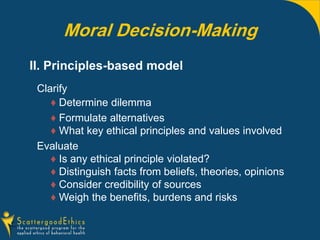
II. Principles-based model
Clarify
♦ Determine dilemma
♦ Formulate alternatives
♦ What key ethical principles and values involved
Evaluate
♦ Is any ethical principle violated?
♦ Distinguish facts from beliefs, theories, opinions
♦ Consider credibility of sources
♦ Weigh the benefits, burdens and risks
Moral Decision-Making
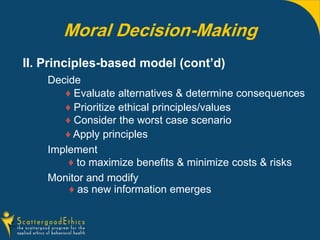
II. Principles-based model (cont’d)
Decide
♦ Evaluate alternatives & determine consequences
♦ Prioritize ethical principles/values
♦ Consider the worst case scenario
♦ Apply principles
Implement
♦ to maximize benefits & minimize costs & risks
Monitor and modify
♦ as new information emerges
Moral Decision-Making
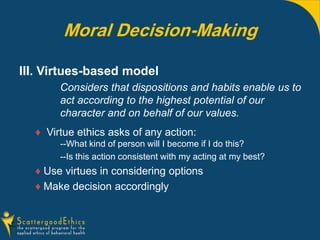
III. Virtues-based model
Considers that dispositions and habits enable us to
act according to the highest potential of our
character and on behalf of our values.
♦ Virtue ethics asks of any action:
--What kind of person will I become if I do this?
--Is this action consistent with my acting at my best?
♦ Use virtues in considering options
♦ Make decision accordingly
Moral Decision-Making
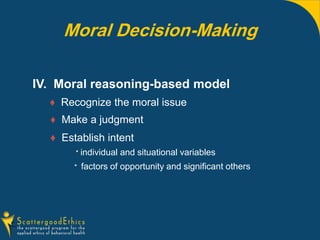
IV. Moral reasoning-based model
♦ Recognize the moral issue
♦ Make a judgment
♦ Establish intent
* individual and situational variables
* factors of opportunity and significant others
Moral Decision-Making
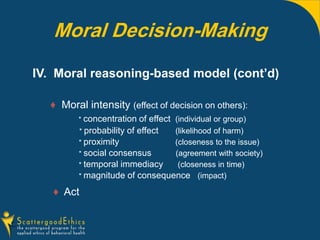
IV. Moral reasoning-based model (cont’d)
♦ Moral intensity (effect of decision on others):
* concentration of effect (individual or group)
* probability of effect (likelihood of harm)
* proximity (closeness to the issue)
* social consensus (agreement with society)
* temporal immediacy (closeness in time)
* magnitude of consequence (impact)
♦ Act
Moral Decision-Making
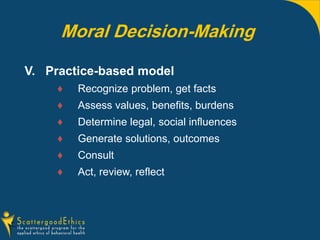
V. Practice-based model
♦ Recognize problem, get facts
♦ Assess values, benefits, burdens
♦ Determine legal, social influences
♦ Generate solutions, outcomes
♦ Consult
♦ Act, review, reflect
Moral Decision-Making
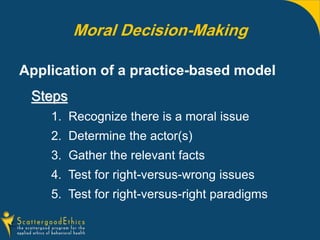
Application of a practice-based model
Steps
1. Recognize there is a moral issue
2. Determine the actor(s)
3. Gather the relevant facts
4. Test for right-versus-wrong issues
5. Test for right-versus-right paradigms
Moral Decision-Making
Steps
6. Determine resolution principles involved
• Ends-based
• Rule-based or Kantian principle
• Justice or fairness-based
• Care-based principle
• Virtue-based
7. Investigate possibilities for action: “trilemma”
Moral Decision-Making
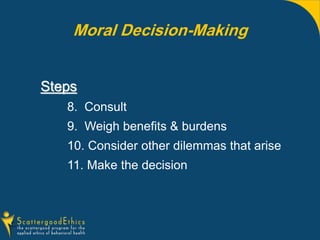
Steps
8. Consult
9. Weigh benefits & burdens
10. Consider other dilemmas that arise
11. Make the decision
Moral Decision-Making
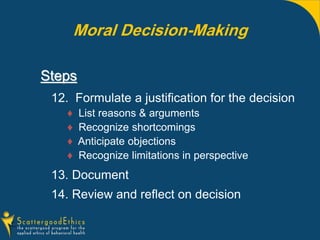
Steps
12. Formulate a justification for the decision
♦ List reasons & arguments
♦ Recognize shortcomings
♦ Anticipate objections
♦ Recognize limitations in perspective
13. Document
14. Review and reflect on decision

Moral decision making

  • 1.
    Moral Decision-Making Marna S.Barrett, Ph.D. Department of Psychiatry University of Pennsylvania School of Medicine
  • 2.
    Moral Decision-Making • Whatis decision-making? • How is moral decision-making different? • Why do we need a model specific to ethics and mental health?
  • 3.
    Moral Decision-Making • Whatis decision-making? – identifying and choosing alternatives based on values and preferences. – process of sufficiently reducing uncertainty and doubt about alternatives to allow a reasonable choice to be made.
  • 4.
    Moral Decision-Making • Howis moral decision-making different? – process for dealing with moral uncertainties – introduces a degree of rationality and rigor into our moral deliberations
  • 5.
    Moral Decision-Making • Whydo we need a model specific to ethics and mental health? – ethical problems require examination through filters (organizational, social, personal, legal) – mental health has unique issues (authority over others, determine social policy, legal influence)
  • 6.
    Organizing Principles ofEthics  Autonomy: right to noninterference, self-determination  Beneficence: mercy, kindness, charity to others  Empathy: experience the experience of others  Fidelity: faithfulness to duties or obligations  Justice: benefits, risks, costs distributed fairly  Nonmaleficience: avoid harm or risk of harm  Universalizability: all moral principles/judgments have universal applicability Moral Decision-Making
  • 7.
    Moral Decision-Making Ethics Principlesinform decisions ♦ Ends -based ♦ Rule-based or Kantian principle ♦ Justice or fairness-based (Aristotle) ♦ Care-based principle (i.e., Golden Rule) ♦ Virtue-based
  • 8.
    Moral decision-making 1. Mostdilemmas are not right vs. wrong but right vs. right dilemmas. - It is right to protect forests, it is right to provide jobs for loggers - It is right to uphold confidentiality, it is right to protect the welfare of others How Good People Make Tough Choices Rushworth M. Kidder, 1995 Moral Decision-Making
  • 9.
    Moral decision-making 2. Dilemmasoften represent competing moral paradigms - Truth vs. Loyalty - Individual vs. Community - Short-term vs. Long-term goals - Justice vs. Mercy Moral Decision-Making
  • 10.
    I. Standards-based model Basedon the assumption that rules, laws, & policies provide the best basis for determining action. ♦ Determine primary dilemma ♦ Spell out ethical standards for response ♦ Determine if there is a reason to deviate ♦ Decide on course of action Moral Decision-Making
  • 11.
    II. Principles-based model Clarify ♦Determine dilemma ♦ Formulate alternatives ♦ What key ethical principles and values involved Evaluate ♦ Is any ethical principle violated? ♦ Distinguish facts from beliefs, theories, opinions ♦ Consider credibility of sources ♦ Weigh the benefits, burdens and risks Moral Decision-Making
  • 12.
    II. Principles-based model(cont’d) Decide ♦ Evaluate alternatives & determine consequences ♦ Prioritize ethical principles/values ♦ Consider the worst case scenario ♦ Apply principles Implement ♦ to maximize benefits & minimize costs & risks Monitor and modify ♦ as new information emerges Moral Decision-Making
  • 13.
    III. Virtues-based model Considersthat dispositions and habits enable us to act according to the highest potential of our character and on behalf of our values. ♦ Virtue ethics asks of any action: --What kind of person will I become if I do this? --Is this action consistent with my acting at my best? ♦ Use virtues in considering options ♦ Make decision accordingly Moral Decision-Making
  • 14.
    IV. Moral reasoning-basedmodel ♦ Recognize the moral issue ♦ Make a judgment ♦ Establish intent * individual and situational variables * factors of opportunity and significant others Moral Decision-Making
  • 15.
    IV. Moral reasoning-basedmodel (cont’d) ♦ Moral intensity (effect of decision on others): * concentration of effect (individual or group) * probability of effect (likelihood of harm) * proximity (closeness to the issue) * social consensus (agreement with society) * temporal immediacy (closeness in time) * magnitude of consequence (impact) ♦ Act Moral Decision-Making
  • 16.
    V. Practice-based model ♦Recognize problem, get facts ♦ Assess values, benefits, burdens ♦ Determine legal, social influences ♦ Generate solutions, outcomes ♦ Consult ♦ Act, review, reflect Moral Decision-Making
  • 17.
    Moral Decision-Making Application ofa practice-based model Steps 1. Recognize there is a moral issue 2. Determine the actor(s) 3. Gather the relevant facts 4. Test for right-versus-wrong issues 5. Test for right-versus-right paradigms
  • 18.
    Moral Decision-Making Steps 6. Determineresolution principles involved • Ends-based • Rule-based or Kantian principle • Justice or fairness-based • Care-based principle • Virtue-based 7. Investigate possibilities for action: “trilemma”
  • 19.
    Moral Decision-Making Steps 8. Consult 9.Weigh benefits & burdens 10. Consider other dilemmas that arise 11. Make the decision
  • 20.
    Moral Decision-Making Steps 12. Formulatea justification for the decision ♦ List reasons & arguments ♦ Recognize shortcomings ♦ Anticipate objections ♦ Recognize limitations in perspective 13. Document 14. Review and reflect on decision

Editor's Notes

  • #7 Ends-Based: act utilitarian: actions justify the means, rule utilitarian: Justice or Fairness-based model: While respecting and valuing the freedom of individuals to pursue their own goals, the common-good approach challenges us also to recognize and further those goals we share in common. Virtue-base model: In dealing with an ethical problem using the virtue approach, we might ask, What kind of person should I be? What will promote the development of character within myself and my community?
  • #10 - Truth vs. Loyalty (duty to courts --- duty to patients) - Individual vs. Community (self needs --- patient needs) - Short-term vs. Long-term goals (work demands --- family demands) - Justice vs. Mercy (respect for automony --- respect for others)
  • #15 Virtues: Autonomy: right to noninterference, self-determination Beneficence: mercy, kindness, charity to others Empathy: experience the experience of others Fidelity: faithfulness to duties or obligations (competence) Justice: benefits, risks, costs distributed fairly Nonmaleficience: avoid harm or risk of harm Universalizability: all moral principles/judgments have universal applicability
  • #16 Virtues: Autonomy: right to noninterference, self-determination Beneficence: mercy, kindness, charity to others Empathy: experience the experience of others Fidelity: faithfulness to duties or obligations (competence) Justice: benefits, risks, costs distributed fairly Nonmaleficience: avoid harm or risk of harm Universalizability: all moral principles/judgments have universal applicability
  • #18 3. Facts: who, what, where, when. Do I even need to be involved? 4. Right vs wrong: stench test, front-page test, Mom test 5. Right vs right: (1) truth vs. loyalty, (2) self vs. community, (3) short-term vs. long-term, (4) justice vs. mercy What values are influencing the problem?
  • #19 Resolution principles: ends justify means, would I want rule established based on my behavior, what is fair & just do to others how I would want to be treated what are the values I hold important