LESSON 3
Responsible Use of
Media and
Information
It is undeniable that media, in all its various forms, have helped
society advance and progress. In fact, media have aided in shaping
the world’s social, cultural, political, and economic landscape to what
it is today. The rise of technological advances have also changed the
way media is consumed and produced. These innovations created a
faster and much free- flowing movement of information and
communication such as allowing easier connection to people around
the globe, opening more opportunities for sharing of ideas, and
creating more outlets for us to share our thoughts and opinions.
Introduction
However, although media has brought about many
benefits, it also has its fair share of disadvantages.
Moreover, the more we immerse ourselves in mediated
communication, the more we lose touch of the meaning,
value, and authenticity of human interaction. Thus, it is
important to inculcate the proper use of media and
information so as to maximize its benefits and not be
overpowered by its downsides.
Introduction
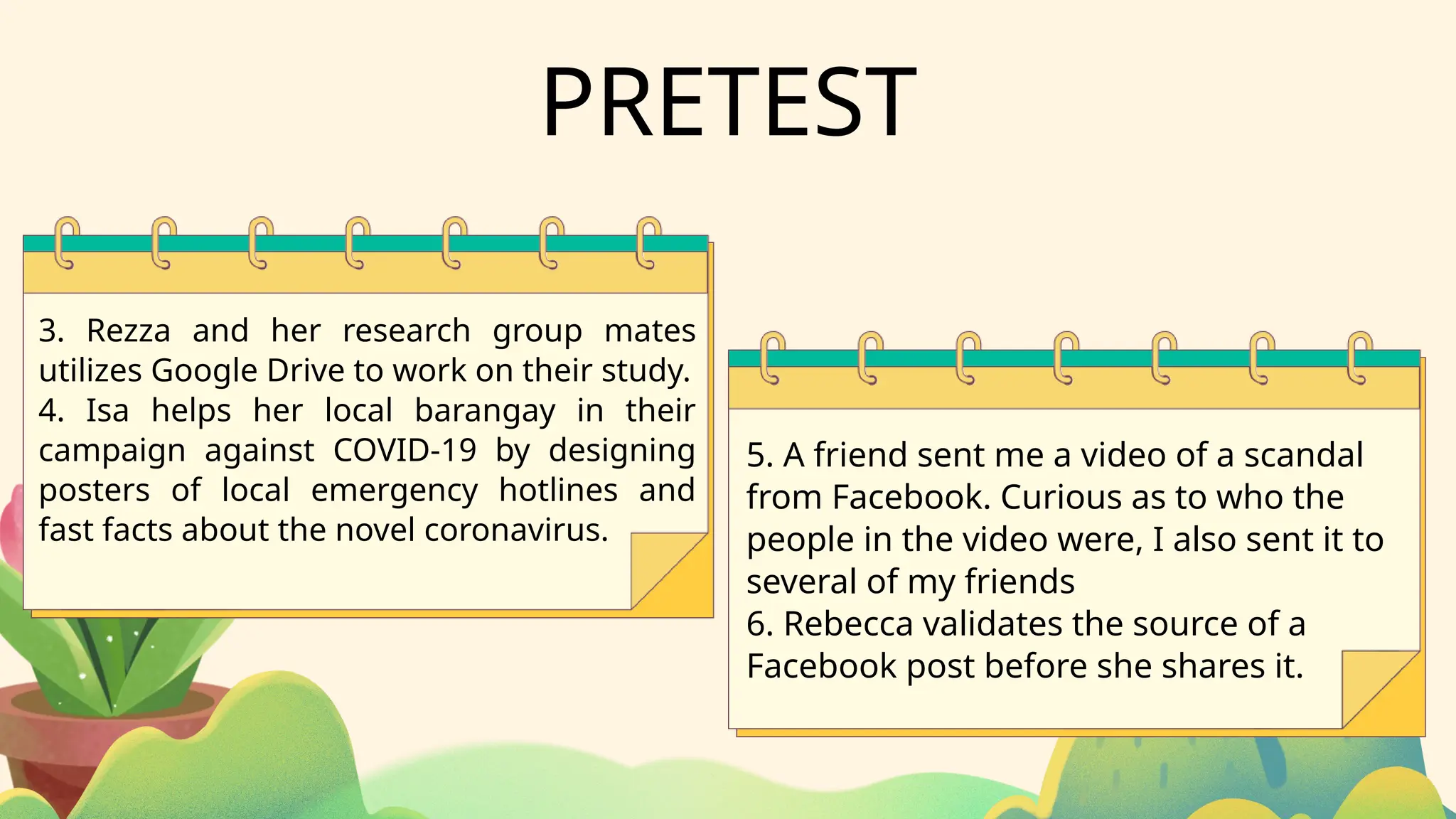
PRETEST
1. Kim checks the truthfulness of the news she sees
online by looking into other news outlets for the
same content.
2. Kristoffer’s Facebook friend sent him through FB
messenger a forwarded message about an
upcoming 7.8 earthquake in their locality. Rattled,
he also forwarded the unverified message to his
family’s group chats, warning them of such quake.
Before we continue, answer the short test
below to see how much you know about the
next lesson. Analyze each statement. Write Y
for YES if you think the statement shows
responsible use of media and information.
Write N for No if you think otherwise.
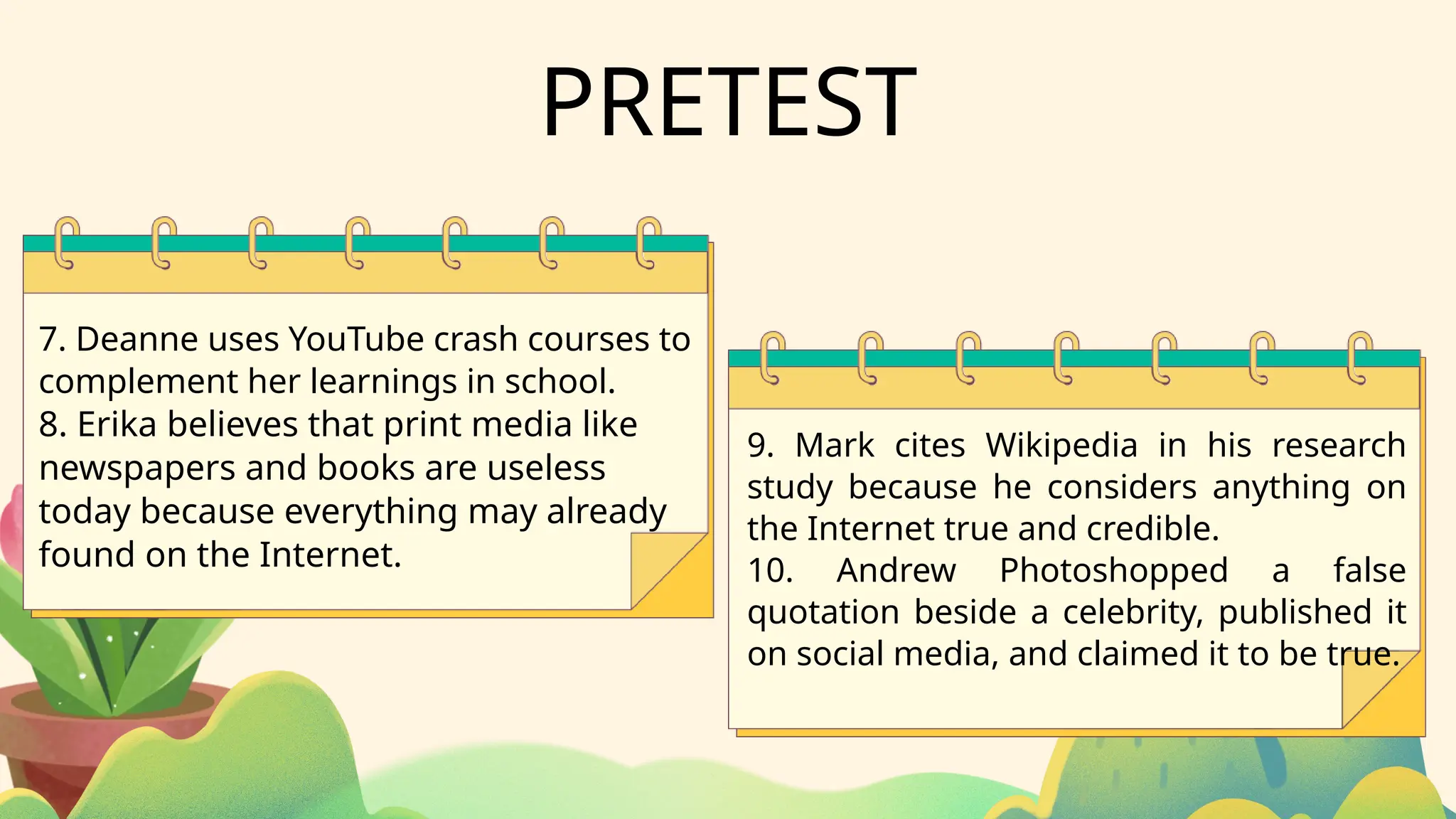
PRETEST
3. Rezza and her research group mates
utilizes Google Drive to work on their study.
4. Isa helps her local barangay in their
campaign against COVID-19 by designing
posters of local emergency hotlines and
fast facts about the novel coronavirus.
5. A friend sent me a video of a scandal
from Facebook. Curious as to who the
people in the video were, I also sent it to
several of my friends
6. Rebecca validates the source of a
Facebook post before she shares it.
PRETEST
7. Deanne uses YouTube crash courses to
complement her learnings in school.
8. Erika believes that print media like
newspapers and books are useless
today because everything may already
found on the Internet.
9. Mark cites Wikipedia in his research
study because he considers anything on
the Internet true and credible.
10. Andrew Photoshopped a false
quotation beside a celebrity, published it
on social media, and claimed it to be true.
WHAT’S IN
(REVIEW)
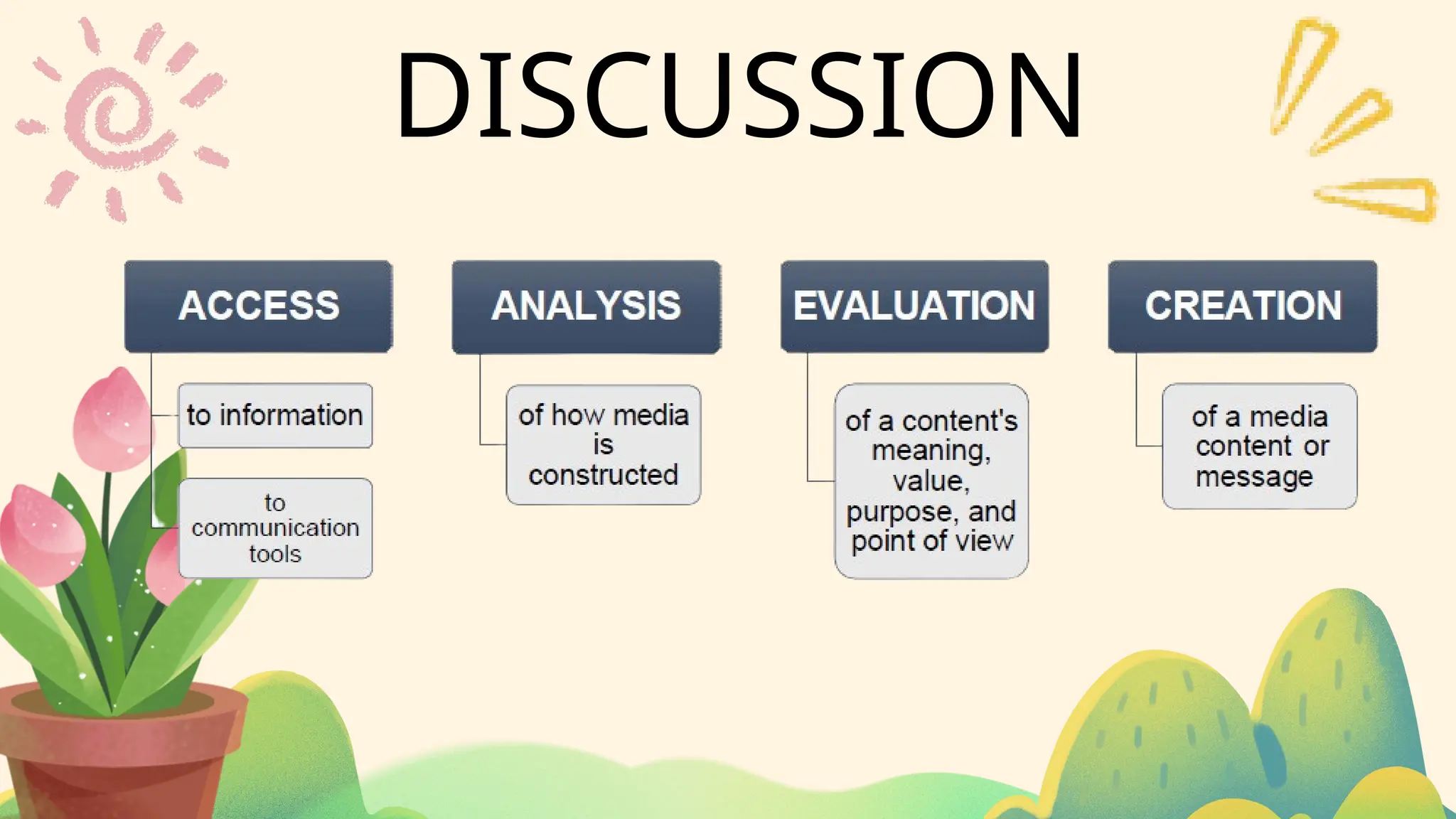
In Lesson 2, you have learned the definitions of Media Literacy,
Information Literacy, and Technology Literacy. When you
understand and use various media forms to access
information, you consider yourself media literate. When you
are able to recognize when information is most needed and is
knowledgeable on how to locate, evaluate, use, and share it in
different forms, you are information literate. And lastly, when
you are digitally literate, you are able to utilize different digital
technologies and communication tools or networks to manage
information.
Activity 3.1: Media Interaction
Log
Try to think of your media consumption during the past
week. In the table below, record your use and interaction
with media and information providers (such as internet,
social media, TV, radio, newspaper, etc.) and indicate how
many hours were spent engaged with each one.
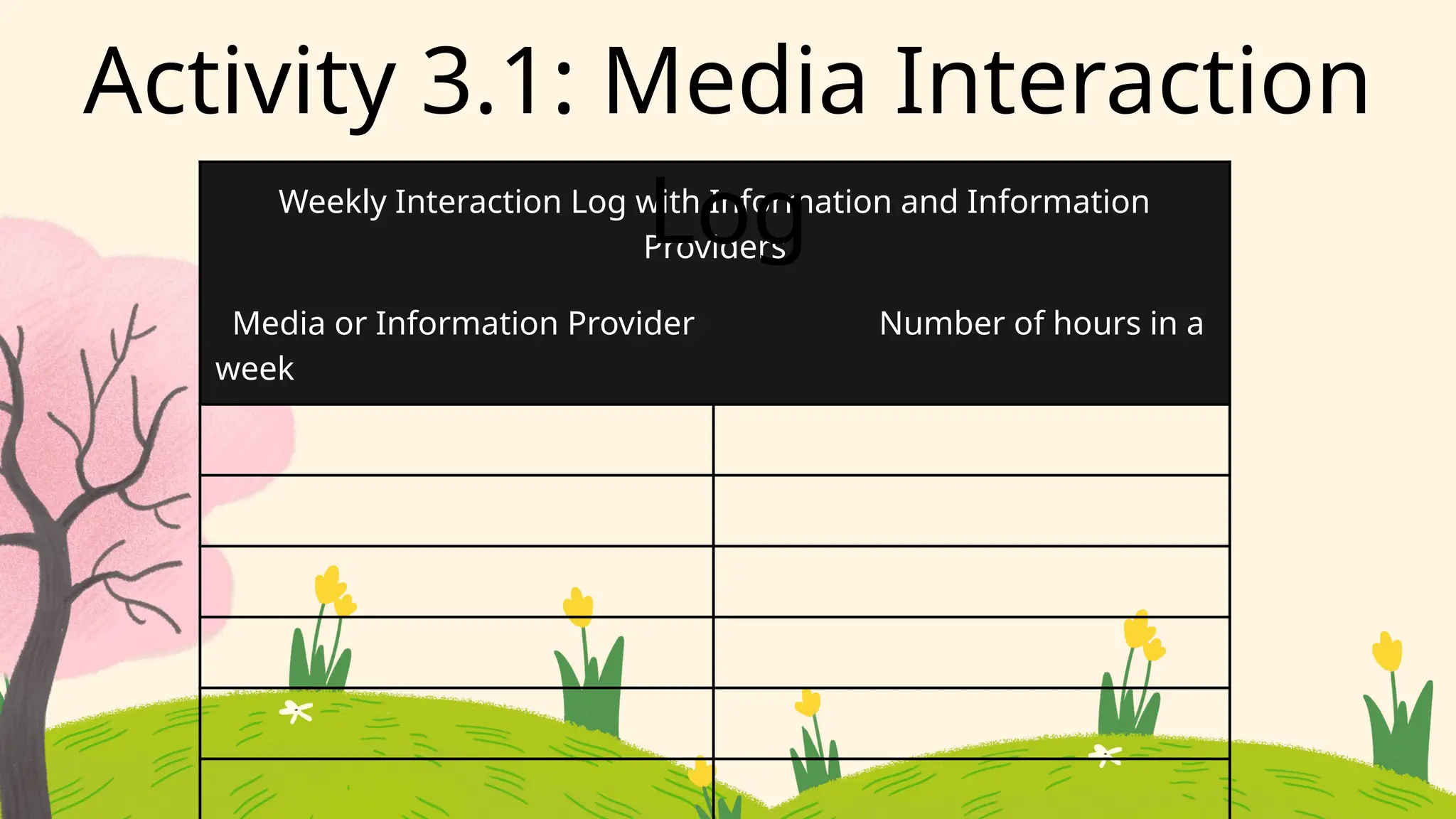
Weekly Interaction Log with Information and Information
Providers
Media or Information Provider Number of hours in a
week
Activity 3.1: Media Interaction
Log
From the moment you wake up to the time you
fall asleep, you are, in one way or another,
exposed to all media you listed above, and
actually even more. Wherever you go, you see
and hear all forms of it and you may even be
consuming media unconsciously.
DISCUSSIO
N
Unfortunately, there is a sad reality about media and
information consumption in today’s society: Information
Disorder. Information Disorder refers to the many ways our
information environment is polluted – content are fake, used
out of context, or weaponized to attack certain individuals or
groups of people. Understanding this landscape is the first step
towards better and responsible use of media and information.
DISCUSSIO
N
The Information Disorder
There are three categories of Information Disorder: Misinformation,
Disinformation, and Mal-information.
1. Misinformation – refers to information that is false, but the person
sharing or disseminating it unknowingly perceives it as something
true.
A. False connection – when headlines or visuals do not support the
content
B. Misleading content - by cropping photos or choosing quotes or
statistics selectively
DISCUSSION
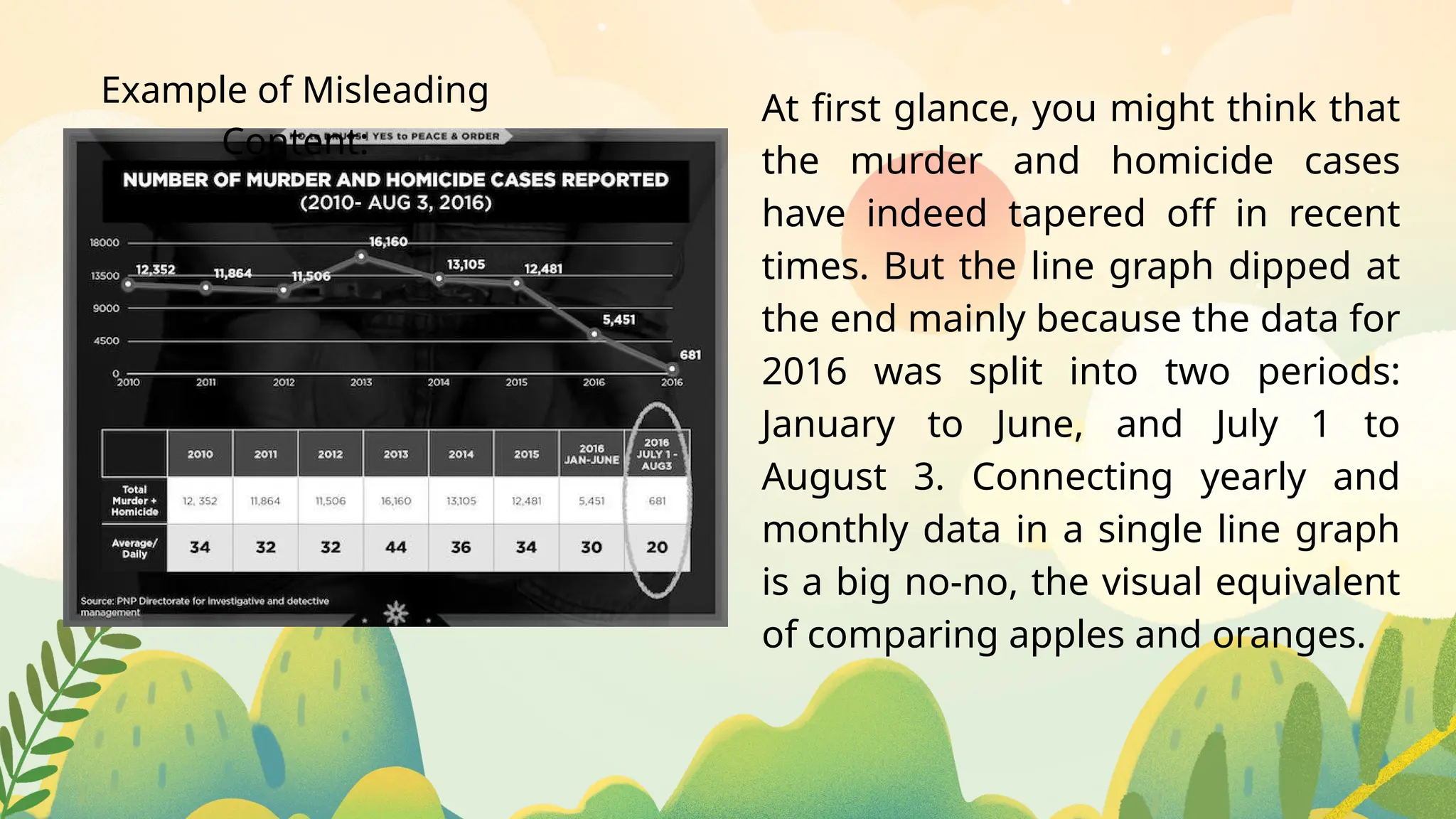
Example of Misleading
Content:
At first glance, you might think that
the murder and homicide cases
have indeed tapered off in recent
times. But the line graph dipped at
the end mainly because the data for
2016 was split into two periods:
January to June, and July 1 to
August 3. Connecting yearly and
monthly data in a single line graph
is a big no-no, the visual equivalent
of comparing apples and oranges.
2. Disinformation – refers to content that contains false information with
the deliberate intention to mislead or deceive the audience.
A. False context – when genuine content is re-circulated out of its original
context
B. Imposter content – persons’ bylines used alongside articles they did not
write, or organizations’ logos used in videos or images they did not create
C. Manipulated content – when genuine content is manipulated to deceive
D. Fabricated content – fabricated “news sites” or fabricated visual
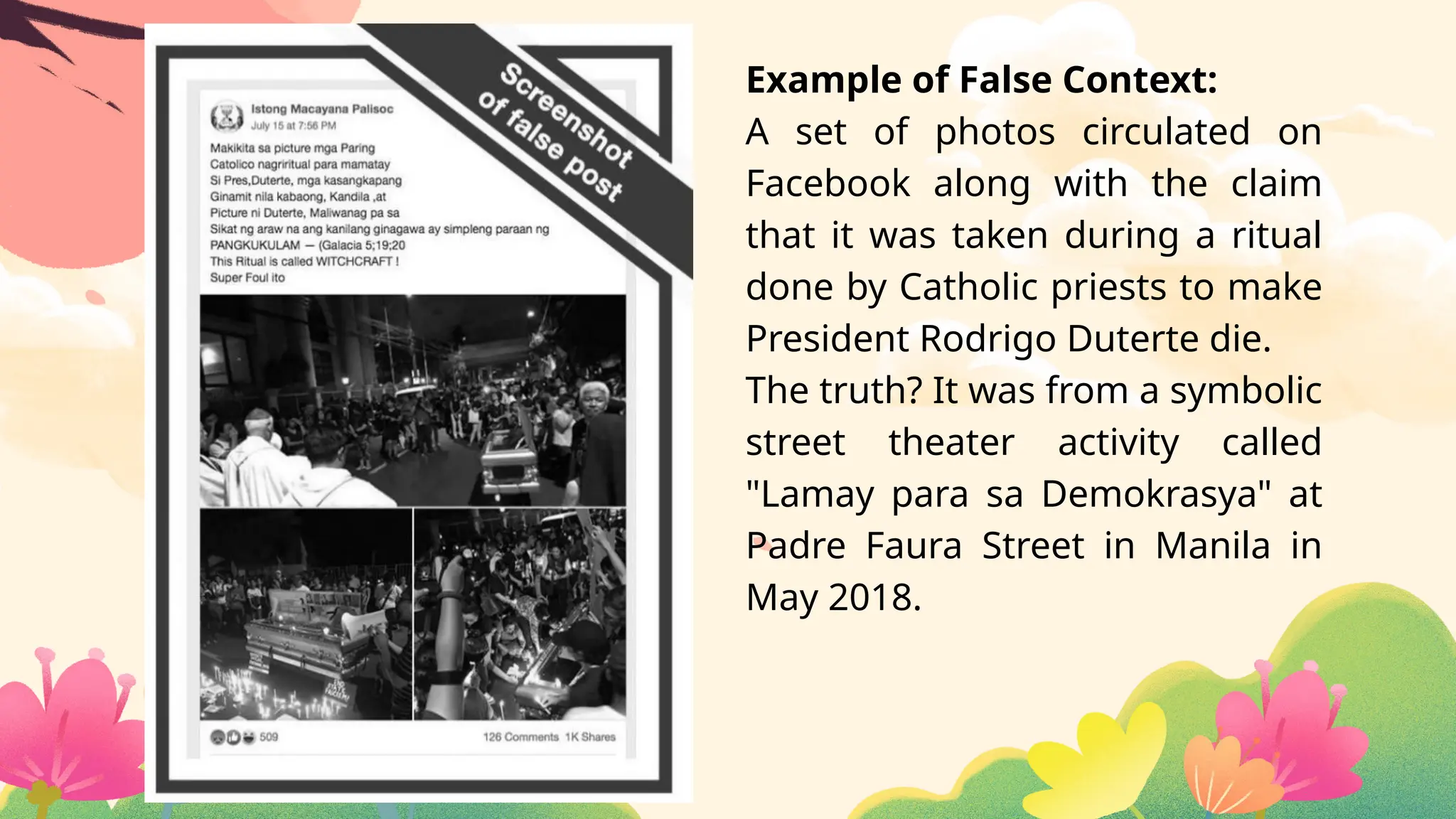
Example of False Context:
A set of photos circulated on
Facebook along with the claim
that it was taken during a ritual
done by Catholic priests to make
President Rodrigo Duterte die.
The truth? It was from a symbolic
street theater activity called
"Lamay para sa Demokrasya" at
Padre Faura Street in Manila in
May 2018.
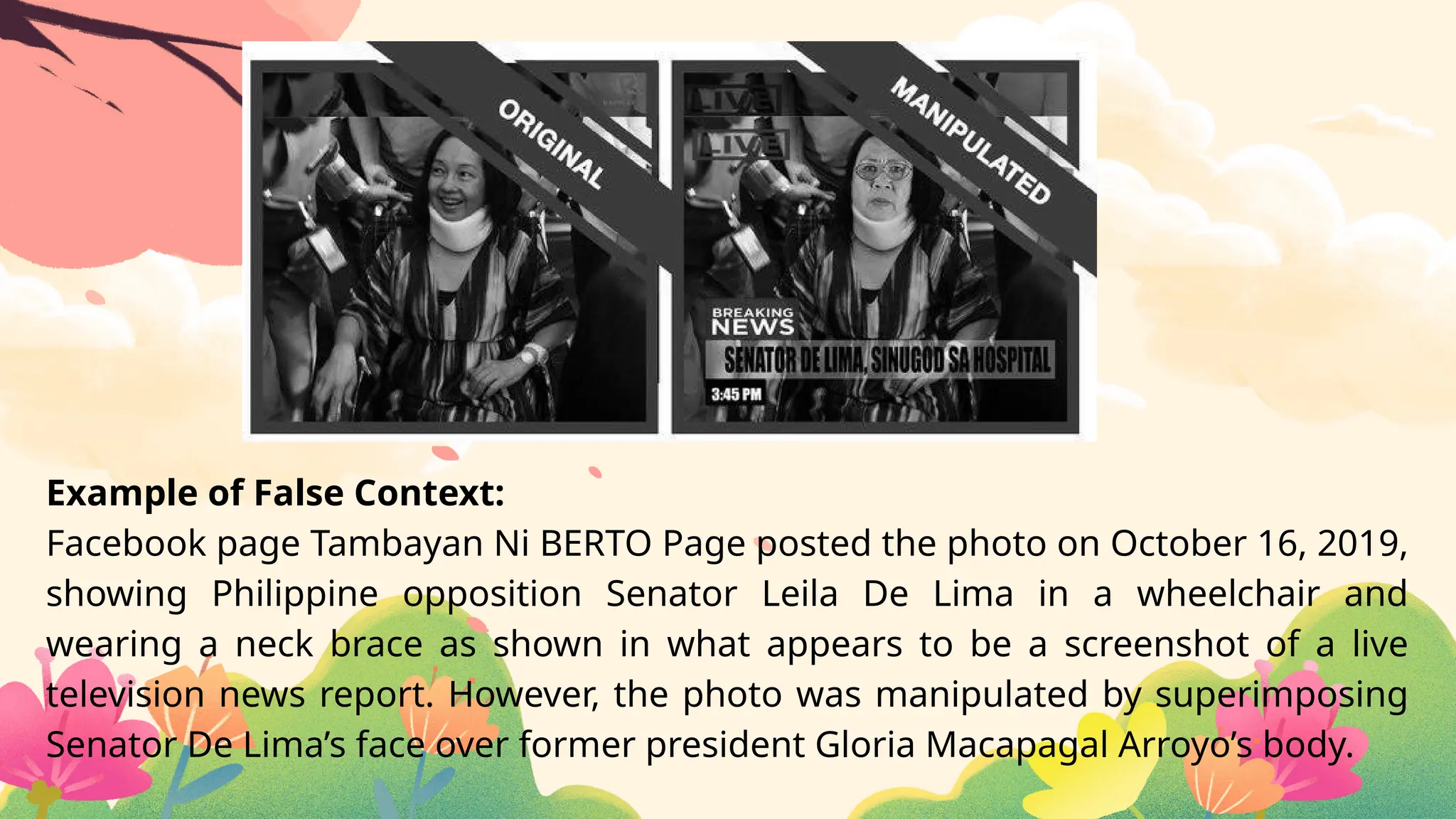
Example of False Context:
Facebook page Tambayan Ni BERTO Page posted the photo on October 16, 2019,
showing Philippine opposition Senator Leila De Lima in a wheelchair and
wearing a neck brace as shown in what appears to be a screenshot of a live
television news report. However, the photo was manipulated by superimposing
Senator De Lima’s face over former president Gloria Macapagal Arroyo’s body.
3. Mal-information – refers to information that is based on reality but is used to
inflict harm.
Examples:
A. Leaks to the press of private information for personal or corporate interest
(e.g. revenge porn)
B. Using a picture (e.g. of a dead child, with no context or false context) in an effort to
ignite hatred of a particular ethnic group
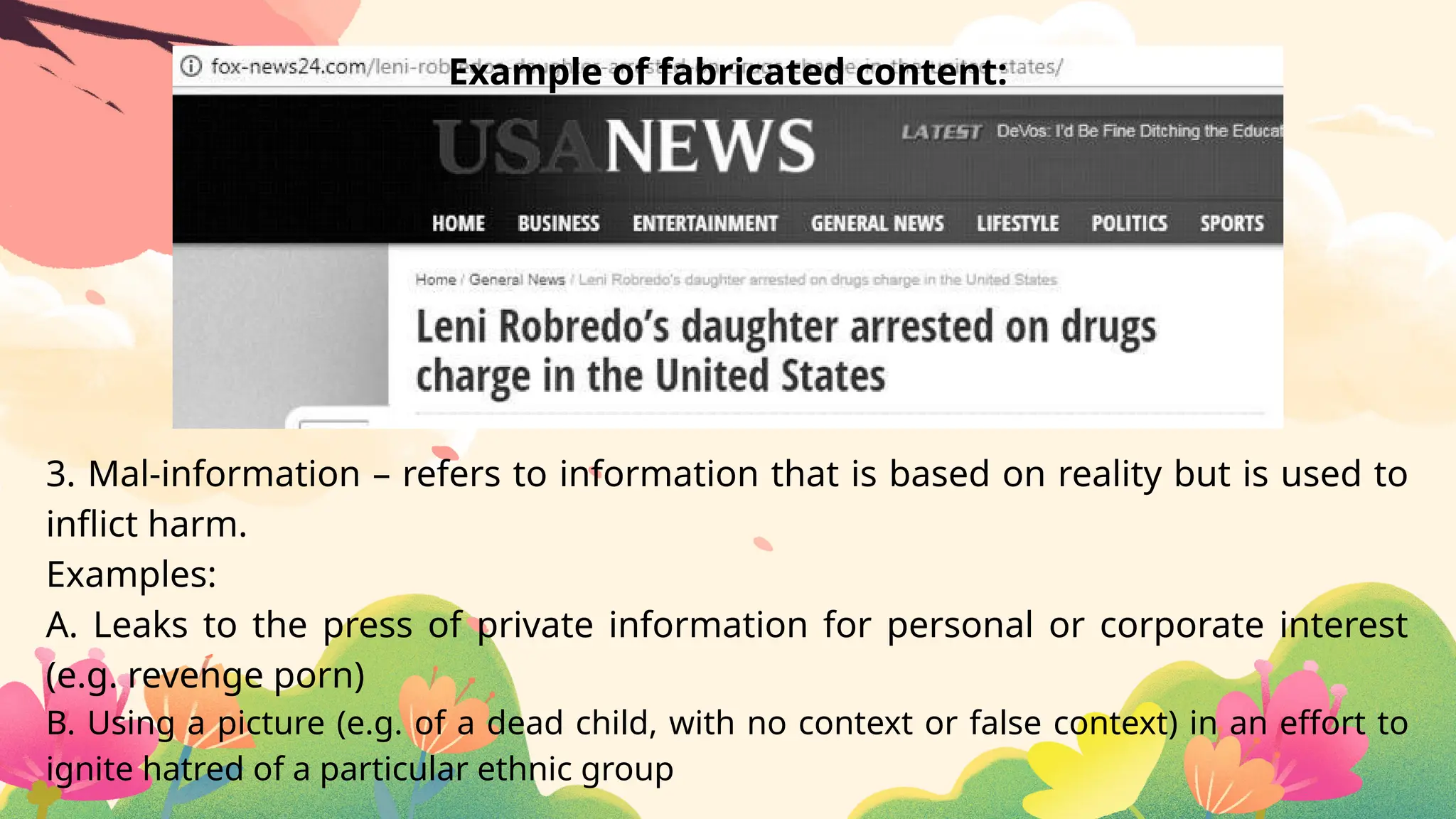
Example of fabricated content:
At first glance, you might think that the murder and
homicide cases have indeed tapered off in recent times. But
the line graph dipped at the end mainly because the data for
2016 was split into two periods: January to June, and July 1 to
August 3. Connecting yearly and monthly data in a single
line graph is a big no-no, the visual equivalent of comparing
apples and oranges.
Because Information Disorder is prevalent in this times, the need
to inculcate and practice the responsible use of media and
information is of utmost importance. As media is very much
embedded in our lives, it is important that we must learn the skills
on how to responsibly and wisely use these information and
media tools at our disposal. Moreover, we must understand that
how we use media and information can also affect the people we
know, our community, and the society in general
7 MIL skills that you, as a media user and
producer, should develop:
In the Information Age, the need to
emphasize on other essential skills also
arises. As we are bombarded with media
and information that we are compelled to
deconstruct and evaluate, competence and
proficiency in media literacy are already
considered life-long learning skills today 1. The ability and willingness to make an
effort to understand content, to pay
attention, and to filter out noise.
DISCUSSION
2. An understanding of and respect for the
power of media messages.
6. A knowledge of genre conventions and
the ability to recognize when they are
being mixed
3. An understanding of and respect for the
power of media messages.
4. Development of heightened expectations
of media content. 7. A knowledge and appreciation of the
internal language of various media and the
ability to understand its effects, no matter
how complex
DISCUSSION
DISCUSSION
DISCUSSION
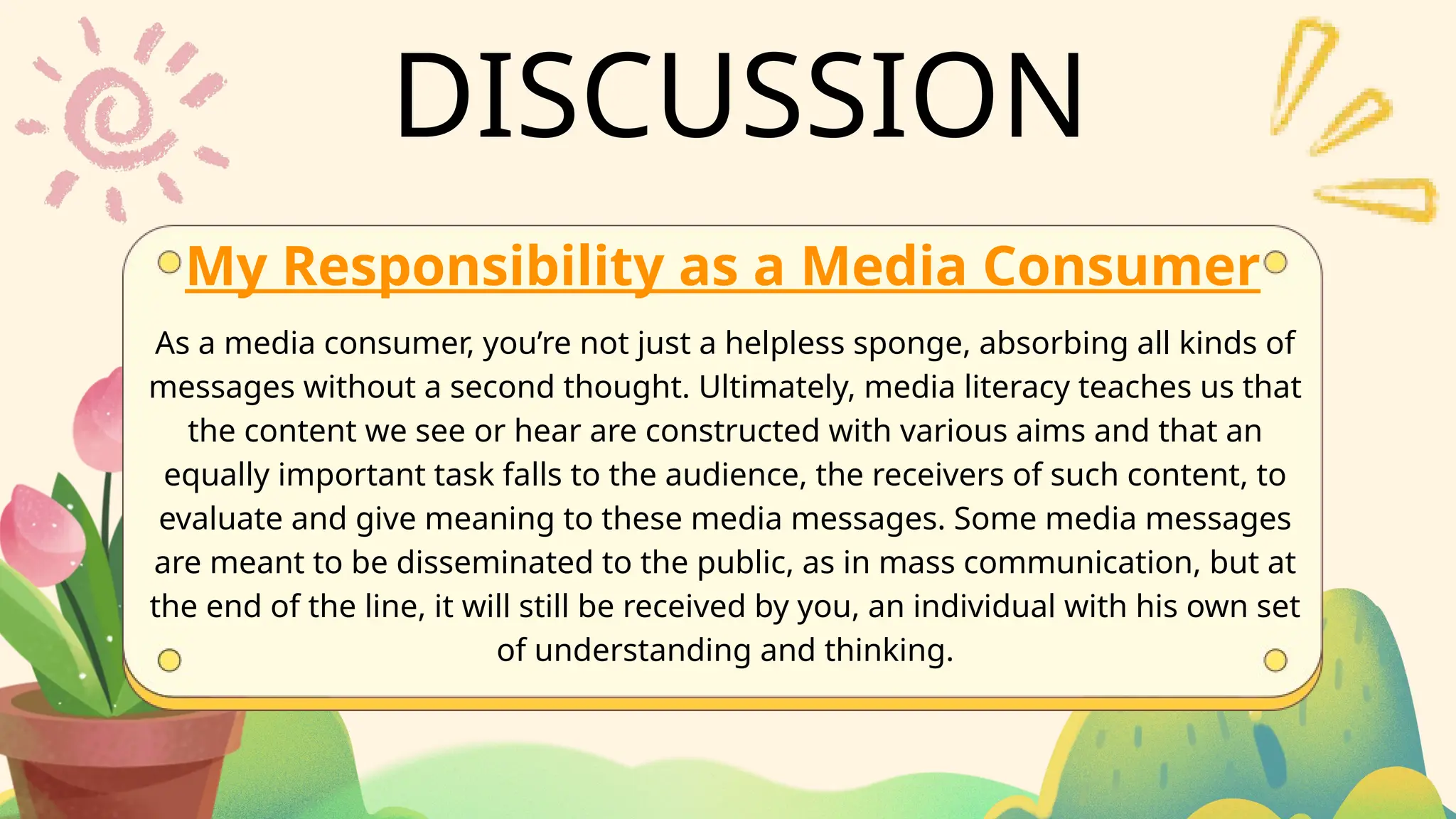
My Responsibility as a Media Consumer
As a media consumer, you’re not just a helpless sponge, absorbing all kinds of
messages without a second thought. Ultimately, media literacy teaches us that
the content we see or hear are constructed with various aims and that an
equally important task falls to the audience, the receivers of such content, to
evaluate and give meaning to these media messages. Some media messages
are meant to be disseminated to the public, as in mass communication, but at
the end of the line, it will still be received by you, an individual with his own set
of understanding and thinking.
DISCUSSION
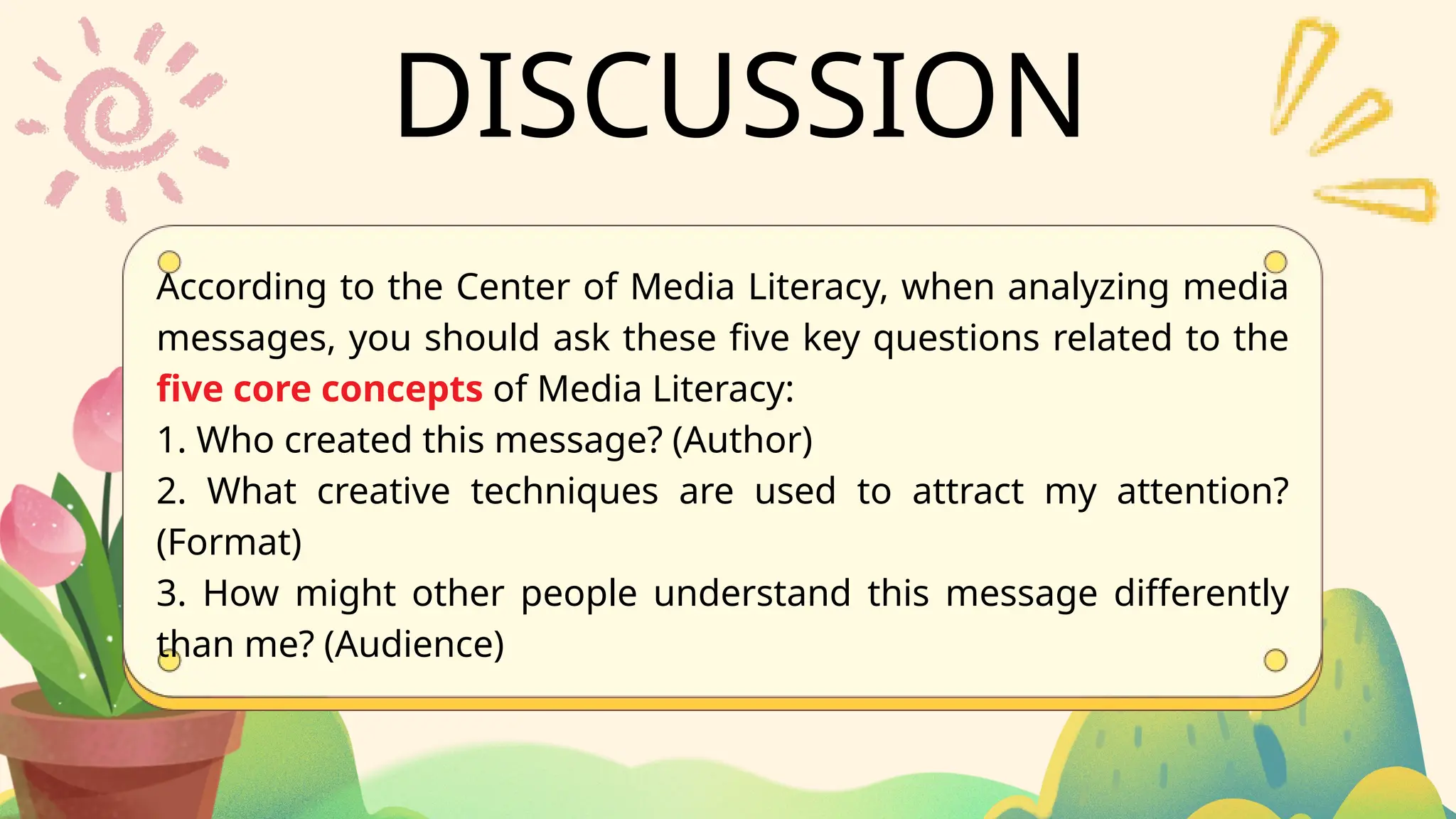
According to the Center of Media Literacy, when analyzing media
messages, you should ask these five key questions related to the
five core concepts of Media Literacy:
1. Who created this message? (Author)
2. What creative techniques are used to attract my attention?
(Format)
3. How might other people understand this message differently
than me? (Audience)
DISCUSSION
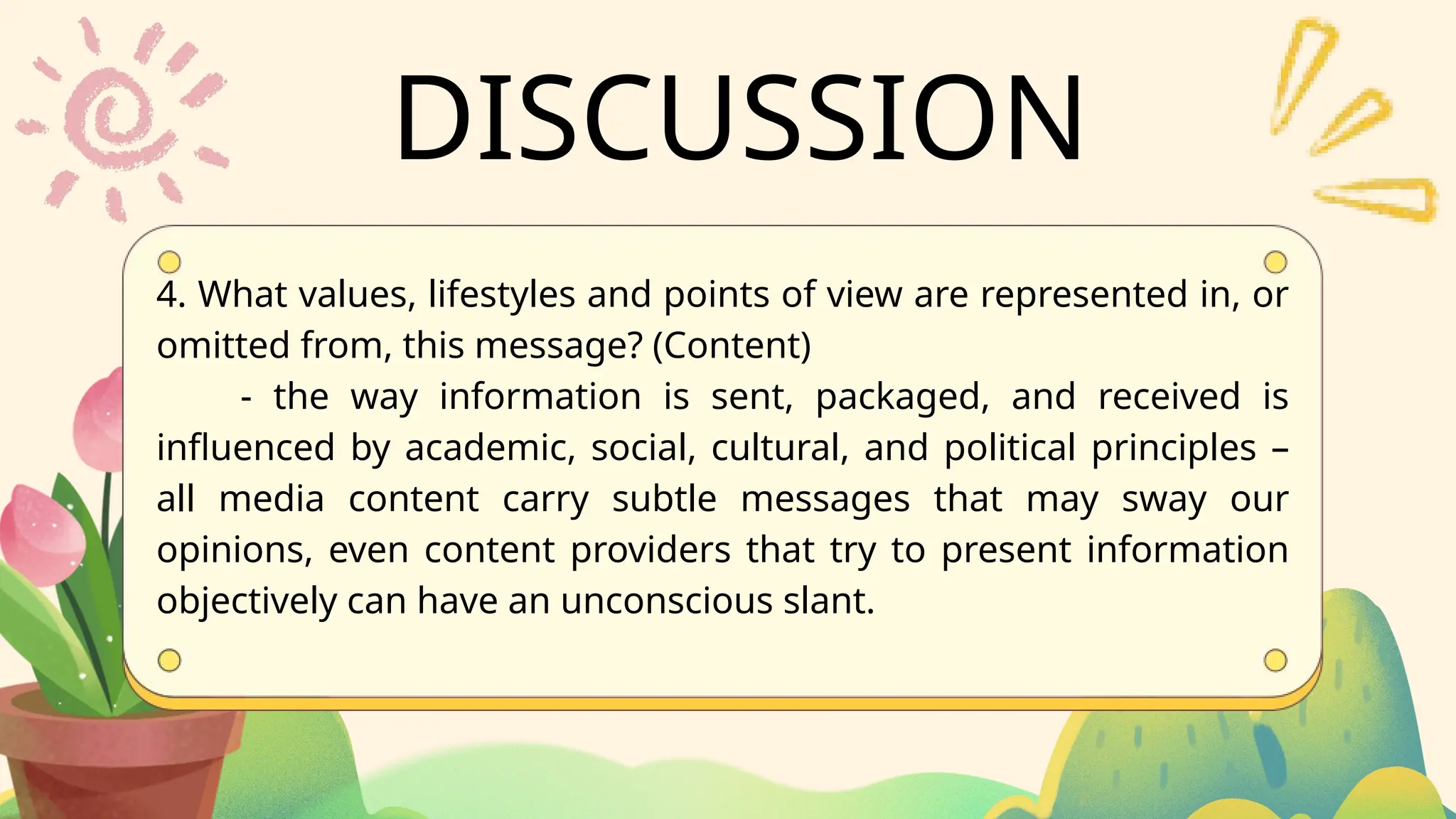
4. What values, lifestyles and points of view are represented in, or
omitted from, this message? (Content)
- the way information is sent, packaged, and received is
influenced by academic, social, cultural, and political principles –
all media content carry subtle messages that may sway our
opinions, even content providers that try to present information
objectively can have an unconscious slant.
DISCUSSION
5. Why is this message being sent? (Purpose)
- Examining the purpose of a message uncovers how it may
have been influenced by money, ego or ideology and gives you
knowledge on how to interpret and respond to a message
appropriately.
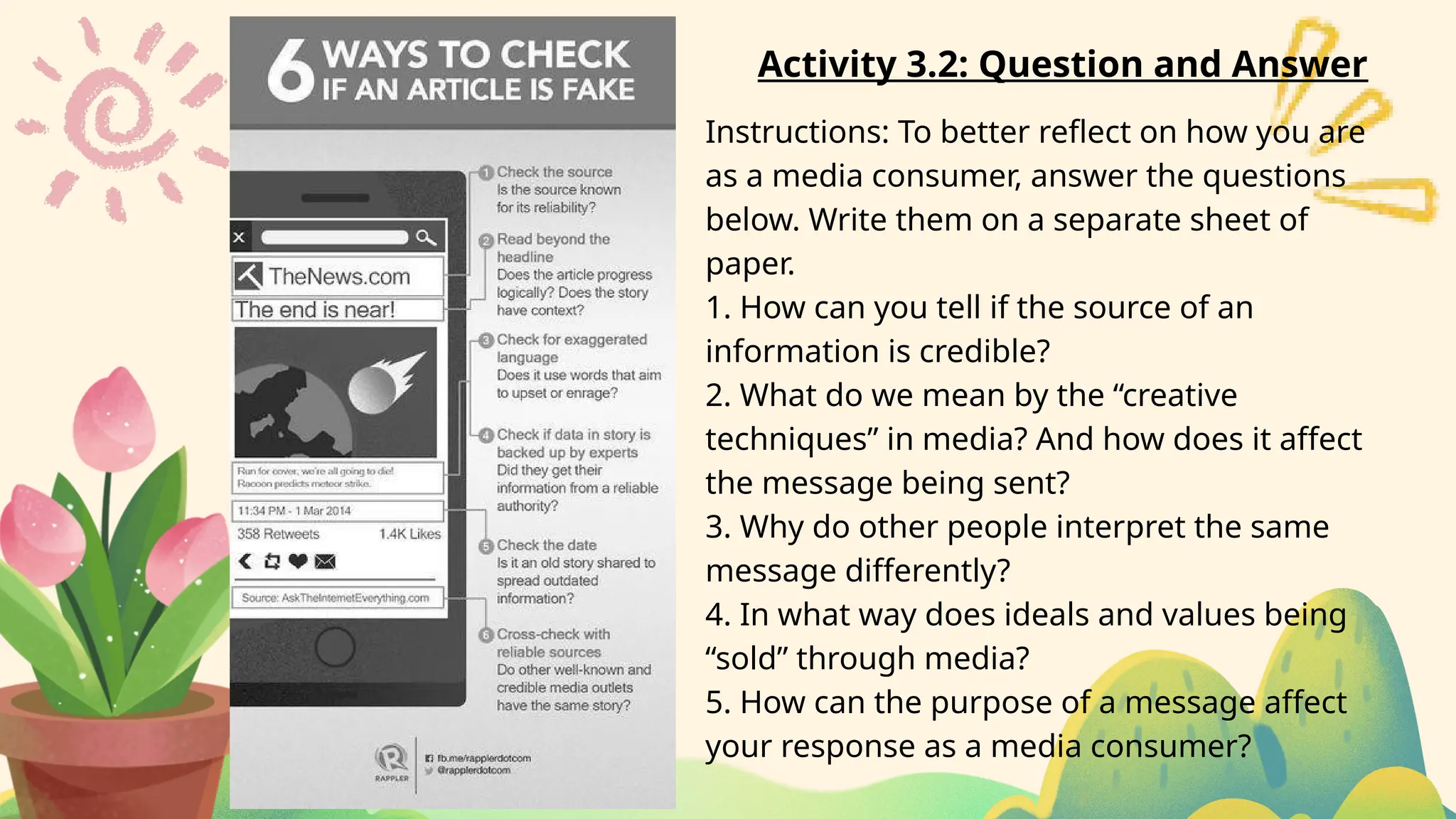
Activity 3.2: Question and Answer
Instructions: To better reflect on how you are
as a media consumer, answer the questions
below. Write them on a separate sheet of
paper.
1. How can you tell if the source of an
information is credible?
2. What do we mean by the “creative
techniques” in media? And how does it affect
the message being sent?
3. Why do other people interpret the same
message differently?
4. In what way does ideals and values being
“sold” through media?
5. How can the purpose of a message affect
your response as a media consumer?
DISCUSSION
My Responsibility as a Media Producer
So what is your role as a media producer? Let’s start with how it is defined. In its
most technical meaning, media producers are described as people who oversee
media projects (like films, TV shows, etc.) from conception to completion and may
also be involved in the marketing and distribution process (Gonzales, 2016).
However, throughout the years, the term has evolved to take in those who
contribute intellectual or creative content through and in media, even including
your Facebook posts, tweets, Instagram photos, or vlogs. Simply put, in today’s
context, media producers are people who are capable of creating and sharing
information through a media channel – that includes you.
DISCUSSION
My Responsibility as a Media Producer
Technological advances in the Digital Age gave tons of people
access to tools for communication and media creation.
However, this opportunity also opened a chance for illegal and
irresponsible making and sharing of media messages. Here,
you will learn your responsibilities as a media and information
literate content producer.
DISCUSSION
1. Give credit where credit is due.
2. Avoid sharing raw and unverified information
3. Think about who can see what you have shared
4. Be open to learning and constructive criticisms
5. Share expert knowledge
6. Respect other people’s privacy
7. Always be respectful
DISCUSSION
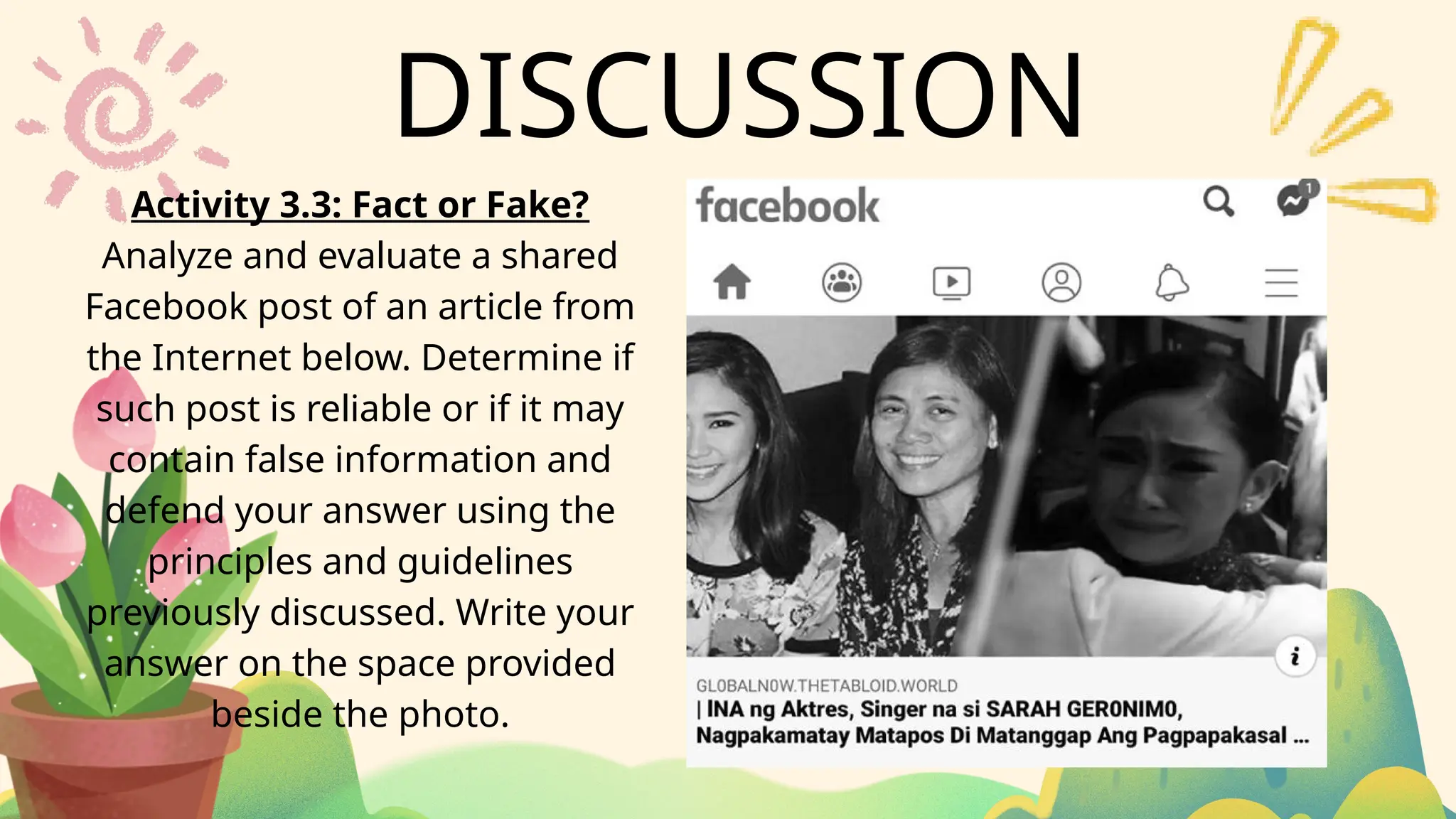
Activity 3.3: Fact or Fake?
Analyze and evaluate a shared
Facebook post of an article from
the Internet below. Determine if
such post is reliable or if it may
contain false information and
defend your answer using the
principles and guidelines
previously discussed. Write your
answer on the space provided
beside the photo.
DISCUSSION
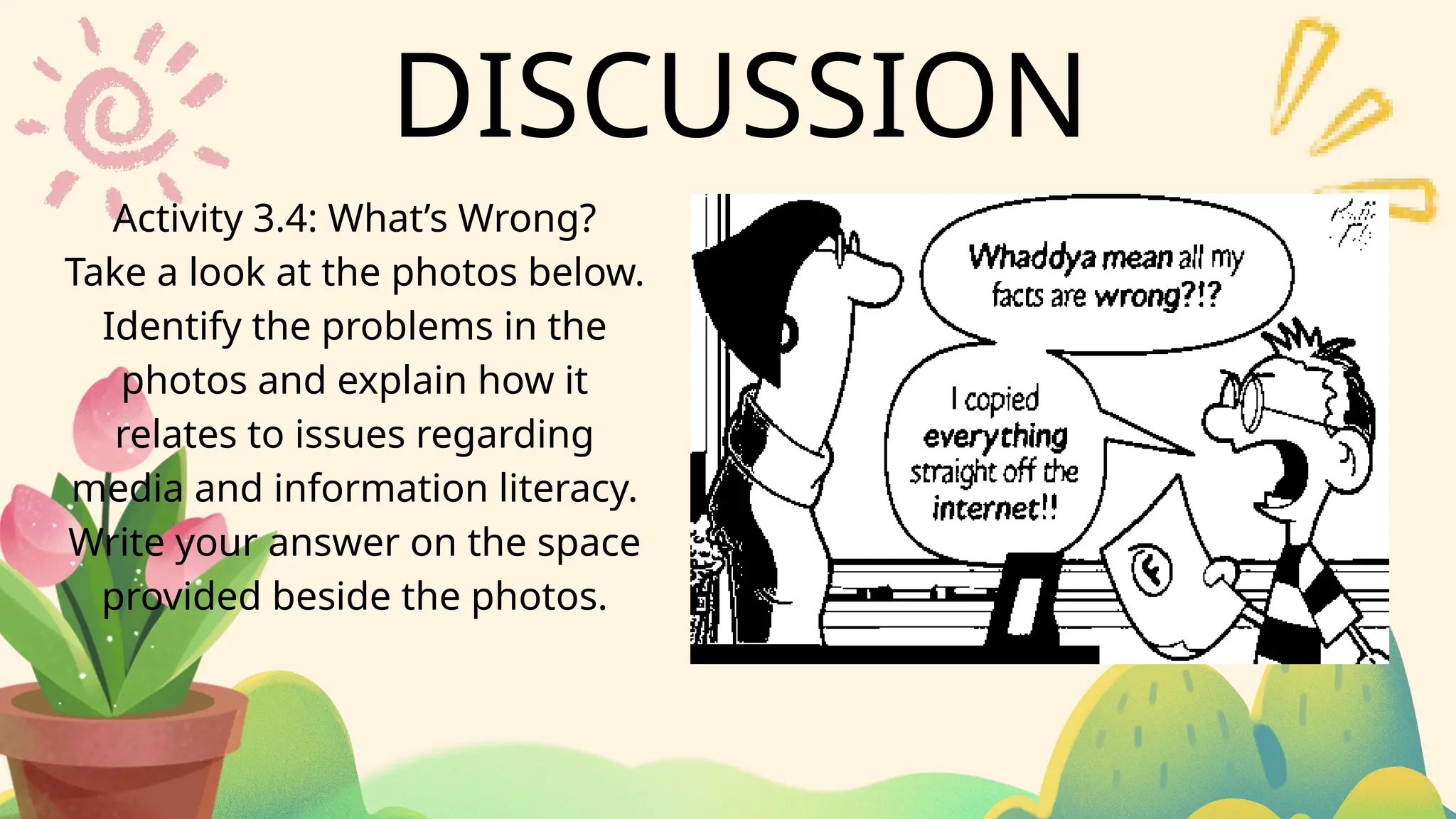
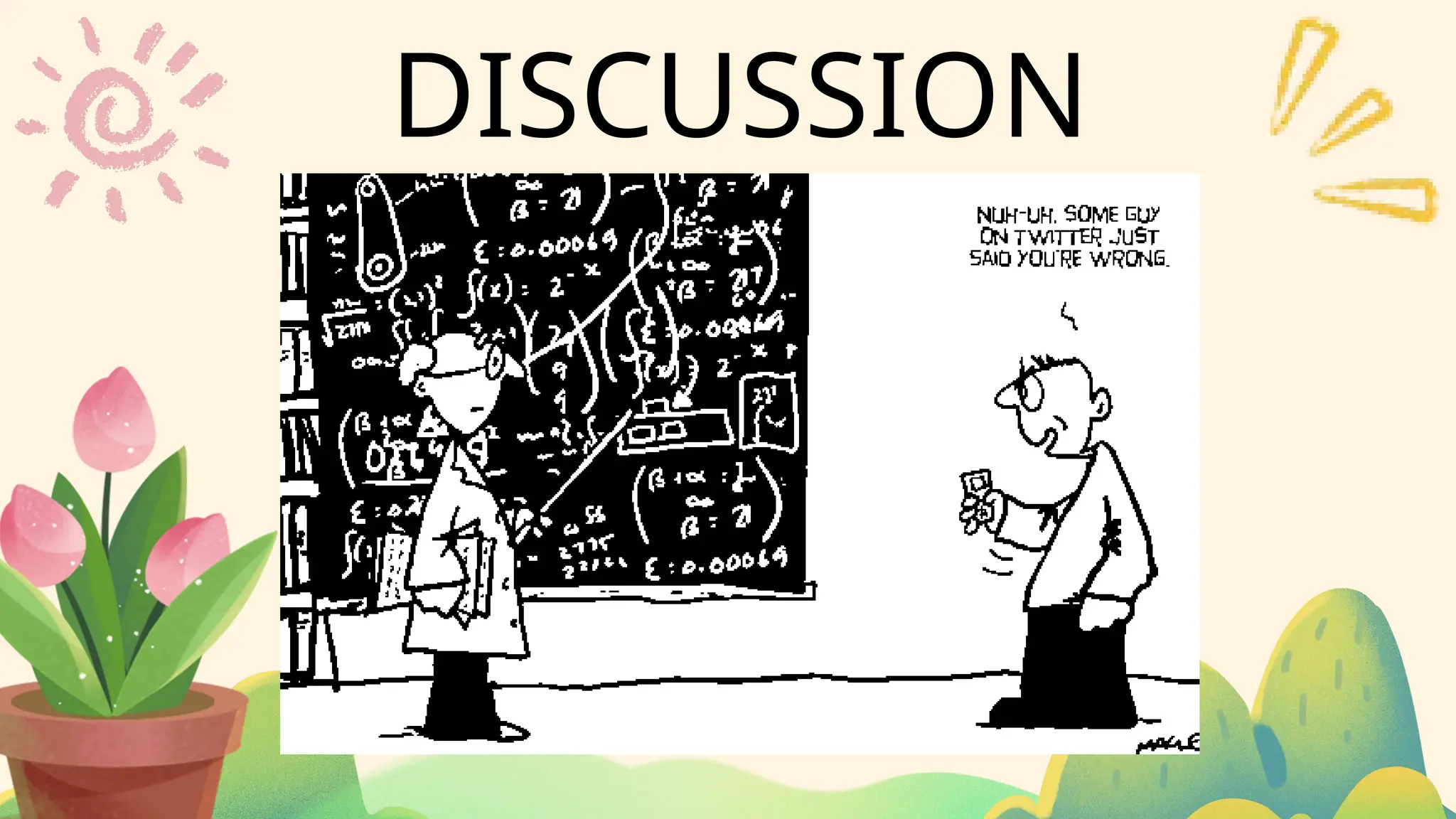
Activity 3.4: What’s Wrong?
Take a look at the photos below.
Identify the problems in the
photos and explain how it
relates to issues regarding
media and information literacy.
Write your answer on the space
provided beside the photos.
DISCUSSION
DISCUSSION
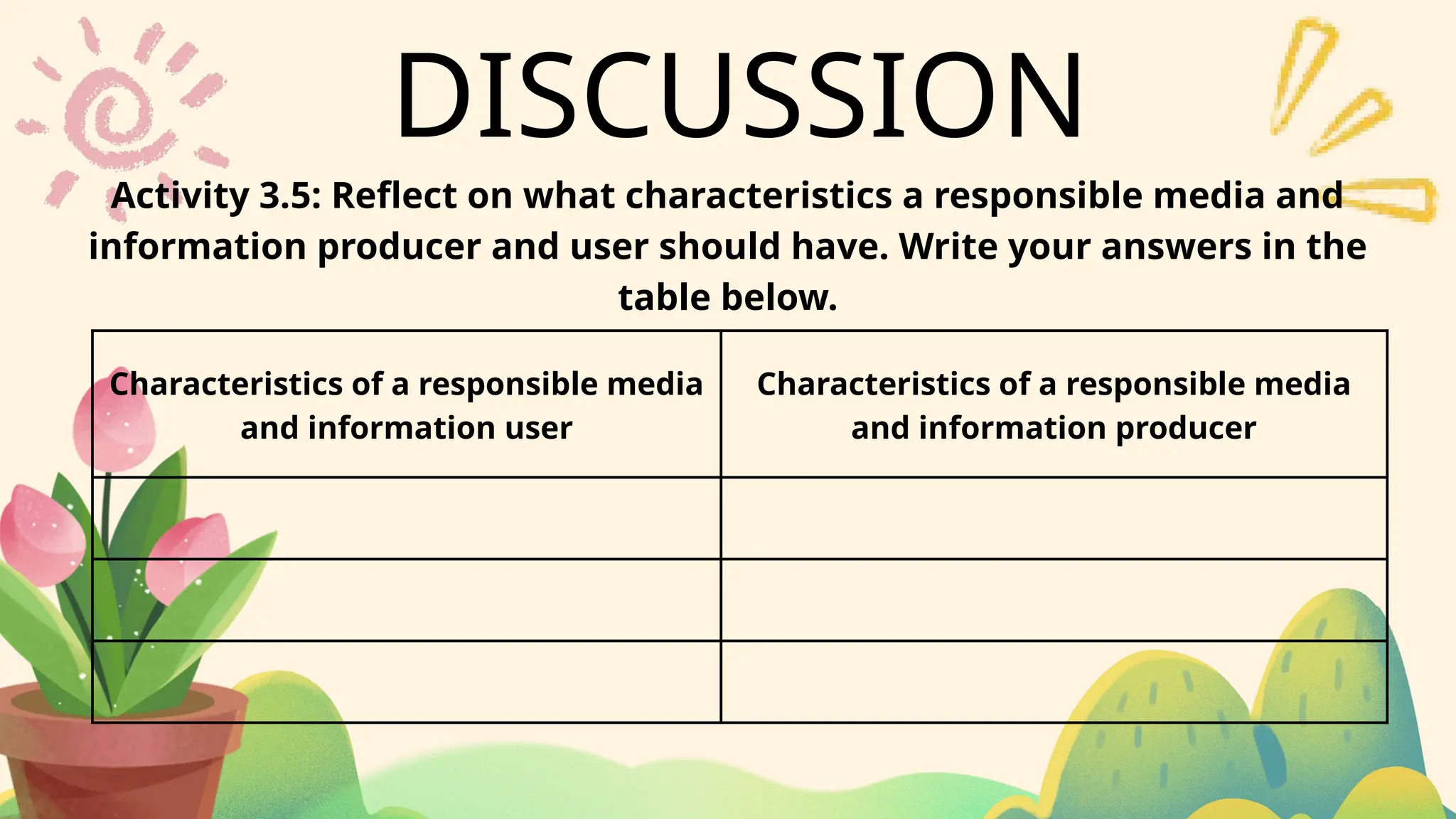
Characteristics of a responsible media
and information user
Characteristics of a responsible media
and information producer
Activity 3.5: Reflect on what characteristics a responsible media and
information producer and user should have. Write your answers in the
table below.
DISCUSSION
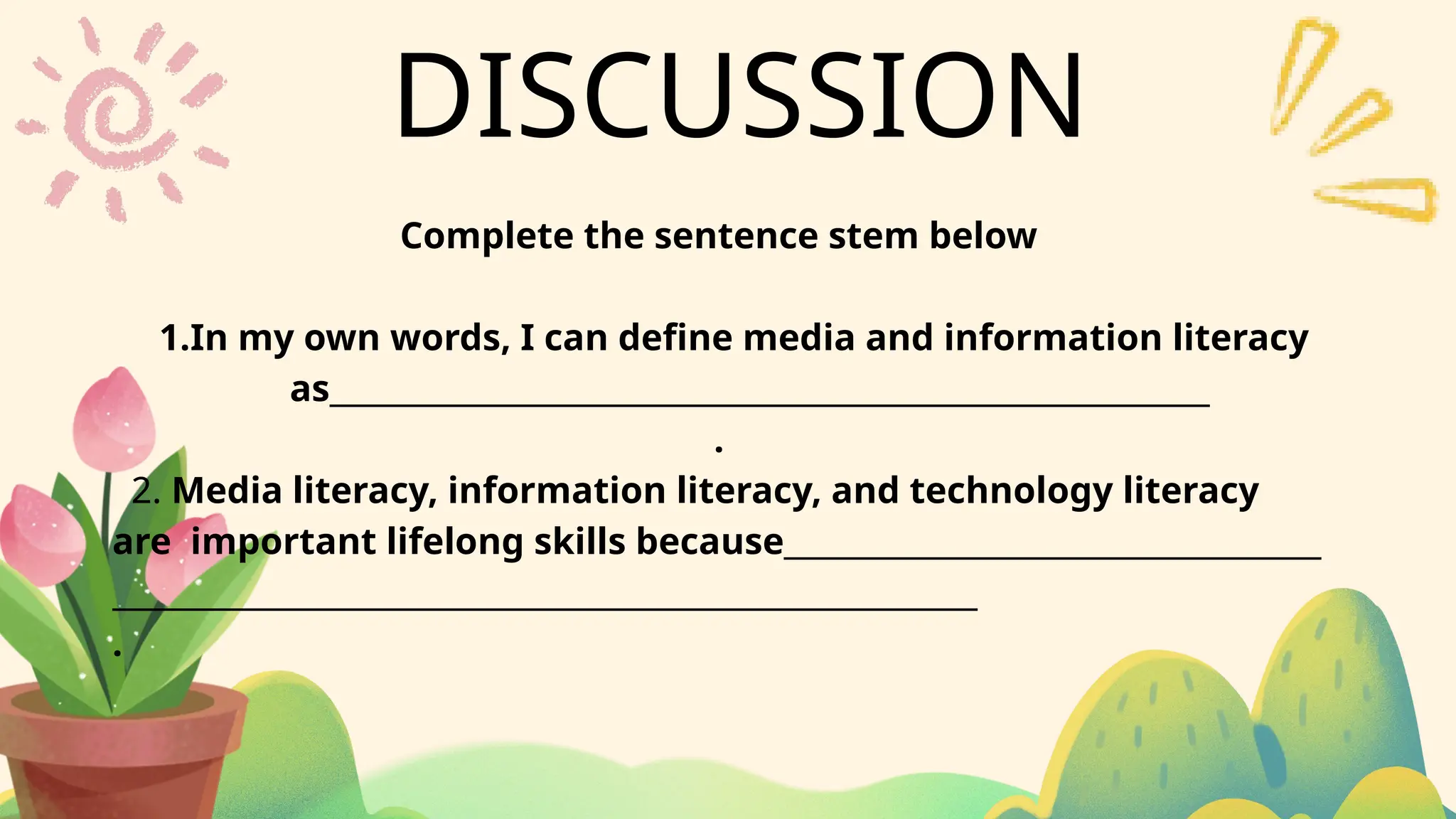
Complete the sentence stem below
1.In my own words, I can define media and information literacy
as___________________________________________________________
.
2. Media literacy, information literacy, and technology literacy
are important lifelong skills because____________________________________
__________________________________________________________
.
WHAT CAN I DO
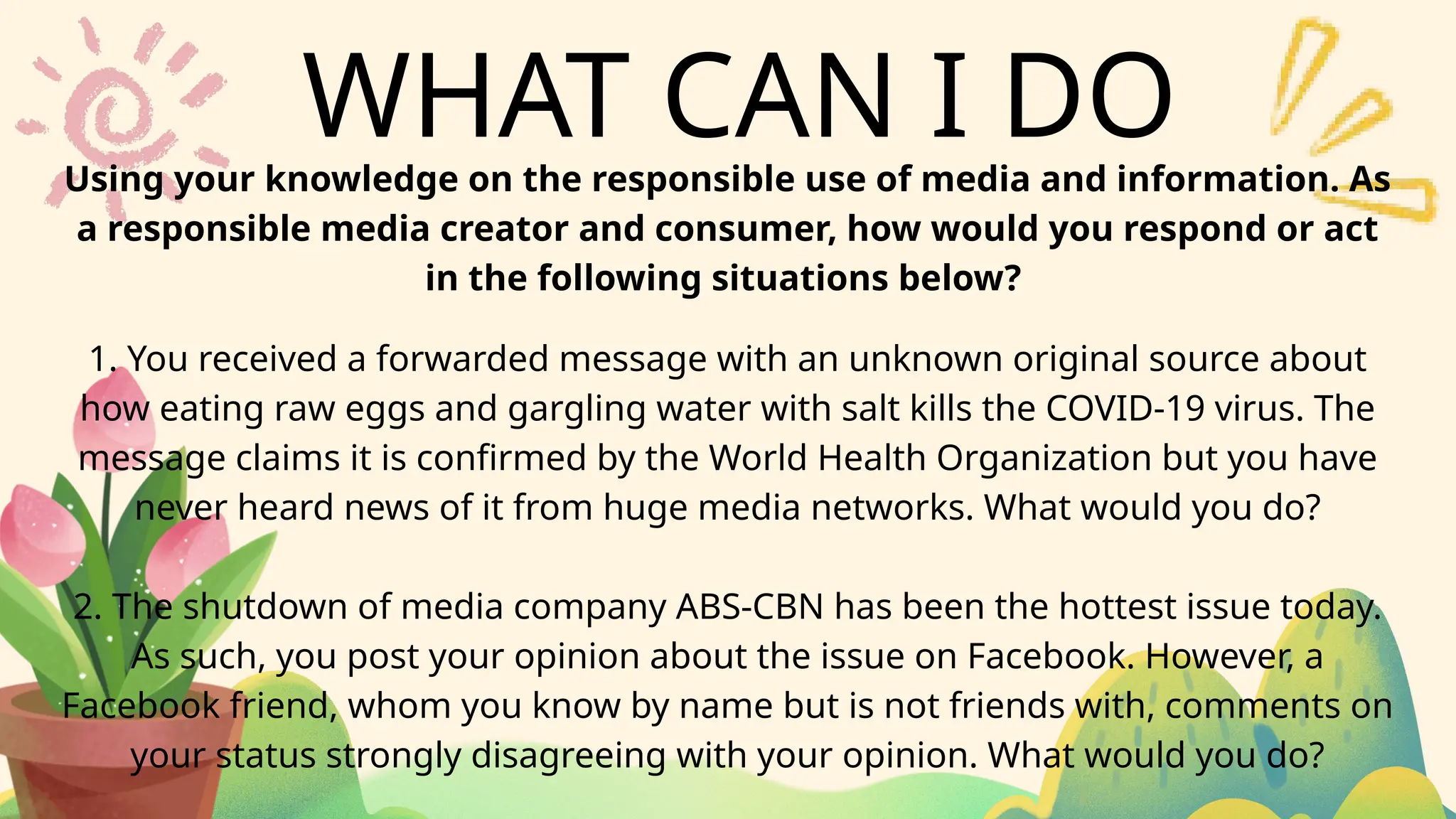
Using your knowledge on the responsible use of media and information. As
a responsible media creator and consumer, how would you respond or act
in the following situations below?
1. You received a forwarded message with an unknown original source about
how eating raw eggs and gargling water with salt kills the COVID-19 virus. The
message claims it is confirmed by the World Health Organization but you have
never heard news of it from huge media networks. What would you do?
2. The shutdown of media company ABS-CBN has been the hottest issue today.
As such, you post your opinion about the issue on Facebook. However, a
Facebook friend, whom you know by name but is not friends with, comments on
your status strongly disagreeing with your opinion. What would you do?
WHAT CAN I DO
3. A video scandal of two teenage students have been circulating in social
media. Unknowingly, one of your schoolmates forwarded such video in one of
your GCs. Being the talk of the town, another schoolmate messaged you asking
if you have a copy of the said video scandal. What would you do?
4. In your research group, you were tasked to write the Review of Related
Literature. As you browse the web, you have stumbled upon many books and
articles that you may use for your RRL. How would you manage all the
information you have?
5. As you are scrolling through your newsfeed, you come across a news article
from a certain unfamiliar website. You wanted to share the news article but
hesitated as to its truthfulness. How would you verify its validity?
Additional Activity
Case Study on Disinformation
1. Download and read the one-page handout - Case Study: This is how an
Iranian network created a “disinformation supply chain” to spread fake
news (https://www.niemanlab.org/2019/05/this-is-how-an-iranian-
network-created-a- disinformation-supply-chain-to-spread-fake-news/)
2. Draw/illustrate the steps on how the disinformation supply chain
worked – Be creative. Use colors and illustrations with your text.
Quarter1-Lesson 3-ResponsibleUseofMedia.pptx

  • 1.
    LESSON 3 Responsible Useof Media and Information
  • 2.
    It is undeniablethat media, in all its various forms, have helped society advance and progress. In fact, media have aided in shaping the world’s social, cultural, political, and economic landscape to what it is today. The rise of technological advances have also changed the way media is consumed and produced. These innovations created a faster and much free- flowing movement of information and communication such as allowing easier connection to people around the globe, opening more opportunities for sharing of ideas, and creating more outlets for us to share our thoughts and opinions. Introduction
  • 3.
    However, although mediahas brought about many benefits, it also has its fair share of disadvantages. Moreover, the more we immerse ourselves in mediated communication, the more we lose touch of the meaning, value, and authenticity of human interaction. Thus, it is important to inculcate the proper use of media and information so as to maximize its benefits and not be overpowered by its downsides. Introduction
  • 4.
    PRETEST 1. Kim checksthe truthfulness of the news she sees online by looking into other news outlets for the same content. 2. Kristoffer’s Facebook friend sent him through FB messenger a forwarded message about an upcoming 7.8 earthquake in their locality. Rattled, he also forwarded the unverified message to his family’s group chats, warning them of such quake. Before we continue, answer the short test below to see how much you know about the next lesson. Analyze each statement. Write Y for YES if you think the statement shows responsible use of media and information. Write N for No if you think otherwise.
  • 5.
    PRETEST 3. Rezza andher research group mates utilizes Google Drive to work on their study. 4. Isa helps her local barangay in their campaign against COVID-19 by designing posters of local emergency hotlines and fast facts about the novel coronavirus. 5. A friend sent me a video of a scandal from Facebook. Curious as to who the people in the video were, I also sent it to several of my friends 6. Rebecca validates the source of a Facebook post before she shares it.
  • 6.
    PRETEST 7. Deanne usesYouTube crash courses to complement her learnings in school. 8. Erika believes that print media like newspapers and books are useless today because everything may already found on the Internet. 9. Mark cites Wikipedia in his research study because he considers anything on the Internet true and credible. 10. Andrew Photoshopped a false quotation beside a celebrity, published it on social media, and claimed it to be true.
  • 7.
    WHAT’S IN (REVIEW) In Lesson2, you have learned the definitions of Media Literacy, Information Literacy, and Technology Literacy. When you understand and use various media forms to access information, you consider yourself media literate. When you are able to recognize when information is most needed and is knowledgeable on how to locate, evaluate, use, and share it in different forms, you are information literate. And lastly, when you are digitally literate, you are able to utilize different digital technologies and communication tools or networks to manage information.
  • 8.
    Activity 3.1: MediaInteraction Log Try to think of your media consumption during the past week. In the table below, record your use and interaction with media and information providers (such as internet, social media, TV, radio, newspaper, etc.) and indicate how many hours were spent engaged with each one.
  • 9.
    Weekly Interaction Logwith Information and Information Providers Media or Information Provider Number of hours in a week Activity 3.1: Media Interaction Log
  • 10.
    From the momentyou wake up to the time you fall asleep, you are, in one way or another, exposed to all media you listed above, and actually even more. Wherever you go, you see and hear all forms of it and you may even be consuming media unconsciously. DISCUSSIO N
  • 11.
    Unfortunately, there isa sad reality about media and information consumption in today’s society: Information Disorder. Information Disorder refers to the many ways our information environment is polluted – content are fake, used out of context, or weaponized to attack certain individuals or groups of people. Understanding this landscape is the first step towards better and responsible use of media and information. DISCUSSIO N
  • 12.
    The Information Disorder Thereare three categories of Information Disorder: Misinformation, Disinformation, and Mal-information. 1. Misinformation – refers to information that is false, but the person sharing or disseminating it unknowingly perceives it as something true. A. False connection – when headlines or visuals do not support the content B. Misleading content - by cropping photos or choosing quotes or statistics selectively DISCUSSION
  • 13.
    Example of Misleading Content: Atfirst glance, you might think that the murder and homicide cases have indeed tapered off in recent times. But the line graph dipped at the end mainly because the data for 2016 was split into two periods: January to June, and July 1 to August 3. Connecting yearly and monthly data in a single line graph is a big no-no, the visual equivalent of comparing apples and oranges.
  • 14.
    2. Disinformation –refers to content that contains false information with the deliberate intention to mislead or deceive the audience. A. False context – when genuine content is re-circulated out of its original context B. Imposter content – persons’ bylines used alongside articles they did not write, or organizations’ logos used in videos or images they did not create C. Manipulated content – when genuine content is manipulated to deceive D. Fabricated content – fabricated “news sites” or fabricated visual
  • 15.
    Example of FalseContext: A set of photos circulated on Facebook along with the claim that it was taken during a ritual done by Catholic priests to make President Rodrigo Duterte die. The truth? It was from a symbolic street theater activity called "Lamay para sa Demokrasya" at Padre Faura Street in Manila in May 2018.
  • 16.
    Example of FalseContext: Facebook page Tambayan Ni BERTO Page posted the photo on October 16, 2019, showing Philippine opposition Senator Leila De Lima in a wheelchair and wearing a neck brace as shown in what appears to be a screenshot of a live television news report. However, the photo was manipulated by superimposing Senator De Lima’s face over former president Gloria Macapagal Arroyo’s body.
  • 17.
    3. Mal-information –refers to information that is based on reality but is used to inflict harm. Examples: A. Leaks to the press of private information for personal or corporate interest (e.g. revenge porn) B. Using a picture (e.g. of a dead child, with no context or false context) in an effort to ignite hatred of a particular ethnic group Example of fabricated content:
  • 18.
    At first glance,you might think that the murder and homicide cases have indeed tapered off in recent times. But the line graph dipped at the end mainly because the data for 2016 was split into two periods: January to June, and July 1 to August 3. Connecting yearly and monthly data in a single line graph is a big no-no, the visual equivalent of comparing apples and oranges.
  • 19.
    Because Information Disorderis prevalent in this times, the need to inculcate and practice the responsible use of media and information is of utmost importance. As media is very much embedded in our lives, it is important that we must learn the skills on how to responsibly and wisely use these information and media tools at our disposal. Moreover, we must understand that how we use media and information can also affect the people we know, our community, and the society in general
  • 21.
    7 MIL skillsthat you, as a media user and producer, should develop: In the Information Age, the need to emphasize on other essential skills also arises. As we are bombarded with media and information that we are compelled to deconstruct and evaluate, competence and proficiency in media literacy are already considered life-long learning skills today 1. The ability and willingness to make an effort to understand content, to pay attention, and to filter out noise. DISCUSSION
  • 22.
    2. An understandingof and respect for the power of media messages. 6. A knowledge of genre conventions and the ability to recognize when they are being mixed 3. An understanding of and respect for the power of media messages. 4. Development of heightened expectations of media content. 7. A knowledge and appreciation of the internal language of various media and the ability to understand its effects, no matter how complex DISCUSSION
  • 23.
  • 24.
    DISCUSSION My Responsibility asa Media Consumer As a media consumer, you’re not just a helpless sponge, absorbing all kinds of messages without a second thought. Ultimately, media literacy teaches us that the content we see or hear are constructed with various aims and that an equally important task falls to the audience, the receivers of such content, to evaluate and give meaning to these media messages. Some media messages are meant to be disseminated to the public, as in mass communication, but at the end of the line, it will still be received by you, an individual with his own set of understanding and thinking.
  • 25.
    DISCUSSION According to theCenter of Media Literacy, when analyzing media messages, you should ask these five key questions related to the five core concepts of Media Literacy: 1. Who created this message? (Author) 2. What creative techniques are used to attract my attention? (Format) 3. How might other people understand this message differently than me? (Audience)
  • 26.
    DISCUSSION 4. What values,lifestyles and points of view are represented in, or omitted from, this message? (Content) - the way information is sent, packaged, and received is influenced by academic, social, cultural, and political principles – all media content carry subtle messages that may sway our opinions, even content providers that try to present information objectively can have an unconscious slant.
  • 27.
    DISCUSSION 5. Why isthis message being sent? (Purpose) - Examining the purpose of a message uncovers how it may have been influenced by money, ego or ideology and gives you knowledge on how to interpret and respond to a message appropriately.
  • 28.
    Activity 3.2: Questionand Answer Instructions: To better reflect on how you are as a media consumer, answer the questions below. Write them on a separate sheet of paper. 1. How can you tell if the source of an information is credible? 2. What do we mean by the “creative techniques” in media? And how does it affect the message being sent? 3. Why do other people interpret the same message differently? 4. In what way does ideals and values being “sold” through media? 5. How can the purpose of a message affect your response as a media consumer?
  • 29.
    DISCUSSION My Responsibility asa Media Producer So what is your role as a media producer? Let’s start with how it is defined. In its most technical meaning, media producers are described as people who oversee media projects (like films, TV shows, etc.) from conception to completion and may also be involved in the marketing and distribution process (Gonzales, 2016). However, throughout the years, the term has evolved to take in those who contribute intellectual or creative content through and in media, even including your Facebook posts, tweets, Instagram photos, or vlogs. Simply put, in today’s context, media producers are people who are capable of creating and sharing information through a media channel – that includes you.
  • 30.
    DISCUSSION My Responsibility asa Media Producer Technological advances in the Digital Age gave tons of people access to tools for communication and media creation. However, this opportunity also opened a chance for illegal and irresponsible making and sharing of media messages. Here, you will learn your responsibilities as a media and information literate content producer.
  • 31.
    DISCUSSION 1. Give creditwhere credit is due. 2. Avoid sharing raw and unverified information 3. Think about who can see what you have shared 4. Be open to learning and constructive criticisms 5. Share expert knowledge 6. Respect other people’s privacy 7. Always be respectful
  • 32.
    DISCUSSION Activity 3.3: Factor Fake? Analyze and evaluate a shared Facebook post of an article from the Internet below. Determine if such post is reliable or if it may contain false information and defend your answer using the principles and guidelines previously discussed. Write your answer on the space provided beside the photo.
  • 33.
    DISCUSSION Activity 3.4: What’sWrong? Take a look at the photos below. Identify the problems in the photos and explain how it relates to issues regarding media and information literacy. Write your answer on the space provided beside the photos.
  • 34.
  • 35.
    DISCUSSION Characteristics of aresponsible media and information user Characteristics of a responsible media and information producer Activity 3.5: Reflect on what characteristics a responsible media and information producer and user should have. Write your answers in the table below.
  • 36.
    DISCUSSION Complete the sentencestem below 1.In my own words, I can define media and information literacy as___________________________________________________________ . 2. Media literacy, information literacy, and technology literacy are important lifelong skills because____________________________________ __________________________________________________________ .
  • 37.
    WHAT CAN IDO Using your knowledge on the responsible use of media and information. As a responsible media creator and consumer, how would you respond or act in the following situations below? 1. You received a forwarded message with an unknown original source about how eating raw eggs and gargling water with salt kills the COVID-19 virus. The message claims it is confirmed by the World Health Organization but you have never heard news of it from huge media networks. What would you do? 2. The shutdown of media company ABS-CBN has been the hottest issue today. As such, you post your opinion about the issue on Facebook. However, a Facebook friend, whom you know by name but is not friends with, comments on your status strongly disagreeing with your opinion. What would you do?
  • 38.
    WHAT CAN IDO 3. A video scandal of two teenage students have been circulating in social media. Unknowingly, one of your schoolmates forwarded such video in one of your GCs. Being the talk of the town, another schoolmate messaged you asking if you have a copy of the said video scandal. What would you do? 4. In your research group, you were tasked to write the Review of Related Literature. As you browse the web, you have stumbled upon many books and articles that you may use for your RRL. How would you manage all the information you have? 5. As you are scrolling through your newsfeed, you come across a news article from a certain unfamiliar website. You wanted to share the news article but hesitated as to its truthfulness. How would you verify its validity?
  • 39.
    Additional Activity Case Studyon Disinformation 1. Download and read the one-page handout - Case Study: This is how an Iranian network created a “disinformation supply chain” to spread fake news (https://www.niemanlab.org/2019/05/this-is-how-an-iranian- network-created-a- disinformation-supply-chain-to-spread-fake-news/) 2. Draw/illustrate the steps on how the disinformation supply chain worked – Be creative. Use colors and illustrations with your text.