{
ICT-Pedagogy Integration in
Language Learning Plans
Group 2 - BSED Fil/Eng
Learning Outcomes:
 At the end of the lesson, the learner should be able to:
 discuss essential points to consider when integrating any ICT in
facilitating language education;
 present learning plans that integrate ICT in the learning procedures
to be able to attain the learning outcomes, and;
 plan for some activities that will help develop digital citizenship and
relate this to the development of 21st Century skills among learners.
 Teaching has always been a challenging profession
since knowledge has been expanding and essential
skills have been increasing and changing. With these
challenges, teachers need to engage educational
technologies to assist them in the teaching and
learning process. Engaging educational technologies
in teaching are founded on principles and
philosophies. Understanding these will help you
successfully integrate technologies to allow your
students to demonstrate the intended learning
outcomes of your field of specialization.
Integrating Technology in
Instruction
Various educators and researchers
provided the following concepts and
principles about integrating
technoloy in instruction:
1. John Pisapia (1994)
 Integrating technoloy with teaching means
the use of learning technologies to introduce,
reinforce, supplement and extend skills.
 Integrating technoloy into curricula can
mean different things: 1) computer science
courses, computer-assissted instruction, and/or
computer enhanced or enriched instruction, 2)
matching software with basic skill
competencies, and 3) keyboarding with word
processing followed up with presentation tools.
2. International Society for Technology in
Education (ISTE)
 Effective integration of technoloy is achieved
when students are able to select technoloy tools
to help them obtain information in a timely
manner, analyze and synthesize the information,
and present it professionally. The technoloy
should become an integral part of how the
classroom functions - as accessible as all other
classroom tools.
3. Margaret Lloyd (2005)
 ICT integration encompasses an integral part of
broader curriculum reforms which include both infra-
structural as well as pedagogical considerations that
are changing not only how learning occurs but what is
learned.
4. Qiyun Wang and Huay Lit Woo ( 2007)
 Integration Information and Communication
(ICT) into teaching and learning is a growing area
that has attracted many educators' efforts in recent
years. Based on the scope of content covered, ICT,
integration can happen in three areas: curriculum,
topic, and lesson.
5. Bernard Bahati (2010)
 The process of integrating ICT in teaching and
learning has to be done at both pedagogical and
technological levels with much emphasis put on
pedagogy. ICT integration into teaching and learning
has to be underpinned by sound pedagogical
principles.
6. UNESCO (2005)
 ICT integration is not merely mastering the
hardware and software skills. Teachers need to
realize how to organize the classroom to structure the
learning tasks so that ICT resources become
automatic and natural response to the requirements
for learning environments in the same way as
teachers use markers and whiteboards in the
classroom.
Information and Communication
Technoloy (ICT)
 The following are the definitions of ICT
from various sources:
1. Moursund (2005)
 ICT includes all the full range of computer
hardware, computer software, and telecommunication
facilities. Thus, it includes computer devices ranging
from handheld calculators to multimillion worth
supercomputers.
2. Tinio (2009)
 ICT is a diverse set of technological tools and
resources used to communicate, create,
disseminate, store, and manage information.
3. UNESCO (2020)
 ICT is a diverse set of technological tools and
resources used to transmit, store, create, share,or
exchange information. UNESCO defines it also as a
scientific, technological, and engineering discipline,
and management technique used. ICT also refers to
handling information, its application, and
association with social, economic, and cultural
matters.
4. Ratheeswari (2018)
 ICT influence every aspect of human life. They
play salient roles in workplaces, in business,
education and entertainment. Moreover, many
people recognize ICTs as catalysts for change that
include change in working conditions, handling and
exchanging information, teaching methods, learning
approaches, scientific research, and in accessing
information communication technologies.
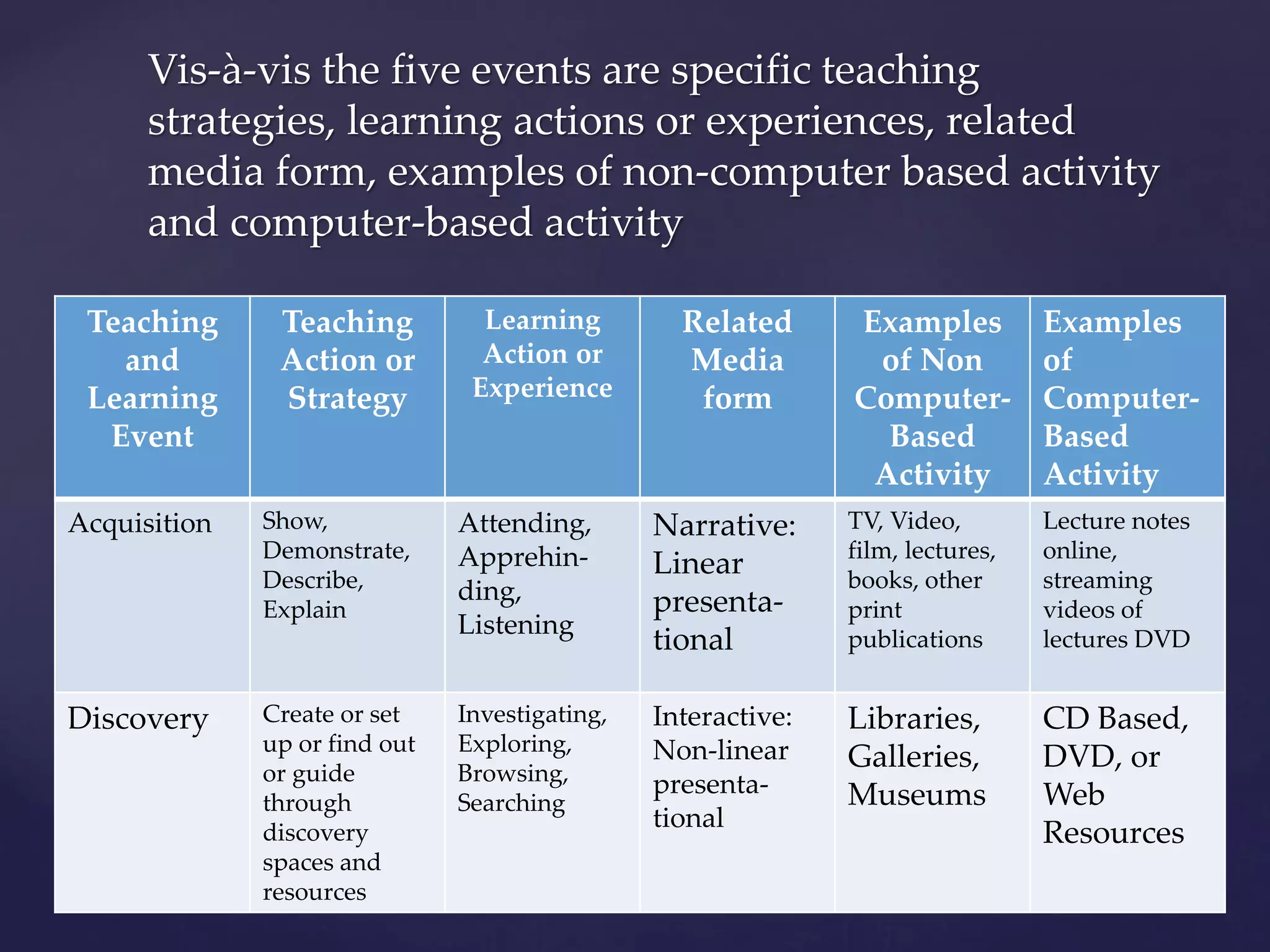
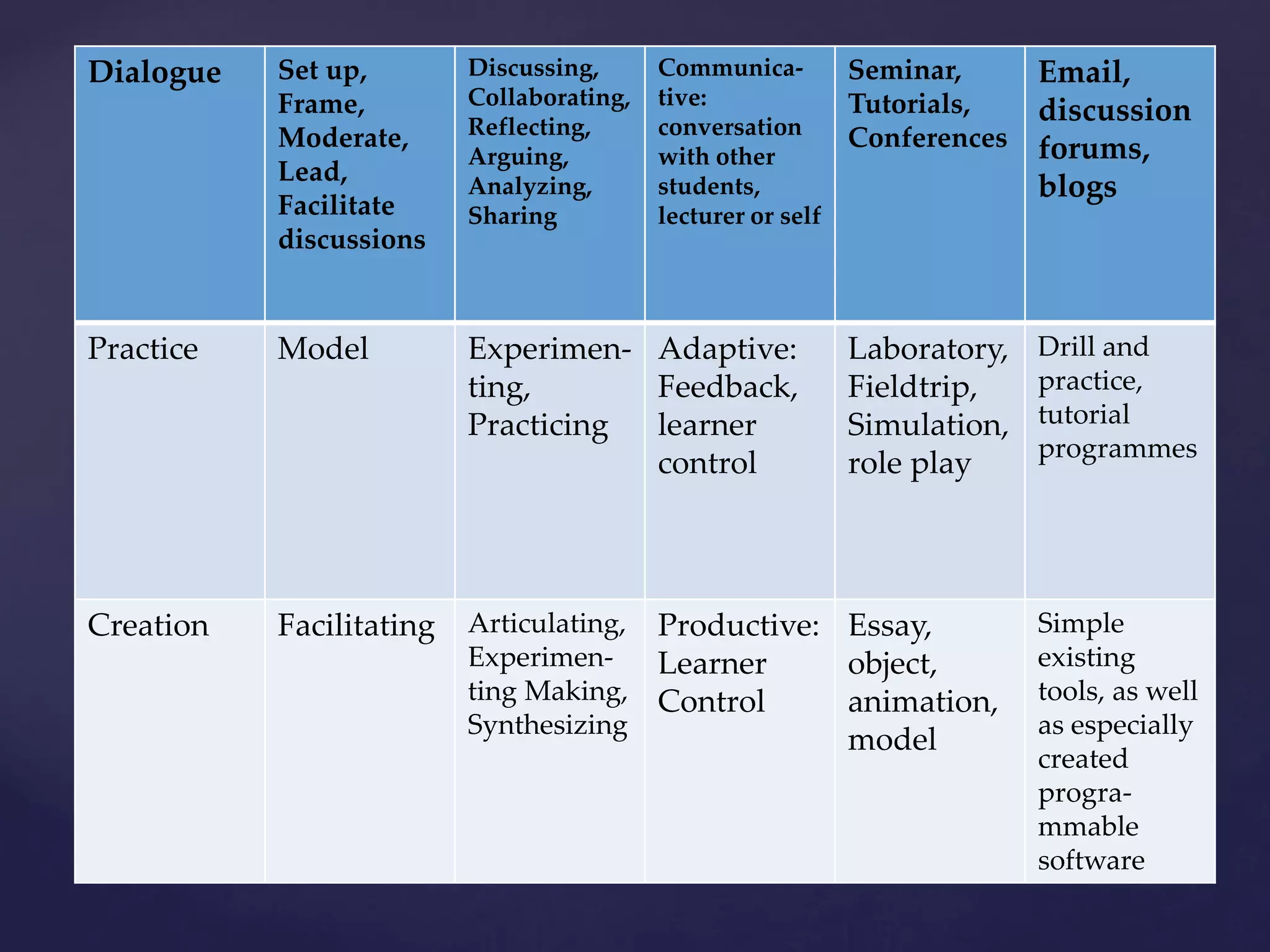
Vis-à-vis the five events are specific teaching
strategies, learning actions or experiences, related
media form, examples of non-computer based activity
and computer-based activity
Teaching
and
Learning
Event
Teaching
Action or
Strategy
Learning
Action or
Experience
Related
Media
form
Examples
of Non
Computer-
Based
Activity
Examples
of
Computer-
Based
Activity
Acquisition Show,
Demonstrate,
Describe,
Explain
Attending,
Apprehin-
ding,
Listening
Narrative:
Linear
presenta-
tional
TV, Video,
film, lectures,
books, other
print
publications
Lecture notes
online,
streaming
videos of
lectures DVD
Discovery Create or set
up or find out
or guide
through
discovery
spaces and
resources
Investigating,
Exploring,
Browsing,
Searching
Interactive:
Non-linear
presenta-
tional
Libraries,
Galleries,
Museums
CD Based,
DVD, or
Web
Resources
Dialogue Set up,
Frame,
Moderate,
Lead,
Facilitate
discussions
Discussing,
Collaborating,
Reflecting,
Arguing,
Analyzing,
Sharing
Communica-
tive:
conversation
with other
students,
lecturer or self
Seminar,
Tutorials,
Conferences
Email,
discussion
forums,
blogs
Practice Model Experimen-
ting,
Practicing
Adaptive:
Feedback,
learner
control
Laboratory,
Fieldtrip,
Simulation,
role play
Drill and
practice,
tutorial
programmes
Creation Facilitating Articulating,
Experimen-
ting Making,
Synthesizing
Productive:
Learner
Control
Essay,
object,
animation,
model
Simple
existing
tools, as well
as especially
created
progra-
mmable
software
Using ICT Integration
Frameworks in Language
Education Learning Plans
A. Conversational Framework of Laurilllard
(2002)
 The teaching-learning process poses very complex
talks to allow learners to understand their lessons and
master the skills they are expected to demonstrate.
Thus, it will be reassuring if teacher will explore on
engaging various media to support various learning
activities in classrooms. This is how the
Conversational Framework (Laurilllard, 2022) may
support. The framework postulates a way of
presenting teaching and learning in terms of events.
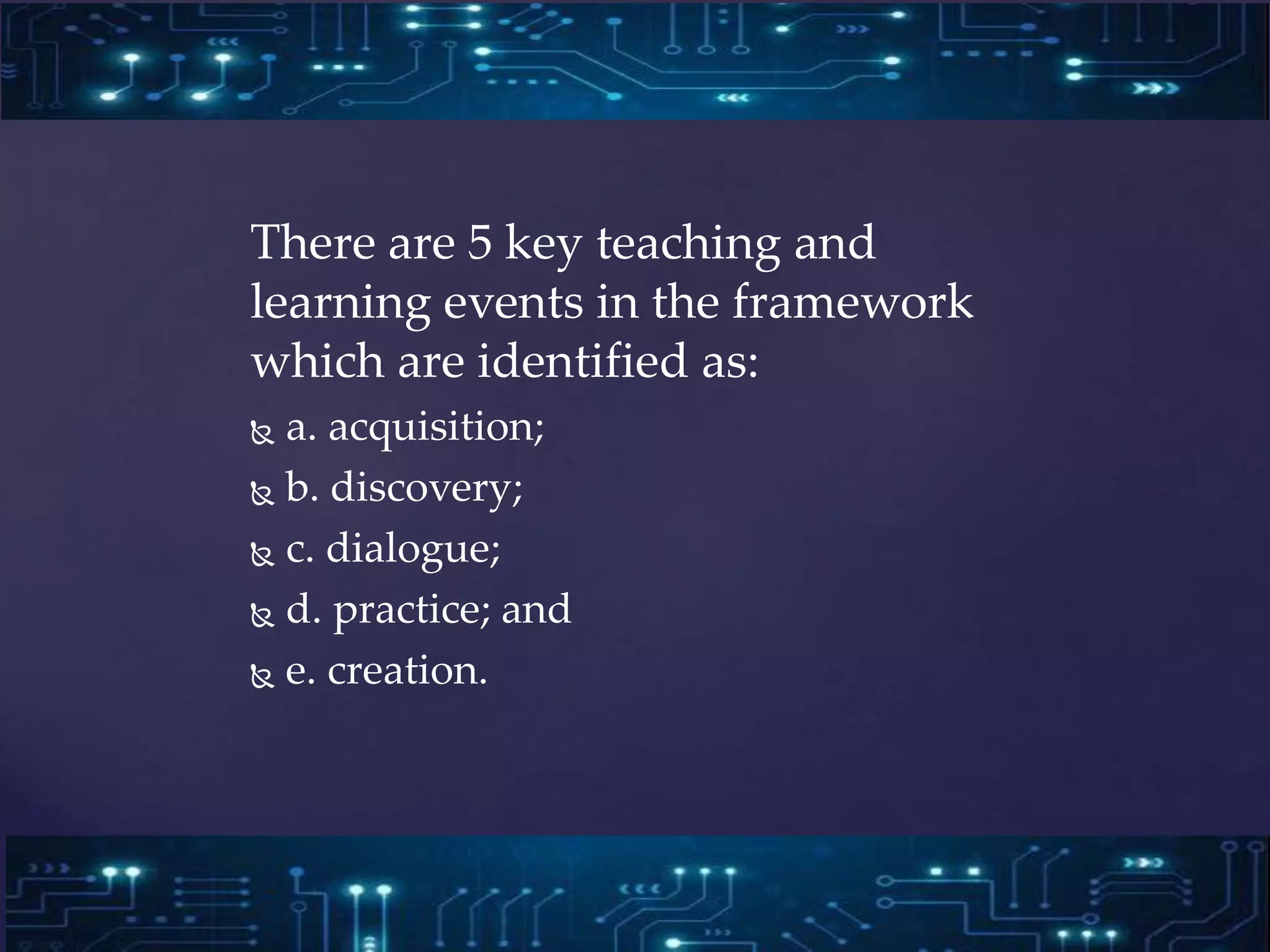
There are 5 key teaching and
learning events in the framework
which are identified as:
 a. acquisition;
 b. discovery;
 c. dialogue;
 d. practice; and
 e. creation.
B. Three Fundamental Elements of ICT
Integration by Wang (2008)
 Wang in 2008 posited that Integration of ICT
consists of three fundamental elements. These are
pedagogy, social interaction, and technoloy.
C. Categories for Information Communication
and Technoloy (ICT) in Teacher Training
 There is a lot of researches that will prove that the
integration of ICTs can fully transform classroom
instruction. Haddad in 2003 states that teachers' use of
ICT supports the development of higher-order-thinking
skills (HOTS) and promotes collaboration. This is the
reason why training in ICT pedagogy-integration are
promoted.
D. UNESCO ICT Competency Framework for
Teachers
 Having a society that is increasingly based on
information and knowledge and with the ubiquity of
Information and Communication Technoloy (ICT) for
instruction, UNESCO was able to develop ICT
competence Framework for Teachers (UNESCO, 2018).
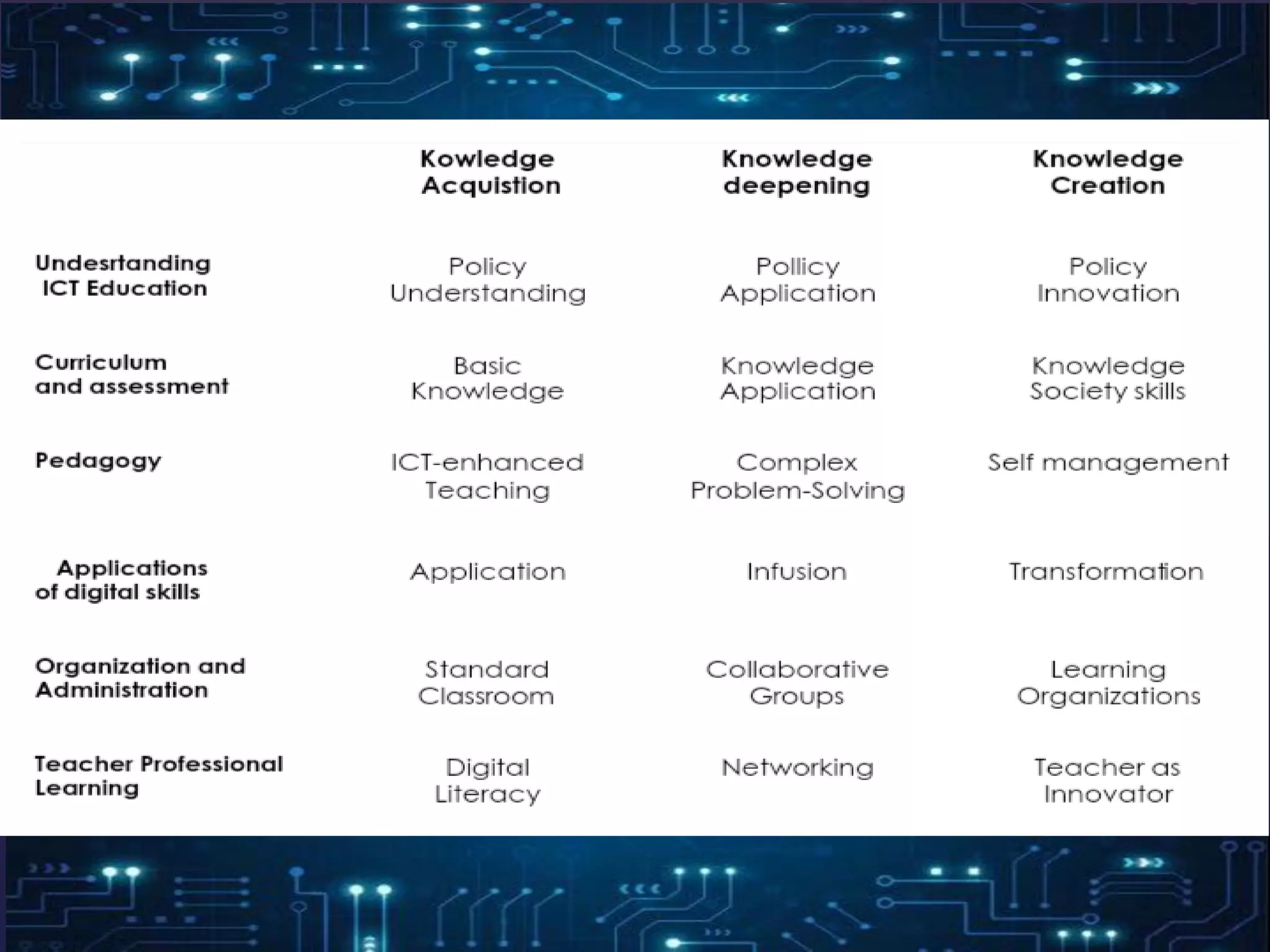
This frame work, which is a part of range of initiatives by the UN
and its specialized agencies including UNESCO, aims to promote
educational reform and sustainable economic development
anchored on the principles of objectives in the Millennium
Development Goals (MDG), Education for All (EFA), the UN
Literacy Decade (UNLD), and the Decade of Education for
sustainable Development (DESD). As shown from the framework,
the teachers have six aspects of work: understanding ICT in
education, curriculum and assessment pedagogy, application of
digital skills, organization and administration, and teacher
professional learning. Across the six aspects of work are the three
approaches to teaching based on human capacity development-
knowledge acquisitions, knowledge deepening, and knowleege
creation.

M2_ICT-Pedagogy Integration in Language Learning Plans.pdf

  • 1.
    { ICT-Pedagogy Integration in LanguageLearning Plans Group 2 - BSED Fil/Eng
  • 2.
    Learning Outcomes:  Atthe end of the lesson, the learner should be able to:  discuss essential points to consider when integrating any ICT in facilitating language education;  present learning plans that integrate ICT in the learning procedures to be able to attain the learning outcomes, and;  plan for some activities that will help develop digital citizenship and relate this to the development of 21st Century skills among learners.
  • 3.
     Teaching hasalways been a challenging profession since knowledge has been expanding and essential skills have been increasing and changing. With these challenges, teachers need to engage educational technologies to assist them in the teaching and learning process. Engaging educational technologies in teaching are founded on principles and philosophies. Understanding these will help you successfully integrate technologies to allow your students to demonstrate the intended learning outcomes of your field of specialization.
  • 4.
    Integrating Technology in Instruction Variouseducators and researchers provided the following concepts and principles about integrating technoloy in instruction:
  • 5.
    1. John Pisapia(1994)  Integrating technoloy with teaching means the use of learning technologies to introduce, reinforce, supplement and extend skills.  Integrating technoloy into curricula can mean different things: 1) computer science courses, computer-assissted instruction, and/or computer enhanced or enriched instruction, 2) matching software with basic skill competencies, and 3) keyboarding with word processing followed up with presentation tools.
  • 6.
    2. International Societyfor Technology in Education (ISTE)  Effective integration of technoloy is achieved when students are able to select technoloy tools to help them obtain information in a timely manner, analyze and synthesize the information, and present it professionally. The technoloy should become an integral part of how the classroom functions - as accessible as all other classroom tools.
  • 7.
    3. Margaret Lloyd(2005)  ICT integration encompasses an integral part of broader curriculum reforms which include both infra- structural as well as pedagogical considerations that are changing not only how learning occurs but what is learned.
  • 8.
    4. Qiyun Wangand Huay Lit Woo ( 2007)  Integration Information and Communication (ICT) into teaching and learning is a growing area that has attracted many educators' efforts in recent years. Based on the scope of content covered, ICT, integration can happen in three areas: curriculum, topic, and lesson.
  • 9.
    5. Bernard Bahati(2010)  The process of integrating ICT in teaching and learning has to be done at both pedagogical and technological levels with much emphasis put on pedagogy. ICT integration into teaching and learning has to be underpinned by sound pedagogical principles.
  • 10.
    6. UNESCO (2005) ICT integration is not merely mastering the hardware and software skills. Teachers need to realize how to organize the classroom to structure the learning tasks so that ICT resources become automatic and natural response to the requirements for learning environments in the same way as teachers use markers and whiteboards in the classroom.
  • 11.
    Information and Communication Technoloy(ICT)  The following are the definitions of ICT from various sources:
  • 12.
    1. Moursund (2005) ICT includes all the full range of computer hardware, computer software, and telecommunication facilities. Thus, it includes computer devices ranging from handheld calculators to multimillion worth supercomputers.
  • 13.
    2. Tinio (2009) ICT is a diverse set of technological tools and resources used to communicate, create, disseminate, store, and manage information.
  • 14.
    3. UNESCO (2020) ICT is a diverse set of technological tools and resources used to transmit, store, create, share,or exchange information. UNESCO defines it also as a scientific, technological, and engineering discipline, and management technique used. ICT also refers to handling information, its application, and association with social, economic, and cultural matters.
  • 15.
    4. Ratheeswari (2018) ICT influence every aspect of human life. They play salient roles in workplaces, in business, education and entertainment. Moreover, many people recognize ICTs as catalysts for change that include change in working conditions, handling and exchanging information, teaching methods, learning approaches, scientific research, and in accessing information communication technologies.
  • 16.
    Vis-à-vis the fiveevents are specific teaching strategies, learning actions or experiences, related media form, examples of non-computer based activity and computer-based activity Teaching and Learning Event Teaching Action or Strategy Learning Action or Experience Related Media form Examples of Non Computer- Based Activity Examples of Computer- Based Activity Acquisition Show, Demonstrate, Describe, Explain Attending, Apprehin- ding, Listening Narrative: Linear presenta- tional TV, Video, film, lectures, books, other print publications Lecture notes online, streaming videos of lectures DVD Discovery Create or set up or find out or guide through discovery spaces and resources Investigating, Exploring, Browsing, Searching Interactive: Non-linear presenta- tional Libraries, Galleries, Museums CD Based, DVD, or Web Resources
  • 17.
    Dialogue Set up, Frame, Moderate, Lead, Facilitate discussions Discussing, Collaborating, Reflecting, Arguing, Analyzing, Sharing Communica- tive: conversation withother students, lecturer or self Seminar, Tutorials, Conferences Email, discussion forums, blogs Practice Model Experimen- ting, Practicing Adaptive: Feedback, learner control Laboratory, Fieldtrip, Simulation, role play Drill and practice, tutorial programmes Creation Facilitating Articulating, Experimen- ting Making, Synthesizing Productive: Learner Control Essay, object, animation, model Simple existing tools, as well as especially created progra- mmable software
  • 18.
    Using ICT Integration Frameworksin Language Education Learning Plans
  • 19.
    A. Conversational Frameworkof Laurilllard (2002)  The teaching-learning process poses very complex talks to allow learners to understand their lessons and master the skills they are expected to demonstrate. Thus, it will be reassuring if teacher will explore on engaging various media to support various learning activities in classrooms. This is how the Conversational Framework (Laurilllard, 2022) may support. The framework postulates a way of presenting teaching and learning in terms of events.
  • 20.
    There are 5key teaching and learning events in the framework which are identified as:  a. acquisition;  b. discovery;  c. dialogue;  d. practice; and  e. creation.
  • 21.
    B. Three FundamentalElements of ICT Integration by Wang (2008)  Wang in 2008 posited that Integration of ICT consists of three fundamental elements. These are pedagogy, social interaction, and technoloy.
  • 22.
    C. Categories forInformation Communication and Technoloy (ICT) in Teacher Training  There is a lot of researches that will prove that the integration of ICTs can fully transform classroom instruction. Haddad in 2003 states that teachers' use of ICT supports the development of higher-order-thinking skills (HOTS) and promotes collaboration. This is the reason why training in ICT pedagogy-integration are promoted.
  • 23.
    D. UNESCO ICTCompetency Framework for Teachers  Having a society that is increasingly based on information and knowledge and with the ubiquity of Information and Communication Technoloy (ICT) for instruction, UNESCO was able to develop ICT competence Framework for Teachers (UNESCO, 2018).
  • 25.
    This frame work,which is a part of range of initiatives by the UN and its specialized agencies including UNESCO, aims to promote educational reform and sustainable economic development anchored on the principles of objectives in the Millennium Development Goals (MDG), Education for All (EFA), the UN Literacy Decade (UNLD), and the Decade of Education for sustainable Development (DESD). As shown from the framework, the teachers have six aspects of work: understanding ICT in education, curriculum and assessment pedagogy, application of digital skills, organization and administration, and teacher professional learning. Across the six aspects of work are the three approaches to teaching based on human capacity development- knowledge acquisitions, knowledge deepening, and knowleege creation.