PRODUCT SAFETY
Safety is a state in which hazards
and conditions leading to physical,
psychological or material harm are
controlled in order to preserve the
health and well-being of
individuals and the community
What is Safety
What is Product Safety
Product Safety is the condition of a
'steady state' of the product when
it provides the services /
usefulness / purpose for which it
is designed and manufactured –
without harm / loss / damage to
life or property.
Safe Product
A safe product is one that provides
either no risk or a minimum
acceptable level of risk, taking into
account the normal or reasonably
foreseeable use of the product and the
need to maintain a high level of
protection for consumers.
Supplying safe products
 Businesses must use quality control measures to ensure products:
 meet mandatory levels of safety
 will not cause harm when used in a reasonable manner, including
reasonable misuse.
 If you supply or manufacture products, you need to make sure they are
safe. To do this you need to:
 provide clear instructions for use
 provide warnings against possible misuse
 be aware of and meet industry and mandatory standards
 develop product recall plans and procedures
 incorporate safety into product design
 implement a quality assurance program
 respond quickly to safety concerns that arise.
 It makes good business sense to think about product safety. Complying
with safety standards and bans will make your products safe and help
you avoid:
 the cost of recalls
 damaging your reputation
 exposing your business to legal action or formal complaints
 losing customers.
Product safety problems ?
 If you have a product safety problem you should
act quickly.
 If you think a product is not safe you can:
 report an unsafe product- external site
 notify a death, or serious injury or illness-
external site
 notify a recall- external site
STANDARDS
 Technical specification approved by a
recognised standardisation body for
repeated and continuous application
with which compliance is not
compuslory and which is adopted by
an international, regional or national
standardisation body and made
available to the public
STANDARDS
 Detailed technical (design and
manufacturing) specifications
 Define how to reach the level of
safety envisaged by essential safety
requirements in a manner
acceptable to industry
 Voluntary in nature
 Produced by professional public and
independent standardisation bodies
STANDARDS
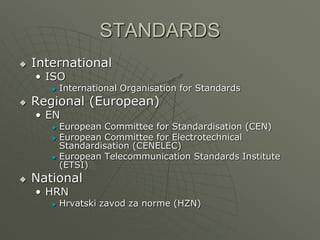
 International
• ISO
 International Organisation for Standards
 Regional (European)
• EN
 European Committee for Standardisation (CEN)
 European Committee for Electrotechnical
Standardisation (CENELEC)
 European Telecommunication Standards Institute
(ETSI)
 National
• HRN
 Hrvatski zavod za norme (HZN)
QUALITY ASSESSMENT
PROCEDURE
 Manufacturer ensures and declares that
the products are in conformity with
technical documentation and essential
safety requirements
 Manufacturer affixes CE marking and
draws up a written declaration
 The manufacturer must operate an
approved quality system for production,
final product inspection and testing which
is subject to monitoring
 The quality system must be under
surveillance of a notified body
THIRD PARTY CERTIFICATION
 Manufacturer establishes technical
documentation to enable conformity
assessment concerning the design,
manufacture and operation of the product
 Manufacturer lodges an application with a
notified body
 If the “type” or actual product is in
conformity with technical documentation
and essential safety requirements, notified
body issues a certificate

PRODUCT_SAFETY[2].ppt

  • 1.
  • 2.
    Safety is astate in which hazards and conditions leading to physical, psychological or material harm are controlled in order to preserve the health and well-being of individuals and the community What is Safety
  • 3.
    What is ProductSafety Product Safety is the condition of a 'steady state' of the product when it provides the services / usefulness / purpose for which it is designed and manufactured – without harm / loss / damage to life or property.
  • 4.
    Safe Product A safeproduct is one that provides either no risk or a minimum acceptable level of risk, taking into account the normal or reasonably foreseeable use of the product and the need to maintain a high level of protection for consumers.
  • 5.
    Supplying safe products Businesses must use quality control measures to ensure products:  meet mandatory levels of safety  will not cause harm when used in a reasonable manner, including reasonable misuse.  If you supply or manufacture products, you need to make sure they are safe. To do this you need to:  provide clear instructions for use  provide warnings against possible misuse  be aware of and meet industry and mandatory standards  develop product recall plans and procedures  incorporate safety into product design  implement a quality assurance program  respond quickly to safety concerns that arise.  It makes good business sense to think about product safety. Complying with safety standards and bans will make your products safe and help you avoid:  the cost of recalls  damaging your reputation  exposing your business to legal action or formal complaints  losing customers.
  • 6.
    Product safety problems?  If you have a product safety problem you should act quickly.  If you think a product is not safe you can:  report an unsafe product- external site  notify a death, or serious injury or illness- external site  notify a recall- external site
  • 7.
    STANDARDS  Technical specificationapproved by a recognised standardisation body for repeated and continuous application with which compliance is not compuslory and which is adopted by an international, regional or national standardisation body and made available to the public
  • 8.
    STANDARDS  Detailed technical(design and manufacturing) specifications  Define how to reach the level of safety envisaged by essential safety requirements in a manner acceptable to industry  Voluntary in nature  Produced by professional public and independent standardisation bodies
  • 9.
    STANDARDS  International • ISO International Organisation for Standards  Regional (European) • EN  European Committee for Standardisation (CEN)  European Committee for Electrotechnical Standardisation (CENELEC)  European Telecommunication Standards Institute (ETSI)  National • HRN  Hrvatski zavod za norme (HZN)
  • 10.
    QUALITY ASSESSMENT PROCEDURE  Manufacturerensures and declares that the products are in conformity with technical documentation and essential safety requirements  Manufacturer affixes CE marking and draws up a written declaration  The manufacturer must operate an approved quality system for production, final product inspection and testing which is subject to monitoring  The quality system must be under surveillance of a notified body
  • 11.
    THIRD PARTY CERTIFICATION Manufacturer establishes technical documentation to enable conformity assessment concerning the design, manufacture and operation of the product  Manufacturer lodges an application with a notified body  If the “type” or actual product is in conformity with technical documentation and essential safety requirements, notified body issues a certificate