Productivity
Hacks For
Getting More
Done In Less
Time
Dr. Tim Baker
To assist you to become more
efficient and effective
Proactive & reactive time Pareto Principle Planning
What are
you three
top
challenges in
managing
your time?
You never will have enough
time to do everything ….
But you will always have
enough time to do the
important things
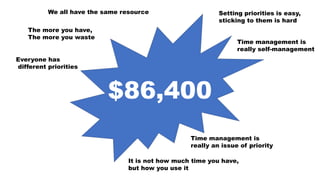
$86,400
$86,400
$86,400
$86,400
We all have the same resource
It is not how much time you have,
but how you use it
Setting priorities is easy,
sticking to them is hard
The more you have,
The more you waste
Everyone has
different priorities
Time management is
really an issue of priority
Time management is
really self-management
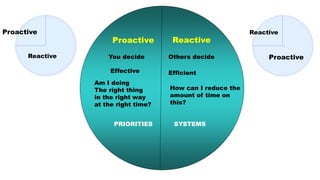
Proactive Reactive
You decide Others decide
Effective Efficient
Am I doing
The right thing
in the right way
at the right time?
How can I reduce the
amount of time on
this?
PRIORITIES SYSTEMS
Proactive
Reactive Proactive
Reactive
Pareto’s Principle
(80:20 Rule)
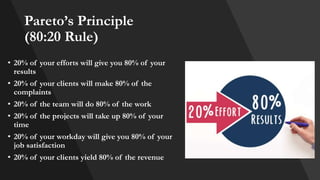
Pareto’s Principle
(80:20 Rule)
• 20% of your efforts will give you 80% of your
results
• 20% of your clients will make 80% of the
complaints
• 20% of the team will do 80% of the work
• 20% of the projects will take up 80% of your
time
• 20% of your workday will give you 80% of your
job satisfaction
• 20% of your clients yield 80% of the revenue
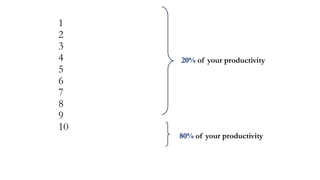
1
2
3
4
5
6
7
8
9
10
20% of your productivity
80% of your productivity
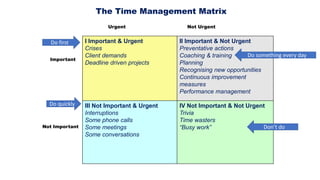
The Time Management Matrix
Urgent Not Urgent
I Important & Urgent
Crises
Client demands
Deadline driven projects
II Important & Not Urgent
Preventative actions
Coaching & training
Planning
Recognising new opportunities
Continuous improvement
measures
Performance management
III Not Important & Urgent
Interruptions
Some phone calls
Some meetings
Some conversations
IV Not Important & Not Urgent
Trivia
Time wasters
“Busy work”
Important
Not Important
Do first
Do quickly
Do something every day
Don’t do
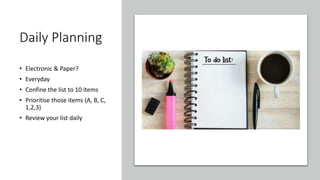
Daily Planning
• Electronic & Paper?
• Everyday
• Confine the list to 10 items
• Prioritise those items (A, B, C,
1,2,3)
• Review your list daily
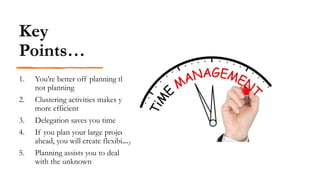
Key
Points…
1. You’re better off planning than
not planning
2. Clustering activities makes you
more efficient
3. Delegation saves you time
4. If you plan your large projects
ahead, you will create flexibility
5. Planning assists you to deal
with the unknown
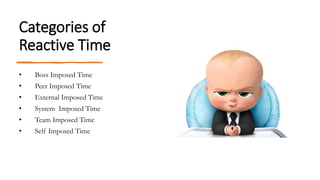
Categories of
Reactive Time
• Boss Imposed Time
• Peer Imposed Time
• External Imposed Time
• System Imposed Time
• Team Imposed Time
• Self Imposed Time
Tips & Hints on
Managing Email
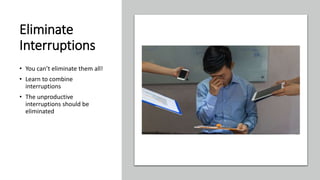
Eliminate
Interruptions
• You can’t eliminate them all!
• Learn to combine
interruptions
• The unproductive
interruptions should be
eliminated
Work Together to
Reduce interruptions
• Respect each other’s time
• Get to the point
• Learn to say NO to each
other
• Approach each other with
solutions, not problems
• Think before you ask
• Make sure that each
interruption is worthy of two
people’s time

Productivity Hacks For Getting More Done In Less

  • 1.
    Productivity Hacks For Getting More DoneIn Less Time Dr. Tim Baker
  • 2.
    To assist youto become more efficient and effective
  • 3.
    Proactive & reactivetime Pareto Principle Planning
  • 4.
    What are you three top challengesin managing your time?
  • 5.
    You never willhave enough time to do everything …. But you will always have enough time to do the important things
  • 6.
  • 7.
    $86,400 $86,400 We all havethe same resource It is not how much time you have, but how you use it Setting priorities is easy, sticking to them is hard The more you have, The more you waste Everyone has different priorities Time management is really an issue of priority Time management is really self-management
  • 8.
    Proactive Reactive You decideOthers decide Effective Efficient Am I doing The right thing in the right way at the right time? How can I reduce the amount of time on this? PRIORITIES SYSTEMS Proactive Reactive Proactive Reactive
  • 9.
  • 10.
    Pareto’s Principle (80:20 Rule) •20% of your efforts will give you 80% of your results • 20% of your clients will make 80% of the complaints • 20% of the team will do 80% of the work • 20% of the projects will take up 80% of your time • 20% of your workday will give you 80% of your job satisfaction • 20% of your clients yield 80% of the revenue
  • 11.
    1 2 3 4 5 6 7 8 9 10 20% of yourproductivity 80% of your productivity
  • 12.
    The Time ManagementMatrix Urgent Not Urgent I Important & Urgent Crises Client demands Deadline driven projects II Important & Not Urgent Preventative actions Coaching & training Planning Recognising new opportunities Continuous improvement measures Performance management III Not Important & Urgent Interruptions Some phone calls Some meetings Some conversations IV Not Important & Not Urgent Trivia Time wasters “Busy work” Important Not Important Do first Do quickly Do something every day Don’t do
  • 13.
    Daily Planning • Electronic& Paper? • Everyday • Confine the list to 10 items • Prioritise those items (A, B, C, 1,2,3) • Review your list daily
  • 14.
    Key Points… 1. You’re betteroff planning than not planning 2. Clustering activities makes you more efficient 3. Delegation saves you time 4. If you plan your large projects ahead, you will create flexibility 5. Planning assists you to deal with the unknown
  • 15.
    Categories of Reactive Time •Boss Imposed Time • Peer Imposed Time • External Imposed Time • System Imposed Time • Team Imposed Time • Self Imposed Time
  • 16.
    Tips & Hintson Managing Email
  • 17.
    Eliminate Interruptions • You can’teliminate them all! • Learn to combine interruptions • The unproductive interruptions should be eliminated
  • 18.
    Work Together to Reduceinterruptions • Respect each other’s time • Get to the point • Learn to say NO to each other • Approach each other with solutions, not problems • Think before you ask • Make sure that each interruption is worthy of two people’s time