productive games x @brainopera
         SingTel Accelerate 2010
Michael Heilemann’s 25 Most Influential Games
         http://www.flickr.com/photos/heilemann/5013484/
I'm interested in how game mechanics
acts as a form of architecture that
doesn't necessary focus on restriction,
but rather stimulates specific behaviors.
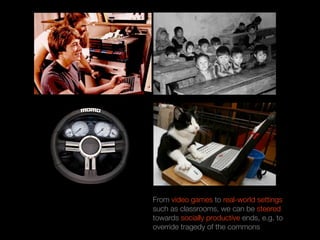
From video games to real-world settings
such as classrooms, we can be steered
towards socially productive ends, e.g. to
override tragedy of the commons
Why this is interesting...
Casual games consist of...

a crazy collection of addictive
mini-games

drive the player to perform
trivial tasks

in pursuit of the almighty
“dollar”.
Real-life consists of...

                              a tired collection of boring
                              mini-games

                              drive the player to perform
                              trivial tasks

                              in pursuit of the almighty
                              “dollar”.

Photo by flickr user: kenyee
Labor
need not be
laborious
our social responsibility
to make tasks fun
game mechanics
  in the everyday
making house / work chores fun... chorewars.com
Epic Win
http://www.nytimes.com/2009/01/31/science/earth/31compete.html
Development
Status
Cultured Code

Cultured Code's development
status dashboard @
http://culturedcode.com/
status/
The Panic
Status Board

The Panic Inc. Status Board as seen
on http://www.panic.com/blog/
2010/03/the-panic-status-board/
How the heck
do we create

fun ?
Be forewarned...
this is sinister territory
What makes popular social platforms addictive?
Visible Scoreboard


  To motivate students, I tried using
Amy Jo Kim's game mechanics (2006)
Photo by flickr user: Nemo's great uncle (Aug, 2008)


Amy Jo Kim explained game mechanics
 with how Frequent Flyer Miles work
“I see a game
                    mechanics working well
                    on sites like YouTube,
                    Yelp, Twitter, and
                    Flickster. [...] like points,
Amy Jo Kim          leaderboards, level-ups,
Creative Director
ShuffleBrain         social exchanges, and
                    customization to a
                    strong core experience.”
Five Game Mechanics
                    1. Collecting
                    2. Earning Points
                    3. Feedback
Amy Jo Kim
Creative Director
                    4. Exchanges
ShuffleBrain
                    5. Customization
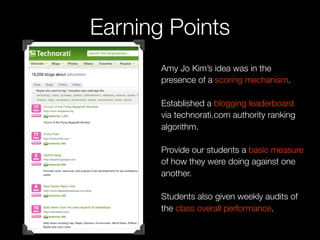
Earning Points
       Amy Jo Kim’s idea was in the
       presence of a scoring mechanism.

       Established a blogging leaderboard
       via technorati.com authority ranking
       algorithm.

       Provide our students a basic measure
       of how they were doing against one
       another.

       Students also given weekly audits of
       the class overall performance.
Collecting Things


For quality blog posts, students earned weekly awards
Variety of awards promotes diverse behaviors
Awards can be traded for extra credits or the ability to
gain “immunity” from extra assignments.
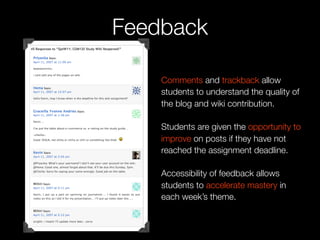
Feedback

    Comments and trackback allow
    students to understand the quality of
    the blog and wiki contribution.

    Students are given the opportunity to
    improve on posts if they have not
    reached the assignment deadline.

    Accessibility of feedback allows
    students to accelerate mastery in
    each week’s theme.
Customization
       Students instinctively personalized
       their blogs by the first week of use.

       Low level: Blog templates

       High level: Sidebar widgets

       Social Objects
       - personal photos
       - favorite music
       - branding
       - chat box
Exchanges


To track the layers of interaction, we visually aggregated
RSS feeds of their blogs and wikis using Netvibes.com
Title	 	 : JFDI Academy - http://jedi.ddns.comp.nus.edu.sg
Module	 : CS1101S Programming Methodology @ NUS
Professor	: Ben Leong / Collaborator : Su Yuen
Amy Jo Kim’s Community Building on the Web (Peachpit, 2000)
I work at The National Art Gallery, Singapore
foursquare iPhone app
location-aware gaming with virtual & real-world rewards
art.sg/307


Artwork as
Social Objects
✦   rapid & economical
✦   shared experiences
✦   game mechanics
✦   granular analytics
Tiers of Social Media Engagement
                                                 Recruit others to donate
       ADVOCATE                                 Create a group
                                                Host an event

                                           Post pictures/videos
     SOCIAL                               Write a blog post
                                         Join a group

                                   Create a profile
PERSONAL                           Post a comment
                                  Make a donation
                                Sign up for e-mail/SMS
                               Friend on social networks
            “Barack Obama’s Social Media Toolkit” by Monte Lutz (Feb 2009)
  http://www.slideshare.net/montelutz/social-pulpit-barack-obamas-social-media-toolkit
Thank you.
for a copy of
productive games
see (and retweet)
  @brainopera

Productive Games

  • 1.
    productive games x@brainopera SingTel Accelerate 2010
  • 2.
    Michael Heilemann’s 25Most Influential Games http://www.flickr.com/photos/heilemann/5013484/
  • 3.
    I'm interested inhow game mechanics acts as a form of architecture that doesn't necessary focus on restriction, but rather stimulates specific behaviors.
  • 4.
    From video gamesto real-world settings such as classrooms, we can be steered towards socially productive ends, e.g. to override tragedy of the commons
  • 5.
    Why this isinteresting...
  • 6.
    Casual games consistof... a crazy collection of addictive mini-games drive the player to perform trivial tasks in pursuit of the almighty “dollar”.
  • 7.
    Real-life consists of... a tired collection of boring mini-games drive the player to perform trivial tasks in pursuit of the almighty “dollar”. Photo by flickr user: kenyee
  • 8.
  • 9.
  • 10.
    game mechanics in the everyday
  • 11.
    making house /work chores fun... chorewars.com
  • 13.
  • 14.
  • 21.
    Development Status Cultured Code Cultured Code'sdevelopment status dashboard @ http://culturedcode.com/ status/
  • 22.
    The Panic Status Board ThePanic Inc. Status Board as seen on http://www.panic.com/blog/ 2010/03/the-panic-status-board/
  • 23.
    How the heck dowe create fun ?
  • 24.
    Be forewarned... this issinister territory
  • 25.
    What makes popularsocial platforms addictive?
  • 26.
    Visible Scoreboard To motivate students, I tried using Amy Jo Kim's game mechanics (2006)
  • 27.
    Photo by flickruser: Nemo's great uncle (Aug, 2008) Amy Jo Kim explained game mechanics with how Frequent Flyer Miles work
  • 28.
    “I see agame mechanics working well on sites like YouTube, Yelp, Twitter, and Flickster. [...] like points, Amy Jo Kim leaderboards, level-ups, Creative Director ShuffleBrain social exchanges, and customization to a strong core experience.”
  • 29.
    Five Game Mechanics 1. Collecting 2. Earning Points 3. Feedback Amy Jo Kim Creative Director 4. Exchanges ShuffleBrain 5. Customization
  • 32.
    Earning Points Amy Jo Kim’s idea was in the presence of a scoring mechanism. Established a blogging leaderboard via technorati.com authority ranking algorithm. Provide our students a basic measure of how they were doing against one another. Students also given weekly audits of the class overall performance.
  • 33.
    Collecting Things For qualityblog posts, students earned weekly awards Variety of awards promotes diverse behaviors Awards can be traded for extra credits or the ability to gain “immunity” from extra assignments.
  • 34.
    Feedback Comments and trackback allow students to understand the quality of the blog and wiki contribution. Students are given the opportunity to improve on posts if they have not reached the assignment deadline. Accessibility of feedback allows students to accelerate mastery in each week’s theme.
  • 35.
    Customization Students instinctively personalized their blogs by the first week of use. Low level: Blog templates High level: Sidebar widgets Social Objects - personal photos - favorite music - branding - chat box
  • 36.
    Exchanges To track thelayers of interaction, we visually aggregated RSS feeds of their blogs and wikis using Netvibes.com
  • 37.
    Title :JFDI Academy - http://jedi.ddns.comp.nus.edu.sg Module : CS1101S Programming Methodology @ NUS Professor : Ben Leong / Collaborator : Su Yuen
  • 38.
    Amy Jo Kim’sCommunity Building on the Web (Peachpit, 2000)
  • 39.
    I work atThe National Art Gallery, Singapore
  • 41.
    foursquare iPhone app location-awaregaming with virtual & real-world rewards
  • 43.
    art.sg/307 Artwork as Social Objects ✦ rapid & economical ✦ shared experiences ✦ game mechanics ✦ granular analytics
  • 44.
    Tiers of SocialMedia Engagement Recruit others to donate ADVOCATE Create a group Host an event Post pictures/videos SOCIAL Write a blog post Join a group Create a profile PERSONAL Post a comment Make a donation Sign up for e-mail/SMS Friend on social networks “Barack Obama’s Social Media Toolkit” by Monte Lutz (Feb 2009) http://www.slideshare.net/montelutz/social-pulpit-barack-obamas-social-media-toolkit
  • 45.
  • 46.
    for a copyof productive games see (and retweet) @brainopera