Bethany Vaughan
4137
Bethany Vaughan
4137
Production Plan
Monday:Researchproductionprocessfor‘KERRANG’
Date ofpublication – thefirst thing to do is to set up a date of publication. The date of
publication is simply the date that youwant the magazine to be released as a finished product to
the general public. Oncethis date has been established, youare now operating witha schedule.
A schedule is yourplan on how youare going to go about the production process and when each
of the process will occur.
Managingtheschedule – this is an extremely important step that you should not take for
granted when it comes to the production of a magazine. If you want yourmagazine to be
produced successfully then you must properly manage the schedule. Your schedule should be
made in such a way that there are provisions for certain mishaps so that even when these
mishaps occur,youcan always meet the deadline. This is the reason why a proper management
of the schedule is very vital.
Editorial andbudgetarydecision – thenext step that is taken during the production process
of a magazine is the editorial decision. The editorial decisions involvethe magazine’s editorial
team assembling and deciding what topics will be coveredin the next issue of the magazine.
Here, the editorial team basically talks about the various contents that will make up the
magazine. After deciding whichtypes of article ideas or topics, news stories, illustrations and
photographs will be used in the magazine, the team now makes the budgetary decisions. Here,
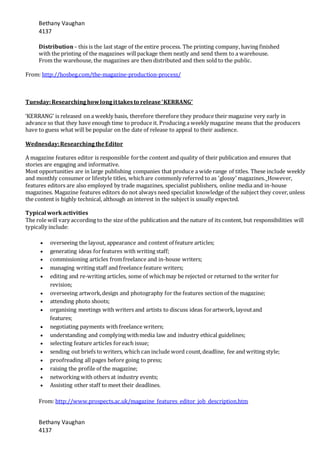
Week beginning: Monday 10th November 2014
Monday Tuesday Wednesday Thursday Friday Saturday Sunday
Researching
the
production
process for
‘KERRANG’
Researching
how long it
takes to
release
‘KERRANG’
Researching
the Editor
and the job
roles at the
magazine.
Researching
what the
production
company
does in
order to
publish the
magazine
and the
costs
involved.
Researching
key people
involvedin
the
production
process
Statistics
about the
magazine
in terms of
circulation
figures and
frequency
of the
magazine.
Complete
by:
Complete
by:
Complete
by:
Complete
by:
Complete
by:
Complete
by:
Complete
by:
10/11/14 11/11/14 12/11/14 13/11/14 14/11/14 15/11/14 16/11/14
Bethany Vaughan
4137
Bethany Vaughan
4137
they lookat the money that is available tothem and how it willbe spent towards the production
of the magazine. Having done this, it is now time to moveon to the next stage.
ContentAcquisition – thecontent acquisition process is arguably the most important step
because withoutcontent we simply cannot have the magazine in the first place. Content
therefore is king. There are two major waysthat content can be gathered for a magazine. The
first is through in-house staff writers and the second way is through external writers that are
commissioned to write on topics that are specialist in nature. It is at this stage that artwork and
graphics are also workedon. The artworkis defined as illustrations and pictures that are going
to be placed in the magazine. Graphics are the pictures or images that are designed with a
computer program.
At this stage too, a lot of research is made by journalists or reporters into the topics and events
being covered.The research can be done via the use of the internet and news databases.
Meetings are also arranged with interviewees.
Sub-editing – this is the next step to be taken. Sub editing focuses on one major thing, whichis
quality control.If the media organization is big enough to have a sub-editor, then he is going to
be responsible forthis job; if there is no sub-editor, then the editor does this job. This step
involves the followingimportant things:
 Checking of the accuracy of all factsin the articles
 Making sure that words are properly spelled
 Making sure that grammar and punctuation are used correctly
 Making sure that all articles follow the house-style
 Working on the page layout…..
Page Layout– in big publications, there is a special team responsible forpage layouts called the
layout staff.Their jobis to typeset and layout the various pages that come together to make the
magazine. In performing this task, they use very powerfulDesktop Publishing (DTP) programs
such as InDesign or Pagemaker to get the job done. It is at this stage that adverts from
advertisers are placed into the content.
Proofreading – oncethe abovestage has been completed, the next stage is the proofreading.
The editorial department will print out a hardcopy of the magazine forthe sole purpose of
reading through to find and correctany mistakes in it. It is easier to proofread a hardcopy than
it is to proofread a softcopy.Any mistake that is spotted is quickly correctedon the DTP file. The
editorial team keeps proofreading until every member is satisfied that all mistakes have been
corrected.
Fileemailedto printer – After the proofreading stage, the DTP file of the entire magazine is
sent to the printer whose job will be to print the magazine. It is at this point the popular term
‘pre-press’comes in. Pre-pressis defined as the process of checking to make sure that youare
sending all the fonts and images needed forthe magazine withyour file. Once this stage is over,
the printing company takes over.But before the printing company prints the hundreds or
thousands of copies requested by the publication, the company first prints a few copies and
sends them to the publication’s editor forchecking once again. This is called the printer’s proofs.
If the editor and his team are satisfied with the printer’s proofs,then the green light is given to
the printer for mass printing to commence. Each copy the printer prints is the final finished
product – the magazine that readers are going to have in their hands to read.
Bethany Vaughan
4137
Bethany Vaughan
4137
Distribution– this is the last stage of the entire process. The printing company, having finished
with the printing of the magazines willpackage them neatly and send them to a warehouse.
From the warehouse, the magazines are then distributed and then sold to the public.
From: http://hosbeg.com/the-magazine-production-process/
Tuesday:Researchinghowlongittakesto release‘KERRANG’
‘KERRANG’ is released on a weekly basis, therefore therefore they produce their magazine very early in
advance so that they have enough time to produce it. Producing a weekly magazine means that the producers
have to guess what will be popular on the date of release to appeal to their audience.
Wednesday:ResearchingtheEditor
A magazine features editor is responsible forthe content and quality of their publication and ensures that
stories are engaging and informative.
Most opportunities are in large publishing companies that produce a wide range of titles. These include weekly
and monthly consumer or lifestyle titles, whichare commonly referred to as 'glossy' magazines. However,
features editors are also employed by trade magazines, specialist publishers, online media and in-house
magazines. Magazine features editors do not always need specialist knowledge of the subject they cover,unless
the content is highly technical, although an interest in the subject is usually expected.
Typical workactivities
The role will vary according to the size of the publication and the nature of its content, but responsibilities will
typically include:
 overseeing the layout, appearance and content of feature articles;
 generating ideas forfeatures with writing staff;
 commissioning articles fromfreelance and in-house writers;
 managing writing staff and freelance feature writers;
 editing and re-writing articles, some of whichmay be rejected or returned to the writer for
revision;
 overseeing artwork,design and photography for the features section of the magazine;
 attending photo shoots;
 organising meetings with writers and artists to discuss ideas forartwork, layoutand
features;
 negotiating payments with freelance writers;
 understanding and complying withmedia law and industry ethical guidelines;
 selecting feature articles foreach issue;
 sending out briefs to writers, which can include word count,deadline, fee and writing style;
 proofreading all pages before going to press;
 raising the profile of the magazine;
 networking with others at industry events;
 Assisting other staff to meet their deadlines.
From: http://www.prospects.ac.uk/magazine_features_editor_job_description.htm
Bethany Vaughan
4137
Bethany Vaughan
4137
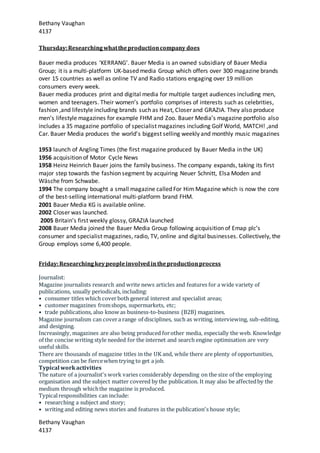
Thursday:Researchingwhattheproductioncompany does
Bauer media produces ‘KERRANG’. Bauer Media is an owned subsidiary of Bauer Media
Group; it is a multi-platform UK-based media Group which offers over 300 magazine brands
over 15 countries as well as online TV and Radio stations engaging over 19 million
consumers every week.
Bauer media produces print and digital media for multiple target audiences including men,
women and teenagers. Their women’s portfolio comprises of interests such as celebrities,
fashion ,and lifestyle including brands such as Heat, Closer and GRAZIA. They also produce
men’s lifestyle magazines for example FHM and Zoo. Bauer Media’s magazine portfolio also
includes a 35 magazine portfolio of specialist magazines including Golf World, MATCH! ,and
Car. Bauer Media produces the world’s biggest selling weekly and monthly music magazines
1953 launch of Angling Times (the first magazine produced by Bauer Media in the UK)
1956 acquisition of Motor Cycle News
1958 Heinz Heinrich Bauer joins the family business. The company expands, taking its first
major step towards the fashion segment by acquiring Neuer Schnitt, Elsa Moden and
Wäsche from Schwabe.
1994 The company bought a small magazine called For Him Magazine which is now the core
of the best-selling international multi-platform brand FHM.
2001 Bauer Media KG is available online.
2002 Closer was launched.
2005 Britain’s first weekly glossy, GRAZIA launched
2008 Bauer Media joined the Bauer Media Group following acquisition of Emap plc’s
consumer and specialist magazines, radio, TV, online and digital businesses. Collectively, the
Group employs some 6,400 people.
Friday:Researchingkeypeopleinvolvedintheproductionprocess
Journalist:
Magazine journalists research and write news articles and features for a wide variety of
publications, usually periodicals, including:
• consumer titles which coverboth general interest and specialist areas;
• customer magazines fromshops, supermarkets, etc;
• trade publications, also know as business-to-business (B2B) magazines.
Magazine journalism can covera range of disciplines, such as writing, interviewing, sub-editing,
and designing.
Increasingly, magazines are also being produced forother media, especially the web. Knowledge
of the concise writing style needed for the internet and search engine optimisation are very
useful skills.
There are thousands of magazine titles in the UK and, while there are plenty of opportunities,
competition can be fiercewhen trying to get a job.
Typical workactivities
The nature of a journalist's work varies considerably depending on the size of the employing
organisation and the subject matter covered by the publication. It may also be affectedby the
medium through whichthe magazine is produced.
Typicalresponsibilities can include:
• researching a subject and story;
• writing and editing news stories and features in the publication's house style;
Bethany Vaughan
4137
Bethany Vaughan
4137
• ensuring workis well written, accurate and submitted to deadline;
• conducting interviews, either in person or remotely;
• attending seminars, conferences and fairs (some magazine publishers hold exhibitions and
events to allow advertisers to meet their readership);
• generating ideas forstories;
• sourcing images to accompany written pieces;
• meeting with colleagues to plan the content of the issue and the character of the publication
ProductionManager
A production manager is involved withthe planning, coordination and control of manufacturing
processes. They ensure that goods and services are produced efficiently and that the correct
amount is produced at the right cost and levelof quality.
The scope of the job depends on the nature of the production system:
• jobbing;
• mass;
• process;
• batch production.
Many companies are involved in several types of production, adding tothe complexity of the
job. Most production managers are responsible for both human and material resources.
The job role is also referred to as operations manager.
Typical workactivities
The exact nature of the workwill depend on the size of the employing organisation. However,
tasks typically involve:
• overseeing the production process, drawing up a production schedule;
• ensuring that the production is cost effective;
• making sure that products are produced on time and are of good quality;
• working out the human and material resources needed;
• drafting a timescale forthe job;
• estimating costs and setting the quality standards;
• monitoring the production processes and adjusting schedules as needed;
• being responsible for the selection and maintenance of equipment;
• monitoring product standards and implementing quality-controlprograms;
• liaising among different departments, e.g. suppliers, managers;
• working withmanagers to implement the company'spolicies and goals;
• ensuring that health and safety guidelines are followed;
• supervising and motivating a team of workers;
• reviewing workerperformance;
• identifying training needs.
Saturday:Statisticsabout the magazine
Title Total Male Female 15-24 25-34 35-44 45-54 55-64 65+ ABC 1
KERRANG! 345000 54.7% 45.3% 56.1% 21.5% 13.4% 7.1% 1.8% 0.1% 51%
Date ofPublication
Saturday 6TH December, by releasing this on a Saturday it allows people to buy it on the
weekend of release as they are more likely to be free especially considering the young target
audience as they are likely to be free on the weekend. Furthermore by releasing it on the first
Saturday of the month it means that the magazine can update the audience on the previous
Bethany Vaughan
4137
Bethany Vaughan
4137
month in music. It also means that the next issue is release mid-month and these issue could be
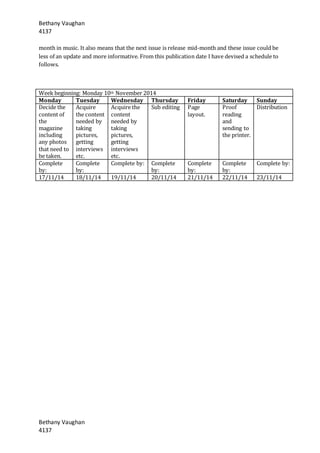
less of an update and more informative. From this publication date I have devised a schedule to
follows.
Week beginning: Monday 10th November 2014
Monday Tuesday Wednesday Thursday Friday Saturday Sunday
Decide the
content of
the
magazine
including
any photos
that need to
be taken.
Acquire
the content
needed by
taking
pictures,
getting
interviews
etc.
Acquire the
content
needed by
taking
pictures,
getting
interviews
etc.
Sub editing Page
layout.
Proof
reading
and
sending to
the printer.
Distribution
Complete
by:
Complete
by:
Complete by: Complete
by:
Complete
by:
Complete
by:
Complete by:
17/11/14 18/11/14 19/11/14 20/11/14 21/11/14 22/11/14 23/11/14

Production Plan

  • 1.
    Bethany Vaughan 4137 Bethany Vaughan 4137 ProductionPlan Monday:Researchproductionprocessfor‘KERRANG’ Date ofpublication – thefirst thing to do is to set up a date of publication. The date of publication is simply the date that youwant the magazine to be released as a finished product to the general public. Oncethis date has been established, youare now operating witha schedule. A schedule is yourplan on how youare going to go about the production process and when each of the process will occur. Managingtheschedule – this is an extremely important step that you should not take for granted when it comes to the production of a magazine. If you want yourmagazine to be produced successfully then you must properly manage the schedule. Your schedule should be made in such a way that there are provisions for certain mishaps so that even when these mishaps occur,youcan always meet the deadline. This is the reason why a proper management of the schedule is very vital. Editorial andbudgetarydecision – thenext step that is taken during the production process of a magazine is the editorial decision. The editorial decisions involvethe magazine’s editorial team assembling and deciding what topics will be coveredin the next issue of the magazine. Here, the editorial team basically talks about the various contents that will make up the magazine. After deciding whichtypes of article ideas or topics, news stories, illustrations and photographs will be used in the magazine, the team now makes the budgetary decisions. Here, Week beginning: Monday 10th November 2014 Monday Tuesday Wednesday Thursday Friday Saturday Sunday Researching the production process for ‘KERRANG’ Researching how long it takes to release ‘KERRANG’ Researching the Editor and the job roles at the magazine. Researching what the production company does in order to publish the magazine and the costs involved. Researching key people involvedin the production process Statistics about the magazine in terms of circulation figures and frequency of the magazine. Complete by: Complete by: Complete by: Complete by: Complete by: Complete by: Complete by: 10/11/14 11/11/14 12/11/14 13/11/14 14/11/14 15/11/14 16/11/14
  • 2.
    Bethany Vaughan 4137 Bethany Vaughan 4137 theylookat the money that is available tothem and how it willbe spent towards the production of the magazine. Having done this, it is now time to moveon to the next stage. ContentAcquisition – thecontent acquisition process is arguably the most important step because withoutcontent we simply cannot have the magazine in the first place. Content therefore is king. There are two major waysthat content can be gathered for a magazine. The first is through in-house staff writers and the second way is through external writers that are commissioned to write on topics that are specialist in nature. It is at this stage that artwork and graphics are also workedon. The artworkis defined as illustrations and pictures that are going to be placed in the magazine. Graphics are the pictures or images that are designed with a computer program. At this stage too, a lot of research is made by journalists or reporters into the topics and events being covered.The research can be done via the use of the internet and news databases. Meetings are also arranged with interviewees. Sub-editing – this is the next step to be taken. Sub editing focuses on one major thing, whichis quality control.If the media organization is big enough to have a sub-editor, then he is going to be responsible forthis job; if there is no sub-editor, then the editor does this job. This step involves the followingimportant things:  Checking of the accuracy of all factsin the articles  Making sure that words are properly spelled  Making sure that grammar and punctuation are used correctly  Making sure that all articles follow the house-style  Working on the page layout….. Page Layout– in big publications, there is a special team responsible forpage layouts called the layout staff.Their jobis to typeset and layout the various pages that come together to make the magazine. In performing this task, they use very powerfulDesktop Publishing (DTP) programs such as InDesign or Pagemaker to get the job done. It is at this stage that adverts from advertisers are placed into the content. Proofreading – oncethe abovestage has been completed, the next stage is the proofreading. The editorial department will print out a hardcopy of the magazine forthe sole purpose of reading through to find and correctany mistakes in it. It is easier to proofread a hardcopy than it is to proofread a softcopy.Any mistake that is spotted is quickly correctedon the DTP file. The editorial team keeps proofreading until every member is satisfied that all mistakes have been corrected. Fileemailedto printer – After the proofreading stage, the DTP file of the entire magazine is sent to the printer whose job will be to print the magazine. It is at this point the popular term ‘pre-press’comes in. Pre-pressis defined as the process of checking to make sure that youare sending all the fonts and images needed forthe magazine withyour file. Once this stage is over, the printing company takes over.But before the printing company prints the hundreds or thousands of copies requested by the publication, the company first prints a few copies and sends them to the publication’s editor forchecking once again. This is called the printer’s proofs. If the editor and his team are satisfied with the printer’s proofs,then the green light is given to the printer for mass printing to commence. Each copy the printer prints is the final finished product – the magazine that readers are going to have in their hands to read.
  • 3.
    Bethany Vaughan 4137 Bethany Vaughan 4137 Distribution–this is the last stage of the entire process. The printing company, having finished with the printing of the magazines willpackage them neatly and send them to a warehouse. From the warehouse, the magazines are then distributed and then sold to the public. From: http://hosbeg.com/the-magazine-production-process/ Tuesday:Researchinghowlongittakesto release‘KERRANG’ ‘KERRANG’ is released on a weekly basis, therefore therefore they produce their magazine very early in advance so that they have enough time to produce it. Producing a weekly magazine means that the producers have to guess what will be popular on the date of release to appeal to their audience. Wednesday:ResearchingtheEditor A magazine features editor is responsible forthe content and quality of their publication and ensures that stories are engaging and informative. Most opportunities are in large publishing companies that produce a wide range of titles. These include weekly and monthly consumer or lifestyle titles, whichare commonly referred to as 'glossy' magazines. However, features editors are also employed by trade magazines, specialist publishers, online media and in-house magazines. Magazine features editors do not always need specialist knowledge of the subject they cover,unless the content is highly technical, although an interest in the subject is usually expected. Typical workactivities The role will vary according to the size of the publication and the nature of its content, but responsibilities will typically include:  overseeing the layout, appearance and content of feature articles;  generating ideas forfeatures with writing staff;  commissioning articles fromfreelance and in-house writers;  managing writing staff and freelance feature writers;  editing and re-writing articles, some of whichmay be rejected or returned to the writer for revision;  overseeing artwork,design and photography for the features section of the magazine;  attending photo shoots;  organising meetings with writers and artists to discuss ideas forartwork, layoutand features;  negotiating payments with freelance writers;  understanding and complying withmedia law and industry ethical guidelines;  selecting feature articles foreach issue;  sending out briefs to writers, which can include word count,deadline, fee and writing style;  proofreading all pages before going to press;  raising the profile of the magazine;  networking with others at industry events;  Assisting other staff to meet their deadlines. From: http://www.prospects.ac.uk/magazine_features_editor_job_description.htm
  • 4.
    Bethany Vaughan 4137 Bethany Vaughan 4137 Thursday:Researchingwhattheproductioncompanydoes Bauer media produces ‘KERRANG’. Bauer Media is an owned subsidiary of Bauer Media Group; it is a multi-platform UK-based media Group which offers over 300 magazine brands over 15 countries as well as online TV and Radio stations engaging over 19 million consumers every week. Bauer media produces print and digital media for multiple target audiences including men, women and teenagers. Their women’s portfolio comprises of interests such as celebrities, fashion ,and lifestyle including brands such as Heat, Closer and GRAZIA. They also produce men’s lifestyle magazines for example FHM and Zoo. Bauer Media’s magazine portfolio also includes a 35 magazine portfolio of specialist magazines including Golf World, MATCH! ,and Car. Bauer Media produces the world’s biggest selling weekly and monthly music magazines 1953 launch of Angling Times (the first magazine produced by Bauer Media in the UK) 1956 acquisition of Motor Cycle News 1958 Heinz Heinrich Bauer joins the family business. The company expands, taking its first major step towards the fashion segment by acquiring Neuer Schnitt, Elsa Moden and Wäsche from Schwabe. 1994 The company bought a small magazine called For Him Magazine which is now the core of the best-selling international multi-platform brand FHM. 2001 Bauer Media KG is available online. 2002 Closer was launched. 2005 Britain’s first weekly glossy, GRAZIA launched 2008 Bauer Media joined the Bauer Media Group following acquisition of Emap plc’s consumer and specialist magazines, radio, TV, online and digital businesses. Collectively, the Group employs some 6,400 people. Friday:Researchingkeypeopleinvolvedintheproductionprocess Journalist: Magazine journalists research and write news articles and features for a wide variety of publications, usually periodicals, including: • consumer titles which coverboth general interest and specialist areas; • customer magazines fromshops, supermarkets, etc; • trade publications, also know as business-to-business (B2B) magazines. Magazine journalism can covera range of disciplines, such as writing, interviewing, sub-editing, and designing. Increasingly, magazines are also being produced forother media, especially the web. Knowledge of the concise writing style needed for the internet and search engine optimisation are very useful skills. There are thousands of magazine titles in the UK and, while there are plenty of opportunities, competition can be fiercewhen trying to get a job. Typical workactivities The nature of a journalist's work varies considerably depending on the size of the employing organisation and the subject matter covered by the publication. It may also be affectedby the medium through whichthe magazine is produced. Typicalresponsibilities can include: • researching a subject and story; • writing and editing news stories and features in the publication's house style;
  • 5.
    Bethany Vaughan 4137 Bethany Vaughan 4137 •ensuring workis well written, accurate and submitted to deadline; • conducting interviews, either in person or remotely; • attending seminars, conferences and fairs (some magazine publishers hold exhibitions and events to allow advertisers to meet their readership); • generating ideas forstories; • sourcing images to accompany written pieces; • meeting with colleagues to plan the content of the issue and the character of the publication ProductionManager A production manager is involved withthe planning, coordination and control of manufacturing processes. They ensure that goods and services are produced efficiently and that the correct amount is produced at the right cost and levelof quality. The scope of the job depends on the nature of the production system: • jobbing; • mass; • process; • batch production. Many companies are involved in several types of production, adding tothe complexity of the job. Most production managers are responsible for both human and material resources. The job role is also referred to as operations manager. Typical workactivities The exact nature of the workwill depend on the size of the employing organisation. However, tasks typically involve: • overseeing the production process, drawing up a production schedule; • ensuring that the production is cost effective; • making sure that products are produced on time and are of good quality; • working out the human and material resources needed; • drafting a timescale forthe job; • estimating costs and setting the quality standards; • monitoring the production processes and adjusting schedules as needed; • being responsible for the selection and maintenance of equipment; • monitoring product standards and implementing quality-controlprograms; • liaising among different departments, e.g. suppliers, managers; • working withmanagers to implement the company'spolicies and goals; • ensuring that health and safety guidelines are followed; • supervising and motivating a team of workers; • reviewing workerperformance; • identifying training needs. Saturday:Statisticsabout the magazine Title Total Male Female 15-24 25-34 35-44 45-54 55-64 65+ ABC 1 KERRANG! 345000 54.7% 45.3% 56.1% 21.5% 13.4% 7.1% 1.8% 0.1% 51% Date ofPublication Saturday 6TH December, by releasing this on a Saturday it allows people to buy it on the weekend of release as they are more likely to be free especially considering the young target audience as they are likely to be free on the weekend. Furthermore by releasing it on the first Saturday of the month it means that the magazine can update the audience on the previous
  • 6.
    Bethany Vaughan 4137 Bethany Vaughan 4137 monthin music. It also means that the next issue is release mid-month and these issue could be less of an update and more informative. From this publication date I have devised a schedule to follows. Week beginning: Monday 10th November 2014 Monday Tuesday Wednesday Thursday Friday Saturday Sunday Decide the content of the magazine including any photos that need to be taken. Acquire the content needed by taking pictures, getting interviews etc. Acquire the content needed by taking pictures, getting interviews etc. Sub editing Page layout. Proof reading and sending to the printer. Distribution Complete by: Complete by: Complete by: Complete by: Complete by: Complete by: Complete by: 17/11/14 18/11/14 19/11/14 20/11/14 21/11/14 22/11/14 23/11/14