HARYANA SCHOOL OF BUSINESS
PRESENTETION :- MANAGRIAL ECONOMIC
production function
GURU JAMBHESHWER SCIENCE &
TECHNOLOGY UNIVERSITY ,HISSAR
“PRODUCTION IS THE TRANSFORMETION OF INPUT
INTO OUTPAT “
WHAT IS PRODUCTION ????
PRODUCTION FUNCTION
 “Production function is the relation between
A firm’s production (output) and the material
factor of production (input)”
_Watson
PRODUCTION FUNCATION
Total product (TP)
Average product (AP)
Marginal product (MP)
5
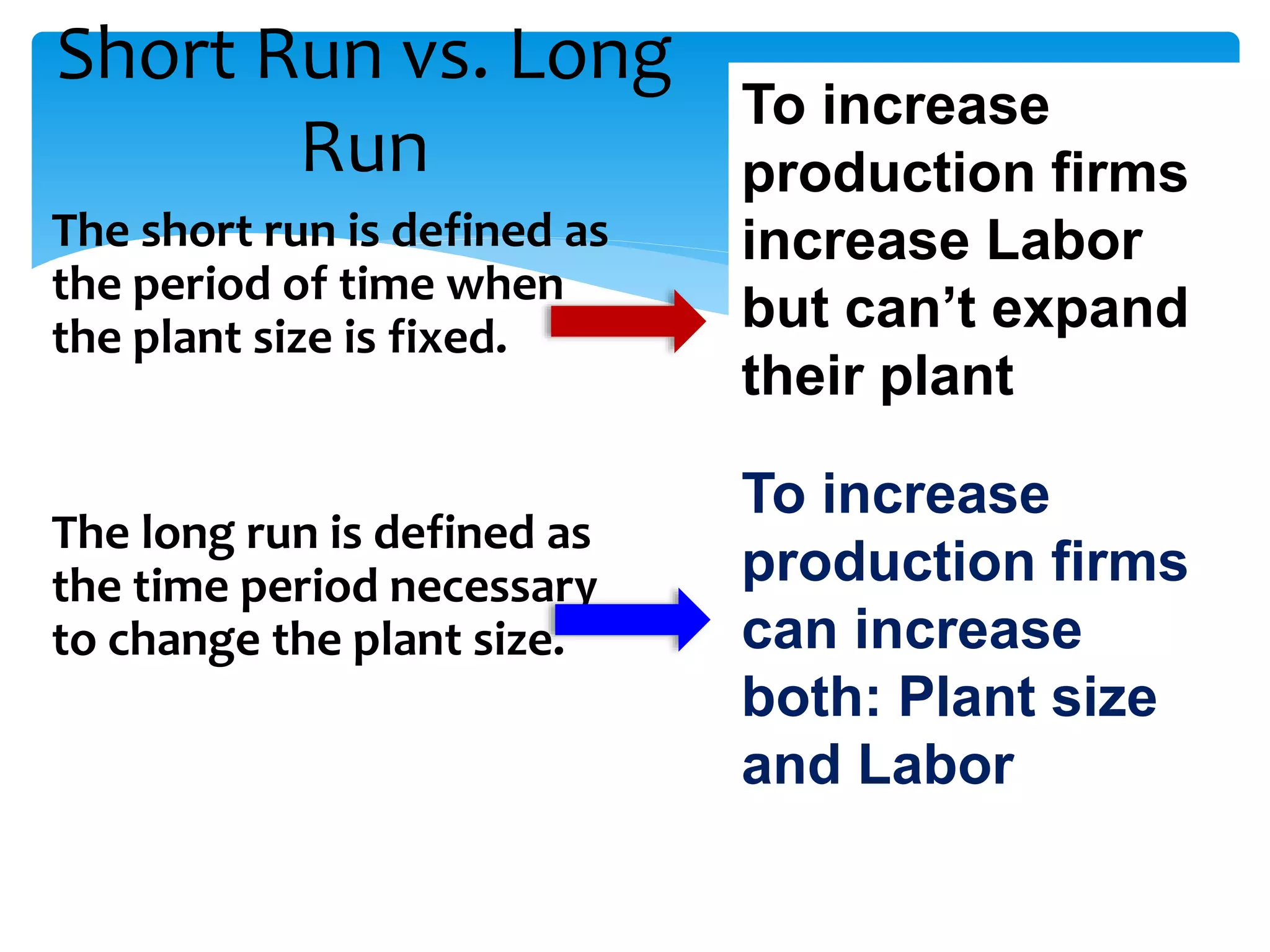
To increase
production firms
increase Labor but
can’t expand their
plant
Short Run vs. Long
Run
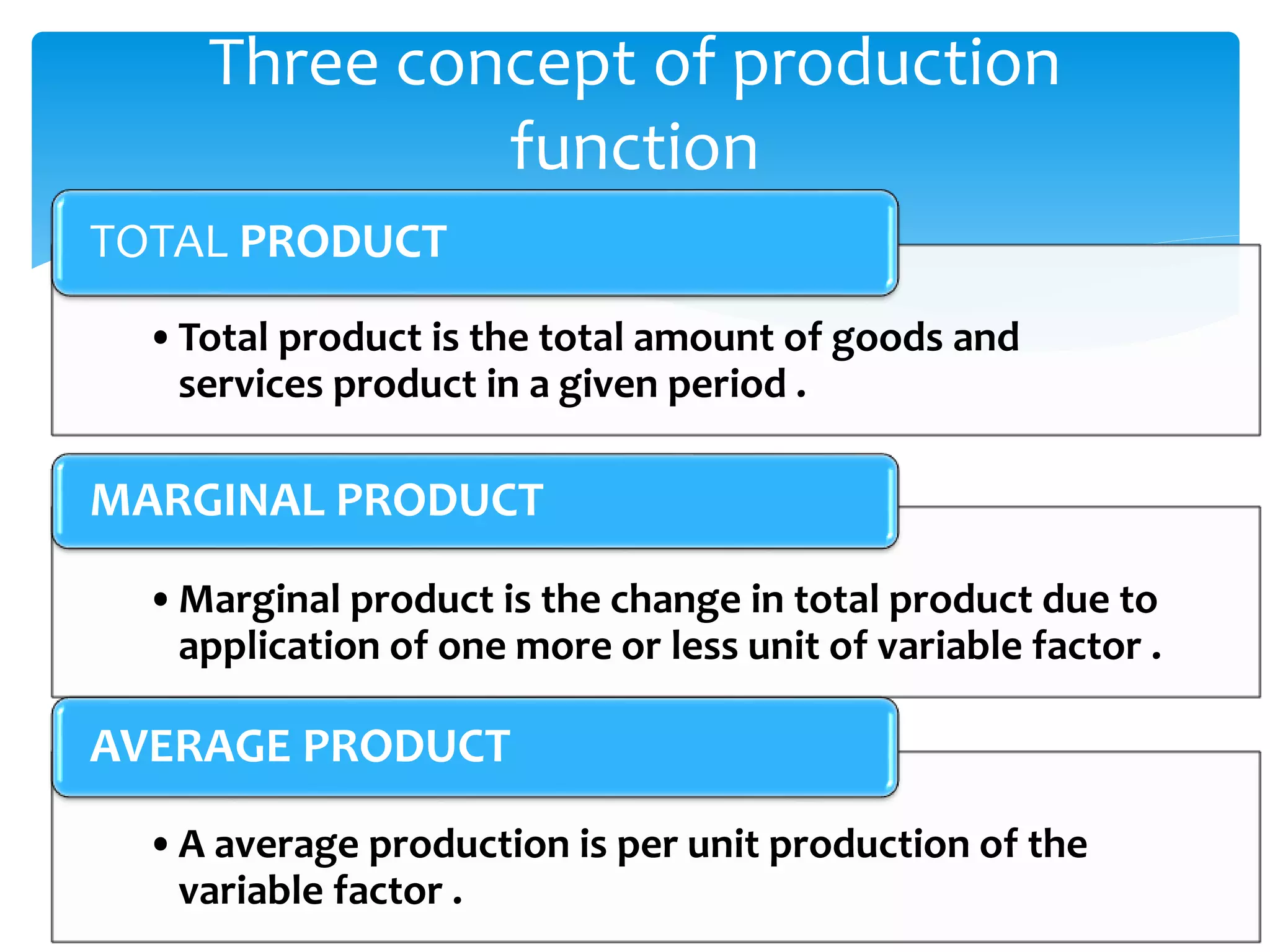
The short run is defined as
the period of time when
the plant size is fixed.
The long run is defined as
the time period necessary
to change the plant size.
6
Plant size is
fixed, labor
is variable
Both Plant
size and labor
are variable
To increase
production firms
increase Labor
but can’t expand
their plant
To increase
production firms
can increase
both: Plant size
and Labor
•Total product is the total amount of goods and
services product in a given period .
TOTAL PRODUCT
•Marginal product is the change in total product due to
application of one more or less unit of variable factor .
MARGINAL PRODUCT
•A average production is per unit production of the
variable factor .
AVERAGE PRODUCT
Three concept of production
function
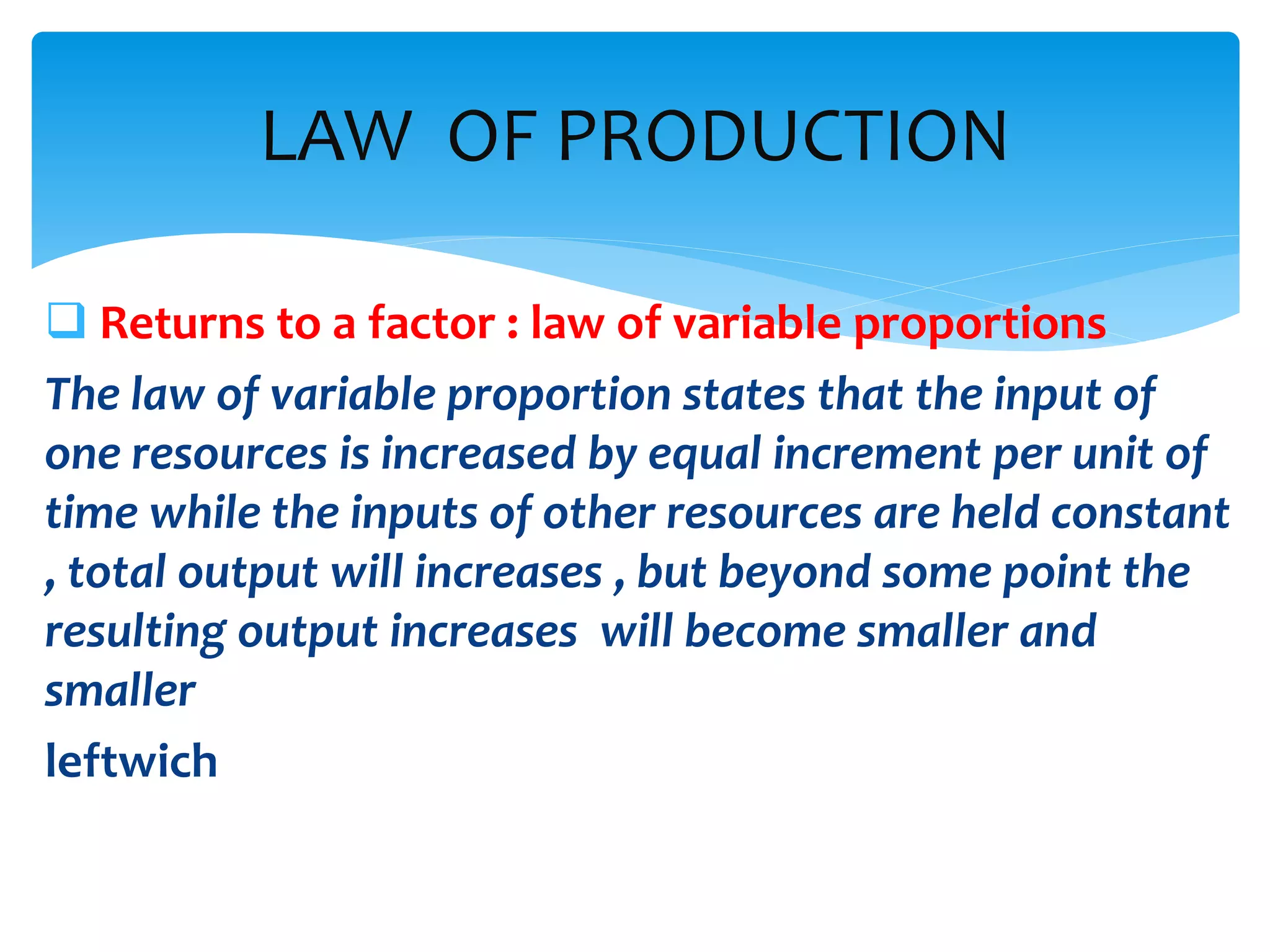
 Returns to a factor : law of variable proportions
The law of variable proportion states that the input of
one resources is increased by equal increment per unit of
time while the inputs of other resources are held constant
, total output will increases , but beyond some point the
resulting output increases will become smaller and
smaller
leftwich
LAW OF PRODUCTION
ASSUMPTION OF LAW
The ratio which factor of production are combined
can be
changed.
 units of variable factor are homogeneous or equally
efficient and
are increased one by one. Thus diminishing returns
start occurring
not because latter unit of the variable factor are less
efficient
then the former once , but because fixity of the factor .
State of technology does not change.
 indivisibility of factors
Change in factor ratio
Imperfect substitutes
Condition of applicability
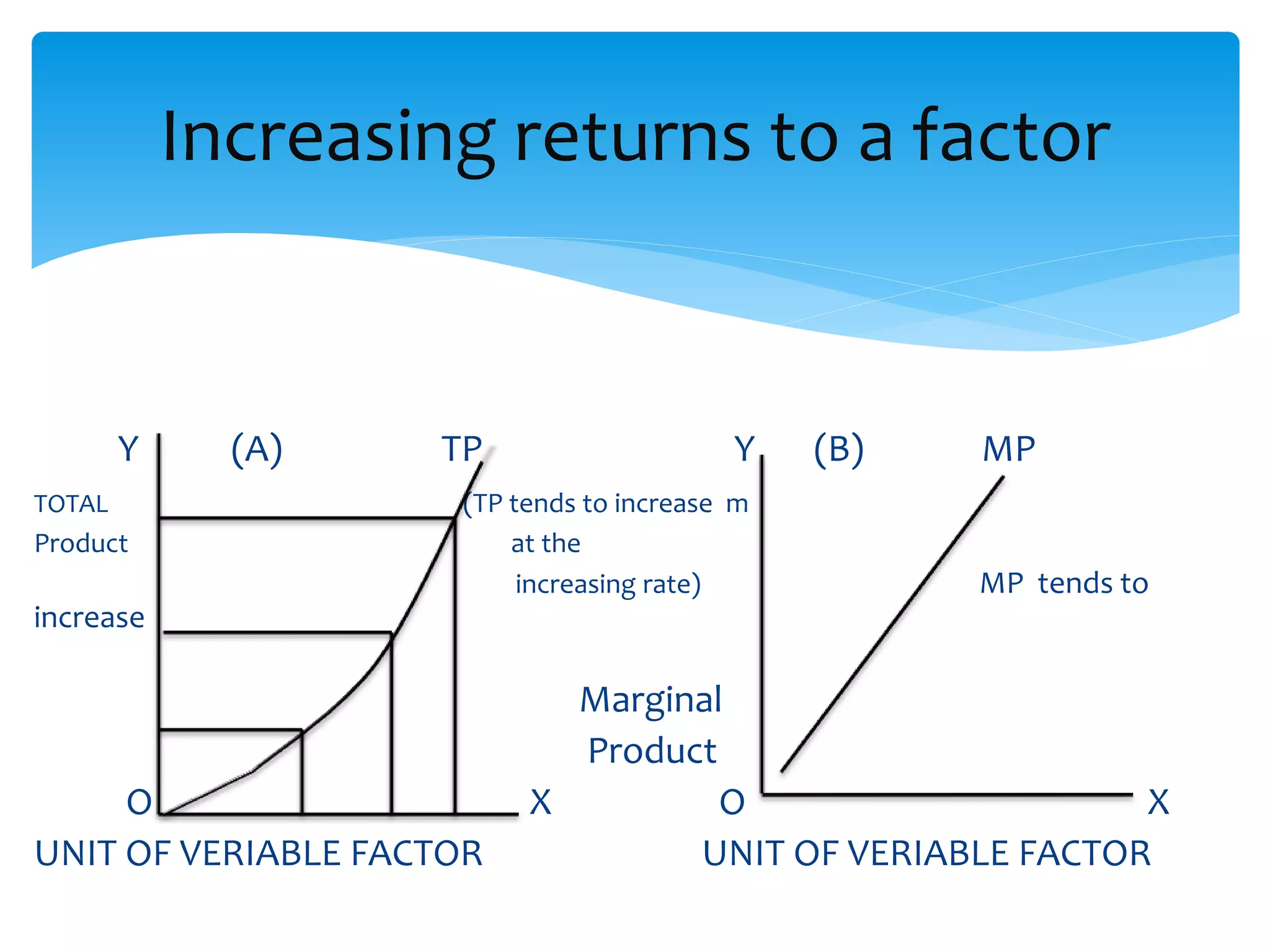
• Increasing return to a factor :- increase return
to factor sates as the proportion of one factor
in a combination of factors is increased upto a
point the, marginal productivity of the factor
will increase.
Retunes to a factor
Y (A) TP Y (B) MP
TOTAL (TP tends to increase m
Product at the
increasing rate) MP tends to
increase
Marginal
Product
O X O X
UNIT OF VERIABLE FACTOR UNIT OF VERIABLE FACTOR
Increasing returns to a factor
Under utilisation of fixed factor
Increase in efficiency
Better coordination between the factors
Cause of increasing returns to a
factor
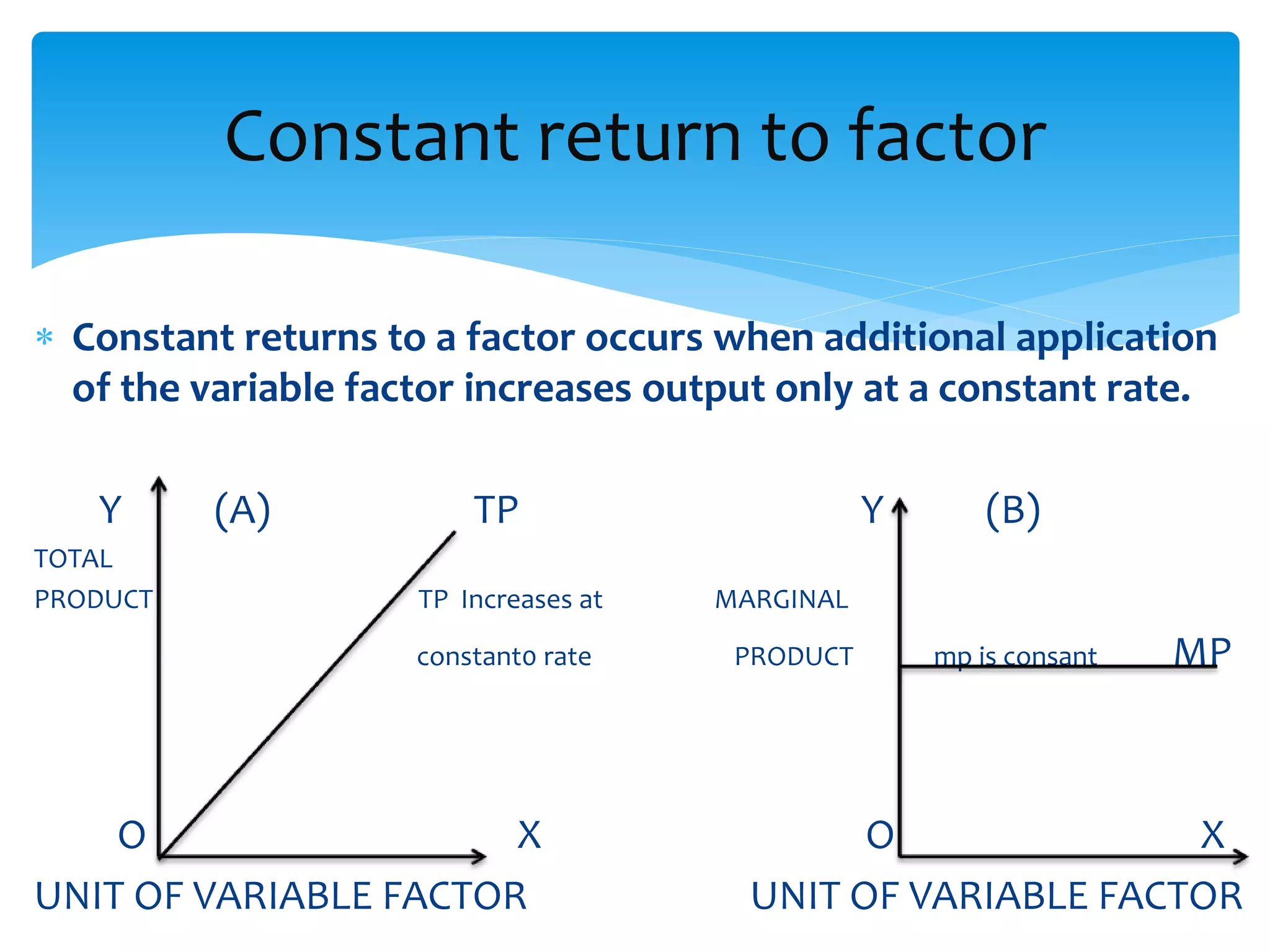
 Constant returns to a factor occurs when additional application
of the variable factor increases output only at a constant rate.
Y (A) TP Y (B)
TOTAL
PRODUCT TP Increases at MARGINAL
constant0 rate PRODUCT mp is consant MP
O X O X
UNIT OF VARIABLE FACTOR UNIT OF VARIABLE FACTOR
Constant return to factor
Optimum utilisation of the fixed factor
Ideal factor ratio
Most efficient of the utilisation of variable
factor
Couse Of constant returns to a factor
 an increase amount of capital and labour
applied in the cultivation of land cause , in
general in a less then proportionate increase
in the amount of product raised unless it
happens to coincide with an improvement in
the art of agriculture.
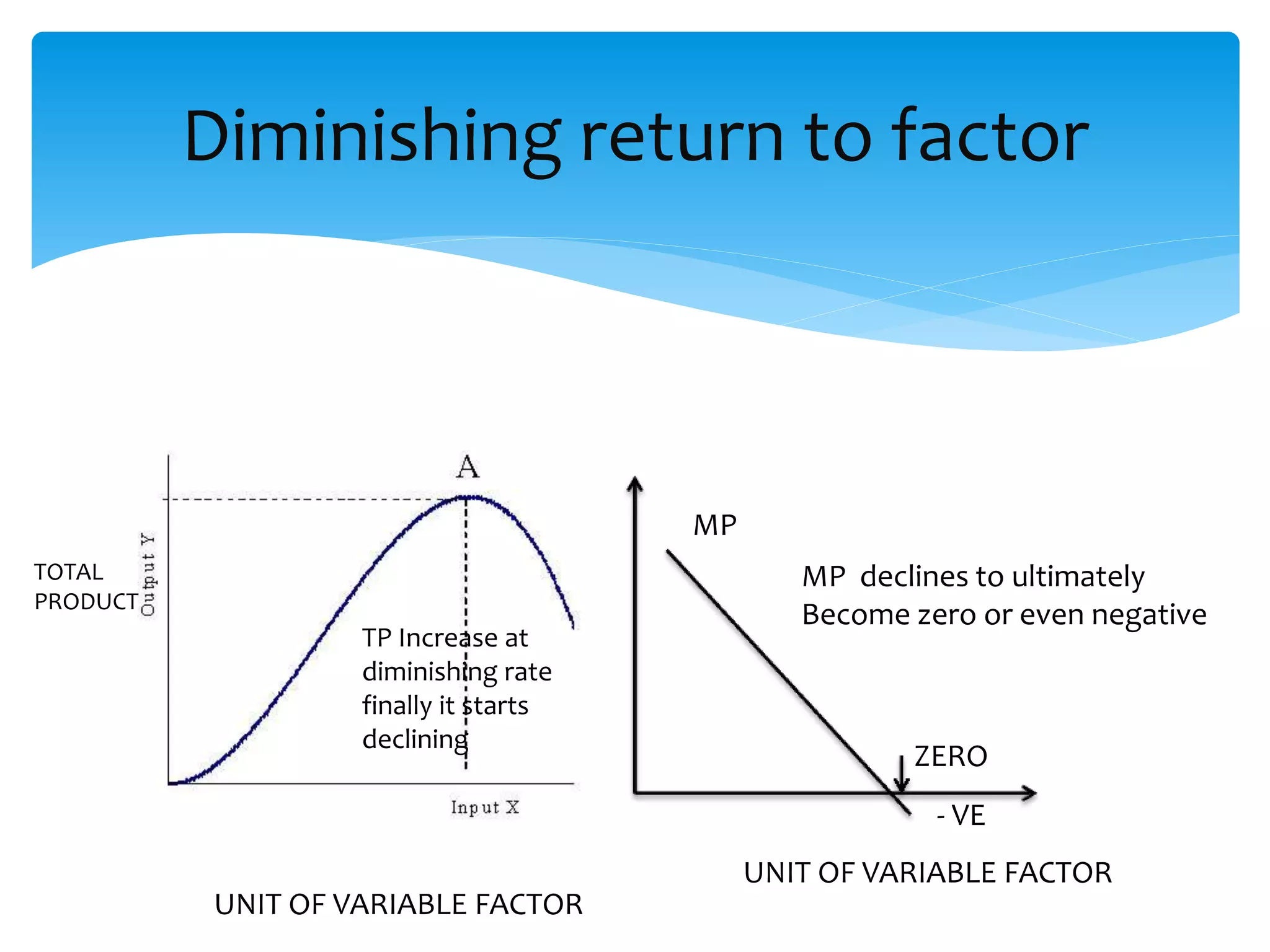
Diminishing return to a factor
Diminishing return to factor
TP Increase at
diminishing rate
finally it starts
declining
TOTAL
PRODUCT
UNIT OF VARIABLE FACTOR
MP declines to ultimately
Become zero or even negative
MP
ZERO
- VE
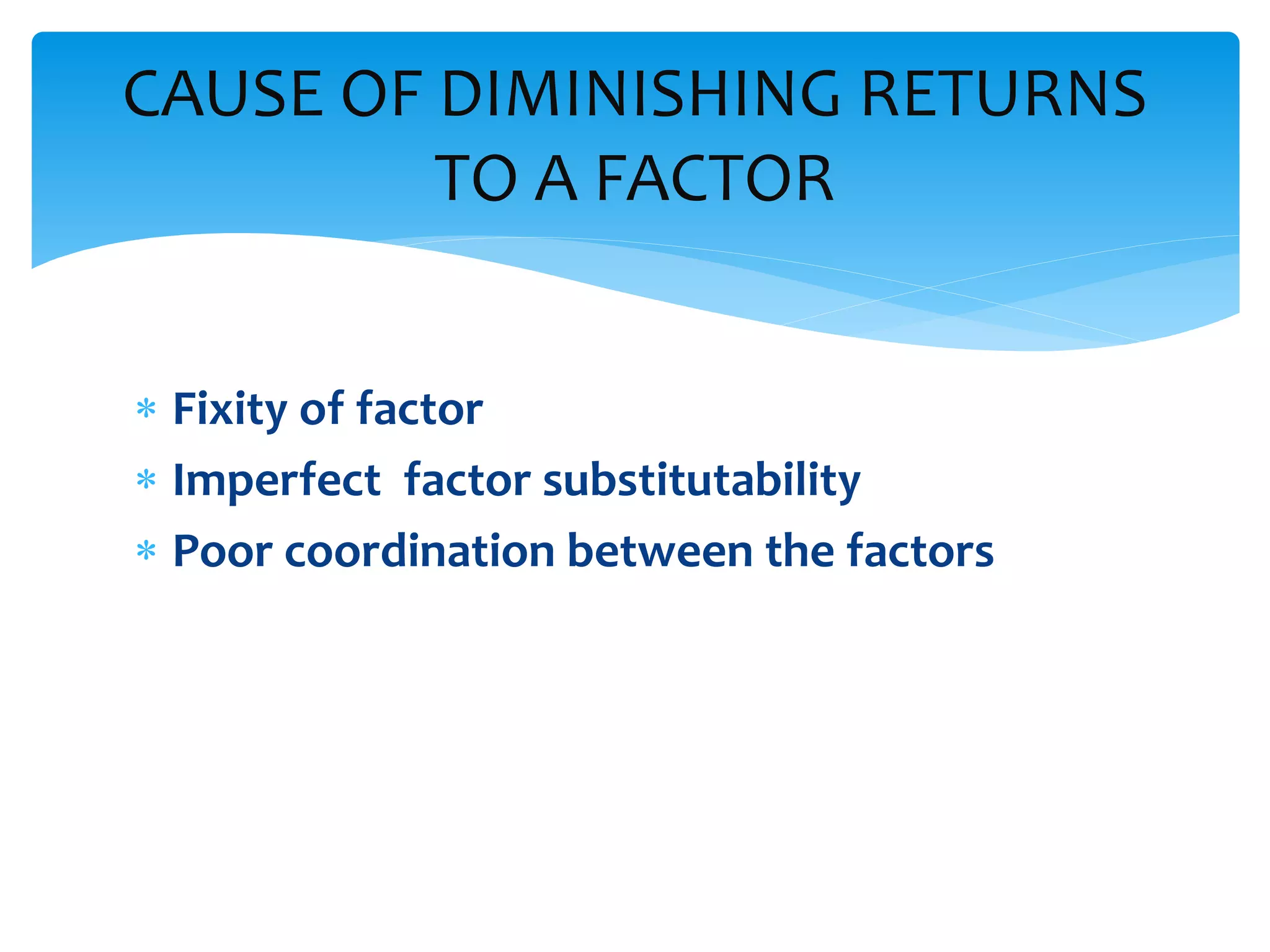
 Fixity of factor
 Imperfect factor substitutability
 Poor coordination between the factors
CAUSE OF DIMINISHING RETURNS
TO A FACTOR
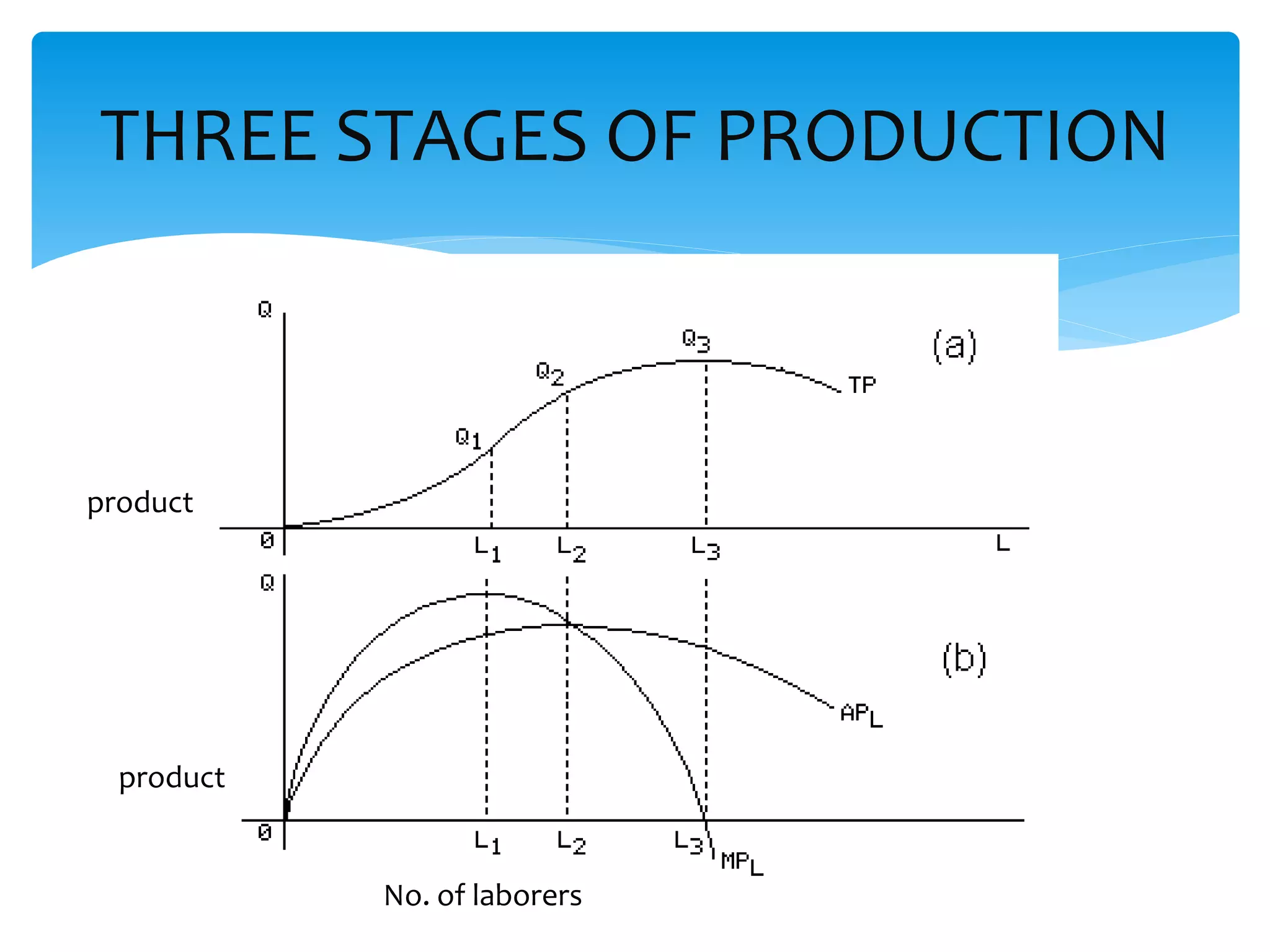
THREE STAGES OF PRODUCTION
product
product
No. of laborers
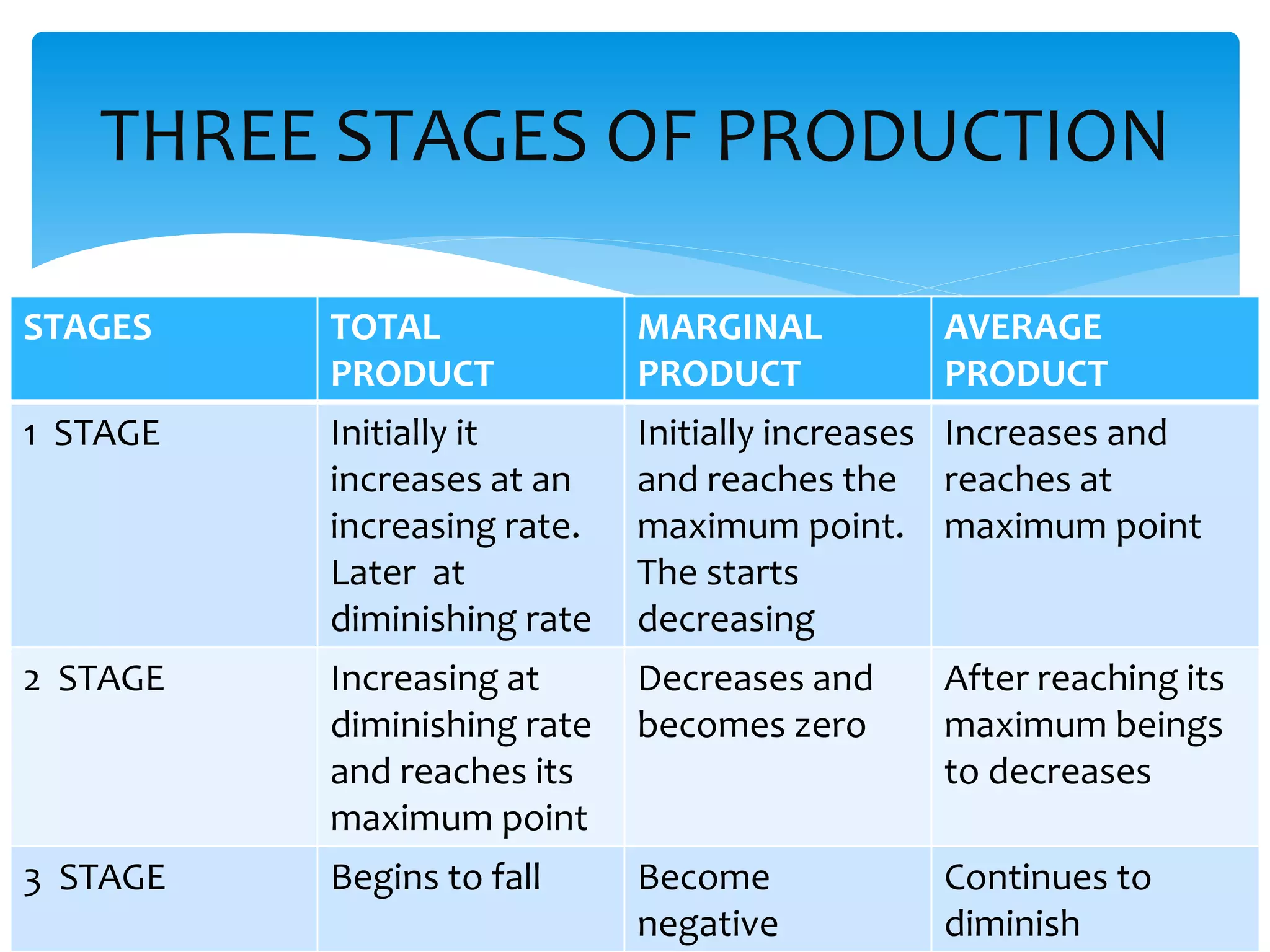
STAGES TOTAL
PRODUCT
MARGINAL
PRODUCT
AVERAGE
PRODUCT
1 STAGE Initially it
increases at an
increasing rate.
Later at
diminishing rate
Initially increases
and reaches the
maximum point.
The starts
decreasing
Increases and
reaches at
maximum point
2 STAGE Increasing at
diminishing rate
and reaches its
maximum point
Decreases and
becomes zero
After reaching its
maximum beings
to decreases
3 STAGE Begins to fall Become
negative
Continues to
diminish
THREE STAGES OF PRODUCTION
 “The term return to scale refer to the change
in output as all factor change by the same
proportion ”
RETURN TO SCALE
P = f[L,K]
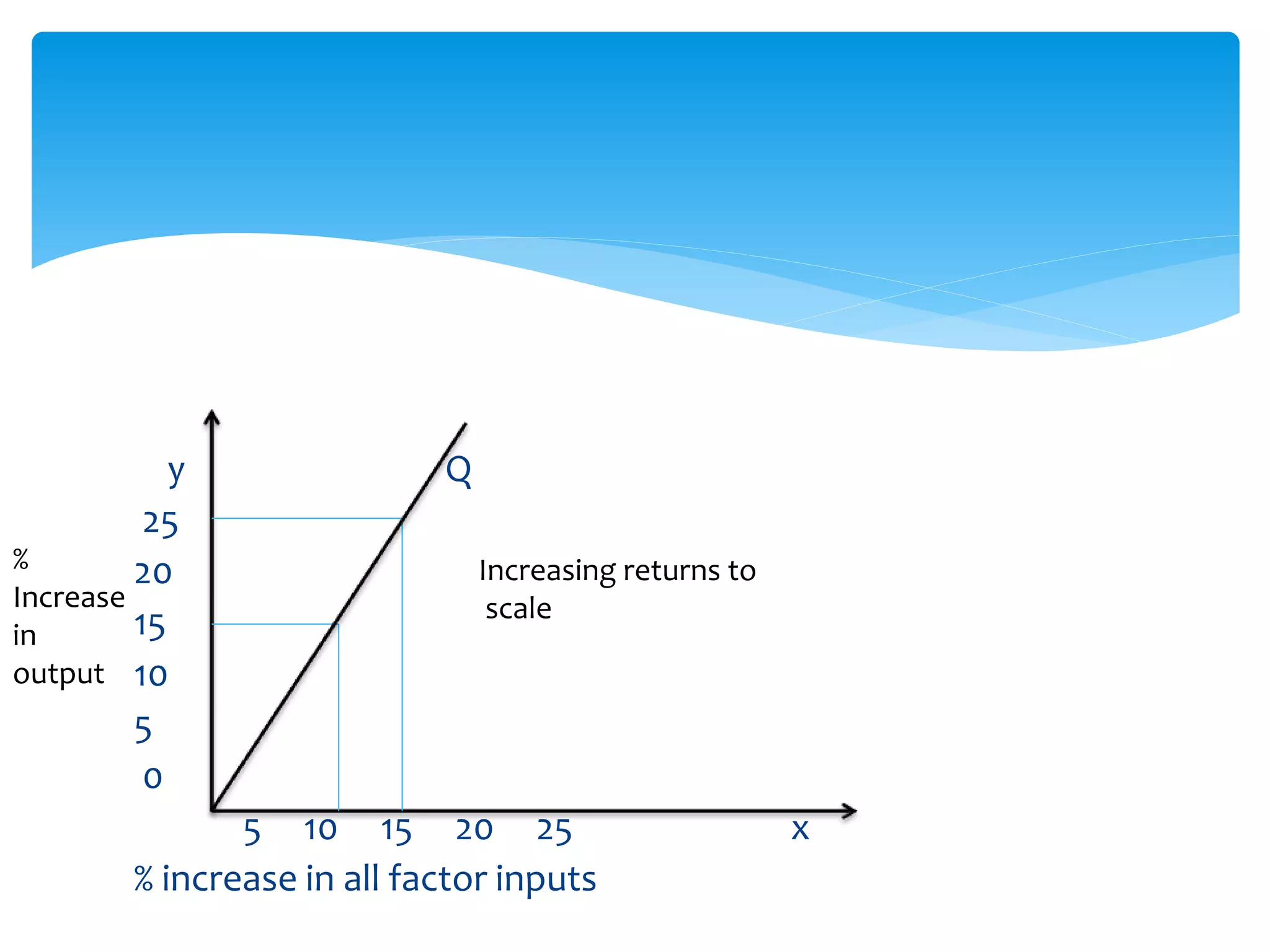
 Increasing return to scale occur when a given
percentage increase in all factor inputs cause
proportionately grater increasing in output
INCREASING RETURNS TO SCALE
y Q
25
20
15
10
5
0
5 10 15 20 25 x
% increase in all factor inputs
Increasing returns to
scale
%
Increase
in
output
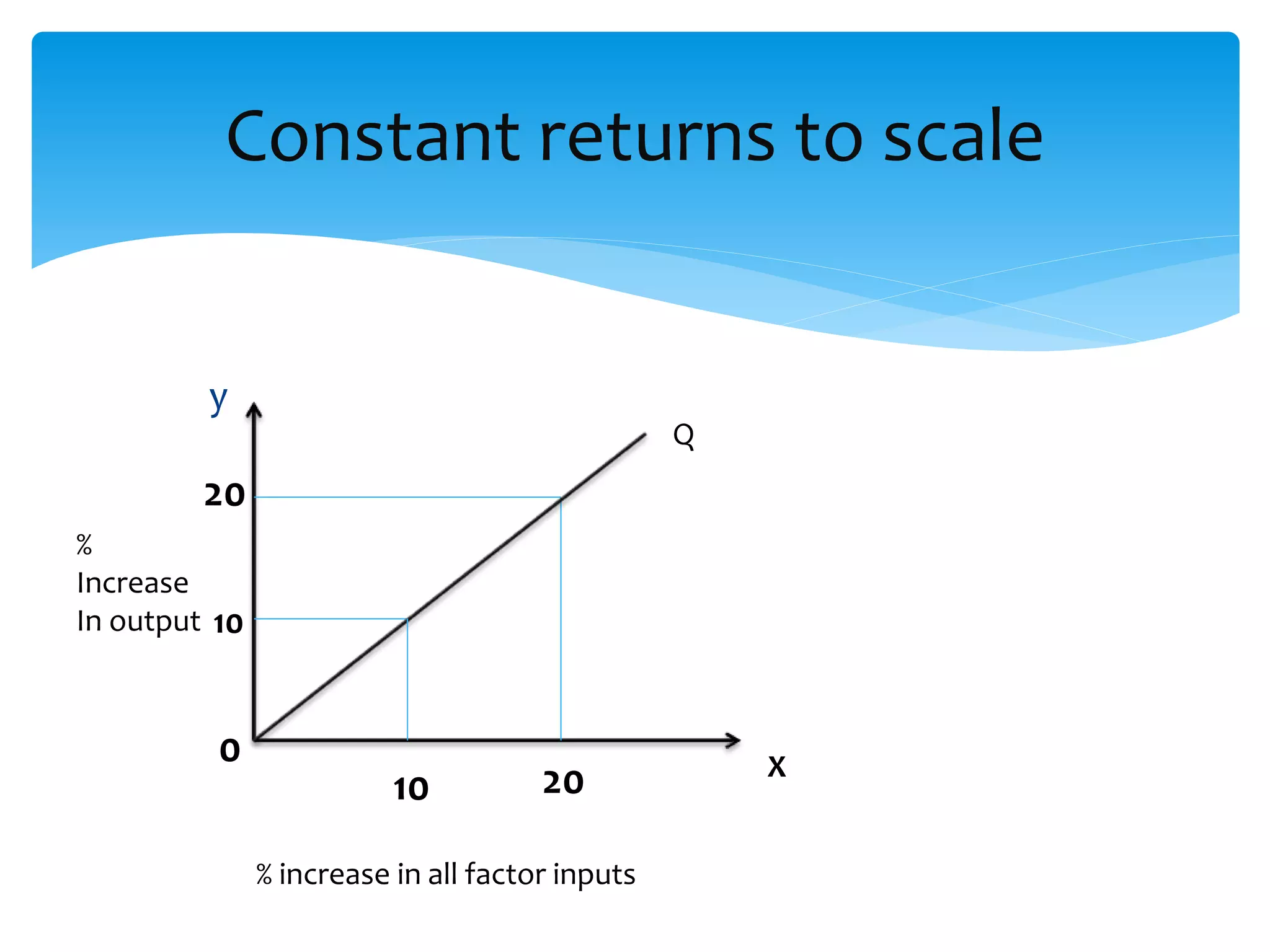
 Constant return to scale occurs when
percentage increase in all factor input cause
equal percentage increase in output
Constant returns to scale
y
Constant returns to scale
% increase in all factor inputs
%
Increase
In output
Q
20
10
0
10 20 X
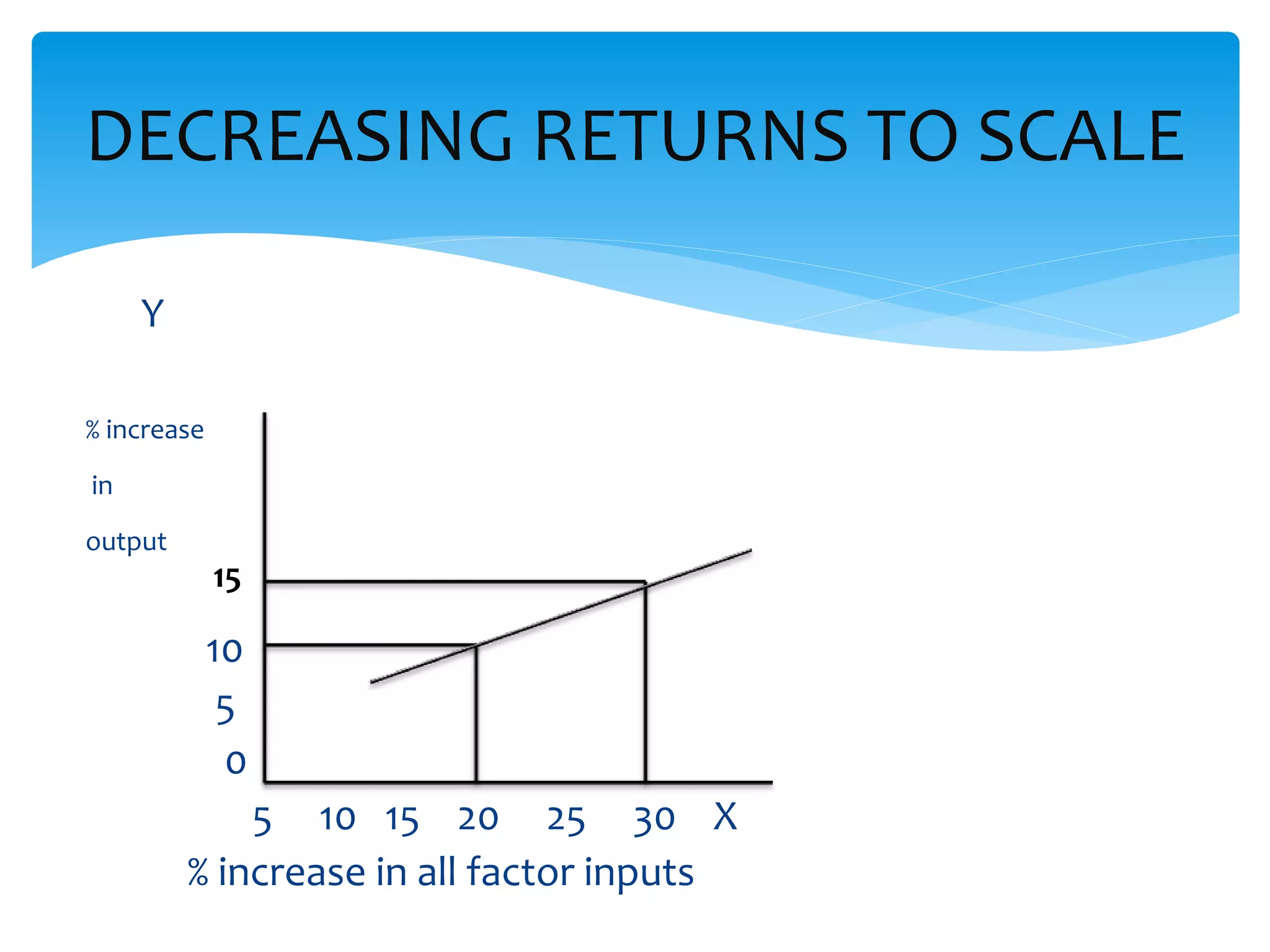
 Decreasing returns to scale occurs when
given percentage increase in all factor inputs
causes proportionately lesser increase in
output.
DECREASING RETURNS TO SCALE
Y
% increase
in
output
10
5
0
5 10 15 20 25 30 X
% increase in all factor inputs
DECREASING RETURNS TO SCALE
15
 Increasing rate to scale refer to the situation
in which increasing the scale of production
reduces the unit cost of production or raises
output per unit of the factor inputs.
Couse of increasing return to scale
 internal economies of scale :- when a firm
increases its scale of production it enjoys several
economies. These economies are called internal
economies.
 real economies :- real economies are those which
are associated with a reduction in the physical
quantity of inputs raw materials various type of
labour and various type of capital.
Real economies can be six type :-
Increasing return to scale
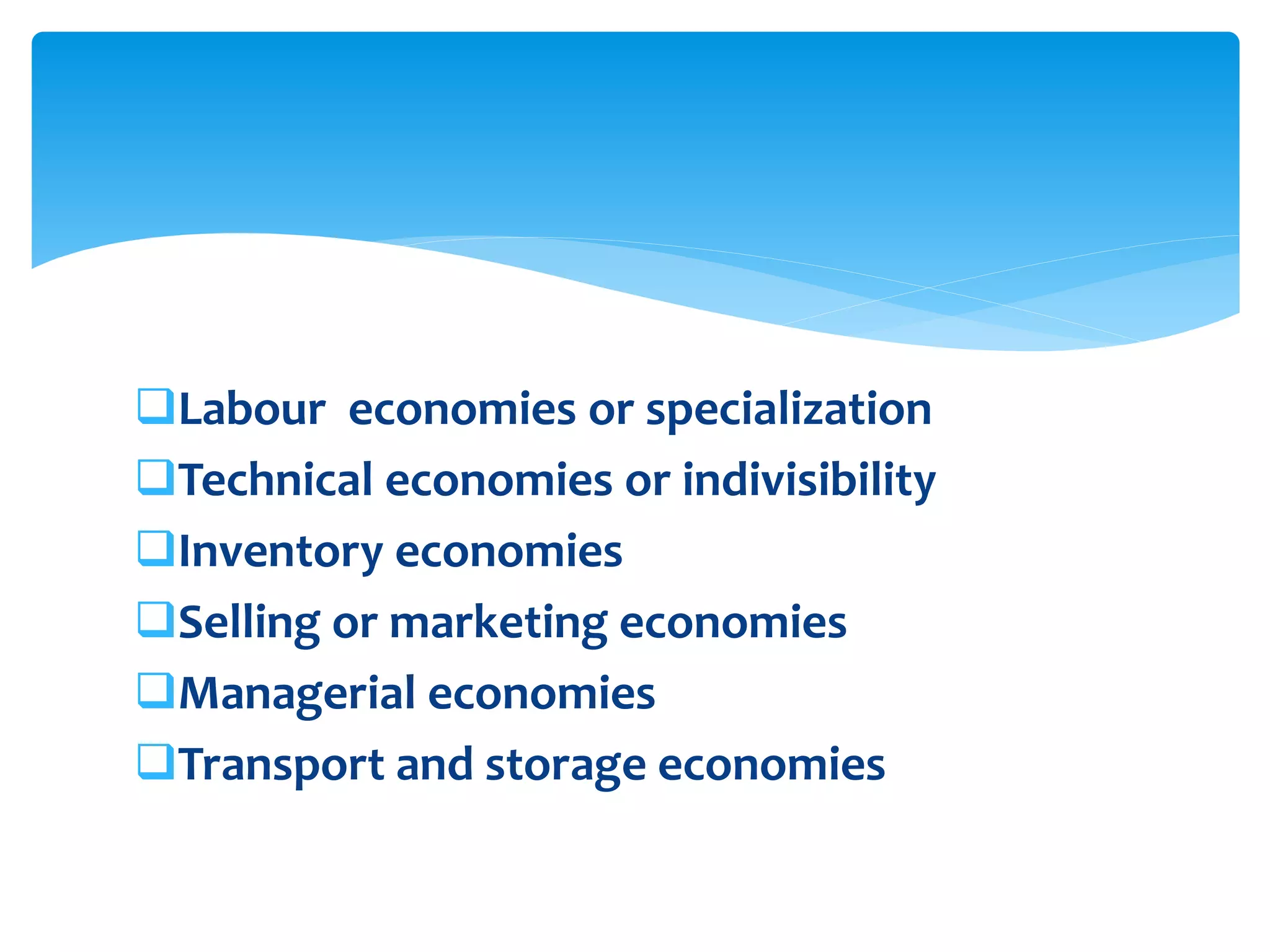
Labour economies or specialization
Technical economies or indivisibility
Inventory economies
Selling or marketing economies
Managerial economies
Transport and storage economies
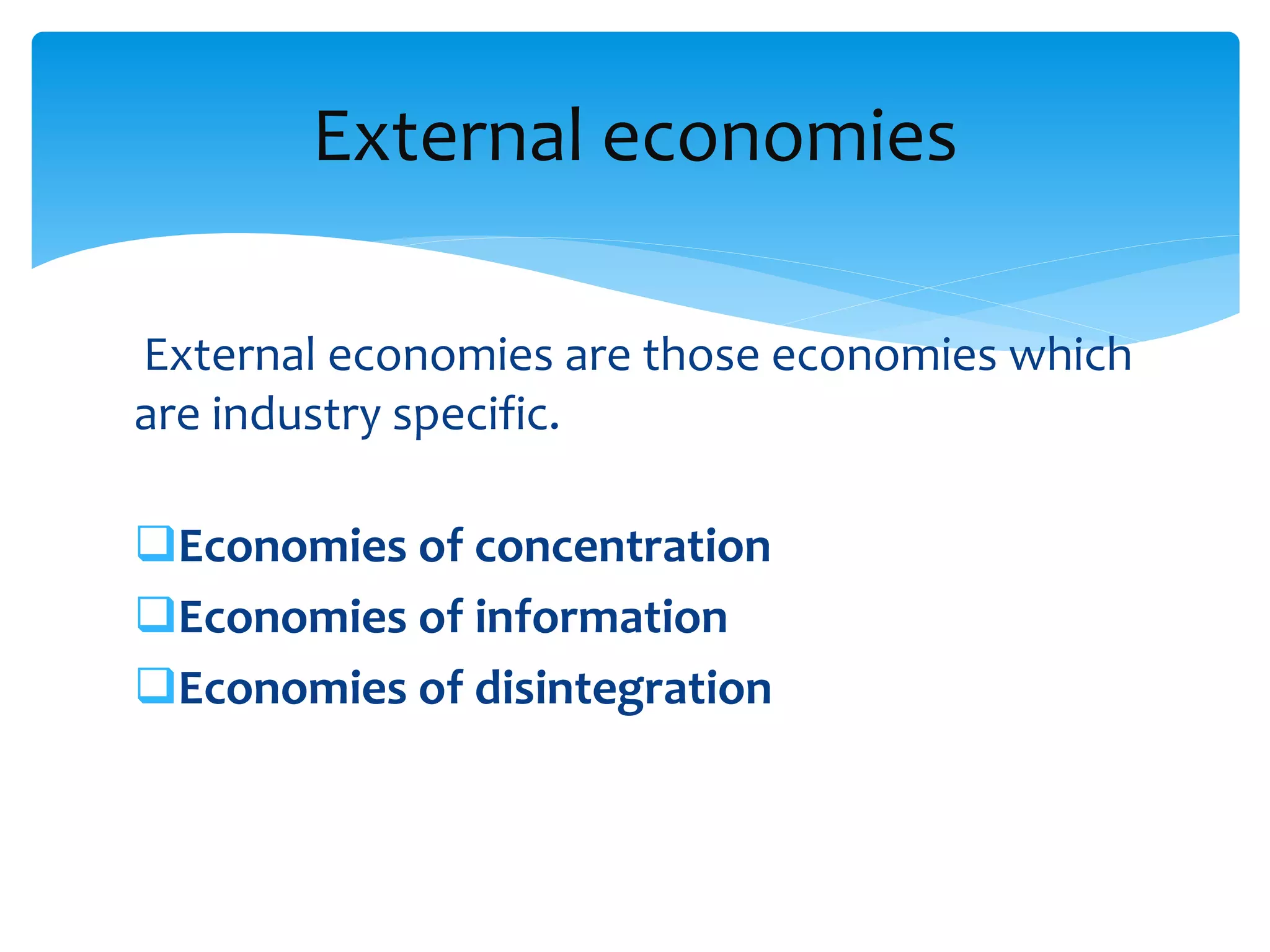
External economies are those economies which
are industry specific.
Economies of concentration
Economies of information
Economies of disintegration
External economies
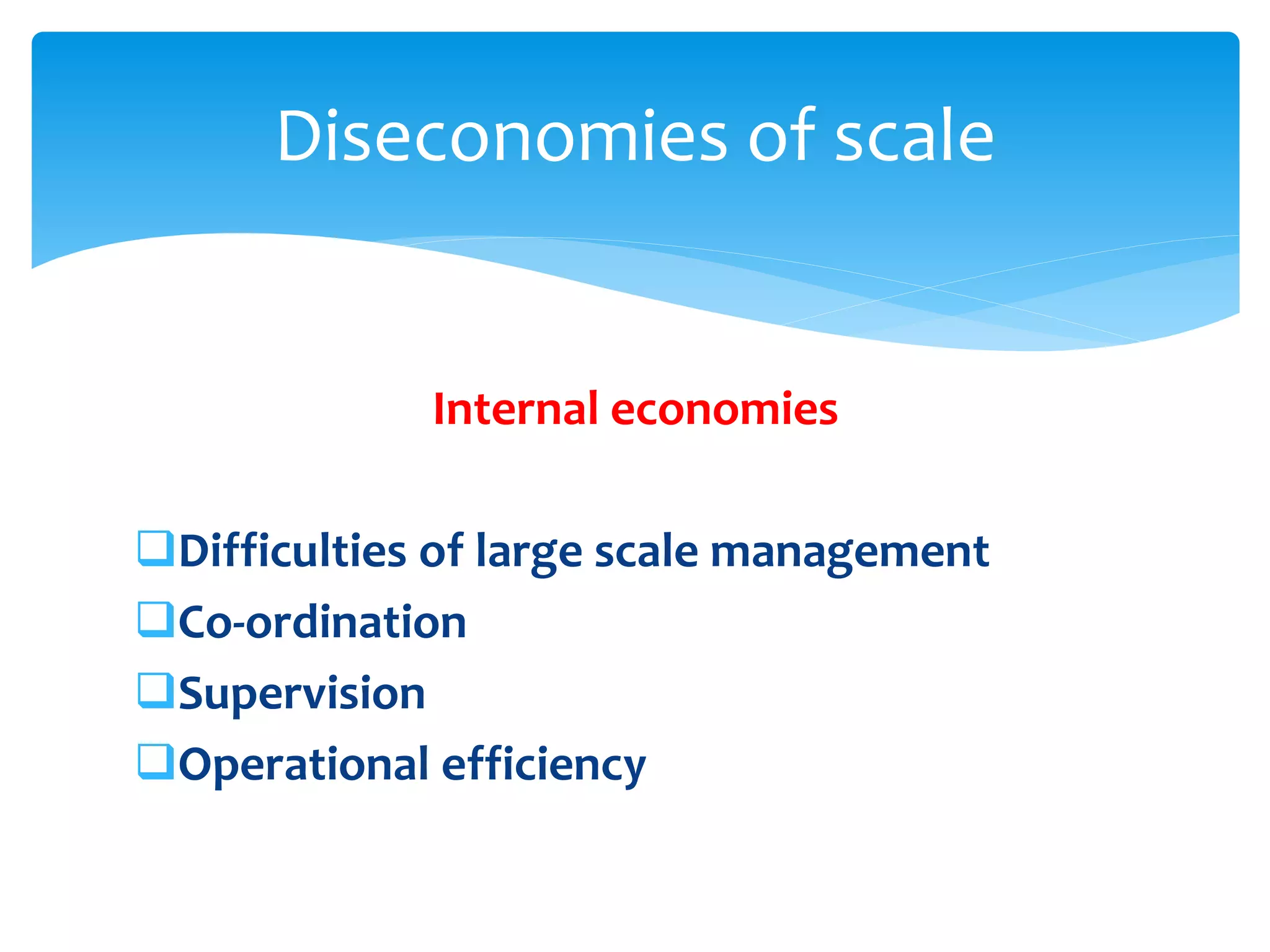
Internal economies
Difficulties of large scale management
Co-ordination
Supervision
Operational efficiency
Diseconomies of scale
External diseconomies
Localisation
Skilled
Presented by :- GURMEET SINGH & GORAV CHOBEY

production funcation

  • 1.
    HARYANA SCHOOL OFBUSINESS PRESENTETION :- MANAGRIAL ECONOMIC production function GURU JAMBHESHWER SCIENCE & TECHNOLOGY UNIVERSITY ,HISSAR
  • 2.
    “PRODUCTION IS THETRANSFORMETION OF INPUT INTO OUTPAT “ WHAT IS PRODUCTION ????
  • 3.
  • 4.
     “Production functionis the relation between A firm’s production (output) and the material factor of production (input)” _Watson PRODUCTION FUNCATION
  • 5.
    Total product (TP) Averageproduct (AP) Marginal product (MP) 5 To increase production firms increase Labor but can’t expand their plant
  • 6.
    Short Run vs.Long Run The short run is defined as the period of time when the plant size is fixed. The long run is defined as the time period necessary to change the plant size. 6 Plant size is fixed, labor is variable Both Plant size and labor are variable To increase production firms increase Labor but can’t expand their plant To increase production firms can increase both: Plant size and Labor
  • 7.
    •Total product isthe total amount of goods and services product in a given period . TOTAL PRODUCT •Marginal product is the change in total product due to application of one more or less unit of variable factor . MARGINAL PRODUCT •A average production is per unit production of the variable factor . AVERAGE PRODUCT Three concept of production function
  • 8.
     Returns toa factor : law of variable proportions The law of variable proportion states that the input of one resources is increased by equal increment per unit of time while the inputs of other resources are held constant , total output will increases , but beyond some point the resulting output increases will become smaller and smaller leftwich LAW OF PRODUCTION
  • 9.
    ASSUMPTION OF LAW Theratio which factor of production are combined can be changed.  units of variable factor are homogeneous or equally efficient and are increased one by one. Thus diminishing returns start occurring not because latter unit of the variable factor are less efficient then the former once , but because fixity of the factor . State of technology does not change.
  • 10.
     indivisibility offactors Change in factor ratio Imperfect substitutes Condition of applicability
  • 11.
    • Increasing returnto a factor :- increase return to factor sates as the proportion of one factor in a combination of factors is increased upto a point the, marginal productivity of the factor will increase. Retunes to a factor
  • 12.
    Y (A) TPY (B) MP TOTAL (TP tends to increase m Product at the increasing rate) MP tends to increase Marginal Product O X O X UNIT OF VERIABLE FACTOR UNIT OF VERIABLE FACTOR Increasing returns to a factor
  • 13.
    Under utilisation offixed factor Increase in efficiency Better coordination between the factors Cause of increasing returns to a factor
  • 14.
     Constant returnsto a factor occurs when additional application of the variable factor increases output only at a constant rate. Y (A) TP Y (B) TOTAL PRODUCT TP Increases at MARGINAL constant0 rate PRODUCT mp is consant MP O X O X UNIT OF VARIABLE FACTOR UNIT OF VARIABLE FACTOR Constant return to factor
  • 15.
    Optimum utilisation ofthe fixed factor Ideal factor ratio Most efficient of the utilisation of variable factor Couse Of constant returns to a factor
  • 16.
     an increaseamount of capital and labour applied in the cultivation of land cause , in general in a less then proportionate increase in the amount of product raised unless it happens to coincide with an improvement in the art of agriculture. Diminishing return to a factor
  • 17.
    Diminishing return tofactor TP Increase at diminishing rate finally it starts declining TOTAL PRODUCT UNIT OF VARIABLE FACTOR UNIT OF VARIABLE FACTOR MP declines to ultimately Become zero or even negative MP ZERO - VE
  • 18.
     Fixity offactor  Imperfect factor substitutability  Poor coordination between the factors CAUSE OF DIMINISHING RETURNS TO A FACTOR
  • 19.
    THREE STAGES OFPRODUCTION product product No. of laborers
  • 20.
    STAGES TOTAL PRODUCT MARGINAL PRODUCT AVERAGE PRODUCT 1 STAGEInitially it increases at an increasing rate. Later at diminishing rate Initially increases and reaches the maximum point. The starts decreasing Increases and reaches at maximum point 2 STAGE Increasing at diminishing rate and reaches its maximum point Decreases and becomes zero After reaching its maximum beings to decreases 3 STAGE Begins to fall Become negative Continues to diminish THREE STAGES OF PRODUCTION
  • 21.
     “The termreturn to scale refer to the change in output as all factor change by the same proportion ” RETURN TO SCALE P = f[L,K]
  • 22.
     Increasing returnto scale occur when a given percentage increase in all factor inputs cause proportionately grater increasing in output INCREASING RETURNS TO SCALE
  • 23.
    y Q 25 20 15 10 5 0 5 1015 20 25 x % increase in all factor inputs Increasing returns to scale % Increase in output
  • 24.
     Constant returnto scale occurs when percentage increase in all factor input cause equal percentage increase in output Constant returns to scale
  • 25.
    y Constant returns toscale % increase in all factor inputs % Increase In output Q 20 10 0 10 20 X
  • 26.
     Decreasing returnsto scale occurs when given percentage increase in all factor inputs causes proportionately lesser increase in output. DECREASING RETURNS TO SCALE
  • 27.
    Y % increase in output 10 5 0 5 1015 20 25 30 X % increase in all factor inputs DECREASING RETURNS TO SCALE 15
  • 28.
     Increasing rateto scale refer to the situation in which increasing the scale of production reduces the unit cost of production or raises output per unit of the factor inputs. Couse of increasing return to scale
  • 29.
     internal economiesof scale :- when a firm increases its scale of production it enjoys several economies. These economies are called internal economies.  real economies :- real economies are those which are associated with a reduction in the physical quantity of inputs raw materials various type of labour and various type of capital. Real economies can be six type :- Increasing return to scale
  • 30.
    Labour economies orspecialization Technical economies or indivisibility Inventory economies Selling or marketing economies Managerial economies Transport and storage economies
  • 31.
    External economies arethose economies which are industry specific. Economies of concentration Economies of information Economies of disintegration External economies
  • 32.
    Internal economies Difficulties oflarge scale management Co-ordination Supervision Operational efficiency Diseconomies of scale
  • 33.
  • 34.
    Presented by :-GURMEET SINGH & GORAV CHOBEY