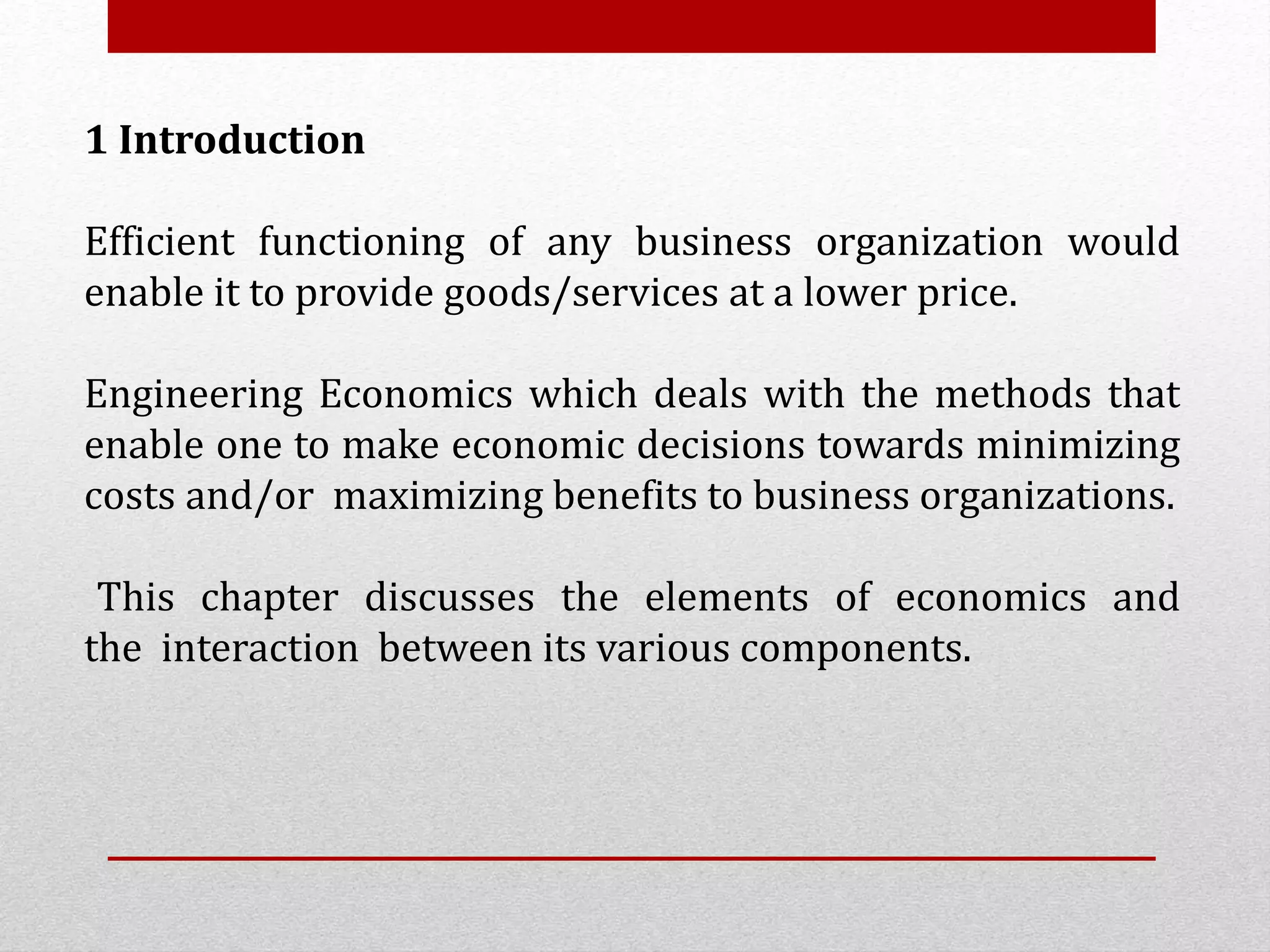
1 Introduction
Efficient functioning of any business organization would
enable it to provide goods/services at a lower price.
Engineering Economics which deals with the methods that
enable one to make economic decisions towards minimizing
costs and/or maximizing benefits to business organizations.
This chapter discusses the elements of economics and
the interaction between its various components.
1.2 Economics is a study of economic problems of the
people concerning production, consumption, exchange and
distribution of wealth.
Economics is the science that deals with the production and
consumption of goods and services and the distribution and
rendering of these for human welfare.
The following are the economic goals.
 A high level of employment
 Price stability
 Efficiency
 An equitable distribution of income
 Growth
1.3 Flow in economy :The flow of goods, services, resources
and money payments in a simple economy
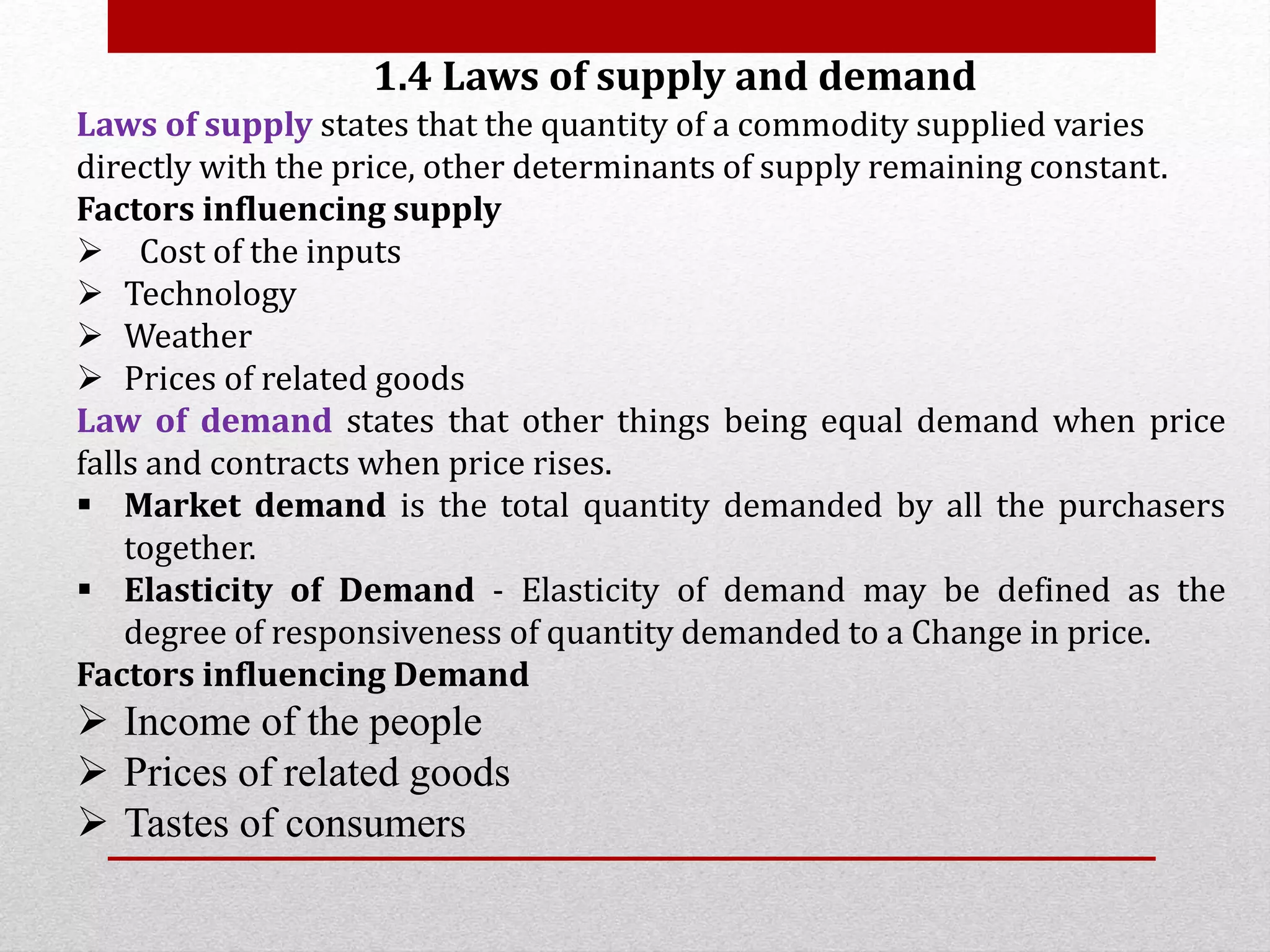
1.4 Laws of supply and demand
Laws of supply states that the quantity of a commodity supplied varies
directly with the price, other determinants of supply remaining constant.
Factors influencing supply
 Cost of the inputs
 Technology
 Weather
 Prices of related goods
Law of demand states that other things being equal demand when price
falls and contracts when price rises.
 Market demand is the total quantity demanded by all the purchasers
together.
 Elasticity of Demand - Elasticity of demand may be defined as the
degree of responsiveness of quantity demanded to a Change in price.
Factors influencing Demand
 Income of the people
 Prices of related goods
 Tastes of consumers
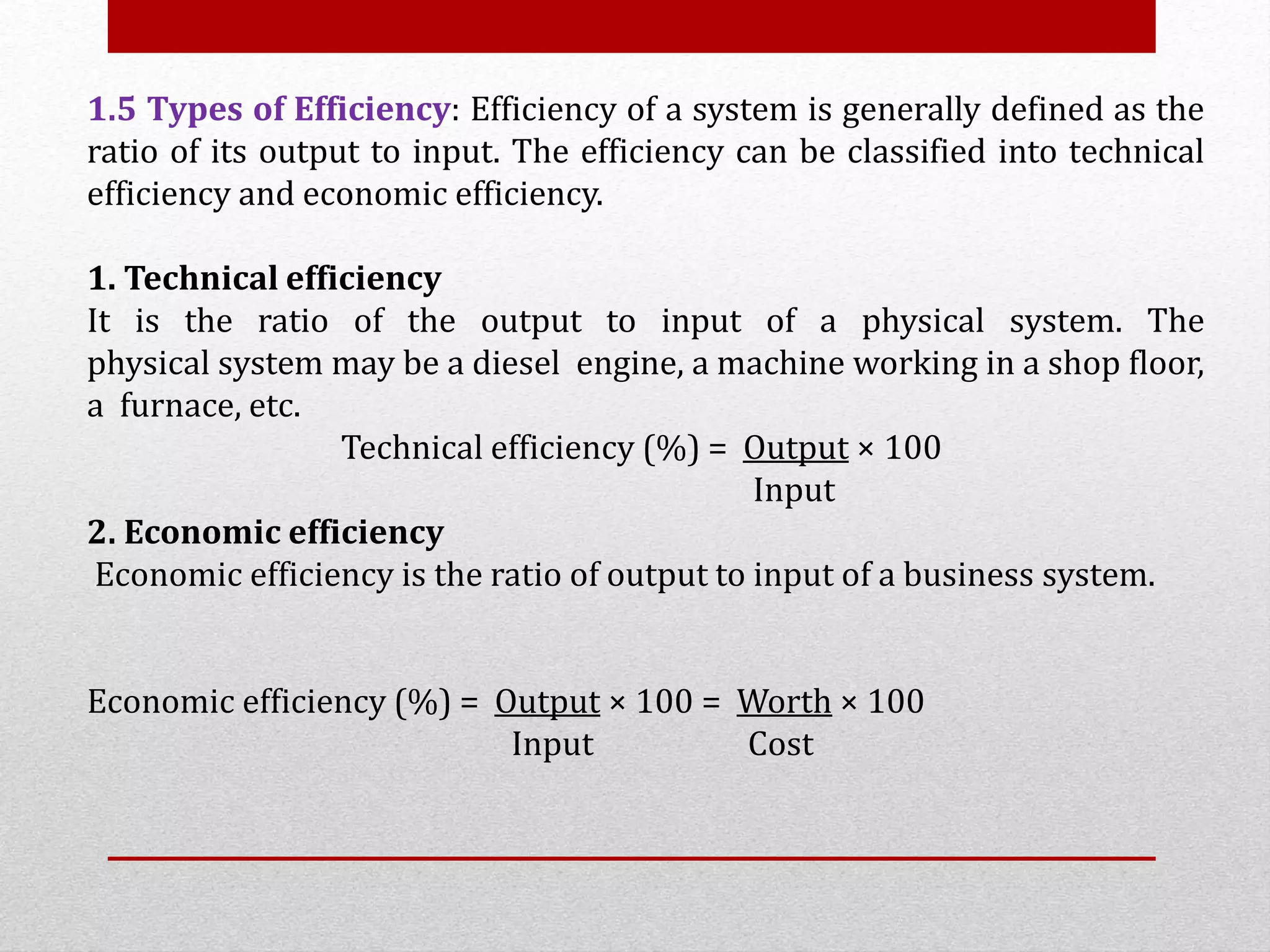
1.5 Types of Efficiency: Efficiency of a system is generally defined as the
ratio of its output to input. The efficiency can be classified into technical
efficiency and economic efficiency.
1. Technical efficiency
It is the ratio of the output to input of a physical system. The
physical system may be a diesel engine, a machine working in a shop floor,
a furnace, etc.
Technical efficiency (%) = Output × 100
Input
2. Economic efficiency
Economic efficiency is the ratio of output to input of a business system.
Economic efficiency (%) = Output × 100 = Worth × 100
Input Cost
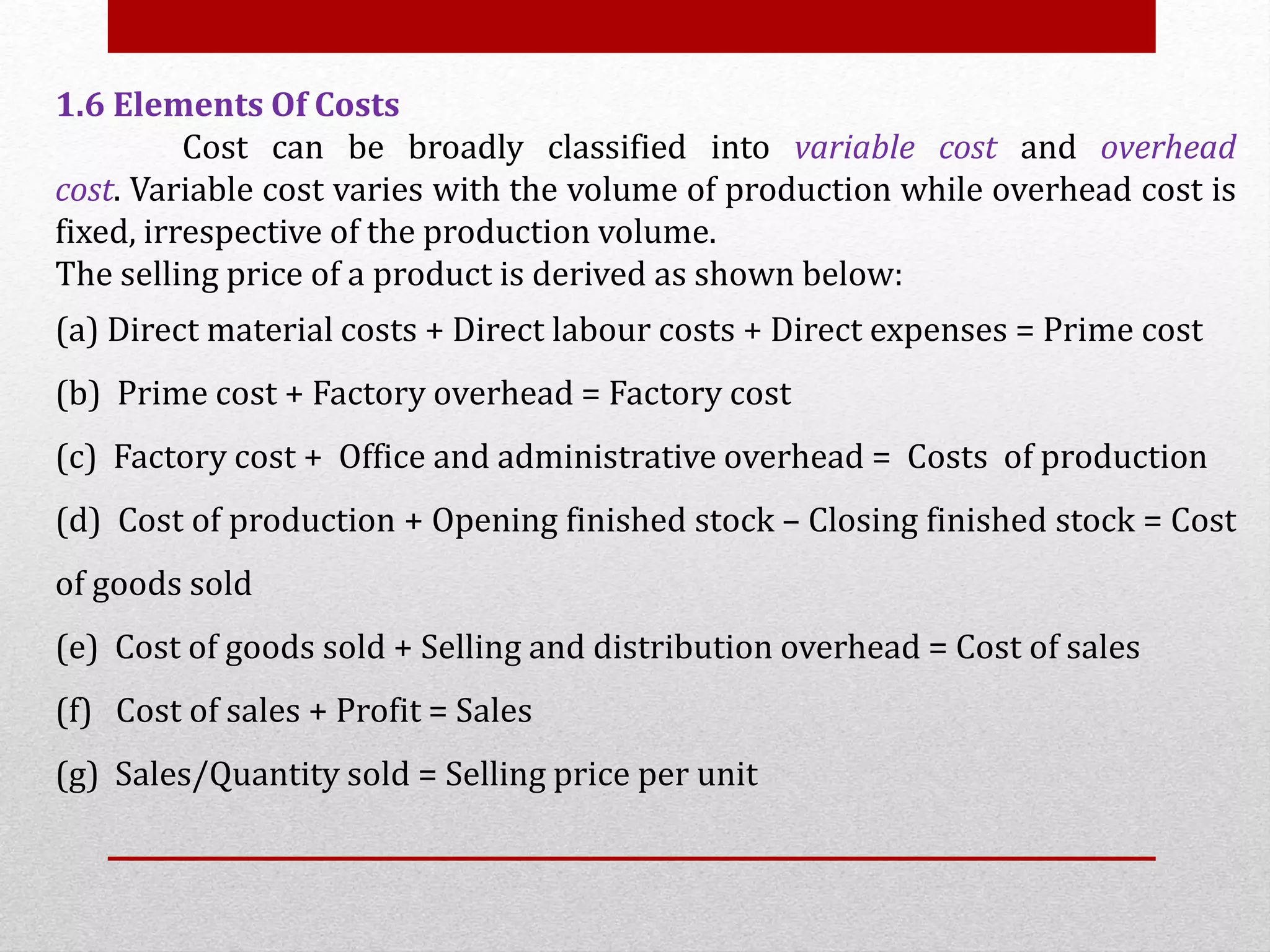
1.6 Elements Of Costs
Cost can be broadly classified into variable cost and overhead
cost. Variable cost varies with the volume of production while overhead cost is
fixed, irrespective of the production volume.
The selling price of a product is derived as shown below:
(a) Direct material costs + Direct labour costs + Direct expenses = Prime cost
(b) Prime cost + Factory overhead = Factory cost
(c) Factory cost + Office and administrative overhead = Costs of production
(d) Cost of production + Opening finished stock – Closing finished stock = Cost
of goods sold
(e) Cost of goods sold + Selling and distribution overhead = Cost of sales
(f) Cost of sales + Profit = Sales
(g) Sales/Quantity sold = Selling price per unit
1.7 Other Costs/Revenues:
(a)Marginal Cost: Marginal cost of a product is the cost of producing an
additional unit of that product. Let the cost of producing 20 units of a
product be Rs. 10,000, and the cost of producing 21 units of the same
product be Rs. 10,045. Then the marginal cost of producing the 21st unit
is Rs. 45.
(b)Marginal Revenue: Marginal revenue of a product is the incremental
revenue of selling an additional unit of that product. Let, the revenue of
selling 20 units of a product be Rs. 15,000 and the revenue of selling 21
units of the same product be Rs. 15,085. Then, the marginal revenue of
selling the 21st unit is Rs. 85.
(c)Sunk Cost: This is known as the past cost of an equipment/asset. Let us
assume that an equipment has been purchased for Rs. 1,00,000 about three
years back. If it is considered for replacement, then its present value is not
Rs. 1,00,000. Instead, its present market value should be taken as the present
value of the equipment for further analysis.
So, the purchase value of the equipment in the past is known as its sunk cost.
(d) Opportunity Cost: In practice, if an alternative (X, Y )
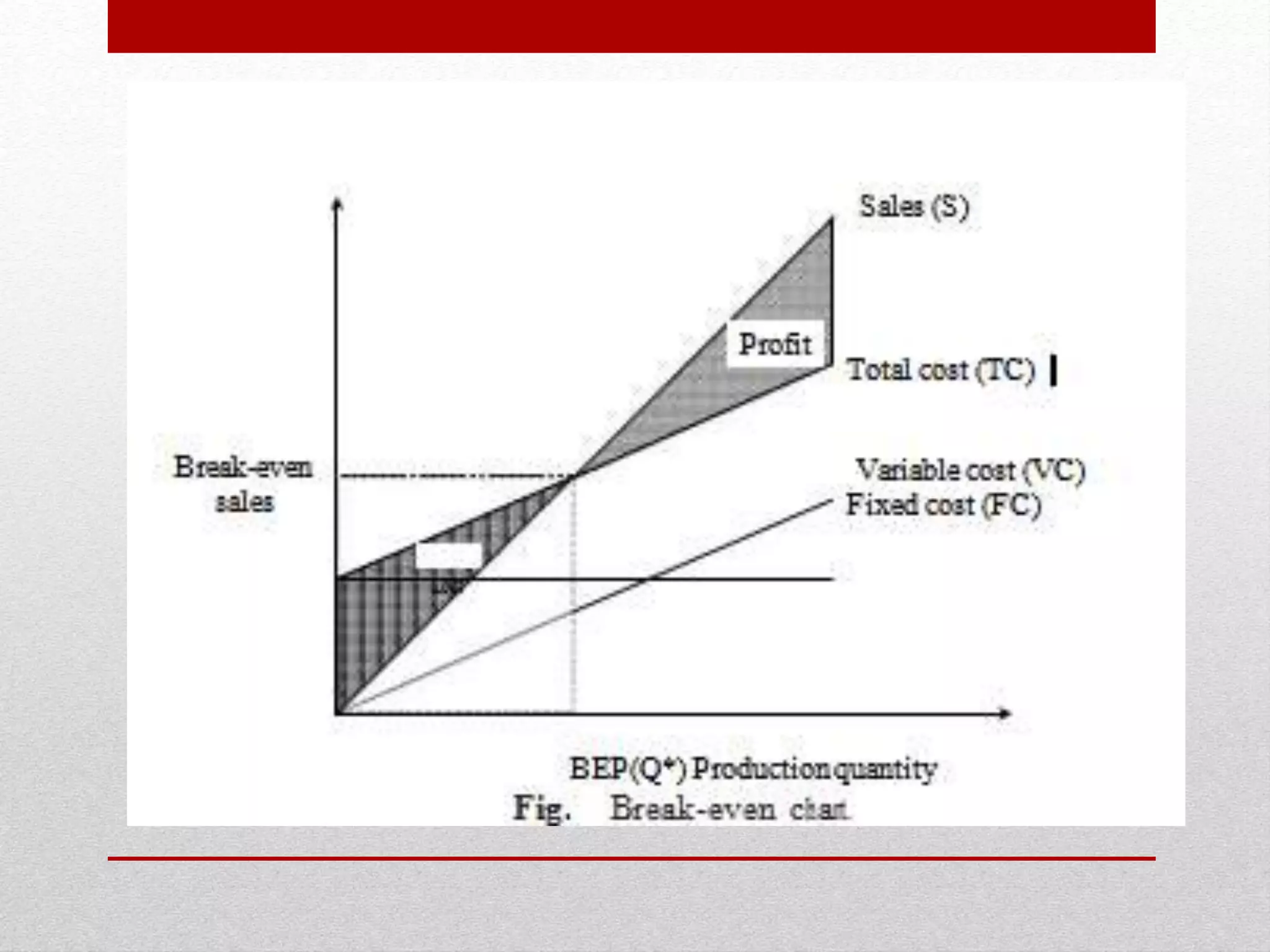
1.8 Break-Even Analysis
The main objective of break-even analysis is to find the cut-off production
volume from where a firm will make profit.
Let s = selling price per unit v = variable cost per unit
FC = fixed cost per period Q = volume of production
The total sales revenue (S) of the firm is given by the following formula:
S = s Q
The total cost of the firm for a given production volume is given as
TC = Total variable cost + Fixed cost = v Q + FC
Profit = Sales – (Fixed cost + Variable costs) = sQ – (FC + vQ)
The formulae to find the break-even quantity and break-even sales
quantity
Break-even quantity = Fixed cost
Selling price / unit − Variable cost / unit
FC
= s-v (in units)
Break-even sales = Fixed cost Selling price/ unit
Selling price/ unit − Variable cost / unit
= FC × s (Rs.)
s − v
1.9 Profit/Volume Ratio (P/V Ratio)
P/V ratio is a valid ratio which is useful for further analysis.
The different formulae for the P/V ratio are as follows:
P/V ratio = Contribution = Sales − Variable costs
Sales Sales
The relationship between BEP and P/V ratio is as follows:
BEP = Fixed cost
P /V ratio
1.10 Material Selection For A Product/Substitution Of Raw Material
The cost of a product can be reduced greatly by substitution of the raw
materials.
Among various elements of cost, raw material cost is most significant and
it forms a major portion of the total cost of any product.
So, any attempt to find a suitable raw material will bring a reduction in
the total cost in any one or combinations of the following ways:
 Reduced machining/process time
 Enhanced durability of the product
 Cheaper raw material price
1.11 Process Planning / Process Modification
While planning for a new component, a feasible sequence of operations with
the least cost of processing is to be considered.
It is always subject to modification with a view to minimize the cost of
manufacturing the component.
So, the objective of process planning/process modification is to identify the
most economical sequence of operations to produce a component.
The steps in process planning are as follows:
1. Analyze the part drawing to get an overall picture of what is required.
2.Make recommendations to or consult with product engineers on product
design changes.
3.List the basic operations required to produce the part to the drawing or
specifications.
4.Determine the most practical and economical manufacturing method and
the form or tooling required for each operation.
5.Devise the best way to combine the operations and put them in sequence.
6. Specify the gauging required for the process.
Steps 3–5 aim to determine the most practical and economical sequence of
operations to produce a component.

unit -1

  • 2.
    1 Introduction Efficient functioningof any business organization would enable it to provide goods/services at a lower price. Engineering Economics which deals with the methods that enable one to make economic decisions towards minimizing costs and/or maximizing benefits to business organizations. This chapter discusses the elements of economics and the interaction between its various components.
  • 3.
    1.2 Economics isa study of economic problems of the people concerning production, consumption, exchange and distribution of wealth. Economics is the science that deals with the production and consumption of goods and services and the distribution and rendering of these for human welfare. The following are the economic goals.  A high level of employment  Price stability  Efficiency  An equitable distribution of income  Growth
  • 4.
    1.3 Flow ineconomy :The flow of goods, services, resources and money payments in a simple economy
  • 5.
    1.4 Laws ofsupply and demand Laws of supply states that the quantity of a commodity supplied varies directly with the price, other determinants of supply remaining constant. Factors influencing supply  Cost of the inputs  Technology  Weather  Prices of related goods Law of demand states that other things being equal demand when price falls and contracts when price rises.  Market demand is the total quantity demanded by all the purchasers together.  Elasticity of Demand - Elasticity of demand may be defined as the degree of responsiveness of quantity demanded to a Change in price. Factors influencing Demand  Income of the people  Prices of related goods  Tastes of consumers
  • 7.
    1.5 Types ofEfficiency: Efficiency of a system is generally defined as the ratio of its output to input. The efficiency can be classified into technical efficiency and economic efficiency. 1. Technical efficiency It is the ratio of the output to input of a physical system. The physical system may be a diesel engine, a machine working in a shop floor, a furnace, etc. Technical efficiency (%) = Output × 100 Input 2. Economic efficiency Economic efficiency is the ratio of output to input of a business system. Economic efficiency (%) = Output × 100 = Worth × 100 Input Cost
  • 8.
    1.6 Elements OfCosts Cost can be broadly classified into variable cost and overhead cost. Variable cost varies with the volume of production while overhead cost is fixed, irrespective of the production volume. The selling price of a product is derived as shown below: (a) Direct material costs + Direct labour costs + Direct expenses = Prime cost (b) Prime cost + Factory overhead = Factory cost (c) Factory cost + Office and administrative overhead = Costs of production (d) Cost of production + Opening finished stock – Closing finished stock = Cost of goods sold (e) Cost of goods sold + Selling and distribution overhead = Cost of sales (f) Cost of sales + Profit = Sales (g) Sales/Quantity sold = Selling price per unit
  • 9.
    1.7 Other Costs/Revenues: (a)MarginalCost: Marginal cost of a product is the cost of producing an additional unit of that product. Let the cost of producing 20 units of a product be Rs. 10,000, and the cost of producing 21 units of the same product be Rs. 10,045. Then the marginal cost of producing the 21st unit is Rs. 45. (b)Marginal Revenue: Marginal revenue of a product is the incremental revenue of selling an additional unit of that product. Let, the revenue of selling 20 units of a product be Rs. 15,000 and the revenue of selling 21 units of the same product be Rs. 15,085. Then, the marginal revenue of selling the 21st unit is Rs. 85. (c)Sunk Cost: This is known as the past cost of an equipment/asset. Let us assume that an equipment has been purchased for Rs. 1,00,000 about three years back. If it is considered for replacement, then its present value is not Rs. 1,00,000. Instead, its present market value should be taken as the present value of the equipment for further analysis. So, the purchase value of the equipment in the past is known as its sunk cost. (d) Opportunity Cost: In practice, if an alternative (X, Y )
  • 10.
    1.8 Break-Even Analysis Themain objective of break-even analysis is to find the cut-off production volume from where a firm will make profit. Let s = selling price per unit v = variable cost per unit FC = fixed cost per period Q = volume of production The total sales revenue (S) of the firm is given by the following formula: S = s Q The total cost of the firm for a given production volume is given as TC = Total variable cost + Fixed cost = v Q + FC Profit = Sales – (Fixed cost + Variable costs) = sQ – (FC + vQ) The formulae to find the break-even quantity and break-even sales quantity Break-even quantity = Fixed cost Selling price / unit − Variable cost / unit FC = s-v (in units) Break-even sales = Fixed cost Selling price/ unit Selling price/ unit − Variable cost / unit = FC × s (Rs.) s − v
  • 12.
    1.9 Profit/Volume Ratio(P/V Ratio) P/V ratio is a valid ratio which is useful for further analysis. The different formulae for the P/V ratio are as follows: P/V ratio = Contribution = Sales − Variable costs Sales Sales The relationship between BEP and P/V ratio is as follows: BEP = Fixed cost P /V ratio
  • 13.
    1.10 Material SelectionFor A Product/Substitution Of Raw Material The cost of a product can be reduced greatly by substitution of the raw materials. Among various elements of cost, raw material cost is most significant and it forms a major portion of the total cost of any product. So, any attempt to find a suitable raw material will bring a reduction in the total cost in any one or combinations of the following ways:  Reduced machining/process time  Enhanced durability of the product  Cheaper raw material price
  • 14.
    1.11 Process Planning/ Process Modification While planning for a new component, a feasible sequence of operations with the least cost of processing is to be considered. It is always subject to modification with a view to minimize the cost of manufacturing the component. So, the objective of process planning/process modification is to identify the most economical sequence of operations to produce a component. The steps in process planning are as follows: 1. Analyze the part drawing to get an overall picture of what is required. 2.Make recommendations to or consult with product engineers on product design changes. 3.List the basic operations required to produce the part to the drawing or specifications. 4.Determine the most practical and economical manufacturing method and the form or tooling required for each operation. 5.Devise the best way to combine the operations and put them in sequence. 6. Specify the gauging required for the process. Steps 3–5 aim to determine the most practical and economical sequence of operations to produce a component.