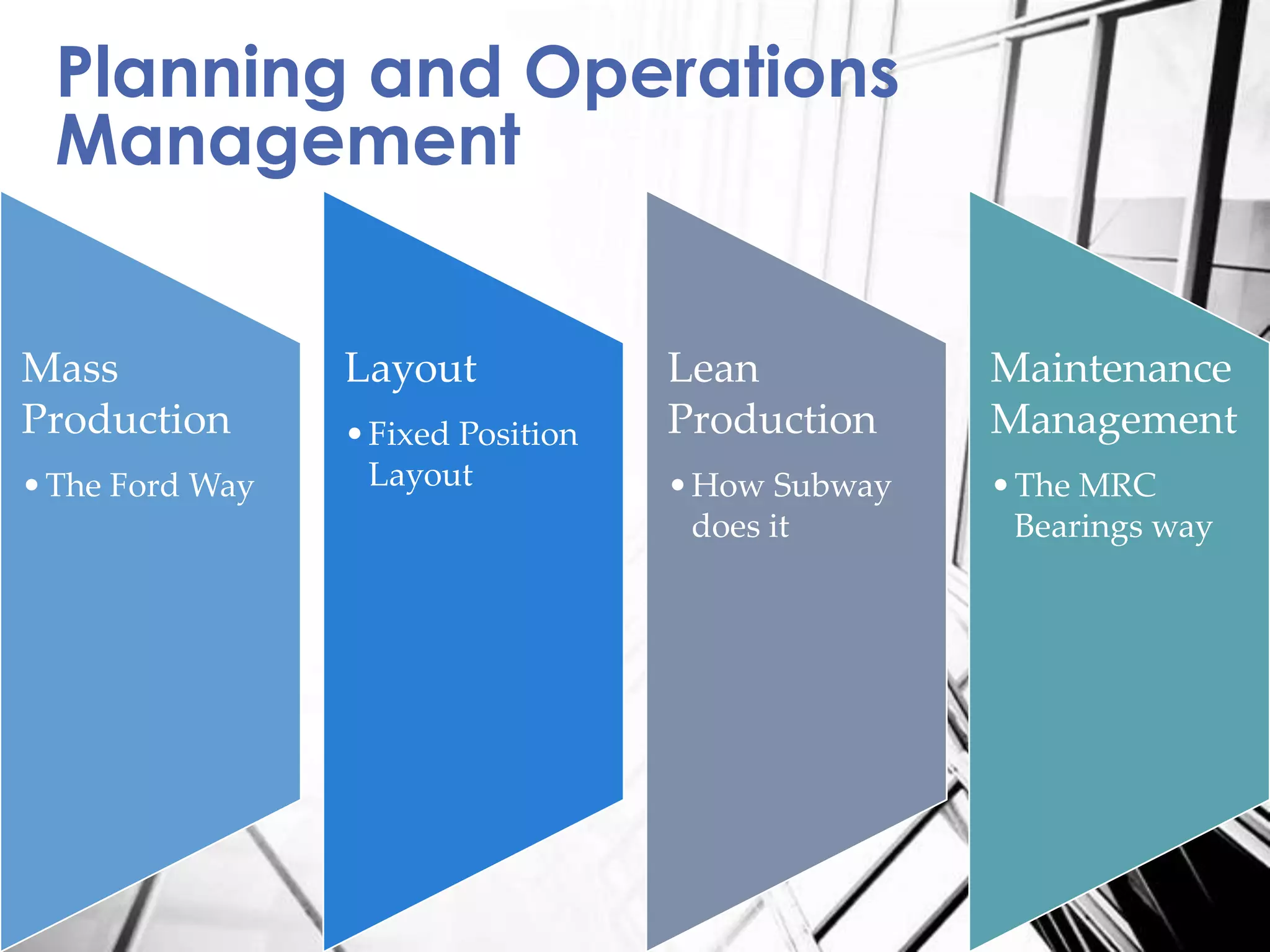
Planning and Operations
Management
Mass
Production
•The Ford Way
Layout
•Fixed Position
Layout
Lean
Production
•How Subway
does it
Maintenance
Management
•The MRC
Bearings way
• Mass production is the production of large amounts
of standardized products, including and especially
on assembly lines.
• Mass Production involves making many copies of
products, very quickly, using assembly line
techniques to send partially complete products to
workers who each work on an individual step, rather
than having a worker work on a whole product from
start to finish.
Mass Production
The Ford Way
• "Lean," is a production practice that considers the
expenditure of resources for any goal other than the
creation of value for the end customer to be wasteful.And
thus makes it a target for elimination.
• Works from the perspective of the customer who
consumes a product or service.
• “Value" is defined as any action or process that a customer
would be willing to pay for.
• Lean is centered on preserving value with less work.
Lean Production
• Subway makes the exact sandwich the customer wants at
the time the customer orders it.
• During higher volume meal times Subway utilizes
teamwork. Several people will assembly parts of the
sandwich passing it from one another along the line.
• While the sandwich is made just in time the materials to
make all the sandwiches have been prepared before
hand.
• Some of the inventory is kited for accuracy and efficiency
like the meat.
• The sandwich area is laid out in the form of an assembly
line from taking your order to paying for your order.
A production technique used to assemble products that are too
large, bulky, or fragile to safely or effectively move to
a location for completion. In a fixed position
layout, personnel, supplies, and equipment are brought to
the site where the product will be assembled, rather than the
product being moved through an assembly line or set
of assembly stations.
Fixed Position Layout
Fixed Position Layout: Ship Building in L&T
• Easy for products which are difficult to
move.
• Flexibility for change in design, operation
sequence, labor availability, etc., exists in this
layout.
• This layout is very cost effective when many
orders of similar type are existing in
different stages of progress.
• Large project type of jobs such as
construction are suited in this layout.
Advantages of fixed position layout
• Total productive maintenance (TPM) originated in Japan in
1971 as a method for improved machine availability through
better utilization of maintenance and production resources.
• In this setting the operators are enabled to understand the
machinery and identify potential problems, righting them
before they can impact production and by so doing, decrease
downtime and reduce costs of production.
• TPM is a critical adjunct to lean manufacturing.
• TPM is a proactive approach that essentially aims to identify
issues as soon as possible and plan to prevent any issues
before occurrence.
"zero error, zero work-related accident, and
zero loss"
Total Productive Maintenance
• In 1996 MRC Bearings, a unionized aerospace industry
supplier, recognized it had a problem. They were behind
on their orders.
• Their customers were pushing for shorter lead times and
cost reductions.
• They implemented TPM to counter problems like
emergency work orders, unplanned maintenance in just
one area and several faults.
• Once a machine was cleaned, it would be painted. At
first, people were reluctant to participate in TPM events.
As time went on, people began to notice what
improvements were being accomplished under the TPM
events.
MRC Bearings' TPM Journey
From Totally Painted Machines to Taking
Pride in Our Machines
Management should learn the
philosophy
Management must promote the
philosophy
Training for all the employees
Identifying key areas
Make an implementation plan
Steps to implement TPM

Production and Operations Management

  • 1.
    Planning and Operations Management Mass Production •TheFord Way Layout •Fixed Position Layout Lean Production •How Subway does it Maintenance Management •The MRC Bearings way
  • 2.
    • Mass productionis the production of large amounts of standardized products, including and especially on assembly lines. • Mass Production involves making many copies of products, very quickly, using assembly line techniques to send partially complete products to workers who each work on an individual step, rather than having a worker work on a whole product from start to finish. Mass Production
  • 3.
  • 4.
    • "Lean," isa production practice that considers the expenditure of resources for any goal other than the creation of value for the end customer to be wasteful.And thus makes it a target for elimination. • Works from the perspective of the customer who consumes a product or service. • “Value" is defined as any action or process that a customer would be willing to pay for. • Lean is centered on preserving value with less work. Lean Production
  • 5.
    • Subway makesthe exact sandwich the customer wants at the time the customer orders it. • During higher volume meal times Subway utilizes teamwork. Several people will assembly parts of the sandwich passing it from one another along the line. • While the sandwich is made just in time the materials to make all the sandwiches have been prepared before hand. • Some of the inventory is kited for accuracy and efficiency like the meat. • The sandwich area is laid out in the form of an assembly line from taking your order to paying for your order.
  • 6.
    A production techniqueused to assemble products that are too large, bulky, or fragile to safely or effectively move to a location for completion. In a fixed position layout, personnel, supplies, and equipment are brought to the site where the product will be assembled, rather than the product being moved through an assembly line or set of assembly stations. Fixed Position Layout
  • 7.
    Fixed Position Layout:Ship Building in L&T
  • 8.
    • Easy forproducts which are difficult to move. • Flexibility for change in design, operation sequence, labor availability, etc., exists in this layout. • This layout is very cost effective when many orders of similar type are existing in different stages of progress. • Large project type of jobs such as construction are suited in this layout. Advantages of fixed position layout
  • 9.
    • Total productivemaintenance (TPM) originated in Japan in 1971 as a method for improved machine availability through better utilization of maintenance and production resources. • In this setting the operators are enabled to understand the machinery and identify potential problems, righting them before they can impact production and by so doing, decrease downtime and reduce costs of production. • TPM is a critical adjunct to lean manufacturing. • TPM is a proactive approach that essentially aims to identify issues as soon as possible and plan to prevent any issues before occurrence. "zero error, zero work-related accident, and zero loss" Total Productive Maintenance
  • 10.
    • In 1996MRC Bearings, a unionized aerospace industry supplier, recognized it had a problem. They were behind on their orders. • Their customers were pushing for shorter lead times and cost reductions. • They implemented TPM to counter problems like emergency work orders, unplanned maintenance in just one area and several faults. • Once a machine was cleaned, it would be painted. At first, people were reluctant to participate in TPM events. As time went on, people began to notice what improvements were being accomplished under the TPM events. MRC Bearings' TPM Journey From Totally Painted Machines to Taking Pride in Our Machines
  • 11.
    Management should learnthe philosophy Management must promote the philosophy Training for all the employees Identifying key areas Make an implementation plan Steps to implement TPM