Product
Management
Introduction
Implementing product management in an existing company
Context
• This is a sanitized version of an intro presentation I gave to the
leadership of a company where I was brought in to create a
product management group where none had existed before
• I adapted this product management process and methodology
to fit the organization – I think every org is different, so use
what works for you and discard the rest.
Agenda
• Discussions:
• Product Management Overview
• What you can expect
• Where we fit in
• Product Strategy
• Product Council Intro
• Product Lifecycle
• Sample Product Launch Checklist
Product Management
Deliveringmeasurablebusinessresultsthroughproductsolutionsthat
meetbothmarketneedsandcompanygoals
• Mission: To own and manage the full suite of the company’s
products, including:
• Business roadmap for new products and enhancements to existing
products
• Drive pricing, positioning and messaging for all products with Marketing
• Partnerships with complementary companies to enhance our portfolio
• Product management is an input into the business strategy
• Philosophy: Listen to our customers, and build superior and
differentiated products that solve their problems at prices they are
willing to pay
What can you expect from us
• Single point of contact for all product needs
• Better visibility into product roadmap and prioritization
• Improved communication throughout the company around
product capabilities and new releases
• Competitive Information
• Pricing
• Go to market strategy
• Features/formats
• How we compare
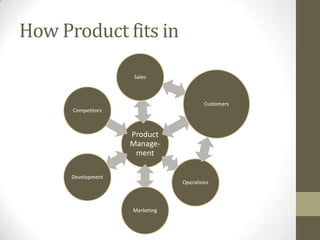
How Product fits in
Product
Manage-
ment
Sales
Customers
Operations
Marketing
Development
Competitors
Product Strategy
• The product strategy should be clear, compelling and inspiring.
• How will things be better when this product or service reaches its
potential? It’s not about the specific features or functionality that
may or may not be built, but rather the benefits of having this
product.
• What problems will be solved with this product?
• Why will users love this product?
• How will the world be better once this vision is reality?
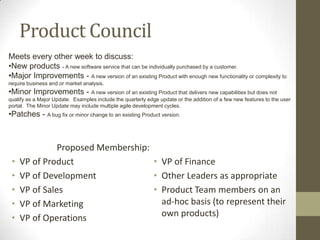
Product Council
• The purpose of the Product Council is to
• set strategic product direction
• allocate product resources and investments
• provide a level of oversight of the company’s product efforts
• This group is not trying to set the company’s business
strategy, but rather, given the business strategy, come up with
a product strategy that aligns with the needs of the business.
Product Council
Proposed Membership:
• VP of Product
• VP of Development
• VP of Sales
• VP of Marketing
• VP of Operations
• VP of Finance
• Other Leaders as appropriate
• Product Team members on an
ad-hoc basis (to represent their
own products)
Meets every other week to discuss:
•New products - A new software service that can be individually purchased by a customer.
•Major Improvements - A new version of an existing Product with enough new functionality or complexity to
require business and or market analysis.
•Minor Improvements - A new version of an existing Product that delivers new capabilities but does not
qualify as a Major Update. Examples include the quarterly edge update or the addition of a few new features to the user
portal. The Minor Update may include multiple agile development cycles.
•Patches - A bug fix or minor change to an existing Product version.
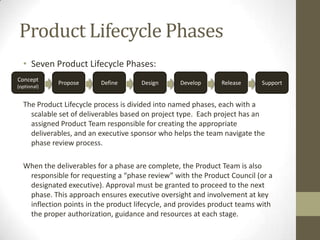
Product Lifecycle Phases
• Seven Product Lifecycle Phases:
The Product Lifecycle process is divided into named phases, each with a
scalable set of deliverables based on project type. Each project has an
assigned Product Team responsible for creating the appropriate
deliverables, and an executive sponsor who helps the team navigate the
phase review process.
When the deliverables for a phase are complete, the Product Team is also
responsible for requesting a “phase review” with the Product Council (or a
designated executive). Approval must be granted to proceed to the next
phase. This approach ensures executive oversight and involvement at key
inflection points in the product lifecycle, and provides product teams with
the proper authorization, guidance and resources at each stage.
Concept
(optional)
Propose Define Design Develop Release Support
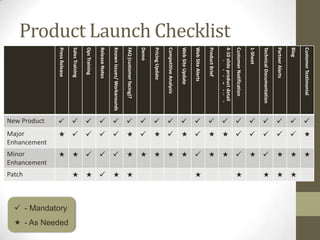
Product Launch Checklist
PressRelease
SalesTraining
OpsTraining
ReleaseNotes
Knownissues/Workarounds
FAQ(customerfacing)?
Demo
PricingUpdate
CompetitiveAnalysis
WebSiteUpdate
WebSiteAlerts
ProductBrief
4-10slideproductdetail
overview(sales&mkting)
CustomerNotification
1-Sheet
TechnicalDocumentation
PartnerAlerts
Blog
CustomerTestimonial
New Product                   
Major
Enhancement
                  
Minor
Enhancement
                  
Patch          


- Mandatory
- As Needed

Product management intro

  • 1.
  • 2.
    Context • This isa sanitized version of an intro presentation I gave to the leadership of a company where I was brought in to create a product management group where none had existed before • I adapted this product management process and methodology to fit the organization – I think every org is different, so use what works for you and discard the rest.
  • 3.
    Agenda • Discussions: • ProductManagement Overview • What you can expect • Where we fit in • Product Strategy • Product Council Intro • Product Lifecycle • Sample Product Launch Checklist
  • 4.
    Product Management Deliveringmeasurablebusinessresultsthroughproductsolutionsthat meetbothmarketneedsandcompanygoals • Mission:To own and manage the full suite of the company’s products, including: • Business roadmap for new products and enhancements to existing products • Drive pricing, positioning and messaging for all products with Marketing • Partnerships with complementary companies to enhance our portfolio • Product management is an input into the business strategy • Philosophy: Listen to our customers, and build superior and differentiated products that solve their problems at prices they are willing to pay
  • 5.
    What can youexpect from us • Single point of contact for all product needs • Better visibility into product roadmap and prioritization • Improved communication throughout the company around product capabilities and new releases • Competitive Information • Pricing • Go to market strategy • Features/formats • How we compare
  • 6.
    How Product fitsin Product Manage- ment Sales Customers Operations Marketing Development Competitors
  • 7.
    Product Strategy • Theproduct strategy should be clear, compelling and inspiring. • How will things be better when this product or service reaches its potential? It’s not about the specific features or functionality that may or may not be built, but rather the benefits of having this product. • What problems will be solved with this product? • Why will users love this product? • How will the world be better once this vision is reality?
  • 8.
    Product Council • Thepurpose of the Product Council is to • set strategic product direction • allocate product resources and investments • provide a level of oversight of the company’s product efforts • This group is not trying to set the company’s business strategy, but rather, given the business strategy, come up with a product strategy that aligns with the needs of the business.
  • 9.
    Product Council Proposed Membership: •VP of Product • VP of Development • VP of Sales • VP of Marketing • VP of Operations • VP of Finance • Other Leaders as appropriate • Product Team members on an ad-hoc basis (to represent their own products) Meets every other week to discuss: •New products - A new software service that can be individually purchased by a customer. •Major Improvements - A new version of an existing Product with enough new functionality or complexity to require business and or market analysis. •Minor Improvements - A new version of an existing Product that delivers new capabilities but does not qualify as a Major Update. Examples include the quarterly edge update or the addition of a few new features to the user portal. The Minor Update may include multiple agile development cycles. •Patches - A bug fix or minor change to an existing Product version.
  • 10.
    Product Lifecycle Phases •Seven Product Lifecycle Phases: The Product Lifecycle process is divided into named phases, each with a scalable set of deliverables based on project type. Each project has an assigned Product Team responsible for creating the appropriate deliverables, and an executive sponsor who helps the team navigate the phase review process. When the deliverables for a phase are complete, the Product Team is also responsible for requesting a “phase review” with the Product Council (or a designated executive). Approval must be granted to proceed to the next phase. This approach ensures executive oversight and involvement at key inflection points in the product lifecycle, and provides product teams with the proper authorization, guidance and resources at each stage. Concept (optional) Propose Define Design Develop Release Support
  • 11.
    Product Launch Checklist PressRelease SalesTraining OpsTraining ReleaseNotes Knownissues/Workarounds FAQ(customerfacing)? Demo PricingUpdate CompetitiveAnalysis WebSiteUpdate WebSiteAlerts ProductBrief 4-10slideproductdetail overview(sales&mkting) CustomerNotification 1-Sheet TechnicalDocumentation PartnerAlerts Blog CustomerTestimonial NewProduct                    Major Enhancement                    Minor Enhancement                    Patch             - Mandatory - As Needed

Editor's Notes

  • #5 We will “cleanup” and productize what exists today.There will be standard definitions for what something is – sku, etc.Can’t do custom billing for every customer (scale) – how do we do this with resellers?Working toward single invoicing, and other integration with limelight – etc
  • #9 Llnw – half update, half strategyFormat quick update on key initiatives
  • #10 This is still a large group – I bounced it off Rob, and he suggested Cliona, and potentially Erwin. Rob - Will Erwin actually participate, and what are we expecting of him?Volker?Cadence may need to be different
  • #11 When necessary, we can combine multiple phases (Propose and Define, for example, or Design and Develop in many cases.)
  • #12 Much of this is captured in the previous three slides, some of it is not specifically called out in the matrix.I have a few Marketing-specific additions I will add soon.