Product Management
Prepared by
Utkarsh Bhanawat
College of Technology and Engineering
Udaipur
Master of Business Administration
Product Management
ď‚— Product
ď‚— Classification of Product
ď‚— Defining New Product
ď‚— Product Management
ď‚— Product Life Cycle and its stages
Product
ď‚— A product is anything that can be offered to a market for
attention, acquisition, use or consumption and that might satisfy a want or
need.
ď‚— Product includes more than tangible goods.
ď‚— Broadly defined, products include physical objects, services
events, persons, places organization, ideas or mix with these entities.
Classification of Product
ď‚— Goods: Anything is considered to be a good if it is a tangible item.
ď‚— Services: Sometimes service is the offering that a company offers to the
customers in the form of labour or work.
ď‚— Ideas: Marketing ideas is often a solution put forth by non-profiting
groups and government in order to avoid certain changed behaviour.
Defining New Product
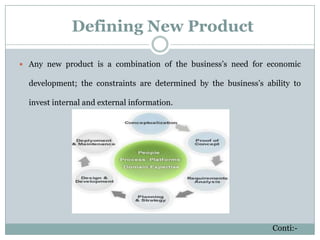
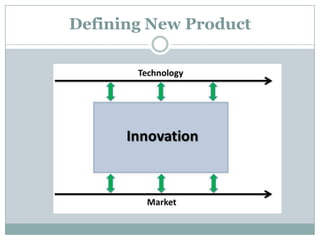
 Any new product is a combination of the business’s need for economic
development; the constraints are determined by the business’s ability to
invest internal and external information.
Conti:-
Defining New Product
Product Management
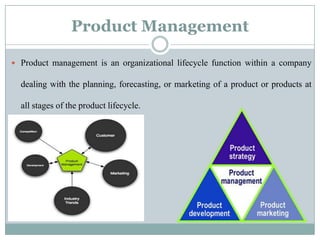
ď‚— Product management is an organizational lifecycle function within a company
dealing with the planning, forecasting, or marketing of a product or products at
all stages of the product lifecycle.
Product Management
1. Responsible for analyzing market condition
2. defining features or function of a product.
3. Main Focus ob Driving New products.
4. Spans many Activities from Strategic to tactical.
5. Bring a product to market and actively monitor and manage in market.
6. It has many variety of functions depends upon company size and history.
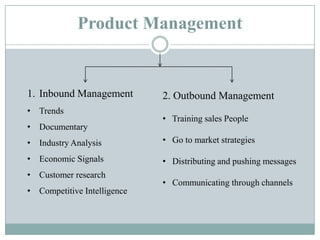
Product Management
1. Inbound Management
• Trends
• Documentary
• Industry Analysis
• Economic Signals
• Customer research
• Competitive Intelligence
2. Outbound Management
• Training sales People
• Go to market strategies
• Distributing and pushing messages
• Communicating through channels
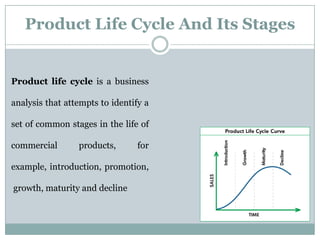
Product Life Cycle And Its Stages
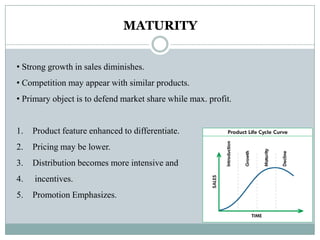
Product life cycle is a business
analysis that attempts to identify a
set of common stages in the life of
commercial products, for
example, introduction, promotion,
growth, maturity and decline
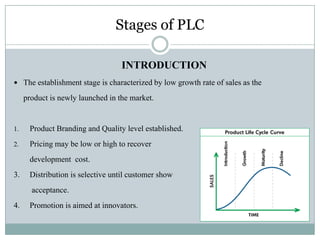
Stages of PLC
INTRODUCTION
ď‚— The establishment stage is characterized by low growth rate of sales as the
product is newly launched in the market.
1. Product Branding and Quality level established.
2. Pricing may be low or high to recover
development cost.
3. Distribution is selective until customer show
acceptance.
4. Promotion is aimed at innovators.
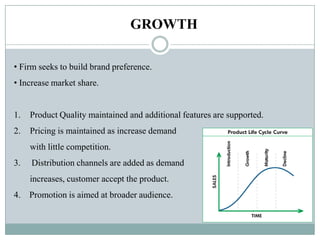
• Firm seeks to build brand preference.
• Increase market share.
1. Product Quality maintained and additional features are supported.
2. Pricing is maintained as increase demand
with little competition.
3. Distribution channels are added as demand
increases, customer accept the product.
4. Promotion is aimed at broader audience.
GROWTH
MATURITY
• Strong growth in sales diminishes.
• Competition may appear with similar products.
• Primary object is to defend market share while max. profit.
1. Product feature enhanced to differentiate.
2. Pricing may be lower.
3. Distribution becomes more intensive and
4. incentives.
5. Promotion Emphasizes.
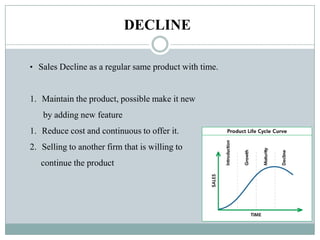
DECLINE
• Sales Decline as a regular same product with time.
1. Maintain the product, possible make it new
by adding new feature
1. Reduce cost and continuous to offer it.
2. Selling to another firm that is willing to
continue the product
Product Management
Product Management

Product Management

  • 1.
    Product Management Prepared by UtkarshBhanawat College of Technology and Engineering Udaipur Master of Business Administration
  • 2.
    Product Management ď‚— Product ď‚—Classification of Product ď‚— Defining New Product ď‚— Product Management ď‚— Product Life Cycle and its stages
  • 3.
    Product ď‚— A productis anything that can be offered to a market for attention, acquisition, use or consumption and that might satisfy a want or need. ď‚— Product includes more than tangible goods. ď‚— Broadly defined, products include physical objects, services events, persons, places organization, ideas or mix with these entities.
  • 4.
    Classification of Product ď‚—Goods: Anything is considered to be a good if it is a tangible item. ď‚— Services: Sometimes service is the offering that a company offers to the customers in the form of labour or work. ď‚— Ideas: Marketing ideas is often a solution put forth by non-profiting groups and government in order to avoid certain changed behaviour.
  • 5.
    Defining New Product Any new product is a combination of the business’s need for economic development; the constraints are determined by the business’s ability to invest internal and external information. Conti:-
  • 6.
  • 7.
    Product Management ď‚— Productmanagement is an organizational lifecycle function within a company dealing with the planning, forecasting, or marketing of a product or products at all stages of the product lifecycle.
  • 8.
    Product Management 1. Responsiblefor analyzing market condition 2. defining features or function of a product. 3. Main Focus ob Driving New products. 4. Spans many Activities from Strategic to tactical. 5. Bring a product to market and actively monitor and manage in market. 6. It has many variety of functions depends upon company size and history.
  • 9.
    Product Management 1. InboundManagement • Trends • Documentary • Industry Analysis • Economic Signals • Customer research • Competitive Intelligence 2. Outbound Management • Training sales People • Go to market strategies • Distributing and pushing messages • Communicating through channels
  • 10.
    Product Life CycleAnd Its Stages Product life cycle is a business analysis that attempts to identify a set of common stages in the life of commercial products, for example, introduction, promotion, growth, maturity and decline
  • 11.
    Stages of PLC INTRODUCTION ď‚—The establishment stage is characterized by low growth rate of sales as the product is newly launched in the market. 1. Product Branding and Quality level established. 2. Pricing may be low or high to recover development cost. 3. Distribution is selective until customer show acceptance. 4. Promotion is aimed at innovators.
  • 12.
    • Firm seeksto build brand preference. • Increase market share. 1. Product Quality maintained and additional features are supported. 2. Pricing is maintained as increase demand with little competition. 3. Distribution channels are added as demand increases, customer accept the product. 4. Promotion is aimed at broader audience. GROWTH
  • 13.
    MATURITY • Strong growthin sales diminishes. • Competition may appear with similar products. • Primary object is to defend market share while max. profit. 1. Product feature enhanced to differentiate. 2. Pricing may be lower. 3. Distribution becomes more intensive and 4. incentives. 5. Promotion Emphasizes.
  • 14.
    DECLINE • Sales Declineas a regular same product with time. 1. Maintain the product, possible make it new by adding new feature 1. Reduce cost and continuous to offer it. 2. Selling to another firm that is willing to continue the product