Presentation on
“Product management’’
by
Rahul Gargal
(2030331612053)
Department of Mechanical Engineering
Dr. Babasaheb Ambedkar Technological University,
Lonere - 402 103, Dist- Raigad, Maharashtra
Introduction to
Product Management
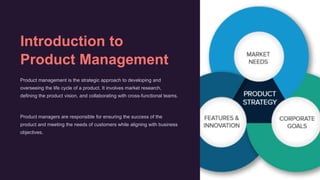
Product management is the strategic approach to developing and
overseeing the life cycle of a product. It involves market research,
defining the product vision, and collaborating with cross-functional teams.
Product managers are responsible for ensuring the success of the
product and meeting the needs of customers while aligning with business
objectives.
Key responsibilities of a product
manager
Product Strategy
Defining the long-term vision and strategy for
the product.
Team Coordination
Leading and coordinating cross-functional
teams to deliver products.
Market Analysis
Conducting market research and competitive
analysis to inform product decisions.
Customer Advocacy
Advocating for the customer's needs and
preferences throughout the product lifecycle.
Product Discovery and Market Research
• Identifying Market Needs: Conducting in-depth research to understand customer pain points and
needs.
• Competitive Analysis: Analyzing competitors' products, pricing, and market positioning.
• Trend Analysis: Monitoring industry trends and technology advancements for product innovation.
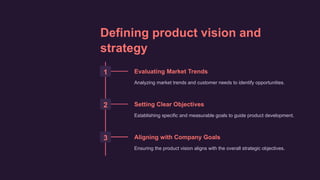
Defining product vision and
strategy
1 Evaluating Market Trends
Analyzing market trends and customer needs to identify opportunities.
2 Setting Clear Objectives
Establishing specific and measurable goals to guide product development.
3 Aligning with Company Goals
Ensuring the product vision aligns with the overall strategic objectives.
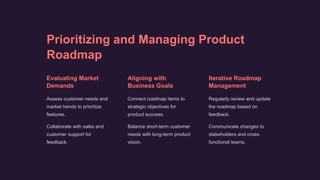
Prioritizing and Managing Product
Roadmap
Evaluating Market
Demands
Assess customer needs and
market trends to prioritize
features.
Collaborate with sales and
customer support for
feedback.
Aligning with
Business Goals
Connect roadmap items to
strategic objectives for
product success.
Balance short-term customer
needs with long-term product
vision.
Iterative Roadmap
Management
Regularly review and update
the roadmap based on
feedback.
Communicate changes to
stakeholders and cross-
functional teams.
Cross-functional Collaboration and
Stakeholder Management
Product managers work across departments to
ensure cohesive product development.
• Facilitate communication among
engineering, design, and marketing
teams.
• Manage stakeholder expectations and
gather diverse perspectives.
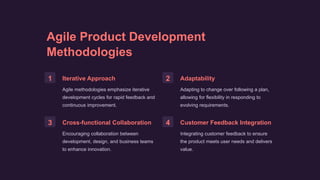
Agile Product Development
Methodologies
1 Iterative Approach
Agile methodologies emphasize iterative
development cycles for rapid feedback and
continuous improvement.
2 Adaptability
Adapting to change over following a plan,
allowing for flexibility in responding to
evolving requirements.
3 Cross-functional Collaboration
Encouraging collaboration between
development, design, and business teams
to enhance innovation.
4 Customer Feedback Integration
Integrating customer feedback to ensure
the product meets user needs and delivers
value.
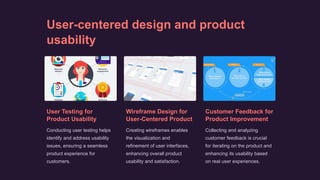
User-centered design and product
usability
User Testing for
Product Usability
Conducting user testing helps
identify and address usability
issues, ensuring a seamless
product experience for
customers.
Wireframe Design for
User-Centered Product
Creating wireframes enables
the visualization and
refinement of user interfaces,
enhancing overall product
usability and satisfaction.
Customer Feedback for
Product Improvement
Collecting and analyzing
customer feedback is crucial
for iterating on the product and
enhancing its usability based
on real user experiences.
Product Launch and Go-to-Market
Strategies
Launch Event
Create buzz and excitement
with a captivating product
launch event.
Go-to-Market Plan
Develop a strategic plan for
effectively reaching and
engaging target audiences.
Market Penetration
Implement tactics to enter new
markets and establish a strong
foothold.
Measuring Product Success and
Continuous Improvement
ROI
ROI
Tracking return on investment to measure product
success.
KPIs
KPIs
Identifying and monitoring key performance
indicators.
Measuring product success involves tracking various metrics such as Return on Investment (ROI) to
determine the financial impact of the product, and Key Performance Indicators (KPIs) to assess its overall
performance. Continuous improvement is supported by analyzing customer feedback and iterating on the
product based on user insights.

Product development fiffhbbhfdfvgg bigffgj

  • 1.
    Presentation on “Product management’’ by RahulGargal (2030331612053) Department of Mechanical Engineering Dr. Babasaheb Ambedkar Technological University, Lonere - 402 103, Dist- Raigad, Maharashtra
  • 2.
    Introduction to Product Management Productmanagement is the strategic approach to developing and overseeing the life cycle of a product. It involves market research, defining the product vision, and collaborating with cross-functional teams. Product managers are responsible for ensuring the success of the product and meeting the needs of customers while aligning with business objectives.
  • 3.
    Key responsibilities ofa product manager Product Strategy Defining the long-term vision and strategy for the product. Team Coordination Leading and coordinating cross-functional teams to deliver products. Market Analysis Conducting market research and competitive analysis to inform product decisions. Customer Advocacy Advocating for the customer's needs and preferences throughout the product lifecycle.
  • 4.
    Product Discovery andMarket Research • Identifying Market Needs: Conducting in-depth research to understand customer pain points and needs. • Competitive Analysis: Analyzing competitors' products, pricing, and market positioning. • Trend Analysis: Monitoring industry trends and technology advancements for product innovation.
  • 5.
    Defining product visionand strategy 1 Evaluating Market Trends Analyzing market trends and customer needs to identify opportunities. 2 Setting Clear Objectives Establishing specific and measurable goals to guide product development. 3 Aligning with Company Goals Ensuring the product vision aligns with the overall strategic objectives.
  • 6.
    Prioritizing and ManagingProduct Roadmap Evaluating Market Demands Assess customer needs and market trends to prioritize features. Collaborate with sales and customer support for feedback. Aligning with Business Goals Connect roadmap items to strategic objectives for product success. Balance short-term customer needs with long-term product vision. Iterative Roadmap Management Regularly review and update the roadmap based on feedback. Communicate changes to stakeholders and cross- functional teams.
  • 7.
    Cross-functional Collaboration and StakeholderManagement Product managers work across departments to ensure cohesive product development. • Facilitate communication among engineering, design, and marketing teams. • Manage stakeholder expectations and gather diverse perspectives.
  • 8.
    Agile Product Development Methodologies 1Iterative Approach Agile methodologies emphasize iterative development cycles for rapid feedback and continuous improvement. 2 Adaptability Adapting to change over following a plan, allowing for flexibility in responding to evolving requirements. 3 Cross-functional Collaboration Encouraging collaboration between development, design, and business teams to enhance innovation. 4 Customer Feedback Integration Integrating customer feedback to ensure the product meets user needs and delivers value.
  • 9.
    User-centered design andproduct usability User Testing for Product Usability Conducting user testing helps identify and address usability issues, ensuring a seamless product experience for customers. Wireframe Design for User-Centered Product Creating wireframes enables the visualization and refinement of user interfaces, enhancing overall product usability and satisfaction. Customer Feedback for Product Improvement Collecting and analyzing customer feedback is crucial for iterating on the product and enhancing its usability based on real user experiences.
  • 10.
    Product Launch andGo-to-Market Strategies Launch Event Create buzz and excitement with a captivating product launch event. Go-to-Market Plan Develop a strategic plan for effectively reaching and engaging target audiences. Market Penetration Implement tactics to enter new markets and establish a strong foothold.
  • 11.
    Measuring Product Successand Continuous Improvement ROI ROI Tracking return on investment to measure product success. KPIs KPIs Identifying and monitoring key performance indicators. Measuring product success involves tracking various metrics such as Return on Investment (ROI) to determine the financial impact of the product, and Key Performance Indicators (KPIs) to assess its overall performance. Continuous improvement is supported by analyzing customer feedback and iterating on the product based on user insights.