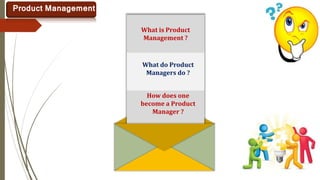
What is Product
Management ?
What do Product
Managers do ?
How does one
become a Product
Manager ?
Product Management
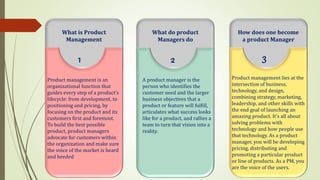
What is Product
Management
Product management is an
organizational function that
guides every step of a product’s
lifecycle: from development, to
positioning and pricing, by
focusing on the product and its
customers first and foremost.
To build the best possible
product, product managers
advocate for customers within
the organization and make sure
the voice of the market is heard
and heeded
1
What do product
Managers do
A product manager is the
person who identifies the
customer need and the larger
business objectives that a
product or feature will fulfill,
articulates what success looks
like for a product, and rallies a
team to turn that vision into a
reality.
2
How does one become
a product Manager
Product management lies at the
intersection of business,
technology, and design,
combining strategy, marketing,
leadership, and other skills with
the end goal of launching an
amazing product. It’s all about
solving problems with
technology and how people use
that technology. As a product
manager, you will be developing
pricing, distributing and
promoting a particular product
or line of products. As a PM, you
are the voice of the users.
3
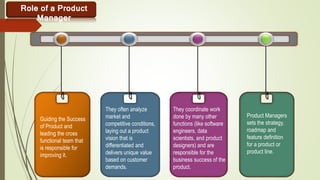
Guiding the Success
of Product and
leading the cross
functional team that
is responsible for
improving it.
Product Managers
sets the strategy,
roadmap and
feature definition
for a product or
product line.
They coordinate work
done by many other
functions (like software
engineers, data
scientists, and product
designers) and are
responsible for the
business success of the
product.
They often analyze
market and
competitive conditions,
laying out a product
vision that is
differentiated and
delivers unique value
based on customer
demands.
Role of a Product
Manager
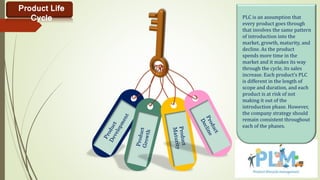
PLC is an assumption that
every product goes through
that involves the same pattern
of introduction into the
market, growth, maturity, and
decline. As the product
spends more time in the
market and it makes its way
through the cycle, its sales
increase. Each product’s PLC
is different in the length of
scope and duration, and each
product is at risk of not
making it out of the
introduction phase. However,
the company strategy should
remain consistent throughout
each of the phases.
Product Life
Cycle
Product Life Cycle
in brief
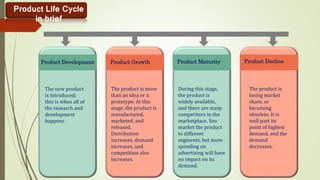
Product Development
The new product
is introduced;
this is when all of
the research and
development
happens
Product Growth
The product is more
than an idea or a
prototype. At this
stage, the product is
manufactured,
marketed, and
released.
Distribution
increases, demand
increases, and
competition also
increases.
Product Maturity
During this stage,
the product is
widely available,
and there are many
competitors in the
marketplace. You
market the product
to different
segments, but more
spending on
advertising will have
no impact on its
demand.
Product Decline
The product is
losing market
share, or
becoming
obsolete. It is
well past its
point of highest
demand, and the
demand
decreases.
How to identify and make
product improvements?
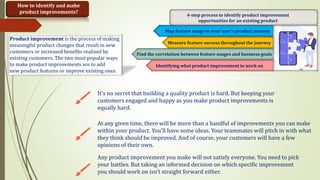
Map feature usage to your user's product journey
Measure feature success throughout the journey
Find the correlation between feature usages and business goals
Identifying what product improvement to work on
4-step process to identify product improvement
opportunities for an existing product
It's no secret that building a quality product is hard. But keeping your
customers engaged and happy as you make product improvements is
equally hard.
At any given time, there will be more than a handful of improvements you can make
within your product. You’ll have some ideas. Your teammates will pitch in with what
they think should be improved. And of course, your customers will have a few
opinions of their own.
Any product improvement you make will not satisfy everyone. You need to pick
your battles. But taking an informed decision on which specific improvement
you should work on isn’t straight forward either.
Product improvement is the process of making
meaningful product changes that result in new
customers or increased benefits realized by
existing customers. The two most popular ways
to make product improvements are to add
new product features or improve existing ones.
User Journey
Mapping
It's easy to develop tunnel vision when you're building a product. You spend a lot of time thinking about
every little feature and every single process running under the hood.
But that's not how your users interface with your product. They're coming from the opposite direction—
they have no reason to care about your product until you show them what it can do for them.
Turning first-time users into long-term customers requires an understanding of where your users are
coming from and what they want to do. Creating user journey maps helps you keep user motivation at the
front of your mind and create UX flows that get users where they want to go.
What is a user journey map?
A user journey is a timeline of user actions
that describes the relationship between
your brand and its customers. It's a
visualization all of a user's interactions with
your product, from their point of view.
User journey mapping creates a
timeline of all touch points between a
customer and your organization,
including all channels they happen in.
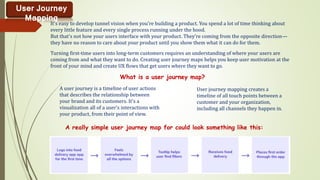
A really simple user journey map for could look something like this:
Thank You

Product manager jyoti

  • 2.
    What is Product Management? What do Product Managers do ? How does one become a Product Manager ? Product Management
  • 3.
    What is Product Management Productmanagement is an organizational function that guides every step of a product’s lifecycle: from development, to positioning and pricing, by focusing on the product and its customers first and foremost. To build the best possible product, product managers advocate for customers within the organization and make sure the voice of the market is heard and heeded 1 What do product Managers do A product manager is the person who identifies the customer need and the larger business objectives that a product or feature will fulfill, articulates what success looks like for a product, and rallies a team to turn that vision into a reality. 2 How does one become a product Manager Product management lies at the intersection of business, technology, and design, combining strategy, marketing, leadership, and other skills with the end goal of launching an amazing product. It’s all about solving problems with technology and how people use that technology. As a product manager, you will be developing pricing, distributing and promoting a particular product or line of products. As a PM, you are the voice of the users. 3
  • 4.
    Guiding the Success ofProduct and leading the cross functional team that is responsible for improving it. Product Managers sets the strategy, roadmap and feature definition for a product or product line. They coordinate work done by many other functions (like software engineers, data scientists, and product designers) and are responsible for the business success of the product. They often analyze market and competitive conditions, laying out a product vision that is differentiated and delivers unique value based on customer demands. Role of a Product Manager
  • 5.
    PLC is anassumption that every product goes through that involves the same pattern of introduction into the market, growth, maturity, and decline. As the product spends more time in the market and it makes its way through the cycle, its sales increase. Each product’s PLC is different in the length of scope and duration, and each product is at risk of not making it out of the introduction phase. However, the company strategy should remain consistent throughout each of the phases. Product Life Cycle
  • 6.
    Product Life Cycle inbrief Product Development The new product is introduced; this is when all of the research and development happens Product Growth The product is more than an idea or a prototype. At this stage, the product is manufactured, marketed, and released. Distribution increases, demand increases, and competition also increases. Product Maturity During this stage, the product is widely available, and there are many competitors in the marketplace. You market the product to different segments, but more spending on advertising will have no impact on its demand. Product Decline The product is losing market share, or becoming obsolete. It is well past its point of highest demand, and the demand decreases.
  • 7.
    How to identifyand make product improvements? Map feature usage to your user's product journey Measure feature success throughout the journey Find the correlation between feature usages and business goals Identifying what product improvement to work on 4-step process to identify product improvement opportunities for an existing product It's no secret that building a quality product is hard. But keeping your customers engaged and happy as you make product improvements is equally hard. At any given time, there will be more than a handful of improvements you can make within your product. You’ll have some ideas. Your teammates will pitch in with what they think should be improved. And of course, your customers will have a few opinions of their own. Any product improvement you make will not satisfy everyone. You need to pick your battles. But taking an informed decision on which specific improvement you should work on isn’t straight forward either. Product improvement is the process of making meaningful product changes that result in new customers or increased benefits realized by existing customers. The two most popular ways to make product improvements are to add new product features or improve existing ones.
  • 8.
    User Journey Mapping It's easyto develop tunnel vision when you're building a product. You spend a lot of time thinking about every little feature and every single process running under the hood. But that's not how your users interface with your product. They're coming from the opposite direction— they have no reason to care about your product until you show them what it can do for them. Turning first-time users into long-term customers requires an understanding of where your users are coming from and what they want to do. Creating user journey maps helps you keep user motivation at the front of your mind and create UX flows that get users where they want to go. What is a user journey map? A user journey is a timeline of user actions that describes the relationship between your brand and its customers. It's a visualization all of a user's interactions with your product, from their point of view. User journey mapping creates a timeline of all touch points between a customer and your organization, including all channels they happen in. A really simple user journey map for could look something like this:
  • 9.