Product Life Cycle:
iPhone by
MHD AZMIL
MHD AFSAL
MOHAN KUMAR
MURUGAVEL ARASU
NAVEEN R
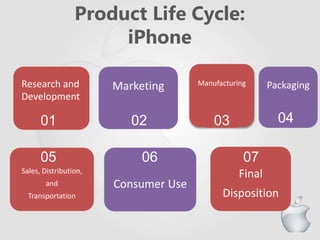
Research and
Development
Sales, Distribution,
and
Transportation
01
05
Marketing
Consumer Use
02
06
Manufacturing
Final
Disposition
03
07
Packaging
04
Product Life Cycle:
iPhone
Research and Development
❏ Design started in 2004 as apple’s project
purple
❏ Apple CEO Steve Jobs wanted to “kick
start the new market of cell phones”
❏ Steve Jobs steered design away from
tablet and towards phone
❏ Many different prototypes were
considered before iphone was released
❏ Announced and released in 2007 your
text here
Marketing
❏ Through short promotions, commercials, and press
releases,Apple caught the attention of millions.
❏ The idea was to demonstrate how fun and effortless the
iPhone was, rather than product details.
❏ Apple targeted teenagers, young adults, business
people,and adults in the release of the iPhone.
❏ After the release of the iPhone 3G, much of Apple’s
success was a result of customers acting as ambassadors
for the product.
❏ The iPhone is available through Sprint, Verizon Wireless,
and AT&T.
Manufacturing
❏ iPhone parts are from all over the world and are only
sent to China to be assembled
❏ Only 6% of the parts come from the USA, 34% from
Japan, 13% South Korea, 17% Germany, 3.6% from China,
and 27% from other smaller countries around the world
❏ The iPhone is a Chinese export to America even
though the company Apple is from California and the
product was completely designed in the States
❏ The iPhone has increased American trade deficit by 1.9
billion dollars
❏ It would cost $4.2 billion for Apple to bring iPhone
manufacturing to the USA
Packaging
❏ Apple has a team of design and engineer
experts to help with this process
❏ Slim, light, and protective are the 3 main
things Apple works with when packaging
❏ Efficient packaging reduces materials and
wastes
❏ Almost all materials in the packaging are
recyclable
❏ This makes the package more eco-
friendly
Sales, Distribution, and
Transportation
❏ The iPhone is available in nearly 100
countries and is still expanding.
❏ The iPhone 6 is estimated to ship 68
million units in the first batch alone.
❏ Apple sold more than 9 million models of
the iPhone 5c and 5s alone in their first
weekend of sales.
❏ Over 500 million iPhones have been sold
worldwide
Consumer Use
❏ Apple designed their iPhone to be energy
efficient while being able to be powerful
❏ This lets the iPhone have a great battery
life considering it has to perform many
complex tasks
❏ Apple was able to do this by making a
very good processing chip called the A7
Final Disposition
❏ Apple has instilled many recycling
programs for iphone users
❏ The iphone has removed many toxins
including mercury, lead, pvc, arson, and bfr
❏ Apple makes products with recycled
material
❏ The company has made many efforts to
reduce the iphone’s environmental footprint
Reference Websites
• http://bgr.com/2014/07/10/apple-iphone-6-
production/
• http://www.forbes.com/sites/markrogowsky/201
4/03/25/without-much-fanfareapple-has-sold-
its-500-millionth-iphone/
• http://financesonline.com/how-iphone-is-made/
• https://www.apple.com/environment/
• http://mobile-review.com/articles/2010/iphone-
history3-en.shtml

Product life cycle iphone

  • 1.
    Product Life Cycle: iPhoneby MHD AZMIL MHD AFSAL MOHAN KUMAR MURUGAVEL ARASU NAVEEN R
  • 2.
    Research and Development Sales, Distribution, and Transportation 01 05 Marketing ConsumerUse 02 06 Manufacturing Final Disposition 03 07 Packaging 04 Product Life Cycle: iPhone
  • 3.
    Research and Development ❏Design started in 2004 as apple’s project purple ❏ Apple CEO Steve Jobs wanted to “kick start the new market of cell phones” ❏ Steve Jobs steered design away from tablet and towards phone ❏ Many different prototypes were considered before iphone was released ❏ Announced and released in 2007 your text here
  • 4.
    Marketing ❏ Through shortpromotions, commercials, and press releases,Apple caught the attention of millions. ❏ The idea was to demonstrate how fun and effortless the iPhone was, rather than product details. ❏ Apple targeted teenagers, young adults, business people,and adults in the release of the iPhone. ❏ After the release of the iPhone 3G, much of Apple’s success was a result of customers acting as ambassadors for the product. ❏ The iPhone is available through Sprint, Verizon Wireless, and AT&T.
  • 5.
    Manufacturing ❏ iPhone partsare from all over the world and are only sent to China to be assembled ❏ Only 6% of the parts come from the USA, 34% from Japan, 13% South Korea, 17% Germany, 3.6% from China, and 27% from other smaller countries around the world ❏ The iPhone is a Chinese export to America even though the company Apple is from California and the product was completely designed in the States ❏ The iPhone has increased American trade deficit by 1.9 billion dollars ❏ It would cost $4.2 billion for Apple to bring iPhone manufacturing to the USA
  • 6.
    Packaging ❏ Apple hasa team of design and engineer experts to help with this process ❏ Slim, light, and protective are the 3 main things Apple works with when packaging ❏ Efficient packaging reduces materials and wastes ❏ Almost all materials in the packaging are recyclable ❏ This makes the package more eco- friendly
  • 7.
    Sales, Distribution, and Transportation ❏The iPhone is available in nearly 100 countries and is still expanding. ❏ The iPhone 6 is estimated to ship 68 million units in the first batch alone. ❏ Apple sold more than 9 million models of the iPhone 5c and 5s alone in their first weekend of sales. ❏ Over 500 million iPhones have been sold worldwide
  • 8.
    Consumer Use ❏ Appledesigned their iPhone to be energy efficient while being able to be powerful ❏ This lets the iPhone have a great battery life considering it has to perform many complex tasks ❏ Apple was able to do this by making a very good processing chip called the A7
  • 9.
    Final Disposition ❏ Applehas instilled many recycling programs for iphone users ❏ The iphone has removed many toxins including mercury, lead, pvc, arson, and bfr ❏ Apple makes products with recycled material ❏ The company has made many efforts to reduce the iphone’s environmental footprint
  • 10.
    Reference Websites • http://bgr.com/2014/07/10/apple-iphone-6- production/ •http://www.forbes.com/sites/markrogowsky/201 4/03/25/without-much-fanfareapple-has-sold- its-500-millionth-iphone/ • http://financesonline.com/how-iphone-is-made/ • https://www.apple.com/environment/ • http://mobile-review.com/articles/2010/iphone- history3-en.shtml