Product Life Cycle 
& 
BCG Matrix 
By, 
Praveen Choudhary.
History 
In 1806, William Colgate introduced starch, soap and 
candle factory on Dutch Street in New York 
City under the name of "William Colgate & 
Company". 
 In 1857, William Colgate died and the company was 
reorganized as "Colgate & Company" under the 
management of Samuel Colgate, his son. 
In 1873, the firm introduced its first toothpaste, an 
aromatic toothpaste sold in jars.
His company sold the first toothpaste in a tube, 
Colgate Ribbon Dental Cream, in 1896. 
In 1928, Palmolive-Peet bought the Colgate Company 
to create the Colgate-Palmolive-Peet Company. 
 In 1953 "Peet" was dropped from the title, leaving 
only "Colgate-Palmolive Company", the current name. 
Today Colgate has numerous subsidiary organizations 
spanning 200 countries, but it is publicly listed in only 
two, the United States and India.
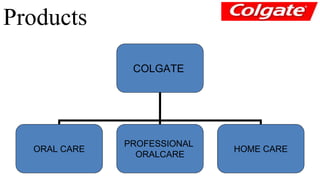
COLGATE 
ORAL CARE 
PROFESSIONAL 
ORALCARE 
HOME CARE 
Products
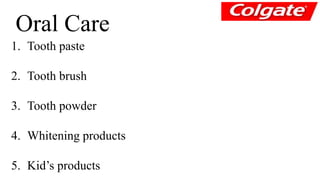
Oral Care 
1. Tooth paste 
2. Tooth brush 
3. Tooth powder 
4. Whitening products 
5. Kid’s products
Products
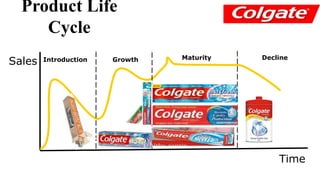
Product Life 
Cycle 
Sales Introduction Growth Maturity Decline 
Time
Description on PLC Curve 
INTRODUCTION: 
Colgate has introduced first product as Colgate’s Ribbon Dental 
Cream in the year 1896. Years later this dental cream was disappeared 
by replacing other formulas in introduction of new creams in Colgate. 
GROWTH: 
In 1997 Colgate Total toothpaste is introduced in the U.S. and quickly 
becomes the market leader. Only Colgate Total, with its 12-hour 
protection, fights a complete range of oral health problems and 
quickly becomes the market leader.
MATURITY: 
The maturity stage is divided into three stages : 
a) In the beginning sales increases but at declining rate. 
b) In second stage sales rate remain stable. 
c) In third stage sales begin to decline 
DECLINE: 
Today Colgate’s Toothpowder is not much popular. People 
have stopped using toothpowders and shifted themselves by 
dental creams and mouthwash.
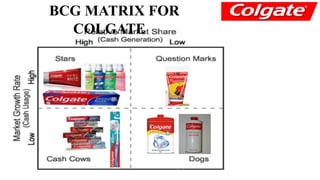
BCG Matrix 
The BCG matrix, invented by the Boston Consulting Group, is a 
tool that allows to classify and evaluate the products and services of a 
business. It is a decision making tool in order to balance the activities 
of a company among those which make profits, those who ensure 
growth, those which constitute the future of the firm or those who are 
its heritage. With this tool one is able to define the development 
policy of the company. 
The matrix will position the products/services in two ways: 
1. The rate of growth of the market ; 
2. The market share of a product offered facing the competitors.
BCG MATRIX FOR 
COLGATE
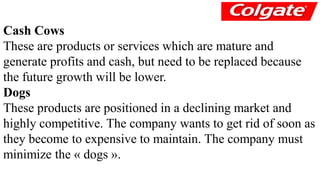
Cash Cows 
These are products or services which are mature and 
generate profits and cash, but need to be replaced because 
the future growth will be lower. 
Dogs 
These products are positioned in a declining market and 
highly competitive. The company wants to get rid of soon as 
they become to expensive to maintain. The company must 
minimize the « dogs ».
Question marks 
They do not generate profits unless the company decides to invest 
resources to maintain and even increase the market share (become 
potential stars). They have a high demand for liquidity and the 
company must ask the question: Invest or give up the product? 
Stars 
These are promising products for the company, they even can be 
considered as leaders of the industry. The strategy is to boost these 
products by appropriate investments to monitor the growth and 
maintain a position of strength. These products require a large 
amount of cash but also contribute to the company's profitability.
Life is short. Smile while 
you still have teeth. ~Mallory Hopkins
If a patient cannot clean his 
teeth, no dentist can clean them 
for him. ~Martin H. Fischer
Colgate Product life cycle and Bcg Matrix

Colgate Product life cycle and Bcg Matrix

  • 1.
    Product Life Cycle & BCG Matrix By, Praveen Choudhary.
  • 2.
    History In 1806,William Colgate introduced starch, soap and candle factory on Dutch Street in New York City under the name of "William Colgate & Company".  In 1857, William Colgate died and the company was reorganized as "Colgate & Company" under the management of Samuel Colgate, his son. In 1873, the firm introduced its first toothpaste, an aromatic toothpaste sold in jars.
  • 3.
    His company soldthe first toothpaste in a tube, Colgate Ribbon Dental Cream, in 1896. In 1928, Palmolive-Peet bought the Colgate Company to create the Colgate-Palmolive-Peet Company.  In 1953 "Peet" was dropped from the title, leaving only "Colgate-Palmolive Company", the current name. Today Colgate has numerous subsidiary organizations spanning 200 countries, but it is publicly listed in only two, the United States and India.
  • 4.
    COLGATE ORAL CARE PROFESSIONAL ORALCARE HOME CARE Products
  • 5.
    Oral Care 1.Tooth paste 2. Tooth brush 3. Tooth powder 4. Whitening products 5. Kid’s products
  • 6.
  • 7.
    Product Life Cycle Sales Introduction Growth Maturity Decline Time
  • 8.
    Description on PLCCurve INTRODUCTION: Colgate has introduced first product as Colgate’s Ribbon Dental Cream in the year 1896. Years later this dental cream was disappeared by replacing other formulas in introduction of new creams in Colgate. GROWTH: In 1997 Colgate Total toothpaste is introduced in the U.S. and quickly becomes the market leader. Only Colgate Total, with its 12-hour protection, fights a complete range of oral health problems and quickly becomes the market leader.
  • 9.
    MATURITY: The maturitystage is divided into three stages : a) In the beginning sales increases but at declining rate. b) In second stage sales rate remain stable. c) In third stage sales begin to decline DECLINE: Today Colgate’s Toothpowder is not much popular. People have stopped using toothpowders and shifted themselves by dental creams and mouthwash.
  • 10.
    BCG Matrix TheBCG matrix, invented by the Boston Consulting Group, is a tool that allows to classify and evaluate the products and services of a business. It is a decision making tool in order to balance the activities of a company among those which make profits, those who ensure growth, those which constitute the future of the firm or those who are its heritage. With this tool one is able to define the development policy of the company. The matrix will position the products/services in two ways: 1. The rate of growth of the market ; 2. The market share of a product offered facing the competitors.
  • 11.
  • 12.
    Cash Cows Theseare products or services which are mature and generate profits and cash, but need to be replaced because the future growth will be lower. Dogs These products are positioned in a declining market and highly competitive. The company wants to get rid of soon as they become to expensive to maintain. The company must minimize the « dogs ».
  • 13.
    Question marks Theydo not generate profits unless the company decides to invest resources to maintain and even increase the market share (become potential stars). They have a high demand for liquidity and the company must ask the question: Invest or give up the product? Stars These are promising products for the company, they even can be considered as leaders of the industry. The strategy is to boost these products by appropriate investments to monitor the growth and maintain a position of strength. These products require a large amount of cash but also contribute to the company's profitability.
  • 14.
    Life is short.Smile while you still have teeth. ~Mallory Hopkins
  • 15.
    If a patientcannot clean his teeth, no dentist can clean them for him. ~Martin H. Fischer