Apple Inc.
"Think
Different"
Brand development
and evolution
Table of contents
05
01
03
02
04
About Apple
Inc.
Development
Marketing
scheme
Visual
Merchandising
Target Audience
About Apple Inc.
01
"Think Different"
Introduction
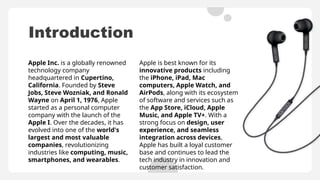
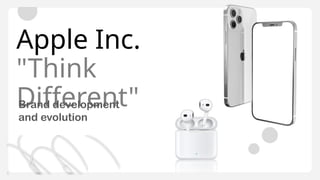
Apple is best known for its
innovative products including
the iPhone, iPad, Mac
computers, Apple Watch, and
AirPods, along with its ecosystem
of software and services such as
the App Store, iCloud, Apple
Music, and Apple TV+. With a
strong focus on design, user
experience, and seamless
integration across devices,
Apple has built a loyal customer
base and continues to lead the
tech industry in innovation and
customer satisfaction.
Apple Inc. is a globally renowned
technology company
headquartered in Cupertino,
California. Founded by Steve
Jobs, Steve Wozniak, and Ronald
Wayne on April 1, 1976, Apple
started as a personal computer
company with the launch of the
Apple I. Over the decades, it has
evolved into one of the world's
largest and most valuable
companies, revolutionizing
industries like computing, music,
smartphones, and wearables.
02. Development of
Apple Inc. Overtime
1. Founding and Early Years (1976-1984)
• Founded by Steve Jobs, Steve Wozniak, and Ronald Wayne in
1976.
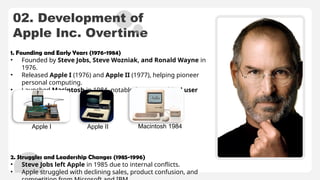
• Released Apple I (1976) and Apple II (1977), helping pioneer
personal computing.
• Launched Macintosh in 1984, notable for its graphical user
interface (GUI).
2. Struggles and Leadership Changes (1985-1996)
• Steve Jobs left Apple in 1985 due to internal conflicts.
• Apple struggled with declining sales, product confusion, and
Apple I Apple II Macintosh 1984
3. Return of Steve Jobs and Revival (1997-2000)
• Jobs returned in 1997 after Apple acquired his company NeXT.
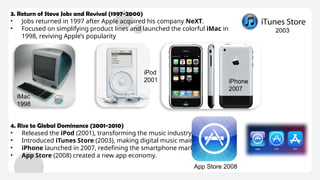
• Focused on simplifying product lines and launched the colorful iMac in
1998, reviving Apple’s popularity
4. Rise to Global Dominance (2001-2010)
• Released the iPod (2001), transforming the music industry.
• Introduced iTunes Store (2003), making digital music mainstream.
• iPhone launched in 2007, redefining the smartphone market.
• App Store (2008) created a new app economy.
iMac
1998
iPod
2001
2003
iPhone
2007
App Store 2008
5. Expansion into Ecosystem and Services (2011-2020)
• After Steve Jobs’ death in 2011, Tim Cook took over as CEO.
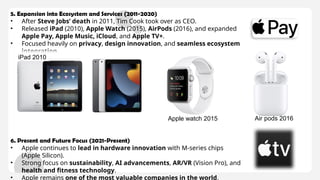
• Released iPad (2010), Apple Watch (2015), AirPods (2016), and expanded
Apple Pay, Apple Music, iCloud, and Apple TV+.
• Focused heavily on privacy, design innovation, and seamless ecosystem
integration.
6. Present and Future Focus (2021-Present)
• Apple continues to lead in hardware innovation with M-series chips
(Apple Silicon).
• Strong focus on sustainability, AI advancements, AR/VR (Vision Pro), and
health and fitness technology.
• Apple remains one of the most valuable companies in the world.
iPad 2010
Apple watch 2015 Air pods 2016
03. Marketing Scheme
Minimalist Product Design and User Experience
Apple's products are renowned for their sleek, minimalist designs and intuitive
interfaces. This aesthetic not only appeals visually but also enhances user
experience, fostering strong customer loyalty. ​
Iconic Advertising Campaigns
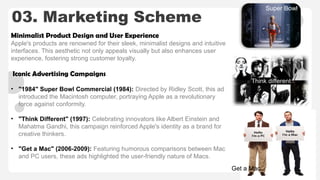
• "1984" Super Bowl Commercial (1984): Directed by Ridley Scott, this ad
introduced the Macintosh computer, portraying Apple as a revolutionary
force against conformity.​
• "Think Different" (1997): Celebrating innovators like Albert Einstein and
Mahatma Gandhi, this campaign reinforced Apple's identity as a brand for
creative thinkers.​
• "Get a Mac" (2006-2009): Featuring humorous comparisons between Mac
and PC users, these ads highlighted the user-friendly nature of Macs.
Super Bowl
Think different
Get a Mac
Consistent Branding and Storytelling
Apple maintains a consistent brand narrative that emphasizes
innovation, quality, and elegance. Their storytelling resonates with
consumers on an emotional level, creating a strong brand connection. ​
Focus on Value and Premium Pricing
By highlighting the unique value and superior experience of their
products, Apple justifies its premium pricing strategy, attracting
customers who perceive higher value in their offerings. ​
Strategic Product Launches
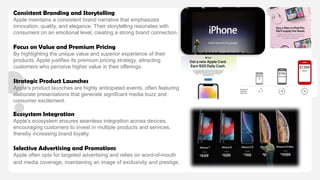
Apple's product launches are highly anticipated events, often featuring
elaborate presentations that generate significant media buzz and
consumer excitement. ​
Ecosystem Integration
Apple's ecosystem ensures seamless integration across devices,
encouraging customers to invest in multiple products and services,
thereby increasing brand loyalty.​
Selective Advertising and Promotions
Apple often opts for targeted advertising and relies on word-of-mouth
and media coverage, maintaining an image of exclusivity and prestige.
04. Apple’s Visual
Merchandising philosophy
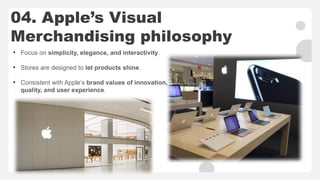
• Focus on simplicity, elegance, and interactivity.
• Stores are designed to let products shine.
• Consistent with Apple’s brand values of innovation,
quality, and user experience.
Minimalist Store Design
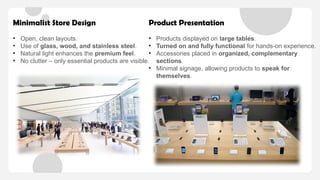
• Open, clean layouts.
• Use of glass, wood, and stainless steel.
• Natural light enhances the premium feel.
• No clutter – only essential products are visible.
Product Presentation
• Products displayed on large tables.
• Turned on and fully functional for hands-on experience.
• Accessories placed in organized, complementary
sections.
• Minimal signage, allowing products to speak for
themselves.
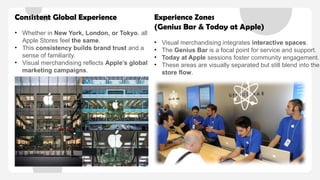
Consistent Global Experience
• Whether in New York, London, or Tokyo, all
Apple Stores feel the same.
• This consistency builds brand trust and a
sense of familiarity.
• Visual merchandising reflects Apple’s global
marketing campaigns.
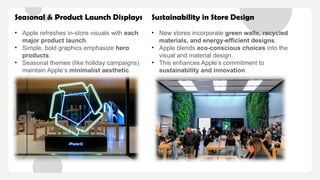
Experience Zones
(Genius Bar & Today at Apple)
• Visual merchandising integrates interactive spaces.
• The Genius Bar is a focal point for service and support.
• Today at Apple sessions foster community engagement.
• These areas are visually separated but still blend into the
store flow.
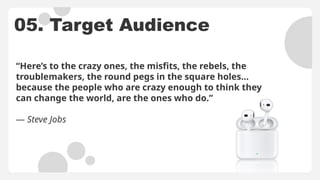
Seasonal & Product Launch Displays
• Apple refreshes in-store visuals with each
major product launch.
• Simple, bold graphics emphasize hero
products.
• Seasonal themes (like holiday campaigns)
maintain Apple’s minimalist aesthetic.
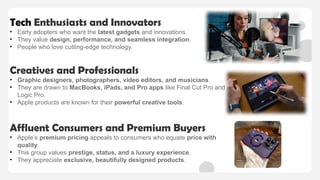
Sustainability in Store Design
• New stores incorporate green walls, recycled
materials, and energy-efficient designs.
• Apple blends eco-conscious choices into the
visual and material design.
• This enhances Apple’s commitment to
sustainability and innovation.
“Here’s to the crazy ones, the misfits, the rebels, the
troublemakers, the round pegs in the square holes…
because the people who are crazy enough to think they
can change the world, are the ones who do.”
— Steve Jobs
05. Target Audience
Tech Enthusiasts and Innovators
• Early adopters who want the latest gadgets and innovations.
• They value design, performance, and seamless integration.
• People who love cutting-edge technology.
Creatives and Professionals
• Graphic designers, photographers, video editors, and musicians.
• They are drawn to MacBooks, iPads, and Pro apps like Final Cut Pro and
Logic Pro.
• Apple products are known for their powerful creative tools.
Affluent Consumers and Premium Buyers
• Apple’s premium pricing appeals to consumers who equate price with
quality.
• This group values prestige, status, and a luxury experience.
• They appreciate exclusive, beautifully designed products.
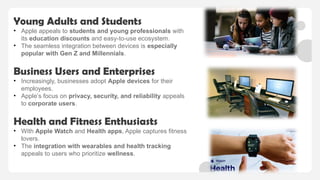
Young Adults and Students
• Apple appeals to students and young professionals with
its education discounts and easy-to-use ecosystem.
• The seamless integration between devices is especially
popular with Gen Z and Millennials.
Business Users and Enterprises
• Increasingly, businesses adopt Apple devices for their
employees.
• Apple’s focus on privacy, security, and reliability appeals
to corporate users.
Health and Fitness Enthusiasts
• With Apple Watch and Health apps, Apple captures fitness
lovers.
• The integration with wearables and health tracking
appeals to users who prioritize wellness.
In conclusion, Apple’s journey is a testament to
innovation, design excellence, and customer-centric
thinking. From iconic products to seamless experiences,
Apple has redefined technology and lifestyle. By
combining creativity, simplicity, and innovation, Apple
continues to inspire the world, shaping the future of
technology with every product launched.
“The future is here.”
22011CA011
C Komal
brand development ppt komal 22011ca011.pptx

  • 1.
  • 2.
    Table of contents 05 01 03 02 04 AboutApple Inc. Development Marketing scheme Visual Merchandising Target Audience
  • 3.
  • 4.
    Introduction Apple is bestknown for its innovative products including the iPhone, iPad, Mac computers, Apple Watch, and AirPods, along with its ecosystem of software and services such as the App Store, iCloud, Apple Music, and Apple TV+. With a strong focus on design, user experience, and seamless integration across devices, Apple has built a loyal customer base and continues to lead the tech industry in innovation and customer satisfaction. Apple Inc. is a globally renowned technology company headquartered in Cupertino, California. Founded by Steve Jobs, Steve Wozniak, and Ronald Wayne on April 1, 1976, Apple started as a personal computer company with the launch of the Apple I. Over the decades, it has evolved into one of the world's largest and most valuable companies, revolutionizing industries like computing, music, smartphones, and wearables.
  • 5.
    02. Development of AppleInc. Overtime 1. Founding and Early Years (1976-1984) • Founded by Steve Jobs, Steve Wozniak, and Ronald Wayne in 1976. • Released Apple I (1976) and Apple II (1977), helping pioneer personal computing. • Launched Macintosh in 1984, notable for its graphical user interface (GUI). 2. Struggles and Leadership Changes (1985-1996) • Steve Jobs left Apple in 1985 due to internal conflicts. • Apple struggled with declining sales, product confusion, and Apple I Apple II Macintosh 1984
  • 6.
    3. Return ofSteve Jobs and Revival (1997-2000) • Jobs returned in 1997 after Apple acquired his company NeXT. • Focused on simplifying product lines and launched the colorful iMac in 1998, reviving Apple’s popularity 4. Rise to Global Dominance (2001-2010) • Released the iPod (2001), transforming the music industry. • Introduced iTunes Store (2003), making digital music mainstream. • iPhone launched in 2007, redefining the smartphone market. • App Store (2008) created a new app economy. iMac 1998 iPod 2001 2003 iPhone 2007 App Store 2008
  • 7.
    5. Expansion intoEcosystem and Services (2011-2020) • After Steve Jobs’ death in 2011, Tim Cook took over as CEO. • Released iPad (2010), Apple Watch (2015), AirPods (2016), and expanded Apple Pay, Apple Music, iCloud, and Apple TV+. • Focused heavily on privacy, design innovation, and seamless ecosystem integration. 6. Present and Future Focus (2021-Present) • Apple continues to lead in hardware innovation with M-series chips (Apple Silicon). • Strong focus on sustainability, AI advancements, AR/VR (Vision Pro), and health and fitness technology. • Apple remains one of the most valuable companies in the world. iPad 2010 Apple watch 2015 Air pods 2016
  • 8.
    03. Marketing Scheme MinimalistProduct Design and User Experience Apple's products are renowned for their sleek, minimalist designs and intuitive interfaces. This aesthetic not only appeals visually but also enhances user experience, fostering strong customer loyalty. ​ Iconic Advertising Campaigns • "1984" Super Bowl Commercial (1984): Directed by Ridley Scott, this ad introduced the Macintosh computer, portraying Apple as a revolutionary force against conformity.​ • "Think Different" (1997): Celebrating innovators like Albert Einstein and Mahatma Gandhi, this campaign reinforced Apple's identity as a brand for creative thinkers.​ • "Get a Mac" (2006-2009): Featuring humorous comparisons between Mac and PC users, these ads highlighted the user-friendly nature of Macs. Super Bowl Think different Get a Mac
  • 9.
    Consistent Branding andStorytelling Apple maintains a consistent brand narrative that emphasizes innovation, quality, and elegance. Their storytelling resonates with consumers on an emotional level, creating a strong brand connection. ​ Focus on Value and Premium Pricing By highlighting the unique value and superior experience of their products, Apple justifies its premium pricing strategy, attracting customers who perceive higher value in their offerings. ​ Strategic Product Launches Apple's product launches are highly anticipated events, often featuring elaborate presentations that generate significant media buzz and consumer excitement. ​ Ecosystem Integration Apple's ecosystem ensures seamless integration across devices, encouraging customers to invest in multiple products and services, thereby increasing brand loyalty.​ Selective Advertising and Promotions Apple often opts for targeted advertising and relies on word-of-mouth and media coverage, maintaining an image of exclusivity and prestige.
  • 10.
    04. Apple’s Visual Merchandisingphilosophy • Focus on simplicity, elegance, and interactivity. • Stores are designed to let products shine. • Consistent with Apple’s brand values of innovation, quality, and user experience.
  • 11.
    Minimalist Store Design •Open, clean layouts. • Use of glass, wood, and stainless steel. • Natural light enhances the premium feel. • No clutter – only essential products are visible. Product Presentation • Products displayed on large tables. • Turned on and fully functional for hands-on experience. • Accessories placed in organized, complementary sections. • Minimal signage, allowing products to speak for themselves.
  • 12.
    Consistent Global Experience •Whether in New York, London, or Tokyo, all Apple Stores feel the same. • This consistency builds brand trust and a sense of familiarity. • Visual merchandising reflects Apple’s global marketing campaigns. Experience Zones (Genius Bar & Today at Apple) • Visual merchandising integrates interactive spaces. • The Genius Bar is a focal point for service and support. • Today at Apple sessions foster community engagement. • These areas are visually separated but still blend into the store flow.
  • 13.
    Seasonal & ProductLaunch Displays • Apple refreshes in-store visuals with each major product launch. • Simple, bold graphics emphasize hero products. • Seasonal themes (like holiday campaigns) maintain Apple’s minimalist aesthetic. Sustainability in Store Design • New stores incorporate green walls, recycled materials, and energy-efficient designs. • Apple blends eco-conscious choices into the visual and material design. • This enhances Apple’s commitment to sustainability and innovation.
  • 14.
    “Here’s to thecrazy ones, the misfits, the rebels, the troublemakers, the round pegs in the square holes… because the people who are crazy enough to think they can change the world, are the ones who do.” — Steve Jobs 05. Target Audience
  • 15.
    Tech Enthusiasts andInnovators • Early adopters who want the latest gadgets and innovations. • They value design, performance, and seamless integration. • People who love cutting-edge technology. Creatives and Professionals • Graphic designers, photographers, video editors, and musicians. • They are drawn to MacBooks, iPads, and Pro apps like Final Cut Pro and Logic Pro. • Apple products are known for their powerful creative tools. Affluent Consumers and Premium Buyers • Apple’s premium pricing appeals to consumers who equate price with quality. • This group values prestige, status, and a luxury experience. • They appreciate exclusive, beautifully designed products.
  • 16.
    Young Adults andStudents • Apple appeals to students and young professionals with its education discounts and easy-to-use ecosystem. • The seamless integration between devices is especially popular with Gen Z and Millennials. Business Users and Enterprises • Increasingly, businesses adopt Apple devices for their employees. • Apple’s focus on privacy, security, and reliability appeals to corporate users. Health and Fitness Enthusiasts • With Apple Watch and Health apps, Apple captures fitness lovers. • The integration with wearables and health tracking appeals to users who prioritize wellness.
  • 17.
    In conclusion, Apple’sjourney is a testament to innovation, design excellence, and customer-centric thinking. From iconic products to seamless experiences, Apple has redefined technology and lifestyle. By combining creativity, simplicity, and innovation, Apple continues to inspire the world, shaping the future of technology with every product launched. “The future is here.” 22011CA011 C Komal