
REPORT WRITING
(for Engineering and Food Technology)These slides can be viewed at:
tinyurl.com/massey211report
Centre for Teaching and
Learning
Library Level 3
ctlalb@massey.ac.nz
09 441 8143
CONTENTS
Executive summary
Analysis of previous reports
Effective writing style
Report specifications
Introduction
Company info
Conclusion
Online extras
Chapter structure and style
REPORT SPECIFICATIONS
DUE DATE: Friday June 16th
MARKS: 20% of the course
OVERALL PURPOSE AND FORM: A final report providing
a clear and concise summary of your final concept, how it
was developed, and recommendations. The report must be
in a form that is appropriate to a client’s company needs.
REQUIREMENTS
This report must be:
• succinct / concise
• accurate (i.e. correct grammar, spelling, punctuation)
• relevant
• credible (i.e. gives client company managers confidence in your
final concept and (or) recommendations).
This report must include:
• a title page
• a contents page
• clear headings
• appendices
• accurate referencing
The report must address:
1) User research
A documented application of an appropriate qualitative user /stakeholder
research technique in your project. It should be clear what information you
were seeking to find out, and how the knowledge gained from the research
is then used to support decision making.
2) Product concept description and design specifications
Description of core benefits, tangible and augmented product with a clear
theme related to the target market requirements and expectations. Well-
constructed and documented design specifications.
3) Product feasibility
The feasibility to commercialise and manufacture your concept.
Financial analysis based on appropriate return on investment criteria.
Consideration of intellectual property (IP) issues and potential.
4) Commercialisation planning
A description of the 4 P’s of marketing and how they relate to
the product and/or process being developed.
5) Prototyping or similar (however you presented your product
concept)
Appropriate use of a means to describe and communicate the
product to the readers without them needing to read the
document more than once.
6) Market research proposal/brief
A proposal that outlines the need for information, a method
that might be used to collect the information, and how the
results would be used.
ANALYSIS OF PREVIOUS
REPORTS
Report A
Report B
Report C
CHAPTER STRUCTURE
AND STYLE
Key Principles
Divide chapters into numbered and titled subsections.
Use bulletpoints, tables and figures to present information
(as recommended in the course!).
Use short sentences and paragraphs; use these to explain
and comment on (but not just to repeat) information that
is already in tables etc.
Use an objective, factual and concise style (more on this
later!).
Example of clear titles for sections and
subsections
Lessons about structure from previous reports
DO
Use the keywords from the six
required elements in your
section or subsection titles.
Pay sufficient attention to
requirements 4 and 6.
Use tables and figures to
present information.
Refer to scholarly literature
where appropriate.
DON’T
Use vague words like
‘implications’ as section titles.
Use a lot of words on lengthy
introductions, company
history etc.
Don’t mix up different topics in
the same section.
Cover the same information in
different sections
EXECUTIVE SUMMARY
Key Principles
Summarises the whole report (so it’s
typically written LAST).
Can be read alone (without having to read
the report).
Concise (typically one page).
Typical structure
Purpose of report
Company
Context (i.e. need for new product)
Research method
Product concept and specifications
Feasibility process and results
Commercialisation
Product development / prototyping
Market research brief
Example phrases
This product development report was commissioned by XXX ltd, a
….. based in …. . The purpose was to design a replacement for their
current …..
Semi-structured interviews with users identified several perceived
needs, such as ….. These were the basis for the development of ….
with the following characteristics: ………….
The cost of …. is estimated at …. . With projected sales of …. at a
wholesale price of $ …, it should generate a profit of $ … per unit
sold, a ….% increase over the current model. Initial market analysis
suggests that ….
In order to test ….. and investigate consumer perceptions, it is
recommended that XXX ltd conducts …..
INTRODUCTION
Key Principles
Concise (typically one page).
Provides the context and purpose.
Gives a brief overview of structure.
Does not summarise results or
recommendations (i.e. UNlike the executive
summary).
Typical structure
Basic company information
Context (i.e. need for new product)
Purpose of the report
Overview of sections
Example phrases
XXX is a …. company based in ….. . Their main products are … which
account for …. of the … market.
The company wishes to introduce … in order to …. . They, therefore
commissioned … to investigate … and develop ….
This report summarises ….. . Chapters 1 and 2 focus on …. in order
to …. . Chapter 3 comprises a …., which …. . Chapter 4 includes a
detailed description of … Finally, chapter 6 presents key
recommendations for further ….
COMPANY INFORMATION
Key Principles
Concentrate on information that is relevant
to your project.
Take care not to plagiarise the company
materials or website.
Be objective and factual; avoid repeating
promotional claims.
Typical structure
Brief history
Current market position
Brand(s) / mission statement
Products and manufacturing
Identity and structure (e.g. ownership, organisational
structure, human resources)
Future plans
Example phrases
XXX was founded by …. in ….. . It has grown steadily into ….. with
manufacturing facilities in …. and distribution networks in …. XXX
currently has a … share of the domestic .. market and … globally, with
particular strengths in … Their major competitors domestically are ….
The company sells products under the … brand with the slogan …. . Its
brand values are said to be ….. . This is consistent with its mission
statement: to …….
In New Zealand, XXX operates two manufacturing plants in ….
employing ….
XXX is a privately-owned limited company with two major shareholders.
The research and development (R & D) unit consists of …. based in …. .
The R & D unit reports to …
XXX plans to increase market share … It aims to become …
EFFECTIVE WRITING
STYLE
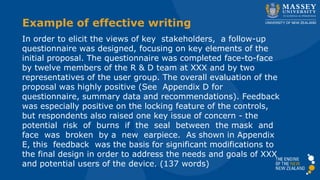
In order to elicit the views of key stakeholders, a follow-up
questionnaire was designed, focusing on key elements of the
initial proposal. The questionnaire was completed face-to-face
by twelve members of the R & D team at XXX and by two
representatives of the user group. The overall evaluation of the
proposal was highly positive (See Appendix D for
questionnaire, summary data and recommendations). Feedback
was especially positive on the locking feature of the controls,
but respondents also raised one key issue of concern - the
potential risk of burns if the seal between the mask and
face was broken by a new earpiece. As shown in Appendix
E, this feedback was the basis for significant modifications to
the final design in order to address the needs and goals of XXX
and potential users of the device. (137 words)
Example of effective writing
Effective writing is:
• logically structured
• coherent
• concise
• precise
• objective
• accurate
In order to elicit the views of key stakeholders, a
follow-up questionnaire was designed, focusing
on key elements of the initial proposal. The
questionnaire was completed face-to-face by
twelve members of the R & D team at XXX and by
two representatives of the user group. The overall
evaluation of the proposal was highly positive
(See Appendix D for questionnaire, summary
data and recommendations). Feedback was
especially positive on the locking feature of the
controls, but respondents also raised one key
issue of concern - the potential risk of burns if
the seal between the mask and face was
broken by a new earpiece. As shown in
Appendix E, this feedback was the basis for
significant modifications to the final design in
order to address the needs and goals of XXX and
potential users of the device. (137 words)
logically structured
TOPIC SENTENCE INTRODUCES
THE TOPIC AND PURPOSE OF
THE PARAGRAPH.
EACH SENTENCE COVERS A
DIFFERENT STAGE OR ASPECT
OF THE PROCESS.
CONCLUSION SENTENCE
HIGHLIGHTS THE OUTCOME
FOR THE PROJECT.
In order to elicit the views of key stakeholders, a
follow-up questionnaire was designed, focusing
on key elements of the initial proposal. The
questionnaire was completed face-to-face by
twelve members of the R & D team at XXX and by
two representatives of the user group. The overall
evaluation of the proposal was highly positive
(See Appendix D for questionnaire, summary
data and recommendations). Feedback was
especially positive on the locking feature of the
controls, but respondents also raised one key
issue of concern - the potential risk of burns if
the seal between the mask and face was
broken by a new earpiece. As shown in
Appendix E, this feedback was the basis for
significant modifications to the final design in
order to address the needs and goals of XXX and
potential users of the device. (137 words)
coherent
BEGIN NEW SENTENCE WITH
TOPIC OF PREVIOUS
SENTENCE(S); i.e. OLD before
NEW.
EMPHASISE COHERENCE BY
USING ‘THE’, ‘THIS’ ETC.
USE ONE OR TWO STRATEGIC
LINKING WORDS IN A
PARAGRAPH.
MAKE EXPLICIT REFERENCES
TO TABLES, FIGURES, &
APPENDICES.
SELECTED LINKING WORDS / PHRASES
Adding points
However, .....
On the other hand, ....
Despite this, ...
In addition, ...
Moreover, ....
Furthermore, ...
Contrasting points
Reaching conclusions
Therefore , ...
Hence, ....
Consequently, ...
Cause-effect
As a result of + NOUN
Due to + NOUN
On account of + NOUN
Twelve members of the R & D team at XXX and
two representatives of the user group completed
a questionnaire. Face to face was the delivery
method and we received highly positive feedback
on the proposal. The purpose was to elicit the
views of key stakeholders and key elements of
the initial proposal were the focus. They liked the
locking feature of the controls, but the potential
risk of burns if the seal between the mask
and face was broken by a new earpiece was a
concern for respondents. (See Appendix D for
questionnaire, summary data and
recommendations and Appendix E for how we
used feedback as the basis for significant
modifications to the final design in order to
address the needs and goals of XXX and potential
users of the device).
illogically structured and incoherent
NO TOPIC SENTENCE; JUST
JUMPS STRAIGHT INTO THE
DETAILS.
MOST SENTENCES START WITH
A NEW TOPIC, INSTEAD OF
BUILDING ON THE ONE FROM
THE SENTENCE BEFORE.
REFERENCE TO APPENDICES IS
TOO FAR AWAY FROM THE
RELEVANT SENTENCE.
In order to elicit the views of key stakeholders, a
follow-up questionnaire was designed, focusing
on key elements of the initial proposal. The
questionnaire was completed face-to-face by
twelve members of the R & D team at XXX and by
two representatives of the user group. The overall
evaluation of the proposal was highly positive
(See Appendix D for questionnaire, summary
data and recommendations). Feedback was
especially positive on the locking feature of the
controls, but respondents also raised one key
issue of concern - the potential risk of burns if
the seal between the mask and face was
broken by a new earpiece. As shown in
Appendix E, this feedback was the basis for
significant modifications to the final design in
order to address the needs and goals of XXX and
potential users of the device. (137 words)
concise, precise, objective
CONCISE: short sentences; no
repetition of information; only
need-to-know detail.
PRECISE: enough details of the
processes to allow someone to
repeat it; exact words for the
meaning.
OBJECTIVE: factual; evidence-
based; avoiding exaggeration
and emotion;.
We wanted to find out what people thought about
the design which we had sent by email the week
before, so the team thought up a follow-up
questionnaire and arranged to meet them during
their lunch break from 1 – 2 pm on Monday April
4th. Fifteen people said they were willing to meet
us, but, unfortunately, only twelve turned up. The
team leader did give us a great tip though, which
was to text some people who might be interested
in buying the product in future to see what they
thought and we were really pleased that at least
two of them were able to meet up with us the
following Thursday at 4 pm in a café next to the
bus station. Anyway, they all basically loved it,
which you can see for yourself in Appendix D,
though they were a bit worried that users could
get burnt. We were really grateful for their
fantastic feedback, and really took it to heart and
came up with a new design which was definitely a
big improvement (Appendix E).
verbose, vague and subjective
VERBOSE: long, shapeless
sentences; too many little
words; too much irrelevant
detail.
VAGUE: lack of relevant detail;
general words like ‘people’.
SUBJECTIVE: too much
emotional language like
‘unfortunately’; too much focus
on the personal experiences
and feelings of the
project team.
In order to elicit the views of key stakeholders, a
follow-up questionnaire was designed, focusing
on key elements of the initial proposal. The
questionnaire was completed face-to-face by
twelve members of the R & D team at XXX and by
two representatives of the user group. The overall
evaluation of the proposal was highly positive
(See Appendix D for questionnaire, summary
data and recommendations). Feedback was
especially positive on the locking feature of the
controls, but respondents also raised one key
issue of concern - the potential risk of burns if
the seal between the mask and face was
broken by a new earpiece. As shown in
Appendix E, this feedback was the basis for
significant modifications to the final design in
order to address the needs and goals of XXX and
potential users of the device. (137 words)
accurate
GRAMMAR : word endings;
tenses; ‘the / a’; prepositions
like ‘by’ ‘on’ ‘in’ etc.
PUNCTUATION: full stops,
commas, dashes, brackets.
VOCABULARY: the right words
going together, like ‘complete a
questionnaire’, ‘raise concerns’,
‘address needs’ etc.
In order to know the view of key stakeholders a
follow-up questionnaire is design focus on key
elements of initial proposal, the questionnaire
was answer face-to-face by twelve members of
the R & D team at XXX and by two representative
of the user group. Overall evaluation of proposal
was very good, see Appendix D for
questionnaire, summary data and
recommendations, feedback especially positive of
the locking feature of controls. But respondents
also concerned one key issue, the potential risk
for burn if seal between the mask and face
broken by new earpiece. As demonstrated on
Appendix E these feedback was basis for
significantly change the final design for address
need and goal of XXX and potential user of
device.
inaccurate
GRAMMAR : too many little
errors.
PUNCTUATION: overuse of
commas; underuse of other
punctuation; run-on sentences.
VOCABULARY: the right words
going together, like ‘complete a
questionnaire’, ‘raise concerns’,
‘address needs’ etc.
CONCLUSION
Divide the report into clearly numbered and titled sections and subsections.
Make it easy for the reader to see that you have covered the required
elements.
Present information in clearly numbered and titled tables and figures – and
explain what they mean in short, clear sentences or paragraphs.
Avoid ‘lifting’ irrelevant information from company websites.
Structure your paragraphs, starting with a topic sentence and making sure
sentences build on points made previously.
Keep the style concise, precise and objective.
Check the text for common errors (run-on sentences, missing endings,
vague.
© 2017
This PowerPoint Presentation and the accompanying handouts are
copyrighted by Centre for Teaching and Learning, Massey
University and may not be used, except for personal study,
without written permission from the copyright owner. Please
note that examples are provided for illustration of writing
principles only and no reliance should be placed on any of the
ideas referred to in the texts.
Martin McMorrow, Centre for Teaching and Learning
09 441 8143 ctlalb@massey.ac.nz
These slides can be viewed at: tinyurl.com/massey211report
ONLINE EXTRAS
• Example of science writing
• APA Referencing basics
• Referencing software
• Indenting a reference list
Catechins, derived from both green tea (Mukhtar & Ahmad 2000) and red
wine (Waterhouse, 2002), are a family of flavonoid polyphenols
associated with chemopreventive effects on colon, skin, lung, prostate,
and breast cancers (Butt & Sultan, 2009). Catechins are also associated
with numerous cardiovascular benefits, such as decreased inflammation
and platelet adhesion, increased endothelial nitric oxide activity, and
improved blood lipid profile (Babu & Liu, 2008). Although the addition
of catechins and other polyphenols can increase the functionality
of a product, they can also elicit significant levels of bitterness and
astringency (Peleg et al., 1999). These attributes are generally associated
with lower consumer acceptance (Lesschaeve & Noble, 2005). This may
reduce the uptake of these products in the market and place limits on the
concentration of polyphenolic compounds that can be used in their
formulation. These considerations have led to renewed interest in
strategies to moderate the perception of bitterness and astringency
elicited by these and related functional ingredients. (Guadette, N.J., &
Pickering, G.J., 2012).
Linking phrase
signalling
transition to
problem
(sub-area of
topic)
Linking phrase
signalling
transition to
writers own topic
area
Broad topic area:
Functional
benefits of
catechins
SCIENCE WRITING
APA REFERENCING
BASICS
The most common references are to these four
types of expert source:
BOOKS CHAPTERS IN
EDITED BOOKS
ARTICLES IN
SCHOLARLY,
PEER-REVIEWED
JOURNALS
CREDIBLE
WEBSITES
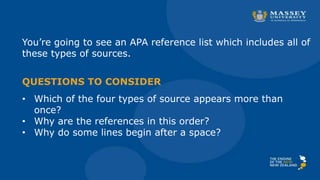
You’re going to see an APA reference list which includes all of
these types of sources.
QUESTIONS TO CONSIDER
• Which of the four types of source appears more than
once?
• Why are the references in this order?
• Why do some lines begin after a space?
References
Biggins, G. (2009). Why I became a social worker. In P. Te Ara & T.
Rogers (Eds.), Social work and social workers in New
Zealand/Aotearoa (pp.102-120). Auckland, New Zealand: Insight
Press.
Hamel, G. (2000). Leading the revolution. Boston, MA: Harvard
Business School Press.
Hubbard, J., Thomas, C., & Varnham, S. (2001). Principles of law for
New Zealand business students (2nd ed.). Auckland, New Zealand:
Pearson Education.
Silverblatt, A. (2004). Media as a social institution. American
Behavioral Scientist, 48(1), 35-42. doi:10.1080/09585190802707433
Statistics New Zealand. (2009). Mapping trends in the Auckland
region. Retrieved from
http://www.stats.govt.nz/Publications/PopulationStatistics/mapping
-trends-in-the-auckland-region.aspx.
References
Biggins, G. (2009). Why I became a social worker. In P. Te Ara & T.
Rogers (Eds.), Social work and social workers in New
Zealand/Aotearoa (pp.102-120). Auckland, New Zealand: Insight
Press.
Hamel, G. (2000). Leading the revolution. Boston, MA: Harvard
Business School Press.
Hubbard, J., Thomas, C., & Varnham, S. (2001). Principles of law for
New Zealand business students (2nd ed.). Auckland, New Zealand:
Pearson Education.
Silverblatt, A. (2004). Media as a social institution. American
Behavioral Scientist, 48(1), 35-42. doi:10.1080/09585190802707433
Statistics New Zealand. (2009). Mapping trends in the Auckland
region. Retrieved from
http://www.stats.govt.nz/Publications/PopulationStatistics/mapping
-trends-in-the-auckland-region.aspx.
‘References’ top and centred
Alphabetical order
Hanging indent
• should consist of expert sources
• includes only the sources you have cited in the essay
• is on a separate page at the end of your essay/report with
the title ‘References’ (at the top in the centre)
• is ordered alphabetically by author
• has a hanging indent (i.e. only the first line of each
reference begins at the left margin (see the last slide in
your handout for tips on how to do this)
An APA reference list:
BOOK
Hamel, G. (2000). Leading the revolution. Boston, MA: Harvard Business School Press.
surname,
initial
(year) title city
publisher
For more than one
author, include all
names with initials
(followed by . and ,)
Hubbard, J., Thomas, C., & Varnham, S. (2001). Principles
of law for New Zealand business students (2nd ed.).
Auckland, New Zealand: Pearson Education.
This is how you
indicate second, third
… edition
CITY OF PUBLICATION
UK, NZ etc
city,
country
Harmondsworth, England:
Penguin.
Palmerston North, New
Zealand: Dunmore Press.
USA
city, state
initials
Upper Saddle River, NJ:
Lawrence Erlbaum
Associates.
Check title of book in library catalogue and/or Google if city of
publication is not clear from the book itself
Australia
Either state
abbreviation
OR country
Milton, Qld: McGraw-Hill.
Milton, Australia: McGraw-
Hill.
CHAPTER IN
EDITED BOOK
Biggins, G. (2009). Why I became a social worker. In P. Te Ara & T. Rogers (Eds.),
Social work and social workers in New Zealand/Aotearoa (pp.102-120).
Auckland, New Zealand: Insight Press.
Title of chapter –
not in italics
Editors’ names (initial
before) and (Eds.)
Title of book
– in italics
Page numbers of chapter – in
brackets with pp. before
Author of chapter
and year of
publication
City &
Publisher
ARTICLE IN A
SCHOLARLY JOURNAL
Silverblatt, A. (2004). Media as a social
institution. American Behavioral
Scientist, 48(1), 35-42.
author’s name
year
Title (no italics; not in capitals)
journal name
(italics; main words start
with capitals)
volume number in italics;
issue number in brackets
page numbers
doi:10.1080/09585190802707433
doi number
(if the article has one)
WEB PAGE REFERENCE
Statistics New Zealand. (2009).
Mapping trends in the Auckland
region. Retrieved from
http://www.stats.govt.nz/Publication
s/PopulationStatistics/mapping-
trends-in-the-auckland-region.aspx.
author’s name
(or organisation that owns the web site)
Year
(if it’s missing put (n.d.)
Retrieved from
followed by full internet address
Title of page
You’re going to see another APA reference list.
QUESTIONS TO CONSIDER
Which two of these elements are missing?
A) city of publication B) page numbers
C) publisher D) volume & issue numbers
References
New Zealand Ministry of Education. (2015). What we get for what we spend: Retrieved
from http://www.educationcounts.govt.nz/data/assets/pdf_file/0011/163685/What-we-
get-for-what-we-spend-Inputs-outputs-and-outcomes-of-Govts-tertiary-education-
expenditure-2004-2013.pdf
Nicol, D. J., & Macfarlane-Dick, D. (2006). Formative assessment and self-regulated
learning: A model and seven principles of good feedback practice. Studies in Higher
Education, 31(2), 199 — 218.
North, S. M. (1995). The idea of a writing center. In C. Murphy & J. Law (Eds.), Landmark
essays on writing centers. Davis, CA: Hermagoras Press.
Parker, M. (1992). Post-modern organizations or postmodern organization theory?
Organization Studies, 13(1), 1.
Pascarella, E. T., & Terenzini, P. T. (2005). How college affects students: A third decade of
research. Jossey-Bass.
A) city B) page numbers C) publisher D) volume & issue numbers
A & B were missing References
New Zealand Ministry of Education. (2015). What we get for what we spend.
Retrieved from
http://www.educationcounts.govt.nz/data/assets/pdf_file/0011/163685/Wh
at-we-get-for-what-we-spend-Inputs-outputs-and-outcomes-of-Govts-
tertiary-education-expenditure-2004-2013.pdf
Nicol, D. J., & Macfarlane-Dick, D. (2006). Formative assessment and self-
regulated learning: A model and seven principles of good feedback practice.
Studies in Higher Education, 31(2), 199-218.
North, S. M. (1995). The idea of a writing center. In C. Murphy & J. Law (Eds.),
Landmark essays on writing centers (pp. 71-85). Davis, CA: Hermagoras
Press.
Parker, M. (1992). Post-modern organizations or postmodern organization
theory? Organization Studies, 13(1), 1.
Pascarella, E. T., & Terenzini, P. T. (2005). How college affects students: A third
decade of research. San Francisco, CA: Jossey-Bass.
• For a free download and more information about EndNote see
tinyurl.com/masseyendnote
• For help with EndNote, contact the library at Library@massey.ac.nz
or go to tinyurl.com/masseylibraryquestions
• For upcoming library sessions on EndNote see
tinyurl.com/masseylibraryworkshops
• You can find other free referencing applications at onenote.com,
zotero.com and mendeley.com
Referencing software
Write the list normally – with each reference ‘left-aligned’ like this:
Silverblatt, A. (2004). Media as a social institution. American Behavioral Scientist,
48(1), 35-42.
Select the whole list.
Click on the ‘paragraph’ tab and on ‘special’.
Select ‘hanging’.
Click on ‘OK’. The references change to this:
Silverblatt, A. (2004). Media as a social institution. American Behavioral Scientist,
48(1), 35-42.
Smile – it’s over!
How to indent a reference list (PC)

Product Development Report Writing

  • 1.
    REPORT WRITING (for Engineeringand Food Technology)These slides can be viewed at: tinyurl.com/massey211report Centre for Teaching and Learning Library Level 3 ctlalb@massey.ac.nz 09 441 8143
  • 2.
    CONTENTS Executive summary Analysis ofprevious reports Effective writing style Report specifications Introduction Company info Conclusion Online extras Chapter structure and style
  • 3.
  • 4.
    DUE DATE: FridayJune 16th MARKS: 20% of the course OVERALL PURPOSE AND FORM: A final report providing a clear and concise summary of your final concept, how it was developed, and recommendations. The report must be in a form that is appropriate to a client’s company needs.
  • 5.
    REQUIREMENTS This report mustbe: • succinct / concise • accurate (i.e. correct grammar, spelling, punctuation) • relevant • credible (i.e. gives client company managers confidence in your final concept and (or) recommendations). This report must include: • a title page • a contents page • clear headings • appendices • accurate referencing
  • 6.
    The report mustaddress: 1) User research A documented application of an appropriate qualitative user /stakeholder research technique in your project. It should be clear what information you were seeking to find out, and how the knowledge gained from the research is then used to support decision making. 2) Product concept description and design specifications Description of core benefits, tangible and augmented product with a clear theme related to the target market requirements and expectations. Well- constructed and documented design specifications. 3) Product feasibility The feasibility to commercialise and manufacture your concept. Financial analysis based on appropriate return on investment criteria. Consideration of intellectual property (IP) issues and potential.
  • 7.
    4) Commercialisation planning Adescription of the 4 P’s of marketing and how they relate to the product and/or process being developed. 5) Prototyping or similar (however you presented your product concept) Appropriate use of a means to describe and communicate the product to the readers without them needing to read the document more than once. 6) Market research proposal/brief A proposal that outlines the need for information, a method that might be used to collect the information, and how the results would be used.
  • 8.
  • 9.
  • 10.
  • 11.
  • 12.
  • 13.
    Key Principles Divide chaptersinto numbered and titled subsections. Use bulletpoints, tables and figures to present information (as recommended in the course!). Use short sentences and paragraphs; use these to explain and comment on (but not just to repeat) information that is already in tables etc. Use an objective, factual and concise style (more on this later!).
  • 14.
    Example of cleartitles for sections and subsections
  • 15.
    Lessons about structurefrom previous reports DO Use the keywords from the six required elements in your section or subsection titles. Pay sufficient attention to requirements 4 and 6. Use tables and figures to present information. Refer to scholarly literature where appropriate. DON’T Use vague words like ‘implications’ as section titles. Use a lot of words on lengthy introductions, company history etc. Don’t mix up different topics in the same section. Cover the same information in different sections
  • 16.
  • 17.
    Key Principles Summarises thewhole report (so it’s typically written LAST). Can be read alone (without having to read the report). Concise (typically one page).
  • 18.
    Typical structure Purpose ofreport Company Context (i.e. need for new product) Research method Product concept and specifications Feasibility process and results Commercialisation Product development / prototyping Market research brief
  • 19.
    Example phrases This productdevelopment report was commissioned by XXX ltd, a ….. based in …. . The purpose was to design a replacement for their current ….. Semi-structured interviews with users identified several perceived needs, such as ….. These were the basis for the development of …. with the following characteristics: …………. The cost of …. is estimated at …. . With projected sales of …. at a wholesale price of $ …, it should generate a profit of $ … per unit sold, a ….% increase over the current model. Initial market analysis suggests that …. In order to test ….. and investigate consumer perceptions, it is recommended that XXX ltd conducts …..
  • 20.
  • 21.
    Key Principles Concise (typicallyone page). Provides the context and purpose. Gives a brief overview of structure. Does not summarise results or recommendations (i.e. UNlike the executive summary).
  • 22.
    Typical structure Basic companyinformation Context (i.e. need for new product) Purpose of the report Overview of sections
  • 23.
    Example phrases XXX isa …. company based in ….. . Their main products are … which account for …. of the … market. The company wishes to introduce … in order to …. . They, therefore commissioned … to investigate … and develop …. This report summarises ….. . Chapters 1 and 2 focus on …. in order to …. . Chapter 3 comprises a …., which …. . Chapter 4 includes a detailed description of … Finally, chapter 6 presents key recommendations for further ….
  • 24.
  • 25.
    Key Principles Concentrate oninformation that is relevant to your project. Take care not to plagiarise the company materials or website. Be objective and factual; avoid repeating promotional claims.
  • 26.
    Typical structure Brief history Currentmarket position Brand(s) / mission statement Products and manufacturing Identity and structure (e.g. ownership, organisational structure, human resources) Future plans
  • 27.
    Example phrases XXX wasfounded by …. in ….. . It has grown steadily into ….. with manufacturing facilities in …. and distribution networks in …. XXX currently has a … share of the domestic .. market and … globally, with particular strengths in … Their major competitors domestically are …. The company sells products under the … brand with the slogan …. . Its brand values are said to be ….. . This is consistent with its mission statement: to ……. In New Zealand, XXX operates two manufacturing plants in …. employing …. XXX is a privately-owned limited company with two major shareholders. The research and development (R & D) unit consists of …. based in …. . The R & D unit reports to … XXX plans to increase market share … It aims to become …
  • 28.
  • 29.
    In order toelicit the views of key stakeholders, a follow-up questionnaire was designed, focusing on key elements of the initial proposal. The questionnaire was completed face-to-face by twelve members of the R & D team at XXX and by two representatives of the user group. The overall evaluation of the proposal was highly positive (See Appendix D for questionnaire, summary data and recommendations). Feedback was especially positive on the locking feature of the controls, but respondents also raised one key issue of concern - the potential risk of burns if the seal between the mask and face was broken by a new earpiece. As shown in Appendix E, this feedback was the basis for significant modifications to the final design in order to address the needs and goals of XXX and potential users of the device. (137 words) Example of effective writing
  • 30.
    Effective writing is: •logically structured • coherent • concise • precise • objective • accurate
  • 31.
    In order toelicit the views of key stakeholders, a follow-up questionnaire was designed, focusing on key elements of the initial proposal. The questionnaire was completed face-to-face by twelve members of the R & D team at XXX and by two representatives of the user group. The overall evaluation of the proposal was highly positive (See Appendix D for questionnaire, summary data and recommendations). Feedback was especially positive on the locking feature of the controls, but respondents also raised one key issue of concern - the potential risk of burns if the seal between the mask and face was broken by a new earpiece. As shown in Appendix E, this feedback was the basis for significant modifications to the final design in order to address the needs and goals of XXX and potential users of the device. (137 words) logically structured TOPIC SENTENCE INTRODUCES THE TOPIC AND PURPOSE OF THE PARAGRAPH. EACH SENTENCE COVERS A DIFFERENT STAGE OR ASPECT OF THE PROCESS. CONCLUSION SENTENCE HIGHLIGHTS THE OUTCOME FOR THE PROJECT.
  • 32.
    In order toelicit the views of key stakeholders, a follow-up questionnaire was designed, focusing on key elements of the initial proposal. The questionnaire was completed face-to-face by twelve members of the R & D team at XXX and by two representatives of the user group. The overall evaluation of the proposal was highly positive (See Appendix D for questionnaire, summary data and recommendations). Feedback was especially positive on the locking feature of the controls, but respondents also raised one key issue of concern - the potential risk of burns if the seal between the mask and face was broken by a new earpiece. As shown in Appendix E, this feedback was the basis for significant modifications to the final design in order to address the needs and goals of XXX and potential users of the device. (137 words) coherent BEGIN NEW SENTENCE WITH TOPIC OF PREVIOUS SENTENCE(S); i.e. OLD before NEW. EMPHASISE COHERENCE BY USING ‘THE’, ‘THIS’ ETC. USE ONE OR TWO STRATEGIC LINKING WORDS IN A PARAGRAPH. MAKE EXPLICIT REFERENCES TO TABLES, FIGURES, & APPENDICES.
  • 33.
    SELECTED LINKING WORDS/ PHRASES Adding points However, ..... On the other hand, .... Despite this, ... In addition, ... Moreover, .... Furthermore, ... Contrasting points Reaching conclusions Therefore , ... Hence, .... Consequently, ... Cause-effect As a result of + NOUN Due to + NOUN On account of + NOUN
  • 34.
    Twelve members ofthe R & D team at XXX and two representatives of the user group completed a questionnaire. Face to face was the delivery method and we received highly positive feedback on the proposal. The purpose was to elicit the views of key stakeholders and key elements of the initial proposal were the focus. They liked the locking feature of the controls, but the potential risk of burns if the seal between the mask and face was broken by a new earpiece was a concern for respondents. (See Appendix D for questionnaire, summary data and recommendations and Appendix E for how we used feedback as the basis for significant modifications to the final design in order to address the needs and goals of XXX and potential users of the device). illogically structured and incoherent NO TOPIC SENTENCE; JUST JUMPS STRAIGHT INTO THE DETAILS. MOST SENTENCES START WITH A NEW TOPIC, INSTEAD OF BUILDING ON THE ONE FROM THE SENTENCE BEFORE. REFERENCE TO APPENDICES IS TOO FAR AWAY FROM THE RELEVANT SENTENCE.
  • 35.
    In order toelicit the views of key stakeholders, a follow-up questionnaire was designed, focusing on key elements of the initial proposal. The questionnaire was completed face-to-face by twelve members of the R & D team at XXX and by two representatives of the user group. The overall evaluation of the proposal was highly positive (See Appendix D for questionnaire, summary data and recommendations). Feedback was especially positive on the locking feature of the controls, but respondents also raised one key issue of concern - the potential risk of burns if the seal between the mask and face was broken by a new earpiece. As shown in Appendix E, this feedback was the basis for significant modifications to the final design in order to address the needs and goals of XXX and potential users of the device. (137 words) concise, precise, objective CONCISE: short sentences; no repetition of information; only need-to-know detail. PRECISE: enough details of the processes to allow someone to repeat it; exact words for the meaning. OBJECTIVE: factual; evidence- based; avoiding exaggeration and emotion;.
  • 36.
    We wanted tofind out what people thought about the design which we had sent by email the week before, so the team thought up a follow-up questionnaire and arranged to meet them during their lunch break from 1 – 2 pm on Monday April 4th. Fifteen people said they were willing to meet us, but, unfortunately, only twelve turned up. The team leader did give us a great tip though, which was to text some people who might be interested in buying the product in future to see what they thought and we were really pleased that at least two of them were able to meet up with us the following Thursday at 4 pm in a café next to the bus station. Anyway, they all basically loved it, which you can see for yourself in Appendix D, though they were a bit worried that users could get burnt. We were really grateful for their fantastic feedback, and really took it to heart and came up with a new design which was definitely a big improvement (Appendix E). verbose, vague and subjective VERBOSE: long, shapeless sentences; too many little words; too much irrelevant detail. VAGUE: lack of relevant detail; general words like ‘people’. SUBJECTIVE: too much emotional language like ‘unfortunately’; too much focus on the personal experiences and feelings of the project team.
  • 37.
    In order toelicit the views of key stakeholders, a follow-up questionnaire was designed, focusing on key elements of the initial proposal. The questionnaire was completed face-to-face by twelve members of the R & D team at XXX and by two representatives of the user group. The overall evaluation of the proposal was highly positive (See Appendix D for questionnaire, summary data and recommendations). Feedback was especially positive on the locking feature of the controls, but respondents also raised one key issue of concern - the potential risk of burns if the seal between the mask and face was broken by a new earpiece. As shown in Appendix E, this feedback was the basis for significant modifications to the final design in order to address the needs and goals of XXX and potential users of the device. (137 words) accurate GRAMMAR : word endings; tenses; ‘the / a’; prepositions like ‘by’ ‘on’ ‘in’ etc. PUNCTUATION: full stops, commas, dashes, brackets. VOCABULARY: the right words going together, like ‘complete a questionnaire’, ‘raise concerns’, ‘address needs’ etc.
  • 38.
    In order toknow the view of key stakeholders a follow-up questionnaire is design focus on key elements of initial proposal, the questionnaire was answer face-to-face by twelve members of the R & D team at XXX and by two representative of the user group. Overall evaluation of proposal was very good, see Appendix D for questionnaire, summary data and recommendations, feedback especially positive of the locking feature of controls. But respondents also concerned one key issue, the potential risk for burn if seal between the mask and face broken by new earpiece. As demonstrated on Appendix E these feedback was basis for significantly change the final design for address need and goal of XXX and potential user of device. inaccurate GRAMMAR : too many little errors. PUNCTUATION: overuse of commas; underuse of other punctuation; run-on sentences. VOCABULARY: the right words going together, like ‘complete a questionnaire’, ‘raise concerns’, ‘address needs’ etc.
  • 39.
  • 40.
    Divide the reportinto clearly numbered and titled sections and subsections. Make it easy for the reader to see that you have covered the required elements. Present information in clearly numbered and titled tables and figures – and explain what they mean in short, clear sentences or paragraphs. Avoid ‘lifting’ irrelevant information from company websites. Structure your paragraphs, starting with a topic sentence and making sure sentences build on points made previously. Keep the style concise, precise and objective. Check the text for common errors (run-on sentences, missing endings, vague.
  • 41.
    © 2017 This PowerPointPresentation and the accompanying handouts are copyrighted by Centre for Teaching and Learning, Massey University and may not be used, except for personal study, without written permission from the copyright owner. Please note that examples are provided for illustration of writing principles only and no reliance should be placed on any of the ideas referred to in the texts. Martin McMorrow, Centre for Teaching and Learning 09 441 8143 ctlalb@massey.ac.nz These slides can be viewed at: tinyurl.com/massey211report
  • 42.
    ONLINE EXTRAS • Exampleof science writing • APA Referencing basics • Referencing software • Indenting a reference list
  • 43.
    Catechins, derived fromboth green tea (Mukhtar & Ahmad 2000) and red wine (Waterhouse, 2002), are a family of flavonoid polyphenols associated with chemopreventive effects on colon, skin, lung, prostate, and breast cancers (Butt & Sultan, 2009). Catechins are also associated with numerous cardiovascular benefits, such as decreased inflammation and platelet adhesion, increased endothelial nitric oxide activity, and improved blood lipid profile (Babu & Liu, 2008). Although the addition of catechins and other polyphenols can increase the functionality of a product, they can also elicit significant levels of bitterness and astringency (Peleg et al., 1999). These attributes are generally associated with lower consumer acceptance (Lesschaeve & Noble, 2005). This may reduce the uptake of these products in the market and place limits on the concentration of polyphenolic compounds that can be used in their formulation. These considerations have led to renewed interest in strategies to moderate the perception of bitterness and astringency elicited by these and related functional ingredients. (Guadette, N.J., & Pickering, G.J., 2012). Linking phrase signalling transition to problem (sub-area of topic) Linking phrase signalling transition to writers own topic area Broad topic area: Functional benefits of catechins SCIENCE WRITING
  • 44.
  • 45.
    The most commonreferences are to these four types of expert source: BOOKS CHAPTERS IN EDITED BOOKS ARTICLES IN SCHOLARLY, PEER-REVIEWED JOURNALS CREDIBLE WEBSITES
  • 46.
    You’re going tosee an APA reference list which includes all of these types of sources. QUESTIONS TO CONSIDER • Which of the four types of source appears more than once? • Why are the references in this order? • Why do some lines begin after a space?
  • 47.
    References Biggins, G. (2009).Why I became a social worker. In P. Te Ara & T. Rogers (Eds.), Social work and social workers in New Zealand/Aotearoa (pp.102-120). Auckland, New Zealand: Insight Press. Hamel, G. (2000). Leading the revolution. Boston, MA: Harvard Business School Press. Hubbard, J., Thomas, C., & Varnham, S. (2001). Principles of law for New Zealand business students (2nd ed.). Auckland, New Zealand: Pearson Education. Silverblatt, A. (2004). Media as a social institution. American Behavioral Scientist, 48(1), 35-42. doi:10.1080/09585190802707433 Statistics New Zealand. (2009). Mapping trends in the Auckland region. Retrieved from http://www.stats.govt.nz/Publications/PopulationStatistics/mapping -trends-in-the-auckland-region.aspx.
  • 48.
    References Biggins, G. (2009).Why I became a social worker. In P. Te Ara & T. Rogers (Eds.), Social work and social workers in New Zealand/Aotearoa (pp.102-120). Auckland, New Zealand: Insight Press. Hamel, G. (2000). Leading the revolution. Boston, MA: Harvard Business School Press. Hubbard, J., Thomas, C., & Varnham, S. (2001). Principles of law for New Zealand business students (2nd ed.). Auckland, New Zealand: Pearson Education. Silverblatt, A. (2004). Media as a social institution. American Behavioral Scientist, 48(1), 35-42. doi:10.1080/09585190802707433 Statistics New Zealand. (2009). Mapping trends in the Auckland region. Retrieved from http://www.stats.govt.nz/Publications/PopulationStatistics/mapping -trends-in-the-auckland-region.aspx. ‘References’ top and centred Alphabetical order Hanging indent
  • 49.
    • should consistof expert sources • includes only the sources you have cited in the essay • is on a separate page at the end of your essay/report with the title ‘References’ (at the top in the centre) • is ordered alphabetically by author • has a hanging indent (i.e. only the first line of each reference begins at the left margin (see the last slide in your handout for tips on how to do this) An APA reference list:
  • 50.
    BOOK Hamel, G. (2000).Leading the revolution. Boston, MA: Harvard Business School Press. surname, initial (year) title city publisher For more than one author, include all names with initials (followed by . and ,) Hubbard, J., Thomas, C., & Varnham, S. (2001). Principles of law for New Zealand business students (2nd ed.). Auckland, New Zealand: Pearson Education. This is how you indicate second, third … edition
  • 51.
    CITY OF PUBLICATION UK,NZ etc city, country Harmondsworth, England: Penguin. Palmerston North, New Zealand: Dunmore Press. USA city, state initials Upper Saddle River, NJ: Lawrence Erlbaum Associates. Check title of book in library catalogue and/or Google if city of publication is not clear from the book itself Australia Either state abbreviation OR country Milton, Qld: McGraw-Hill. Milton, Australia: McGraw- Hill.
  • 52.
    CHAPTER IN EDITED BOOK Biggins,G. (2009). Why I became a social worker. In P. Te Ara & T. Rogers (Eds.), Social work and social workers in New Zealand/Aotearoa (pp.102-120). Auckland, New Zealand: Insight Press. Title of chapter – not in italics Editors’ names (initial before) and (Eds.) Title of book – in italics Page numbers of chapter – in brackets with pp. before Author of chapter and year of publication City & Publisher
  • 53.
    ARTICLE IN A SCHOLARLYJOURNAL Silverblatt, A. (2004). Media as a social institution. American Behavioral Scientist, 48(1), 35-42. author’s name year Title (no italics; not in capitals) journal name (italics; main words start with capitals) volume number in italics; issue number in brackets page numbers doi:10.1080/09585190802707433 doi number (if the article has one)
  • 54.
    WEB PAGE REFERENCE StatisticsNew Zealand. (2009). Mapping trends in the Auckland region. Retrieved from http://www.stats.govt.nz/Publication s/PopulationStatistics/mapping- trends-in-the-auckland-region.aspx. author’s name (or organisation that owns the web site) Year (if it’s missing put (n.d.) Retrieved from followed by full internet address Title of page
  • 55.
    You’re going tosee another APA reference list. QUESTIONS TO CONSIDER Which two of these elements are missing? A) city of publication B) page numbers C) publisher D) volume & issue numbers
  • 56.
    References New Zealand Ministryof Education. (2015). What we get for what we spend: Retrieved from http://www.educationcounts.govt.nz/data/assets/pdf_file/0011/163685/What-we- get-for-what-we-spend-Inputs-outputs-and-outcomes-of-Govts-tertiary-education- expenditure-2004-2013.pdf Nicol, D. J., & Macfarlane-Dick, D. (2006). Formative assessment and self-regulated learning: A model and seven principles of good feedback practice. Studies in Higher Education, 31(2), 199 — 218. North, S. M. (1995). The idea of a writing center. In C. Murphy & J. Law (Eds.), Landmark essays on writing centers. Davis, CA: Hermagoras Press. Parker, M. (1992). Post-modern organizations or postmodern organization theory? Organization Studies, 13(1), 1. Pascarella, E. T., & Terenzini, P. T. (2005). How college affects students: A third decade of research. Jossey-Bass. A) city B) page numbers C) publisher D) volume & issue numbers
  • 57.
    A & Bwere missing References New Zealand Ministry of Education. (2015). What we get for what we spend. Retrieved from http://www.educationcounts.govt.nz/data/assets/pdf_file/0011/163685/Wh at-we-get-for-what-we-spend-Inputs-outputs-and-outcomes-of-Govts- tertiary-education-expenditure-2004-2013.pdf Nicol, D. J., & Macfarlane-Dick, D. (2006). Formative assessment and self- regulated learning: A model and seven principles of good feedback practice. Studies in Higher Education, 31(2), 199-218. North, S. M. (1995). The idea of a writing center. In C. Murphy & J. Law (Eds.), Landmark essays on writing centers (pp. 71-85). Davis, CA: Hermagoras Press. Parker, M. (1992). Post-modern organizations or postmodern organization theory? Organization Studies, 13(1), 1. Pascarella, E. T., & Terenzini, P. T. (2005). How college affects students: A third decade of research. San Francisco, CA: Jossey-Bass.
  • 58.
    • For afree download and more information about EndNote see tinyurl.com/masseyendnote • For help with EndNote, contact the library at Library@massey.ac.nz or go to tinyurl.com/masseylibraryquestions • For upcoming library sessions on EndNote see tinyurl.com/masseylibraryworkshops • You can find other free referencing applications at onenote.com, zotero.com and mendeley.com Referencing software
  • 59.
    Write the listnormally – with each reference ‘left-aligned’ like this: Silverblatt, A. (2004). Media as a social institution. American Behavioral Scientist, 48(1), 35-42. Select the whole list. Click on the ‘paragraph’ tab and on ‘special’. Select ‘hanging’. Click on ‘OK’. The references change to this: Silverblatt, A. (2004). Media as a social institution. American Behavioral Scientist, 48(1), 35-42. Smile – it’s over! How to indent a reference list (PC)

Editor's Notes

  • #43 Evaluating sources is an important skill. It's been called an art as well as work—much of which is detective work. You have to decide where to look, what clues to search for, and what to accept. You may be overwhelmed with too much information or too little. The temptation is to accept whatever you find. But don't be tempted. Learning how to evaluate effectively is a skill you need both for your course papers and for your life. When writing assignments, you will also be evaluating sources as you search for information. You will need to make decisions about what to search for, where to look, and once you've found material on your topic, if it’s a valid or useful source for your writing. Information on this slide retrieved from: http://etc.usf.edu/techease/win/internet/how-can-my-students-know-if-a-web-source-is-reliable/ “Tech-Ease is your source for just-in-time answers for classroom technology questions. Funding for Tech-Ease content development has been provided by various grants from the University of South Florida and the Florida Department of Education. Copyright ©2011 by the Florida Center for Instructional Technology, College of Education, University of South Florida.”
  • #44 This convention is very important for improving flow in all forms of technical writing
  • #45 Evaluating sources is an important skill. It's been called an art as well as work—much of which is detective work. You have to decide where to look, what clues to search for, and what to accept. You may be overwhelmed with too much information or too little. The temptation is to accept whatever you find. But don't be tempted. Learning how to evaluate effectively is a skill you need both for your course papers and for your life. When writing assignments, you will also be evaluating sources as you search for information. You will need to make decisions about what to search for, where to look, and once you've found material on your topic, if it’s a valid or useful source for your writing. Information on this slide retrieved from: http://etc.usf.edu/techease/win/internet/how-can-my-students-know-if-a-web-source-is-reliable/ “Tech-Ease is your source for just-in-time answers for classroom technology questions. Funding for Tech-Ease content development has been provided by various grants from the University of South Florida and the Florida Department of Education. Copyright ©2011 by the Florida Center for Instructional Technology, College of Education, University of South Florida.”