Product analysis - TEA

              Presented by,
    V. Pradeep Pravin Kumar(11AD29)
           R. Sasipriya(11AD36)
Tea processing methods
 Two methods:

• CTC (Crush, Tear and Curl)

  - Tea prepared is used for tea bags

Orthodox method:

  - Includes withering, drying etc
Tea processing
             • Tea leaves are plucked twice in a year usually during early spring and early summer seasons
             • Hand picking – high quality, machine picking – low quality
PLUCKING

             • To remove excess water by putting tea leaves either under sun or cool breeze
             • Leaves lose quarter of their weight and leaf proteins are broken down into amino acids
WITHERING

             • Tea leaves are bruised or torn to promote oxidation
             • It also releases some of the leaf juices which may change the taste profile of the tea
DISRUPTION

             • Tea leaves are left on their own in a climate controlled room where they turn progressively darker
OXIDATION    • Oxidation determines the tea color, strength, briskness and taste(Oolong – 5% -to 40%, black – 100%)

             • To stop the tea leaf oxidation at a desired level
             • Tea leaves are heated moderately to deactivate their oxidative enzymes
 FIXATION

             • (Unique to yellow tea) Tea leaves are lightly heated in a closed container so that the leaves turn yellow
             • The leaves are sweltered for 6-8 hours which help in chemical reactions of amino acids
YELLOWING

             • The damp tea leaves are rolled into strips to make some essential oils and juice to ooze out
             • They are then rolled into other shapes
 ROLLING

             • Drying is done by panning, sunning, air drying or baking
             • Baking is commonly used and is very important for green tea
 DRYING

             • Second fermentation is done to make the tea reach their drinking potential
             • Flavored teas are manufactured in this stage by spraying the tea with aromas and flavours
  AGING
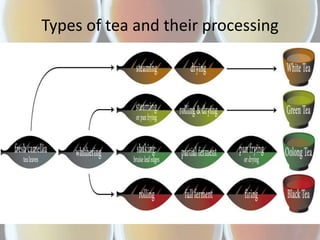
Types of tea and their processing
Composition of tea
•   Polyphenols – has antioxidizing properties
o Nonoxidized tea like green tea – has more catechins(simple
    flavanoids), oxidized tea – different forms of flavanoids like theaflavins and
    thearubigins
•   Tannins – polyphenol molecules
•   Nonoxidized tea – rich in vitamin A, B and C, oxidized tea – has only less
    vitamins
•   Minerals in tea are
o fluor (prevents cavities action)
o Selenium (prevents heart diseases)
o Zinc (fights indigestions and skin infections)
•   Carotene in tea - help reduce cholesterol and BP
•   Glycosides - prevent blood sugar increase
•   Caffeine
Why is tea good for health???
• Antioxidants in green tea increase body’s ability to burn fat
  as fuel and thus aids weight loss

• Drinking tea can help reduce the risk of heart attack

• Antioxidants in tea helps in protecting against cancer

• Drinking tea reduces the risk of Parkinson’s disease

• Tea could keep waist circumference in check!!!!!

• Green tea has been found to increase the bone mineral
  density and strength
Some bad effects of drinking tea
• Drinking more tea can cause osteofluorosis (because of
  fluorides)
• Drinking tea often can cause alzheimer’s disease (because of
  aluminium)
• Drinking tea in large quantities can cause insomnia
• Tea contains “oxalate” that is harmful to kidneys and can
  result in stone formation
• Drinking tea very hot can cause esophageal cancer
• Drinking tea hot can affect teeth and gums’ health
Milk tea – good or bad???
• According to a study conducted at University of Berlin:
o Milk protein called caseins reduces the efficiency of tea
  compound called catechin (which protects heart from diseases)

o Adding 50 gms of milk per cup of tea reduces insulin activity by
  90%

o Adding milk reduces the antioxidant properties of tea
Common adulterants and tests to identify
          the adulterants
• Added color – by spreading tea leaves on wet filter
  paper, added colors can be identified

• Iron flakes – Iron flakes if present can be identified by
  spreading magnet over a sample of tea powder

• Leather flakes – An odour of burnt leather will be emitted if a
  sample is spread over burning paper ball

• Coal tar dye - On a moistened white blotting paper scatter a
  little amount of the sample. Remove the sample and examine
  the paper after 5min. Colored spots indicate the use of the coal
  tar dye
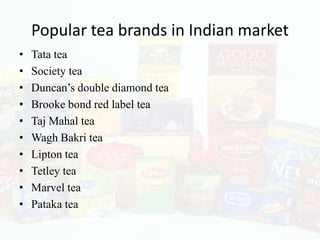
Popular tea brands in Indian market
•   Tata tea
•   Society tea
•   Duncan’s double diamond tea
•   Brooke bond red label tea
•   Taj Mahal tea
•   Wagh Bakri tea
•   Lipton tea
•   Tetley tea
•   Marvel tea
•   Pataka tea
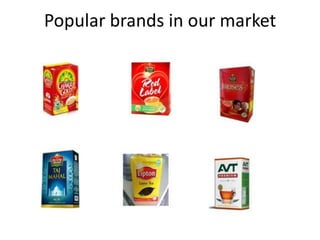
Popular brands in our market
Criteria for grading
• Sourcing of tea leaves (15)
• Health and nutrition levels of the product (25)
• Quality (25)
   - process
   - Ingredients and additives
• Sustainability of the operations (15)
   - energy consumption
• CSR activities by the company (20)
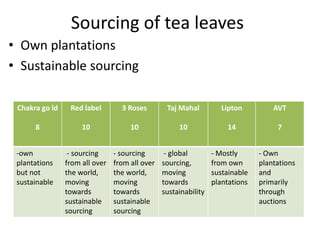
Sourcing of tea leaves
• Own plantations
• Sustainable sourcing

 Chakra go ld    Red label        3 Roses        Taj Mahal          Lipton         AVT

      8              10              10              10              14             7


 -own            - sourcing     - sourcing       - global        - Mostly      - Own
 plantations    from all over   from all over   sourcing,        from own      plantations
 but not        the world,      the world,      moving           sustainable   and
 sustainable    moving          moving          towards          plantations   primarily
                towards         towards         sustainability                 through
                sustainable     sustainable                                    auctions
                sourcing        sourcing
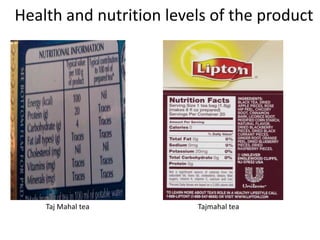
Health and nutrition levels of the product


    Taj Mahal tea        Tajmahal tea
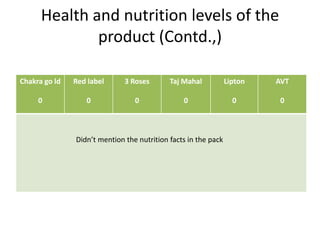
Health and nutrition levels of the
              product (Contd.,)

Chakra go ld   Red label      3 Roses       Taj Mahal           Lipton   AVT

     0            0              0              0                 0       0


               Didn’t mention the nutrition facts in the pack
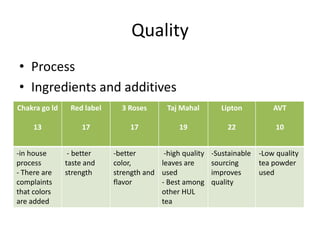
Quality
• Process
• Ingredients and additives
Chakra go ld    Red label     3 Roses      Taj Mahal        Lipton         AVT

     13             17           17            19             22            10


-in house       - better    -better       -high quality   -Sustainable -Low quality
process        taste and    color,       leaves are       sourcing     tea powder
- There are    strength     strength and used             improves     used
complaints                  flavor       - Best among     quality
that colors                              other HUL
are added                                tea
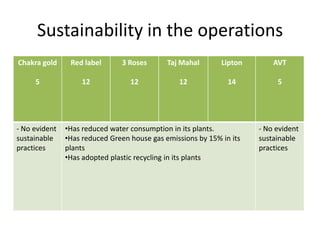
Sustainability in the operations
Chakra gold     Red label      3 Roses       Taj Mahal       Lipton       AVT

     5              12            12            12             14          5


- No evident   •Has reduced water consumption in its plants.          - No evident
sustainable    •Has reduced Green house gas emissions by 15% in its   sustainable
practices      plants                                                 practices
               •Has adopted plastic recycling in its plants
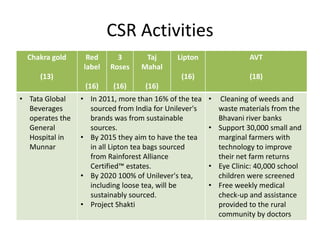
CSR Activities
  Chakra gold     Red      3       Taj       Lipton               AVT
                 label   Roses    Mahal
     (13)                                     (16)                (18)
                  (16)    (16)     (16)
• Tata Global    • In 2011, more than 16% of the tea   •  Cleaning of weeds and
  Beverages        sourced from India for Unilever's     waste materials from the
  operates the     brands was from sustainable           Bhavani river banks
  General          sources.                            • Support 30,000 small and
  Hospital in    • By 2015 they aim to have the tea      marginal farmers with
  Munnar           in all Lipton tea bags sourced        technology to improve
                   from Rainforest Alliance              their net farm returns
                   Certified™ estates.                 • Eye Clinic: 40,000 school
                 • By 2020 100% of Unilever's tea,       children were screened
                   including loose tea, will be        • Free weekly medical
                   sustainably sourced.                  check-up and assistance
                 • Project Shakti                        provided to the rural
                                                         community by doctors
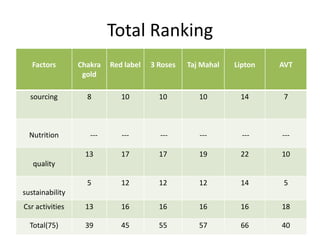
Total Ranking
   Factors       Chakra   Red label   3 Roses   Taj Mahal   Lipton   AVT
                  gold

  sourcing         8         10         10         10        14       7


  Nutrition         ---      ---        ---        ---        ---    ---

                  13         17         17         19        22      10
   quality

                   5         12         12         12        14       5
sustainability
Csr activities    13         16         16         16        16      18

  Total(75)       39         45         55         57        66      40
Thank You

Product analysis tea

  • 1.
    Product analysis -TEA Presented by, V. Pradeep Pravin Kumar(11AD29) R. Sasipriya(11AD36)
  • 2.
    Tea processing methods Two methods: • CTC (Crush, Tear and Curl) - Tea prepared is used for tea bags Orthodox method: - Includes withering, drying etc
  • 3.
    Tea processing • Tea leaves are plucked twice in a year usually during early spring and early summer seasons • Hand picking – high quality, machine picking – low quality PLUCKING • To remove excess water by putting tea leaves either under sun or cool breeze • Leaves lose quarter of their weight and leaf proteins are broken down into amino acids WITHERING • Tea leaves are bruised or torn to promote oxidation • It also releases some of the leaf juices which may change the taste profile of the tea DISRUPTION • Tea leaves are left on their own in a climate controlled room where they turn progressively darker OXIDATION • Oxidation determines the tea color, strength, briskness and taste(Oolong – 5% -to 40%, black – 100%) • To stop the tea leaf oxidation at a desired level • Tea leaves are heated moderately to deactivate their oxidative enzymes FIXATION • (Unique to yellow tea) Tea leaves are lightly heated in a closed container so that the leaves turn yellow • The leaves are sweltered for 6-8 hours which help in chemical reactions of amino acids YELLOWING • The damp tea leaves are rolled into strips to make some essential oils and juice to ooze out • They are then rolled into other shapes ROLLING • Drying is done by panning, sunning, air drying or baking • Baking is commonly used and is very important for green tea DRYING • Second fermentation is done to make the tea reach their drinking potential • Flavored teas are manufactured in this stage by spraying the tea with aromas and flavours AGING
  • 4.
    Types of teaand their processing
  • 5.
    Composition of tea • Polyphenols – has antioxidizing properties o Nonoxidized tea like green tea – has more catechins(simple flavanoids), oxidized tea – different forms of flavanoids like theaflavins and thearubigins • Tannins – polyphenol molecules • Nonoxidized tea – rich in vitamin A, B and C, oxidized tea – has only less vitamins • Minerals in tea are o fluor (prevents cavities action) o Selenium (prevents heart diseases) o Zinc (fights indigestions and skin infections) • Carotene in tea - help reduce cholesterol and BP • Glycosides - prevent blood sugar increase • Caffeine
  • 6.
    Why is teagood for health??? • Antioxidants in green tea increase body’s ability to burn fat as fuel and thus aids weight loss • Drinking tea can help reduce the risk of heart attack • Antioxidants in tea helps in protecting against cancer • Drinking tea reduces the risk of Parkinson’s disease • Tea could keep waist circumference in check!!!!! • Green tea has been found to increase the bone mineral density and strength
  • 7.
    Some bad effectsof drinking tea • Drinking more tea can cause osteofluorosis (because of fluorides) • Drinking tea often can cause alzheimer’s disease (because of aluminium) • Drinking tea in large quantities can cause insomnia • Tea contains “oxalate” that is harmful to kidneys and can result in stone formation • Drinking tea very hot can cause esophageal cancer • Drinking tea hot can affect teeth and gums’ health
  • 8.
    Milk tea –good or bad??? • According to a study conducted at University of Berlin: o Milk protein called caseins reduces the efficiency of tea compound called catechin (which protects heart from diseases) o Adding 50 gms of milk per cup of tea reduces insulin activity by 90% o Adding milk reduces the antioxidant properties of tea
  • 9.
    Common adulterants andtests to identify the adulterants • Added color – by spreading tea leaves on wet filter paper, added colors can be identified • Iron flakes – Iron flakes if present can be identified by spreading magnet over a sample of tea powder • Leather flakes – An odour of burnt leather will be emitted if a sample is spread over burning paper ball • Coal tar dye - On a moistened white blotting paper scatter a little amount of the sample. Remove the sample and examine the paper after 5min. Colored spots indicate the use of the coal tar dye
  • 10.
    Popular tea brandsin Indian market • Tata tea • Society tea • Duncan’s double diamond tea • Brooke bond red label tea • Taj Mahal tea • Wagh Bakri tea • Lipton tea • Tetley tea • Marvel tea • Pataka tea
  • 11.
  • 12.
    Criteria for grading •Sourcing of tea leaves (15) • Health and nutrition levels of the product (25) • Quality (25) - process - Ingredients and additives • Sustainability of the operations (15) - energy consumption • CSR activities by the company (20)
  • 13.
    Sourcing of tealeaves • Own plantations • Sustainable sourcing Chakra go ld Red label 3 Roses Taj Mahal Lipton AVT 8 10 10 10 14 7 -own - sourcing - sourcing - global - Mostly - Own plantations from all over from all over sourcing, from own plantations but not the world, the world, moving sustainable and sustainable moving moving towards plantations primarily towards towards sustainability through sustainable sustainable auctions sourcing sourcing
  • 14.
    Health and nutritionlevels of the product Taj Mahal tea Tajmahal tea
  • 15.
    Health and nutritionlevels of the product (Contd.,) Chakra go ld Red label 3 Roses Taj Mahal Lipton AVT 0 0 0 0 0 0 Didn’t mention the nutrition facts in the pack
  • 16.
    Quality • Process • Ingredientsand additives Chakra go ld Red label 3 Roses Taj Mahal Lipton AVT 13 17 17 19 22 10 -in house - better -better -high quality -Sustainable -Low quality process taste and color, leaves are sourcing tea powder - There are strength strength and used improves used complaints flavor - Best among quality that colors other HUL are added tea
  • 17.
    Sustainability in theoperations Chakra gold Red label 3 Roses Taj Mahal Lipton AVT 5 12 12 12 14 5 - No evident •Has reduced water consumption in its plants. - No evident sustainable •Has reduced Green house gas emissions by 15% in its sustainable practices plants practices •Has adopted plastic recycling in its plants
  • 18.
    CSR Activities Chakra gold Red 3 Taj Lipton AVT label Roses Mahal (13) (16) (18) (16) (16) (16) • Tata Global • In 2011, more than 16% of the tea • Cleaning of weeds and Beverages sourced from India for Unilever's waste materials from the operates the brands was from sustainable Bhavani river banks General sources. • Support 30,000 small and Hospital in • By 2015 they aim to have the tea marginal farmers with Munnar in all Lipton tea bags sourced technology to improve from Rainforest Alliance their net farm returns Certified™ estates. • Eye Clinic: 40,000 school • By 2020 100% of Unilever's tea, children were screened including loose tea, will be • Free weekly medical sustainably sourced. check-up and assistance • Project Shakti provided to the rural community by doctors
  • 19.
    Total Ranking Factors Chakra Red label 3 Roses Taj Mahal Lipton AVT gold sourcing 8 10 10 10 14 7 Nutrition --- --- --- --- --- --- 13 17 17 19 22 10 quality 5 12 12 12 14 5 sustainability Csr activities 13 16 16 16 16 18 Total(75) 39 45 55 57 66 40
  • 20.