RIPER
AUTONOMOUS
NAAC &
NBA (UG)
SIRO- DSIR
Raghavendra Institute of Pharmaceutical Education and Research - Autonomous
K.R.Palli Cross, Chiyyedu, Anantapuramu, A. P- 515721 1
Presented by
Ms. K. Sandhya Rani
(Reg.No:20L81S0702)
Pharmaceutical Analysis
A Seminar as a part of curricular requirement for 1st year
M. Pharm 2nd semester
RIPER
AUTONOMOUS
NAAC &
NBA (UG)
SIRO- DSIR
Raghavendra Institute of Pharmaceutical Education and Research - Autonomous
K.R.Palli Cross, Chiyyedu, Anantapuramu, A. P- 515721 2
1. Iodine value
2. Rancidity
3. Peroxide value
Contents:
RIPER
AUTONOMOUS
NAAC &
NBA (UG)
SIRO- DSIR
Raghavendra Institute of Pharmaceutical Education and Research - Autonomous
K.R.Palli Cross, Chiyyedu, Anantapuramu, A. P- 515721 3
 The iodine value of an oil/fat is the number of grams of iodine absorbed
100g of the oil/fat, when determined by using Wijs solution.
Analytical importance:
 The most important application of the iodine value is to determine the amount of
unsaturation contained in fatty acids.
 Iodine number is directly proportional to content of unsaturated fatty is used to
analyze the degree of adulteration.
 This unsaturation is in the form of double bonds which react with iodine
compounds.
Iodine value
RIPER
AUTONOMOUS
NAAC &
NBA (UG)
SIRO- DSIR
Raghavendra Institute of Pharmaceutical Education and Research - Autonomous
K.R.Palli Cross, Chiyyedu, Anantapuramu, A. P- 515721 4
 The higher the iodine value, the more unsaturated fatty acid bonds are present in a
fat.
Procedure:
Weigh accurately an appropriate quantity of the dry oil/fat. into a 500 ml conical
flask with glass stopper, to which 25 ml of carbon tetrachloride have been
added.
RIPER
AUTONOMOUS
NAAC &
NBA (UG)
SIRO- DSIR
Raghavendra Institute of Pharmaceutical Education and Research - Autonomous
K.R.Palli Cross, Chiyyedu, Anantapuramu, A. P- 515721 5
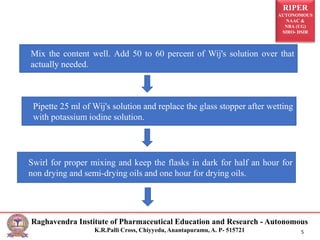
Mix the content well. Add 50 to 60 percent of Wij's solution over that
actually needed.
Pipette 25 ml of Wij's solution and replace the glass stopper after wetting
with potassium iodine solution.
Swirl for proper mixing and keep the flasks in dark for half an hour for
non drying and semi-drying oils and one hour for drying oils.
RIPER
AUTONOMOUS
NAAC &
NBA (UG)
SIRO- DSIR
Raghavendra Institute of Pharmaceutical Education and Research - Autonomous
K.R.Palli Cross, Chiyyedu, Anantapuramu, A. P- 515721 6
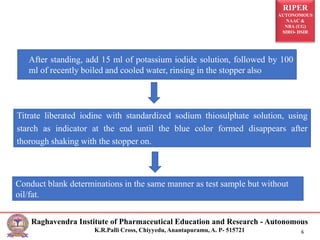
After standing, add 15 ml of potassium iodide solution, followed by 100
ml of recently boiled and cooled water, rinsing in the stopper also
Titrate liberated iodine with standardized sodium thiosulphate solution, using
starch as indicator at the end until the blue color formed disappears after
thorough shaking with the stopper on.
Conduct blank determinations in the same manner as test sample but without
oil/fat.
RIPER
AUTONOMOUS
NAAC &
NBA (UG)
SIRO- DSIR
Raghavendra Institute of Pharmaceutical Education and Research - Autonomous
K.R.Palli Cross, Chiyyedu, Anantapuramu, A. P- 515721 7
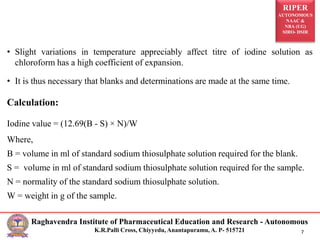
• Slight variations in temperature appreciably affect titre of iodine solution as
chloroform has a high coefficient of expansion.
• It is thus necessary that blanks and determinations are made at the same time.
Calculation:
Iodine value = (12.69(B - S) × N)/W
Where,
B = volume in ml of standard sodium thiosulphate solution required for the blank.
S = volume in ml of standard sodium thiosulphate solution required for the sample.
N = normality of the standard sodium thiosulphate solution.
W = weight in g of the sample.
RIPER
AUTONOMOUS
NAAC &
NBA (UG)
SIRO- DSIR
Raghavendra Institute of Pharmaceutical Education and Research - Autonomous
K.R.Palli Cross, Chiyyedu, Anantapuramu, A. P- 515721 8
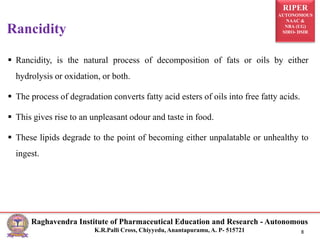
 Rancidity, is the natural process of decomposition of fats or oils by either
hydrolysis or oxidation, or both.
 The process of degradation converts fatty acid esters of oils into free fatty acids.
 This gives rise to an unpleasant odour and taste in food.
 These lipids degrade to the point of becoming either unpalatable or unhealthy to
ingest.
Rancidity
RIPER
AUTONOMOUS
NAAC &
NBA (UG)
SIRO- DSIR
Raghavendra Institute of Pharmaceutical Education and Research - Autonomous
K.R.Palli Cross, Chiyyedu, Anantapuramu, A. P- 515721 9
Types of Rancidity:
There are 3 types/pathways of rancidity:
1. Oxidative Rancidity.
2. Hydrolytic Rancidity
3. Microbial Rancidity
1. Oxidative Rancidity.
i) Known as Auto Oxidation.
ii) It is due to the auto-oxidation of PUFA present in triacylglycerols by the
atmospheric O₂ on free radicals.
RIPER
AUTONOMOUS
NAAC &
NBA (UG)
SIRO- DSIR
Raghavendra Institute of Pharmaceutical Education and Research - Autonomous
K.R.Palli Cross, Chiyyedu, Anantapuramu, A. P- 515721 10
ii) The end product is the formation of aldehyde epoxide and peroxide becoming
either unpalatable or unhealthy to ingest.
2. Hydrolytic Rancidity:
i) Hydrolytic Rancidity also known as hydrolysis/enzymatic oxidation.
ii) It is due to the contamination of fat by lipase leading to the formation of diacyl &
triacylglycerols with free fatty acids.
iii) The end product is the formation of aldehyde epoxide and peroxide.
RIPER
AUTONOMOUS
NAAC &
NBA (UG)
SIRO- DSIR
Raghavendra Institute of Pharmaceutical Education and Research - Autonomous
K.R.Palli Cross, Chiyyedu, Anantapuramu, A. P- 515721 11
3. Microbial Rancidity:
i) In which micro-organisms such bacteria, moulds and yeast use their enzymes to
break down chemical structures in the oil, producing unwanted odours and flavours.
ii) Water needs to be present for microbial growth to occur.
iii) Can be prevented by sterilization
Factors Causing Rancidity:
 Catalysts: trace metal ions & inorganic salts,
 Temperature,
RIPER
AUTONOMOUS
NAAC &
NBA (UG)
SIRO- DSIR
Raghavendra Institute of Pharmaceutical Education and Research - Autonomous
K.R.Palli Cross, Chiyyedu, Anantapuramu, A. P- 515721 12
Amount of PUFA ,
 Time,
Light,
Water.
Harmful Effects of Rancid Food:
Leads to deficiencies such as anaemia, hair loss & dermatitis.
 Kidney & heart diseases
Neurodegeneration
Cancer
RIPER
AUTONOMOUS
NAAC &
NBA (UG)
SIRO- DSIR
Raghavendra Institute of Pharmaceutical Education and Research - Autonomous
K.R.Palli Cross, Chiyyedu, Anantapuramu, A. P- 515721 13
1. Kries Test:
Qualitative:
Shake 5 ml of the oil vigorously with 5 ml of 0.1% phloroglucinol solution in
diethyl ether and add 5 ml of conc. hydrochloric acid.
A pink colour indicates incipient rancidity.
2. Colorimetric method
Quantitative:
i) Shake 5 ml of oil and 5 ml chloroform in a stoppered test tube.
Determination of Rancidity
RIPER
AUTONOMOUS
NAAC &
NBA (UG)
SIRO- DSIR
Raghavendra Institute of Pharmaceutical Education and Research - Autonomous
K.R.Palli Cross, Chiyyedu, Anantapuramu, A. P- 515721 14
ii) Add 10 ml of a 30% solution of trichloroacetic acid in glacial acetic acid and 1 ml
of 1 percent solution of phloroglucinol in glacial acetic acid.
iii) Incubate the test tube at 45℃ for 15 min.
iv) After incubation, add 4 ml of ethanol and immediately measure the absorbance at
545 nm.
 Absorbance values below 0.15 indicate no rancidity.
 Absorbance values greater than 0.2 denote incipient rancidity, and absorbance
values around 1.0 show that the sample is highly rancid.
RIPER
AUTONOMOUS
NAAC &
NBA (UG)
SIRO- DSIR
Raghavendra Institute of Pharmaceutical Education and Research - Autonomous
K.R.Palli Cross, Chiyyedu, Anantapuramu, A. P- 515721 15
Definition - It is the number which expresses in milli equivalents of active oxygen
that expresses the amount of peroxide containing 1000gms (kg) of substances
(meq /kg).
• It is a measure of peroxides present in oil.
• A peroxide value is generally less than 10 mEqkg in fresh samples of oil.
• Due to temperature or storage, rancidity occurs causing increase in peroxide
values.
Peroxide Value
RIPER
AUTONOMOUS
NAAC &
NBA (UG)
SIRO- DSIR
Raghavendra Institute of Pharmaceutical Education and Research - Autonomous
K.R.Palli Cross, Chiyyedu, Anantapuramu, A. P- 515721 16
Calculation:
Peroxide value = T-B× C/wt of sample ×1000
Where,
T = absorbance of test
B = absorbance of blank
C = concentration of HCl
RIPER
AUTONOMOUS
NAAC &
NBA (UG)
SIRO- DSIR
Raghavendra Institute of Pharmaceutical Education and Research - Autonomous
K.R.Palli Cross, Chiyyedu, Anantapuramu, A. P- 515721 17
1. Gurudeep chatwal, edited by M. Arora, Lipids, 7.1- 7.33, Volume-1; 2002.
2. Methods from Indian Pharmacopoeia, 2007, volume-1
3. Kleiner, I.S. and Dotti, laboratory Instructions in Biochemistry, 2nd edition,
pg no:37-39; 1992.
References
RIPER
AUTONOMOUS
NAAC &
NBA (UG)
SIRO- DSIR
Raghavendra Institute of Pharmaceutical Education and Research - Autonomous
K.R.Palli Cross, Chiyyedu, Anantapuramu, A. P- 515721 18

Iodine value, Rancidity, Peroxide value.

  • 1.
    RIPER AUTONOMOUS NAAC & NBA (UG) SIRO-DSIR Raghavendra Institute of Pharmaceutical Education and Research - Autonomous K.R.Palli Cross, Chiyyedu, Anantapuramu, A. P- 515721 1 Presented by Ms. K. Sandhya Rani (Reg.No:20L81S0702) Pharmaceutical Analysis A Seminar as a part of curricular requirement for 1st year M. Pharm 2nd semester
  • 2.
    RIPER AUTONOMOUS NAAC & NBA (UG) SIRO-DSIR Raghavendra Institute of Pharmaceutical Education and Research - Autonomous K.R.Palli Cross, Chiyyedu, Anantapuramu, A. P- 515721 2 1. Iodine value 2. Rancidity 3. Peroxide value Contents:
  • 3.
    RIPER AUTONOMOUS NAAC & NBA (UG) SIRO-DSIR Raghavendra Institute of Pharmaceutical Education and Research - Autonomous K.R.Palli Cross, Chiyyedu, Anantapuramu, A. P- 515721 3  The iodine value of an oil/fat is the number of grams of iodine absorbed 100g of the oil/fat, when determined by using Wijs solution. Analytical importance:  The most important application of the iodine value is to determine the amount of unsaturation contained in fatty acids.  Iodine number is directly proportional to content of unsaturated fatty is used to analyze the degree of adulteration.  This unsaturation is in the form of double bonds which react with iodine compounds. Iodine value
  • 4.
    RIPER AUTONOMOUS NAAC & NBA (UG) SIRO-DSIR Raghavendra Institute of Pharmaceutical Education and Research - Autonomous K.R.Palli Cross, Chiyyedu, Anantapuramu, A. P- 515721 4  The higher the iodine value, the more unsaturated fatty acid bonds are present in a fat. Procedure: Weigh accurately an appropriate quantity of the dry oil/fat. into a 500 ml conical flask with glass stopper, to which 25 ml of carbon tetrachloride have been added.
  • 5.
    RIPER AUTONOMOUS NAAC & NBA (UG) SIRO-DSIR Raghavendra Institute of Pharmaceutical Education and Research - Autonomous K.R.Palli Cross, Chiyyedu, Anantapuramu, A. P- 515721 5 Mix the content well. Add 50 to 60 percent of Wij's solution over that actually needed. Pipette 25 ml of Wij's solution and replace the glass stopper after wetting with potassium iodine solution. Swirl for proper mixing and keep the flasks in dark for half an hour for non drying and semi-drying oils and one hour for drying oils.
  • 6.
    RIPER AUTONOMOUS NAAC & NBA (UG) SIRO-DSIR Raghavendra Institute of Pharmaceutical Education and Research - Autonomous K.R.Palli Cross, Chiyyedu, Anantapuramu, A. P- 515721 6 After standing, add 15 ml of potassium iodide solution, followed by 100 ml of recently boiled and cooled water, rinsing in the stopper also Titrate liberated iodine with standardized sodium thiosulphate solution, using starch as indicator at the end until the blue color formed disappears after thorough shaking with the stopper on. Conduct blank determinations in the same manner as test sample but without oil/fat.
  • 7.
    RIPER AUTONOMOUS NAAC & NBA (UG) SIRO-DSIR Raghavendra Institute of Pharmaceutical Education and Research - Autonomous K.R.Palli Cross, Chiyyedu, Anantapuramu, A. P- 515721 7 • Slight variations in temperature appreciably affect titre of iodine solution as chloroform has a high coefficient of expansion. • It is thus necessary that blanks and determinations are made at the same time. Calculation: Iodine value = (12.69(B - S) × N)/W Where, B = volume in ml of standard sodium thiosulphate solution required for the blank. S = volume in ml of standard sodium thiosulphate solution required for the sample. N = normality of the standard sodium thiosulphate solution. W = weight in g of the sample.
  • 8.
    RIPER AUTONOMOUS NAAC & NBA (UG) SIRO-DSIR Raghavendra Institute of Pharmaceutical Education and Research - Autonomous K.R.Palli Cross, Chiyyedu, Anantapuramu, A. P- 515721 8  Rancidity, is the natural process of decomposition of fats or oils by either hydrolysis or oxidation, or both.  The process of degradation converts fatty acid esters of oils into free fatty acids.  This gives rise to an unpleasant odour and taste in food.  These lipids degrade to the point of becoming either unpalatable or unhealthy to ingest. Rancidity
  • 9.
    RIPER AUTONOMOUS NAAC & NBA (UG) SIRO-DSIR Raghavendra Institute of Pharmaceutical Education and Research - Autonomous K.R.Palli Cross, Chiyyedu, Anantapuramu, A. P- 515721 9 Types of Rancidity: There are 3 types/pathways of rancidity: 1. Oxidative Rancidity. 2. Hydrolytic Rancidity 3. Microbial Rancidity 1. Oxidative Rancidity. i) Known as Auto Oxidation. ii) It is due to the auto-oxidation of PUFA present in triacylglycerols by the atmospheric O₂ on free radicals.
  • 10.
    RIPER AUTONOMOUS NAAC & NBA (UG) SIRO-DSIR Raghavendra Institute of Pharmaceutical Education and Research - Autonomous K.R.Palli Cross, Chiyyedu, Anantapuramu, A. P- 515721 10 ii) The end product is the formation of aldehyde epoxide and peroxide becoming either unpalatable or unhealthy to ingest. 2. Hydrolytic Rancidity: i) Hydrolytic Rancidity also known as hydrolysis/enzymatic oxidation. ii) It is due to the contamination of fat by lipase leading to the formation of diacyl & triacylglycerols with free fatty acids. iii) The end product is the formation of aldehyde epoxide and peroxide.
  • 11.
    RIPER AUTONOMOUS NAAC & NBA (UG) SIRO-DSIR Raghavendra Institute of Pharmaceutical Education and Research - Autonomous K.R.Palli Cross, Chiyyedu, Anantapuramu, A. P- 515721 11 3. Microbial Rancidity: i) In which micro-organisms such bacteria, moulds and yeast use their enzymes to break down chemical structures in the oil, producing unwanted odours and flavours. ii) Water needs to be present for microbial growth to occur. iii) Can be prevented by sterilization Factors Causing Rancidity:  Catalysts: trace metal ions & inorganic salts,  Temperature,
  • 12.
    RIPER AUTONOMOUS NAAC & NBA (UG) SIRO-DSIR Raghavendra Institute of Pharmaceutical Education and Research - Autonomous K.R.Palli Cross, Chiyyedu, Anantapuramu, A. P- 515721 12 Amount of PUFA ,  Time, Light, Water. Harmful Effects of Rancid Food: Leads to deficiencies such as anaemia, hair loss & dermatitis.  Kidney & heart diseases Neurodegeneration Cancer
  • 13.
    RIPER AUTONOMOUS NAAC & NBA (UG) SIRO-DSIR Raghavendra Institute of Pharmaceutical Education and Research - Autonomous K.R.Palli Cross, Chiyyedu, Anantapuramu, A. P- 515721 13 1. Kries Test: Qualitative: Shake 5 ml of the oil vigorously with 5 ml of 0.1% phloroglucinol solution in diethyl ether and add 5 ml of conc. hydrochloric acid. A pink colour indicates incipient rancidity. 2. Colorimetric method Quantitative: i) Shake 5 ml of oil and 5 ml chloroform in a stoppered test tube. Determination of Rancidity
  • 14.
    RIPER AUTONOMOUS NAAC & NBA (UG) SIRO-DSIR Raghavendra Institute of Pharmaceutical Education and Research - Autonomous K.R.Palli Cross, Chiyyedu, Anantapuramu, A. P- 515721 14 ii) Add 10 ml of a 30% solution of trichloroacetic acid in glacial acetic acid and 1 ml of 1 percent solution of phloroglucinol in glacial acetic acid. iii) Incubate the test tube at 45℃ for 15 min. iv) After incubation, add 4 ml of ethanol and immediately measure the absorbance at 545 nm.  Absorbance values below 0.15 indicate no rancidity.  Absorbance values greater than 0.2 denote incipient rancidity, and absorbance values around 1.0 show that the sample is highly rancid.
  • 15.
    RIPER AUTONOMOUS NAAC & NBA (UG) SIRO-DSIR Raghavendra Institute of Pharmaceutical Education and Research - Autonomous K.R.Palli Cross, Chiyyedu, Anantapuramu, A. P- 515721 15 Definition - It is the number which expresses in milli equivalents of active oxygen that expresses the amount of peroxide containing 1000gms (kg) of substances (meq /kg). • It is a measure of peroxides present in oil. • A peroxide value is generally less than 10 mEqkg in fresh samples of oil. • Due to temperature or storage, rancidity occurs causing increase in peroxide values. Peroxide Value
  • 16.
    RIPER AUTONOMOUS NAAC & NBA (UG) SIRO-DSIR Raghavendra Institute of Pharmaceutical Education and Research - Autonomous K.R.Palli Cross, Chiyyedu, Anantapuramu, A. P- 515721 16 Calculation: Peroxide value = T-B× C/wt of sample ×1000 Where, T = absorbance of test B = absorbance of blank C = concentration of HCl
  • 17.
    RIPER AUTONOMOUS NAAC & NBA (UG) SIRO-DSIR Raghavendra Institute of Pharmaceutical Education and Research - Autonomous K.R.Palli Cross, Chiyyedu, Anantapuramu, A. P- 515721 17 1. Gurudeep chatwal, edited by M. Arora, Lipids, 7.1- 7.33, Volume-1; 2002. 2. Methods from Indian Pharmacopoeia, 2007, volume-1 3. Kleiner, I.S. and Dotti, laboratory Instructions in Biochemistry, 2nd edition, pg no:37-39; 1992. References
  • 18.
    RIPER AUTONOMOUS NAAC & NBA (UG) SIRO-DSIR Raghavendra Institute of Pharmaceutical Education and Research - Autonomous K.R.Palli Cross, Chiyyedu, Anantapuramu, A. P- 515721 18