jjj
PRODRUGS
KRISHNAPRIYA K R
M.PHARM 2nd SEM
PHERMACEUTICAL CHEMISTRY
INDEX
• Introduction
• Classification According to Functional Groups
• Pharmaceutical applications of prodrug design
2
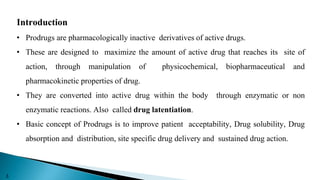
Introduction
• Prodrugs are pharmacologically inactive derivatives of active drugs.
• These are designed to maximize the amount of active drug that reaches its site of
action, through manipulation of physicochemical, biopharmaceutical and
pharmacokinetic properties of drug.
• They are converted into active drug within the body through enzymatic or non
enzymatic reactions. Also called drug latentiation.
• Basic concept of Prodrugs is to improve patient acceptability, Drug solubility, Drug
absorption and distribution, site specific drug delivery and sustained drug action.
3
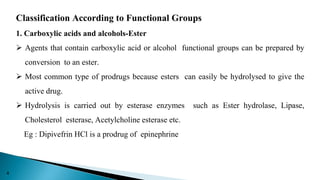
Classification According to Functional Groups
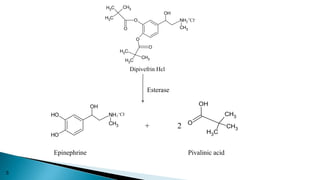
1. Carboxylic acids and alcohols-Ester
 Agents that contain carboxylic acid or alcohol functional groups can be prepared by
conversion to an ester.
 Most common type of prodrugs because esters can easily be hydrolysed to give the
active drug.
 Hydrolysis is carried out by esterase enzymes such as Ester hydrolase, Lipase,
Cholesterol esterase, Acetylcholine esterase etc.
Eg : Dipivefrin HCl is a prodrug of epinephrine
4
NH
CH3
OH
O
O
CH3
C
H3
C
H3
O
O
C
H3
CH3
C
H3
NH
CH3
OH
O
H
O
H
OH
O
CH3
C
H3
CH3
Esterase
2
+Cl-
2
+Cl-
+ 2
Dipivefrin Hcl
Epinephrine Pivalinic acid
5
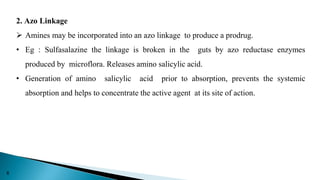
2. Azo Linkage
 Amines may be incorporated into an azo linkage to produce a prodrug.
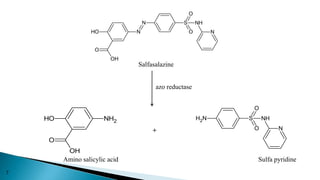
• Eg : Sulfasalazine the linkage is broken in the guts by azo reductase enzymes
produced by microflora. Releases amino salicylic acid.
• Generation of amino salicylic acid prior to absorption, prevents the systemic
absorption and helps to concentrate the active agent at its site of action.
6
O
H
O
OH
N
N S
O
O
NH
N
O
H
O
OH
NH2
N
H2 S
O
O
NH
N
Salfasalazine
Amino salicylic acid Sulfa pyridine
+
azo reductase
7
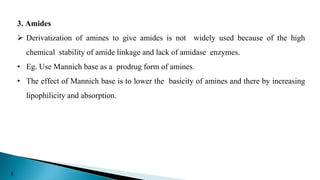
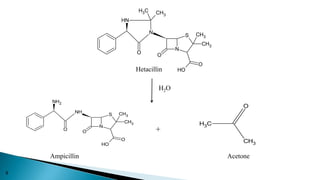
3. Amides
 Derivatization of amines to give amides is not widely used because of the high
chemical stability of amide linkage and lack of amidase enzymes.
• Eg. Use Mannich base as a prodrug form of amines.
• The effect of Mannich base is to lower the basicity of amines and there by increasing
lipophilicity and absorption.
8
N
N
N
H
CH3
C
H3
O O
S
CH3
CH3
O
O
H
N
NH
NH2
O O
S
CH3
CH3
O
O
H
C
H3
CH3
O
Hetacillin
H2O
Ampicillin Acetone
+
9
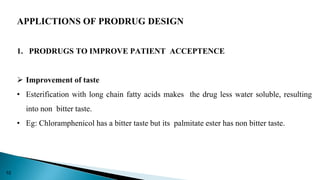
APPLICTIONS OF PRODRUG DESIGN
1. PRODRUGS TO IMPROVE PATIENT ACCEPTENCE
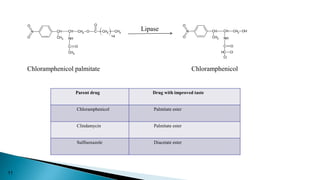
 Improvement of taste
• Esterification with long chain fatty acids makes the drug less water soluble, resulting
into non bitter taste.
• Eg: Chloramphenicol has a bitter taste but its palmitate ester has non bitter taste.
10
N
O
O
CH
CH3
CH
NH
C O
CH3
CH2 O C
O
CH2 CH3
14
N
O
O
CH
CH3
CH
NH
C O
C
H
CH2 OH
Cl
Cl
Lipase
Chloramphenicol palmitate Chloramphenicol
Parent drug Drug with improved taste
Chloramphenicol Palmitate ester
Clindamycin Palmitate ester
Sulfisoxazole Diacetate ester
11
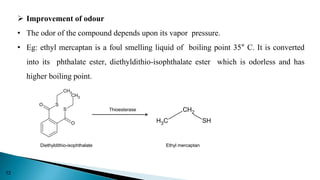
 Improvement of odour
• The odor of the compound depends upon its vapor pressure.
• Eg: ethyl mercaptan is a foul smelling liquid of boiling point 35° C. It is converted
into its phthalate ester, diethyldithio-isophthalate ester which is odorless and has
higher boiling point.
O S
CH3
S
C
C
C
C
C
C
C
C
C
C
C
C
C
C
C
C
C
C
C
C
C
CH3
O C
H3
CH2
SH
Thioesterase
Diethyldithio-isophthalate Ethyl mercaptan
12
 Reduction of pain on injection
• Drug precipitates or penetrates into the surrounding tissues.
• The solution is strongly acidic, alkaline or alcoholic.
Clindamycin-2’-phosphate ester Clindamycin
Phosphatase
13
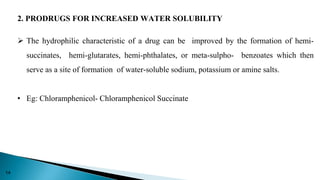
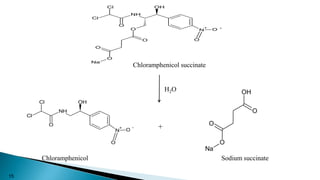
2. PRODRUGS FOR INCREASED WATER SOLUBILITY
 The hydrophilic characteristic of a drug can be improved by the formation of hemi-
succinates, hemi-glutarates, hemi-phthalates, or meta-sulpho- benzoates which then
serve as a site of formation of water-soluble sodium, potassium or amine salts.
• Eg: Chloramphenicol- Chloramphenicol Succinate
14
NH
OH
O
Cl
Cl
O
O
O
O
Na
N
+
O
OH
-
NH
OH
O
Cl
Cl
N
+
O
OH
OH
O
O
O
Na
- +
Chloramphenicol succinate
Chloramphenicol Sodium succinate
H2O
15
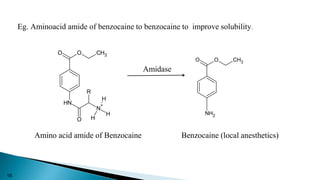
Eg. Aminoacid amide of benzocaine to benzocaine to improve solubility.
O O CH3
N
H
O
R
N
+
H
H
H
O O CH3
NH2
Amino acid amide of Benzocaine Benzocaine (local anesthetics)
Amidase
16
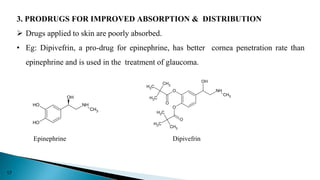
3. PRODRUGS FOR IMPROVED ABSORPTION & DISTRIBUTION
 Drugs applied to skin are poorly absorbed.
• Eg: Dipivefrin, a pro-drug for epinephrine, has better cornea penetration rate than
epinephrine and is used in the treatment of glaucoma.
O
H
O
H
NH
CH3
OH
O
O
CH3
C
H3
C
H3
C
H3
CH3
C
H3
O
O
NH
CH3
OH
Epinephrine Dipivefrin
17
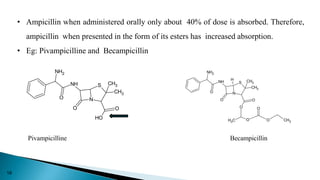
• Ampicillin when administered orally only about 40% of dose is absorbed. Therefore,
ampicillin when presented in the form of its esters has increased absorption.
• Eg: Pivampicilline and Becampicillin
NH2
NH
O N
O
S
CH3
CH3
O
O
H
NH2
NH
O N
O
S
CH3
CH3
O
O
C
H3
O O
O
CH3
H
Pivampicilline Becampicillin
18
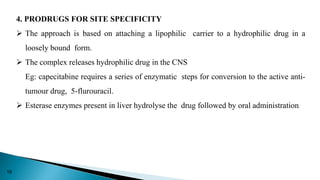
4. PRODRUGS FOR SITE SPECIFICITY
 The approach is based on attaching a lipophilic carrier to a hydrophilic drug in a
loosely bound form.
 The complex releases hydrophilic drug in the CNS
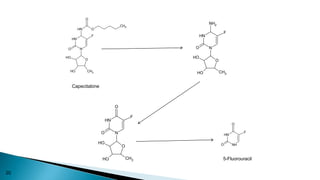
• Eg: capecitabine requires a series of enzymatic steps for conversion to the active anti-
tumour drug, 5-flurouracil.
 Esterase enzymes present in liver hydrolyse the drug followed by oral administration.
19
N
N
H
O
N
H O
O
O
H
O
H CH3
F
O
CH3
Capecitabine
N
N
H
O
NH2
O
O
H
O
H CH3
F
N
N
H
O
O
O
H
O
H CH3
F
O
NH
N
H
O
F
O
5-Fluorouracil
20
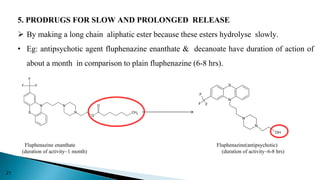
5. PRODRUGS FOR SLOW AND PROLONGED RELEASE
 By making a long chain aliphatic ester because these esters hydrolyse slowly.
• Eg: antipsychotic agent fluphenazine enanthate & decanoate have duration of action of
about a month in comparison to plain fluphenazine (6-8 hrs).
S
N
F
F
F
N
N
O
O
CH3
S
N
F
F F
N
N
OH
Fluphenazine enanthate Fluphenazine(antipsychotic)
(duration of activity~1 month) (duration of activity~6-8 hrs)
21
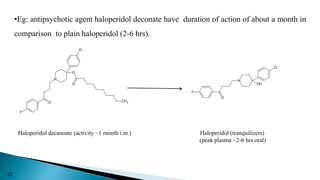
•Eg: antipsychotic agent haloperidol deconate have duration of action of about a month in
comparison to plain haloperidol (2-6 hrs).
F
O
N
Cl
O
CH3
O
F
O
N
Cl
OH
Haloperidol decanoate (activity ~1 month i.m.) Haloperidol (tranquilizers)
(peak plasma ~2-6 hrs oral)
22
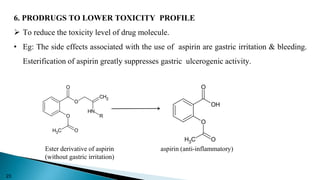
6. PRODRUGS TO LOWER TOXICITY PROFILE
 To reduce the toxicity level of drug molecule.
• Eg: The side effects associated with the use of aspirin are gastric irritation & bleeding.
Esterification of aspirin greatly suppresses gastric ulcerogenic activity.
O
O
CH2
O
C
H3 O
N
H
R
OH
O
O
C
H3 O
Ester derivative of aspirin aspirin (anti-inflammatory)
(without gastric irritation)
23
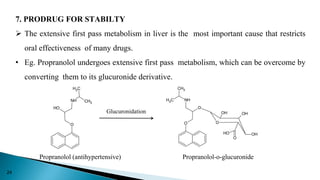
7. PRODRUG FOR STABILTY
 The extensive first pass metabolism in liver is the most important cause that restricts
oral effectiveness of many drugs.
• Eg. Propranolol undergoes extensive first pass metabolism, which can be overcome by
converting them to its glucuronide derivative.
O
NH CH3
C
H3
O
H
O
NH
C
H3
CH3
O
O
OH OH
OH
O
O
H
Glucuronidation
Propranolol (antihypertensive) Propranolol-o-glucuronide
24
REFERENCE
•Andrejus Korolkovas.ESSENTIAL OF MEDICINAL CHEMISTRY.2nd ed. New Delhi: A
Wiley-Interscience Publication;2011. pg.no:101-113
•K.Ilango and P.Valentina. Text book of Medicinal chemistry.Vol.1.Chennai:Keerthi
publishers;2007. pg.no:94-98
25
Thank you

PRODRUG.pptx

  • 1.
    jjj PRODRUGS KRISHNAPRIYA K R M.PHARM2nd SEM PHERMACEUTICAL CHEMISTRY
  • 2.
    INDEX • Introduction • ClassificationAccording to Functional Groups • Pharmaceutical applications of prodrug design 2
  • 3.
    Introduction • Prodrugs arepharmacologically inactive derivatives of active drugs. • These are designed to maximize the amount of active drug that reaches its site of action, through manipulation of physicochemical, biopharmaceutical and pharmacokinetic properties of drug. • They are converted into active drug within the body through enzymatic or non enzymatic reactions. Also called drug latentiation. • Basic concept of Prodrugs is to improve patient acceptability, Drug solubility, Drug absorption and distribution, site specific drug delivery and sustained drug action. 3
  • 4.
    Classification According toFunctional Groups 1. Carboxylic acids and alcohols-Ester  Agents that contain carboxylic acid or alcohol functional groups can be prepared by conversion to an ester.  Most common type of prodrugs because esters can easily be hydrolysed to give the active drug.  Hydrolysis is carried out by esterase enzymes such as Ester hydrolase, Lipase, Cholesterol esterase, Acetylcholine esterase etc. Eg : Dipivefrin HCl is a prodrug of epinephrine 4
  • 5.
  • 6.
    2. Azo Linkage Amines may be incorporated into an azo linkage to produce a prodrug. • Eg : Sulfasalazine the linkage is broken in the guts by azo reductase enzymes produced by microflora. Releases amino salicylic acid. • Generation of amino salicylic acid prior to absorption, prevents the systemic absorption and helps to concentrate the active agent at its site of action. 6
  • 7.
    O H O OH N N S O O NH N O H O OH NH2 N H2 S O O NH N Salfasalazine Aminosalicylic acid Sulfa pyridine + azo reductase 7
  • 8.
    3. Amides  Derivatizationof amines to give amides is not widely used because of the high chemical stability of amide linkage and lack of amidase enzymes. • Eg. Use Mannich base as a prodrug form of amines. • The effect of Mannich base is to lower the basicity of amines and there by increasing lipophilicity and absorption. 8
  • 9.
  • 10.
    APPLICTIONS OF PRODRUGDESIGN 1. PRODRUGS TO IMPROVE PATIENT ACCEPTENCE  Improvement of taste • Esterification with long chain fatty acids makes the drug less water soluble, resulting into non bitter taste. • Eg: Chloramphenicol has a bitter taste but its palmitate ester has non bitter taste. 10
  • 11.
    N O O CH CH3 CH NH C O CH3 CH2 OC O CH2 CH3 14 N O O CH CH3 CH NH C O C H CH2 OH Cl Cl Lipase Chloramphenicol palmitate Chloramphenicol Parent drug Drug with improved taste Chloramphenicol Palmitate ester Clindamycin Palmitate ester Sulfisoxazole Diacetate ester 11
  • 12.
     Improvement ofodour • The odor of the compound depends upon its vapor pressure. • Eg: ethyl mercaptan is a foul smelling liquid of boiling point 35° C. It is converted into its phthalate ester, diethyldithio-isophthalate ester which is odorless and has higher boiling point. O S CH3 S C C C C C C C C C C C C C C C C C C C C C CH3 O C H3 CH2 SH Thioesterase Diethyldithio-isophthalate Ethyl mercaptan 12
  • 13.
     Reduction ofpain on injection • Drug precipitates or penetrates into the surrounding tissues. • The solution is strongly acidic, alkaline or alcoholic. Clindamycin-2’-phosphate ester Clindamycin Phosphatase 13
  • 14.
    2. PRODRUGS FORINCREASED WATER SOLUBILITY  The hydrophilic characteristic of a drug can be improved by the formation of hemi- succinates, hemi-glutarates, hemi-phthalates, or meta-sulpho- benzoates which then serve as a site of formation of water-soluble sodium, potassium or amine salts. • Eg: Chloramphenicol- Chloramphenicol Succinate 14
  • 15.
  • 16.
    Eg. Aminoacid amideof benzocaine to benzocaine to improve solubility. O O CH3 N H O R N + H H H O O CH3 NH2 Amino acid amide of Benzocaine Benzocaine (local anesthetics) Amidase 16
  • 17.
    3. PRODRUGS FORIMPROVED ABSORPTION & DISTRIBUTION  Drugs applied to skin are poorly absorbed. • Eg: Dipivefrin, a pro-drug for epinephrine, has better cornea penetration rate than epinephrine and is used in the treatment of glaucoma. O H O H NH CH3 OH O O CH3 C H3 C H3 C H3 CH3 C H3 O O NH CH3 OH Epinephrine Dipivefrin 17
  • 18.
    • Ampicillin whenadministered orally only about 40% of dose is absorbed. Therefore, ampicillin when presented in the form of its esters has increased absorption. • Eg: Pivampicilline and Becampicillin NH2 NH O N O S CH3 CH3 O O H NH2 NH O N O S CH3 CH3 O O C H3 O O O CH3 H Pivampicilline Becampicillin 18
  • 19.
    4. PRODRUGS FORSITE SPECIFICITY  The approach is based on attaching a lipophilic carrier to a hydrophilic drug in a loosely bound form.  The complex releases hydrophilic drug in the CNS • Eg: capecitabine requires a series of enzymatic steps for conversion to the active anti- tumour drug, 5-flurouracil.  Esterase enzymes present in liver hydrolyse the drug followed by oral administration. 19
  • 20.
    N N H O N H O O O H O H CH3 F O CH3 Capecitabine N N H O NH2 O O H O HCH3 F N N H O O O H O H CH3 F O NH N H O F O 5-Fluorouracil 20
  • 21.
    5. PRODRUGS FORSLOW AND PROLONGED RELEASE  By making a long chain aliphatic ester because these esters hydrolyse slowly. • Eg: antipsychotic agent fluphenazine enanthate & decanoate have duration of action of about a month in comparison to plain fluphenazine (6-8 hrs). S N F F F N N O O CH3 S N F F F N N OH Fluphenazine enanthate Fluphenazine(antipsychotic) (duration of activity~1 month) (duration of activity~6-8 hrs) 21
  • 22.
    •Eg: antipsychotic agenthaloperidol deconate have duration of action of about a month in comparison to plain haloperidol (2-6 hrs). F O N Cl O CH3 O F O N Cl OH Haloperidol decanoate (activity ~1 month i.m.) Haloperidol (tranquilizers) (peak plasma ~2-6 hrs oral) 22
  • 23.
    6. PRODRUGS TOLOWER TOXICITY PROFILE  To reduce the toxicity level of drug molecule. • Eg: The side effects associated with the use of aspirin are gastric irritation & bleeding. Esterification of aspirin greatly suppresses gastric ulcerogenic activity. O O CH2 O C H3 O N H R OH O O C H3 O Ester derivative of aspirin aspirin (anti-inflammatory) (without gastric irritation) 23
  • 24.
    7. PRODRUG FORSTABILTY  The extensive first pass metabolism in liver is the most important cause that restricts oral effectiveness of many drugs. • Eg. Propranolol undergoes extensive first pass metabolism, which can be overcome by converting them to its glucuronide derivative. O NH CH3 C H3 O H O NH C H3 CH3 O O OH OH OH O O H Glucuronidation Propranolol (antihypertensive) Propranolol-o-glucuronide 24
  • 25.
    REFERENCE •Andrejus Korolkovas.ESSENTIAL OFMEDICINAL CHEMISTRY.2nd ed. New Delhi: A Wiley-Interscience Publication;2011. pg.no:101-113 •K.Ilango and P.Valentina. Text book of Medicinal chemistry.Vol.1.Chennai:Keerthi publishers;2007. pg.no:94-98 25
  • 26.