
Bring Fibers into Your
Curriculum
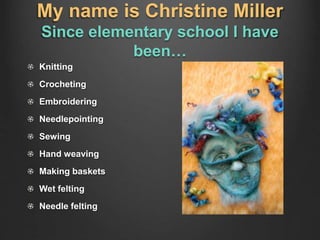
My name is Christine Miller
Since elementary school I have
been…
Knitting
Crocheting
Embroidering
Needlepointing
Sewing
Hand weaving
Making baskets
Wet felting
Needle felting
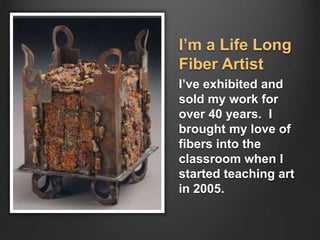
I’m a Life Long
Fiber Artist
I’ve exhibited and
sold my work for
over 40 years. I
brought my love of
fibers into the
classroom when I
started teaching art
in 2005.
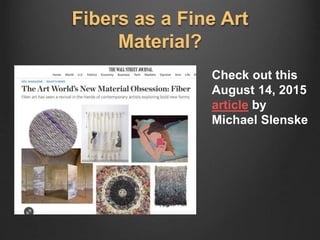
Fibers as a Fine Art
Material?
Check out this
August 14, 2015
article by
Michael Slenske
2013 TEKS Update
Includes Fiber Art!
(2) Creative expression. The student
communicates ideas through original artwork
using a variety of media with appropriate skills.
The student expresses thoughts and ideas
creatively while challenging the imagination,
fostering reflective thinking, and developing
disciplined effort and progressive problem-
solving skills. The student is expected to:
(F) demonstrate effective use of art media and
tools in drawing, painting, printmaking,
sculpture, ceramics, , design, and
digital art and media.
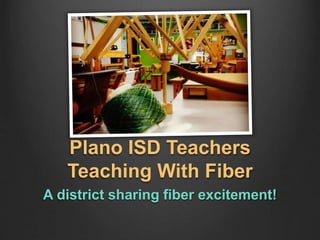
Plano ISD Teachers
Teaching With Fiber
A district sharing fiber excitement!
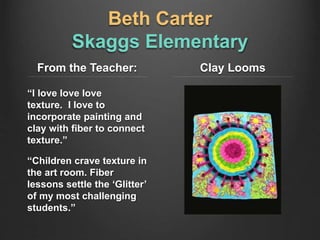
Beth Carter
Skaggs Elementary
From the Teacher:
“I love love love
texture. I love to
incorporate painting and
clay with fiber to connect
texture.”
“Children crave texture in
the art room. Fiber
lessons settle the ‘Glitter’
of my most challenging
students.”
Clay Looms
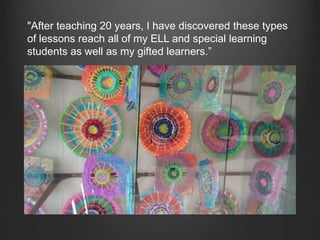
"After teaching 20 years, I have discovered these types
of lessons reach all of my ELL and special learning
students as well as my gifted learners.”
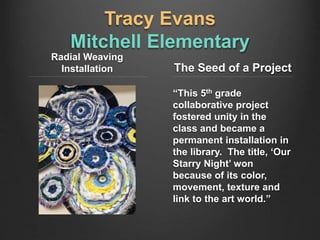
Tracy Evans
Mitchell Elementary
Radial Weaving
Installation The Seed of a Project
“This 5th grade
collaborative project
fostered unity in the
class and became a
permanent installation in
the library. The title, ‘Our
Starry Night’ won
because of its color,
movement, texture and
link to the art world.”
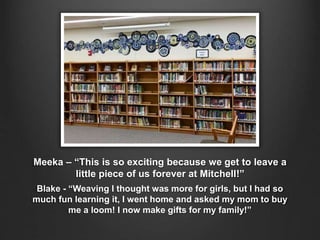
Meeka – “This is so exciting because we get to leave a
little piece of us forever at Mitchell!”
Blake - “Weaving I thought was more for girls, but I had so
much fun learning it, I went home and asked my mom to buy
me a loom! I now make gifts for my family!”
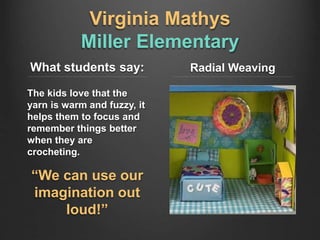
Virginia Mathys
Miller Elementary
What students say:
The kids love that the
yarn is warm and fuzzy, it
helps them to focus and
remember things better
when they are
crocheting.
“We can use our
imagination out
loud!”
Radial Weaving
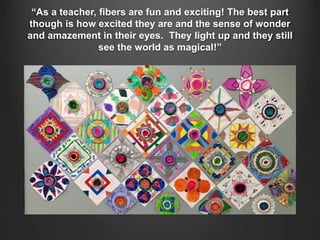
“As a teacher, fibers are fun and exciting! The best part
though is how excited they are and the sense of wonder
and amazement in their eyes. They light up and they still
see the world as magical!”
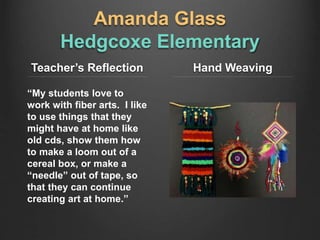
Amanda Glass
Hedgcoxe Elementary
Teacher’s Reflection
“My students love to
work with fiber arts. I like
to use things that they
might have at home like
old cds, show them how
to make a loom out of a
cereal box, or make a
“needle” out of tape, so
that they can continue
creating art at home.”
Hand Weaving
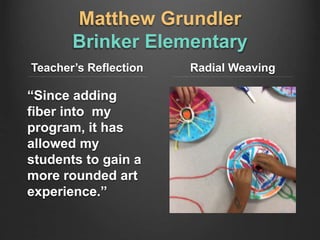
Matthew Grundler
Brinker Elementary
Teacher’s Reflection
“Since adding
fiber into my
program, it has
allowed my
students to gain a
more rounded art
experience.”
Radial Weaving
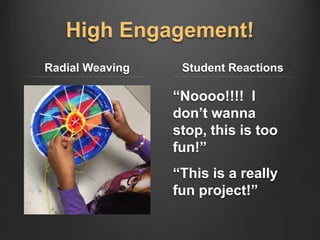
High Engagement!
Radial Weaving Student Reactions
“Noooo!!!! I
don’t wanna
stop, this is too
fun!”
“This is a really
fun project!”
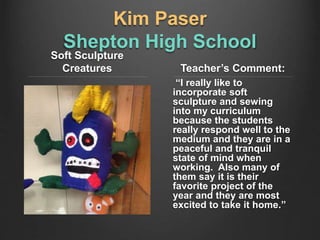
Kim Paser
Shepton High School
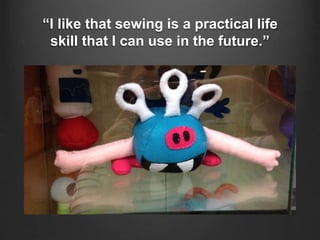
Soft Sculpture
Creatures Teacher’s Comment:
“I really like to
incorporate soft
sculpture and sewing
into my curriculum
because the students
really respond well to the
medium and they are in a
peaceful and tranquil
state of mind when
working. Also many of
them say it is their
favorite project of the
year and they are most
excited to take it home.”
“I like that sewing is a practical life
skill that I can use in the future.”
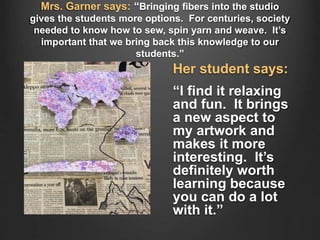
Emily Garner
Williams High School
Stitching on Watercolor
Mrs. Garner says: “Bringing fibers into the studio
gives the students more options. For centuries, society
needed to know how to sew, spin yarn and weave. It’s
important that we bring back this knowledge to our
students.”
Her student says:
“I find it relaxing
and fun. It brings
a new aspect to
my artwork and
makes it more
interesting. It’s
definitely worth
learning because
you can do a lot
with it.”
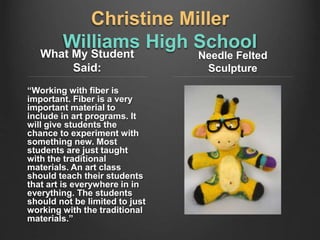
Christine Miller
Williams High School
What My Student
Said:
“Working with fiber is
important. Fiber is a very
important material to
include in art programs. It
will give students the
chance to experiment with
something new. Most
students are just taught
with the traditional
materials. An art class
should teach their students
that art is everywhere in in
everything. The students
should not be limited to just
working with the traditional
materials.”
Needle Felted
Sculpture
Fibers Enrich an Art
Program
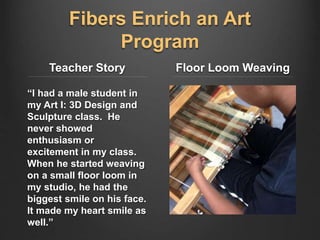
Teacher Story
“I had a male student in
my Art I: 3D Design and
Sculpture class. He
never showed
enthusiasm or
excitement in my class.
When he started weaving
on a small floor loom in
my studio, he had the
biggest smile on his face.
It made my heart smile as
well.”
Floor Loom Weaving
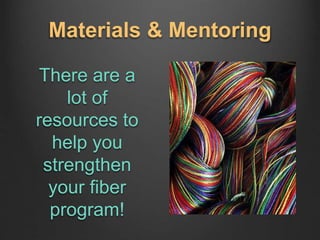
Materials & Mentoring
There are a
lot of
resources to
help you
strengthen
your fiber
program!
It’s scary to
teach
something I’m
not familiar
with!
New materials
and processes
present new
problems! I
have…
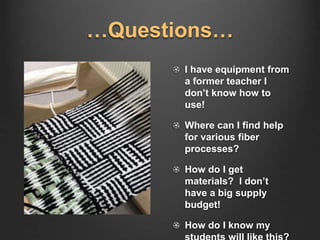
…Questions…
I have equipment from
a former teacher I
don’t know how to
use!
Where can I find help
for various fiber
processes?
How do I get
materials? I don’t
have a big supply
budget!
How do I know my
ExploreFiber.com
Explore Fiber promotes fibers as a contemporary fine art
material in art education.
Explore Fiber is a collaborative initiative and resource by and
for a community of educators and artists working with fibers
through innovative art expressions.
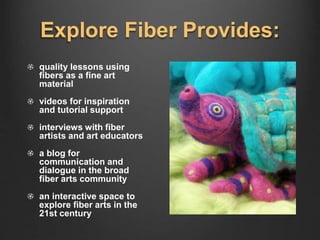
Explore Fiber Provides:
quality lessons using
fibers as a fine art
material
videos for inspiration
and tutorial support
interviews with fiber
artists and art educators
a blog for
communication and
dialogue in the broad
fiber arts community
an interactive space to
explore fiber arts in the
21st century
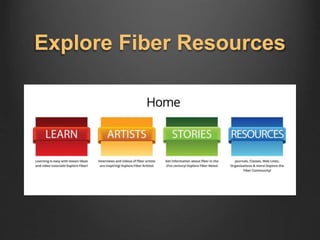
Explore Fiber Resources
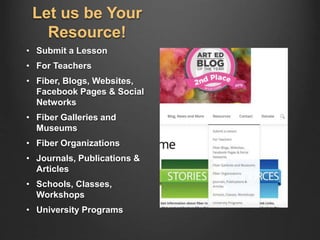
Let us be Your
Resource!
• Submit a Lesson
• For Teachers
• Fiber, Blogs, Websites,
Facebook Pages & Social
Networks
• Fiber Galleries and
Museums
• Fiber Organizations
• Journals, Publications &
Articles
• Schools, Classes,
Workshops
• University Programs
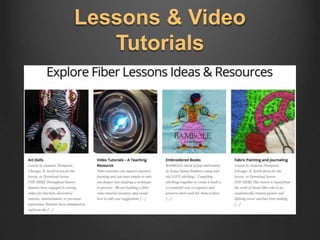
Lessons & Video
Tutorials
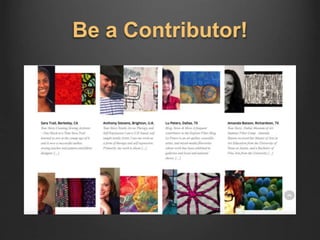
Be a Contributor!
Fiber News & Inspiration
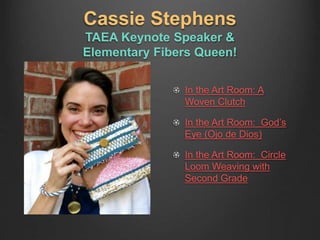
Cassie Stephens
TAEA Keynote Speaker &
Elementary Fibers Queen!
In the Art Room: A
Woven Clutch
In the Art Room: God’s
Eye (Ojo de Dios)
In the Art Room: Circle
Loom Weaving with
Second Grade
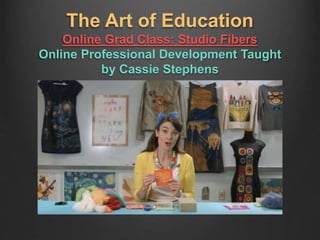
The Art of Education
Online Grad Class: Studio Fibers
Online Professional Development Taught
by Cassie Stephens
Obtainium: something that
can be had for little or no
cost!
Art teachers are experts at scrounging
and begging! You have to contact the
right people to get the materials and
support you need!
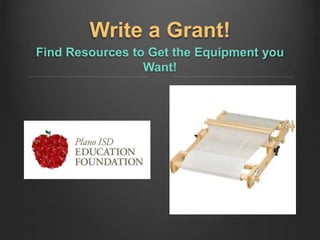
Write a Grant!
Find Resources to Get the Equipment you
Want!
How do I get materials?
Contact Local Fiber Organizations
Fiber
organizations
want their
passion to stay
alive and are very
excited for young
people to learn
about Fiber arts!
Weaving Guilds
Knitting Guilds
Embroidery Guilds
Quilter Guilds
Sewing Guilds
Basket Guilds
How do I learn how to use
equipment I have?
Network & Teach Yourself!
YouTube is a great
resource for video
tutorials.
Explore Fiber is also
building a fiber video
tutorial database.
Contact local artists to
find a mentor that can
help you!
I’M HERE TO HELP!
DON’T HESITATE TO CONTACT ME!
CHRISTINE.MILLER@PISD.EDU
EXPLOREFIBER@GMAIL.COM
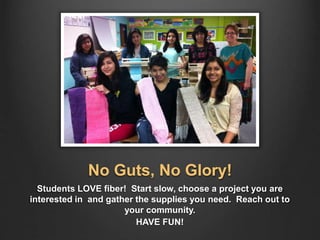
No Guts, No Glory!
Students LOVE fiber! Start slow, choose a project you are
interested in and gather the supplies you need. Reach out to
your community.
HAVE FUN!

Bring Fibers Into Your Art Curriculum

  • 1.
    Bring Fibers intoYour Curriculum
  • 2.
    My name isChristine Miller Since elementary school I have been… Knitting Crocheting Embroidering Needlepointing Sewing Hand weaving Making baskets Wet felting Needle felting
  • 3.
    I’m a LifeLong Fiber Artist I’ve exhibited and sold my work for over 40 years. I brought my love of fibers into the classroom when I started teaching art in 2005.
  • 4.
    Fibers as aFine Art Material? Check out this August 14, 2015 article by Michael Slenske
  • 5.
    2013 TEKS Update IncludesFiber Art! (2) Creative expression. The student communicates ideas through original artwork using a variety of media with appropriate skills. The student expresses thoughts and ideas creatively while challenging the imagination, fostering reflective thinking, and developing disciplined effort and progressive problem- solving skills. The student is expected to: (F) demonstrate effective use of art media and tools in drawing, painting, printmaking, sculpture, ceramics, , design, and digital art and media.
  • 6.
    Plano ISD Teachers TeachingWith Fiber A district sharing fiber excitement!
  • 7.
    Beth Carter Skaggs Elementary Fromthe Teacher: “I love love love texture. I love to incorporate painting and clay with fiber to connect texture.” “Children crave texture in the art room. Fiber lessons settle the ‘Glitter’ of my most challenging students.” Clay Looms
  • 8.
    "After teaching 20years, I have discovered these types of lessons reach all of my ELL and special learning students as well as my gifted learners.”
  • 9.
    Tracy Evans Mitchell Elementary RadialWeaving Installation The Seed of a Project “This 5th grade collaborative project fostered unity in the class and became a permanent installation in the library. The title, ‘Our Starry Night’ won because of its color, movement, texture and link to the art world.”
  • 10.
    Meeka – “Thisis so exciting because we get to leave a little piece of us forever at Mitchell!” Blake - “Weaving I thought was more for girls, but I had so much fun learning it, I went home and asked my mom to buy me a loom! I now make gifts for my family!”
  • 11.
    Virginia Mathys Miller Elementary Whatstudents say: The kids love that the yarn is warm and fuzzy, it helps them to focus and remember things better when they are crocheting. “We can use our imagination out loud!” Radial Weaving
  • 12.
    “As a teacher,fibers are fun and exciting! The best part though is how excited they are and the sense of wonder and amazement in their eyes. They light up and they still see the world as magical!”
  • 13.
    Amanda Glass Hedgcoxe Elementary Teacher’sReflection “My students love to work with fiber arts. I like to use things that they might have at home like old cds, show them how to make a loom out of a cereal box, or make a “needle” out of tape, so that they can continue creating art at home.” Hand Weaving
  • 14.
    Matthew Grundler Brinker Elementary Teacher’sReflection “Since adding fiber into my program, it has allowed my students to gain a more rounded art experience.” Radial Weaving
  • 15.
    High Engagement! Radial WeavingStudent Reactions “Noooo!!!! I don’t wanna stop, this is too fun!” “This is a really fun project!”
  • 16.
    Kim Paser Shepton HighSchool Soft Sculpture Creatures Teacher’s Comment: “I really like to incorporate soft sculpture and sewing into my curriculum because the students really respond well to the medium and they are in a peaceful and tranquil state of mind when working. Also many of them say it is their favorite project of the year and they are most excited to take it home.”
  • 17.
    “I like thatsewing is a practical life skill that I can use in the future.”
  • 18.
    Emily Garner Williams HighSchool Stitching on Watercolor
  • 19.
    Mrs. Garner says:“Bringing fibers into the studio gives the students more options. For centuries, society needed to know how to sew, spin yarn and weave. It’s important that we bring back this knowledge to our students.” Her student says: “I find it relaxing and fun. It brings a new aspect to my artwork and makes it more interesting. It’s definitely worth learning because you can do a lot with it.”
  • 20.
    Christine Miller Williams HighSchool What My Student Said: “Working with fiber is important. Fiber is a very important material to include in art programs. It will give students the chance to experiment with something new. Most students are just taught with the traditional materials. An art class should teach their students that art is everywhere in in everything. The students should not be limited to just working with the traditional materials.” Needle Felted Sculpture
  • 21.
    Fibers Enrich anArt Program Teacher Story “I had a male student in my Art I: 3D Design and Sculpture class. He never showed enthusiasm or excitement in my class. When he started weaving on a small floor loom in my studio, he had the biggest smile on his face. It made my heart smile as well.” Floor Loom Weaving
  • 22.
    Materials & Mentoring Thereare a lot of resources to help you strengthen your fiber program!
  • 23.
    It’s scary to teach somethingI’m not familiar with! New materials and processes present new problems! I have…
  • 24.
    …Questions… I have equipmentfrom a former teacher I don’t know how to use! Where can I find help for various fiber processes? How do I get materials? I don’t have a big supply budget! How do I know my
  • 25.
    ExploreFiber.com Explore Fiber promotesfibers as a contemporary fine art material in art education. Explore Fiber is a collaborative initiative and resource by and for a community of educators and artists working with fibers through innovative art expressions.
  • 26.
    Explore Fiber Provides: qualitylessons using fibers as a fine art material videos for inspiration and tutorial support interviews with fiber artists and art educators a blog for communication and dialogue in the broad fiber arts community an interactive space to explore fiber arts in the 21st century
  • 27.
  • 28.
    Let us beYour Resource! • Submit a Lesson • For Teachers • Fiber, Blogs, Websites, Facebook Pages & Social Networks • Fiber Galleries and Museums • Fiber Organizations • Journals, Publications & Articles • Schools, Classes, Workshops • University Programs
  • 29.
  • 30.
  • 31.
    Fiber News &Inspiration
  • 32.
    Cassie Stephens TAEA KeynoteSpeaker & Elementary Fibers Queen! In the Art Room: A Woven Clutch In the Art Room: God’s Eye (Ojo de Dios) In the Art Room: Circle Loom Weaving with Second Grade
  • 33.
    The Art ofEducation Online Grad Class: Studio Fibers Online Professional Development Taught by Cassie Stephens
  • 34.
    Obtainium: something that canbe had for little or no cost! Art teachers are experts at scrounging and begging! You have to contact the right people to get the materials and support you need!
  • 35.
    Write a Grant! FindResources to Get the Equipment you Want!
  • 36.
    How do Iget materials? Contact Local Fiber Organizations Fiber organizations want their passion to stay alive and are very excited for young people to learn about Fiber arts! Weaving Guilds Knitting Guilds Embroidery Guilds Quilter Guilds Sewing Guilds Basket Guilds
  • 37.
    How do Ilearn how to use equipment I have? Network & Teach Yourself! YouTube is a great resource for video tutorials. Explore Fiber is also building a fiber video tutorial database. Contact local artists to find a mentor that can help you!
  • 38.
    I’M HERE TOHELP! DON’T HESITATE TO CONTACT ME! CHRISTINE.MILLER@PISD.EDU EXPLOREFIBER@GMAIL.COM
  • 39.
    No Guts, NoGlory! Students LOVE fiber! Start slow, choose a project you are interested in and gather the supplies you need. Reach out to your community. HAVE FUN!