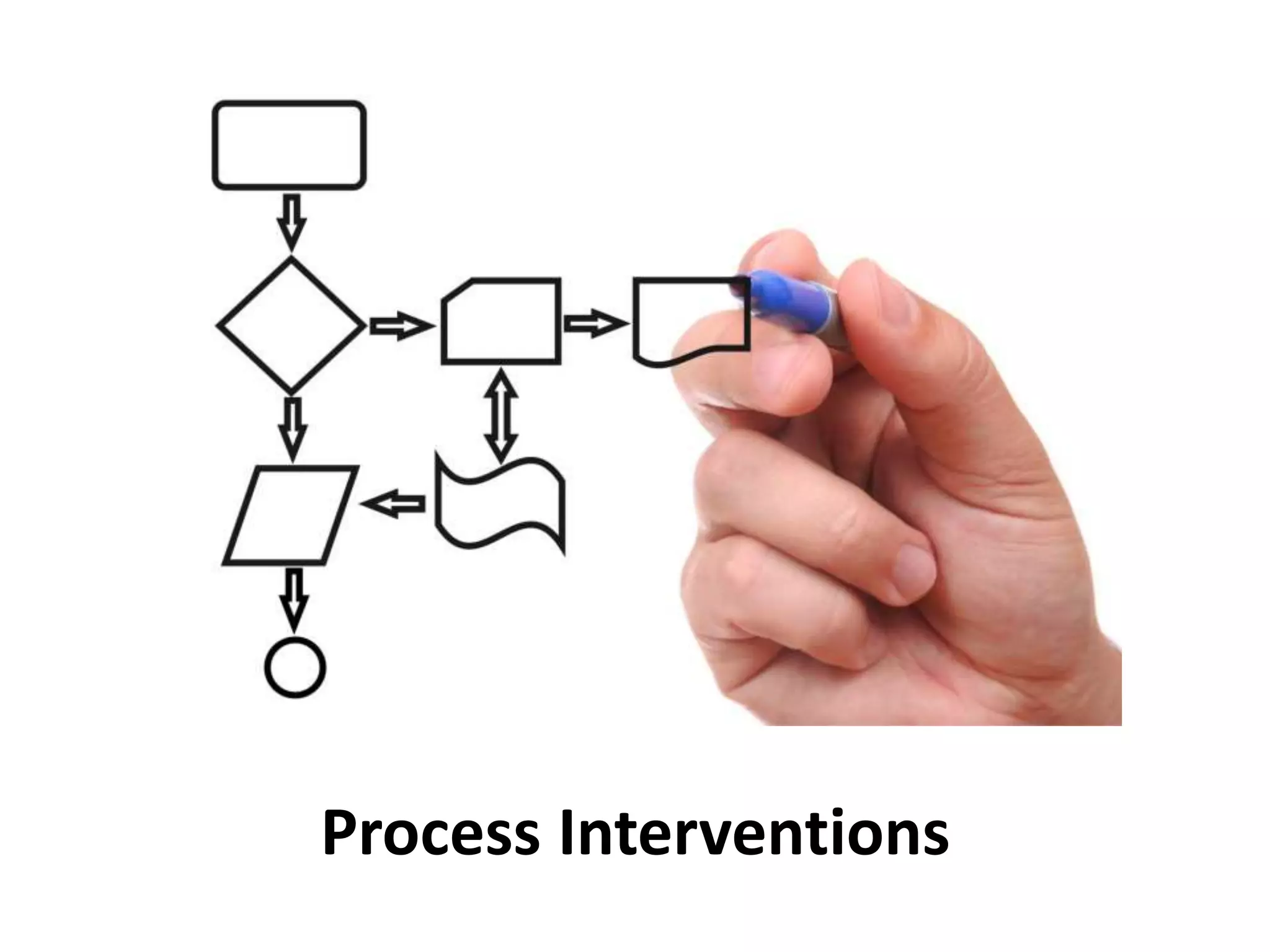
Process Interventions
Prepared By
Kindly restrict the use of slides for personal purpose.
Please seek permission to reproduce the same in public forms and presentations.
Manu Melwin Joy
Assistant Professor
Ilahia School of Management Studies
Kerala, India.
Phone – 9744551114
Mail – manu_melwinjoy@yahoo.com
Sig Sigma
• Six Sigma is a disciplined,
data-driven approach and
methodology for
eliminating defects (driving
toward six standard
deviations between the
mean and the nearest
specification limit) in any
process – from
manufacturing to
transactional and from
product to service.
TQM / Continuous process
improvement
• Total Quality Management
(TQM) is a management
approach that originated in
the 1950s and has steadily
become more popular since
the early 1980s.
• Total quality is a description
of the culture, attitude and
organization of a company
that strives to provide
customers with products and
services that satisfy their
needs.
Process Re engineering
• Business Process
Reengineering involves the
radical redesign of core
business processes to achieve
dramatic improvements in
productivity, cycle times and
quality.
• In Business Process
Reengineering, companies
start with a blank sheet of
paper and rethink existing
processes to deliver more
value to the customer.
Cummings & Worley, 7e (c) 2001 South-
Western College Publishing
14-7
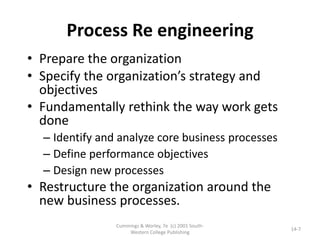
• Prepare the organization
• Specify the organization’s strategy and
objectives
• Fundamentally rethink the way work gets
done
– Identify and analyze core business processes
– Define performance objectives
– Design new processes
• Restructure the organization around the
new business processes.
Process Re engineering
Cummings & Worley, 7e (c) 2001 South-
Western College Publishing
14-8
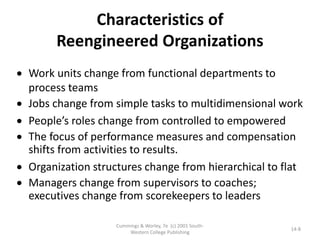
 Work units change from functional departments to
process teams
 Jobs change from simple tasks to multidimensional work
 People’s roles change from controlled to empowered
 The focus of performance measures and compensation
shifts from activities to results.
 Organization structures change from hierarchical to flat
 Managers change from supervisors to coaches;
executives change from scorekeepers to leaders
Characteristics of
Reengineered Organizations
Bench Marking
• Benchmarking is the process of
comparing one's business
processes and performance
matrics to industry bests or best
practices from other companies.
• Dimensions typically measured
are quality, time and cost. In the
process of best practice
benchmarking, management
identifies the best firms in their
industry, or in another industry
where similar processes exist,
and compares the results and
processes of those studied (the
"targets") to one's own results
and processes.
Socio technical systems
• Sociotechnical systems (STS)
in organizational
development is an approach
to complex organizational
work design that recognizes
the interaction between
people and technology in
workplaces.
• The term also refers to the
interaction between society's
complex infrastructures and
human behaviour.
Process interventions -  Organizational Change and Development - Manu Melwin Joy

Process interventions - Organizational Change and Development - Manu Melwin Joy

  • 1.
  • 2.
    Prepared By Kindly restrictthe use of slides for personal purpose. Please seek permission to reproduce the same in public forms and presentations. Manu Melwin Joy Assistant Professor Ilahia School of Management Studies Kerala, India. Phone – 9744551114 Mail – manu_melwinjoy@yahoo.com
  • 4.
    Sig Sigma • SixSigma is a disciplined, data-driven approach and methodology for eliminating defects (driving toward six standard deviations between the mean and the nearest specification limit) in any process – from manufacturing to transactional and from product to service.
  • 5.
    TQM / Continuousprocess improvement • Total Quality Management (TQM) is a management approach that originated in the 1950s and has steadily become more popular since the early 1980s. • Total quality is a description of the culture, attitude and organization of a company that strives to provide customers with products and services that satisfy their needs.
  • 6.
    Process Re engineering •Business Process Reengineering involves the radical redesign of core business processes to achieve dramatic improvements in productivity, cycle times and quality. • In Business Process Reengineering, companies start with a blank sheet of paper and rethink existing processes to deliver more value to the customer.
  • 7.
    Cummings & Worley,7e (c) 2001 South- Western College Publishing 14-7 • Prepare the organization • Specify the organization’s strategy and objectives • Fundamentally rethink the way work gets done – Identify and analyze core business processes – Define performance objectives – Design new processes • Restructure the organization around the new business processes. Process Re engineering
  • 8.
    Cummings & Worley,7e (c) 2001 South- Western College Publishing 14-8  Work units change from functional departments to process teams  Jobs change from simple tasks to multidimensional work  People’s roles change from controlled to empowered  The focus of performance measures and compensation shifts from activities to results.  Organization structures change from hierarchical to flat  Managers change from supervisors to coaches; executives change from scorekeepers to leaders Characteristics of Reengineered Organizations
  • 9.
    Bench Marking • Benchmarkingis the process of comparing one's business processes and performance matrics to industry bests or best practices from other companies. • Dimensions typically measured are quality, time and cost. In the process of best practice benchmarking, management identifies the best firms in their industry, or in another industry where similar processes exist, and compares the results and processes of those studied (the "targets") to one's own results and processes.
  • 10.
    Socio technical systems •Sociotechnical systems (STS) in organizational development is an approach to complex organizational work design that recognizes the interaction between people and technology in workplaces. • The term also refers to the interaction between society's complex infrastructures and human behaviour.