SOFTWARE QUALITY
Defining Software Quality
• QUALITY is the degree to which a component,
system or process meets specified
requirements or customer needs and
expectations.
• SOFTWARE QUALITY is the degree of
conformance to explicit or implicit (indirect)
requirements and expectations.
Software Quality Models
• There are several well established quality
models including McCall’s Model, Dormey’s
Model, Boehm’s Model and ISO 9216 model
of quality.
• The ISO 9216 standard was first introduced in
1991 to identify software quality
characteristics.
Software Quality Models
• ISO 9126 defines six major software quality characteristics:
– Functionality: covers the functions that a software product
provides to satisfy user needs.
– Reliability: the probability of failure-free operation of a computer
program for a specified period in a specified environment.
– Usability: which relates to the effort needed to use the software.
– Efficiency: which relates to the physical resources used when the
software is executed.
– Maintainability: relates to the effort needed to make changes to
the software.
– Portability: relates to the ability of the software to be transferred
to a different environment.
Process Capability Models
• As compared to the product metrics, the process
metrics are more meaningfully measured during a
product development.
• Therefore, process based techniques are very
important to manage quality during development.
• Some of the popular process capability models are
– SEI CMM
– CMMI
– ISO 15504
– Six Sigma
SEI Capability Maturity Model
• CMM was developed by the Software
Engineering Institute (SEI) in 1987.
• It is not a software process model. It is a
framework which is used to analyze the
approach and techniques followed by any
organization to develop a software product.
• In simple words, CMM is a reference model for
appraising a software development organization
into one of the five process maturity levels.
SEI Capability Maturity Model
• The maturity level of an organization is a
ranking of the quality of the development
process used by the organization.
• This information can be used to predict the
most likely outcome of a project that the
organization undertakes.
• It also provides guidelines to further enhance
the maturity of the software products.
SEI Capability Maturity Model
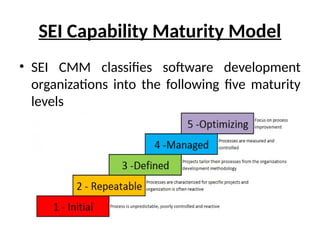
• SEI CMM classifies software development
organizations into the following five maturity
levels
SEI Capability Maturity Model
• Level One :Initial
– The software process is characterized as inconsistent,
and occasionally even chaotic.
– Defined processes and standard practices that exist
are abandoned during a crisis.
– Success of the organization majorly depends on an
individual effort, talent, and heroics.
– The heroes eventually move on to other
organizations taking their wealth of knowledge or
lessons learnt with them.
SEI Capability Maturity Model
• Level Two: Repeatable
– This level of Software Development Organization
has a basic and consistent project management
processes to track cost, schedule, and
functionality.
– The process is in place to repeat the earlier
successes on projects with similar applications.
– Program management is a key characteristic of a
level two organization.
SEI Capability Maturity Model
• Level Three: Defined
– The software process for both management and
engineering activities are documented,
standardized, and integrated into a standard
software process for the entire organization.
– All projects across the organization use an
approved, tailored version of the organization's
standard software process for developing, testing
and maintaining the application.
SEI Capability Maturity Model
• Level Four: Managed
– Management can effectively control the software
development effort using precise measurements.
– At this level, organization set a quantitative quality
goal for both software process and software
maintenance.
– At this maturity level, the performance of processes
is controlled using statistical and other quantitative
techniques, and is quantitatively predictable.
SEI Capability Maturity Model
• Level Five: Optimizing
– The Key characteristic of this level is focusing on
continually improving process performance
through both incremental and innovative
technological improvements.
– At this level, changes to the process are to improve
the process performance and at the same time
maintaining statistical probability to achieve the
established quantitative process-improvement
objectives.
SEI Capability Maturity Model
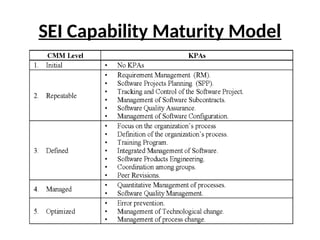
• Key process areas:
– Except for level 1, each maturity level is
characterized by several key process areas (KPAs).
– The KPAs of a level indicate the areas that an
organization at the lower maturity level needs to
focus to reach this level.
– KPAs provide a way for an organization to
gradually improve its quality over several stages
SEI Capability Maturity Model
Techniques for
Enhancing Software quality
• Some prominent techniques for enhancing
software quality are
– Inspections
– Reviews
– Walk-throughs

Lecture 10- Software Quality in software engineering

  • 1.
  • 2.
    Defining Software Quality •QUALITY is the degree to which a component, system or process meets specified requirements or customer needs and expectations. • SOFTWARE QUALITY is the degree of conformance to explicit or implicit (indirect) requirements and expectations.
  • 3.
    Software Quality Models •There are several well established quality models including McCall’s Model, Dormey’s Model, Boehm’s Model and ISO 9216 model of quality. • The ISO 9216 standard was first introduced in 1991 to identify software quality characteristics.
  • 4.
    Software Quality Models •ISO 9126 defines six major software quality characteristics: – Functionality: covers the functions that a software product provides to satisfy user needs. – Reliability: the probability of failure-free operation of a computer program for a specified period in a specified environment. – Usability: which relates to the effort needed to use the software. – Efficiency: which relates to the physical resources used when the software is executed. – Maintainability: relates to the effort needed to make changes to the software. – Portability: relates to the ability of the software to be transferred to a different environment.
  • 5.
    Process Capability Models •As compared to the product metrics, the process metrics are more meaningfully measured during a product development. • Therefore, process based techniques are very important to manage quality during development. • Some of the popular process capability models are – SEI CMM – CMMI – ISO 15504 – Six Sigma
  • 6.
    SEI Capability MaturityModel • CMM was developed by the Software Engineering Institute (SEI) in 1987. • It is not a software process model. It is a framework which is used to analyze the approach and techniques followed by any organization to develop a software product. • In simple words, CMM is a reference model for appraising a software development organization into one of the five process maturity levels.
  • 7.
    SEI Capability MaturityModel • The maturity level of an organization is a ranking of the quality of the development process used by the organization. • This information can be used to predict the most likely outcome of a project that the organization undertakes. • It also provides guidelines to further enhance the maturity of the software products.
  • 8.
    SEI Capability MaturityModel • SEI CMM classifies software development organizations into the following five maturity levels
  • 9.
    SEI Capability MaturityModel • Level One :Initial – The software process is characterized as inconsistent, and occasionally even chaotic. – Defined processes and standard practices that exist are abandoned during a crisis. – Success of the organization majorly depends on an individual effort, talent, and heroics. – The heroes eventually move on to other organizations taking their wealth of knowledge or lessons learnt with them.
  • 10.
    SEI Capability MaturityModel • Level Two: Repeatable – This level of Software Development Organization has a basic and consistent project management processes to track cost, schedule, and functionality. – The process is in place to repeat the earlier successes on projects with similar applications. – Program management is a key characteristic of a level two organization.
  • 11.
    SEI Capability MaturityModel • Level Three: Defined – The software process for both management and engineering activities are documented, standardized, and integrated into a standard software process for the entire organization. – All projects across the organization use an approved, tailored version of the organization's standard software process for developing, testing and maintaining the application.
  • 12.
    SEI Capability MaturityModel • Level Four: Managed – Management can effectively control the software development effort using precise measurements. – At this level, organization set a quantitative quality goal for both software process and software maintenance. – At this maturity level, the performance of processes is controlled using statistical and other quantitative techniques, and is quantitatively predictable.
  • 13.
    SEI Capability MaturityModel • Level Five: Optimizing – The Key characteristic of this level is focusing on continually improving process performance through both incremental and innovative technological improvements. – At this level, changes to the process are to improve the process performance and at the same time maintaining statistical probability to achieve the established quantitative process-improvement objectives.
  • 14.
    SEI Capability MaturityModel • Key process areas: – Except for level 1, each maturity level is characterized by several key process areas (KPAs). – The KPAs of a level indicate the areas that an organization at the lower maturity level needs to focus to reach this level. – KPAs provide a way for an organization to gradually improve its quality over several stages
  • 15.
  • 16.
    Techniques for Enhancing Softwarequality • Some prominent techniques for enhancing software quality are – Inspections – Reviews – Walk-throughs