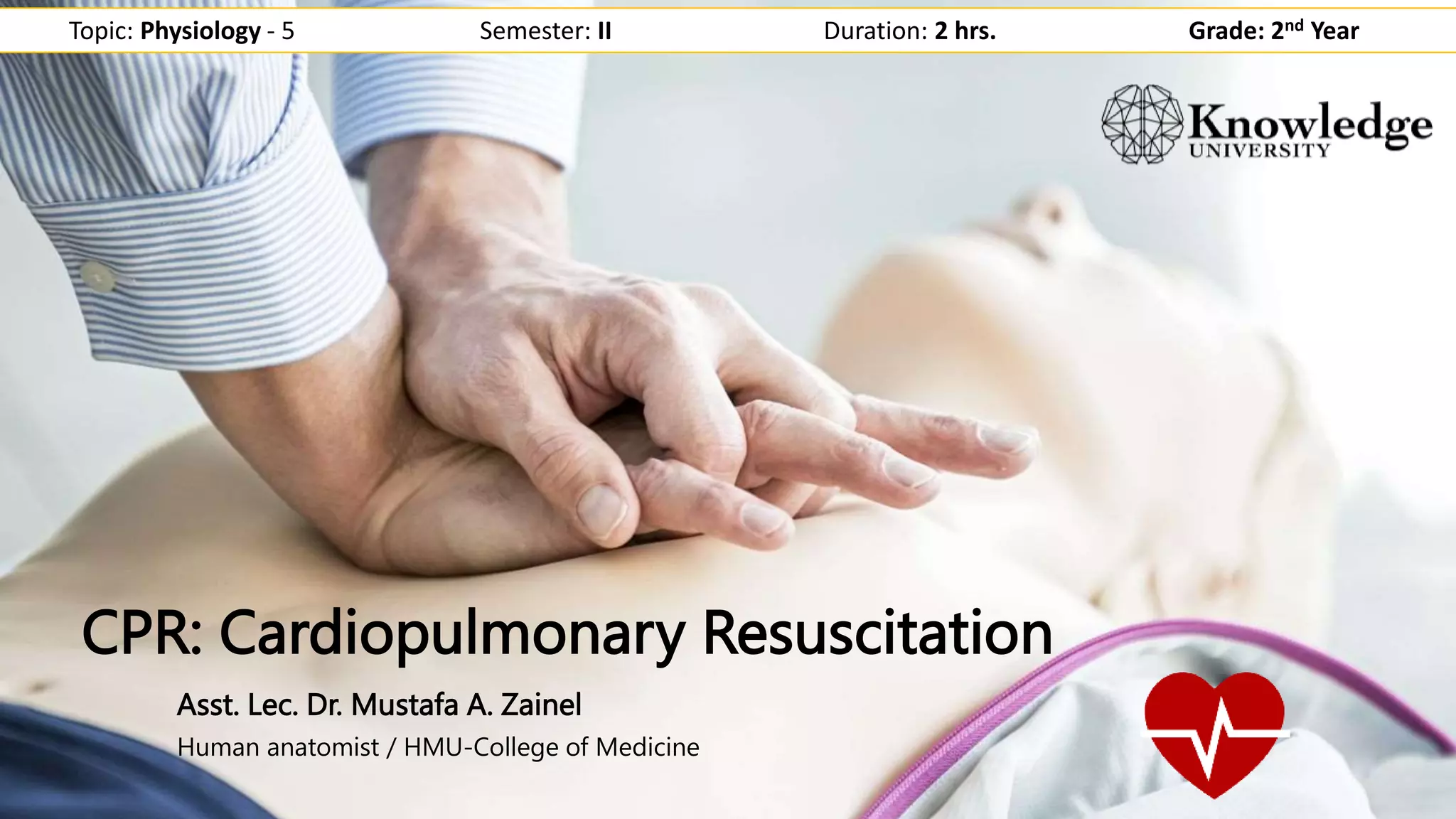
CPR: Cardiopulmonary Resuscitation
Asst. Lec. Dr. Mustafa A. Zainel
Human anatomist / HMU-College of Medicine
Topic: Physiology - 5 Semester: II Duration: 2 hrs. Grade: 2nd Year
CPR is a technique of basic
life support for oxygenating
the brain and heart until
appropriate, definitive medical
treatment can restore normal
heart and ventilatory action.
The heart is
a muscular organ in
humans and other
animals, which pumps
blood through the blood
vessels of the
circulatory system.
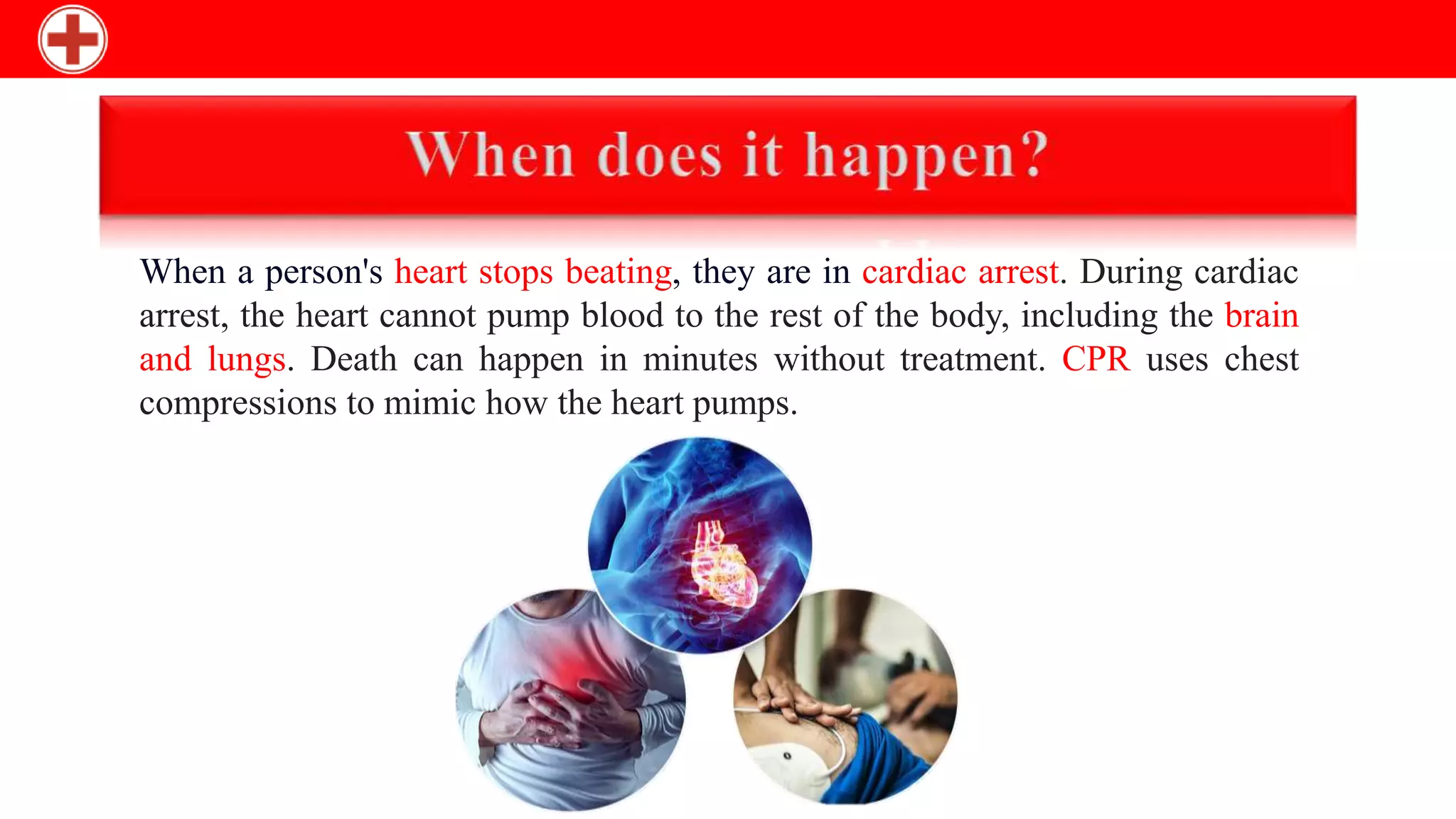
When a person's heart stops beating, they are in cardiac arrest. During cardiac
arrest, the heart cannot pump blood to the rest of the body, including the brain
and lungs. Death can happen in minutes without treatment. CPR uses chest
compressions to mimic how the heart pumps.
Ventricular fibrillation (VF)
Ventricular tachycardia (VT)
Asystole
Pulse less electrical activity
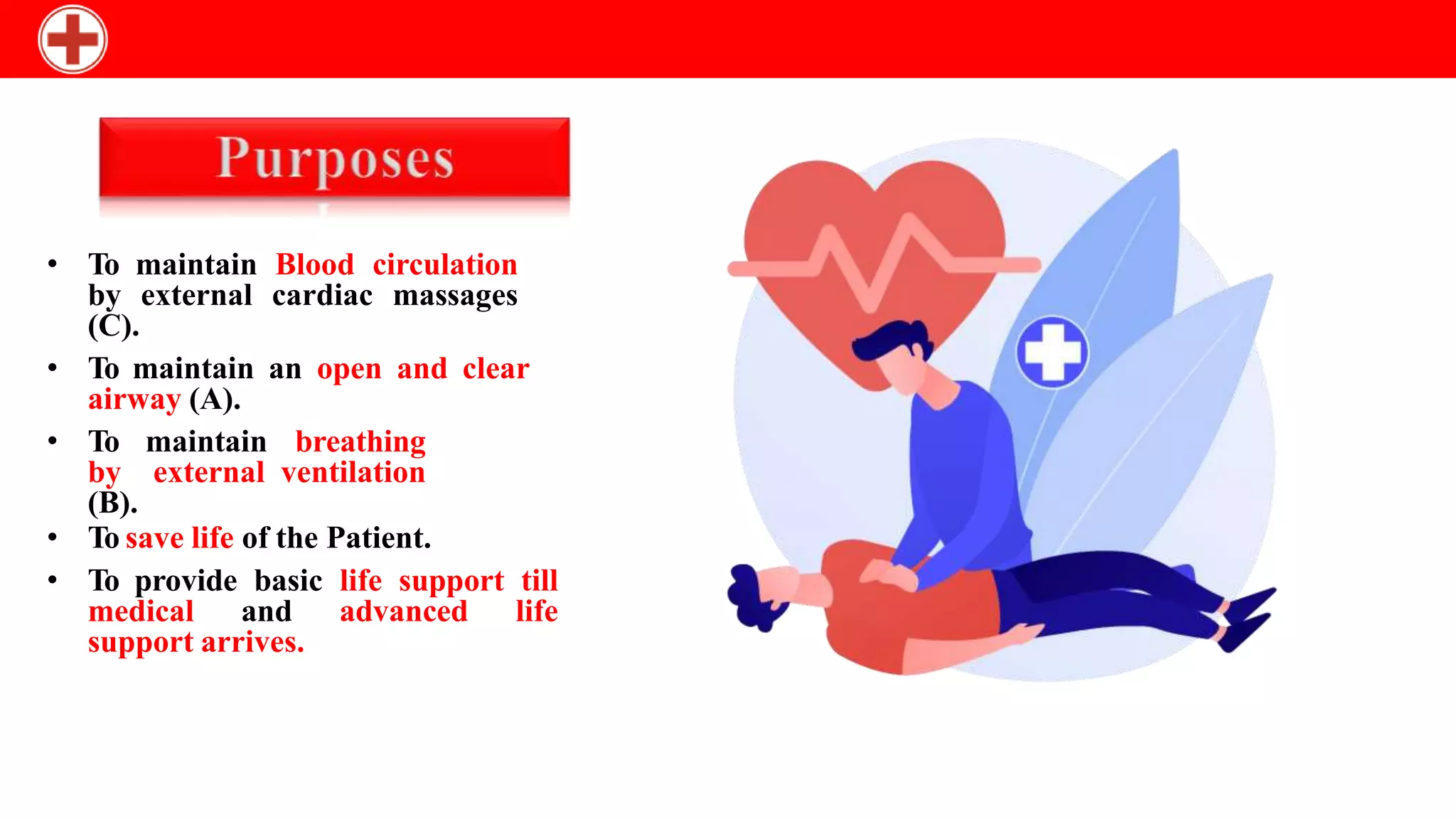
• To maintain Blood circulation
by external cardiac massages
(C).
• To maintain an open and clear
airway (A).
• To maintain breathing
by external ventilation
(B).
• To save life of the Patient.
• To provide basic life support till
medical and advanced life
support arrives.
 To restore effective circulation
and ventilation.
 To prevent irreversible cerebral
damage due to anoxia. When
the heart fails to maintain the
cerebral circulation for
approximately four minutes the
brain may suffer irreversible
damage.
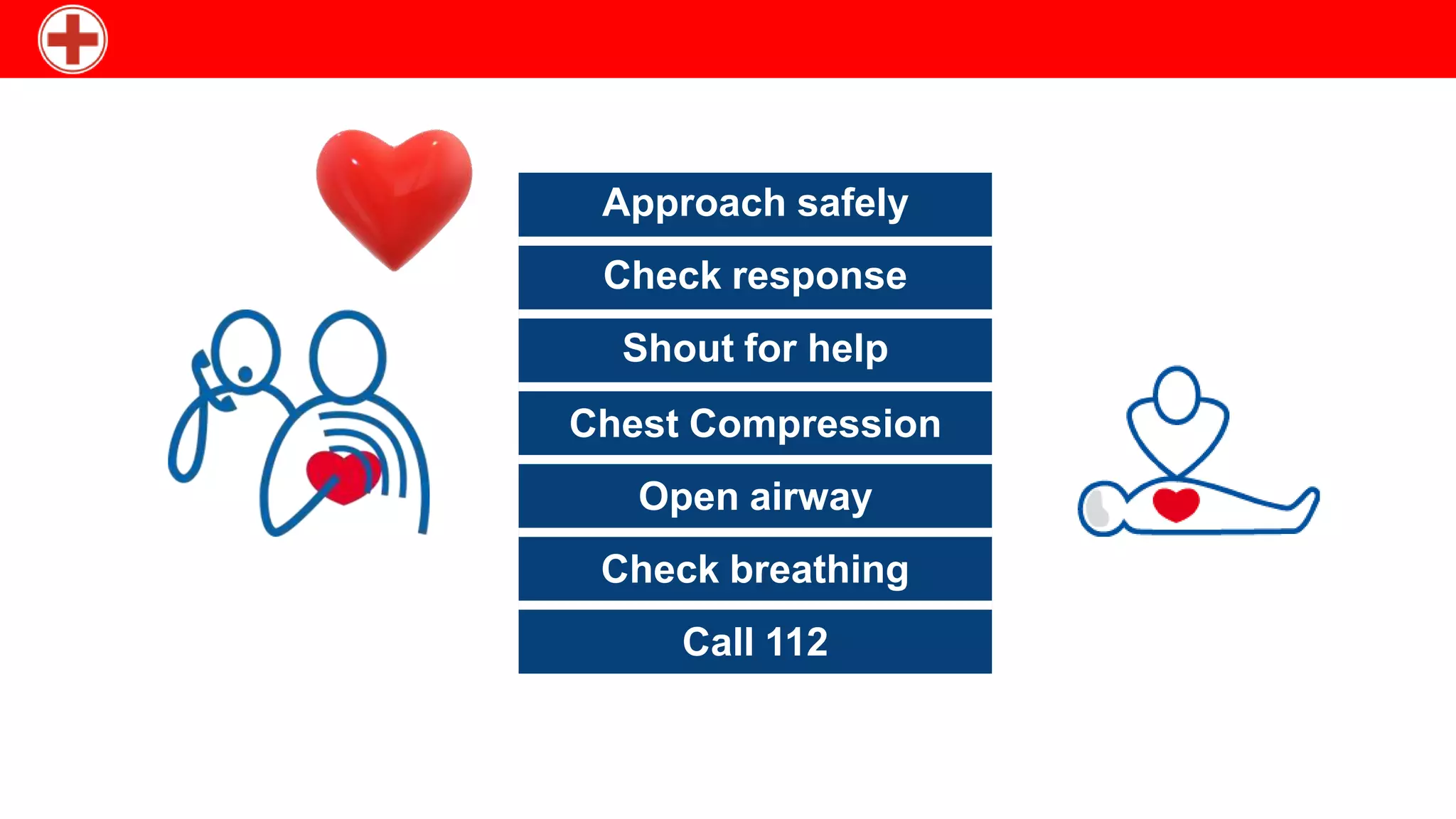
Approach safely
Check response
Shout for help
Chest Compression
Open airway
Check breathing
Call 112
APPROACH SAFELY!
• WATCH
• OBSERVE
Approach safely
Check response
Shout for help
Open airway
Check breathing
Call 112
30 chest compressions
2 rescue breaths
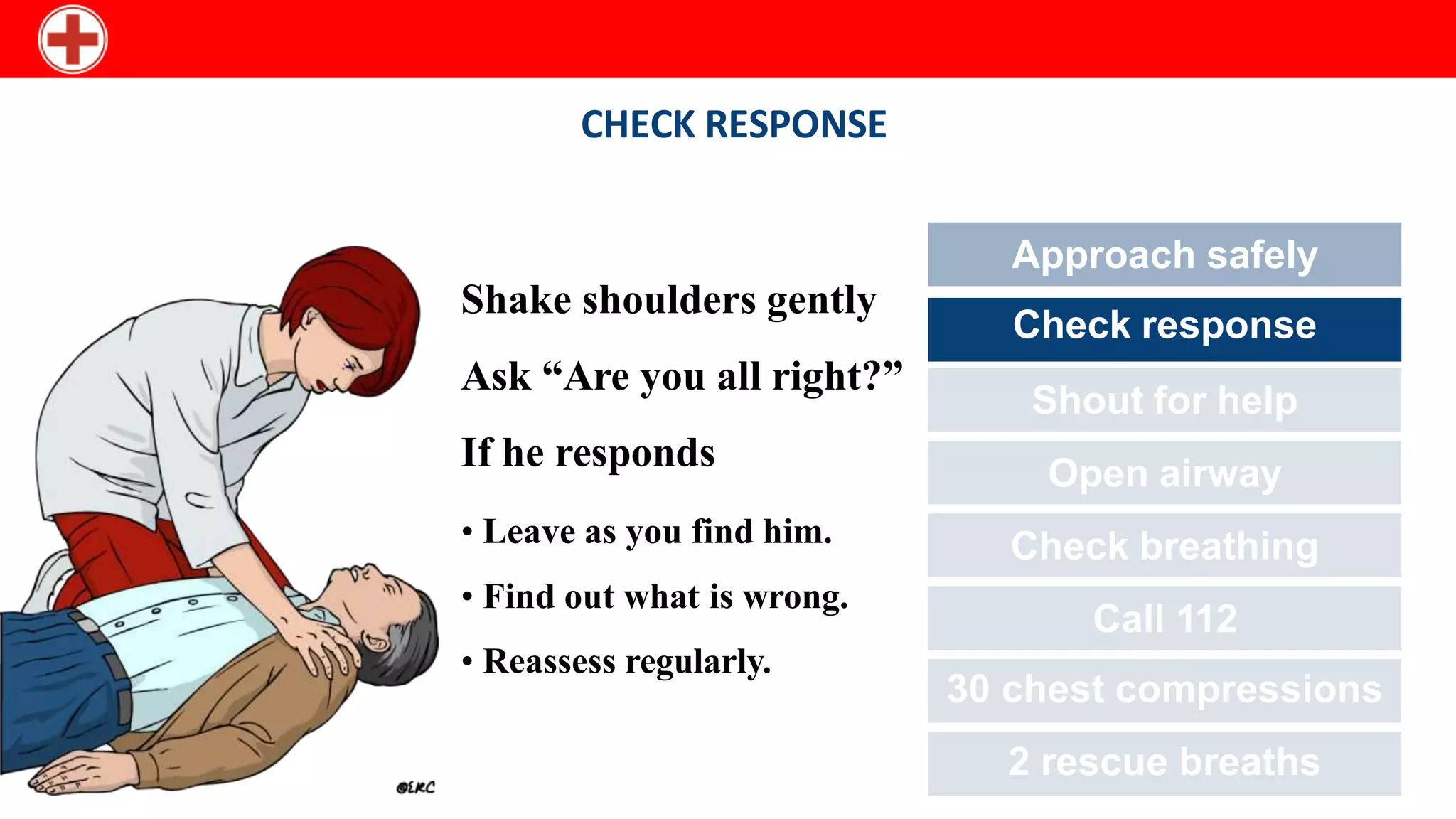
CHECK RESPONSE
Approach safely
Check response
Shout for help
Open airway
Check breathing
Call 112
30 chest compressions
2 rescue breaths
Shake shoulders gently
Ask “Are you all right?”
If he responds
• Leave as you find him.
• Find out what is wrong.
• Reassess regularly.
SHOUT FOR HELP
Approach safely
Check response
Shout for help
Open airway
Check breathing
Call 112
30 chest compressions
2 rescue breaths
Approach safely
Check response
Shout for help
Chest compression
Check breathing
Call 112
30 chest compressions
2 rescue breaths
Chest Compression
• Place the heel of one hand in the
centre of the chest
• Place other hand on top
• Interlock fingers
• Compress the chest
– Rate 100 min
– Depth 4-5 cm (1.5 to 2 inch)
– Equal compression :
relaxation
• When possible change
CPR operator every 2
min
OPEN AIRWAY
Approach safely
Check response
Shout for help
Open airway
Check breathing
Call 112
30 chest compressions
2 rescue breaths
Head tilt and chin lift
- Knell rescuer
No need for finger
sweep
unless solid material
can be seen in the
airway
OPEN AIRWAY
Head tilt, chin lift + jaw thrust
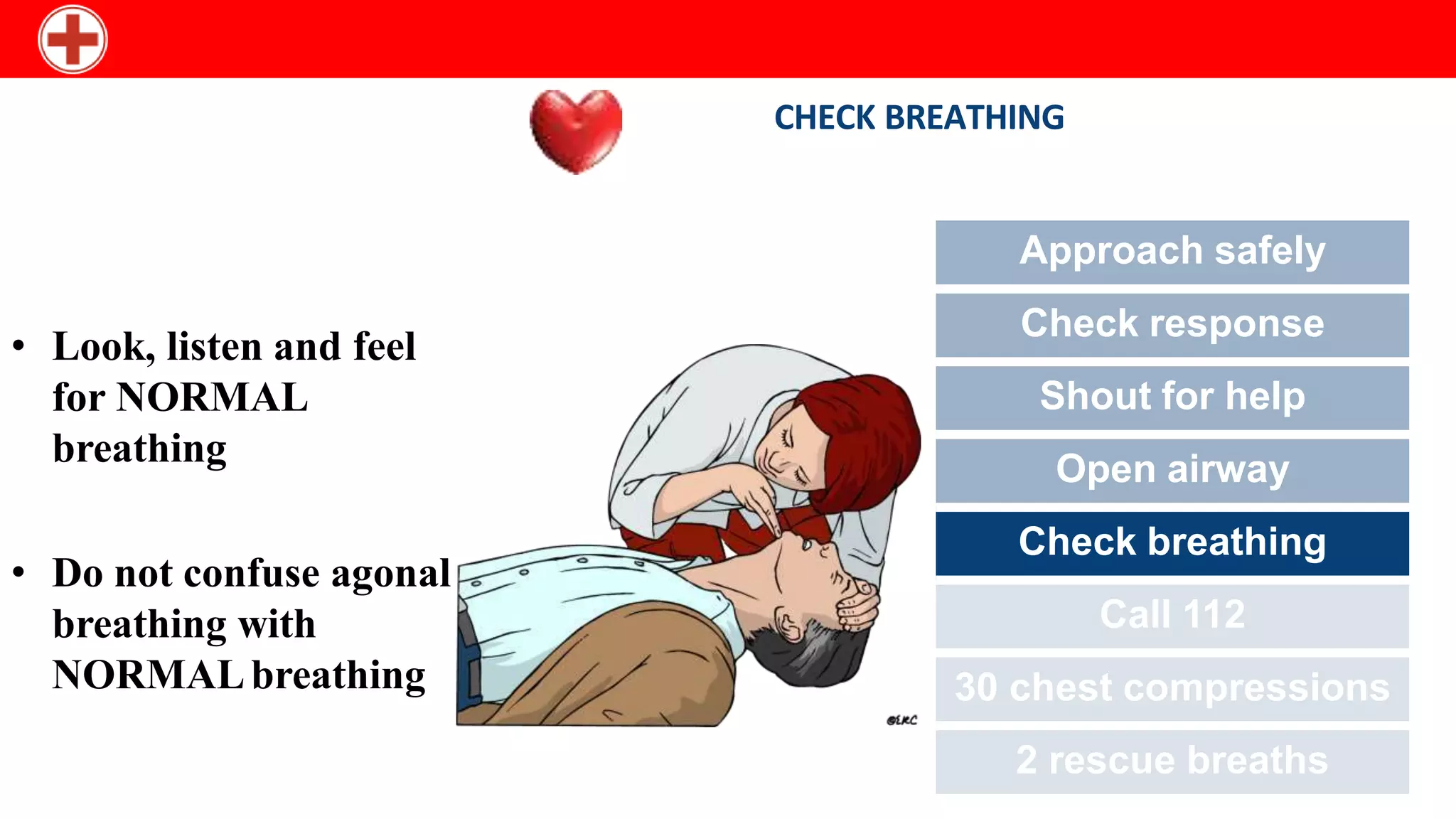
CHECK BREATHING
Approach safely
Check response
Shout for help
Open airway
Check breathing
Call 112
30 chest compressions
2 rescue breaths
• Look, listen and feel
for NORMAL
breathing
• Do not confuse agonal
breathing with
NORMALbreathing
Approach safely
Check response
Shout for help
Open airway
Check breathing
Call 112
30 chest compressions
2 rescue breaths
RESCUEBREATHS
Approach safely
Check response
Shout for help
Chest compression
Open airway
Check breathing
Call 112
30 chest compressions
2 rescue breaths
• Pinch the nose
• Take a normal breath
• Place lips over mouth
• Blow until the chest
rises
• Take about 1 second
• Allow chest to fall
• Repeat
CONTINUE CPR
30 2
Adrenaline
• Adrenaline (epinephrine) is the main drug used during
resuscitation from cardiac arrest.
Atropine
• Atropine as a single dose of 3mg is sufficient to block vagal tone
completely and should be used once in cases of asystole. It is also
indicated for symptomatic bradycardia in a dose of 0.5mg - 1mg.
Amiodarone
• It is an antiarrhythmic drug.
CPR Template lab.pptx

CPR Template lab.pptx

  • 1.
    CPR: Cardiopulmonary Resuscitation Asst.Lec. Dr. Mustafa A. Zainel Human anatomist / HMU-College of Medicine Topic: Physiology - 5 Semester: II Duration: 2 hrs. Grade: 2nd Year
  • 2.
    CPR is atechnique of basic life support for oxygenating the brain and heart until appropriate, definitive medical treatment can restore normal heart and ventilatory action.
  • 3.
    The heart is amuscular organ in humans and other animals, which pumps blood through the blood vessels of the circulatory system.
  • 4.
    When a person'sheart stops beating, they are in cardiac arrest. During cardiac arrest, the heart cannot pump blood to the rest of the body, including the brain and lungs. Death can happen in minutes without treatment. CPR uses chest compressions to mimic how the heart pumps.
  • 7.
    Ventricular fibrillation (VF) Ventriculartachycardia (VT) Asystole Pulse less electrical activity
  • 8.
    • To maintainBlood circulation by external cardiac massages (C). • To maintain an open and clear airway (A). • To maintain breathing by external ventilation (B). • To save life of the Patient. • To provide basic life support till medical and advanced life support arrives.
  • 10.
     To restoreeffective circulation and ventilation.  To prevent irreversible cerebral damage due to anoxia. When the heart fails to maintain the cerebral circulation for approximately four minutes the brain may suffer irreversible damage.
  • 11.
    Approach safely Check response Shoutfor help Chest Compression Open airway Check breathing Call 112
  • 12.
    APPROACH SAFELY! • WATCH •OBSERVE Approach safely Check response Shout for help Open airway Check breathing Call 112 30 chest compressions 2 rescue breaths
  • 13.
    CHECK RESPONSE Approach safely Checkresponse Shout for help Open airway Check breathing Call 112 30 chest compressions 2 rescue breaths Shake shoulders gently Ask “Are you all right?” If he responds • Leave as you find him. • Find out what is wrong. • Reassess regularly.
  • 14.
    SHOUT FOR HELP Approachsafely Check response Shout for help Open airway Check breathing Call 112 30 chest compressions 2 rescue breaths
  • 15.
    Approach safely Check response Shoutfor help Chest compression Check breathing Call 112 30 chest compressions 2 rescue breaths Chest Compression • Place the heel of one hand in the centre of the chest • Place other hand on top • Interlock fingers • Compress the chest – Rate 100 min – Depth 4-5 cm (1.5 to 2 inch) – Equal compression : relaxation • When possible change CPR operator every 2 min
  • 16.
    OPEN AIRWAY Approach safely Checkresponse Shout for help Open airway Check breathing Call 112 30 chest compressions 2 rescue breaths Head tilt and chin lift - Knell rescuer No need for finger sweep unless solid material can be seen in the airway
  • 17.
    OPEN AIRWAY Head tilt,chin lift + jaw thrust
  • 18.
    CHECK BREATHING Approach safely Checkresponse Shout for help Open airway Check breathing Call 112 30 chest compressions 2 rescue breaths • Look, listen and feel for NORMAL breathing • Do not confuse agonal breathing with NORMALbreathing
  • 19.
    Approach safely Check response Shoutfor help Open airway Check breathing Call 112 30 chest compressions 2 rescue breaths
  • 20.
    RESCUEBREATHS Approach safely Check response Shoutfor help Chest compression Open airway Check breathing Call 112 30 chest compressions 2 rescue breaths • Pinch the nose • Take a normal breath • Place lips over mouth • Blow until the chest rises • Take about 1 second • Allow chest to fall • Repeat
  • 21.
  • 22.
    Adrenaline • Adrenaline (epinephrine)is the main drug used during resuscitation from cardiac arrest. Atropine • Atropine as a single dose of 3mg is sufficient to block vagal tone completely and should be used once in cases of asystole. It is also indicated for symptomatic bradycardia in a dose of 0.5mg - 1mg. Amiodarone • It is an antiarrhythmic drug.