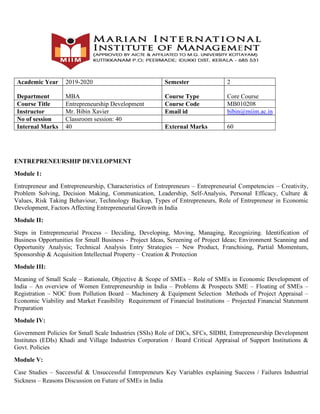
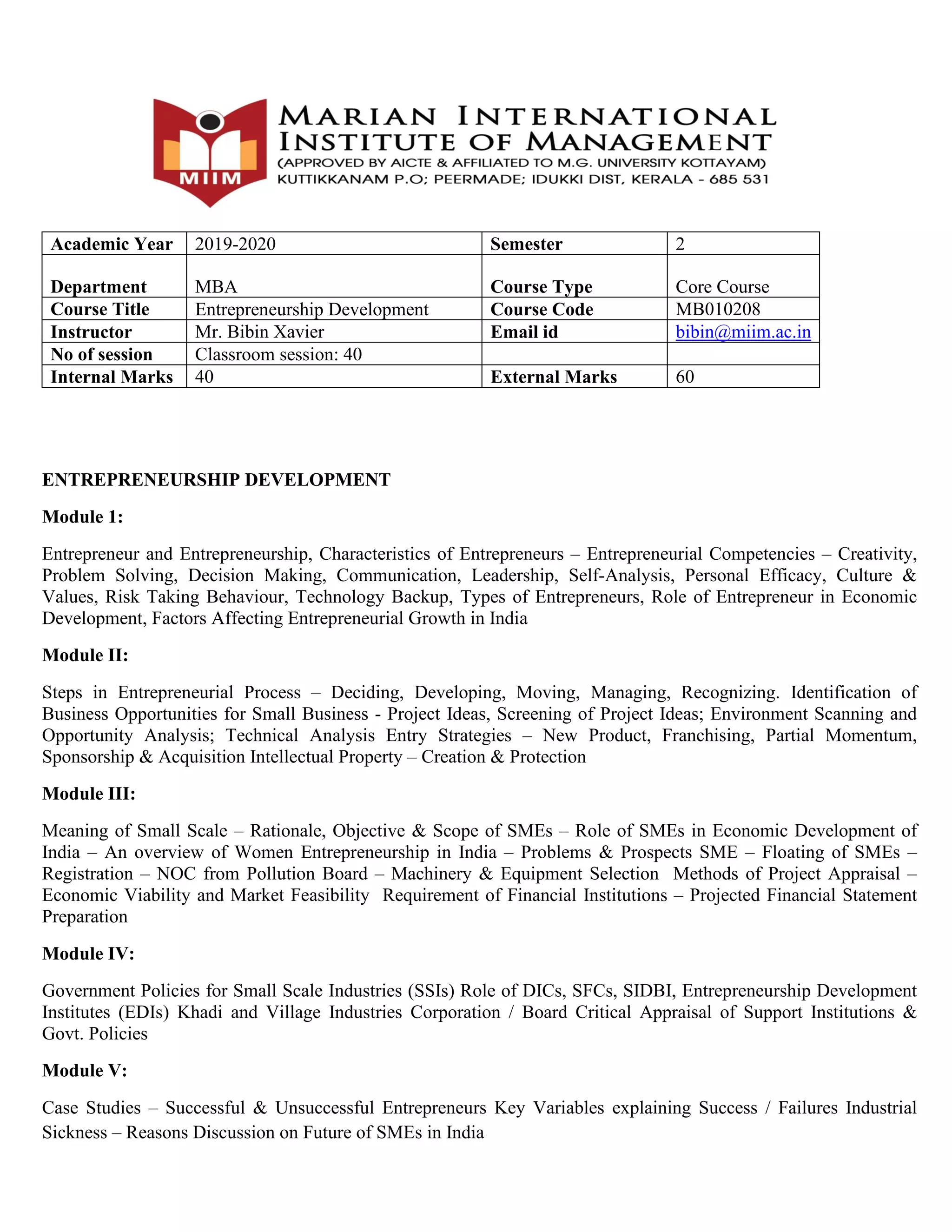

Academic Year 2019-2020 Semester 2
Department MBA Course Type Core Course
Course Title Entrepreneurship Development Course Code MB010208
Instructor Mr. Bibin Xavier Email id bibin@miim.ac.in
No of session Classroom session: 40
Internal Marks 40 External Marks 60
ENTREPRENEURSHIP DEVELOPMENT
Module 1:
Entrepreneur and Entrepreneurship, Characteristics of Entrepreneurs – Entrepreneurial Competencies – Creativity,
Problem Solving, Decision Making, Communication, Leadership, Self-Analysis, Personal Efficacy, Culture &
Values, Risk Taking Behaviour, Technology Backup, Types of Entrepreneurs, Role of Entrepreneur in Economic
Development, Factors Affecting Entrepreneurial Growth in India
Module II:
Steps in Entrepreneurial Process – Deciding, Developing, Moving, Managing, Recognizing. Identification of
Business Opportunities for Small Business - Project Ideas, Screening of Project Ideas; Environment Scanning and
Opportunity Analysis; Technical Analysis Entry Strategies – New Product, Franchising, Partial Momentum,
Sponsorship & Acquisition Intellectual Property – Creation & Protection
Module III:
Meaning of Small Scale – Rationale, Objective & Scope of SMEs – Role of SMEs in Economic Development of
India – An overview of Women Entrepreneurship in India – Problems & Prospects SME – Floating of SMEs –
Registration – NOC from Pollution Board – Machinery & Equipment Selection Methods of Project Appraisal –
Economic Viability and Market Feasibility Requirement of Financial Institutions – Projected Financial Statement
Preparation
Module IV:
Government Policies for Small Scale Industries (SSIs) Role of DICs, SFCs, SIDBI, Entrepreneurship Development
Institutes (EDIs) Khadi and Village Industries Corporation / Board Critical Appraisal of Support Institutions &
Govt. Policies
Module V:
Case Studies – Successful & Unsuccessful Entrepreneurs Key Variables explaining Success / Failures Industrial
Sickness – Reasons Discussion on Future of SMEs in India
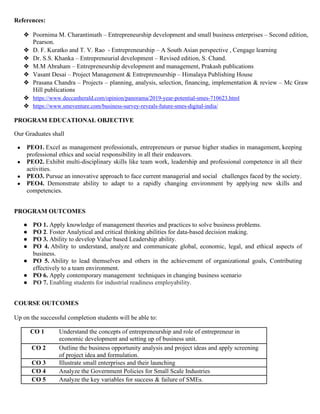
References:
❖ Poornima M. Charantimath – Entrepreneurship development and small business enterprises – Second edition,
Pearson.
❖ D. F. Kuratko and T. V. Rao - Entrepreneurship – A South Asian perspective , Cengage learning
❖ Dr. S.S. Khanka – Entrepreneurial development – Revised edition, S. Chand.
❖ M.M Abraham – Entrepreneurship development and management, Prakash publications
❖ Vasant Desai – Project Management & Entrepreneurship – Himalaya Publishing House
❖ Prasana Chandra – Projects – planning, analysis, selection, financing, implementation & review – Mc Graw
Hill publications
❖ https://www.deccanherald.com/opinion/panorama/2019-year-potential-smes-710623.html
❖ https://www.smeventure.com/business-survey-reveals-future-smes-digital-india/
PROGRAM EDUCATIONAL OBJECTIVE
Our Graduates shall
● PEO1. Excel as management professionals, entrepreneurs or pursue higher studies in management, keeping
professional ethics and social responsibility in all their endeavors.
● PEO2. Exhibit multi-disciplinary skills like team work, leadership and professional competence in all their
activities.
● PEO3. Pursue an innovative approach to face current managerial and social challenges faced by the society.
● PEO4. Demonstrate ability to adapt to a rapidly changing environment by applying new skills and
competencies.
PROGRAM OUTCOMES
● PO 1. Apply knowledge of management theories and practices to solve business problems.
● PO 2. Foster Analytical and critical thinking abilities for data-based decision making.
● PO 3. Ability to develop Value based Leadership ability.
● PO 4. Ability to understand, analyze and communicate global, economic, legal, and ethical aspects of
business.
● PO 5. Ability to lead themselves and others in the achievement of organizational goals, Contributing
effectively to a team environment.
● PO 6. Apply contemporary management techniques in changing business scenario
● PO 7. Enabling students for industrial readiness employability.
COURSE OUTCOMES
Up on the successful completion students will be able to:
CO 1 Understand the concepts of entrepreneurship and role of entrepreneur in
economic development and setting up of business unit.
CO 2 Outline the business opportunity analysis and project ideas and apply screening
of project idea and formulation.
CO 3 Illustrate small enterprises and their launching
CO 4 Analyze the Government Policies for Small Scale Industries
CO 5 Analyze the key variables for success & failure of SMEs.
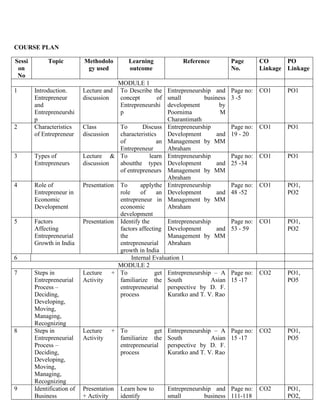
COURSE PLAN
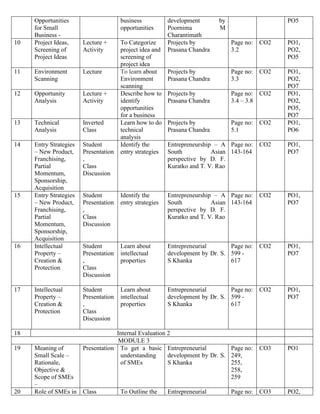
Sessi
on
No
Topic Methodolo
gy used
Learning
outcome
Reference Page
No.
CO
Linkage
PO
Linkage
MODULE 1
1 Introduction.
Entrepreneur
and
Entrepreneurshi
p
Lecture and
discussion
To Describe the
concept of
Entrepreneurshi
p
Entrepreneurship and
small business
development by
Poornima M
Charantimath
Page no:
3 -5
CO1 PO1
2 Characteristics
of Entrepreneur
Class
discussion
To Discuss
characteristics
of an
Entrepreneur
Entrepreneurship
Development and
Management by MM
Abraham
Page no:
19 - 20
CO1 PO1
3 Types of
Entrepreneurs
Lecture &
discussion
To learn
aboutthe types
of entrepreneurs
Entrepreneurship
Development and
Management by MM
Abraham
Page no:
25 -34
CO1 PO1
4 Role of
Entrepreneur in
Economic
Development
Presentation To applythe
role of an
entrepreneur in
economic
development
Entrepreneurship
Development and
Management by MM
Abraham
Page no:
48 -52
CO1 PO1,
PO2
5 Factors
Affecting
Entrepreneurial
Growth in India
Presentation Identify the
factors affecting
the
entrepreneurial
growth in India
Entrepreneurship
Development and
Management by MM
Abraham
Page no:
53 - 59
CO1 PO1,
PO2
6 Internal Evaluation 1
MODULE 2
7 Steps in
Entrepreneurial
Process –
Deciding,
Developing,
Moving,
Managing,
Recognizing
Lecture +
Activity
To get
familiarize the
entrepreneurial
process
Entrepreneurship – A
South Asian
perspective by D. F.
Kuratko and T. V. Rao
Page no:
15 -17
CO2 PO1,
PO5
8 Steps in
Entrepreneurial
Process –
Deciding,
Developing,
Moving,
Managing,
Recognizing
Lecture +
Activity
To get
familiarize the
entrepreneurial
process
Entrepreneurship – A
South Asian
perspective by D. F.
Kuratko and T. V. Rao
Page no:
15 -17
CO2 PO1,
PO5
9 Identification of
Business
Presentation
+ Activity
Learn how to
identify
Entrepreneurship and
small business
Page no:
111-118
CO2 PO1,
PO2,
Opportunities
for Small
Business -
business
opportunities
development by
Poornima M
Charantimath
PO5
10 Project Ideas,
Screening of
Project Ideas
Lecture +
Activity
To Categorize
project idea and
screening of
project idea
Projects by
Prasana Chandra
Page no:
3.2
CO2 PO1,
PO2,
PO5
11 Environment
Scanning
Lecture To learn about
Environment
scanning
Projects by
Prasana Chandra
Page no:
3.3
CO2 PO1,
PO2,
PO7
12 Opportunity
Analysis
Lecture +
Activity
Describe how to
identify
opportunities
for a business
Projects by
Prasana Chandra
Page no:
3.4 – 3.8
CO2 PO1,
PO2,
PO5,
PO7
13 Technical
Analysis
Inverted
Class
Learn how to do
technical
analysis
Projects by
Prasana Chandra
Page no:
5.1
CO2 PO1,
PO6
14 Entry Strategies
– New Product,
Franchising,
Partial
Momentum,
Sponsorship,
Acquisition
Student
Presentation
,
Class
Discussion
Identify the
entry strategies
Entrepreneurship – A
South Asian
perspective by D. F.
Kuratko and T. V. Rao
Page no:
143-164
CO2 PO1,
PO7
15 Entry Strategies
– New Product,
Franchising,
Partial
Momentum,
Sponsorship,
Acquisition
Student
Presentation
,
Class
Discussion
Identify the
entry strategies
Entrepreneurship – A
South Asian
perspective by D. F.
Kuratko and T. V. Rao
Page no:
143-164
CO2 PO1,
PO7
16 Intellectual
Property –
Creation &
Protection
Student
Presentation
,
Class
Discussion
Learn about
intellectual
properties
Entrepreneurial
development by Dr. S.
S Khanka
Page no:
599 -
617
CO2 PO1,
PO7
17 Intellectual
Property –
Creation &
Protection
Student
Presentation
,
Class
Discussion
Learn about
intellectual
properties
Entrepreneurial
development by Dr. S.
S Khanka
Page no:
599 -
617
CO2 PO1,
PO7
18 Internal Evaluation 2
MODULE 3
19 Meaning of
Small Scale –
Rationale,
Objective &
Scope of SMEs
–
Presentation To get a basic
understanding
of SMEs
Entrepreneurial
development by Dr. S.
S Khanka
Page no:
249,
255,
258,
259
CO3 PO1
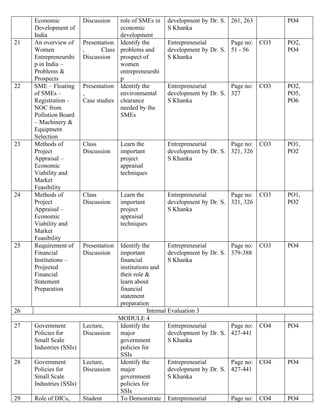
20 Role of SMEs in Class To Outline the Entrepreneurial Page no: CO3 PO2,
Economic
Development of
India
Discussion role of SMEs in
economic
development
development by Dr. S.
S Khanka
261, 263 PO4
21 An overview of
Women
Entrepreneurshi
p in India –
Problems &
Prospects
Presentation
, Class
Discussion
Identify the
problems and
prospect of
women
entrepreneurshi
p
Entrepreneurial
development by Dr. S.
S Khanka
Page no:
51 - 56
CO3 PO2,
PO4
22 SME – Floating
of SMEs –
Registration –
NOC from
Pollution Board
– Machinery &
Equipment
Selection
Presentation
,
Case studies
Identify the
environmental
clearance
needed by the
SMEs
Entrepreneurial
development by Dr. S.
S Khanka
Page no:
327
CO3 PO2,
PO5,
PO6
23 Methods of
Project
Appraisal –
Economic
Viability and
Market
Feasibility
Class
Discussion
Learn the
important
project
appraisal
techniques
Entrepreneurial
development by Dr. S.
S Khanka
Page no:
321, 326
CO3 PO1,
PO2
24 Methods of
Project
Appraisal –
Economic
Viability and
Market
Feasibility
Class
Discussion
Learn the
important
project
appraisal
techniques
Entrepreneurial
development by Dr. S.
S Khanka
Page no:
321, 326
CO3 PO1,
PO2
25 Requirement of
Financial
Institutions –
Projected
Financial
Statement
Preparation
Presentation
Discussion
Identify the
important
financial
institutions and
their role &
learn about
financial
statement
preparation
Entrepreneurial
development by Dr. S.
S Khanka
Page no:
379-388
CO3 PO4
26 Internal Evaluation 3
MODULE 4
27 Government
Policies for
Small Scale
Industries (SSIs)
Lecture,
Discussion
Identify the
major
government
policies for
SSIs
Entrepreneurial
development by Dr. S.
S Khanka
Page no:
427-441
CO4 PO4
28 Government
Policies for
Small Scale
Industries (SSIs)
Lecture,
Discussion
Identify the
major
government
policies for
SSIs
Entrepreneurial
development by Dr. S.
S Khanka
Page no:
427-441
CO4 PO4
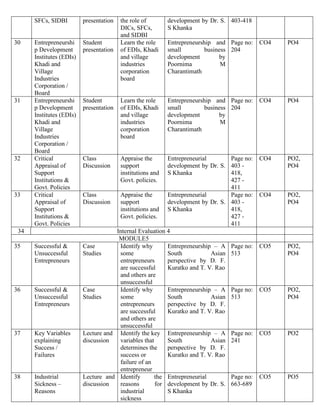
29 Role of DICs, Student To Demonstrate Entrepreneurial Page no: CO4 PO4
SFCs, SIDBI presentation the role of
DICs, SFCs,
and SIDBI
development by Dr. S.
S Khanka
403-418
30 Entrepreneurshi
p Development
Institutes (EDIs)
Khadi and
Village
Industries
Corporation /
Board
Student
presentation
Learn the role
of EDIs, Khadi
and village
industries
corporation
board
Entrepreneurship and
small business
development by
Poornima M
Charantimath
Page no:
204
CO4 PO4
31 Entrepreneurshi
p Development
Institutes (EDIs)
Khadi and
Village
Industries
Corporation /
Board
Student
presentation
Learn the role
of EDIs, Khadi
and village
industries
corporation
board
Entrepreneurship and
small business
development by
Poornima M
Charantimath
Page no:
204
CO4 PO4
32 Critical
Appraisal of
Support
Institutions &
Govt. Policies
Class
Discussion
Appraise the
support
institutions and
Govt. policies.
Entrepreneurial
development by Dr. S.
S Khanka
Page no:
403 -
418,
427 -
411
CO4 PO2,
PO4
33 Critical
Appraisal of
Support
Institutions &
Govt. Policies
Class
Discussion
Appraise the
support
institutions and
Govt. policies.
Entrepreneurial
development by Dr. S.
S Khanka
Page no:
403 -
418,
427 -
411
CO4 PO2,
PO4
34 Internal Evaluation 4
MODULE5
35 Successful &
Unsuccessful
Entrepreneurs
Case
Studies
Identify why
some
entrepreneurs
are successful
and others are
unsuccessful
Entrepreneurship – A
South Asian
perspective by D. F.
Kuratko and T. V. Rao
Page no:
513
CO5 PO2,
PO4
36 Successful &
Unsuccessful
Entrepreneurs
Case
Studies
Identify why
some
entrepreneurs
are successful
and others are
unsuccessful
Entrepreneurship – A
South Asian
perspective by D. F.
Kuratko and T. V. Rao
Page no:
513
CO5 PO2,
PO4
37 Key Variables
explaining
Success /
Failures
Lecture and
discussion
Identify the key
variables that
determines the
success or
failure of an
entrepreneur
Entrepreneurship – A
South Asian
perspective by D. F.
Kuratko and T. V. Rao
Page no:
241
CO5 PO2
38 Industrial
Sickness –
Reasons
Lecture and
discussion
Identify the
reasons for
industrial
sickness
Entrepreneurial
development by Dr. S.
S Khanka
Page no:
663-689
CO5 PO5
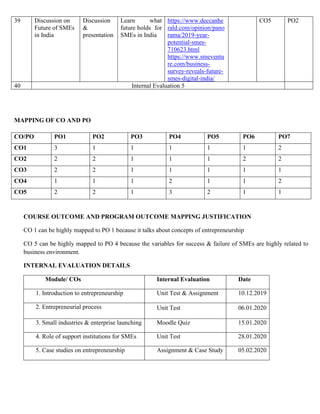
39 Discussion on
Future of SMEs
in India
Discussion
&
presentation
Learn what
future holds for
SMEs in India
https://www.deccanhe
rald.com/opinion/pano
rama/2019-year-
potential-smes-
710623.html
https://www.smeventu
re.com/business-
survey-reveals-future-
smes-digital-india/
CO5 PO2
40 Internal Evaluation 5
MAPPING OF CO AND PO
CO/PO PO1 PO2 PO3 PO4 PO5 PO6 PO7
CO1 3 1 1 1 1 1 2
CO2 2 2 1 1 1 2 2
CO3 2 2 1 1 1 1 1
CO4 1 1 1 2 1 1 2
CO5 2 2 1 3 2 1 1
COURSE OUTCOME AND PROGRAM OUTCOME MAPPING JUSTIFICATION
CO 1 can be highly mapped to PO 1 because it talks about concepts of entrepreneurship
CO 5 can be highly mapped to PO 4 because the variables for success & failure of SMEs are highly related to
business environment.
INTERNAL EVALUATION DETAILS
Module/ COs Internal Evaluation Date
1. Introduction to entrepreneurship Unit Test & Assignment 10.12.2019
2. Entrepreneurial process Unit Test 06.01.2020
3. Small industries & enterprise launching Moodle Quiz 15.01.2020
4. Role of support institutions for SMEs Unit Test 28.01.2020
5. Case studies on entrepreneurship Assignment & Case Study 05.02.2020
GAP ANALYSIS
Gap Action to be taken
The students should get real life knowledge on how to
start an SME & manage it.
Students have to conduct an interview with an
entrepreneur near to his/her home and present the
information in the class.
Latest trends & how to start an online business are not
covered in the syllabus
An expert talk from the industry can be arranged.

Ed bx-20-21

  • 1.
    Academic Year 2019-2020Semester 2 Department MBA Course Type Core Course Course Title Entrepreneurship Development Course Code MB010208 Instructor Mr. Bibin Xavier Email id bibin@miim.ac.in No of session Classroom session: 40 Internal Marks 40 External Marks 60 ENTREPRENEURSHIP DEVELOPMENT Module 1: Entrepreneur and Entrepreneurship, Characteristics of Entrepreneurs – Entrepreneurial Competencies – Creativity, Problem Solving, Decision Making, Communication, Leadership, Self-Analysis, Personal Efficacy, Culture & Values, Risk Taking Behaviour, Technology Backup, Types of Entrepreneurs, Role of Entrepreneur in Economic Development, Factors Affecting Entrepreneurial Growth in India Module II: Steps in Entrepreneurial Process – Deciding, Developing, Moving, Managing, Recognizing. Identification of Business Opportunities for Small Business - Project Ideas, Screening of Project Ideas; Environment Scanning and Opportunity Analysis; Technical Analysis Entry Strategies – New Product, Franchising, Partial Momentum, Sponsorship & Acquisition Intellectual Property – Creation & Protection Module III: Meaning of Small Scale – Rationale, Objective & Scope of SMEs – Role of SMEs in Economic Development of India – An overview of Women Entrepreneurship in India – Problems & Prospects SME – Floating of SMEs – Registration – NOC from Pollution Board – Machinery & Equipment Selection Methods of Project Appraisal – Economic Viability and Market Feasibility Requirement of Financial Institutions – Projected Financial Statement Preparation Module IV: Government Policies for Small Scale Industries (SSIs) Role of DICs, SFCs, SIDBI, Entrepreneurship Development Institutes (EDIs) Khadi and Village Industries Corporation / Board Critical Appraisal of Support Institutions & Govt. Policies Module V: Case Studies – Successful & Unsuccessful Entrepreneurs Key Variables explaining Success / Failures Industrial Sickness – Reasons Discussion on Future of SMEs in India
  • 2.
    References: ❖ Poornima M.Charantimath – Entrepreneurship development and small business enterprises – Second edition, Pearson. ❖ D. F. Kuratko and T. V. Rao - Entrepreneurship – A South Asian perspective , Cengage learning ❖ Dr. S.S. Khanka – Entrepreneurial development – Revised edition, S. Chand. ❖ M.M Abraham – Entrepreneurship development and management, Prakash publications ❖ Vasant Desai – Project Management & Entrepreneurship – Himalaya Publishing House ❖ Prasana Chandra – Projects – planning, analysis, selection, financing, implementation & review – Mc Graw Hill publications ❖ https://www.deccanherald.com/opinion/panorama/2019-year-potential-smes-710623.html ❖ https://www.smeventure.com/business-survey-reveals-future-smes-digital-india/ PROGRAM EDUCATIONAL OBJECTIVE Our Graduates shall ● PEO1. Excel as management professionals, entrepreneurs or pursue higher studies in management, keeping professional ethics and social responsibility in all their endeavors. ● PEO2. Exhibit multi-disciplinary skills like team work, leadership and professional competence in all their activities. ● PEO3. Pursue an innovative approach to face current managerial and social challenges faced by the society. ● PEO4. Demonstrate ability to adapt to a rapidly changing environment by applying new skills and competencies. PROGRAM OUTCOMES ● PO 1. Apply knowledge of management theories and practices to solve business problems. ● PO 2. Foster Analytical and critical thinking abilities for data-based decision making. ● PO 3. Ability to develop Value based Leadership ability. ● PO 4. Ability to understand, analyze and communicate global, economic, legal, and ethical aspects of business. ● PO 5. Ability to lead themselves and others in the achievement of organizational goals, Contributing effectively to a team environment. ● PO 6. Apply contemporary management techniques in changing business scenario ● PO 7. Enabling students for industrial readiness employability. COURSE OUTCOMES Up on the successful completion students will be able to: CO 1 Understand the concepts of entrepreneurship and role of entrepreneur in economic development and setting up of business unit. CO 2 Outline the business opportunity analysis and project ideas and apply screening of project idea and formulation. CO 3 Illustrate small enterprises and their launching CO 4 Analyze the Government Policies for Small Scale Industries CO 5 Analyze the key variables for success & failure of SMEs.
  • 3.
    COURSE PLAN Sessi on No Topic Methodolo gyused Learning outcome Reference Page No. CO Linkage PO Linkage MODULE 1 1 Introduction. Entrepreneur and Entrepreneurshi p Lecture and discussion To Describe the concept of Entrepreneurshi p Entrepreneurship and small business development by Poornima M Charantimath Page no: 3 -5 CO1 PO1 2 Characteristics of Entrepreneur Class discussion To Discuss characteristics of an Entrepreneur Entrepreneurship Development and Management by MM Abraham Page no: 19 - 20 CO1 PO1 3 Types of Entrepreneurs Lecture & discussion To learn aboutthe types of entrepreneurs Entrepreneurship Development and Management by MM Abraham Page no: 25 -34 CO1 PO1 4 Role of Entrepreneur in Economic Development Presentation To applythe role of an entrepreneur in economic development Entrepreneurship Development and Management by MM Abraham Page no: 48 -52 CO1 PO1, PO2 5 Factors Affecting Entrepreneurial Growth in India Presentation Identify the factors affecting the entrepreneurial growth in India Entrepreneurship Development and Management by MM Abraham Page no: 53 - 59 CO1 PO1, PO2 6 Internal Evaluation 1 MODULE 2 7 Steps in Entrepreneurial Process – Deciding, Developing, Moving, Managing, Recognizing Lecture + Activity To get familiarize the entrepreneurial process Entrepreneurship – A South Asian perspective by D. F. Kuratko and T. V. Rao Page no: 15 -17 CO2 PO1, PO5 8 Steps in Entrepreneurial Process – Deciding, Developing, Moving, Managing, Recognizing Lecture + Activity To get familiarize the entrepreneurial process Entrepreneurship – A South Asian perspective by D. F. Kuratko and T. V. Rao Page no: 15 -17 CO2 PO1, PO5 9 Identification of Business Presentation + Activity Learn how to identify Entrepreneurship and small business Page no: 111-118 CO2 PO1, PO2,
  • 4.
    Opportunities for Small Business - business opportunities developmentby Poornima M Charantimath PO5 10 Project Ideas, Screening of Project Ideas Lecture + Activity To Categorize project idea and screening of project idea Projects by Prasana Chandra Page no: 3.2 CO2 PO1, PO2, PO5 11 Environment Scanning Lecture To learn about Environment scanning Projects by Prasana Chandra Page no: 3.3 CO2 PO1, PO2, PO7 12 Opportunity Analysis Lecture + Activity Describe how to identify opportunities for a business Projects by Prasana Chandra Page no: 3.4 – 3.8 CO2 PO1, PO2, PO5, PO7 13 Technical Analysis Inverted Class Learn how to do technical analysis Projects by Prasana Chandra Page no: 5.1 CO2 PO1, PO6 14 Entry Strategies – New Product, Franchising, Partial Momentum, Sponsorship, Acquisition Student Presentation , Class Discussion Identify the entry strategies Entrepreneurship – A South Asian perspective by D. F. Kuratko and T. V. Rao Page no: 143-164 CO2 PO1, PO7 15 Entry Strategies – New Product, Franchising, Partial Momentum, Sponsorship, Acquisition Student Presentation , Class Discussion Identify the entry strategies Entrepreneurship – A South Asian perspective by D. F. Kuratko and T. V. Rao Page no: 143-164 CO2 PO1, PO7 16 Intellectual Property – Creation & Protection Student Presentation , Class Discussion Learn about intellectual properties Entrepreneurial development by Dr. S. S Khanka Page no: 599 - 617 CO2 PO1, PO7 17 Intellectual Property – Creation & Protection Student Presentation , Class Discussion Learn about intellectual properties Entrepreneurial development by Dr. S. S Khanka Page no: 599 - 617 CO2 PO1, PO7 18 Internal Evaluation 2 MODULE 3 19 Meaning of Small Scale – Rationale, Objective & Scope of SMEs – Presentation To get a basic understanding of SMEs Entrepreneurial development by Dr. S. S Khanka Page no: 249, 255, 258, 259 CO3 PO1 20 Role of SMEs in Class To Outline the Entrepreneurial Page no: CO3 PO2,
  • 5.
    Economic Development of India Discussion roleof SMEs in economic development development by Dr. S. S Khanka 261, 263 PO4 21 An overview of Women Entrepreneurshi p in India – Problems & Prospects Presentation , Class Discussion Identify the problems and prospect of women entrepreneurshi p Entrepreneurial development by Dr. S. S Khanka Page no: 51 - 56 CO3 PO2, PO4 22 SME – Floating of SMEs – Registration – NOC from Pollution Board – Machinery & Equipment Selection Presentation , Case studies Identify the environmental clearance needed by the SMEs Entrepreneurial development by Dr. S. S Khanka Page no: 327 CO3 PO2, PO5, PO6 23 Methods of Project Appraisal – Economic Viability and Market Feasibility Class Discussion Learn the important project appraisal techniques Entrepreneurial development by Dr. S. S Khanka Page no: 321, 326 CO3 PO1, PO2 24 Methods of Project Appraisal – Economic Viability and Market Feasibility Class Discussion Learn the important project appraisal techniques Entrepreneurial development by Dr. S. S Khanka Page no: 321, 326 CO3 PO1, PO2 25 Requirement of Financial Institutions – Projected Financial Statement Preparation Presentation Discussion Identify the important financial institutions and their role & learn about financial statement preparation Entrepreneurial development by Dr. S. S Khanka Page no: 379-388 CO3 PO4 26 Internal Evaluation 3 MODULE 4 27 Government Policies for Small Scale Industries (SSIs) Lecture, Discussion Identify the major government policies for SSIs Entrepreneurial development by Dr. S. S Khanka Page no: 427-441 CO4 PO4 28 Government Policies for Small Scale Industries (SSIs) Lecture, Discussion Identify the major government policies for SSIs Entrepreneurial development by Dr. S. S Khanka Page no: 427-441 CO4 PO4 29 Role of DICs, Student To Demonstrate Entrepreneurial Page no: CO4 PO4
  • 6.
    SFCs, SIDBI presentationthe role of DICs, SFCs, and SIDBI development by Dr. S. S Khanka 403-418 30 Entrepreneurshi p Development Institutes (EDIs) Khadi and Village Industries Corporation / Board Student presentation Learn the role of EDIs, Khadi and village industries corporation board Entrepreneurship and small business development by Poornima M Charantimath Page no: 204 CO4 PO4 31 Entrepreneurshi p Development Institutes (EDIs) Khadi and Village Industries Corporation / Board Student presentation Learn the role of EDIs, Khadi and village industries corporation board Entrepreneurship and small business development by Poornima M Charantimath Page no: 204 CO4 PO4 32 Critical Appraisal of Support Institutions & Govt. Policies Class Discussion Appraise the support institutions and Govt. policies. Entrepreneurial development by Dr. S. S Khanka Page no: 403 - 418, 427 - 411 CO4 PO2, PO4 33 Critical Appraisal of Support Institutions & Govt. Policies Class Discussion Appraise the support institutions and Govt. policies. Entrepreneurial development by Dr. S. S Khanka Page no: 403 - 418, 427 - 411 CO4 PO2, PO4 34 Internal Evaluation 4 MODULE5 35 Successful & Unsuccessful Entrepreneurs Case Studies Identify why some entrepreneurs are successful and others are unsuccessful Entrepreneurship – A South Asian perspective by D. F. Kuratko and T. V. Rao Page no: 513 CO5 PO2, PO4 36 Successful & Unsuccessful Entrepreneurs Case Studies Identify why some entrepreneurs are successful and others are unsuccessful Entrepreneurship – A South Asian perspective by D. F. Kuratko and T. V. Rao Page no: 513 CO5 PO2, PO4 37 Key Variables explaining Success / Failures Lecture and discussion Identify the key variables that determines the success or failure of an entrepreneur Entrepreneurship – A South Asian perspective by D. F. Kuratko and T. V. Rao Page no: 241 CO5 PO2 38 Industrial Sickness – Reasons Lecture and discussion Identify the reasons for industrial sickness Entrepreneurial development by Dr. S. S Khanka Page no: 663-689 CO5 PO5
  • 7.
    39 Discussion on Futureof SMEs in India Discussion & presentation Learn what future holds for SMEs in India https://www.deccanhe rald.com/opinion/pano rama/2019-year- potential-smes- 710623.html https://www.smeventu re.com/business- survey-reveals-future- smes-digital-india/ CO5 PO2 40 Internal Evaluation 5 MAPPING OF CO AND PO CO/PO PO1 PO2 PO3 PO4 PO5 PO6 PO7 CO1 3 1 1 1 1 1 2 CO2 2 2 1 1 1 2 2 CO3 2 2 1 1 1 1 1 CO4 1 1 1 2 1 1 2 CO5 2 2 1 3 2 1 1 COURSE OUTCOME AND PROGRAM OUTCOME MAPPING JUSTIFICATION CO 1 can be highly mapped to PO 1 because it talks about concepts of entrepreneurship CO 5 can be highly mapped to PO 4 because the variables for success & failure of SMEs are highly related to business environment. INTERNAL EVALUATION DETAILS Module/ COs Internal Evaluation Date 1. Introduction to entrepreneurship Unit Test & Assignment 10.12.2019 2. Entrepreneurial process Unit Test 06.01.2020 3. Small industries & enterprise launching Moodle Quiz 15.01.2020 4. Role of support institutions for SMEs Unit Test 28.01.2020 5. Case studies on entrepreneurship Assignment & Case Study 05.02.2020
  • 8.
    GAP ANALYSIS Gap Actionto be taken The students should get real life knowledge on how to start an SME & manage it. Students have to conduct an interview with an entrepreneur near to his/her home and present the information in the class. Latest trends & how to start an online business are not covered in the syllabus An expert talk from the industry can be arranged.