08-Dec-22
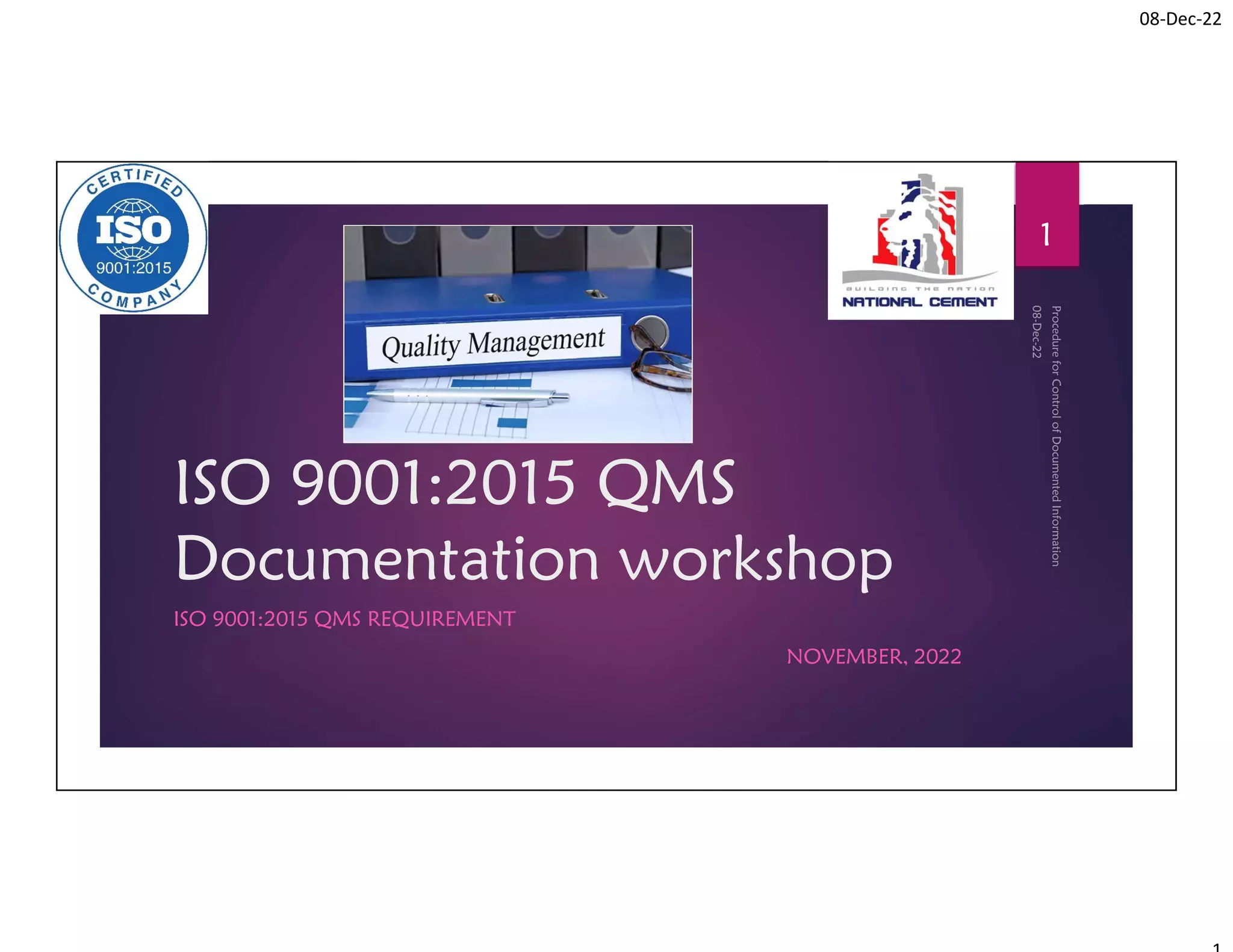
ISO 9001:2015 QMS
Documentation workshop
ISO 9001:2015 QMS REQUIREMENT
NOVEMBER, 2022
1
08-Dec-22
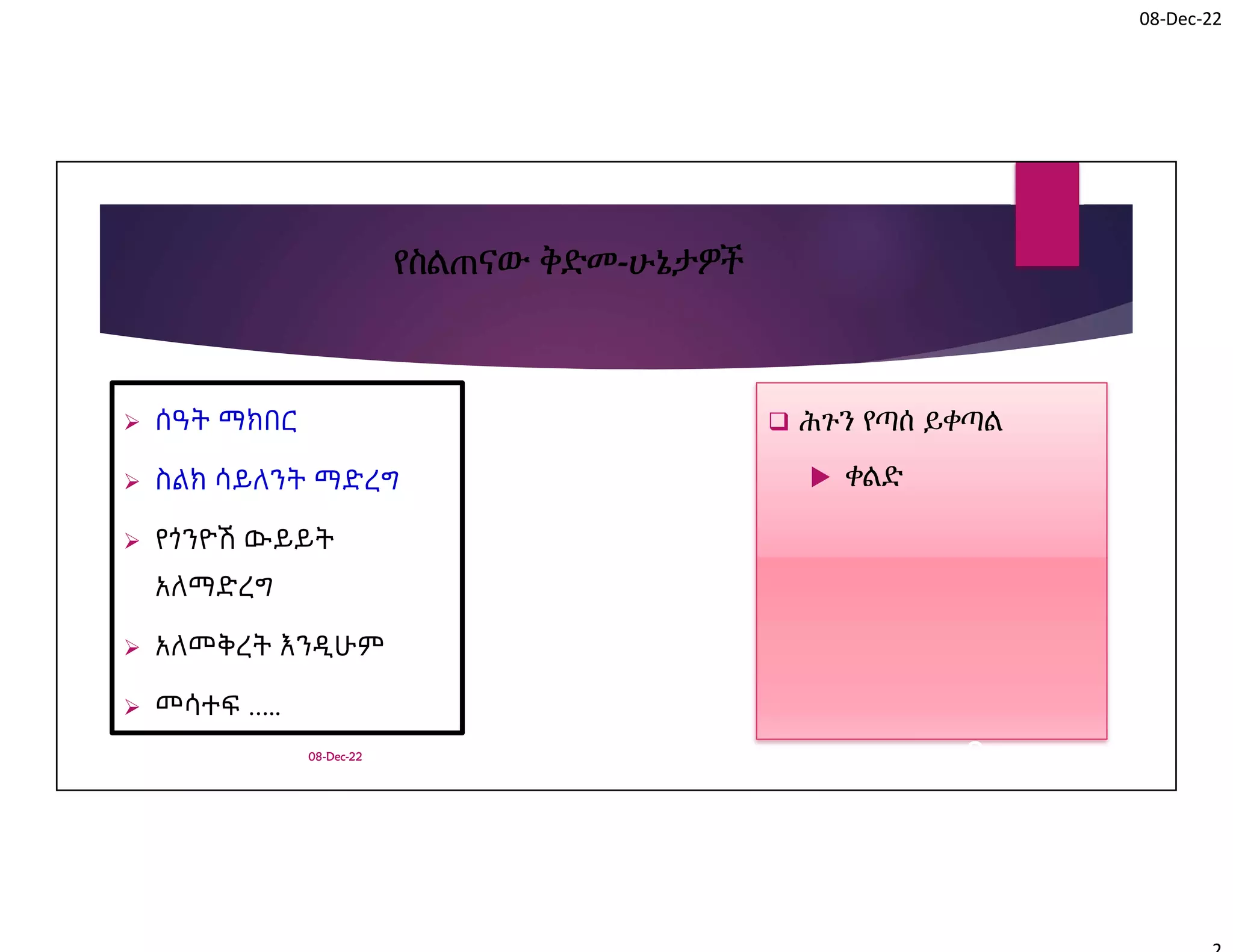
 ሰዓት ማክበር
 ስልክ ሳይለንት ማድረግ
 የጎንዮሽ ውይይት
አለማድረግ
 አለመቅረት እንዲሁም
 መሳተፍ …..
 ሕጉን የጣሰ ይቀጣል
 ቀልድ
2
08-Dec-22
የስልጠናው ቅድመ-ሁኔታዎች
08-Dec-22
Workshop participant
 Top management
 Process owner/Department Managers
 Internal auditors
08-Dec-22
Procedure for Control of Documented Information
3
08-Dec-22
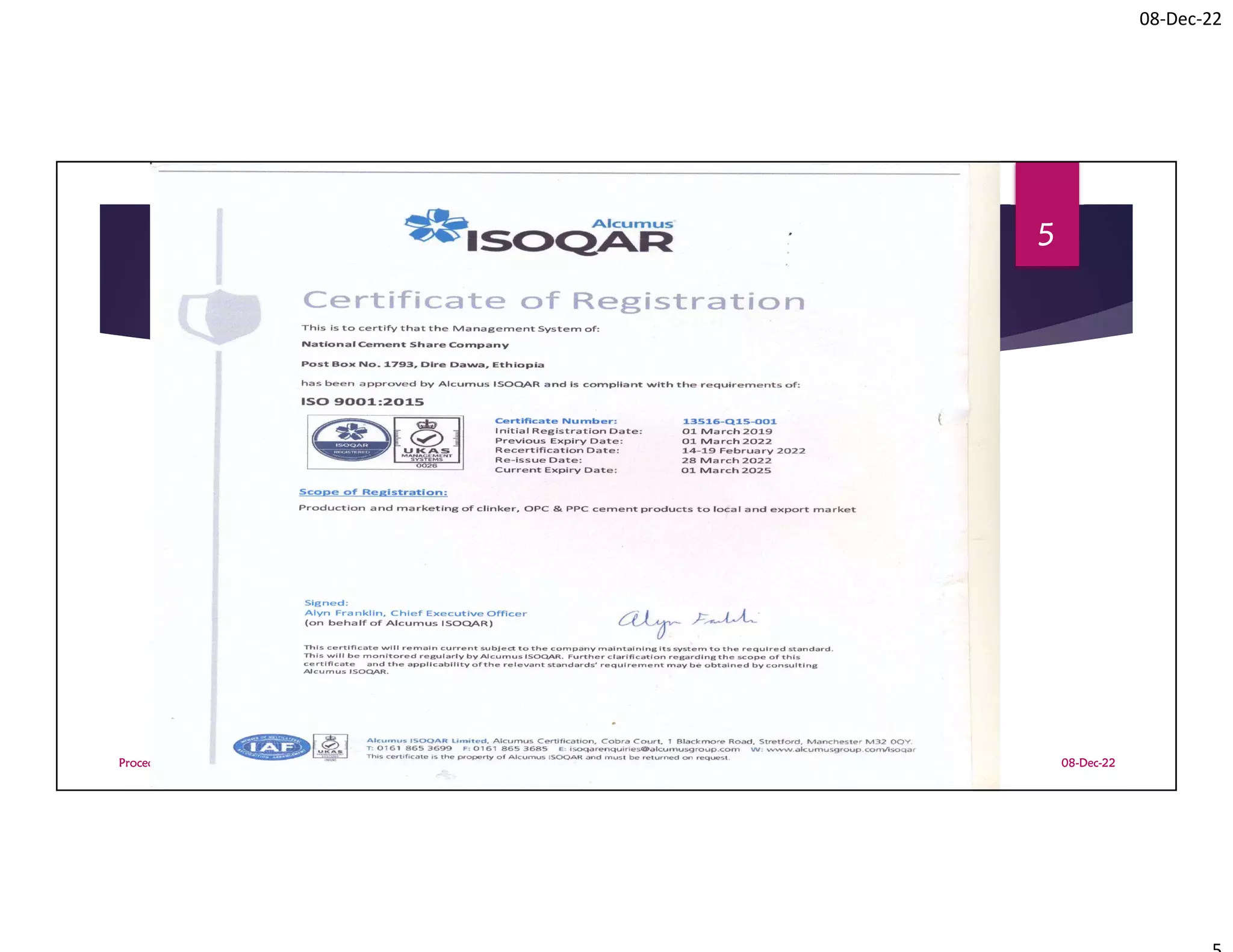
Congratulation on our recertification
of ISO 9001:2015
it is your input has help our success
ISO 9001:2015 RECERTIFICATE DOCUMENT
08-Dec-22
Procedure for Control of Documented Information
4
08-Dec-22
08-Dec-22
Procedure for Control of Documented Information
5
08-Dec-22
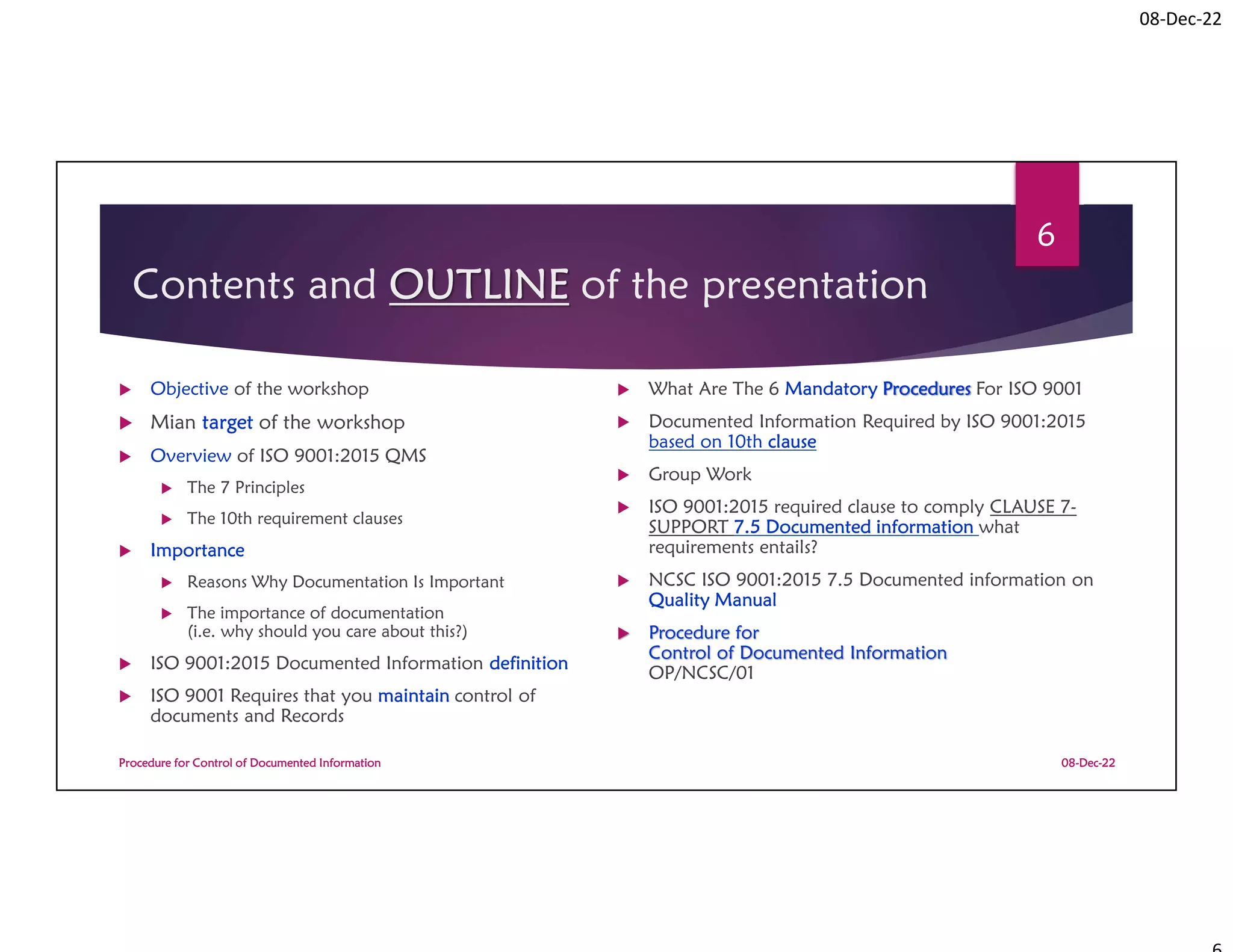
Contents and OUTLINE of the presentation
 Objective of the workshop
 Mian target of the workshop
 Overview of ISO 9001:2015 QMS
 The 7 Principles
 The 10th requirement clauses
 Importance
 Reasons Why Documentation Is Important
 The importance of documentation
(i.e. why should you care about this?)
 ISO 9001:2015 Documented Information definition
 ISO 9001 Requires that you maintain control of
documents and Records
 What Are The 6 Mandatory Procedures For ISO 9001
 Documented Information Required by ISO 9001:2015
based on 10th clause
 Group Work
 ISO 9001:2015 required clause to comply CLAUSE 7-
SUPPORT 7.5 Documented information what
requirements entails?
 NCSC ISO 9001:2015 7.5 Documented information on
Quality Manual
 Procedure for
Control of Documented Information
OP/NCSC/01
08-Dec-22
Procedure for Control of Documented Information
6
08-Dec-22
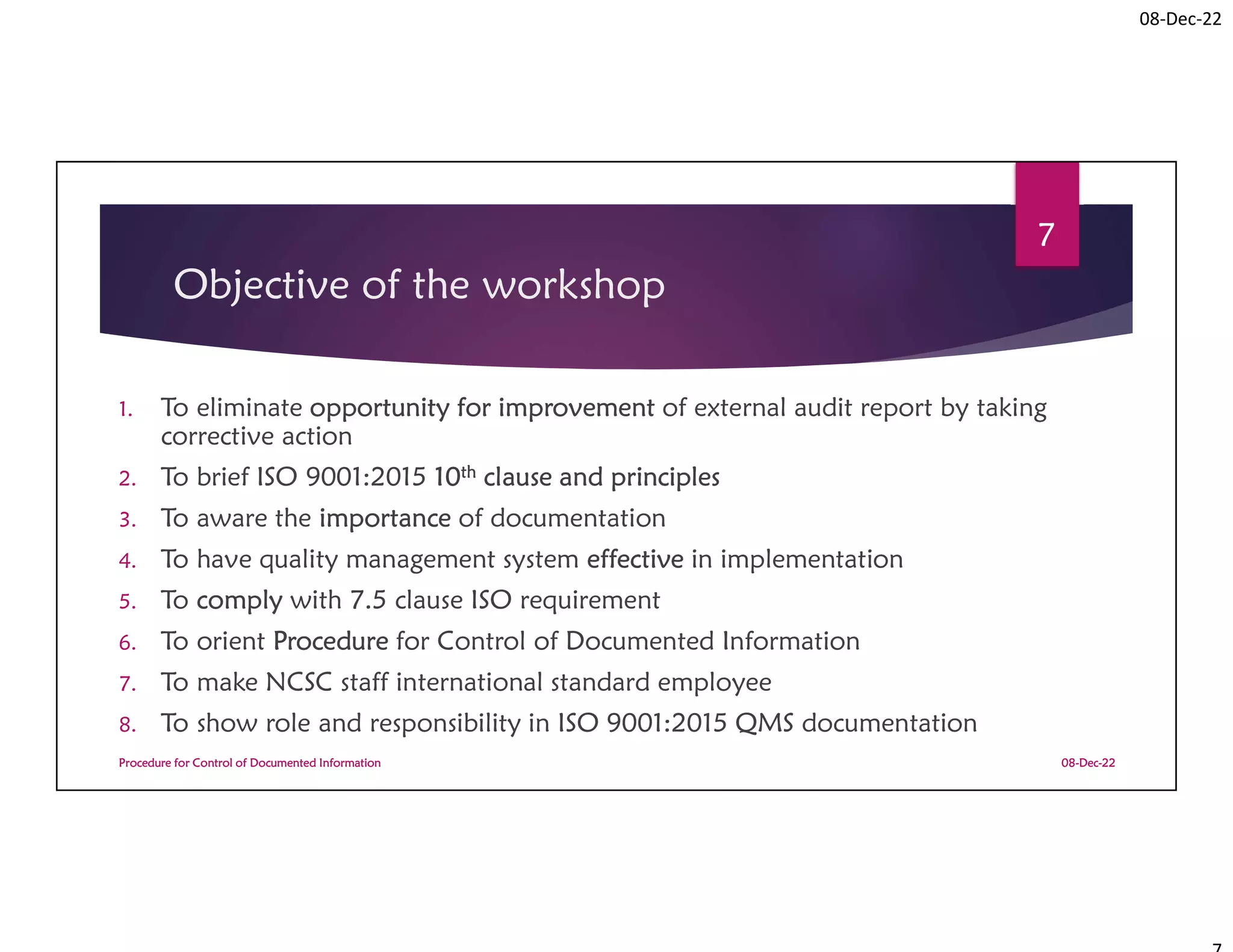
Objective of the workshop
1. To eliminate opportunity for improvement of external audit report by taking
corrective action
2. To brief ISO 9001:2015 10th clause and principles
3. To aware the importance of documentation
4. To have quality management system effective in implementation
5. To comply with 7.5 clause ISO requirement
6. To orient Procedure for Control of Documented Information
7. To make NCSC staff international standard employee
8. To show role and responsibility in ISO 9001:2015 QMS documentation
08-Dec-22
Procedure for Control of Documented Information
7
08-Dec-22
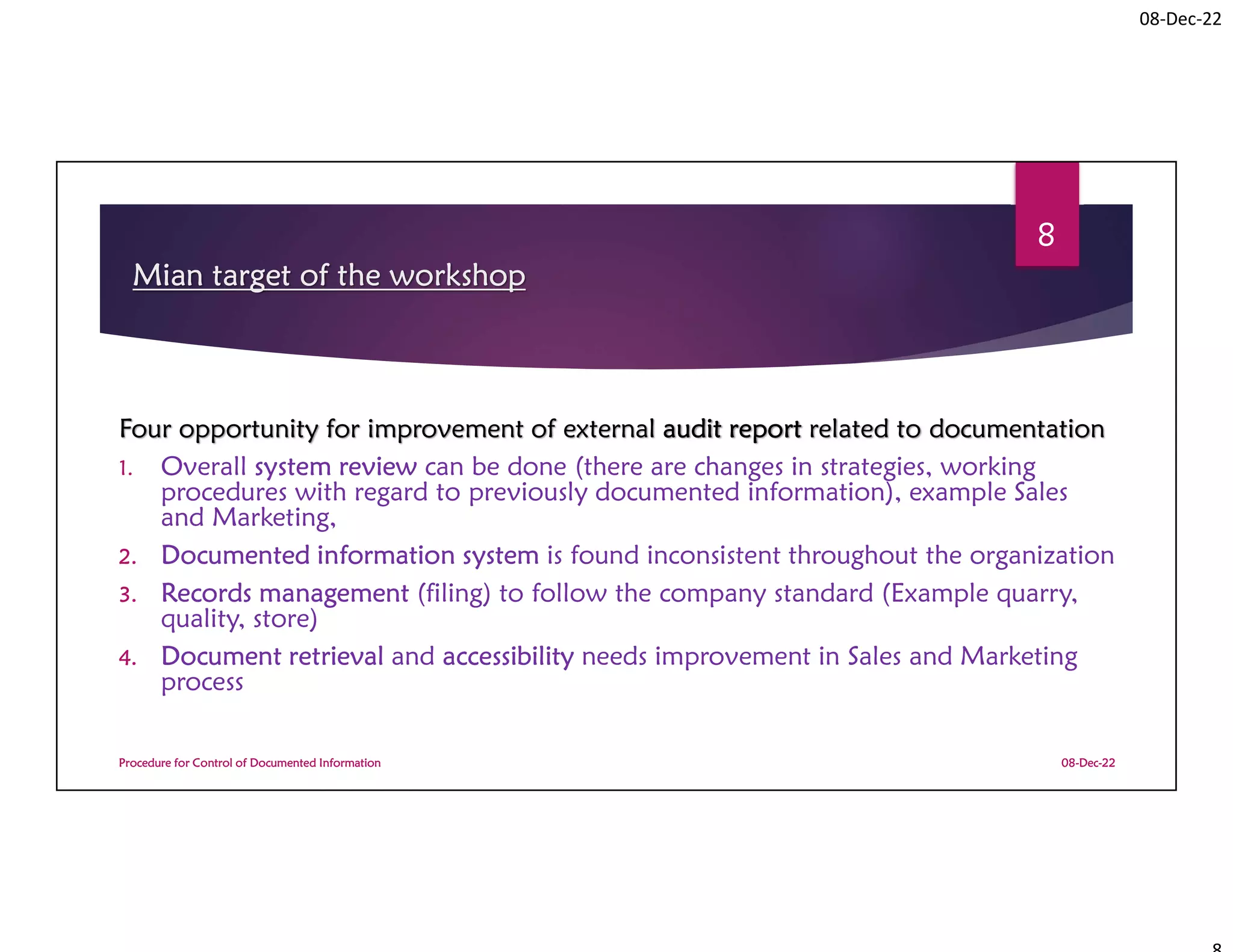
Mian target of the workshop
Four opportunity for improvement of external audit report related to documentation
1. Overall system review can be done (there are changes in strategies, working
procedures with regard to previously documented information), example Sales
and Marketing,
2. Documented information system is found inconsistent throughout the organization
3. Records management (filing) to follow the company standard (Example quarry,
quality, store)
4. Document retrieval and accessibility needs improvement in Sales and Marketing
process
08-Dec-22
Procedure for Control of Documented Information
8
08-Dec-22
All 15
Opportunity for
improvement
status
08-Dec-22
Procedure for Control of Documented Information
9
08-Dec-22
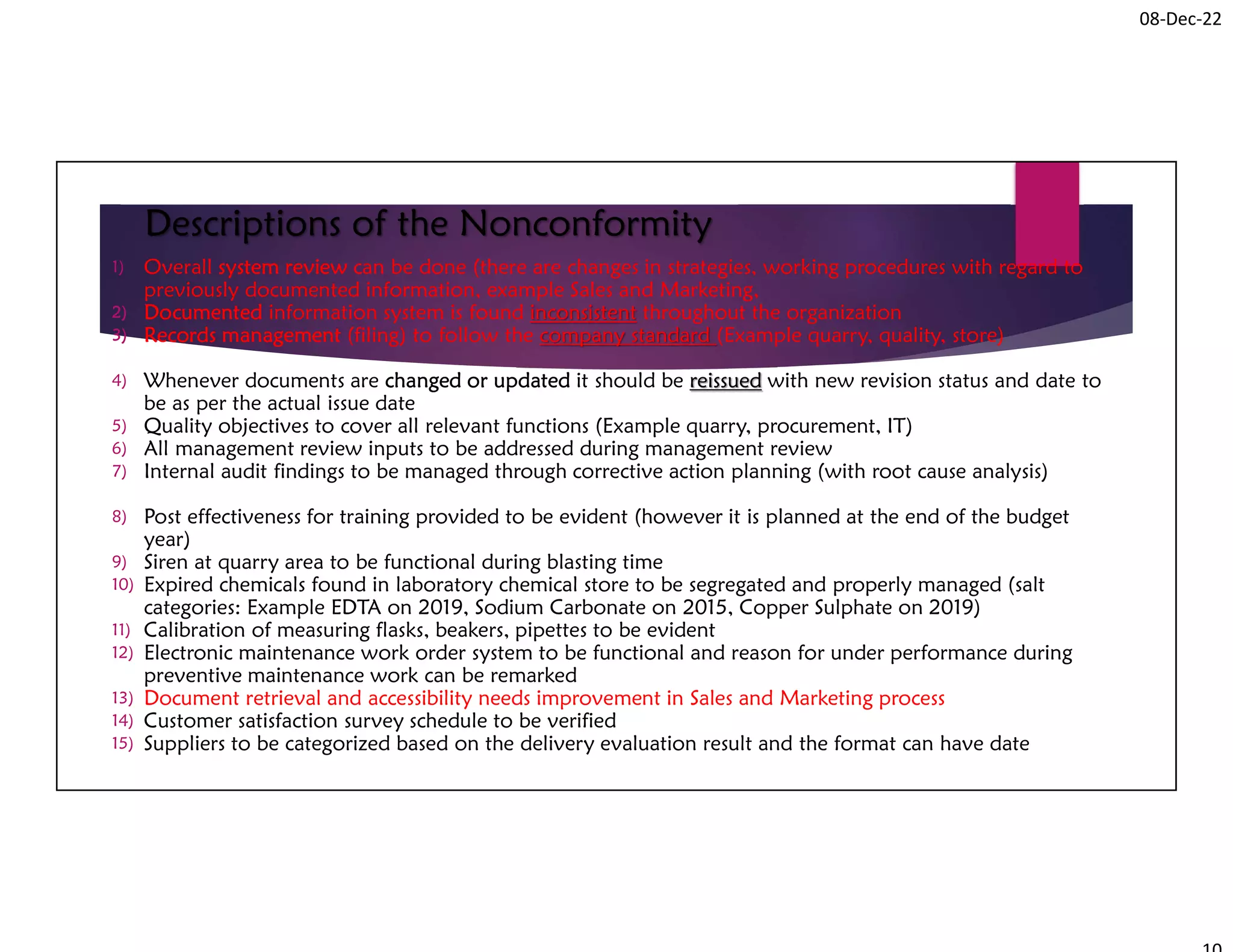
Descriptions of the Nonconformity
1) Overall system review can be done (there are changes in strategies, working procedures with regard to
previously documented information, example Sales and Marketing,
2) Documented information system is found inconsistent throughout the organization
3) Records management (filing) to follow the company standard (Example quarry, quality, store)
4) Whenever documents are changed or updated it should be reissued with new revision status and date to
be as per the actual issue date
5) Quality objectives to cover all relevant functions (Example quarry, procurement, IT)
6) All management review inputs to be addressed during management review
7) Internal audit findings to be managed through corrective action planning (with root cause analysis)
8) Post effectiveness for training provided to be evident (however it is planned at the end of the budget
year)
9) Siren at quarry area to be functional during blasting time
10) Expired chemicals found in laboratory chemical store to be segregated and properly managed (salt
categories: Example EDTA on 2019, Sodium Carbonate on 2015, Copper Sulphate on 2019)
11) Calibration of measuring flasks, beakers, pipettes to be evident
12) Electronic maintenance work order system to be functional and reason for under performance during
preventive maintenance work can be remarked
13) Document retrieval and accessibility needs improvement in Sales and Marketing process
14) Customer satisfaction survey schedule to be verified
15) Suppliers to be categorized based on the delivery evaluation result and the format can have date
08-Dec-22
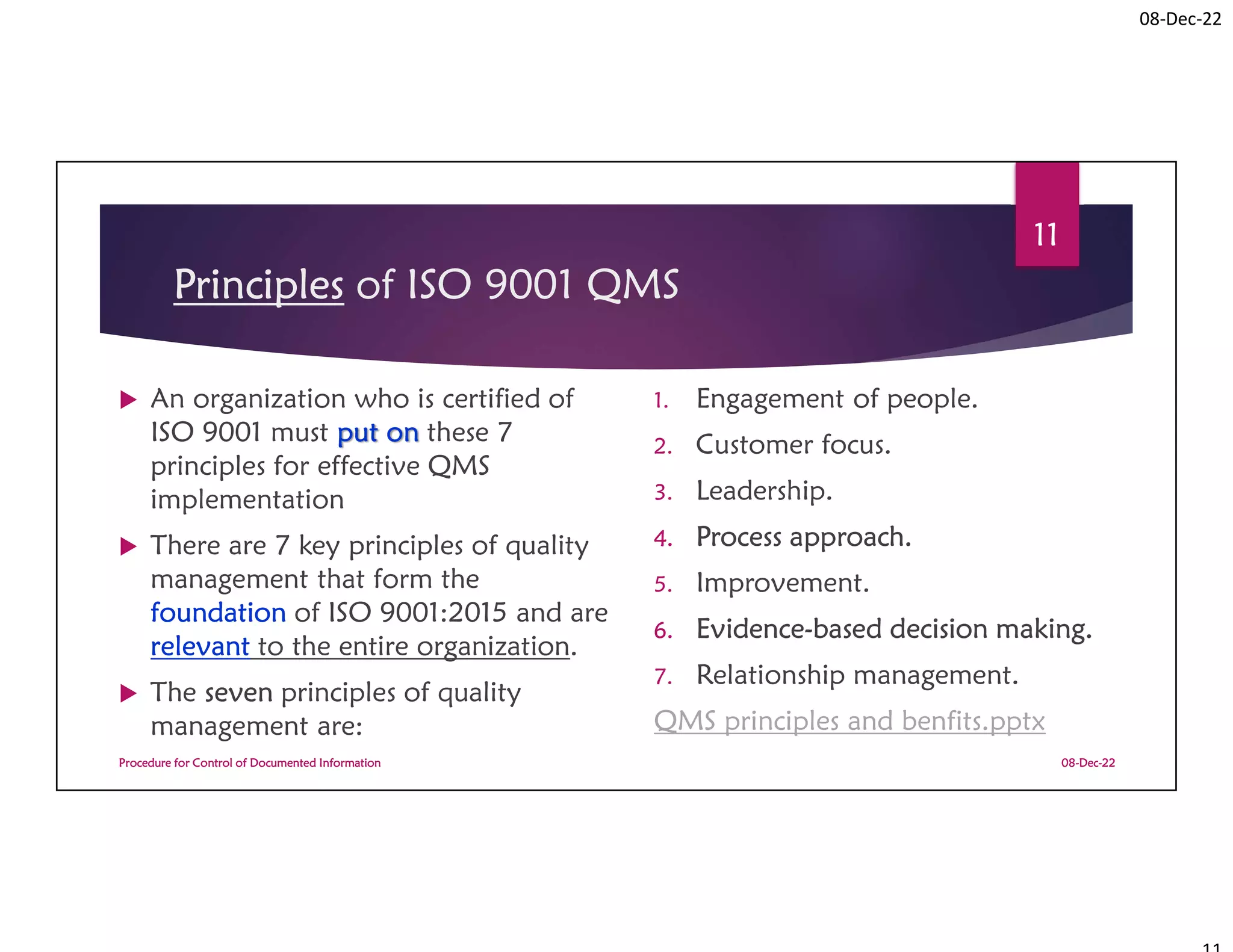
Principles of ISO 9001 QMS
 An organization who is certified of
ISO 9001 must put on these 7
principles for effective QMS
implementation
 There are 7 key principles of quality
management that form the
foundation of ISO 9001:2015 and are
relevant to the entire organization.
 The seven principles of quality
management are:
1. Engagement of people.
2. Customer focus.
3. Leadership.
4. Process approach.
5. Improvement.
6. Evidence-based decision making.
7. Relationship management.
QMS principles and benfits.pptx
08-Dec-22
Procedure for Control of Documented Information
11
08-Dec-22
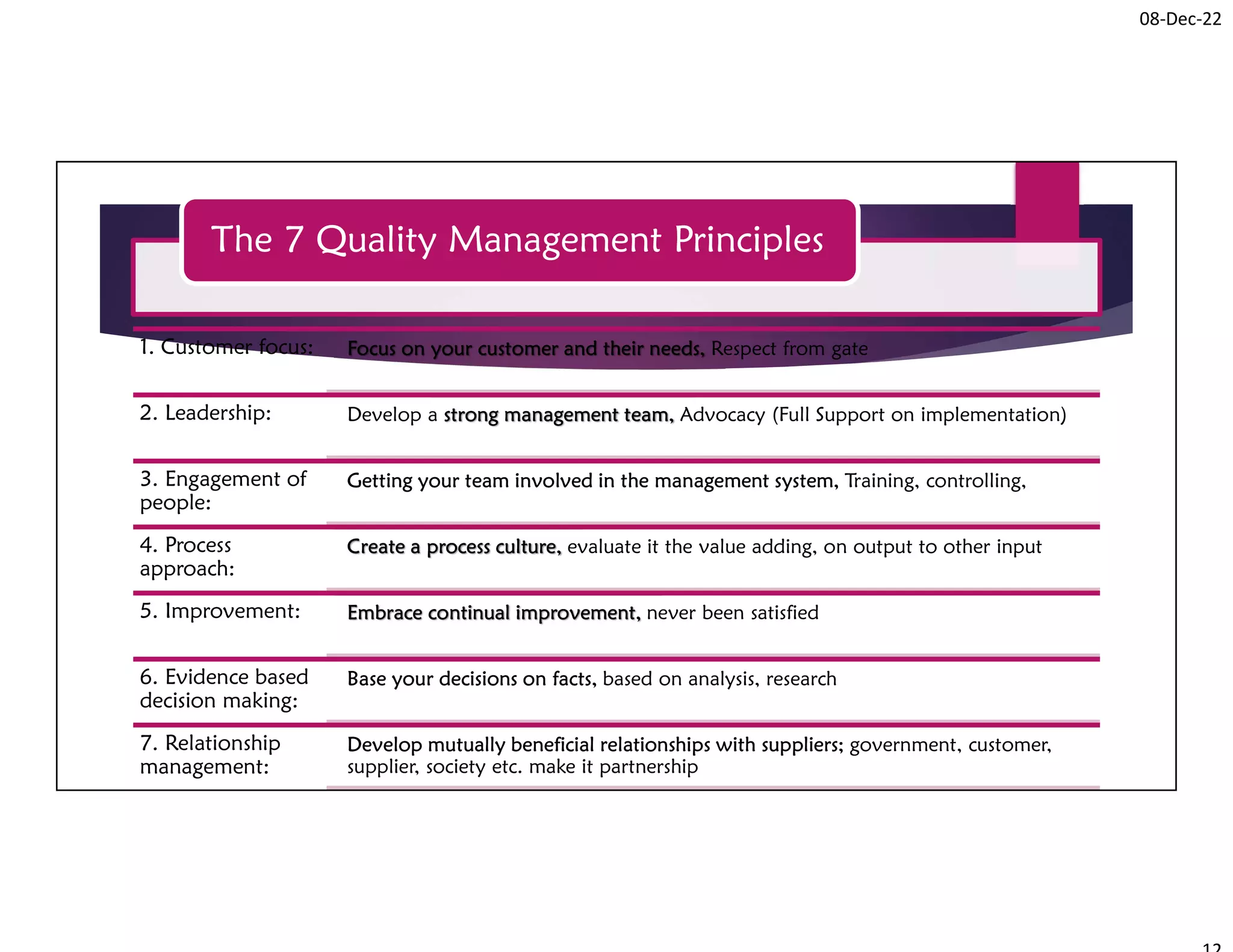
The 7 Quality Management Principles
1. Customer focus: Focus on your customer and their needs, Respect from gate
2. Leadership: Develop a strong management team, Advocacy (Full Support on implementation)
3. Engagement of
people:
Getting your team involved in the management system, Training, controlling,
4. Process
approach:
Create a process culture, evaluate it the value adding, on output to other input
5. Improvement: Embrace continual improvement, never been satisfied
6. Evidence based
decision making:
Base your decisions on facts, based on analysis, research
7. Relationship
management:
Develop mutually beneficial relationships with suppliers; government, customer,
supplier, society etc. make it partnership
08-Dec-22
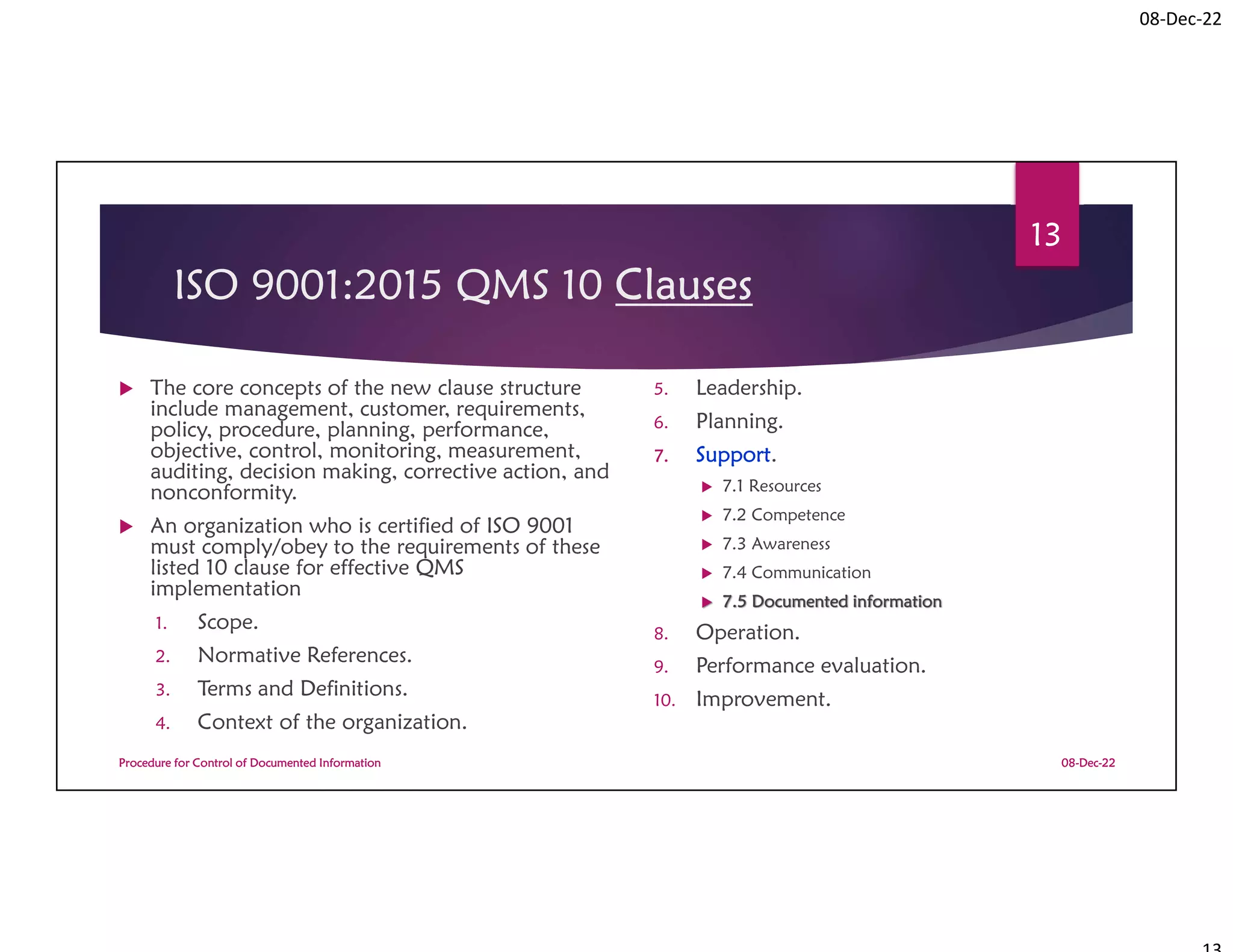
ISO 9001:2015 QMS 10 Clauses
 The core concepts of the new clause structure
include management, customer, requirements,
policy, procedure, planning, performance,
objective, control, monitoring, measurement,
auditing, decision making, corrective action, and
nonconformity.
 An organization who is certified of ISO 9001
must comply/obey to the requirements of these
listed 10 clause for effective QMS
implementation
1. Scope.
2. Normative References.
3. Terms and Definitions.
4. Context of the organization.
5. Leadership.
6. Planning.
7. Support.
 7.1 Resources
 7.2 Competence
 7.3 Awareness
 7.4 Communication
 7.5 Documented information
8. Operation.
9. Performance evaluation.
10. Improvement.
08-Dec-22
Procedure for Control of Documented Information
13
08-Dec-22
ISO 9001:2015 QMS 10 Clauses
 But Today we will look in to the 7.5 clause Document information
 It’s Importance
 Control document information Procedure
08-Dec-22
Procedure for Control of Documented Information
14
08-Dec-22
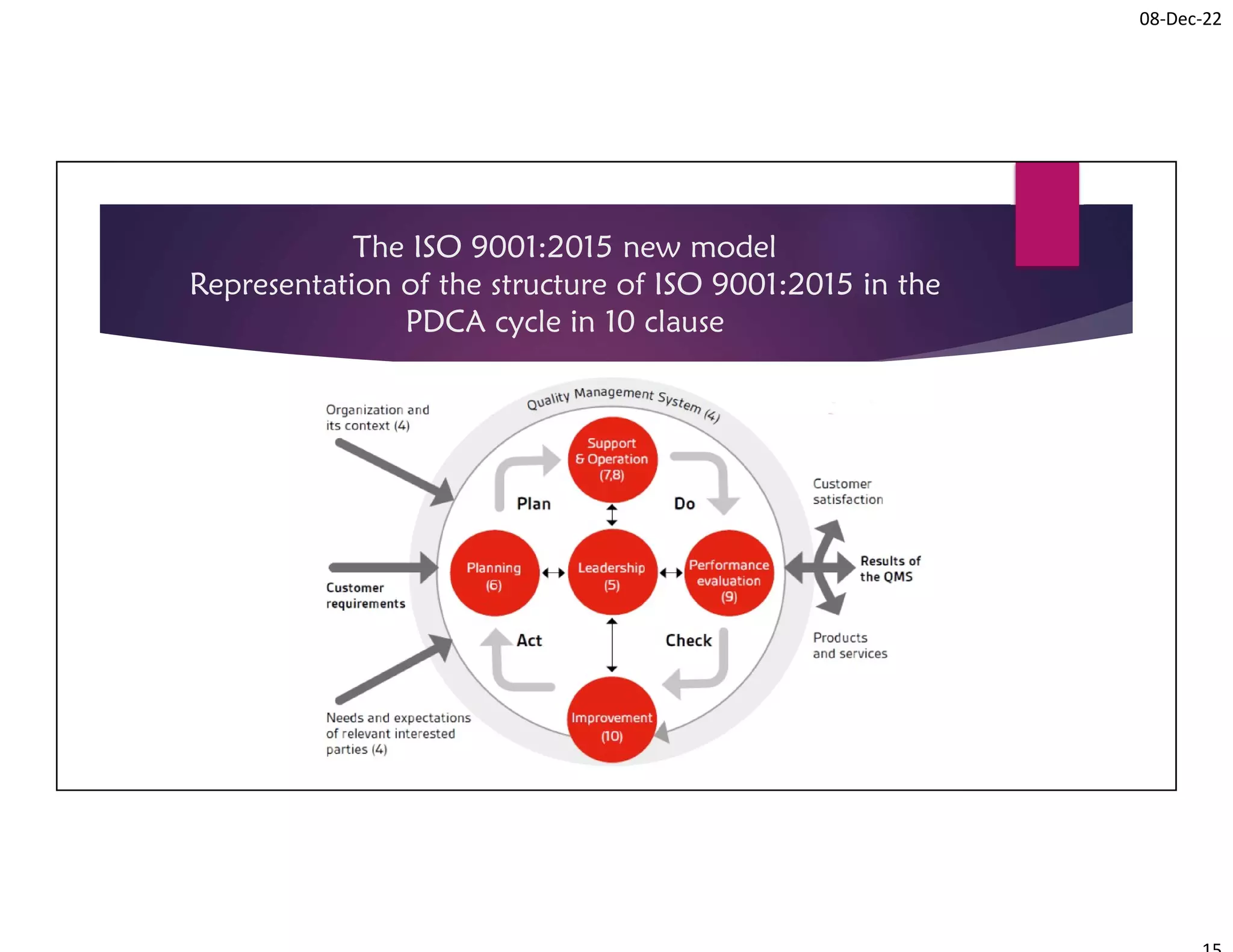
The ISO 9001:2015 new model
Representation of the structure of ISO 9001:2015 in the
PDCA cycle in 10 clause
08-Dec-22
Documented
information
system
& Records
management
DOCUMENT RETRIEVAL
AND ACCESSIBILITY
08-Dec-22
Procedure for Control of Documented Information
16
08-Dec-22
What is documentation?
 Documentation refers to a set of records that professionals or companies keep
to provide evidence or information that can be used to inform decisions.
 In the workplace, documentation is retained records of employment and
company actions and events as required by legal mandates and company
policy.
08-Dec-22
Procedure for Control of Documented Information
17
08-Dec-22
Overview of documentation Importance
 These presentation is the base of the company productivity and your process decision
making.
 First we need understand and accept the importance of documentation then, If you
value on importance of your documentation you will record every process activities
very carefully and attentively by checking the correctness of the document paper to be
filled and records put in the paper.
 We should ask ourself
 What is the importance of documentation for my department/process?
 Should we comply to the requirements?
 Is it relay helpful to my department/process?
08-Dec-22
Procedure for Control of Documented Information
18
08-Dec-22
What is the key advantages of effective documentation?
 Increased Efficiency: Documentation processes reduce document hunting and
wastage of time so that employees can focus more on revenue-generating
tasks.
 Increased Productivity: Documentation simplifies processes and makes
information more accessible. As a result, productivity increases.
08-Dec-22
Procedure for Control of Documented Information
19
08-Dec-22
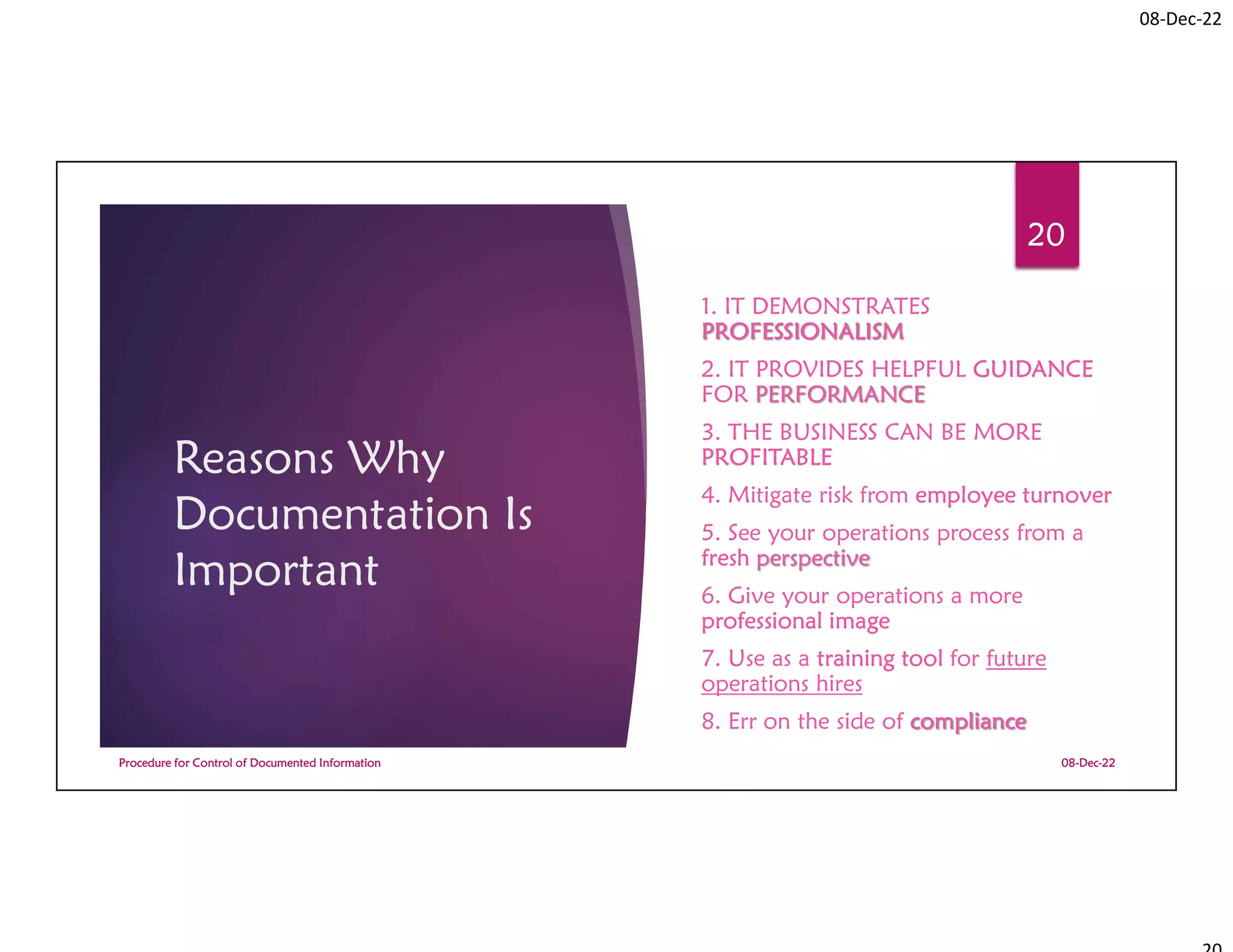
Reasons Why
Documentation Is
Important
1. IT DEMONSTRATES
PROFESSIONALISM
2. IT PROVIDES HELPFUL GUIDANCE
FOR PERFORMANCE
3. THE BUSINESS CAN BE MORE
PROFITABLE
4. Mitigate risk from employee turnover
5. See your operations process from a
fresh perspective
6. Give your operations a more
professional image
7. Use as a training tool for future
operations hires
8. Err on the side of compliance
08-Dec-22
Procedure for Control of Documented Information
20
08-Dec-22
Most of people did not pay
attention to important things that
helps them.
08-Dec-22
Procedure for Control of Documented Information
21
08-Dec-22
Reasons Why Documentation Is Important
 Maintaining a system of organized, accurate and consistent documentation in
the workplace is both necessary and beneficial.
 Making documentation a priority, especially when it comes to the
company’s human resources (HR) department, can help mitigate
arguments,
 offer resources when they are needed and
 answer important questions about the company.
 In this slide, we discuss why documentation is important and ways you might
consider improving your documentation process.
08-Dec-22
Procedure for Control of Documented Information
22
08-Dec-22
Why is documentation important?
 While there are many reasons maintaining a consistent,
organized system for documentation can help you and
your organization to be successful,
 Here are Eight main categories to consider:
08-Dec-22
Procedure for Control of Documented Information
23
08-Dec-22
Why is documentation important?
1. It demonstrates professionalism
 Documentation shows both employees and customers that
 you are committed to safeguarding critical information and
 are dedicated to providing stakeholders with factual/truthful information as
needed.
 The practice of maintaining accurate documentation alone provides
 an accessible, manageable framework for addressing issues that benefits everyone.
08-Dec-22
Procedure for Control of Documented Information
24
08-Dec-22
Why is documentation important?
2. It provides helpful guidance for performance
 Documenting your processes ensures consistency, efficiency and standardization.
 It allows everyone following them to perform at their best and be clear about your
expectations.
 Taking the time to document each of your procedures in a step-by-step format will
save time and money in the long run.
 Once you outline what's important for the business and how to achieve goals, your
overall group effort will be more direct and focused.
 As a result, your employees can reach goals sooner and with more ease.
08-Dec-22
Procedure for Control of Documented Information
25
08-Dec-22
Why is documentation important?
3. The business can be more PROFITABLE
 Documenting information and processes saves employees time by offering
answers to questions in an accessible way.
 Employees can spend more time working than getting caught up in solving
problems for themselves or their coworkers.
 When businesses document procedures, they can run more efficiently.
08-Dec-22
Procedure for Control of Documented Information
26
08-Dec-22
4. Mitigate Risk from Employee Turnover
 If you have no documentation, operational risk will increase when a talented back-office
team member leaves the firm.
 That's because the departed employee will take their operational and portfolio accounting
know-how with them.
 As a result, you and your staff are left haphazardly scrambling to finish the daily reconciliation
reports.
 Documenting all procedures from start to finish will reduce when turnover occurs.
 Following process documentation best practices, you will feel more secure the next time
someone leaves your organization.
08-Dec-22
Procedure for Control of Documented Information
27
08-Dec-22
5. See Your Operations Process from a Fresh Perspective
 When documenting the processes step-by-step, you see things differently.
 You may have executed the steps according to memory and years of experience.
 Now you'll have written instructions.
 When you rely only on memory to get work done, you might forget some steps.
 For example, you'll forget to create backup files, or you’ll forget to remove or edit certain data
points.
 If you have process documentation that reminds you to watch out for any missed
points, then you’ve reduced the risk.
 By having that guide, all someone has to do is follow the instructions, and there will be a
consistent and predictable outcome every time:
 accurate, error-free reports that are ready for the client, performed in the way you want them done.
08-Dec-22
Procedure for Control of Documented Information
28
08-Dec-22
6. Give Your Operations a More Professional Image
 Having documentation not only promotes consistency in your
processes, but it also sets a standard.
 Documented procedures indicate a clear goal to be achieved and the
steps to achieve that goal.
08-Dec-22
Procedure for Control of Documented Information
29
08-Dec-22
7. Use as a Training Tool for Future Operations Hires
 Not only does a good documentation help prevent operational risk in case of turnover,
but it serves as an excellent resource to train new members of your organization.
 A straightforward, easy-to-follow set of instructions for your processes will save you
time, effort, and resources in getting the new hires up to speed.
 In turn, you’ll see how effective the documentation is when someone uses it for the first
time.
 If they struggle with your instructions, you’ll learn how to improve the document so that
when the next new hire arrives, things will be easier.
08-Dec-22
Procedure for Control of Documented Information
30
08-Dec-22
8. Err on the Side of Compliance
 Having documentation should be considered following best practices.
 Not only have you set standards and step-by-step instructions to meet the goals, but you’re
increasing the transparency into your back-office operations.
 Should the firm be audited,
 documenting your reconciliation and reporting processes is one more way to show your
organization takes protocol and compliance seriously.
08-Dec-22
Procedure for Control of Documented Information
31
08-Dec-22
Reasons Why Documentation Is Important
for your Operations
 Whether you’ve
 lost key operational staff, or your reconciliation and reporting processes are
disorganized,
 having good documentation can help eliminate problems you’re facing.
 Do you have documented procedures? If so, when was the last time
you and your team looked at them?
 Whether or not you have any, and whatever your operational issues
you face, proper documentation makes a difference.
08-Dec-22
Procedure for Control of Documented Information
32
08-Dec-22
Why should you
care about
documentation?
1. A single source of truth
saves time and energy
2. Documentation is essential
to quality and process control
3. Documentation cuts down
duplicative work
4. It makes hiring and
onboarding so much easier
5. A single source of truth
makes everyone smarter
08-Dec-22
Procedure for Control of Documented Information
33
08-Dec-22
Why should you care about documentation?
 We get it. You are busy, which means recording things like decisions, statuses, and steps for handling
repetitive tasks probably doesn’t rank near the top of your to-do list.
 When the rubber hits the road (the point at which a theory or idea is put to a practical test.),
documentation will be one of those things that you’ll be glad that you did.
 Whether a team member is unexpectedly absent or you aren’t sure how to move forward with
an unfamiliar initiative, those records will be an undeniably handy resource.
 Need more help convincing your team?
 Here are a few key benefits you can share to illustrate why documentation should be a priority moving
forward.
08-Dec-22
Procedure for Control of Documented Information
34
08-Dec-22
1. A single source of truth saves time and energy
 Estimates state that the average knowledge worker spends about two and a half hours
per day searching for the information they need.
 Effective documentation collects all of the must-know information about a task, or
team (from account logins to step-by-step instructions) in a centralized, organized
place.
 No more digging through email or downloaded files for the latest information.
 Documentation means you’re able to keep the gears turning without spending hours
trying to track down details, credentials, directions, and more.
 Writing down your processes is helpful for spotting bottlenecks and overfed workflows,
so you can further streamline/smooth the way your team works.
08-Dec-22
Procedure for Control of Documented Information
35
08-Dec-22
2. Documentation is essential to quality and
process control
 There’s more than one way to get things done, and you want to give your team the
flexibility to approach their work in a way that suits them best.
 But, at the same time, you want to ensure consistent results – especially when it
comes to things that you’re producing on a regular basis.
 Documentation encourages knowledge sharing, which empowers your team to
understand how processes work and what finished projects typically look like.
 With those resources in hand, your team members don’t need to be mind readers to
maintain consistency of repeated jobs like that monthly report or that quarterly
presentation.
08-Dec-22
Procedure for Control of Documented Information
36
08-Dec-22
3. Documentation cuts down duplicative work
 How many times have you started a new plan only to find out it had been
done before?
 Companies that use documentation to catalog past jobs, share decisions
benefit and etc. by reducing re-work that wastes precious time you could be
using elsewhere.
 Why reinvent/redone the wheel when you can just build on the work that’s
already happened?
 With documentation in place, you can refer to past work and learn from it, instead
of doing it all over again with the same results.
08-Dec-22
Procedure for Control of Documented Information
37
08-Dec-22
4. It makes hiring and onboarding so much
easier
 It’s tough to think about anybody leaving, but the reality of business is that
your team won’t stay the same forever.
 When you’re welcoming new team members, that onboarding period can be
daunting/frightening, both for your existing team and for that new employee.
 And, unfortunately, Gallup found that only 12% of employees strongly
agree that their organization does a great job of onboarding new workers.
88% not satisfied.
08-Dec-22
Procedure for Control of Documented Information
38
08-Dec-22
4. It makes hiring and onboarding so much
easier
You want to educate and empower team members to do their best work, rather
than making them feel like they’re thrown to the wolves.
 If you prioritize documentation,
 they’ll have all sorts of helpful guides, directions, and notes
 that they can refer to as they get up to speed in their new roles.
 Plus, they can use those resources to answer their questions and start to
figure things out independently,
 rather than feeling like they need to ping/ring someone on your team with
every single question or sticking point.
08-Dec-22
Procedure for Control of Documented Information
39
08-Dec-22
5. A single source of truth makes everyone smarter
 At work, we tend to treat our knowledge as currency.
 If we’re the person with all of the answers, it provides us a sense of security, as if we’re the most
irreplaceable person on our team.
 We assume that sharing our know-how will make us less valuable.
 That’s why it’s little surprise that one survey found that 60% of employees have had a difficult
time getting their colleagues to share information that is vital to their work.
 Documentation increases the collective knowledge of everyone that you work with.
 When it becomes the norm/normal on your team to share information, you’ll benefit from
increased transparency and a culture that’s more collaborative and strategic.
 You’ll make smarter decisions because essential information won’t be locked away on just one
person’s hard drive - or worse yet - their head.
08-Dec-22
Procedure for Control of Documented Information
40
08-Dec-22
Documentation should be your best friend
 From covering an unexpected departure or absence of an employee to tackling
an unfamiliar jobs, you’ll be able to make it over plenty of scare obstacles
together.
 While it might sound firm and formal, prioritizing documentation means you
and your team will develop a stockpile/store of information that you’ll lean
on.
 Share the above advantages with your team members,
 find a way to incentivize their participation in documenting what they can,
 and rest easy knowing that your team’s knowledge will no longer live just in their
brains.
08-Dec-22
Procedure for Control of Documented Information
41
08-Dec-22
ISO 9001:2015
Documented
Information
definition
• DOCUMENTS AND
RECORDS
• WHAT ARE THE
REQUIREMENTS FOR
DOCUMENTATION IN
THE ISO 9001:2015
STANDARD?
08-Dec-22
Procedure for Control of Documented Information
42
08-Dec-22
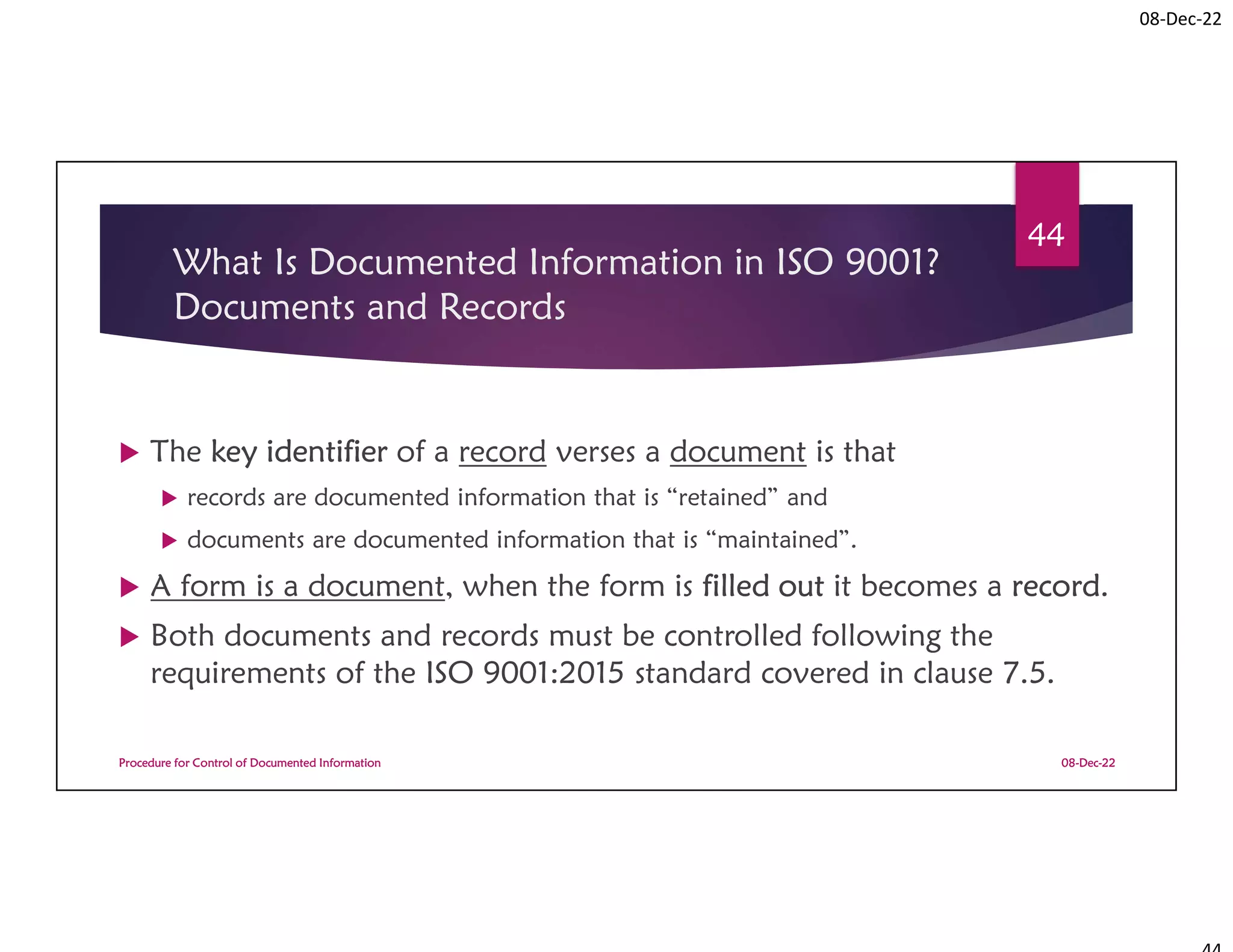
What Is Documented Information in ISO 9001?
Documents and Records
 The term “documented information” in ISO 9001 refers to all of the important
information within a business that must be kept organized and controlled.
 It is basically a combination of: Documents; and Records
 The ISO 9001:2015 standard no longer uses the terms “documents” and “records”.
Both are now called “documented information”.
 As per the ISO 9000:2015 definition, the term documented information refers
to information that must be controlled and maintained.
 Therefore, it expects that you also maintain and control the medium as well as the
information.
 Documented information is used as evidence of conformance.
08-Dec-22
Procedure for Control of Documented Information
43
08-Dec-22
What Is Documented Information in ISO 9001?
Documents and Records
 The key identifier of a record verses a document is that
 records are documented information that is “retained” and
 documents are documented information that is “maintained”.
 A form is a document, when the form is filled out it becomes a record.
 Both documents and records must be controlled following the
requirements of the ISO 9001:2015 standard covered in clause 7.5.
08-Dec-22
Procedure for Control of Documented Information
44
08-Dec-22
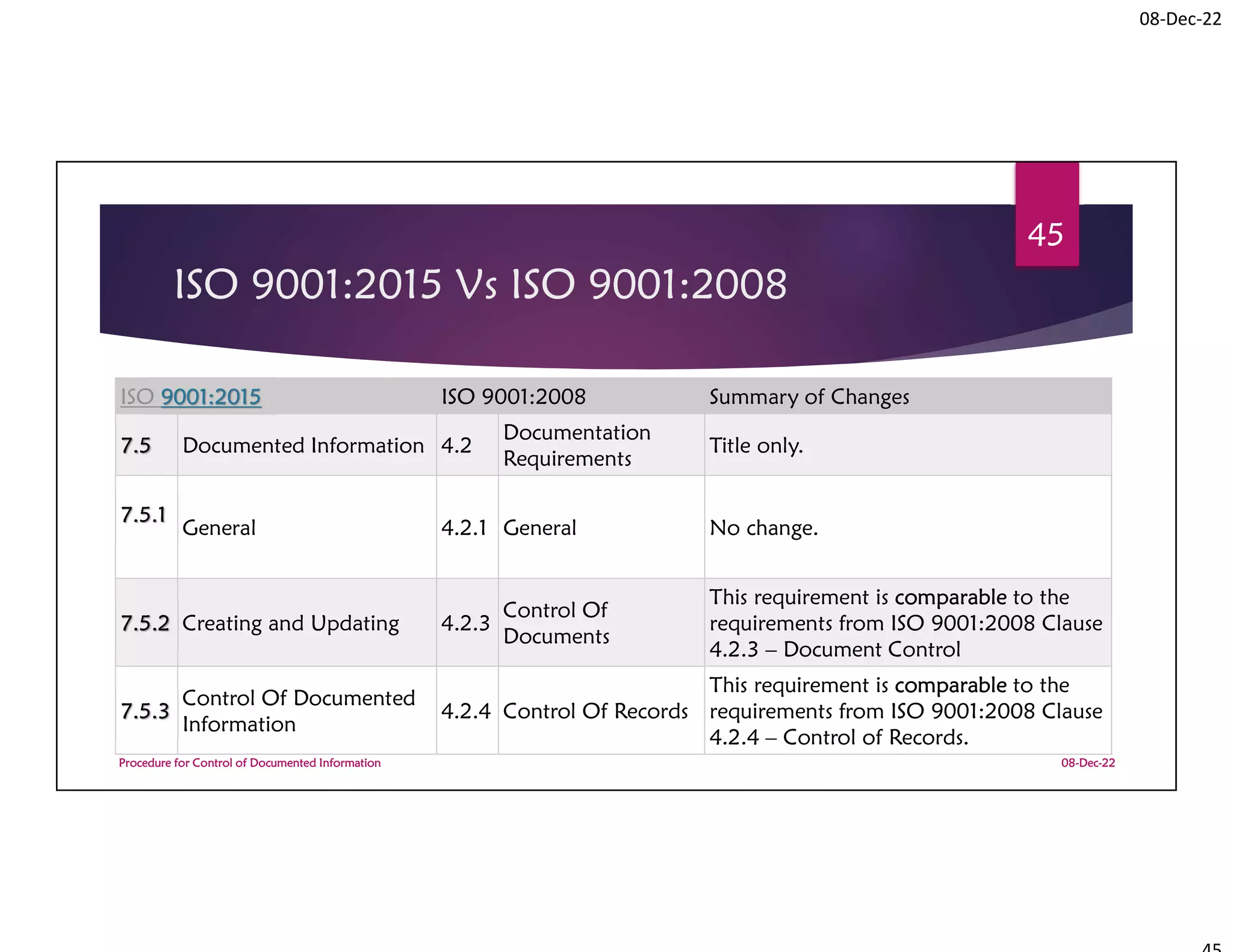
ISO 9001:2015 Vs ISO 9001:2008
08-Dec-22
Procedure for Control of Documented Information
45
ISO 9001:2015 ISO 9001:2008 Summary of Changes
7.5 Documented Information 4.2
Documentation
Requirements
Title only.
7.5.1
General 4.2.1 General No change.
7.5.2 Creating and Updating 4.2.3
Control Of
Documents
This requirement is comparable to the
requirements from ISO 9001:2008 Clause
4.2.3 – Document Control
7.5.3
Control Of Documented
Information
4.2.4 Control Of Records
This requirement is comparable to the
requirements from ISO 9001:2008 Clause
4.2.4 – Control of Records.
08-Dec-22
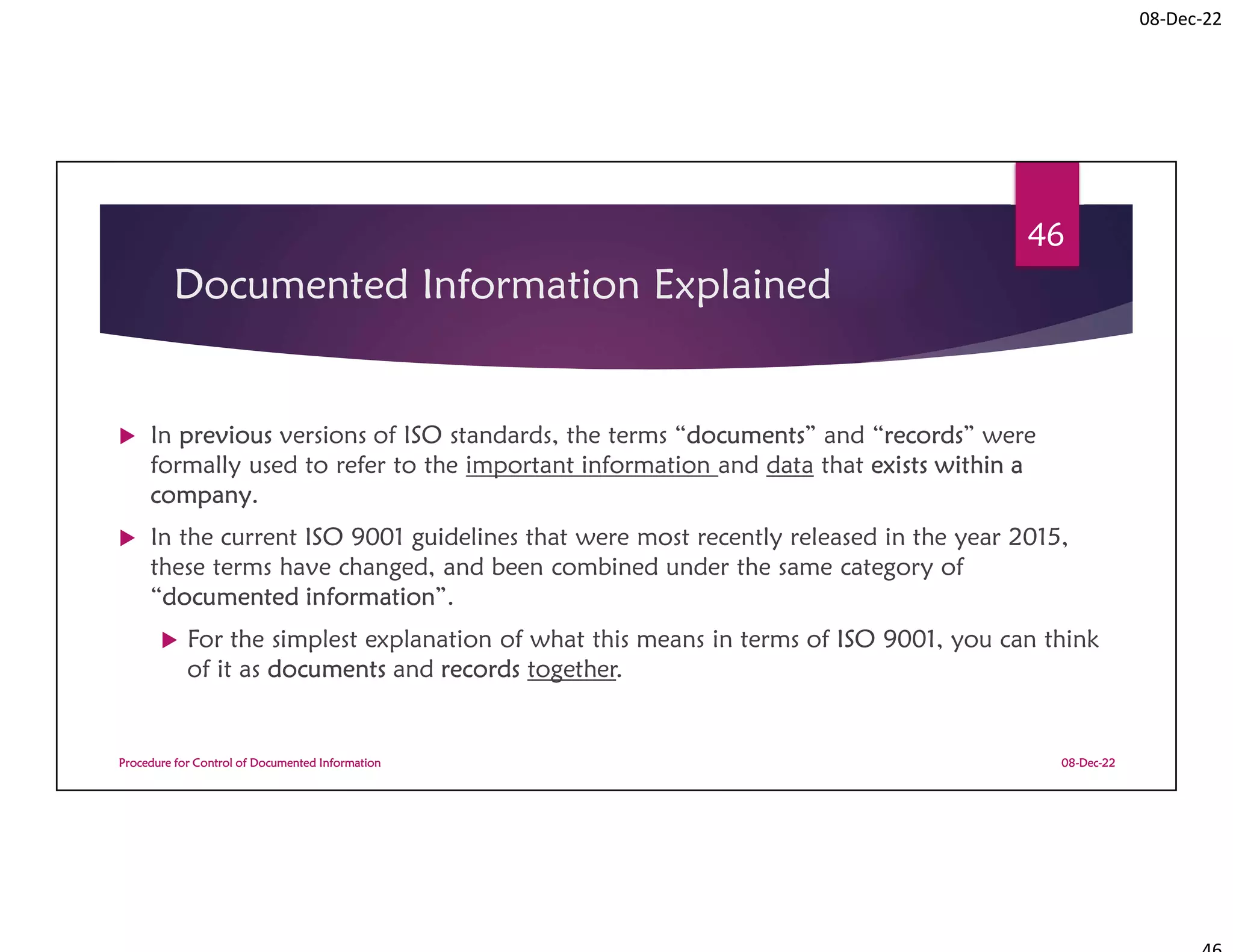
Documented Information Explained
 In previous versions of ISO standards, the terms “documents” and “records” were
formally used to refer to the important information and data that exists within a
company.
 In the current ISO 9001 guidelines that were most recently released in the year 2015,
these terms have changed, and been combined under the same category of
“documented information”.
 For the simplest explanation of what this means in terms of ISO 9001, you can think
of it as documents and records together.
08-Dec-22
Procedure for Control of Documented Information
46
08-Dec-22
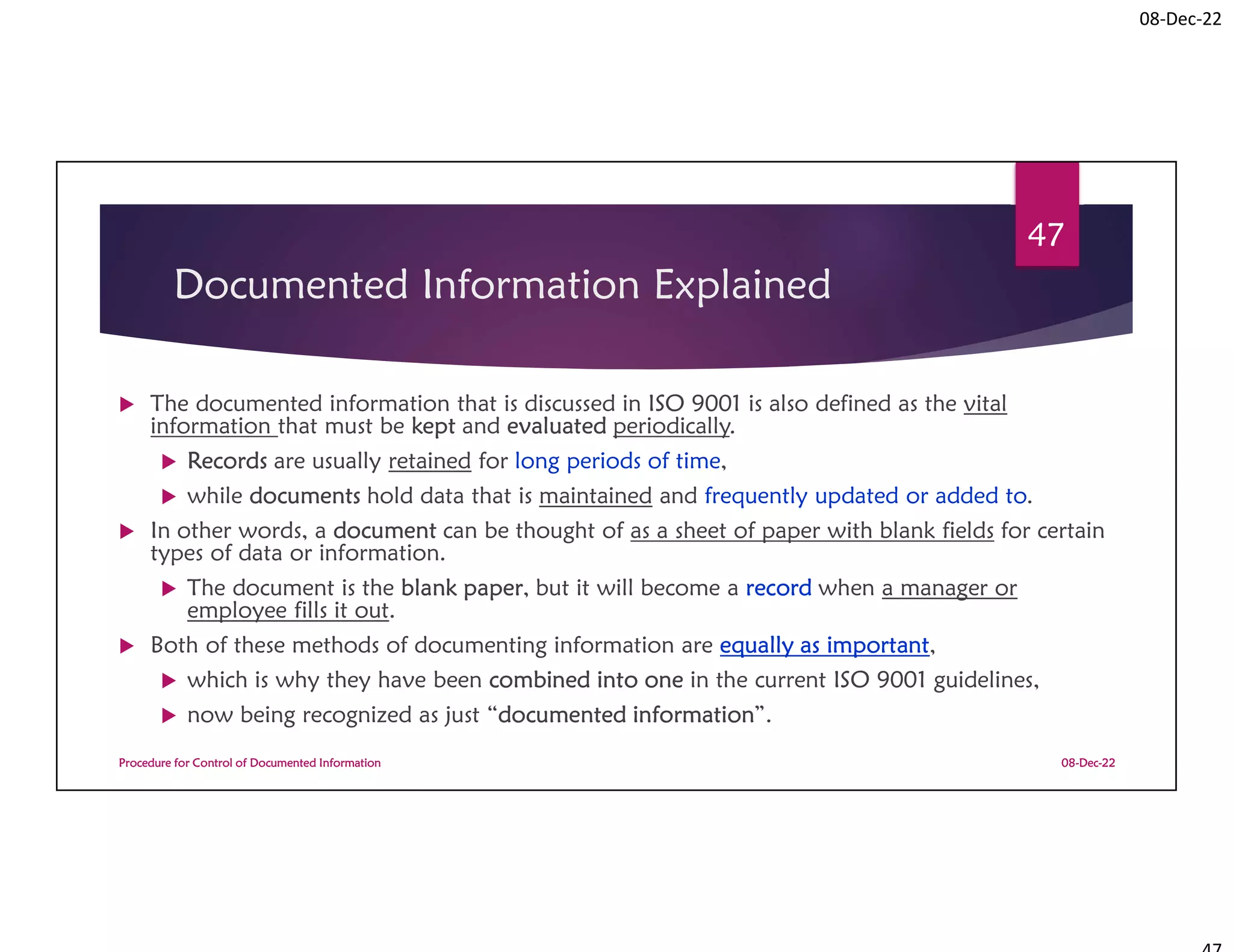
Documented Information Explained
 The documented information that is discussed in ISO 9001 is also defined as the vital
information that must be kept and evaluated periodically.
 Records are usually retained for long periods of time,
 while documents hold data that is maintained and frequently updated or added to.
 In other words, a document can be thought of as a sheet of paper with blank fields for certain
types of data or information.
 The document is the blank paper, but it will become a record when a manager or
employee fills it out.
 Both of these methods of documenting information are equally as important,
 which is why they have been combined into one in the current ISO 9001 guidelines,
 now being recognized as just “documented information”.
08-Dec-22
Procedure for Control of Documented Information
47
08-Dec-22
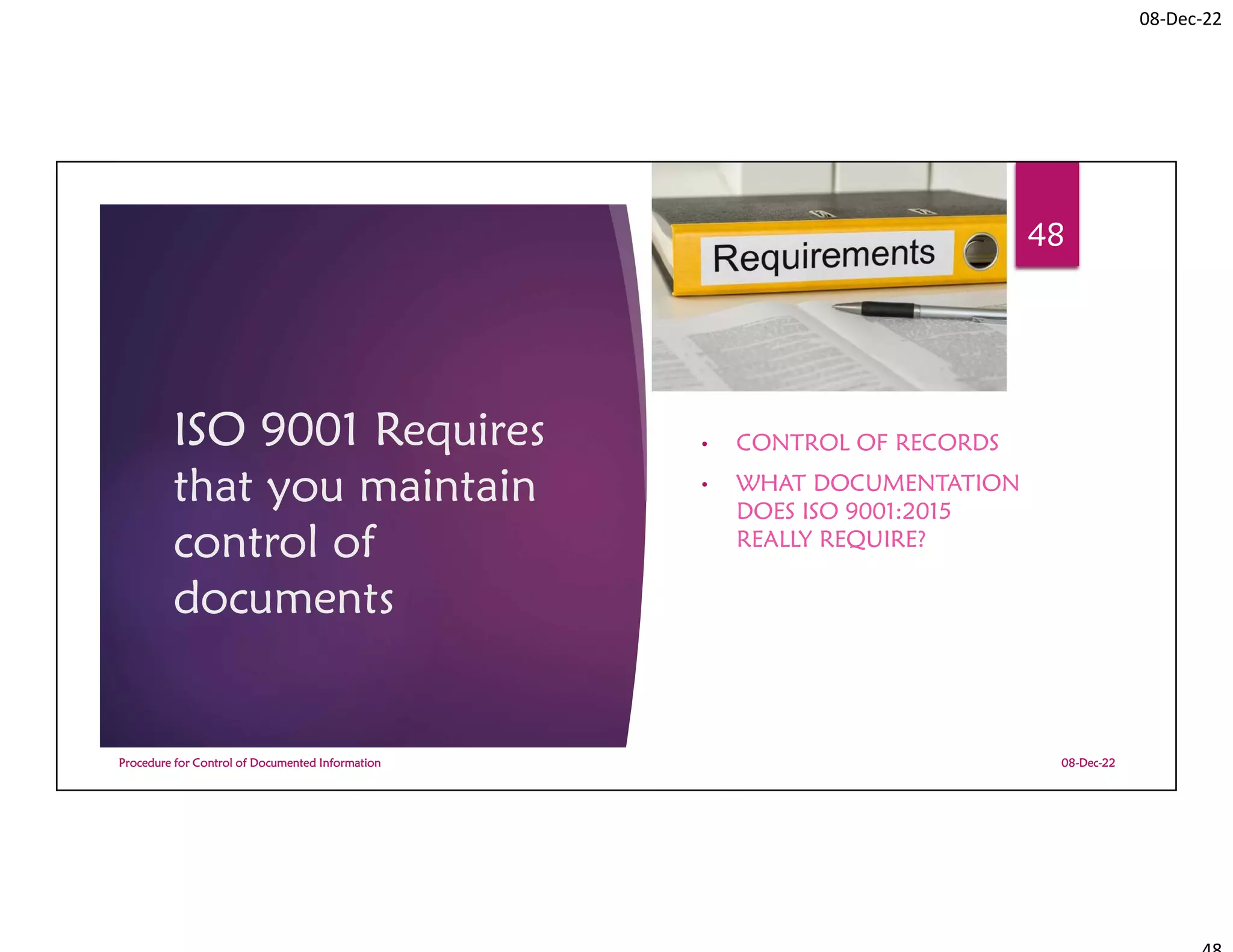
ISO 9001 Requires
that you maintain
control of
documents
• CONTROL OF RECORDS
• WHAT DOCUMENTATION
DOES ISO 9001:2015
REALLY REQUIRE?
08-Dec-22
Procedure for Control of Documented Information
48
08-Dec-22
ISO 9001 Requires that you
maintain control of documents
 ISO 9001:2015 requires that organizations control the documents required by the QMS (quality management system).
 Records are a special type of document and must be controlled as required by clause 7.5.
 Organizations must establish a documented procedure to:
 Approve documents for adequacy prior to issue
 Review, update as necessary, and re-approve documents
 Identify the changes and current document revision status
 Make relevant documents available at points of use
 Ensure the documents remain legible and readily identifiable
 Identify external documents and control their distribution
 Prevent obsolete documents from unintended use
 Apply suitable identification if obsolete documents are retained
08-Dec-22
Procedure for Control of Documented Information
49
08-Dec-22
ISO 9001 Requires that you
Maintain Control of Records
 Establish and control records as evidence of conformity
 to requirements and to demonstrate the effective operation of the quality
management system.
 Establish a documented procedure to define the controls needed for records:
 Identification, Storage, Protection
 Retrieval, Retention, Disposition
 Keep records legible, readily identifiable, and retrievable.
08-Dec-22
Procedure for Control of Documented Information
50
08-Dec-22
What Documentation does ISO 9001:2015
Really Require?
 While the ISO 9001:2008 version was explicit/clear about documentation,
 ISO 9001:2015 allows more freedom in how, what, and when to document a quality
management process (such as specific procedures).
 It appears this evolution is not only to accommodate more modern forms of
communication such as video, audio, and other electronic records,
 but to allow an organization
 the flexibility to reuse appropriate information,
 maintain current versions easier,
 provide wider access/distribution and
 reduce costs associated with documentation.
08-Dec-22
Procedure for Control of Documented Information
51
08-Dec-22
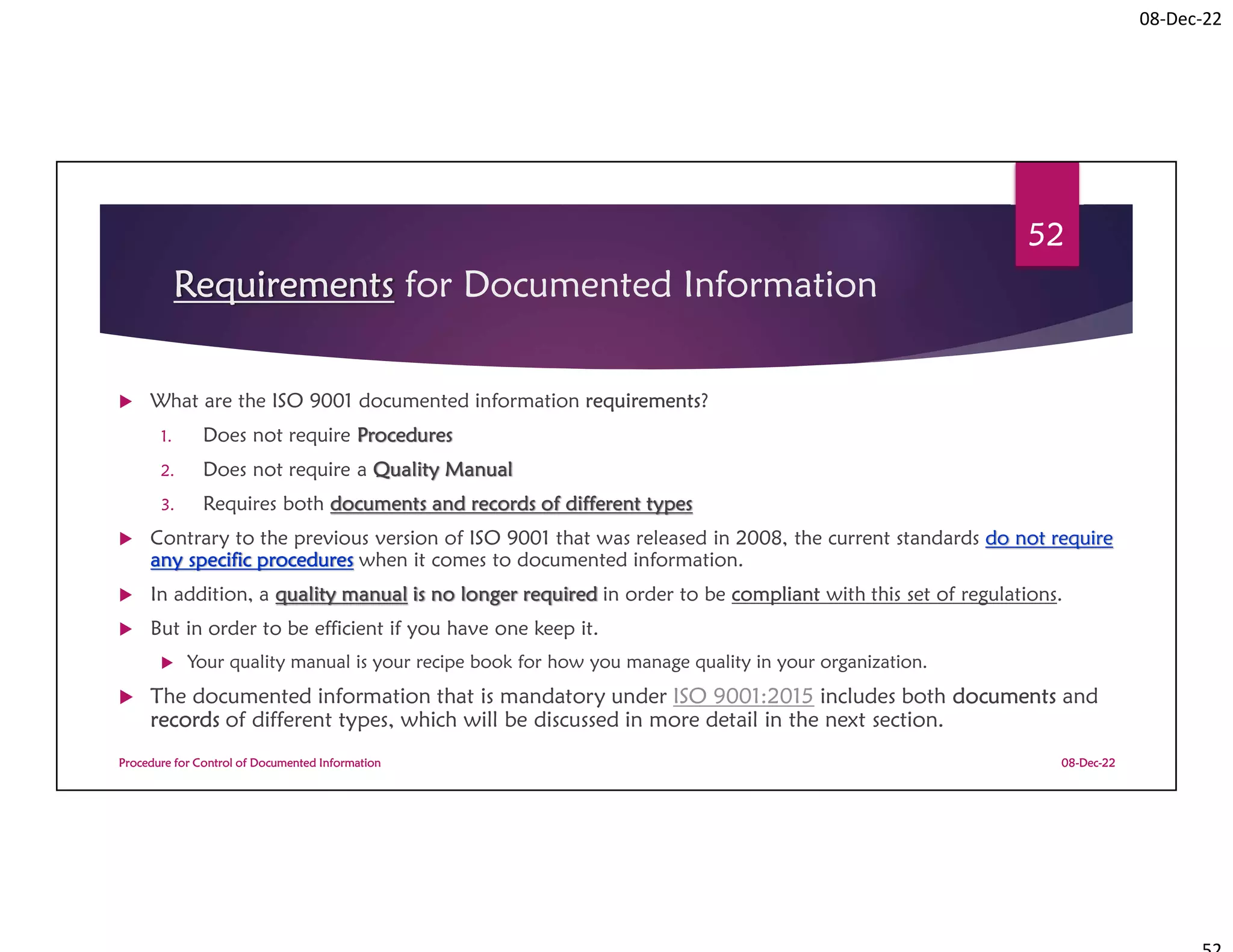
Requirements for Documented Information
 What are the ISO 9001 documented information requirements?
1. Does not require Procedures
2. Does not require a Quality Manual
3. Requires both documents and records of different types
 Contrary to the previous version of ISO 9001 that was released in 2008, the current standards do not require
any specific procedures when it comes to documented information.
 In addition, a quality manual is no longer required in order to be compliant with this set of regulations.
 But in order to be efficient if you have one keep it.
 Your quality manual is your recipe book for how you manage quality in your organization.
 The documented information that is mandatory under ISO 9001:2015 includes both documents and
records of different types, which will be discussed in more detail in the next section.
08-Dec-22
Procedure for Control of Documented Information
52
08-Dec-22
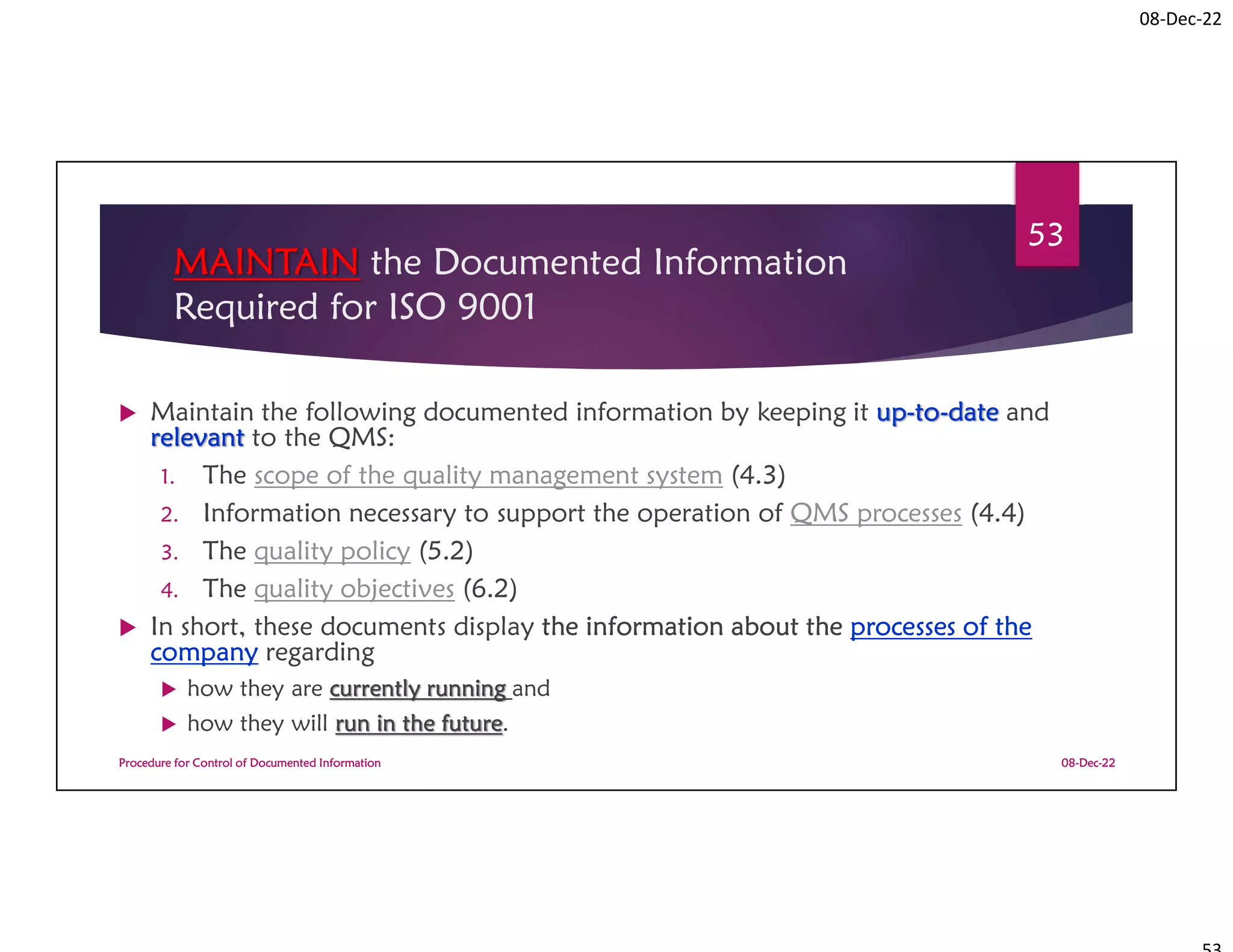
MAINTAIN the Documented Information
Required for ISO 9001
 Maintain the following documented information by keeping it up-to-date and
relevant to the QMS:
1. The scope of the quality management system (4.3)
2. Information necessary to support the operation of QMS processes (4.4)
3. The quality policy (5.2)
4. The quality objectives (6.2)
 In short, these documents display the information about the processes of the
company regarding
 how they are currently running and
 how they will run in the future.
08-Dec-22
Procedure for Control of Documented Information
53
08-Dec-22
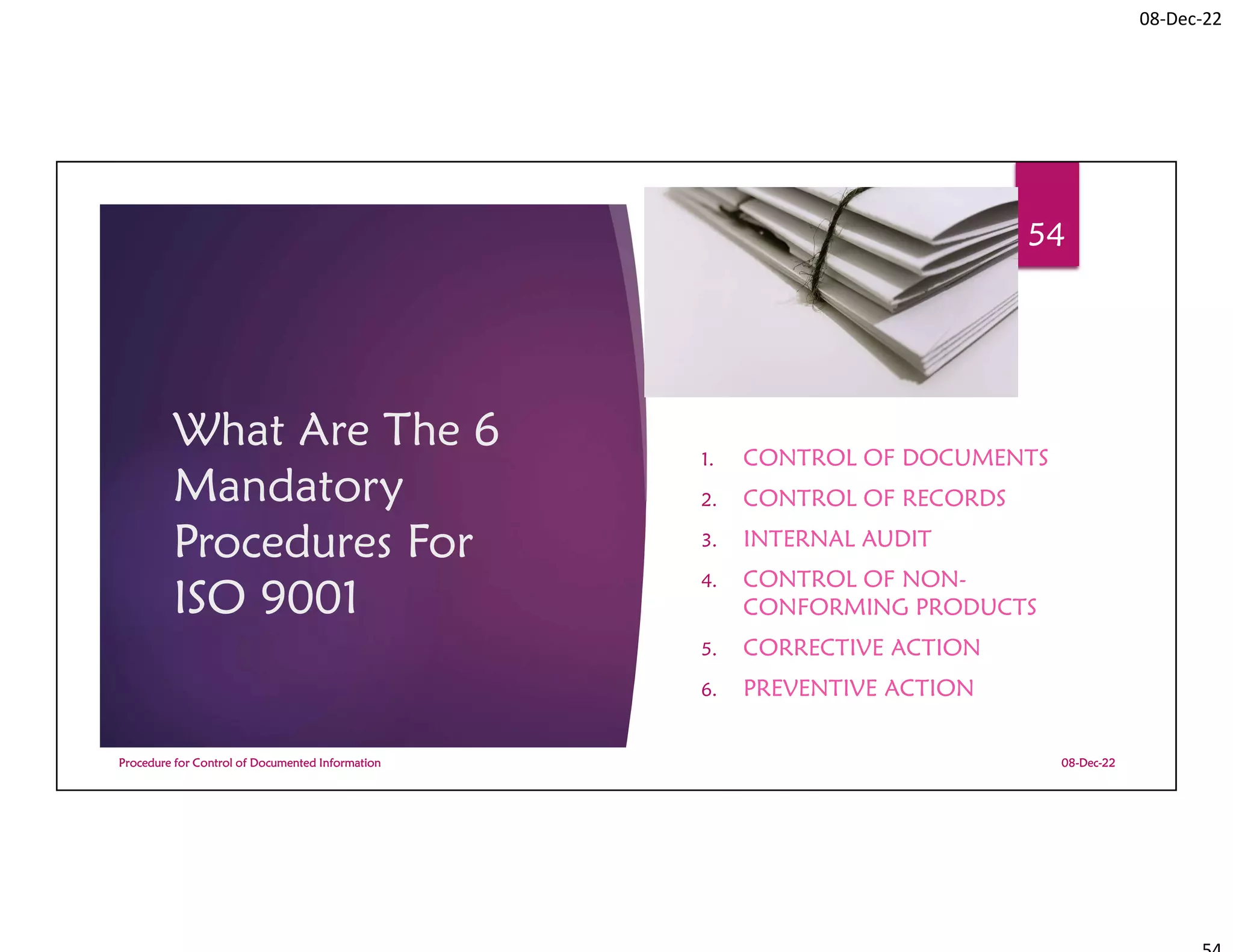
What Are The 6
Mandatory
Procedures For
ISO 9001
1. CONTROL OF DOCUMENTS
2. CONTROL OF RECORDS
3. INTERNAL AUDIT
4. CONTROL OF NON-
CONFORMING PRODUCTS
5. CORRECTIVE ACTION
6. PREVENTIVE ACTION
08-Dec-22
Procedure for Control of Documented Information
54
08-Dec-22
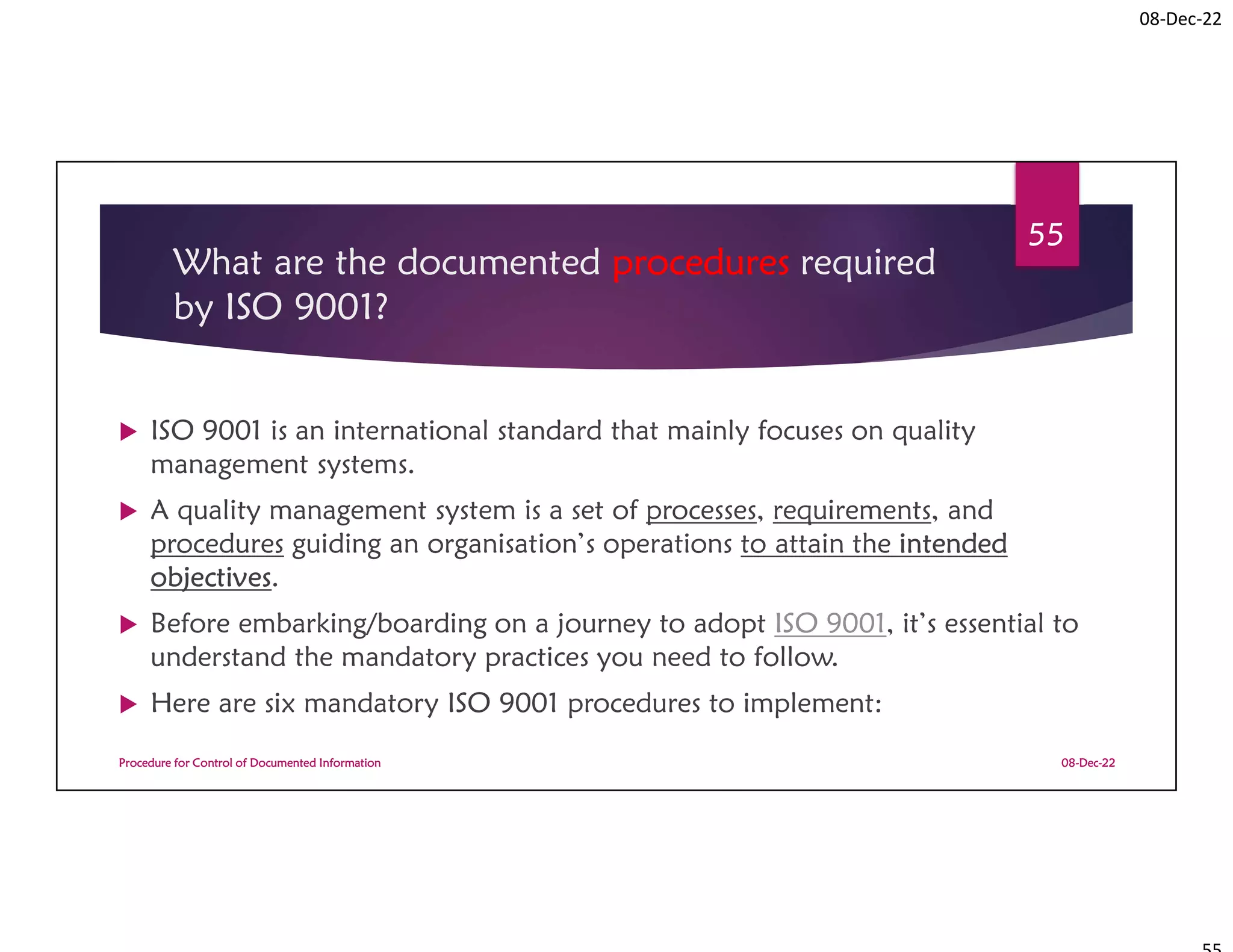
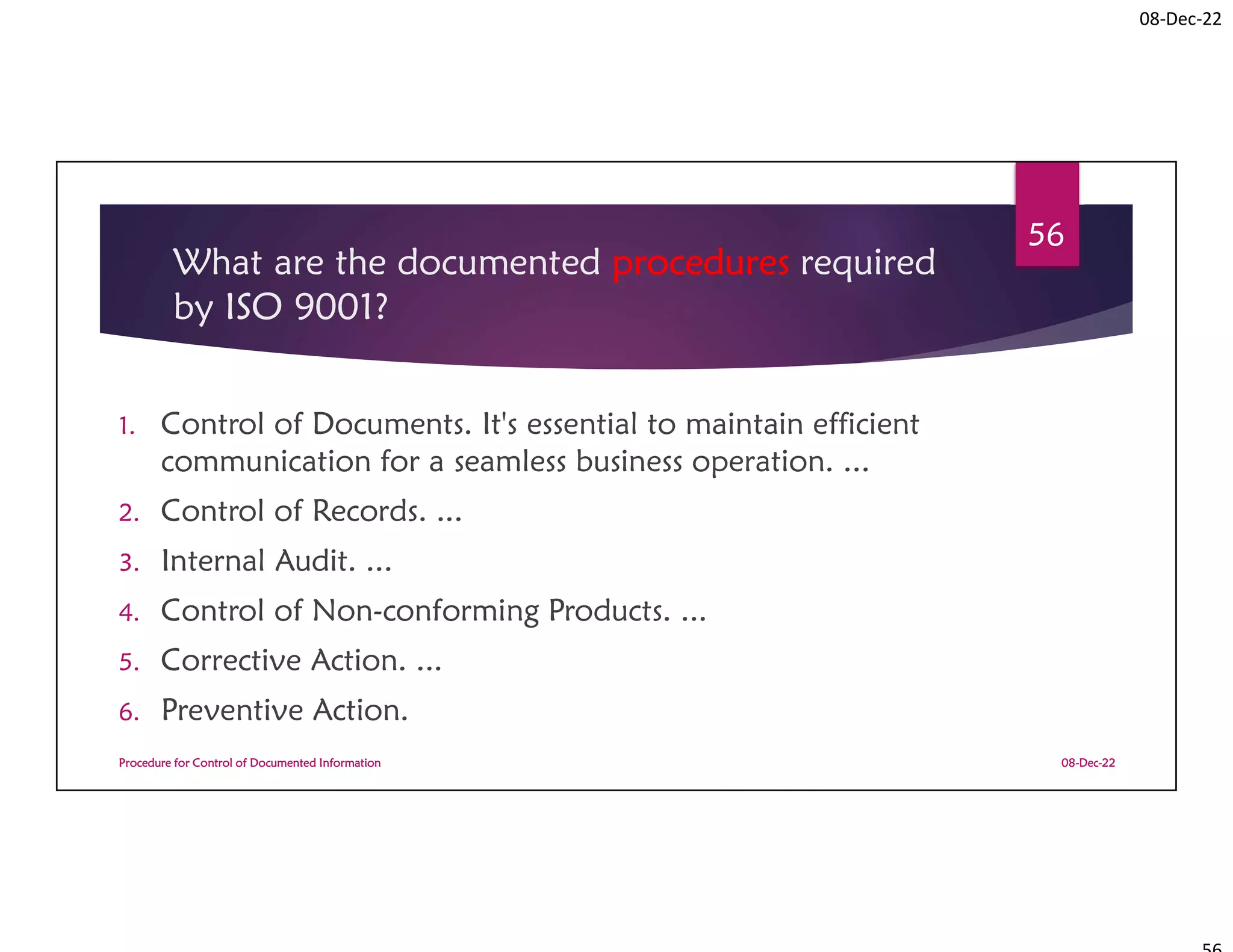
What are the documented procedures required
by ISO 9001?
 ISO 9001 is an international standard that mainly focuses on quality
management systems.
 A quality management system is a set of processes, requirements, and
procedures guiding an organisation’s operations to attain the intended
objectives.
 Before embarking/boarding on a journey to adopt ISO 9001, it’s essential to
understand the mandatory practices you need to follow.
 Here are six mandatory ISO 9001 procedures to implement:
08-Dec-22
Procedure for Control of Documented Information
55
08-Dec-22
What are the documented procedures required
by ISO 9001?
1. Control of Documents. It's essential to maintain efficient
communication for a seamless business operation. ...
2. Control of Records. ...
3. Internal Audit. ...
4. Control of Non-conforming Products. ...
5. Corrective Action. ...
6. Preventive Action.
08-Dec-22
Procedure for Control of Documented Information
56
08-Dec-22
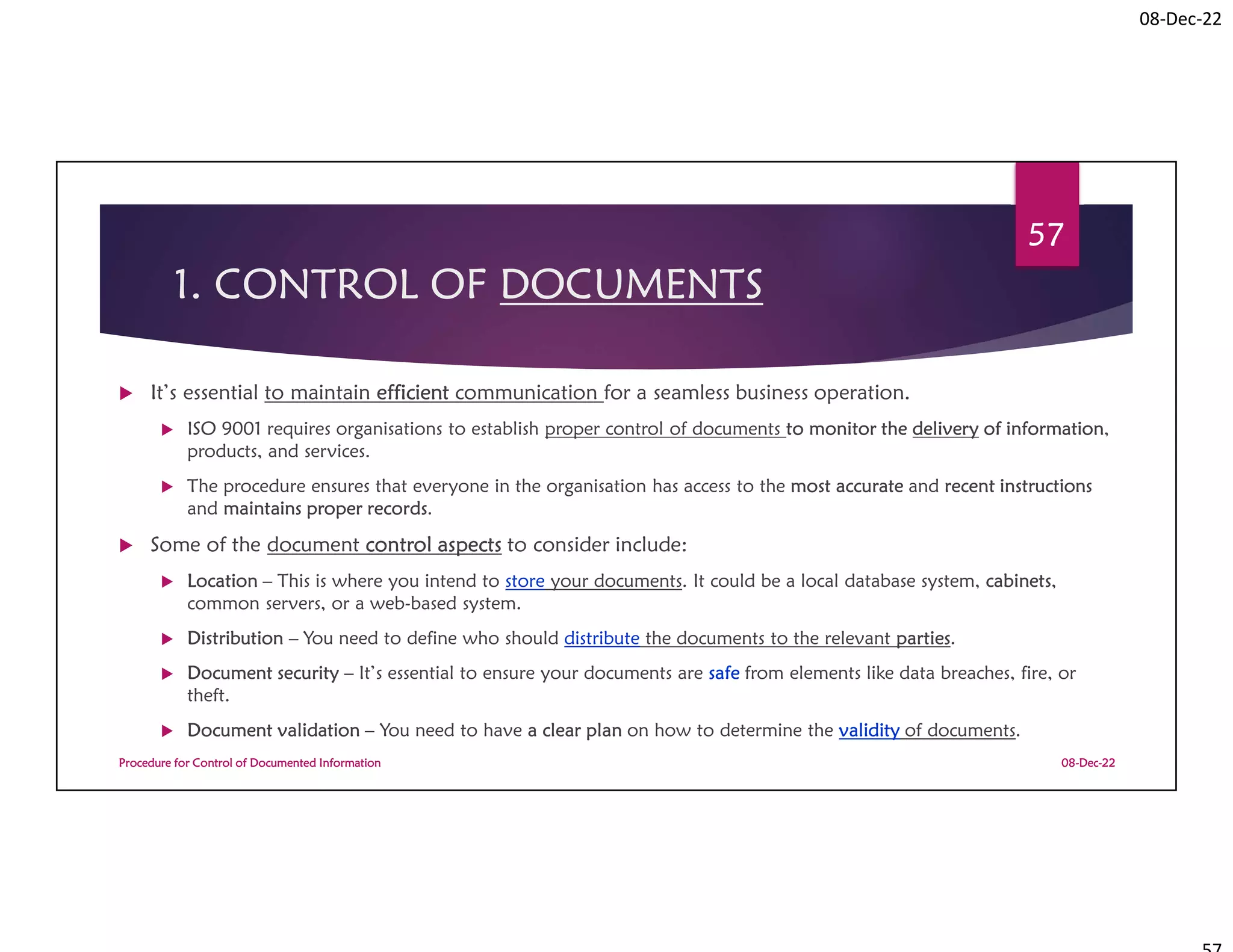
1. CONTROL OF DOCUMENTS
 It’s essential to maintain efficient communication for a seamless business operation.
 ISO 9001 requires organisations to establish proper control of documents to monitor the delivery of information,
products, and services.
 The procedure ensures that everyone in the organisation has access to the most accurate and recent instructions
and maintains proper records.
 Some of the document control aspects to consider include:
 Location – This is where you intend to store your documents. It could be a local database system, cabinets,
common servers, or a web-based system.
 Distribution – You need to define who should distribute the documents to the relevant parties.
 Document security – It’s essential to ensure your documents are safe from elements like data breaches, fire, or
theft.
 Document validation – You need to have a clear plan on how to determine the validity of documents.
08-Dec-22
Procedure for Control of Documented Information
57
08-Dec-22
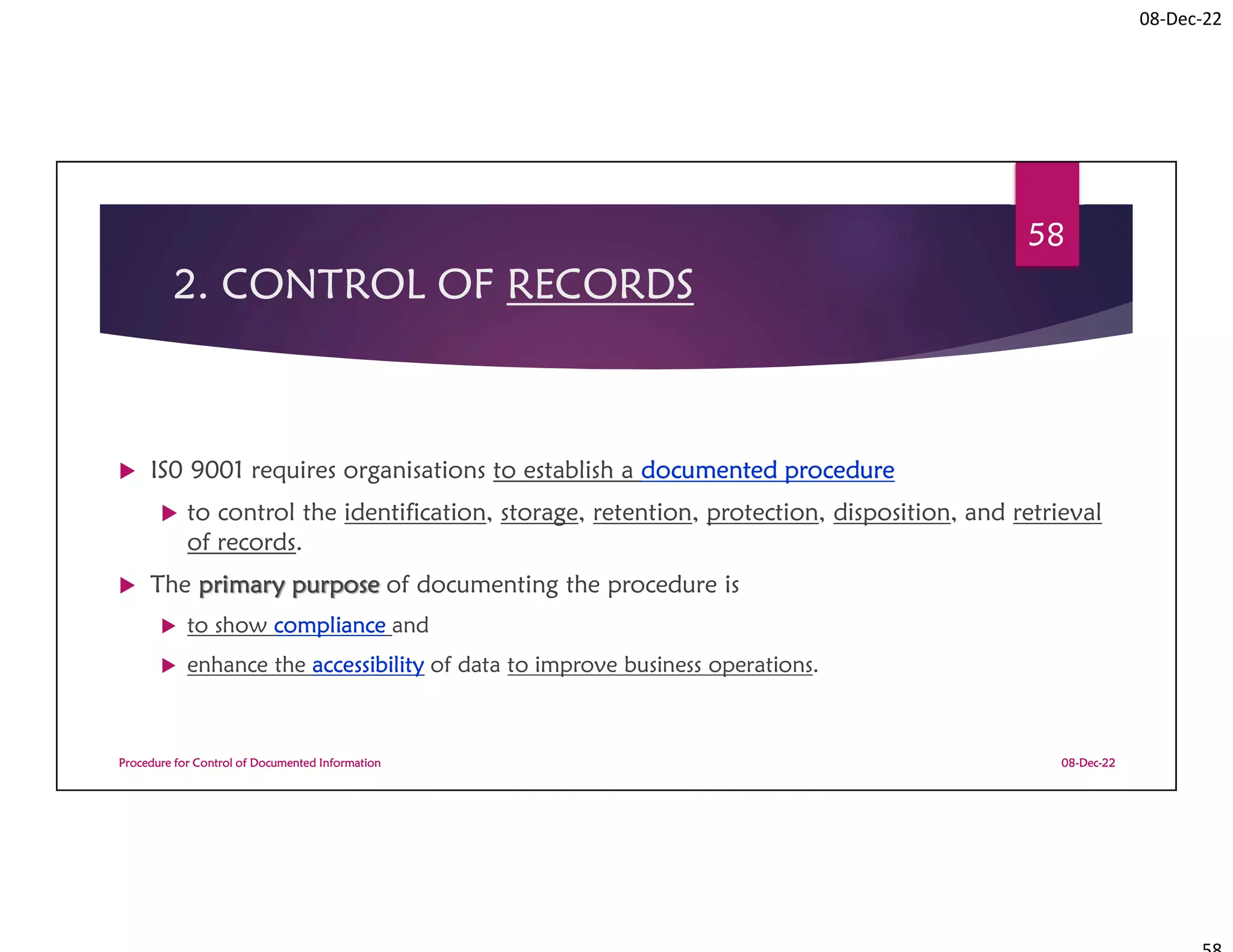
2. CONTROL OF RECORDS
 IS0 9001 requires organisations to establish a documented procedure
 to control the identification, storage, retention, protection, disposition, and retrieval
of records.
 The primary purpose of documenting the procedure is
 to show compliance and
 enhance the accessibility of data to improve business operations.
08-Dec-22
Procedure for Control of Documented Information
58
08-Dec-22
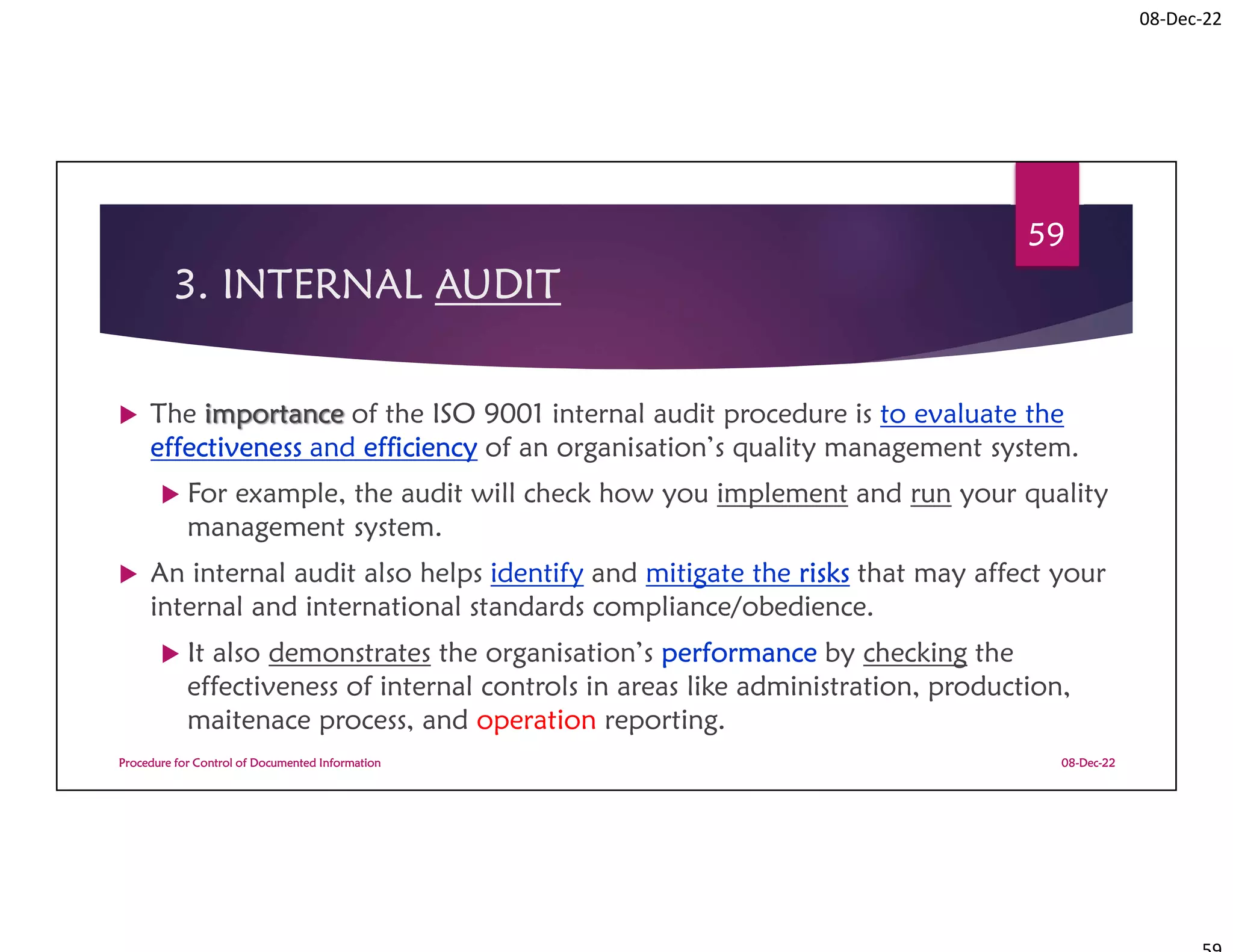
3. INTERNAL AUDIT
 The importance of the ISO 9001 internal audit procedure is to evaluate the
effectiveness and efficiency of an organisation’s quality management system.
 For example, the audit will check how you implement and run your quality
management system.
 An internal audit also helps identify and mitigate the risks that may affect your
internal and international standards compliance/obedience.
 It also demonstrates the organisation’s performance by checking the
effectiveness of internal controls in areas like administration, production,
maitenace process, and operation reporting.
08-Dec-22
Procedure for Control of Documented Information
59
08-Dec-22
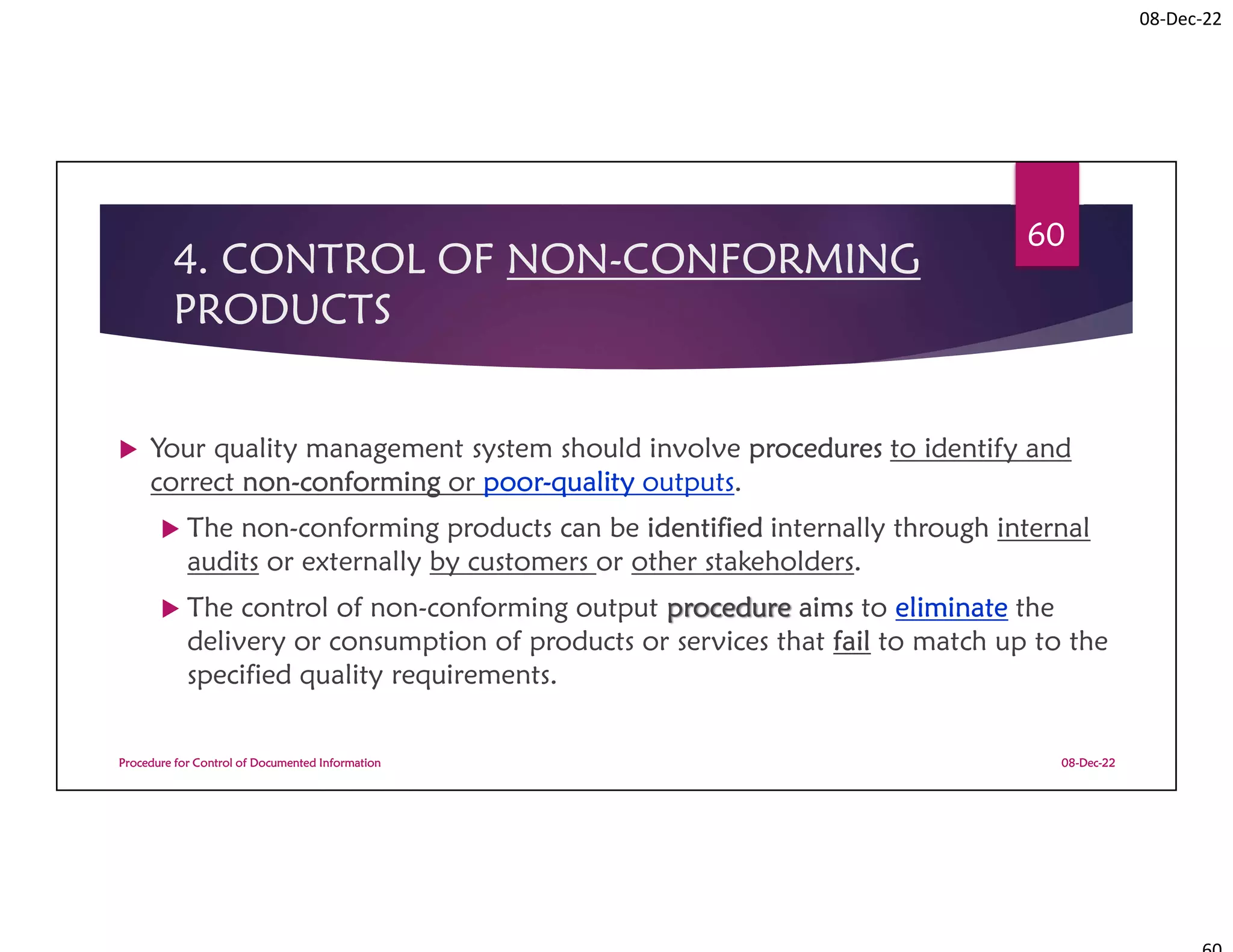
4. CONTROL OF NON-CONFORMING
PRODUCTS
 Your quality management system should involve procedures to identify and
correct non-conforming or poor-quality outputs.
 The non-conforming products can be identified internally through internal
audits or externally by customers or other stakeholders.
 The control of non-conforming output procedure aims to eliminate the
delivery or consumption of products or services that fail to match up to the
specified quality requirements.
08-Dec-22
Procedure for Control of Documented Information
60
08-Dec-22
5. CORRECTIVE ACTION
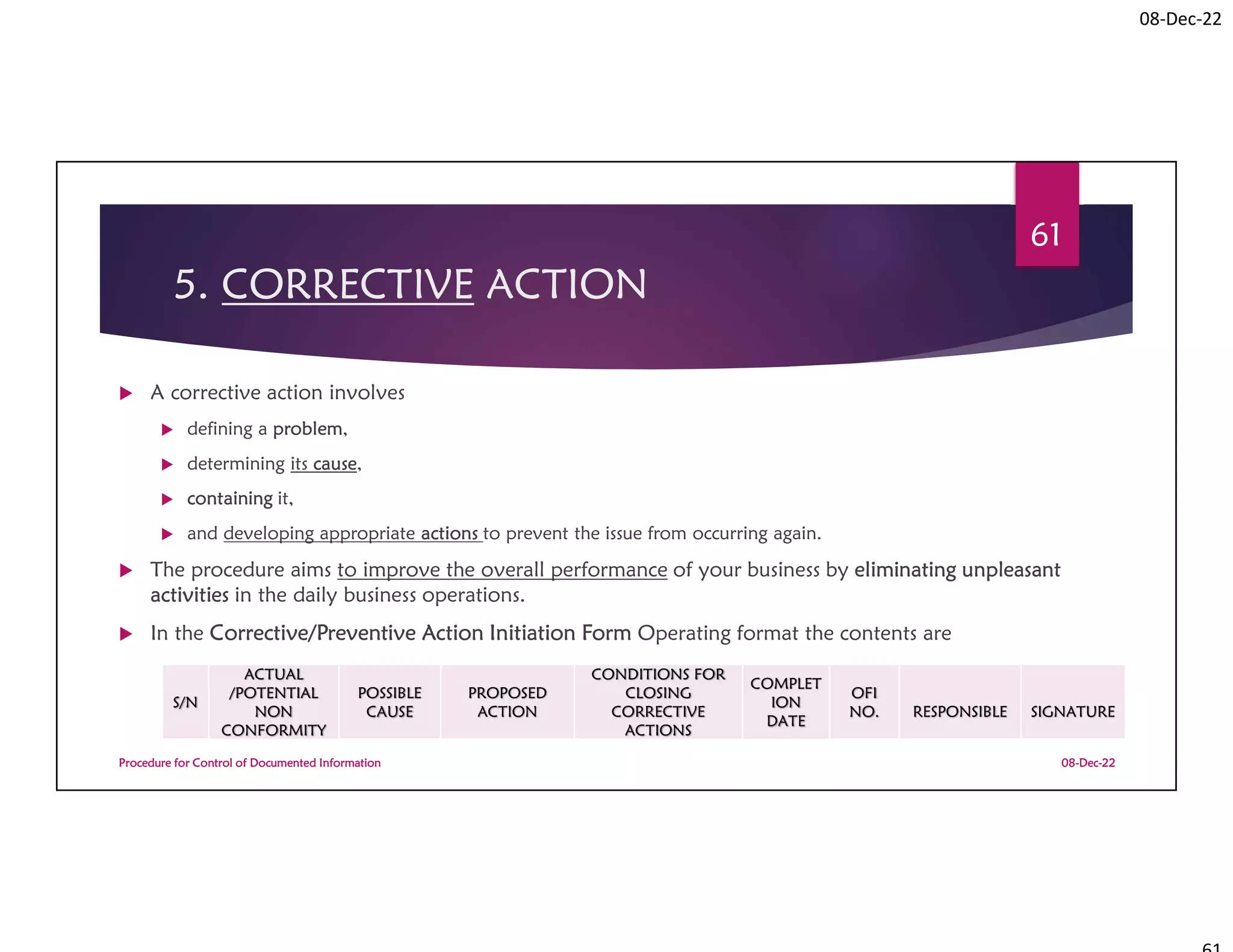
 A corrective action involves
 defining a problem,
 determining its cause,
 containing it,
 and developing appropriate actions to prevent the issue from occurring again.
 The procedure aims to improve the overall performance of your business by eliminating unpleasant
activities in the daily business operations.
 In the Corrective/Preventive Action Initiation Form Operating format the contents are
08-Dec-22
Procedure for Control of Documented Information
61
S/N
ACTUAL
/POTENTIAL
NON
CONFORMITY
POSSIBLE
CAUSE
PROPOSED
ACTION
CONDITIONS FOR
CLOSING
CORRECTIVE
ACTIONS
COMPLET
ION
DATE
OFI
NO. RESPONSIBLE SIGNATURE
08-Dec-22
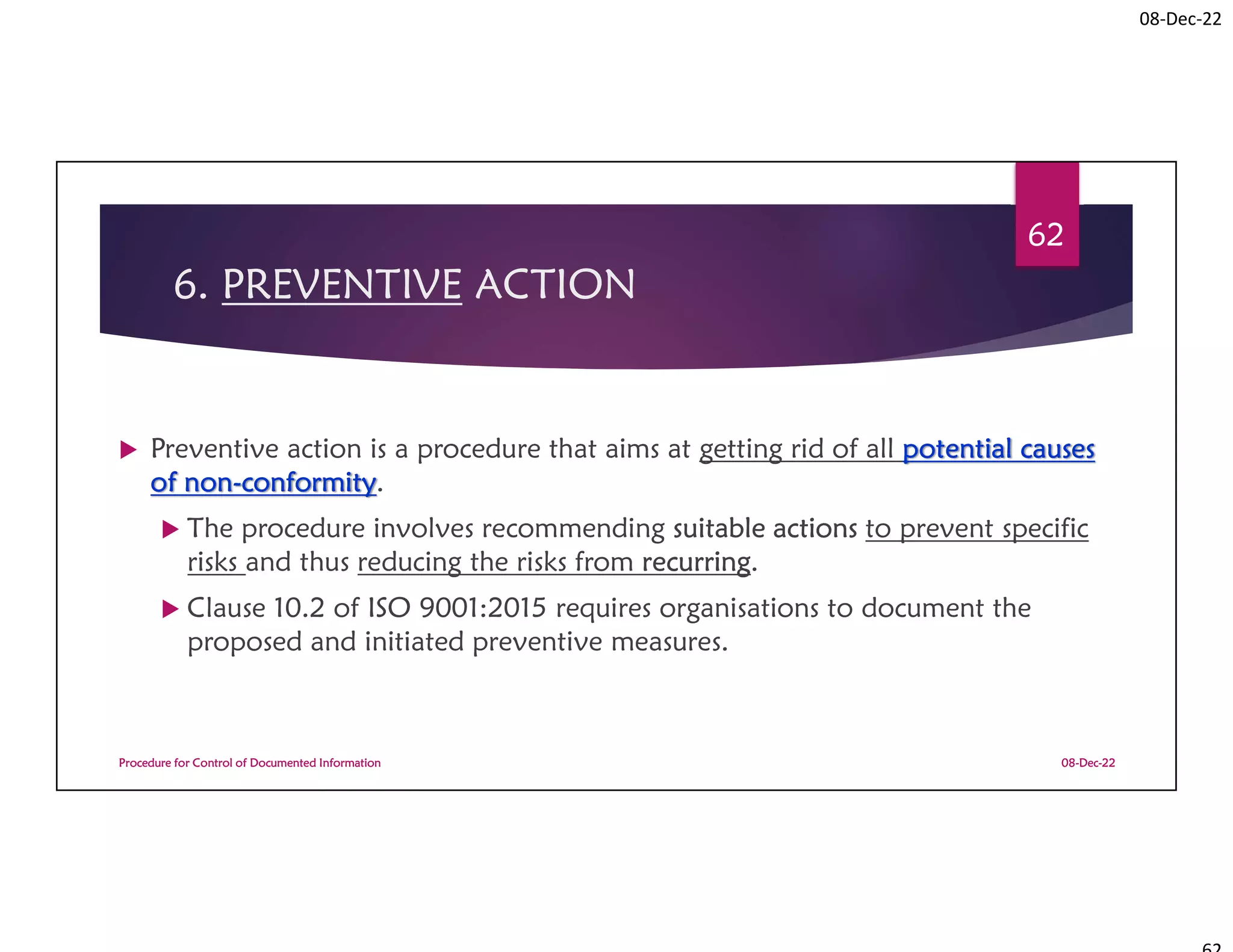
6. PREVENTIVE ACTION
 Preventive action is a procedure that aims at getting rid of all potential causes
of non-conformity.
 The procedure involves recommending suitable actions to prevent specific
risks and thus reducing the risks from recurring.
 Clause 10.2 of ISO 9001:2015 requires organisations to document the
proposed and initiated preventive measures.
08-Dec-22
Procedure for Control of Documented Information
62
08-Dec-22
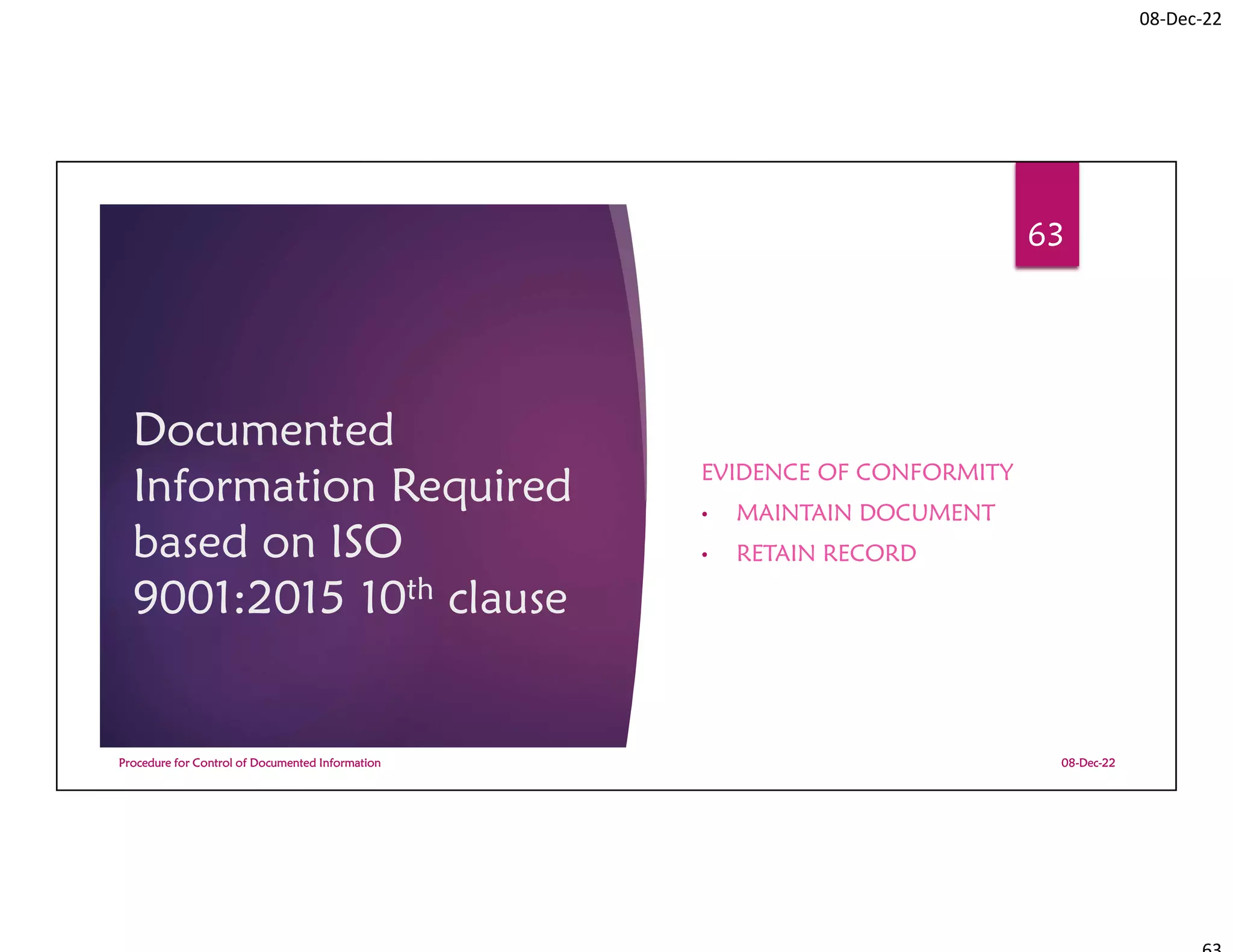
Documented
Information Required
based on ISO
9001:2015 10th clause
EVIDENCE OF CONFORMITY
• MAINTAIN DOCUMENT
• RETAIN RECORD
08-Dec-22
Procedure for Control of Documented Information
63
08-Dec-22
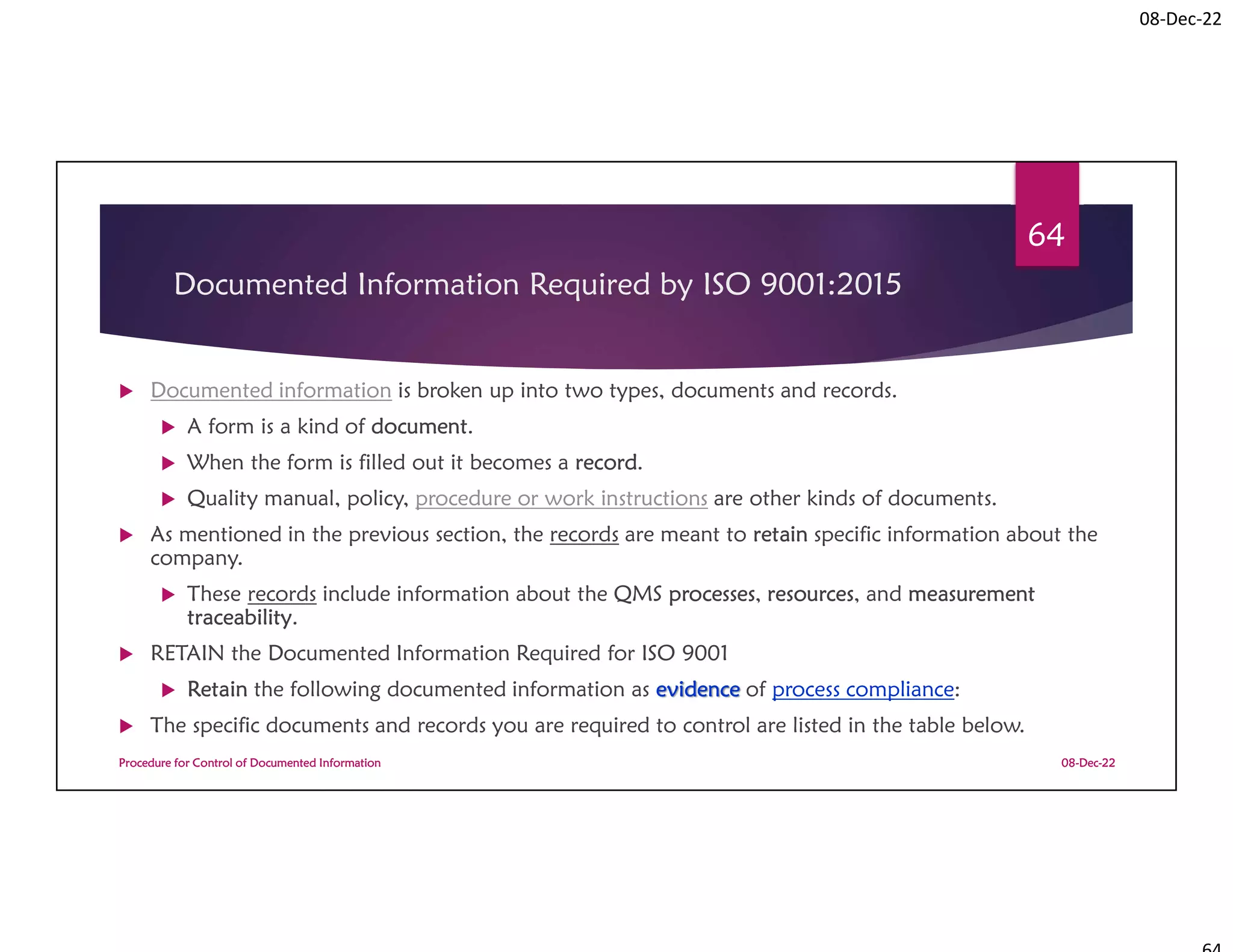
Documented Information Required by ISO 9001:2015
 Documented information is broken up into two types, documents and records.
 A form is a kind of document.
 When the form is filled out it becomes a record.
 Quality manual, policy, procedure or work instructions are other kinds of documents.
 As mentioned in the previous section, the records are meant to retain specific information about the
company.
 These records include information about the QMS processes, resources, and measurement
traceability.
 RETAIN the Documented Information Required for ISO 9001
 Retain the following documented information as evidence of process compliance:
 The specific documents and records you are required to control are listed in the table below.
08-Dec-22
Procedure for Control of Documented Information
64
08-Dec-22
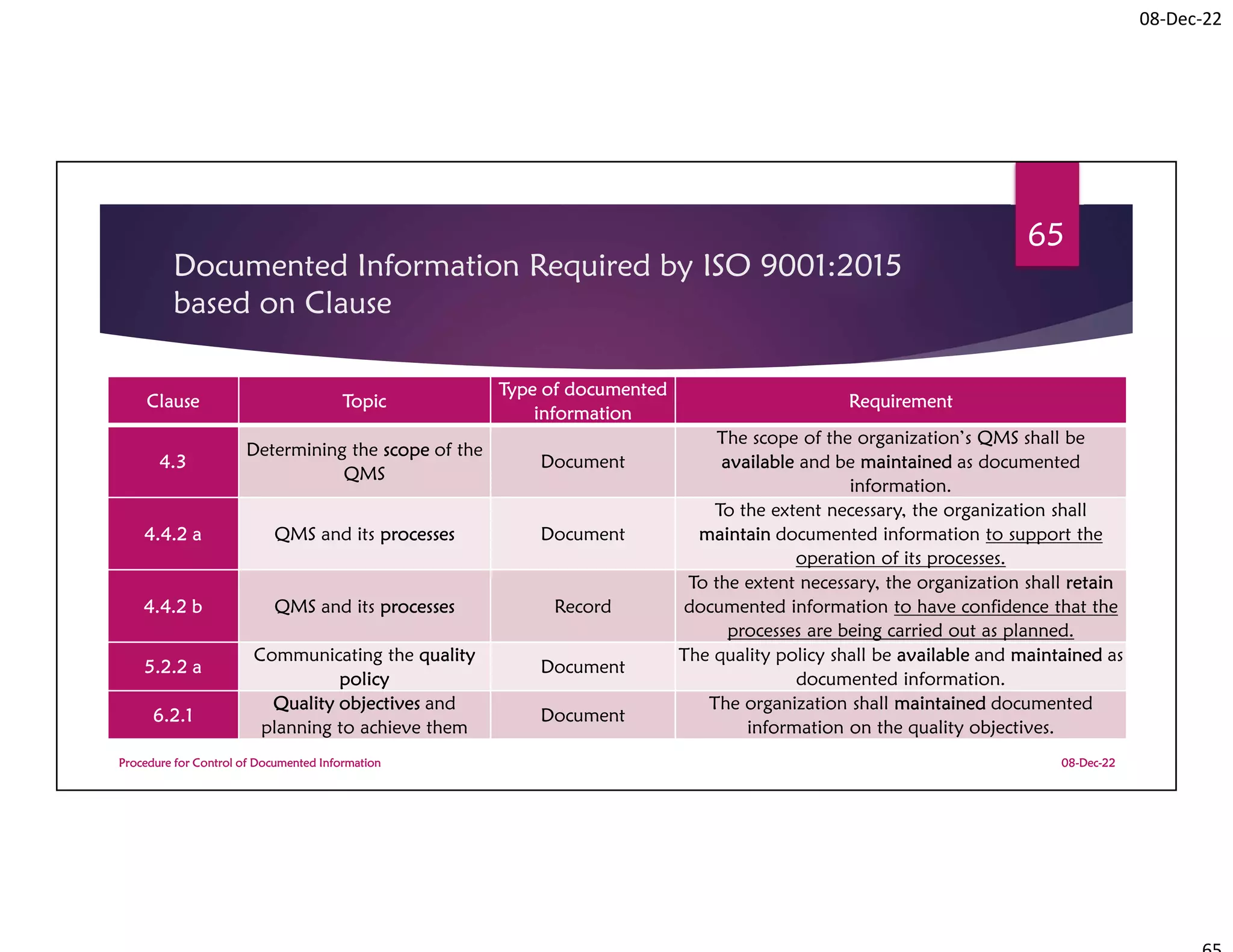
Documented Information Required by ISO 9001:2015
based on Clause
08-Dec-22
Procedure for Control of Documented Information
65
Clause Topic
Type of documented
information
Requirement
4.3
Determining the scope of the
QMS
Document
The scope of the organization’s QMS shall be
available and be maintained as documented
information.
4.4.2 a QMS and its processes Document
To the extent necessary, the organization shall
maintain documented information to support the
operation of its processes.
4.4.2 b QMS and its processes Record
To the extent necessary, the organization shall retain
documented information to have confidence that the
processes are being carried out as planned.
5.2.2 a
Communicating the quality
policy
Document
The quality policy shall be available and maintained as
documented information.
6.2.1
Quality objectives and
planning to achieve them
Document
The organization shall maintained documented
information on the quality objectives.
08-Dec-22
Documented Information Required by ISO 9001:2015
based on Clause
08-Dec-22
Procedure for Control of Documented Information
66
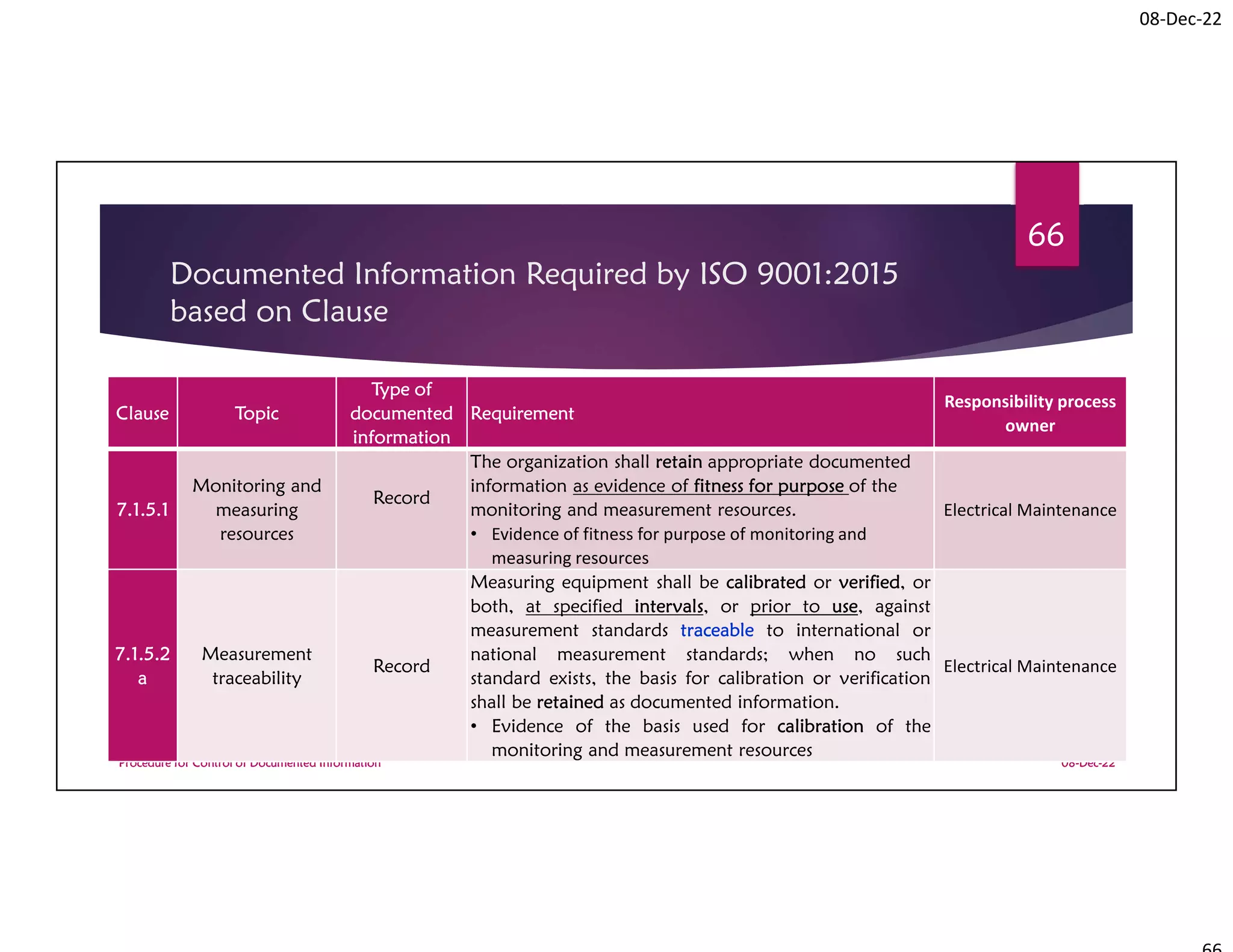
Clause Topic
Type of
documented
information
Requirement
Responsibility process
owner
7.1.5.1
Monitoring and
measuring
resources
Record
The organization shall retain appropriate documented
information as evidence of fitness for purpose of the
monitoring and measurement resources.
• Evidence of fitness for purpose of monitoring and
measuring resources
Electrical Maintenance
7.1.5.2
a
Measurement
traceability
Record
Measuring equipment shall be calibrated or verified, or
both, at specified intervals, or prior to use, against
measurement standards traceable to international or
national measurement standards; when no such
standard exists, the basis for calibration or verification
shall be retained as documented information.
• Evidence of the basis used for calibration of the
monitoring and measurement resources
Electrical Maintenance
08-Dec-22
Documented Information Required by ISO 9001:2015
based on Clause
08-Dec-22
Procedure for Control of Documented Information
67
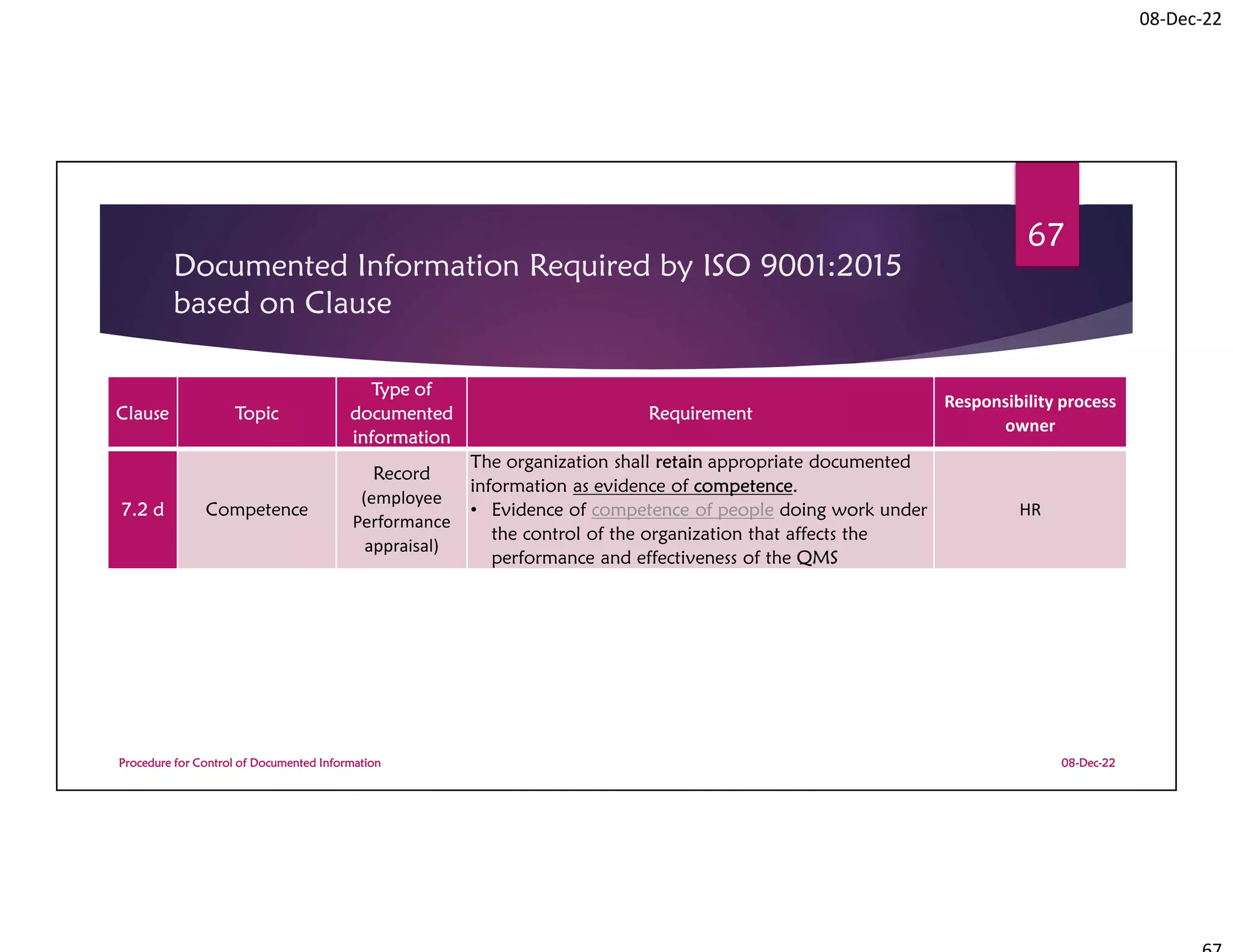
Clause Topic
Type of
documented
information
Requirement
Responsibility process
owner
7.2 d Competence
Record
(employee
Performance
appraisal)
The organization shall retain appropriate documented
information as evidence of competence.
• Evidence of competence of people doing work under
the control of the organization that affects the
performance and effectiveness of the QMS
HR
08-Dec-22
Documented Information Required by ISO 9001:2015
based on Clause
08-Dec-22
Procedure for Control of Documented Information
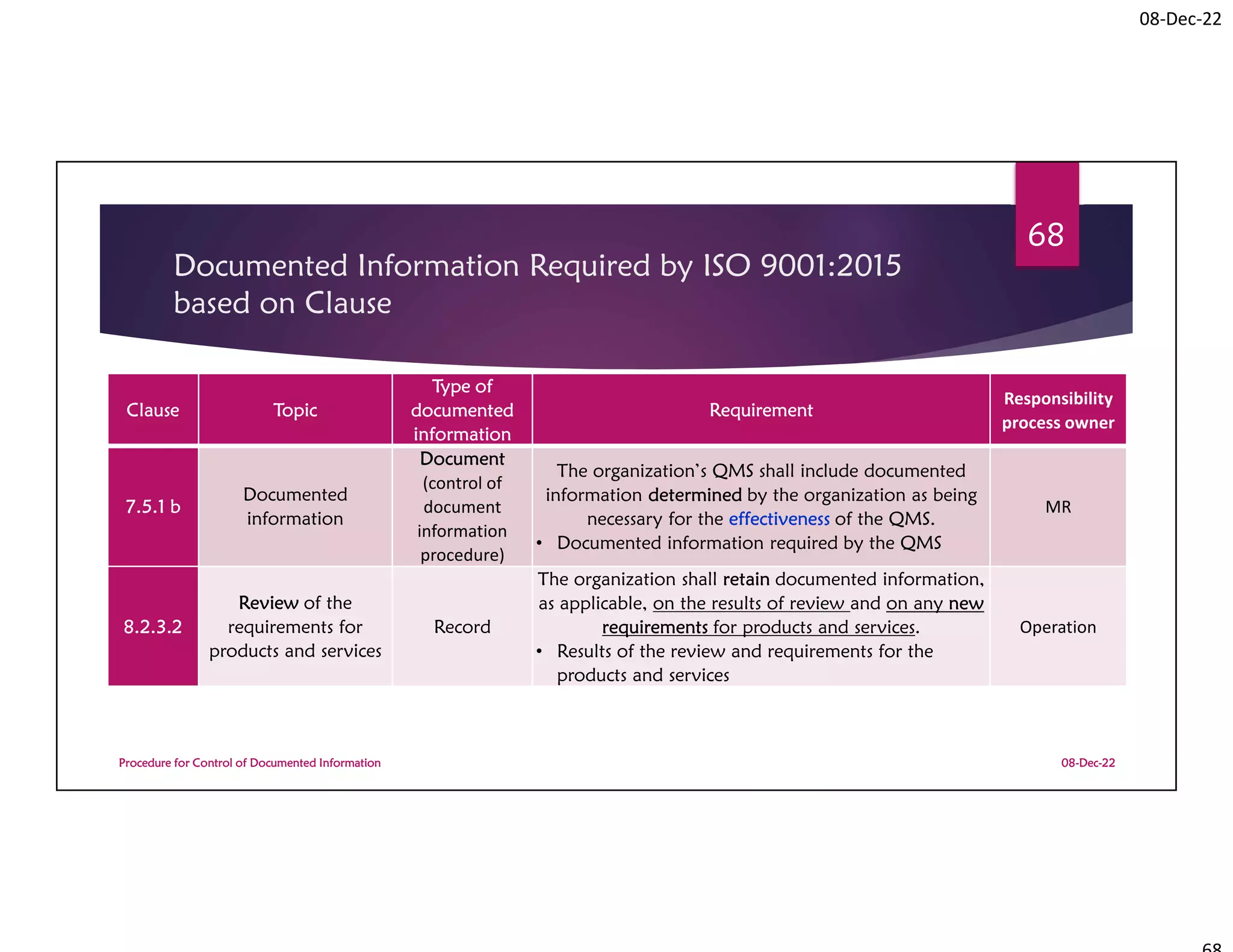
68
Clause Topic
Type of
documented
information
Requirement
Responsibility
process owner
7.5.1 b
Documented
information
Document
(control of
document
information
procedure)
The organization’s QMS shall include documented
information determined by the organization as being
necessary for the effectiveness of the QMS.
• Documented information required by the QMS
MR
8.2.3.2
Review of the
requirements for
products and services
Record
The organization shall retain documented information,
as applicable, on the results of review and on any new
requirements for products and services.
• Results of the review and requirements for the
products and services
Operation
08-Dec-22
Documented Information Required by
ISO 9001:2015 based on Clause
08-Dec-22
Procedure for Control of Documented Information
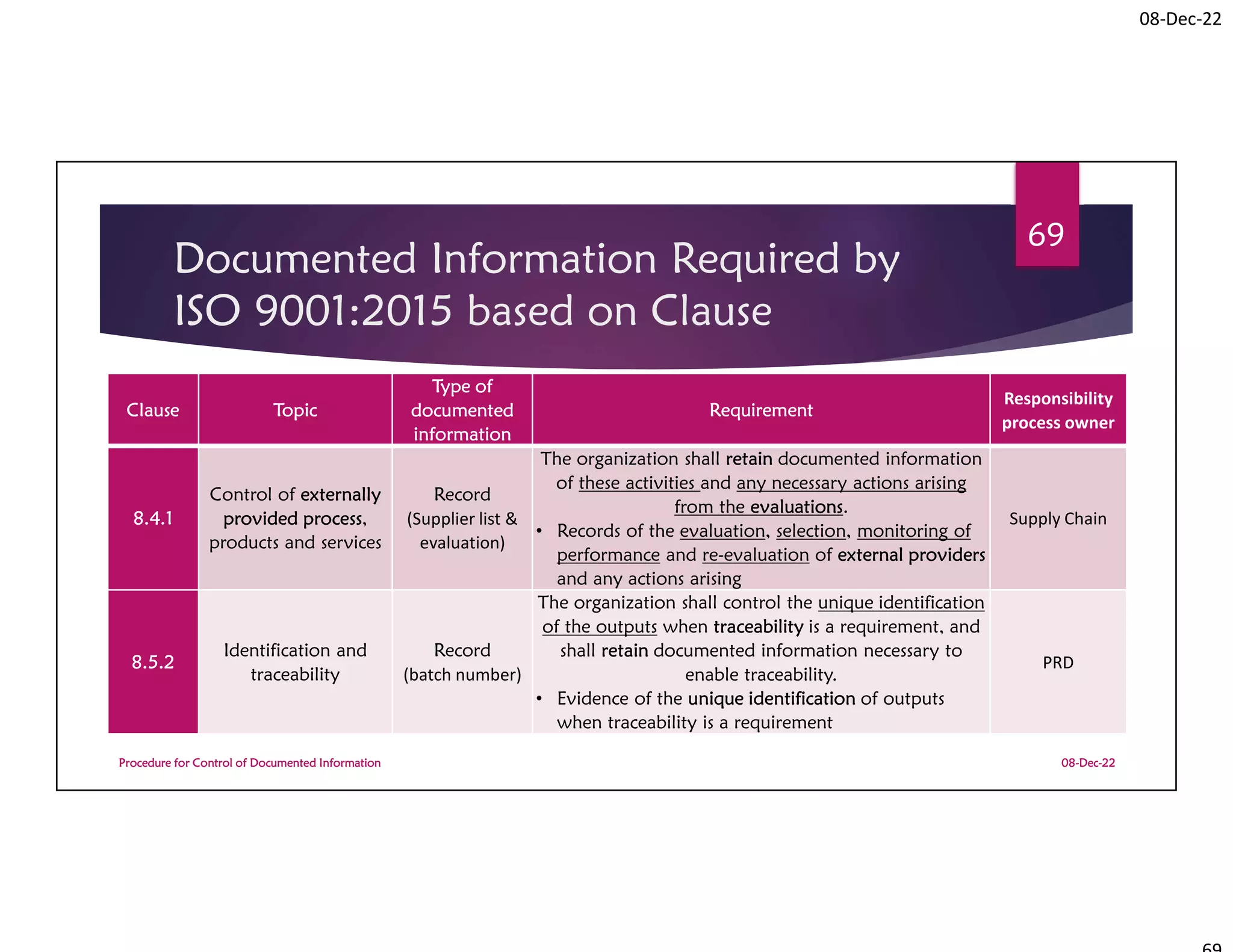
69
Clause Topic
Type of
documented
information
Requirement
Responsibility
process owner
8.4.1
Control of externally
provided process,
products and services
Record
(Supplier list &
evaluation)
The organization shall retain documented information
of these activities and any necessary actions arising
from the evaluations.
• Records of the evaluation, selection, monitoring of
performance and re-evaluation of external providers
and any actions arising
Supply Chain
8.5.2
Identification and
traceability
Record
(batch number)
The organization shall control the unique identification
of the outputs when traceability is a requirement, and
shall retain documented information necessary to
enable traceability.
• Evidence of the unique identification of outputs
when traceability is a requirement
PRD
08-Dec-22
Documented Information Required by
ISO 9001:2015 based on Clause
08-Dec-22
Procedure for Control of Documented Information
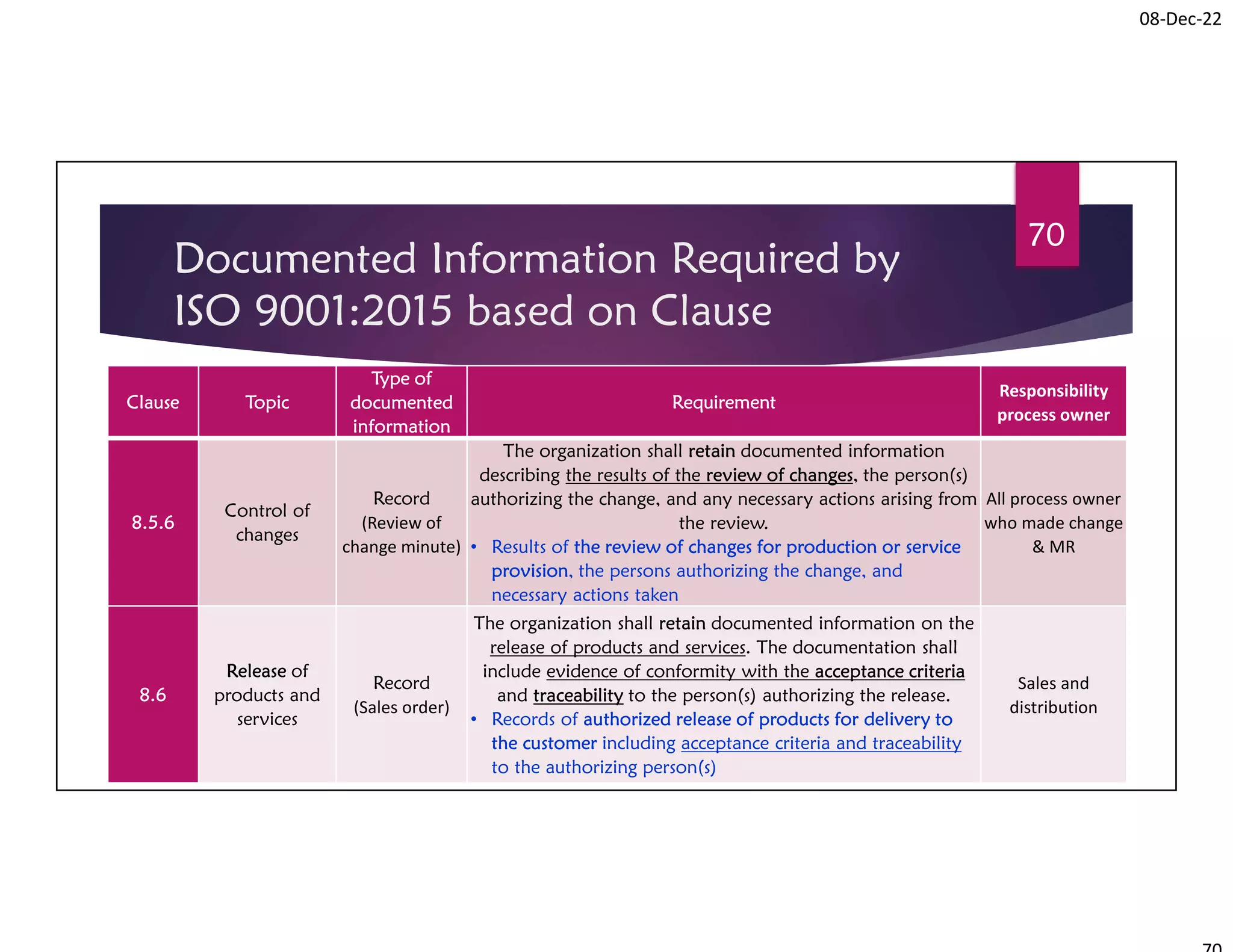
70
Clause Topic
Type of
documented
information
Requirement
Responsibility
process owner
8.5.6
Control of
changes
Record
(Review of
change minute)
The organization shall retain documented information
describing the results of the review of changes, the person(s)
authorizing the change, and any necessary actions arising from
the review.
• Results of the review of changes for production or service
provision, the persons authorizing the change, and
necessary actions taken
All process owner
who made change
& MR
8.6
Release of
products and
services
Record
(Sales order)
The organization shall retain documented information on the
release of products and services. The documentation shall
include evidence of conformity with the acceptance criteria
and traceability to the person(s) authorizing the release.
• Records of authorized release of products for delivery to
the customer including acceptance criteria and traceability
to the authorizing person(s)
Sales and
distribution
08-Dec-22
Documented Information Required by
ISO 9001:2015 based on Clause
08-Dec-22
Procedure for Control of Documented Information
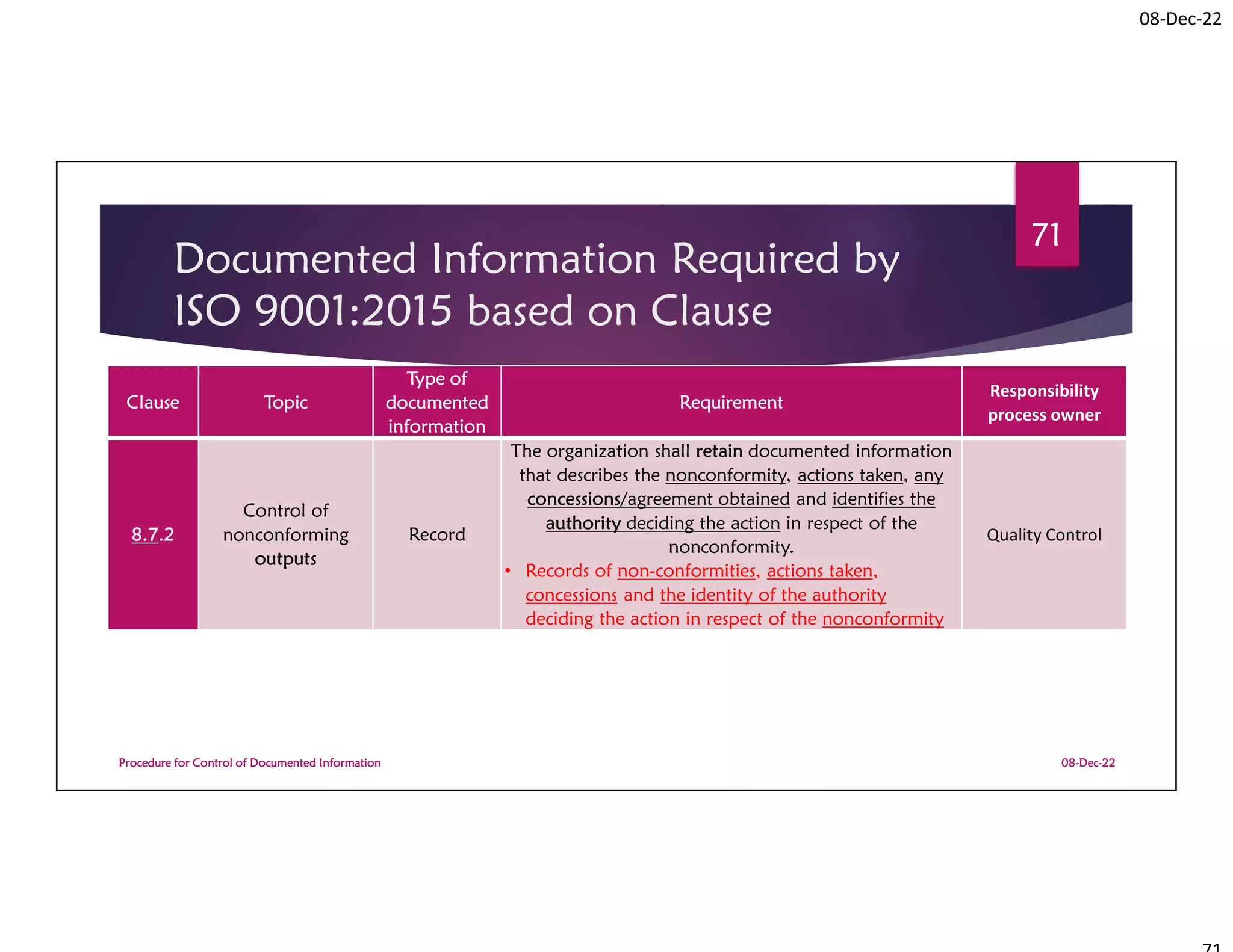
71
Clause Topic
Type of
documented
information
Requirement
Responsibility
process owner
8.7.2
Control of
nonconforming
outputs
Record
The organization shall retain documented information
that describes the nonconformity, actions taken, any
concessions/agreement obtained and identifies the
authority deciding the action in respect of the
nonconformity.
• Records of non-conformities, actions taken,
concessions and the identity of the authority
deciding the action in respect of the nonconformity
Quality Control
08-Dec-22
Documented Information Required by
ISO 9001:2015 based on Clause
08-Dec-22
Procedure for Control of Documented Information
72
Clause Topic
Type of
documented
information
Requirement
Responsibility
process owner
9.1.1
Monitoring,
measurement,
analysis and
evaluation
Record
(monthly and
annual
performance
report)
The organization shall retain documented information as
evidence of the results [of QMS performance
evaluation].
• Results of the evaluation of the performance and the
effectiveness of the QMS
All operational
report
9.2.2 f Internal audit
Record
(internal audit
program &
report)
The organization shall retain documented information as
evidence of the implementation of the audit program
and the audit results.
• Evidence of the implementation of the audit
programme and the audit results
MR
08-Dec-22
Documented Information Required by
ISO 9001:2015 based on Clause
08-Dec-22
Procedure for Control of Documented Information
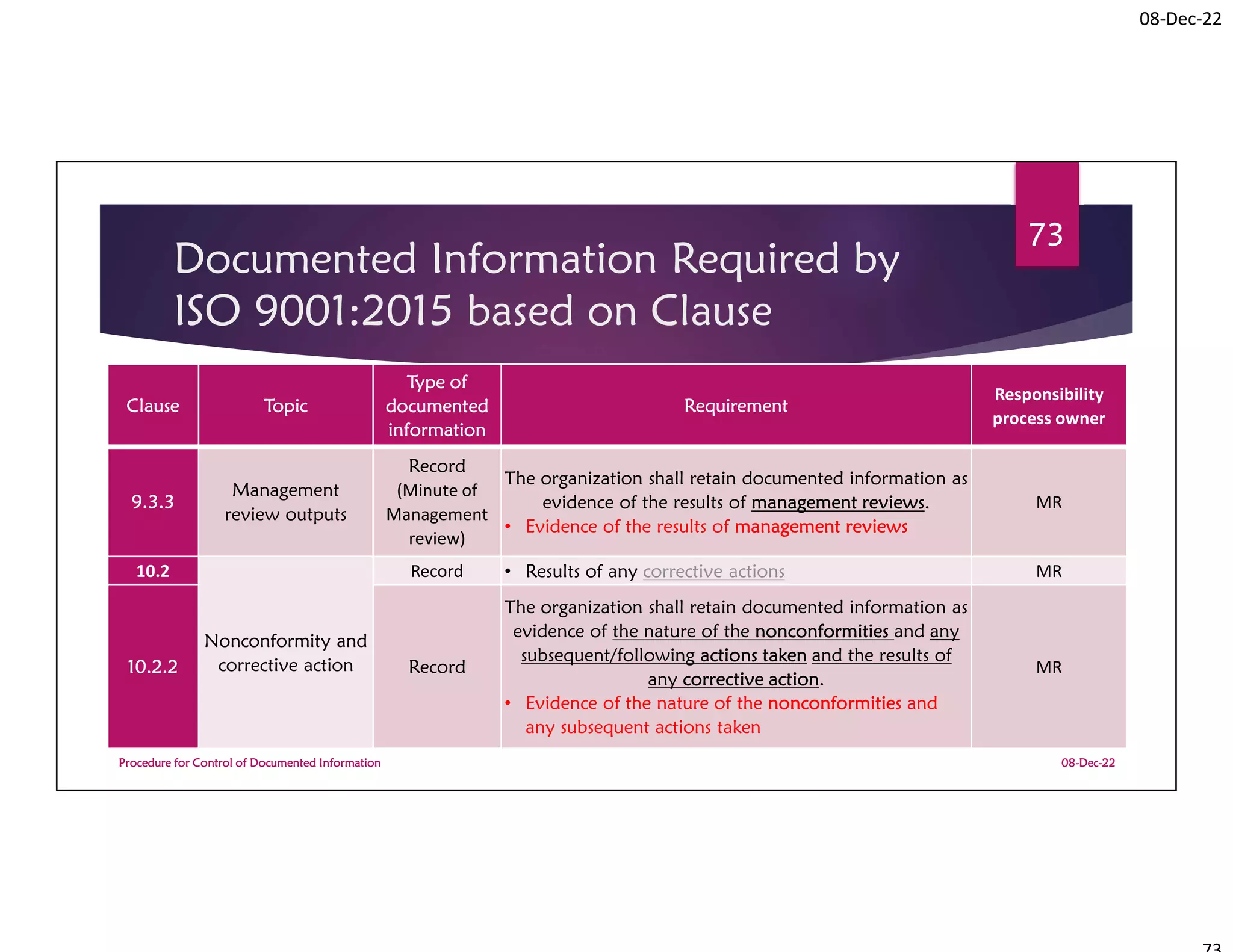
73
Clause Topic
Type of
documented
information
Requirement
Responsibility
process owner
9.3.3
Management
review outputs
Record
(Minute of
Management
review)
The organization shall retain documented information as
evidence of the results of management reviews.
• Evidence of the results of management reviews
MR
10.2
Nonconformity and
corrective action
Record • Results of any corrective actions MR
10.2.2 Record
The organization shall retain documented information as
evidence of the nature of the nonconformities and any
subsequent/following actions taken and the results of
any corrective action.
• Evidence of the nature of the nonconformities and
any subsequent actions taken
MR
08-Dec-22
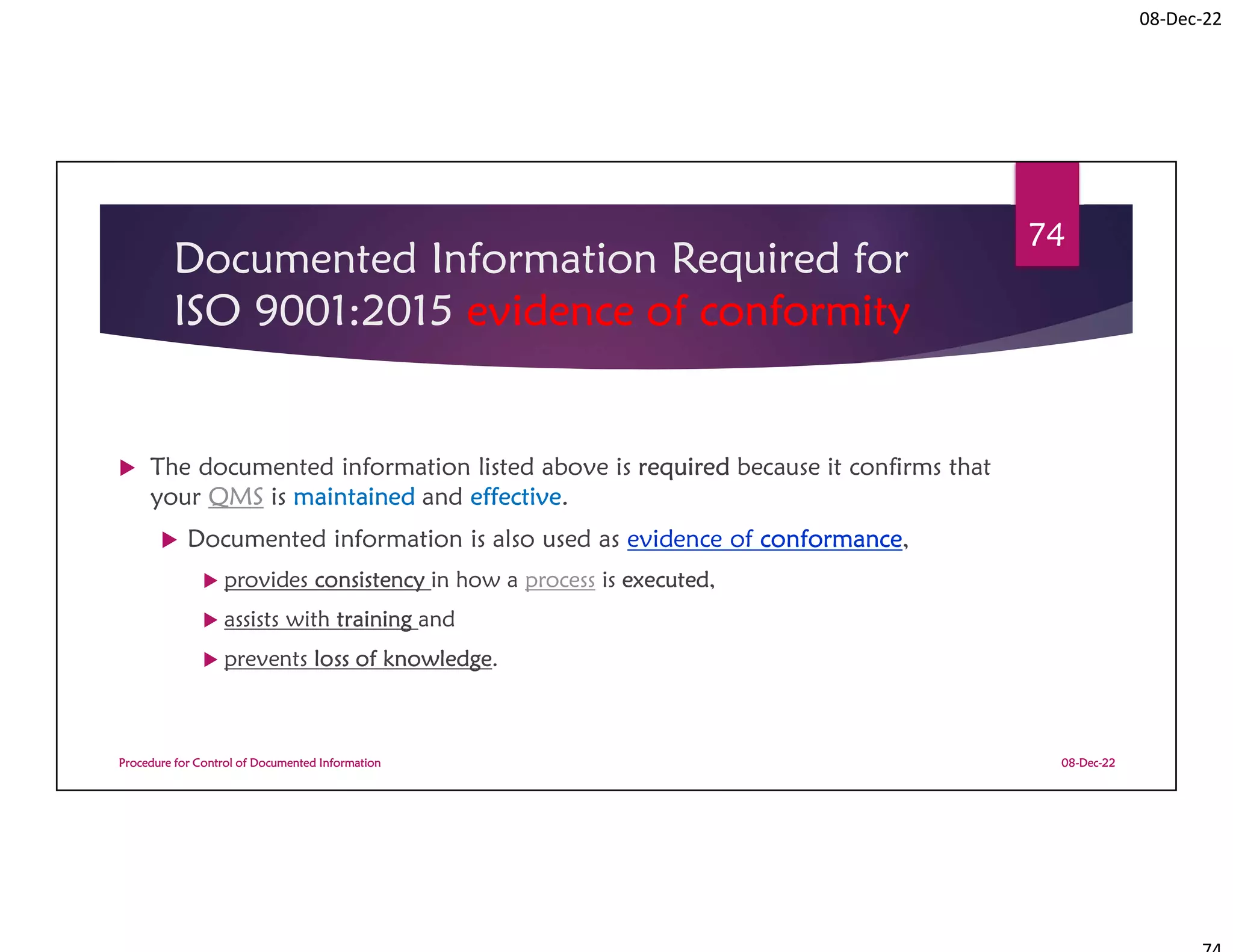
Documented Information Required for
ISO 9001:2015 evidence of conformity
 The documented information listed above is required because it confirms that
your QMS is maintained and effective.
 Documented information is also used as evidence of conformance,
 provides consistency in how a process is executed,
 assists with training and
 prevents loss of knowledge.
08-Dec-22
Procedure for Control of Documented Information
74
08-Dec-22
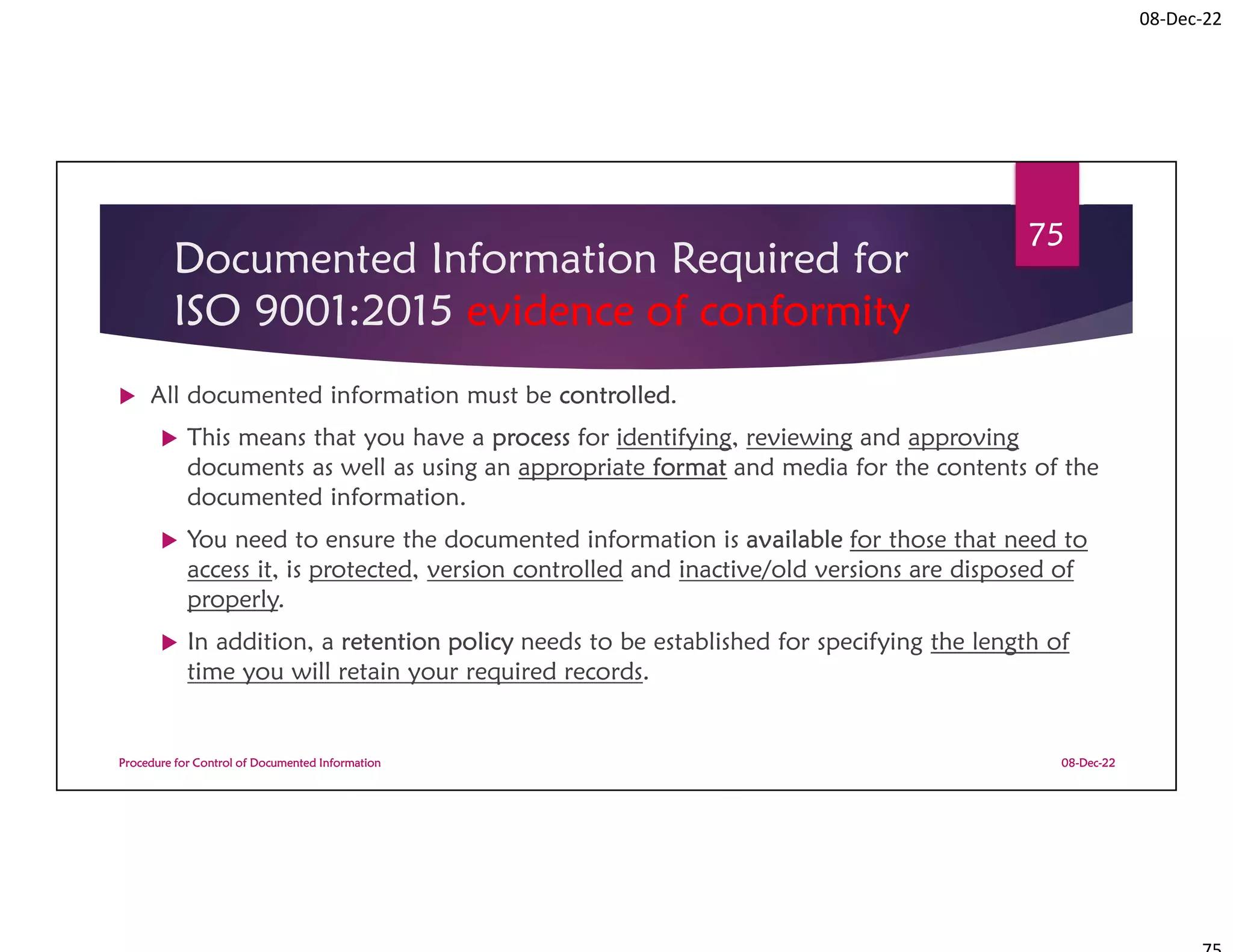
Documented Information Required for
ISO 9001:2015 evidence of conformity
 All documented information must be controlled.
 This means that you have a process for identifying, reviewing and approving
documents as well as using an appropriate format and media for the contents of the
documented information.
 You need to ensure the documented information is available for those that need to
access it, is protected, version controlled and inactive/old versions are disposed of
properly.
 In addition, a retention policy needs to be established for specifying the length of
time you will retain your required records.
08-Dec-22
Procedure for Control of Documented Information
75
08-Dec-22
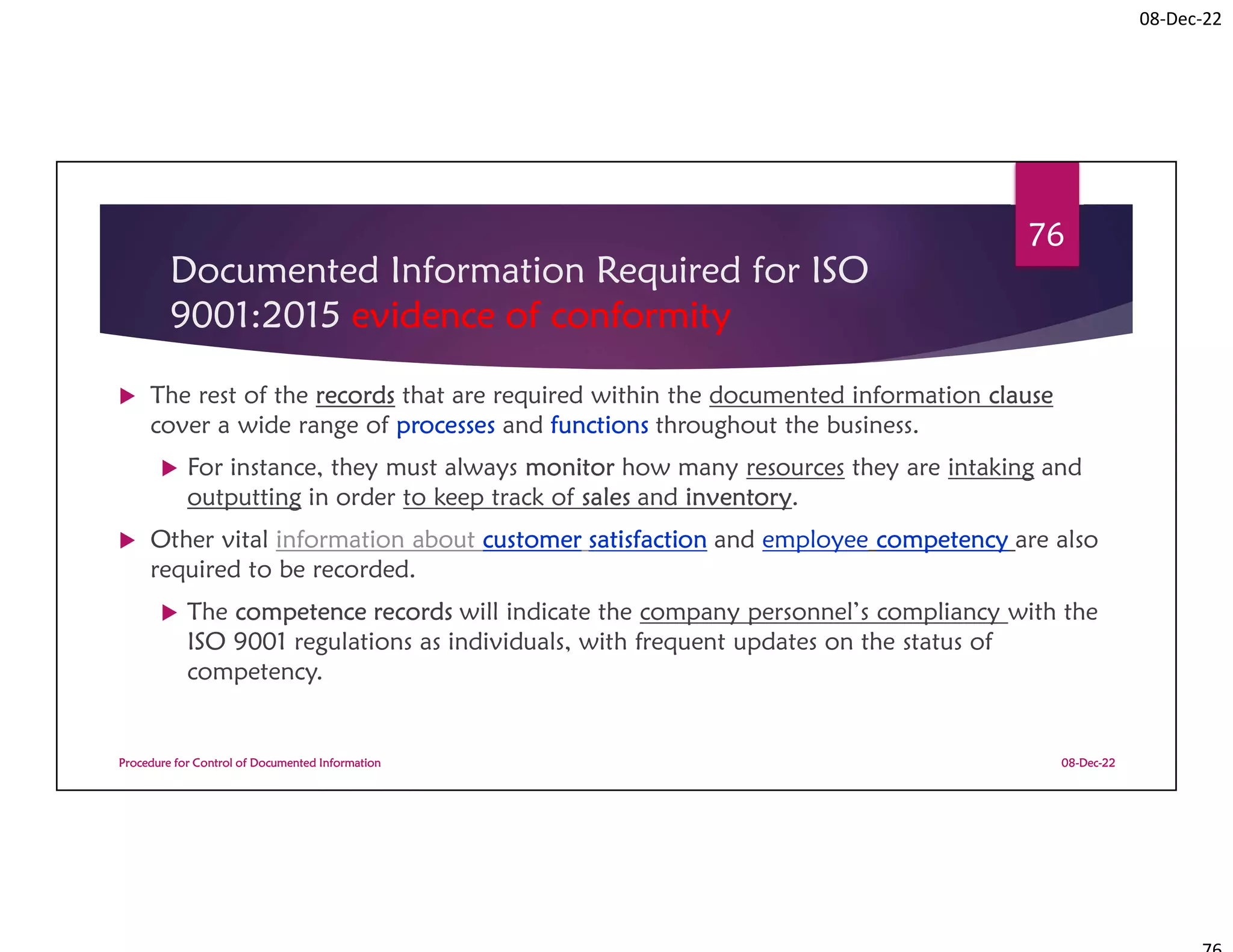
Documented Information Required for ISO
9001:2015 evidence of conformity
 The rest of the records that are required within the documented information clause
cover a wide range of processes and functions throughout the business.
 For instance, they must always monitor how many resources they are intaking and
outputting in order to keep track of sales and inventory.
 Other vital information about customer satisfaction and employee competency are also
required to be recorded.
 The competence records will indicate the company personnel’s compliancy with the
ISO 9001 regulations as individuals, with frequent updates on the status of
competency.
08-Dec-22
Procedure for Control of Documented Information
76
08-Dec-22
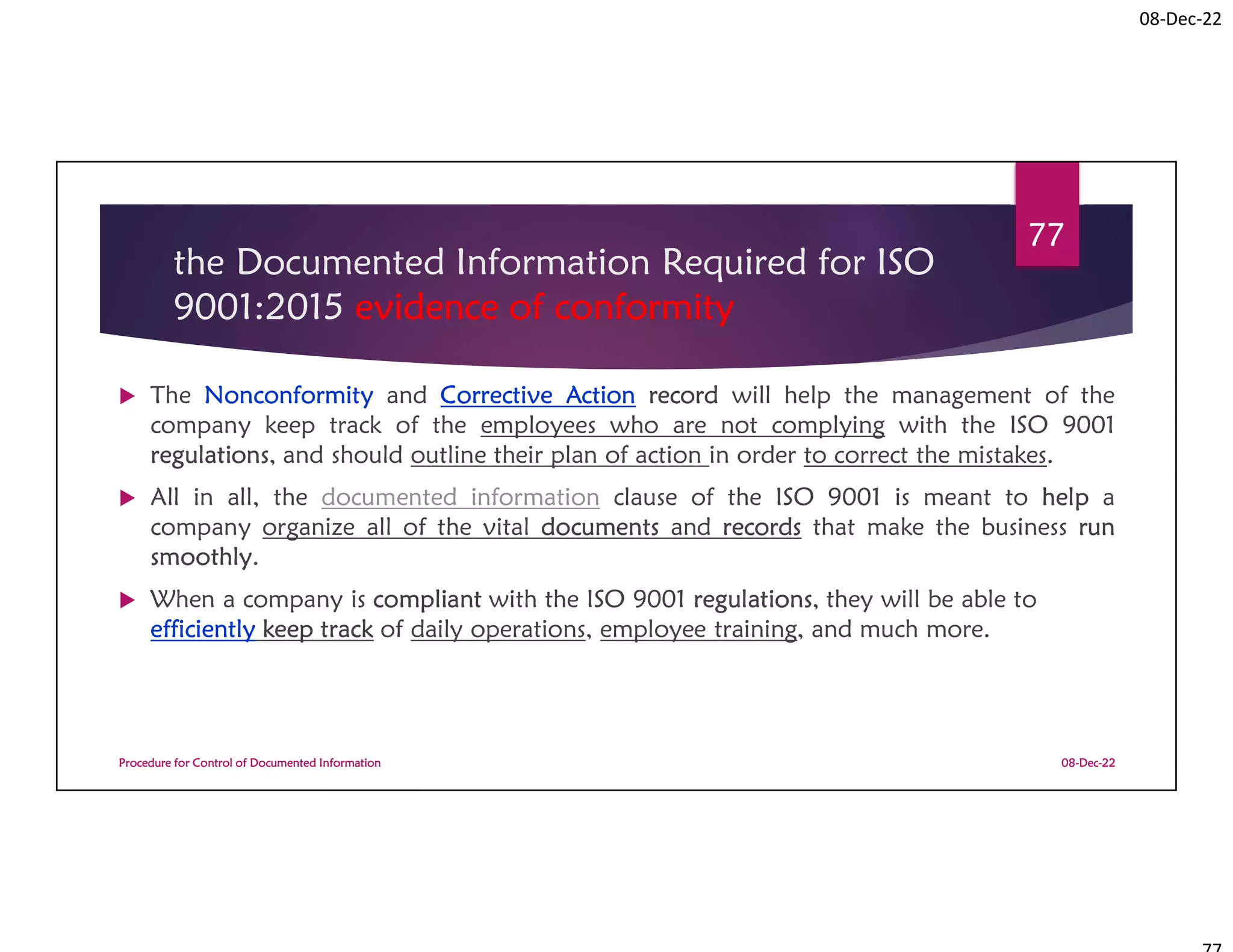
the Documented Information Required for ISO
9001:2015 evidence of conformity
 The Nonconformity and Corrective Action record will help the management of the
company keep track of the employees who are not complying with the ISO 9001
regulations, and should outline their plan of action in order to correct the mistakes.
 All in all, the documented information clause of the ISO 9001 is meant to help a
company organize all of the vital documents and records that make the business run
smoothly.
 When a company is compliant with the ISO 9001 regulations, they will be able to
efficiently keep track of daily operations, employee training, and much more.
08-Dec-22
Procedure for Control of Documented Information
77
08-Dec-22
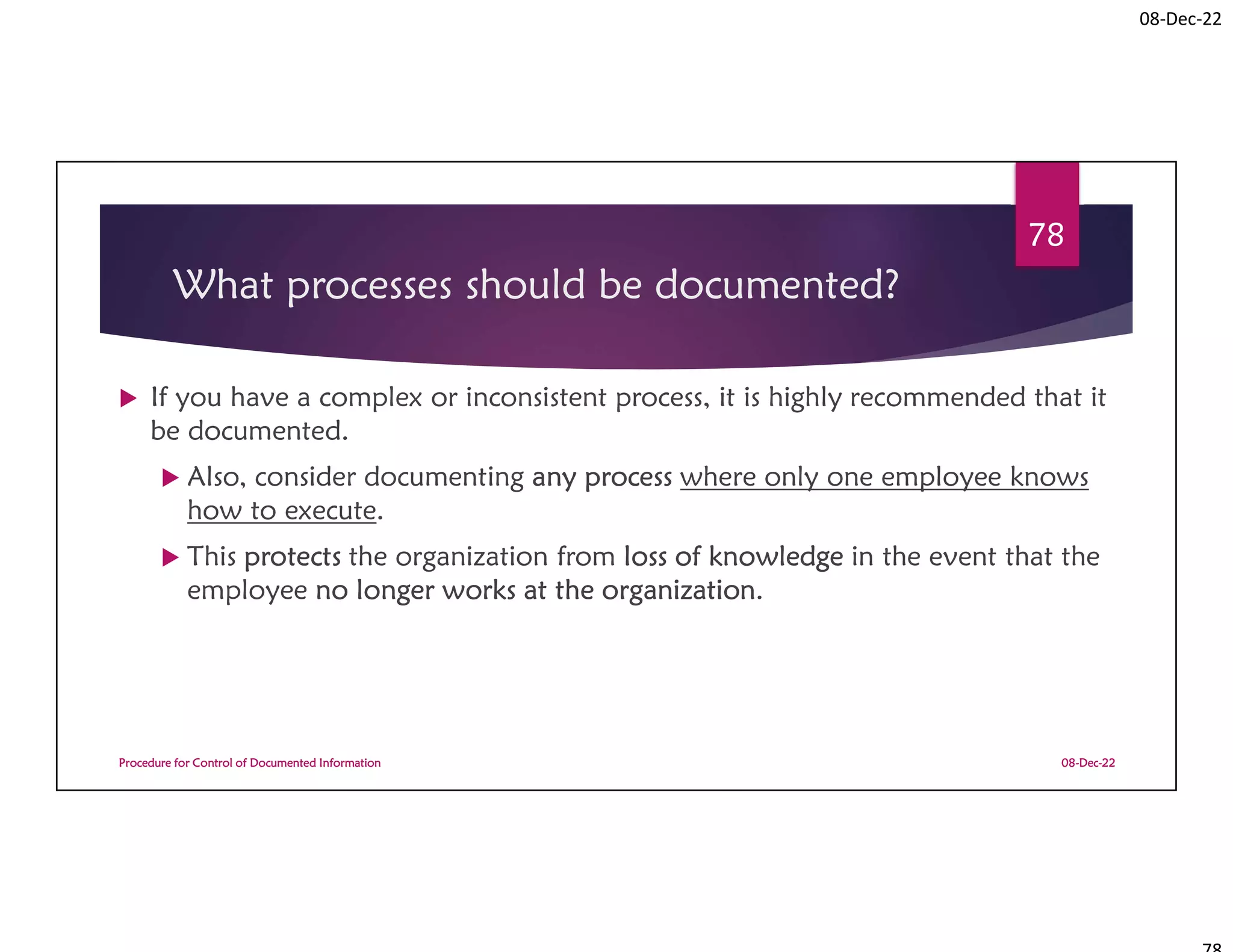
What processes should be documented?
 If you have a complex or inconsistent process, it is highly recommended that it
be documented.
 Also, consider documenting any process where only one employee knows
how to execute.
 This protects the organization from loss of knowledge in the event that the
employee no longer works at the organization.
08-Dec-22
Procedure for Control of Documented Information
78
08-Dec-22
Group Work
1. Do we need documenting our process
2. What is your documenting experiences in work place
Illustrate your Weakness and strength
08-Dec-22
Procedure for Control of Documented Information
79
08-Dec-22
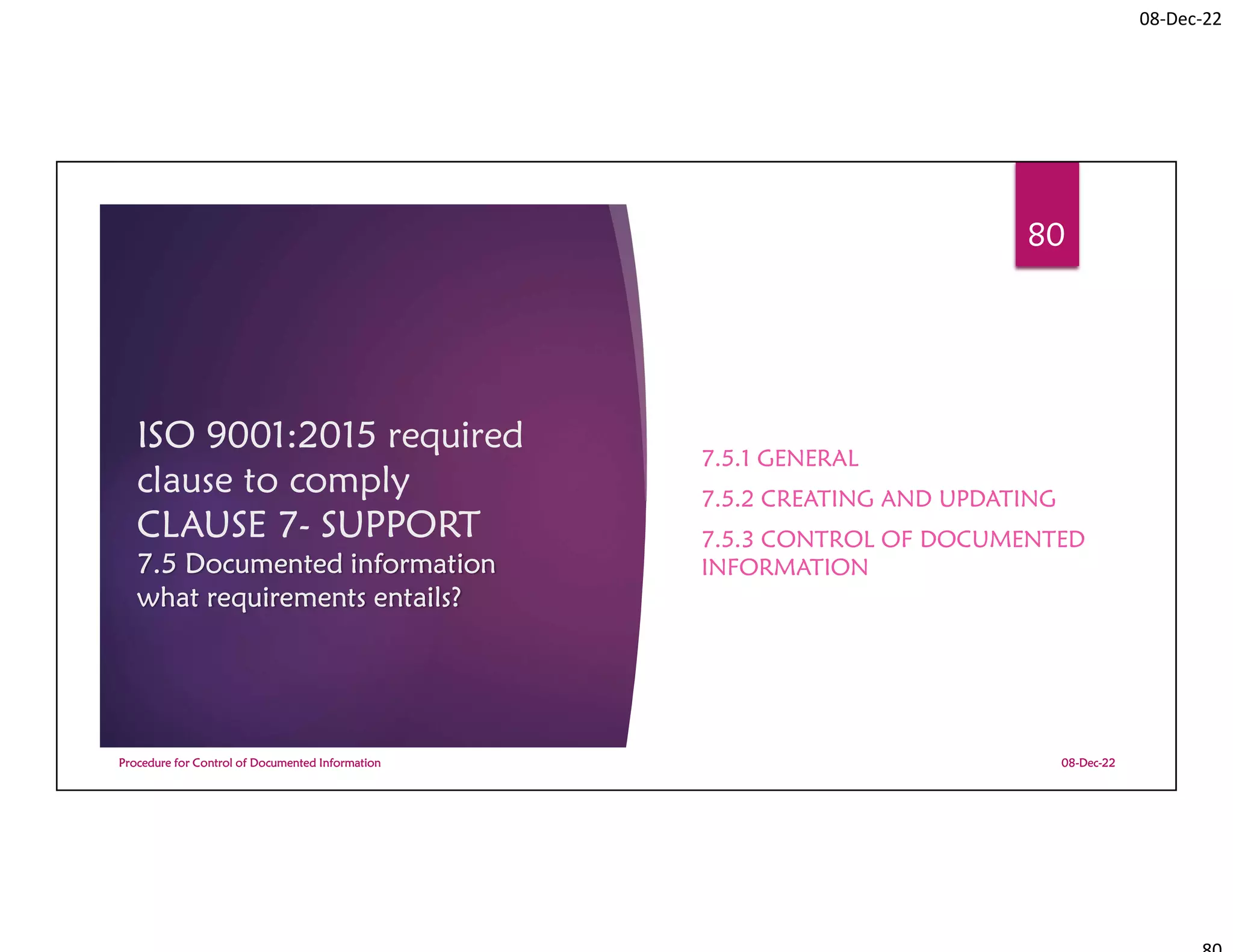
ISO 9001:2015 required
clause to comply
CLAUSE 7- SUPPORT
7.5 Documented information
what requirements entails?
7.5.1 GENERAL
7.5.2 CREATING AND UPDATING
7.5.3 CONTROL OF DOCUMENTED
INFORMATION
08-Dec-22
Procedure for Control of Documented Information
80
08-Dec-22
CLAUSE 7- SUPPORT
7.5 Documented information
what requirements entails?
7.5.1 General
7.5.2 Creating and Updating
7.5.3 Control of Documented Information
08-Dec-22
Procedure for Control of Documented Information
81
08-Dec-22
CLAUSE 7- SUPPORT
7.5 Documented information
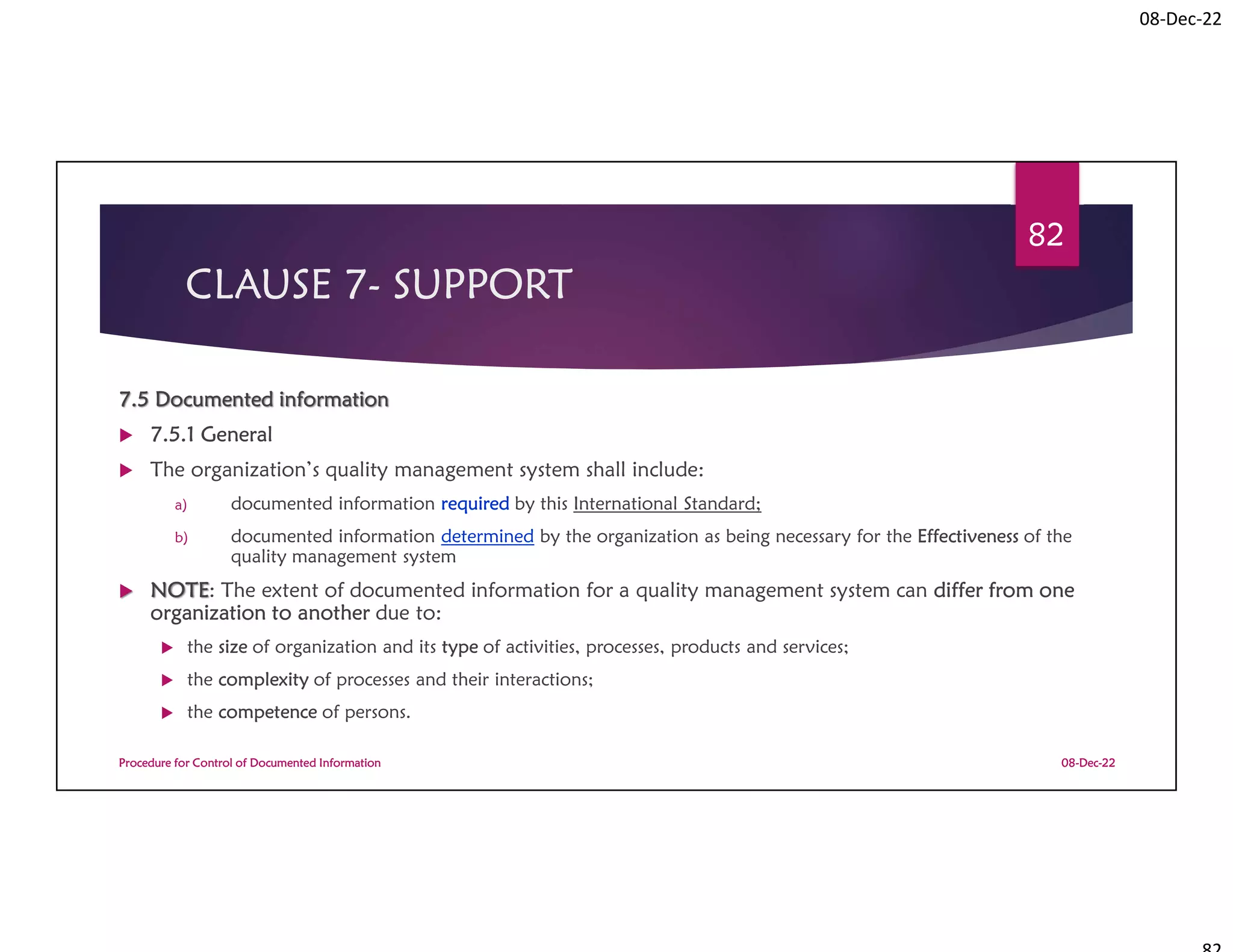
 7.5.1 General
 The organization’s quality management system shall include:
a) documented information required by this International Standard;
b) documented information determined by the organization as being necessary for the Effectiveness of the
quality management system
 NOTE: The extent of documented information for a quality management system can differ from one
organization to another due to:
 the size of organization and its type of activities, processes, products and services;
 the complexity of processes and their interactions;
 the competence of persons.
08-Dec-22
Procedure for Control of Documented Information
82
08-Dec-22
7.5.1 General
definition
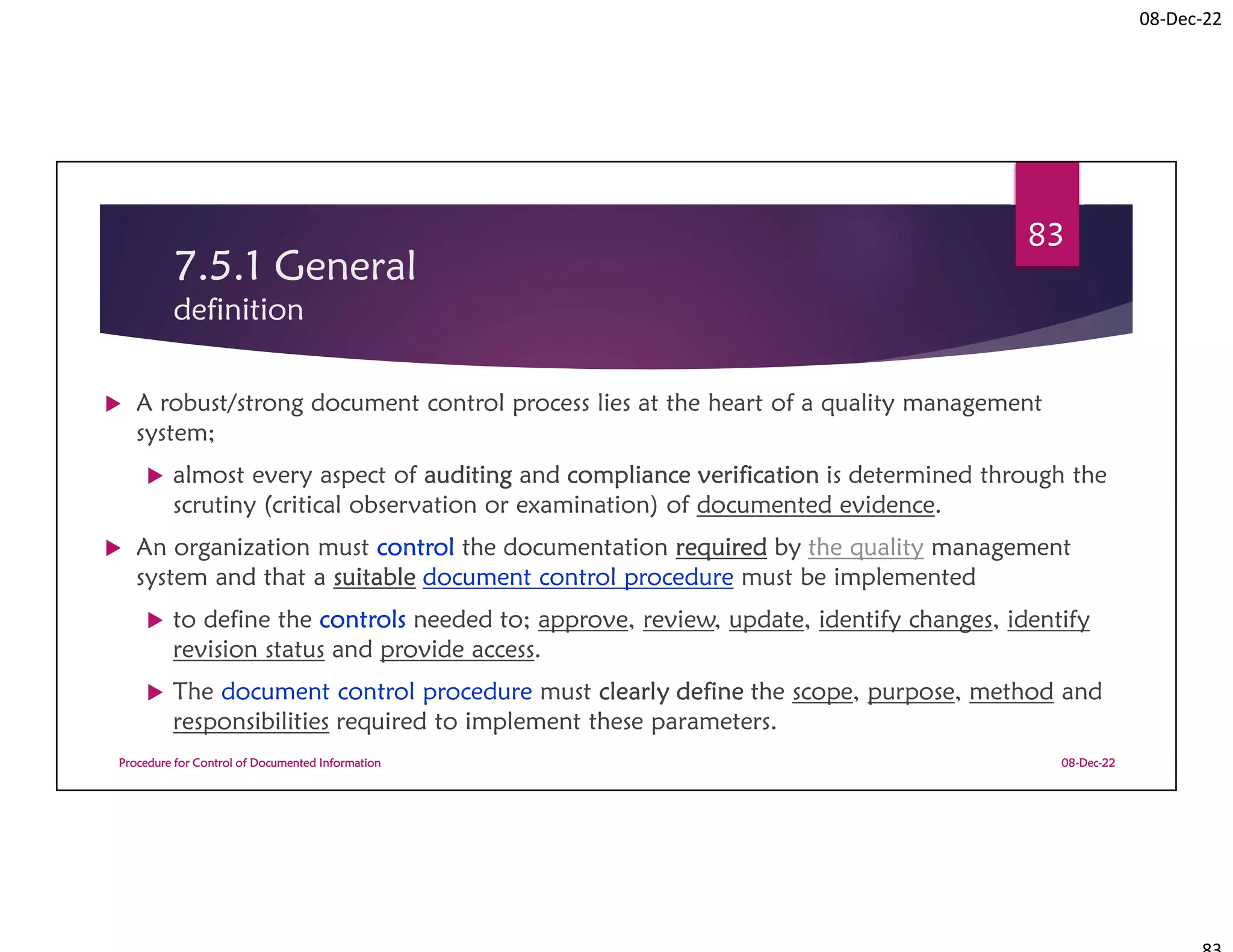
 A robust/strong document control process lies at the heart of a quality management
system;
 almost every aspect of auditing and compliance verification is determined through the
scrutiny (critical observation or examination) of documented evidence.
 An organization must control the documentation required by the quality management
system and that a suitable document control procedure must be implemented
 to define the controls needed to; approve, review, update, identify changes, identify
revision status and provide access.
 The document control procedure must clearly define the scope, purpose, method and
responsibilities required to implement these parameters.
08-Dec-22
Procedure for Control of Documented Information
83
08-Dec-22
7.5.1 General
what to must understand and communicate
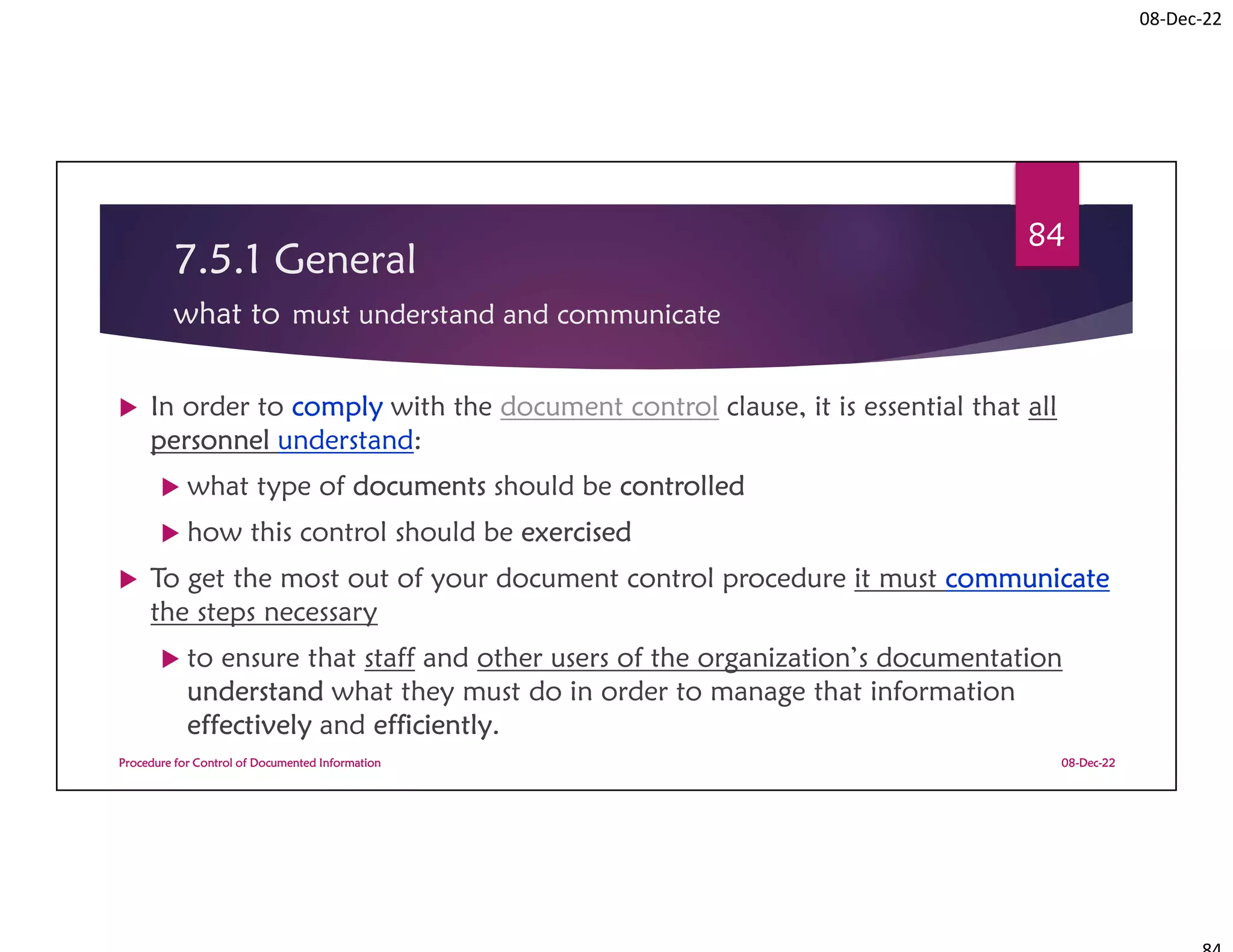
 In order to comply with the document control clause, it is essential that all
personnel understand:
 what type of documents should be controlled
 how this control should be exercised
 To get the most out of your document control procedure it must communicate
the steps necessary
 to ensure that staff and other users of the organization’s documentation
understand what they must do in order to manage that information
effectively and efficiently.
08-Dec-22
Procedure for Control of Documented Information
84
08-Dec-22
7.5.1 General
who is responsible for documentation
 Departmental managers should always be responsible
 for promoting good document and record management practices in their
area
 whilst supporting overall compliance to the document control procedure.
 Individuals and their line managers should be responsible
 for the documents and records that they create, as well as being responsible
 for their retention and disposal in line with legislative requirements and
organizational procedures and practices.
08-Dec-22
Procedure for Control of Documented Information
85
08-Dec-22
7.5.1 General
required, identified document information by the NCSC
 It should be noted that there is no need to maintain a documented procedure
but organizations may still chose to operate one.
 Ensure that the organization’s management system
 includes documented information required to be maintained and retained by ISO 9001:2015,
 and the documented information identified by the organization to demonstrate the effective
operation of its QMS as defined below.
 Operational procedures, work instructions, flow charts, process maps, signs,
placards, container markings, labels etc. are all examples of ‘documented
information’.
08-Dec-22
Procedure for Control of Documented Information
86
08-Dec-22
7.5.1 General
level of document information by the NCSC
 Documented information can be in any format and media and from any
source.
 The organization needs to determine the level of documented information
necessary to control its QMS.
 ‘Access’ can imply a decision regarding the permission to view the
documented information only, or the permission and authority to view and
change the documented information.
08-Dec-22
Procedure for Control of Documented Information
87
08-Dec-22
CLAUSE 7-SUPPORT
 7.5.2 Creating and updating
 When creating and updating documented information, the organization shall ensure
appropriate:
a) identification and description
b) format
c) review and approval
08-Dec-22
Procedure for Control of Documented Information
88
08-Dec-22
7.5.2 Creating and Updating
control of documents
 You should seek to confirm that when documented information is created or
updated,
 your organization has ensured that it is appropriately identified and
described (e.g. title, date, author, reference number).
 It must be in an appropriate format (e.g. language, software version, graphics)
and on appropriate media (e.g. paper, electronic).
 Confirm that documented information is reviewed and approved for
suitability and adequacy.
08-Dec-22
Procedure for Control of Documented Information
89
08-Dec-22
7.5.2 Creating and Updating
control of documents
 Documents that you use as a business should have clear document control.
 You will already be used to doing this. It also expects a clear format and for it to be
approved.
 This is to prevent anyone just using documents that they see fit. እንደተመቸው መጠቀም
 It seems slightly unnecessary when you are a SME (small-to-medium enterprise) as there
may be a very small team or even one of you.
 For larger businesses this is really important so that documents are used properly and
 changes that have been incorporated for the good don’t get lost when someone else
doesn’t understand them or removes them.
08-Dec-22
Procedure for Control of Documented Information
90
08-Dec-22
CLAUSE 7-SUPPORT
 7.5.3 Control of documented information
 7.5.3.1 Documented information required by the quality management system and by ISO 9001:2015
shall be controlled to ensure:
 it is available and suitable for use, where and when it is needed;
 it is adequately protected (e.g. from loss of confidentiality, improper use, or loss of integrity).
 7.5.3.2 For the control of documented information, the organization shall address the following
activities, as applicable:
 a) distribution, access, retrieval and use;
 b) storage and preservation, including preservation of legibility;
 c) control of changes (e.g. version control);
 d) retention and disposition.
08-Dec-22
Procedure for Control of Documented Information
91
08-Dec-22
7.5.3 Control of Documented Information
 A robust/strong document control process invariably/always lies at the heart of any compliant
management system;
 almost every aspect of auditing and compliance verification is determined through the scrutiny of
documented information.
 With this in mind, it becomes apparent/clear that the on-going maintenance of an efficient
document management system must not be overlooked/ignored.
 Your organization must control the documented information required by the QMS.
 A suitable process must be implemented to define the controls needed to; approve, review,
update, identify changes, identify revision status and provide access.
 The documented information process should define the scope, purpose, method and
responsibilities required to implement these parameters.
08-Dec-22
Procedure for Control of Documented Information
92
08-Dec-22
7.5.3 Control of Documented Information
 In order to comply/obey with the documented information requirements,
 it is essential that all personnel understand
 what types of information that should be controlled and
 more importantly, how this control should be exercised.
08-Dec-22
Procedure for Control of Documented Information
93
08-Dec-22
7.5.3 Control of Documented Information
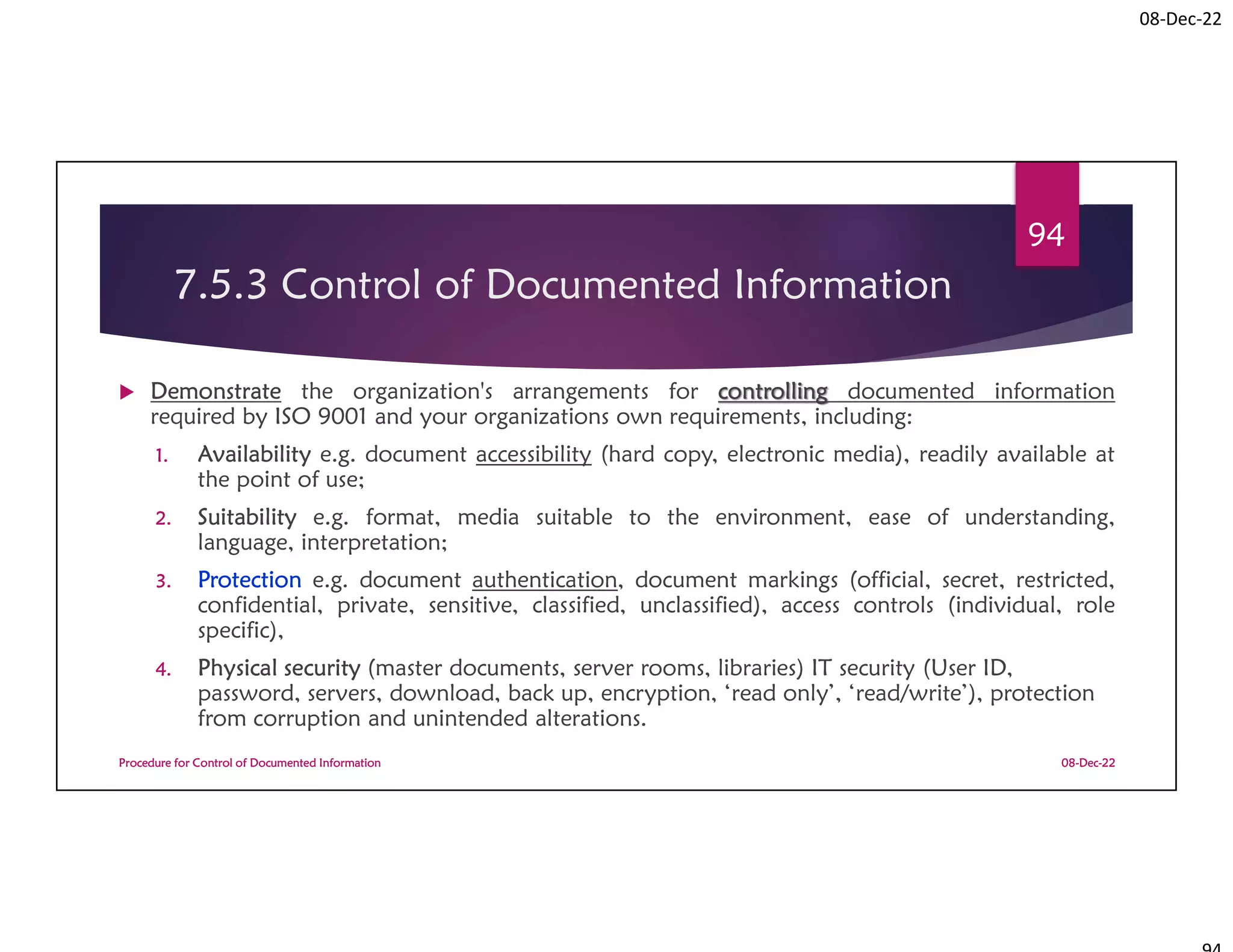
 Demonstrate the organization's arrangements for controlling documented information
required by ISO 9001 and your organizations own requirements, including:
1. Availability e.g. document accessibility (hard copy, electronic media), readily available at
the point of use;
2. Suitability e.g. format, media suitable to the environment, ease of understanding,
language, interpretation;
3. Protection e.g. document authentication, document markings (official, secret, restricted,
confidential, private, sensitive, classified, unclassified), access controls (individual, role
specific),
4. Physical security (master documents, server rooms, libraries) IT security (User ID,
password, servers, download, back up, encryption, ‘read only’, ‘read/write’), protection
from corruption and unintended alterations.
08-Dec-22
Procedure for Control of Documented Information
94
08-Dec-22
7.5.3 Control of Documented Information
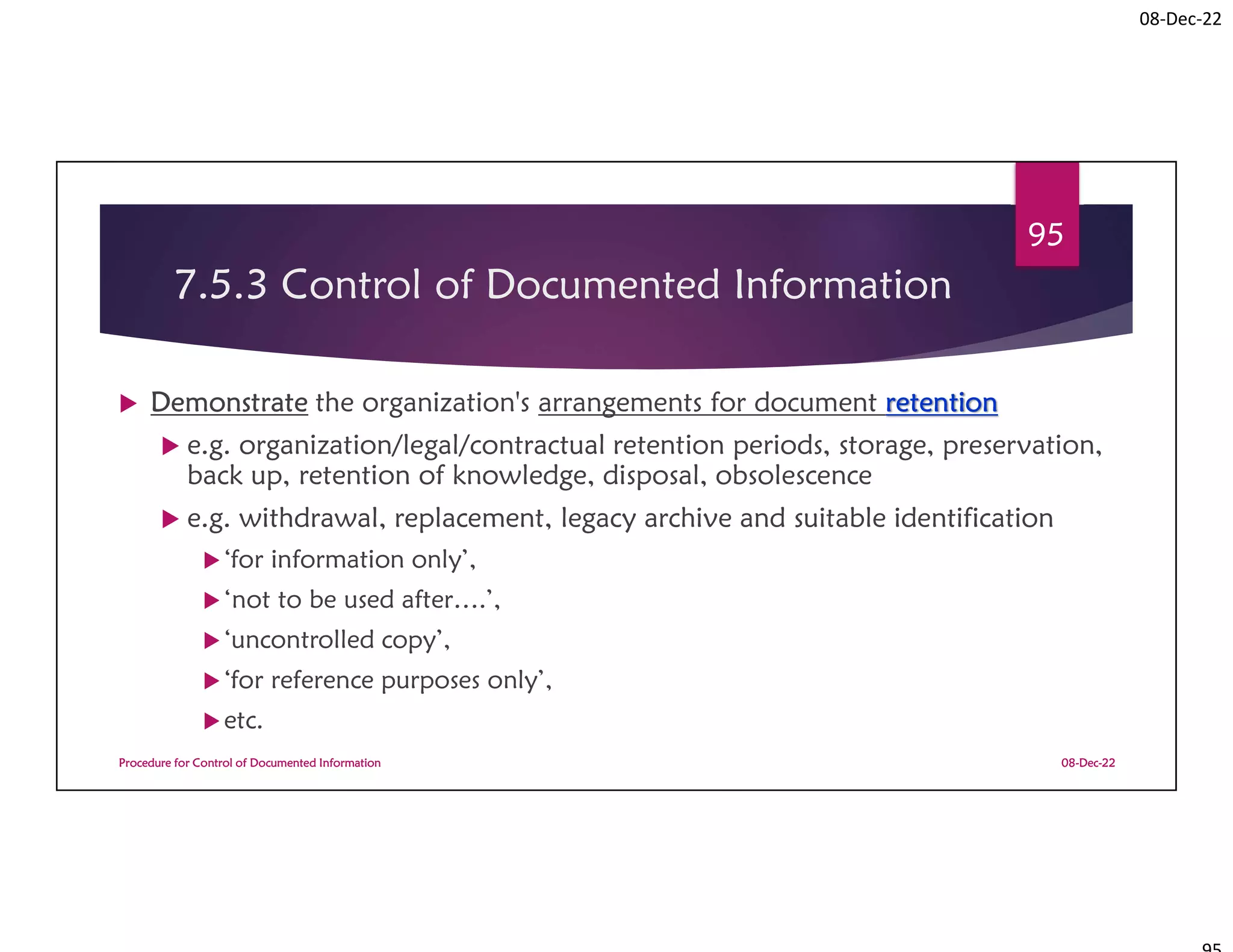
 Demonstrate the organization's arrangements for document retention
 e.g. organization/legal/contractual retention periods, storage, preservation,
back up, retention of knowledge, disposal, obsolescence
 e.g. withdrawal, replacement, legacy archive and suitable identification
‘for information only’,
‘not to be used after….’,
‘uncontrolled copy’,
‘for reference purposes only’,
etc.
08-Dec-22
Procedure for Control of Documented Information
95
08-Dec-22
7.5.3 Control of Documented Information
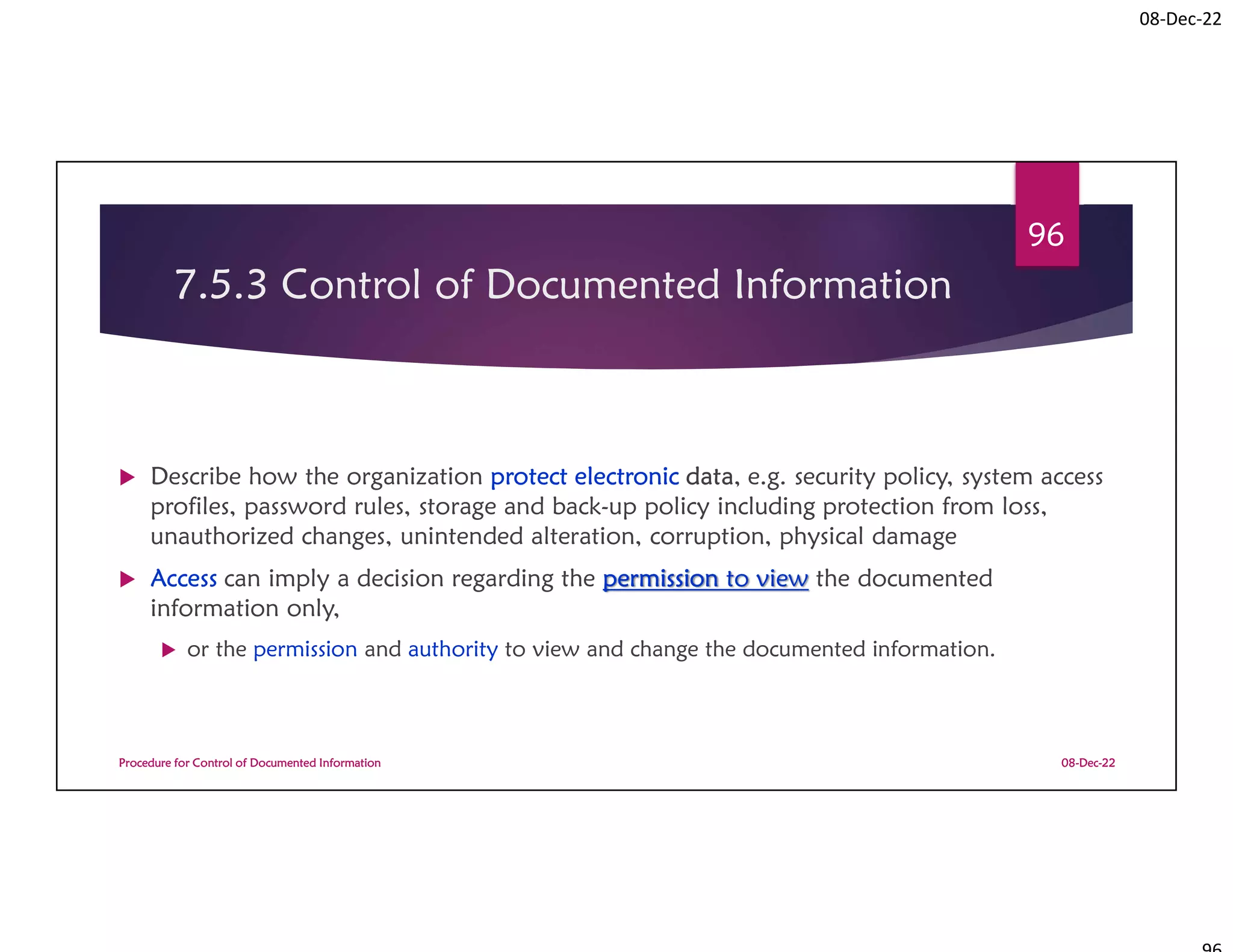
 Describe how the organization protect electronic data, e.g. security policy, system access
profiles, password rules, storage and back-up policy including protection from loss,
unauthorized changes, unintended alteration, corruption, physical damage
 Access can imply a decision regarding the permission to view the documented
information only,
 or the permission and authority to view and change the documented information.
08-Dec-22
Procedure for Control of Documented Information
96
08-Dec-22
NCSC
ISO 9001:2015
Quality Manual
what entails?
SECTION – 7 SUPPORT
7.5 DOCUMENTED
INFORMATION
7.5.1 GENERAL
08-Dec-22
Procedure for Control of Documented Information
97
08-Dec-22
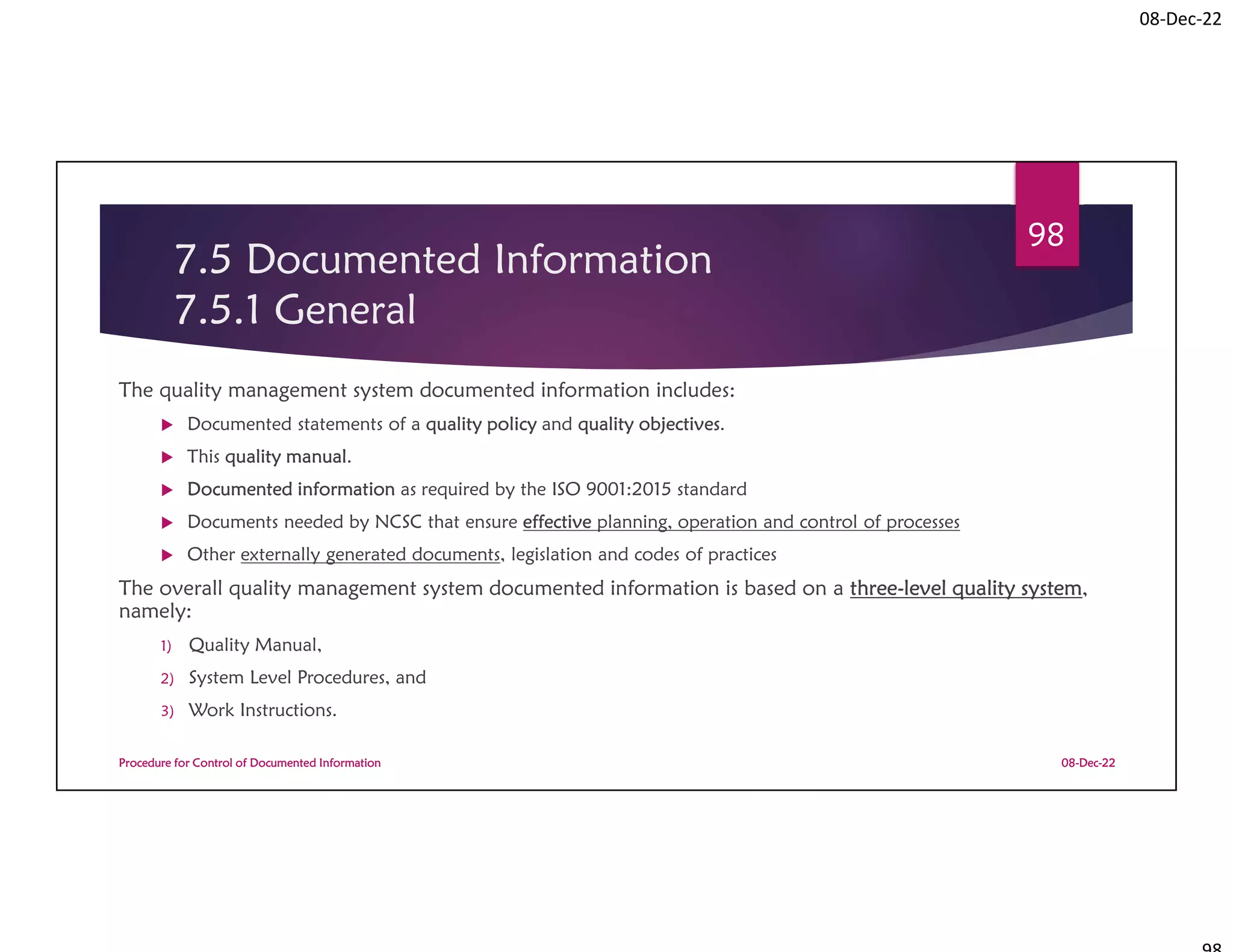
7.5 Documented Information
7.5.1 General
The quality management system documented information includes:
 Documented statements of a quality policy and quality objectives.
 This quality manual.
 Documented information as required by the ISO 9001:2015 standard
 Documents needed by NCSC that ensure effective planning, operation and control of processes
 Other externally generated documents, legislation and codes of practices
The overall quality management system documented information is based on a three-level quality system,
namely:
1) Quality Manual,
2) System Level Procedures, and
3) Work Instructions.
08-Dec-22
Procedure for Control of Documented Information
98
08-Dec-22
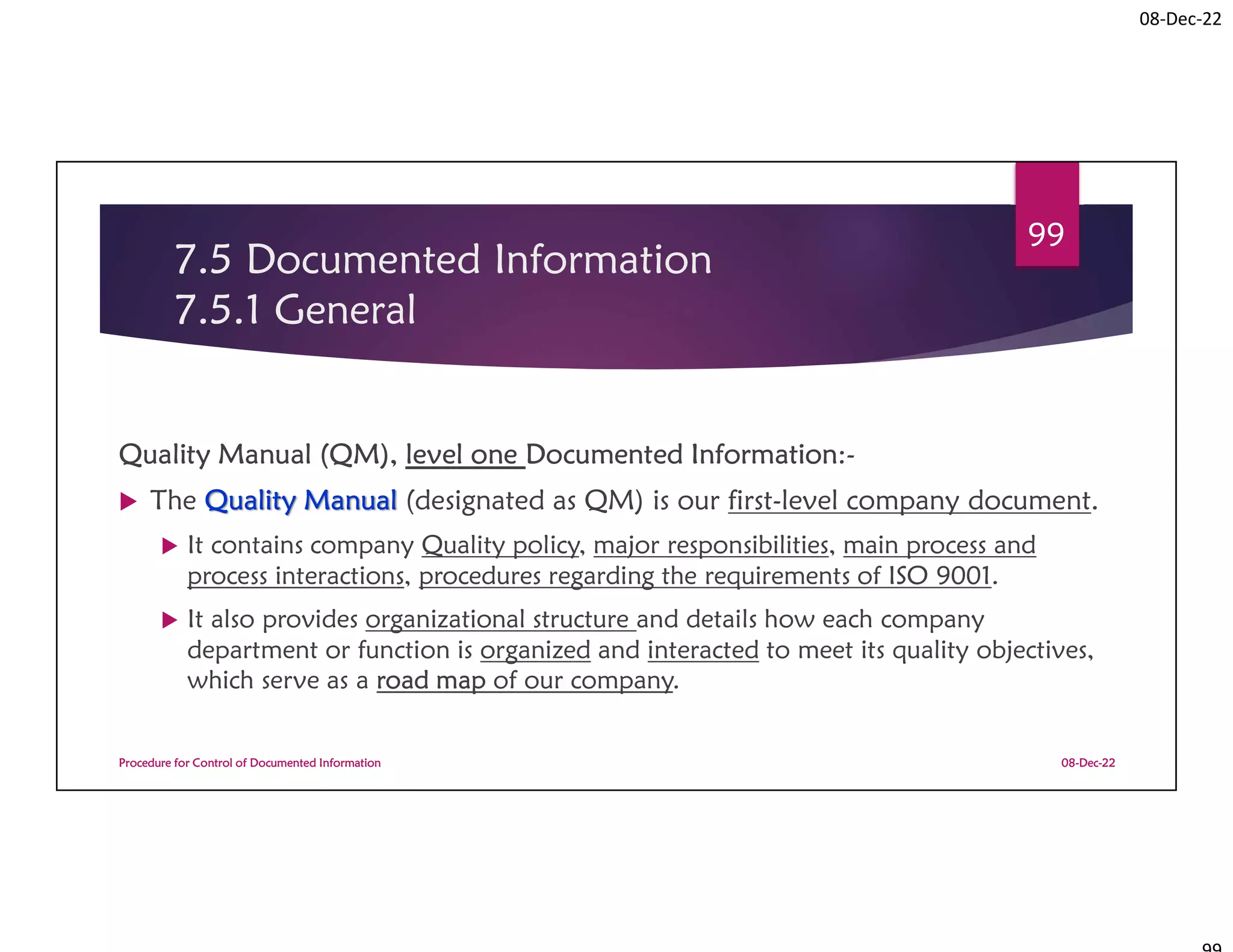
7.5 Documented Information
7.5.1 General
Quality Manual (QM), level one Documented Information:-
 The Quality Manual (designated as QM) is our first-level company document.
 It contains company Quality policy, major responsibilities, main process and
process interactions, procedures regarding the requirements of ISO 9001.
 It also provides organizational structure and details how each company
department or function is organized and interacted to meet its quality objectives,
which serve as a road map of our company.
08-Dec-22
Procedure for Control of Documented Information
99
08-Dec-22
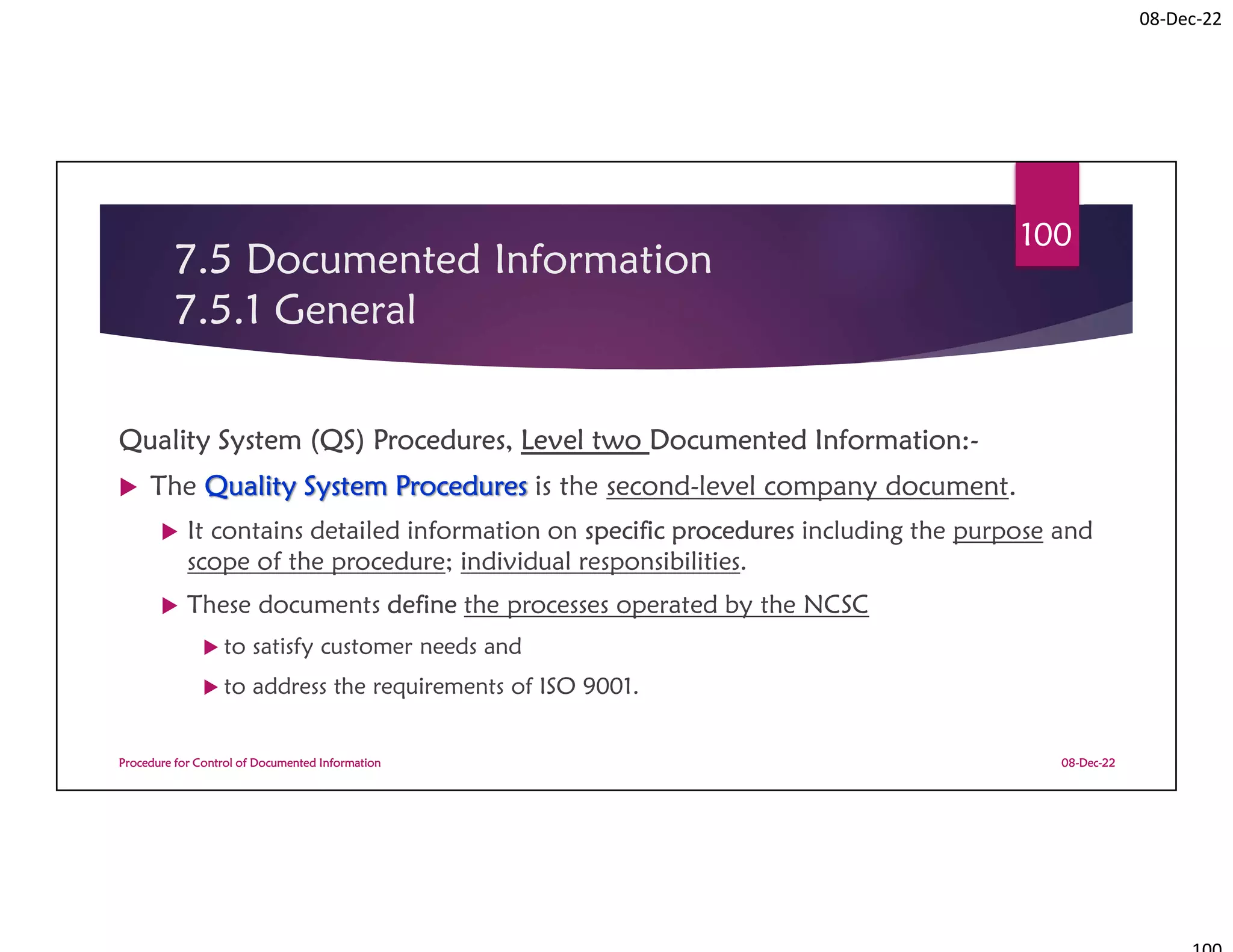
7.5 Documented Information
7.5.1 General
Quality System (QS) Procedures, Level two Documented Information:-
 The Quality System Procedures is the second-level company document.
 It contains detailed information on specific procedures including the purpose and
scope of the procedure; individual responsibilities.
 These documents define the processes operated by the NCSC
 to satisfy customer needs and
 to address the requirements of ISO 9001.
08-Dec-22
Procedure for Control of Documented Information
100
08-Dec-22
7.5 Documented Information
7.5.1 General
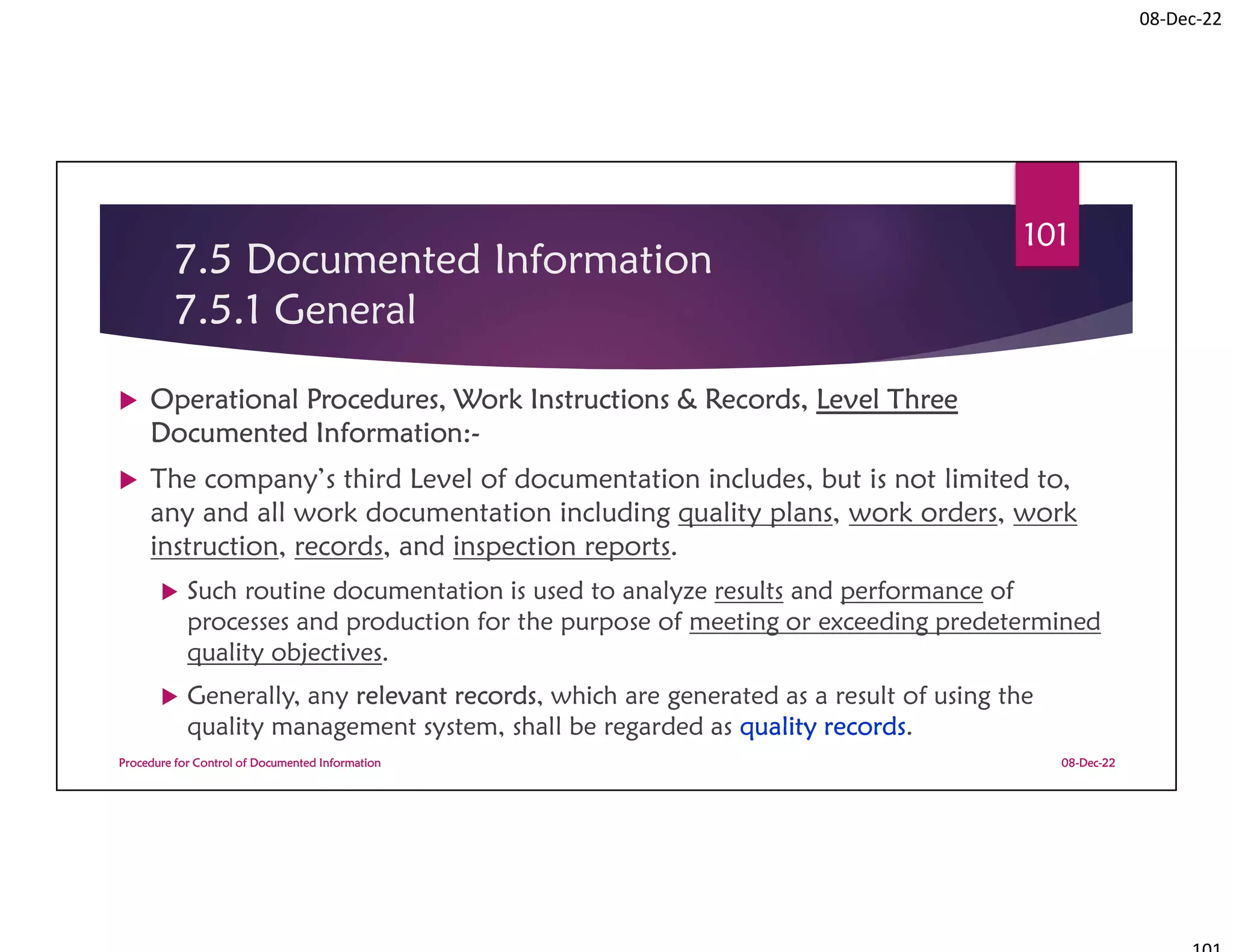
 Operational Procedures, Work Instructions & Records, Level Three
Documented Information:-
 The company’s third Level of documentation includes, but is not limited to,
any and all work documentation including quality plans, work orders, work
instruction, records, and inspection reports.
 Such routine documentation is used to analyze results and performance of
processes and production for the purpose of meeting or exceeding predetermined
quality objectives.
 Generally, any relevant records, which are generated as a result of using the
quality management system, shall be regarded as quality records.
08-Dec-22
Procedure for Control of Documented Information
101
08-Dec-22
Procedure for
Control of Documented Information
OP/NCSC/01
ISO 9001:2015 QMS REQUIREMENT
08-Dec-22
Procedure for Control of Documented Information
102
08-Dec-22
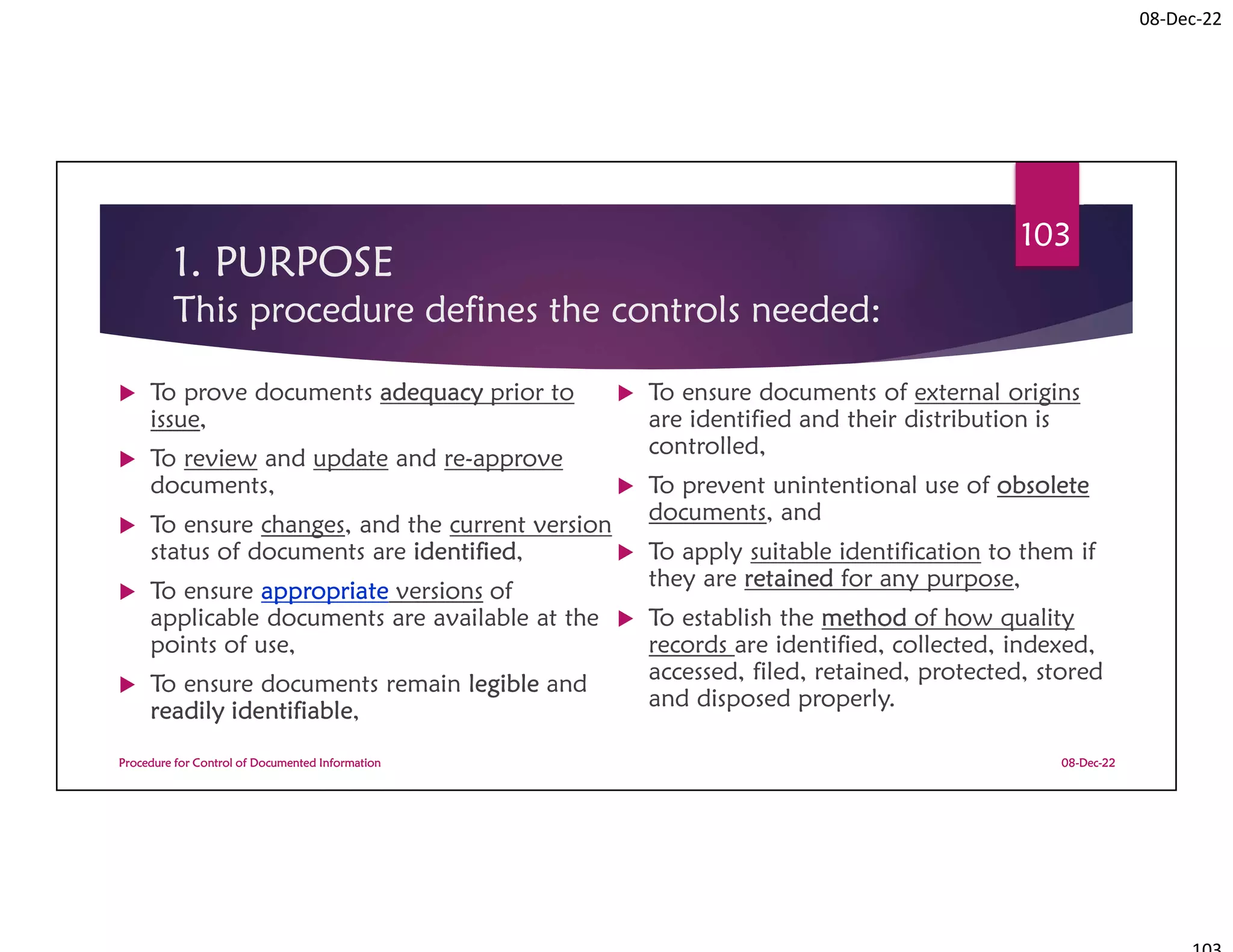
1. PURPOSE
This procedure defines the controls needed:
 To prove documents adequacy prior to
issue,
 To review and update and re-approve
documents,
 To ensure changes, and the current version
status of documents are identified,
 To ensure appropriate versions of
applicable documents are available at the
points of use,
 To ensure documents remain legible and
readily identifiable,
 To ensure documents of external origins
are identified and their distribution is
controlled,
 To prevent unintentional use of obsolete
documents, and
 To apply suitable identification to them if
they are retained for any purpose,
 To establish the method of how quality
records are identified, collected, indexed,
accessed, filed, retained, protected, stored
and disposed properly.
08-Dec-22
Procedure for Control of Documented Information
103
08-Dec-22
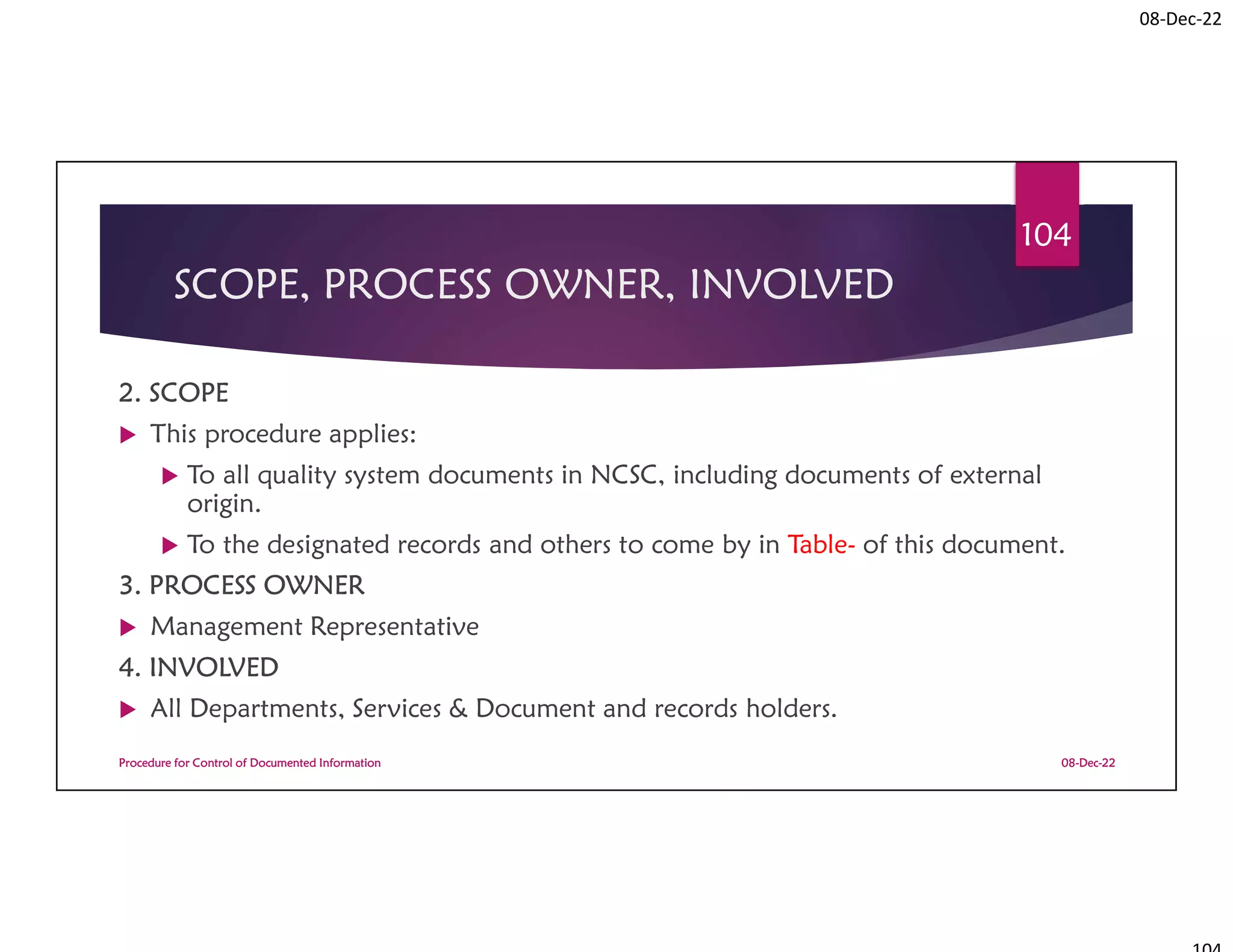
SCOPE, PROCESS OWNER, INVOLVED
2. SCOPE
 This procedure applies:
 To all quality system documents in NCSC, including documents of external
origin.
 To the designated records and others to come by in Table- of this document.
3. PROCESS OWNER
 Management Representative
4. INVOLVED
 All Departments, Services & Document and records holders.
08-Dec-22
Procedure for Control of Documented Information
104
08-Dec-22
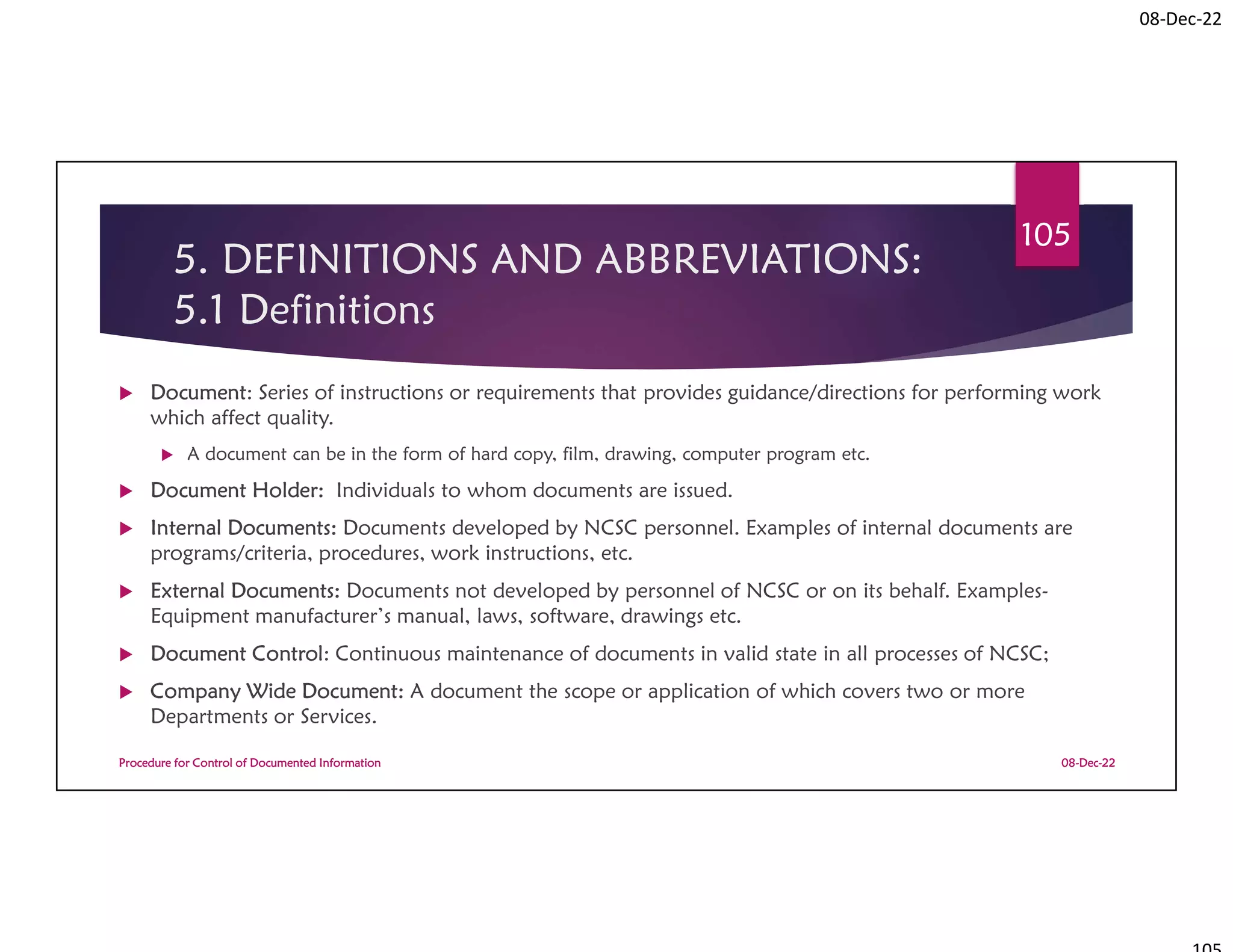
5. DEFINITIONS AND ABBREVIATIONS:
5.1 Definitions
 Document: Series of instructions or requirements that provides guidance/directions for performing work
which affect quality.
 A document can be in the form of hard copy, film, drawing, computer program etc.
 Document Holder: Individuals to whom documents are issued.
 Internal Documents: Documents developed by NCSC personnel. Examples of internal documents are
programs/criteria, procedures, work instructions, etc.
 External Documents: Documents not developed by personnel of NCSC or on its behalf. Examples-
Equipment manufacturer’s manual, laws, software, drawings etc.
 Document Control: Continuous maintenance of documents in valid state in all processes of NCSC;
 Company Wide Document: A document the scope or application of which covers two or more
Departments or Services.
08-Dec-22
Procedure for Control of Documented Information
105
08-Dec-22
5. DEFINITIONS AND ABBREVIATIONS:
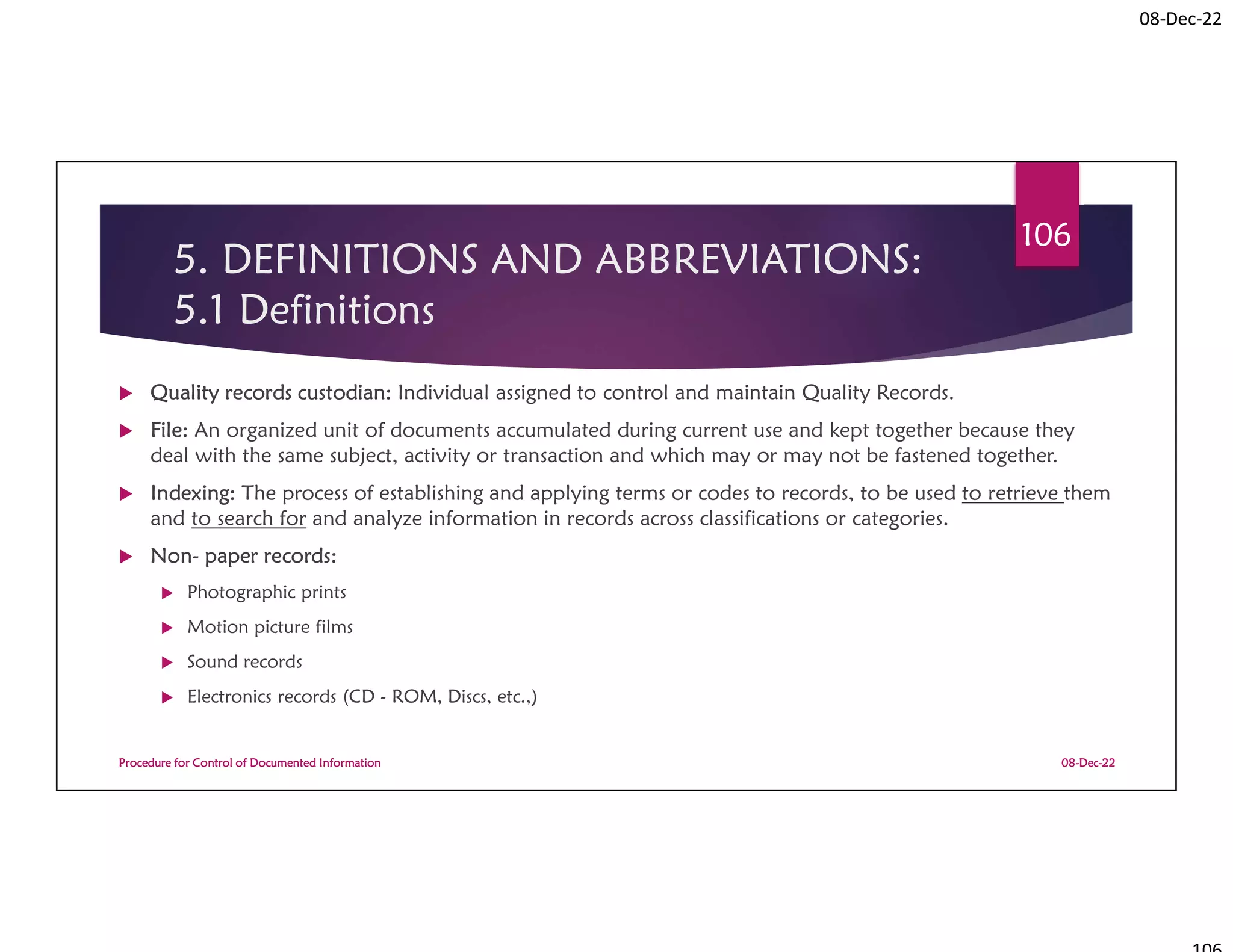
5.1 Definitions
 Quality records custodian: Individual assigned to control and maintain Quality Records.
 File: An organized unit of documents accumulated during current use and kept together because they
deal with the same subject, activity or transaction and which may or may not be fastened together.
 Indexing: The process of establishing and applying terms or codes to records, to be used to retrieve them
and to search for and analyze information in records across classifications or categories.
 Non- paper records:
 Photographic prints
 Motion picture films
 Sound records
 Electronics records (CD - ROM, Discs, etc.,)
08-Dec-22
Procedure for Control of Documented Information
106
08-Dec-22
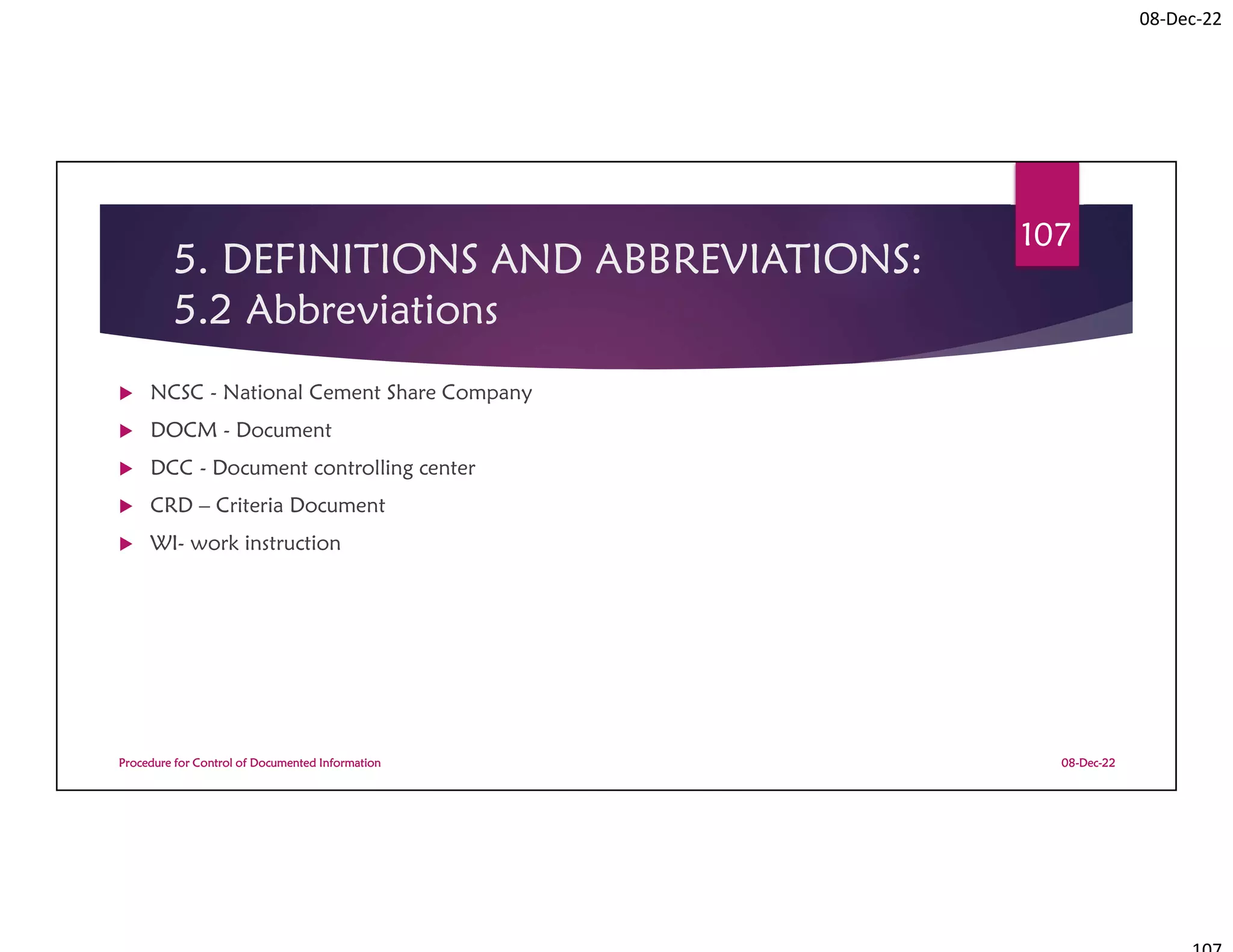
5. DEFINITIONS AND ABBREVIATIONS:
5.2 Abbreviations
 NCSC - National Cement Share Company
 DOCM - Document
 DCC - Document controlling center
 CRD – Criteria Document
 WI- work instruction
08-Dec-22
Procedure for Control of Documented Information
107
08-Dec-22
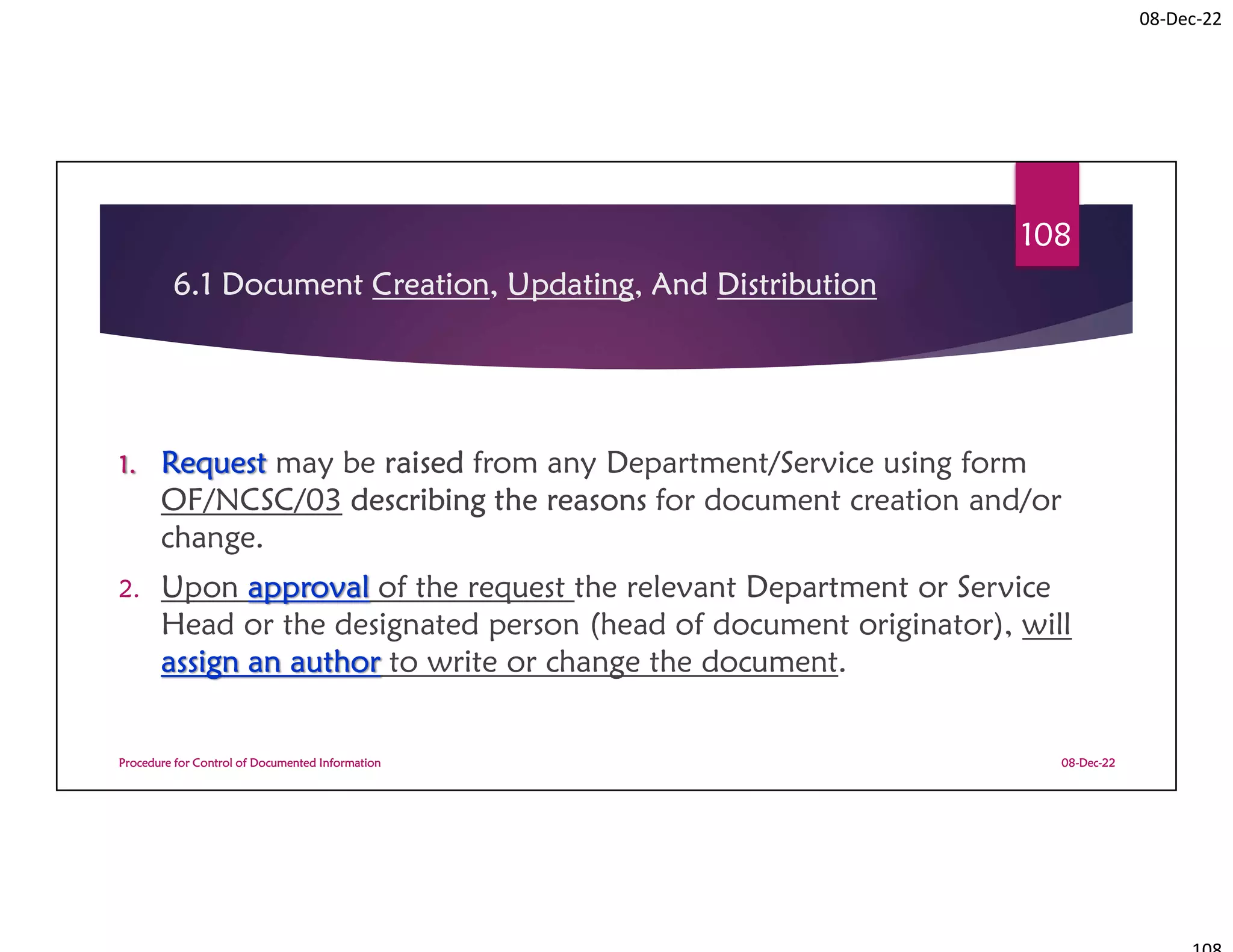
6.1 Document Creation, Updating, And Distribution
1. Request may be raised from any Department/Service using form
OF/NCSC/03 describing the reasons for document creation and/or
change.
2. Upon approval of the request the relevant Department or Service
Head or the designated person (head of document originator), will
assign an author to write or change the document.
08-Dec-22
Procedure for Control of Documented Information
108
08-Dec-22
6.1 Document Creation, Updating, And Distribution
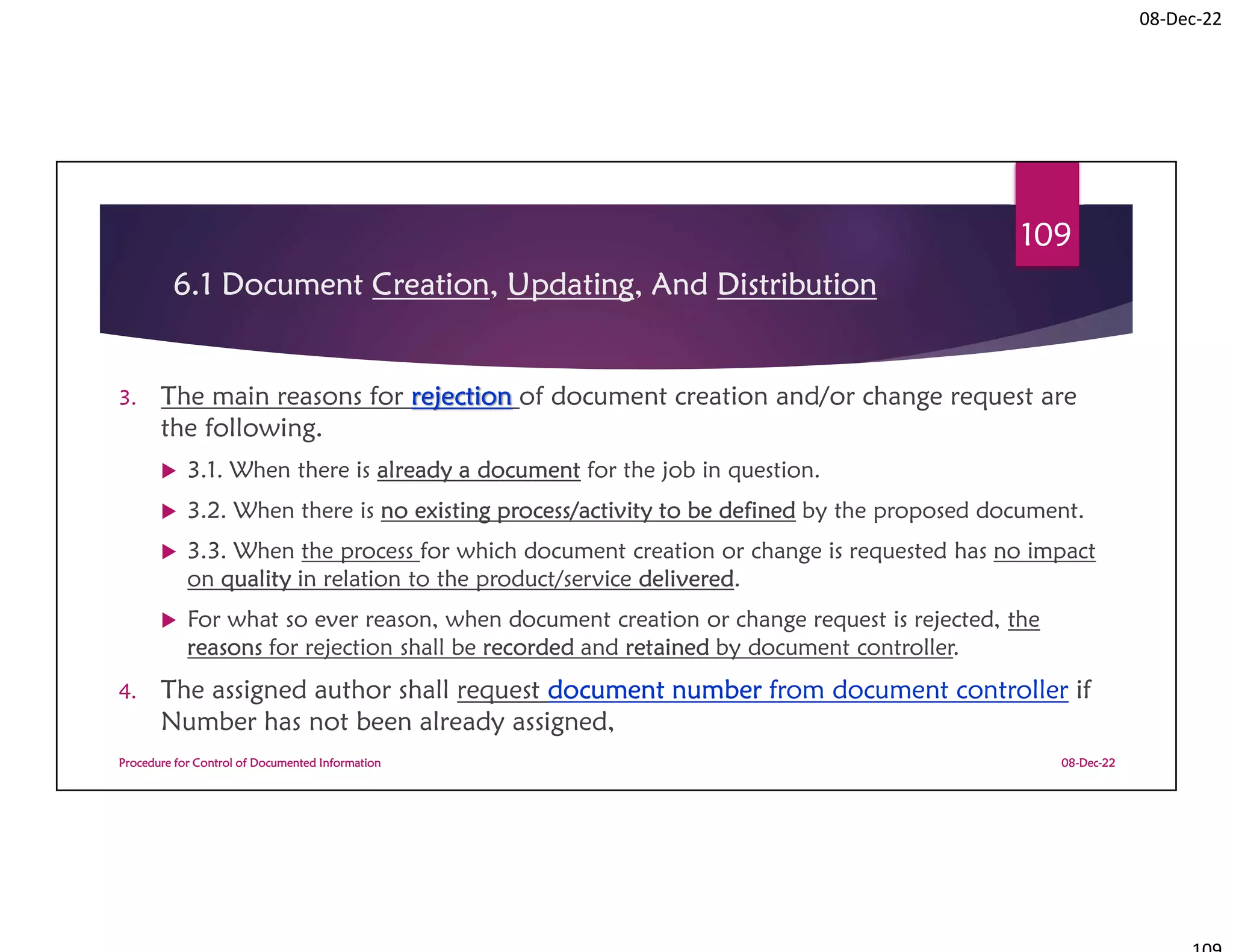
3. The main reasons for rejection of document creation and/or change request are
the following.
 3.1. When there is already a document for the job in question.
 3.2. When there is no existing process/activity to be defined by the proposed document.
 3.3. When the process for which document creation or change is requested has no impact
on quality in relation to the product/service delivered.
 For what so ever reason, when document creation or change request is rejected, the
reasons for rejection shall be recorded and retained by document controller.
4. The assigned author shall request document number from document controller if
Number has not been already assigned,
08-Dec-22
Procedure for Control of Documented Information
109
08-Dec-22
6.1 DOCUMENT CREATION, UPDATING, AND DISTRIBUTION
5. Document controller shall maintain a master record of all document
numbers issued.
 The document controller person must make sure the absence of double provision of
the same number for different documents.
6. During document preparation, the author(s) must ensure the
involvement of concerned employees.
7. All final draft documents shall be reviewed and approved for clarity,
completeness and adequacy by the CEO/ or his delegate in the case of
company wide documents and those documents which have customer
interface.
08-Dec-22
Procedure for Control of Documented Information
110
08-Dec-22
6.1 DOCUMENT CREATION, UPDATING, AND DISTRIBUTION
 Based on Distribution list of the Document Registration Form and/or diffusion
requirement,
 Document controller:
 Shall make required copies of document for issuing;
 Shall file the original copy of document;
 Using a stamp shall indicate on all document:- Date of Issue, Copy Number and
Registration Number;
 Release documents to the respective Department/Service Heads and/or the CEO/DCEO;
 Holder of the document shall acknowledge by signing on the Document Release Note and
returning it to document controller.
08-Dec-22
Procedure for Control of Documented Information
111
08-Dec-22
6.1 DOCUMENT CREATION, UPDATING, AND DISTRIBUTION
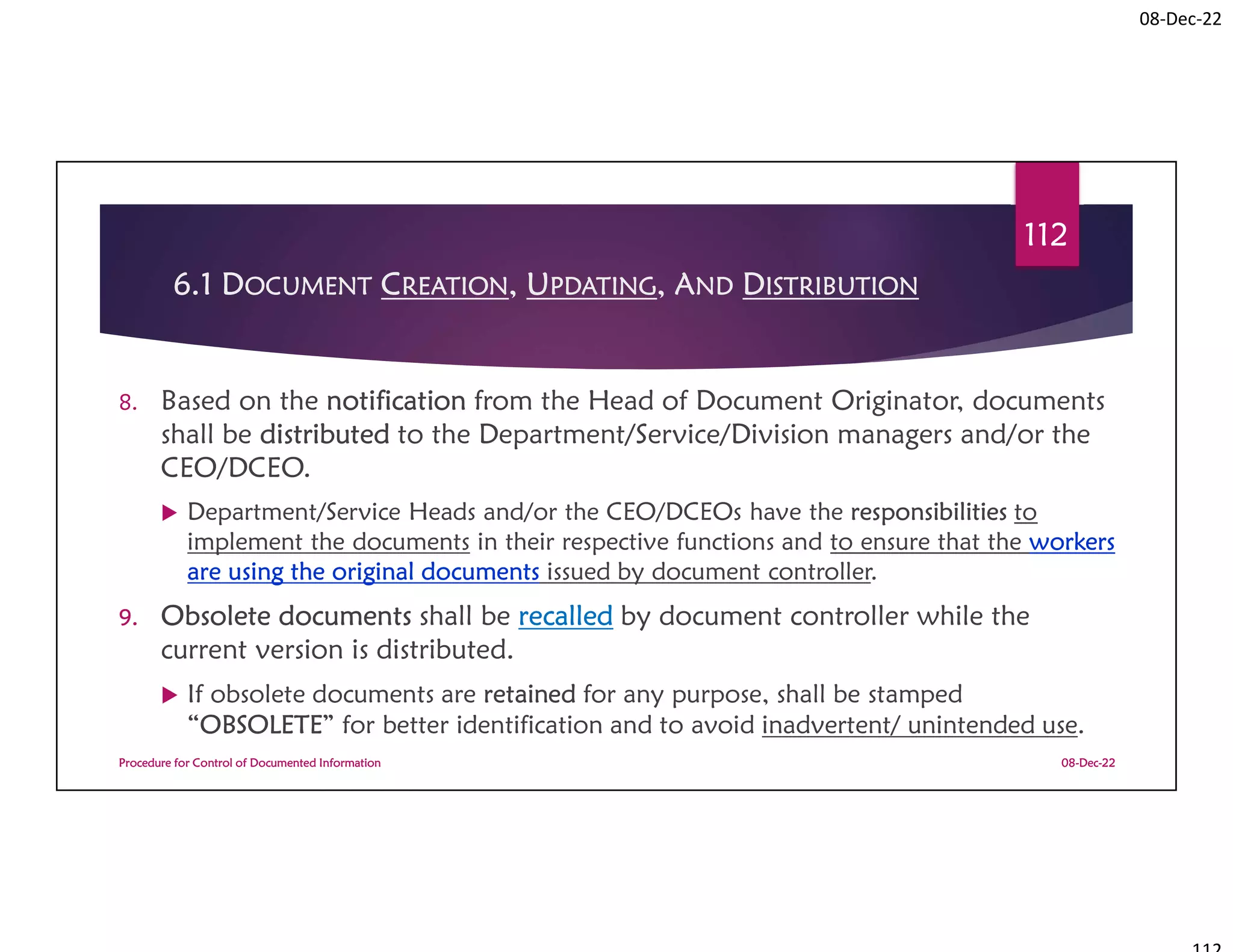
8. Based on the notification from the Head of Document Originator, documents
shall be distributed to the Department/Service/Division managers and/or the
CEO/DCEO.
 Department/Service Heads and/or the CEO/DCEOs have the responsibilities to
implement the documents in their respective functions and to ensure that the workers
are using the original documents issued by document controller.
9. Obsolete documents shall be recalled by document controller while the
current version is distributed.
 If obsolete documents are retained for any purpose, shall be stamped
“OBSOLETE” for better identification and to avoid inadvertent/ unintended use.
08-Dec-22
Procedure for Control of Documented Information
112
08-Dec-22
6.2 Record control
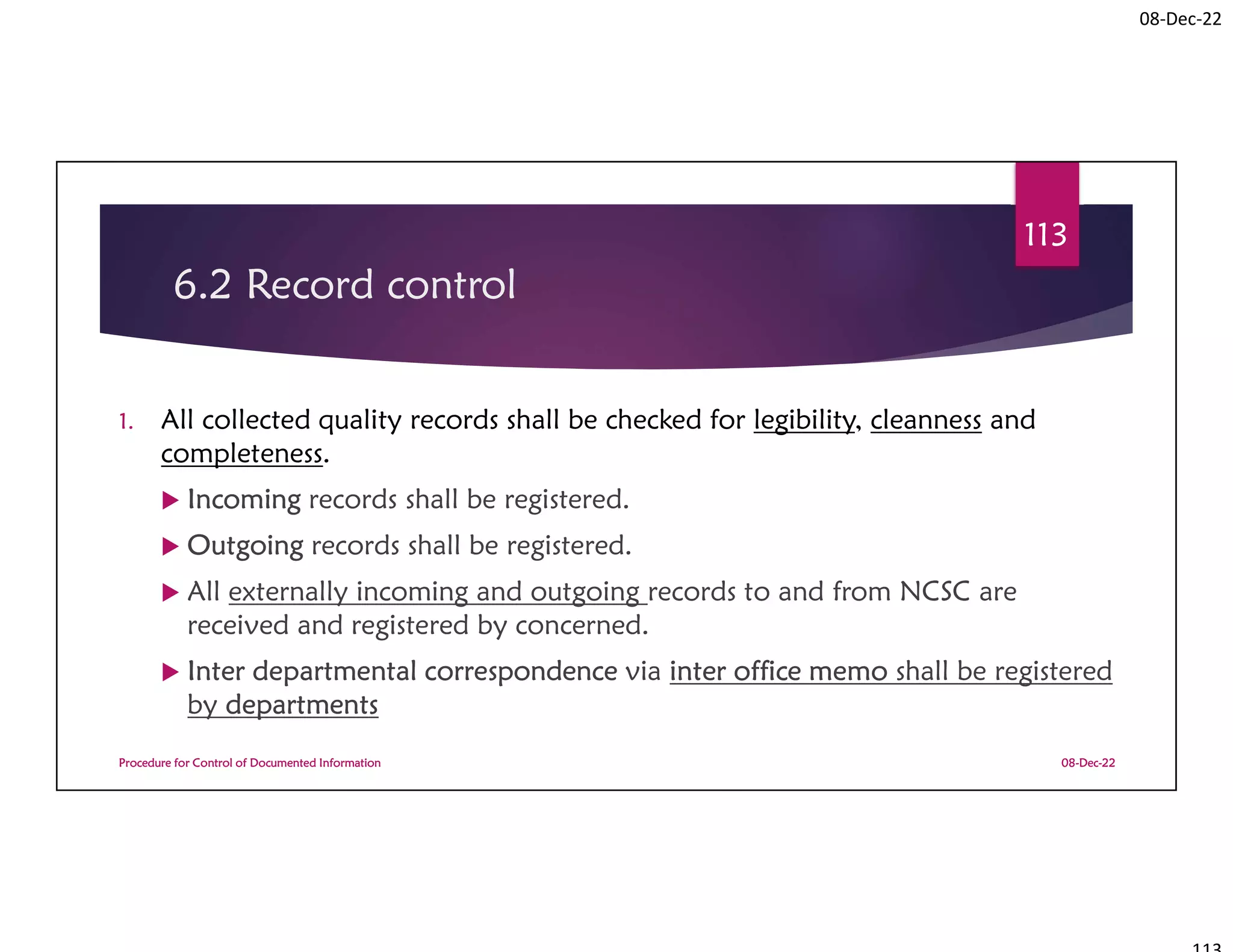
1. All collected quality records shall be checked for legibility, cleanness and
completeness.
 Incoming records shall be registered.
 Outgoing records shall be registered.
 All externally incoming and outgoing records to and from NCSC are
received and registered by concerned.
 Inter departmental correspondence via inter office memo shall be registered
by departments
08-Dec-22
Procedure for Control of Documented Information
113
08-Dec-22
6.2 Record control
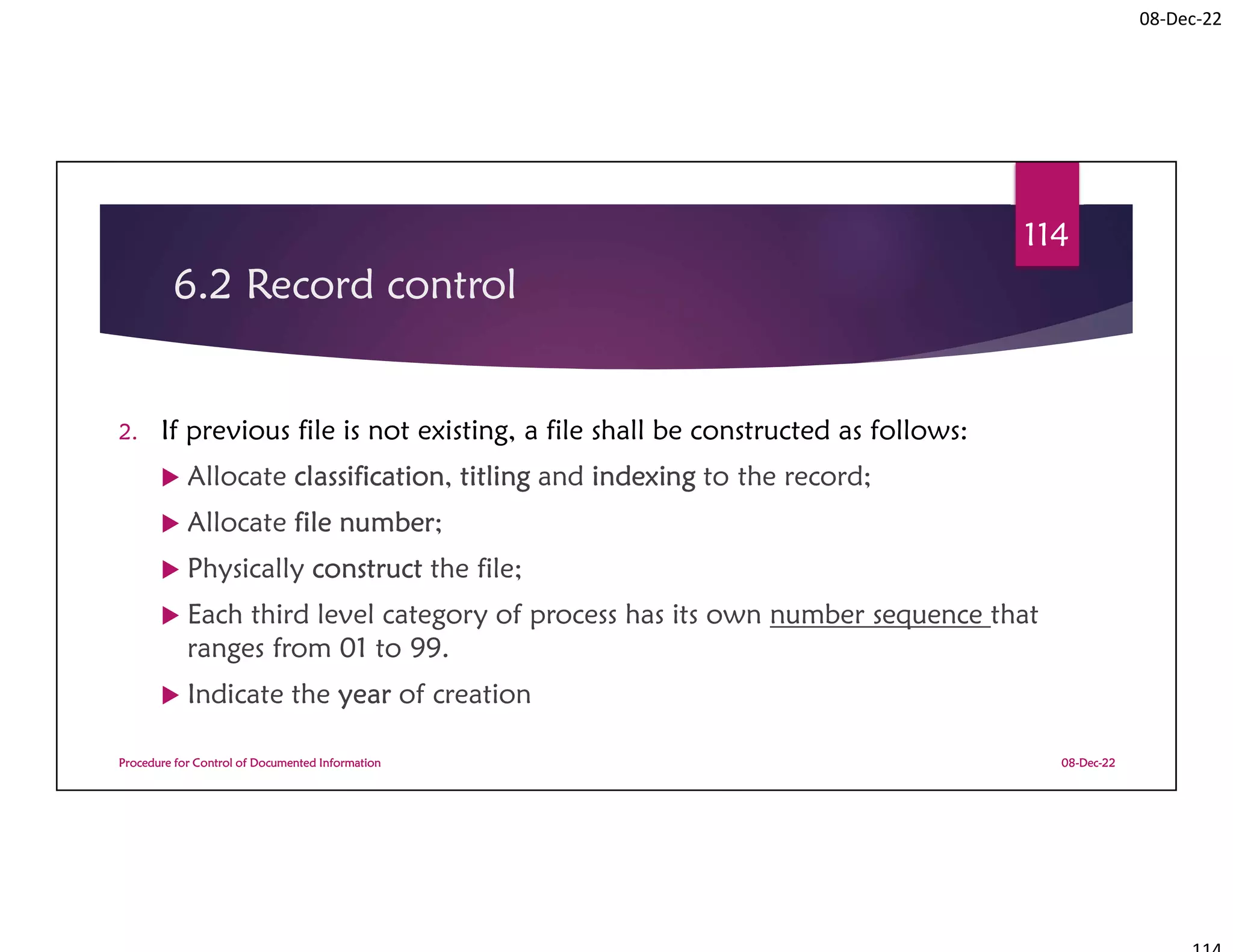
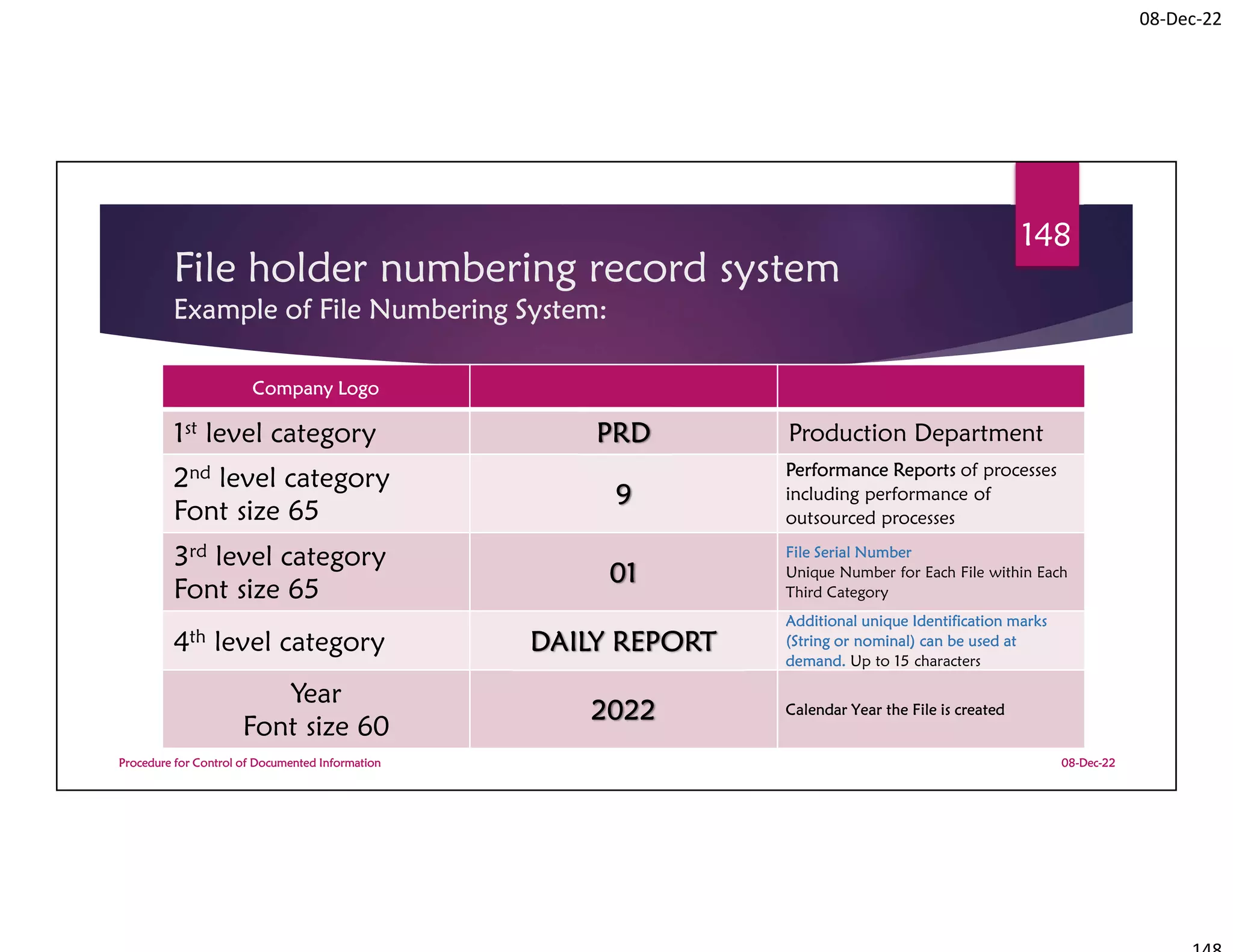
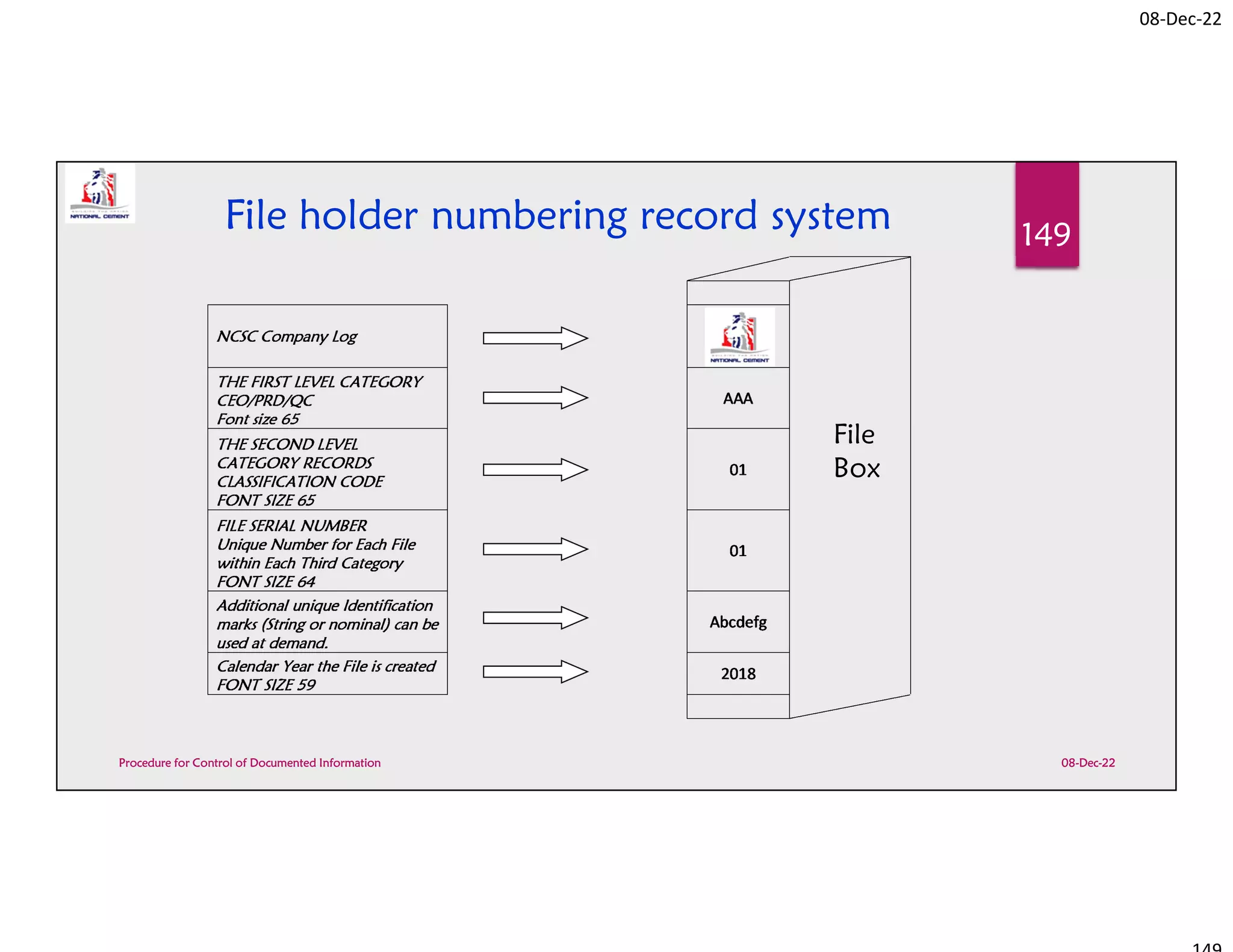
2. If previous file is not existing, a file shall be constructed as follows:
 Allocate classification, titling and indexing to the record;
 Allocate file number;
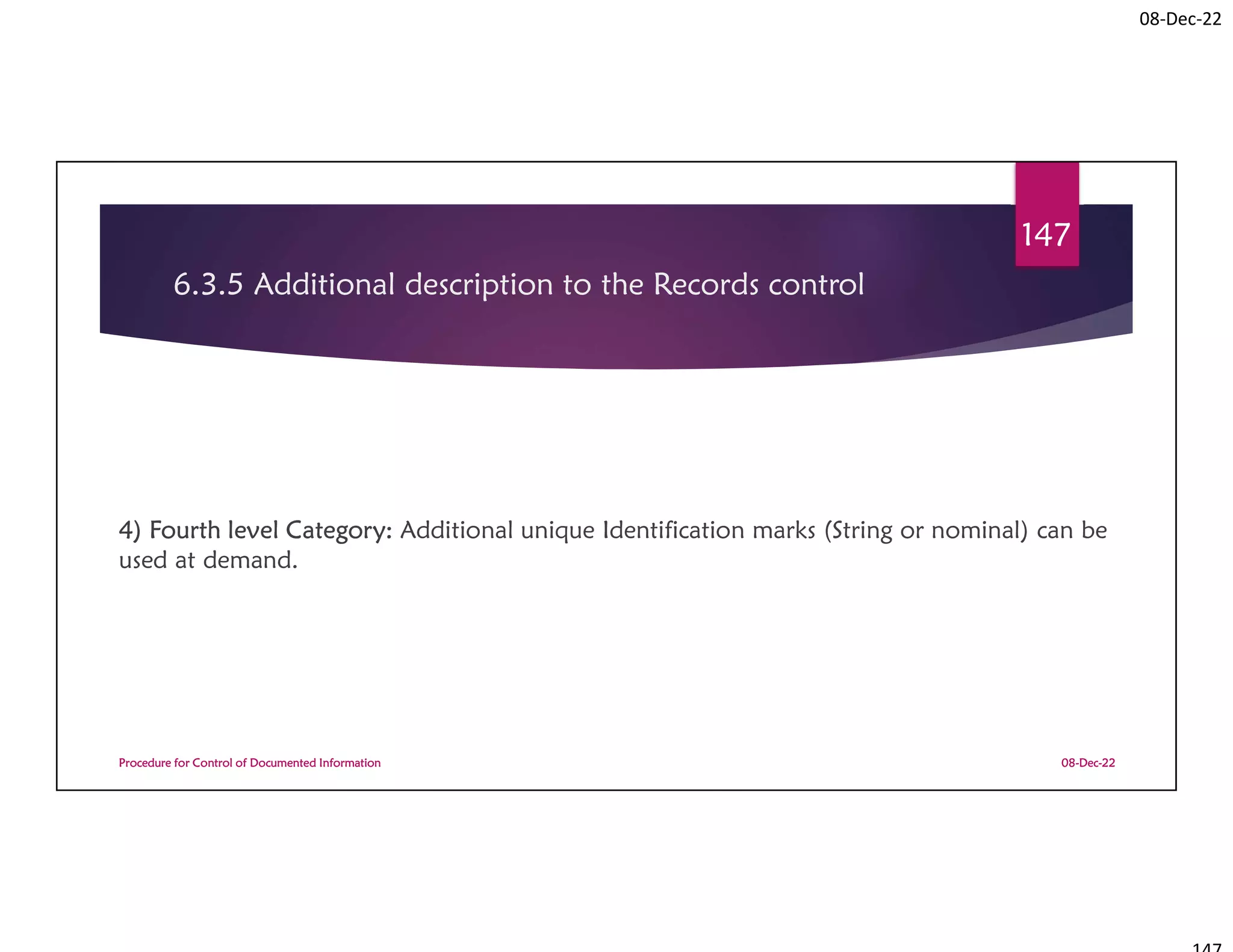
 Physically construct the file;
 Each third level category of process has its own number sequence that
ranges from 01 to 99.
 Indicate the year of creation
08-Dec-22
Procedure for Control of Documented Information
114
08-Dec-22
6.2 Record control
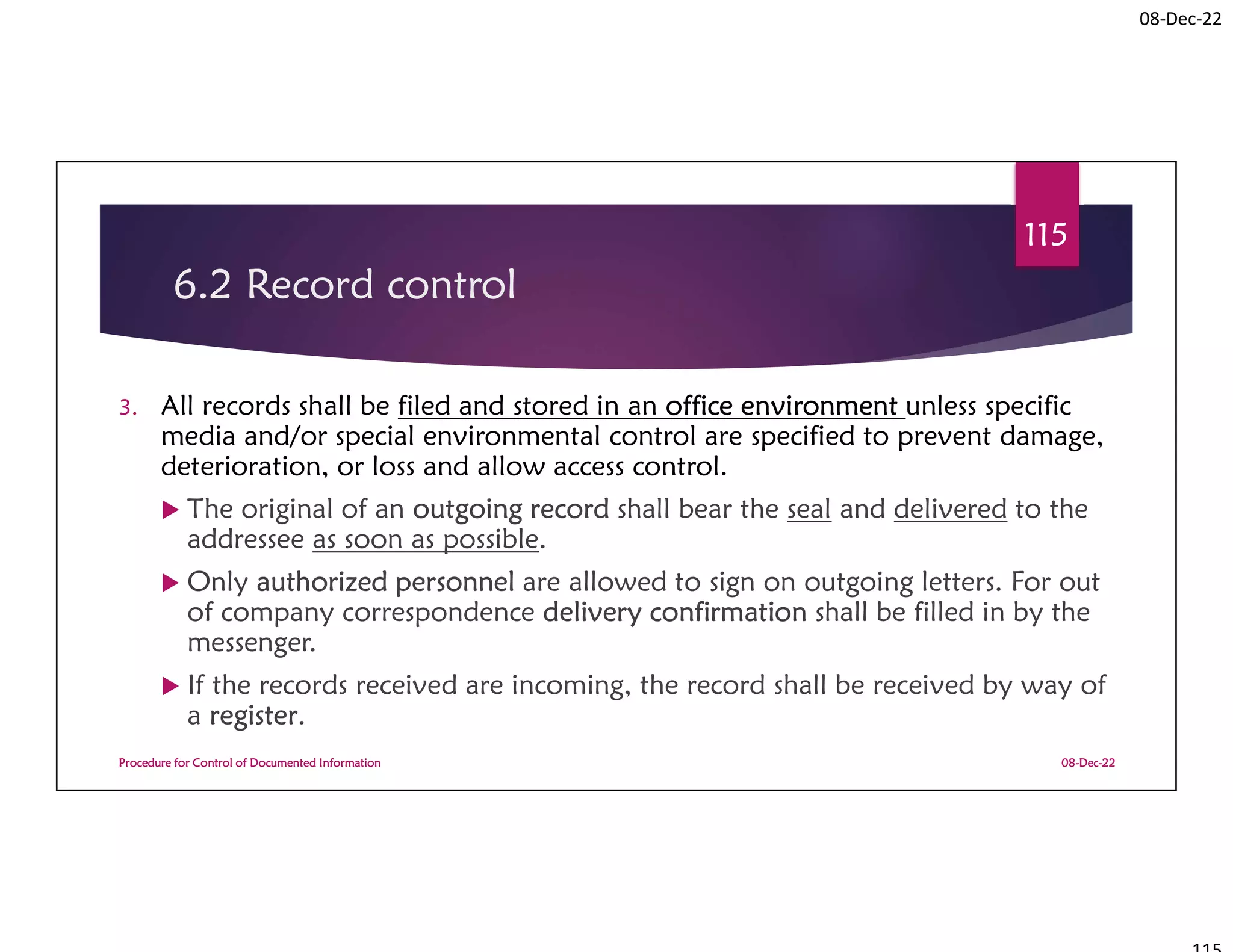
3. All records shall be filed and stored in an office environment unless specific
media and/or special environmental control are specified to prevent damage,
deterioration, or loss and allow access control.
 The original of an outgoing record shall bear the seal and delivered to the
addressee as soon as possible.
 Only authorized personnel are allowed to sign on outgoing letters. For out
of company correspondence delivery confirmation shall be filled in by the
messenger.
 If the records received are incoming, the record shall be received by way of
a register.
08-Dec-22
Procedure for Control of Documented Information
115
08-Dec-22
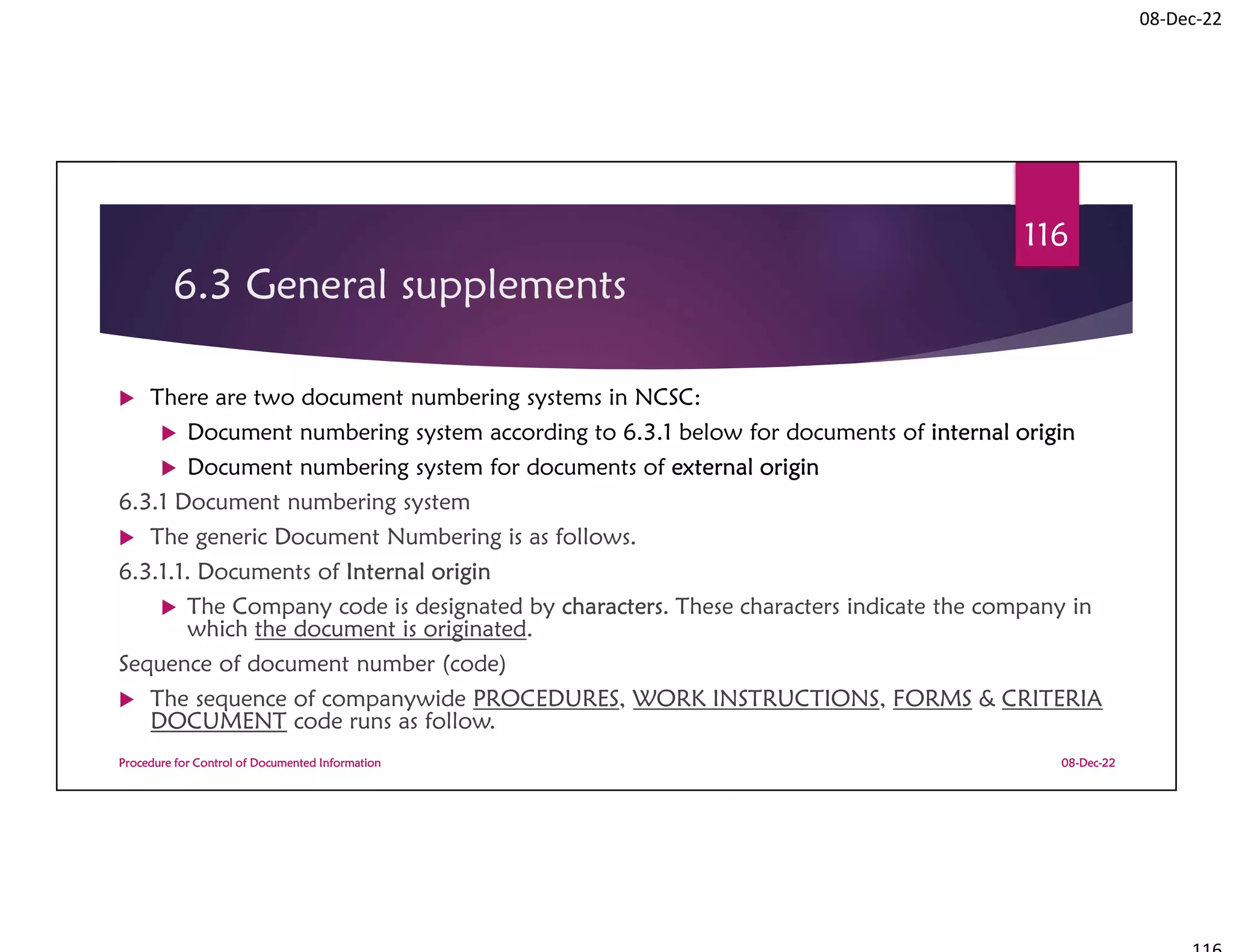
6.3 General supplements
 There are two document numbering systems in NCSC:
 Document numbering system according to 6.3.1 below for documents of internal origin
 Document numbering system for documents of external origin
6.3.1 Document numbering system
 The generic Document Numbering is as follows.
6.3.1.1. Documents of Internal origin
 The Company code is designated by characters. These characters indicate the company in
which the document is originated.
Sequence of document number (code)
 The sequence of companywide PROCEDURES, WORK INSTRUCTIONS, FORMS & CRITERIA
DOCUMENT code runs as follow.
08-Dec-22
Procedure for Control of Documented Information
116
08-Dec-22
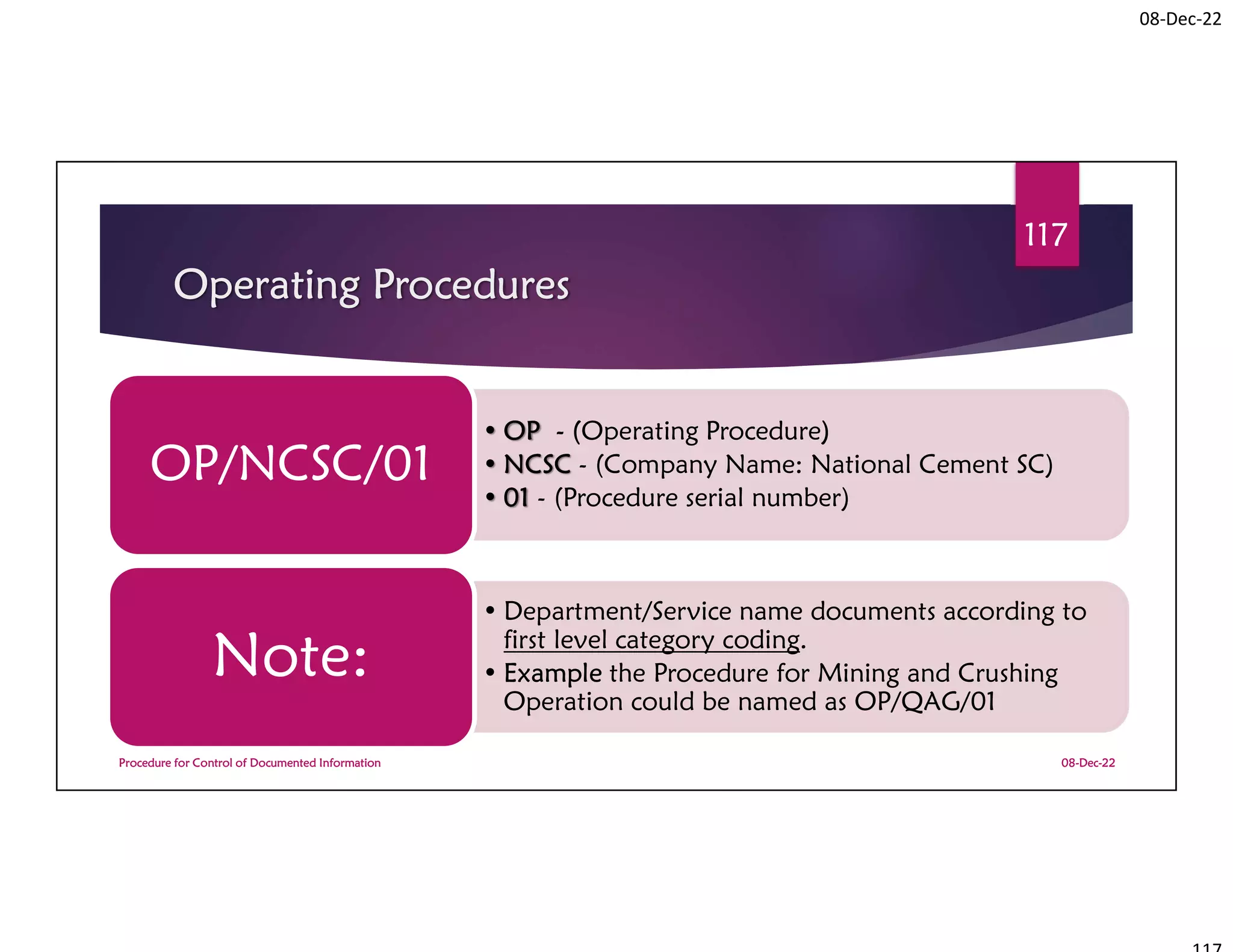
Operating Procedures
08-Dec-22
Procedure for Control of Documented Information
117
• OP - (Operating Procedure)
• NCSC - (Company Name: National Cement SC)
• 01 - (Procedure serial number)
OP/NCSC/01
• Department/Service name documents according to
first level category coding.
• Example the Procedure for Mining and Crushing
Operation could be named as OP/QAG/01
Note:
08-Dec-22
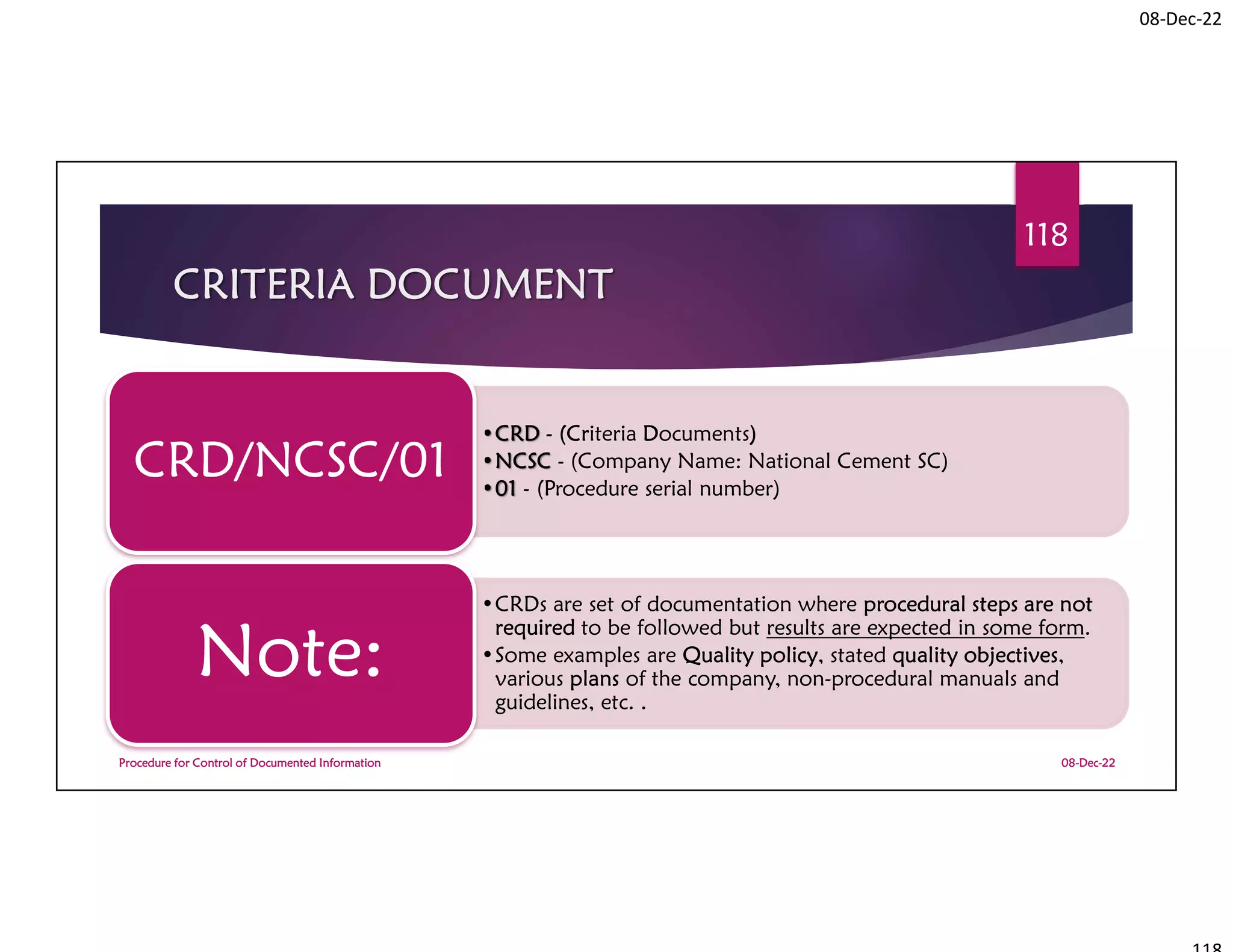
CRITERIA DOCUMENT
•CRD - (Criteria Documents)
•NCSC - (Company Name: National Cement SC)
•01 - (Procedure serial number)
CRD/NCSC/01
•CRDs are set of documentation where procedural steps are not
required to be followed but results are expected in some form.
•Some examples are Quality policy, stated quality objectives,
various plans of the company, non-procedural manuals and
guidelines, etc. .
Note:
08-Dec-22
Procedure for Control of Documented Information
118
08-Dec-22
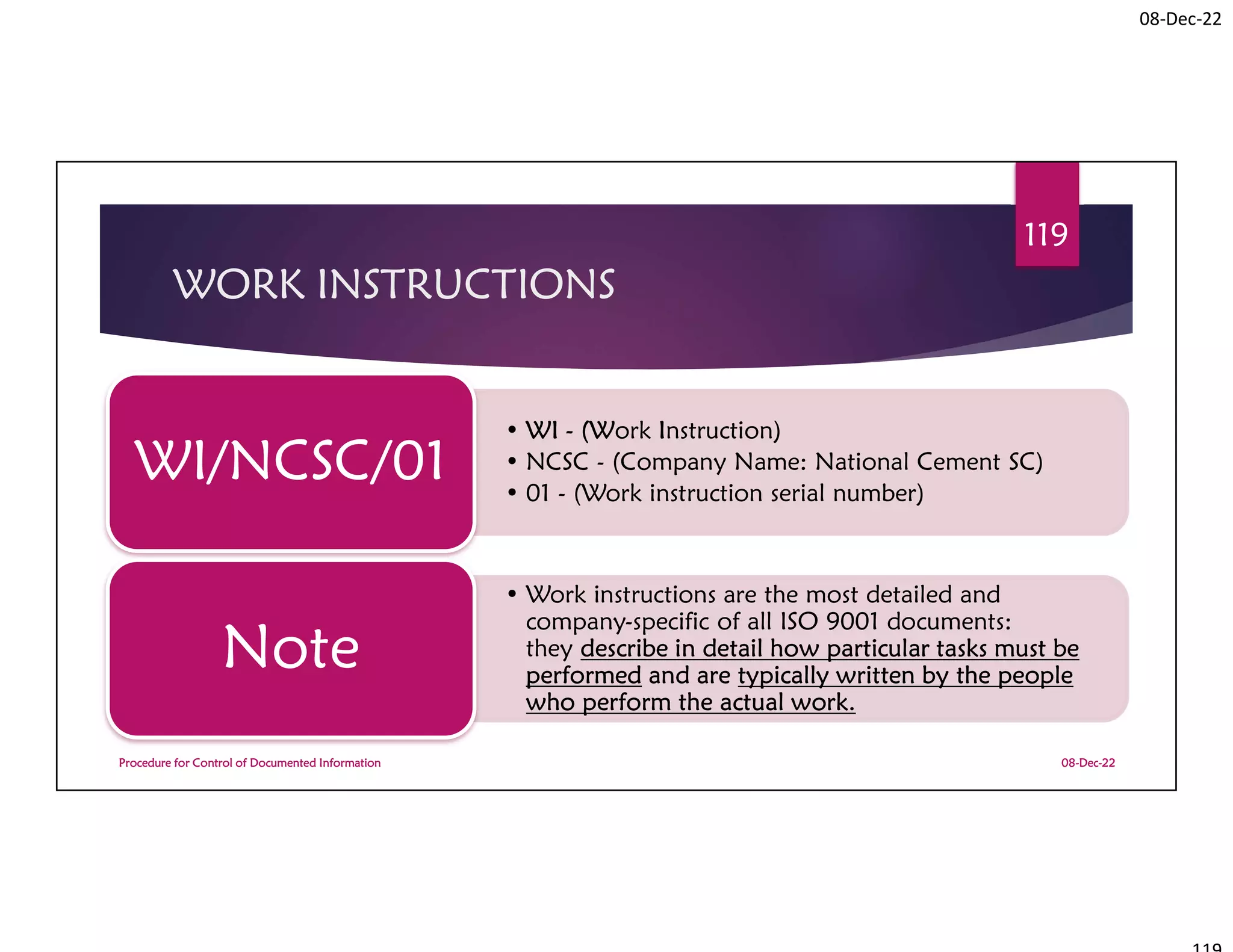
WORK INSTRUCTIONS
• WI - (Work Instruction)
• NCSC - (Company Name: National Cement SC)
• 01 - (Work instruction serial number)
WI/NCSC/01
• Work instructions are the most detailed and
company-specific of all ISO 9001 documents:
they describe in detail how particular tasks must be
performed and are typically written by the people
who perform the actual work.
Note
08-Dec-22
Procedure for Control of Documented Information
119
08-Dec-22
OPERATING FORMS
• OF - (Operating Forms)
• NCSC - (Company Name: National Cement SC)
• 01 - (Form serial number)
OF/NCSC/01
• first form originating in the mining department could be named as
OF/QAG/01.
• Production departments’ first record could also be named OF/PRD/01
following similar patterns.
• Note also that checklists when filled out are forms of that specific
activity.
Note:
08-Dec-22
Procedure for Control of Documented Information
120
08-Dec-22
6.3 General supplements
 6.3.1.2. DOCUMENTS OF EXTERNAL ORIGIN
 Document numbering systems for documents of external
origin are adopted as they are, if possible.
 In all cases the external documents are identified uniquely
based on date of registration and registration number.
08-Dec-22
Procedure for Control of Documented Information
121
08-Dec-22
6.3.2 GENERAL FORMAT FOR PROCEDURES, AND
WORK INSTRUCTIONS:
A) PROCEDURES:- THE GENERAL FORMATS FOR
PROCEDURES ARE AS FOLLOWS:-
 Issue history: List all issues of the
procedure from initial release to current
issue. Description of the change shall be a
summary of change made.
 Reference documents: List reference
documents by their control number and
title (this does not include forms).
 EXAMPLE: ISO 9001: 2015, Quality
Management Systems- Requirements.
 Contents: Contents of the document with
its page number shall be described.
 Purpose: Describe the area or subject
where the procedure is applicable.
 Scope: State the applicability and limits to
which the procedure shall be used.
 EXAMPLE: This procedure applies to
both internal and external customer
complaints handling.
08-Dec-22
Procedure for Control of Documented Information
122
08-Dec-22
6.3.2 GENERAL FORMAT FOR PROCEDURES, AND
WORK INSTRUCTIONS:
A) PROCEDURES:- THE GENERAL FORMATS FOR
PROCEDURES ARE AS FOLLOWS:-
 Processes owner: Describe the overall
owner of the process.
 EXAMPLE: The CEO is the owner
of customers’ complaints handling
process.
 Definitions and abbreviations: Clarify
(if applicable) abbreviation and/or
terms used in the procedure.
 Procedure: Describe the process
clearly and adequately.
 Records OF: List the quality records
that must be generated and
maintained to show that the
requirements of the procedure have
been fulfilled.
 Related Documents: List all related
documents applicable to the
procedure.
08-Dec-22
Procedure for Control of Documented Information
123
08-Dec-22
6.3.2 GENERAL FORMAT FOR PROCEDURES, AND
WORK INSTRUCTIONS:
B) WORK INSTRUCTIONS
 Issue History: List all issues of the work instruction from initial release to current issue.
 Description of the change shall be a summary of changes made.
 Purpose
 Scope
 Work instruction
 Responsibility
 Operator prescription
 Reference document
 Diffusion
08-Dec-22
Procedure for Control of Documented Information
124
08-Dec-22
6.3.3 GENERAL PAGE LAYOUT OF
DOCUMENT WRITING AT NCSC
 In order to ensure legibility and consistency, documents shall possibly
be prepared with the following layout
 15 mm (0.6 inches) left and right margins.
 15 mm (0.6 inches) top and bottom margins.
 FORMAT TYPOGRAPHICAL SPECIFICATIONS
 The following specifications are all typographical matters:
08-Dec-22
Procedure for Control of Documented Information
125
08-Dec-22
6.3.3 GENERAL PAGE LAYOUT OF
DOCUMENT WRITING AT NCSC
Fonts
 a. Headers & Footer
 NCSC – MAIANDRA GD, 12-point, UPPERCASE and bold.
 Document number – Maiandra GD, 11-point, UPPERCASE and normal.
 Issue number፡ Maiandra GD, 11-point, UPPERCASE and normal.
 Page number, issue date, approved by፡ Maiandra GD, 11-point and normal.
 Title – Maiandra GD, 12-point, Title case and bold.
08-Dec-22
Procedure for Control of Documented Information
126
NATIONAL CEMENT SHARE COMPANY DOCUMENT NO: OP/NCSC/01
Title: Procedure for control of Documented Information ISSUE NO. 1 Page 5 of 15
08-Dec-22
6.3.3 GENERAL PAGE LAYOUT OF
DOCUMENT WRITING AT NCSC
 b. Main Headings – Maiandra GD, 11-point, uppercase and bold.
 c. Sub-headings – Maiandra GD 11-point, Sentence case and bold.
 d. Body Text – Maiandra GD 11-point and normal.
 e. In the cases of Graphics and tables body text may be 6-11-points,
bold or normal.
08-Dec-22
Procedure for Control of Documented Information
127
08-Dec-22
6.3.4 GENERAL FORMAT FOR
DEVELOPING FORMS
 All forms generated in NCSC shall be according to Form No. OF/XYZ/01.
 XYZ stands for individual department within the organogram or according to the first level
categorization.
 QUALITY DOCUMENTS SHALL ADDRESS THE FOLLOWING REQUIREMENTS
 a) New documents and data and changes to existing documents and data are reviewed and
approved for adequacy by the responsible person before release.
 b) Any document with a document number and revision level that does not match the current
version as designated on the Master List and /or master document is considered invalid or obsolete.
 Invalid or obsolete documents and data may be kept separately for historical reference or
knowledge preservation purposes.
08-Dec-22
Procedure for Control of Documented Information
128
08-Dec-22
6.3.4 GENERAL FORMAT FOR
DEVELOPING FORMS
 c) Master Lists of all documents shall be kept with Document controller.
 d) External documents shall be reviewed and approved for adequacy before use.
 e) External documents shall be properly identified and distributed for users and
removed from service when obsolete.
 A separate master list and /or document shall also be prepared and maintained
by Document controller.
 f) The latest approved NCSC policies, regulations and directives shall be properly
identified and available to users.
 g) Electronically handled documentation shall be managed in close consultation
with the IT department
08-Dec-22
Procedure for Control of Documented Information
129
08-Dec-22
6.3.5 Additional description to the Records control
A) Records retention time
08-Dec-22
Procedure for Control of Documented Information
130
SN Records On Site (Short term) Retention Time in years Long Term Retention Time in years
1
 Calibration Records
 Inspection & Test records
 wastage and lose records
5 12
2 Management Review records 3 10
3 Contract review records 5 10
4 Product identification & traceability 3 3
5 Work orders 3 7
6 operation control records 2 5
7 Employees’ records including personal files As long as the employee exists in the organization 25 years After resigning
8 Meeting Records (Minutes) 3 10
9 Performance Reports 3 10
10 Procurement Records 3 10
11 Fixed Asset and Financial Records 5 10
12 Financial Audit Report 3 As long as the organization exists
13 Project Document 3 years as from project completion date Knowledge preservation
14 Others 3 5
08-Dec-22
6.3.5 Additional description to the Records control
A) Records retention time
 As soon as the short-term retention time expires, records shall be transferred to the long
term storage room.
 Records under legal case shall be retained until the case is finalized even if the long-term
retention time has been expired.
 Records may be retained after the long-term retention time if they are required to
preserve knowledge.
 If the above records are available in an electronic media the backups shall be properly
labelled and retained longer time.
08-Dec-22
Procedure for Control of Documented Information
131
08-Dec-22
6.3.5 Additional description to the Records control
B) Disposal of quality records
 Records shall be disposed of as soon
as their retention time is expired.
 Head of the Records Custodian has
the responsibility to dispose of the
records up on approval by the
management representative and/or
the Chief Executive Officer.
C) Main Official record retention sites
 Production/ QC/ Maintenance/store
 CEO office
 Finance
 HR
 Marketing
 Procurement
08-Dec-22
Procedure for Control of Documented Information
132
08-Dec-22
6.3.5 Additional description to the Records control
d) Storage of files
 All quality management system records
shall be filed and stored in an office
environment unless specific media
and/or special environmental control
are specified to prevent damage,
deterioration, or loss and allow access
control.
 All quality records shall be physically or
electronically filed by a method which
enhances accessibility and retrieval by a
user.
 If electronic files are used a back-up
system or other suitable measures
shall be used to prevent record loss.
e) Attaching records to files
 Records shall be attached to files after
the respective function or person(s) has
taken the actions (post-action
attachment).
08-Dec-22
Procedure for Control of Documented Information
133
08-Dec-22
6.3.5 Additional description to the Records control
f) Issuance of records (files) upon request
 Access controlled records shall only be issued when the request is approved by an authorized person
g) Access control
 All confidential records shall be handled and stored confidentially. The access to such records shall be
approved by the CEO
 A person who wants to have an access to confidential records shall raise a request clearly describing
his/her reasons and he/she may have an access to such records only when he/she has adequate reasons
and the CEO or other authorized person approves the request.
 Access controlled records shall be stored in an area where their confidentiality is secured i.e. in locked
filing cabinets and/or in separate rooms where entry of unauthorized individuals is restricted.
08-Dec-22
Procedure for Control of Documented Information
134
08-Dec-22
Access control files
08-Dec-22
Procedure for Control of Documented Information
135
S.N. Access Controlled Records Reasons for Access Controlled Location Authorized Persons
1
Marketing Research (needs, satisfactions etc.)
records, Marketing strategy & tactics
 To protect from alteration and loss
 Not to give access to competitors
CEO & DCEO/ Marketing
Departments
CEO
2 Contract document For legal reasons
CEO/DCEO/legal service/
HR/Finance
Specified by the CEO
3
Personal Records
 Medical reports
 Personnel appraisal records
 records of disciplinary action
 Biographic data
 Employment records
To protect personal
information
CEO & DCEO- support, HRM Specified by the CEO
4
Financial Records
 Receipts
 Journal Voucher
 Asset Registers
 Payment Voucher
 Ledgers
To protect from alteration and loss CFO / Finance Department Specified by the CEO
5 Product development and formulation
To protect company product formulation
data
CEO As per decisions by CEO
6 Others The CEO can decide on other records/ or documented information to be access-controlled as needed.
08-Dec-22
6.3.5 Additional description to the Records control
h) Structure of a file system
 File categories
 All files shall be organized into logical groups, which relate to the functions
and activities of the company.
 Records in a filing system shall be categorized as follow:
1) First level category: Name of department/process
2) Second level category: type of records
08-Dec-22
Procedure for Control of Documented Information
136
08-Dec-22
08-Dec-22
Procedure for Control of Documented Information
137
File
Box
File holder numbering record system
08-Dec-22
6.3.5 Additional description to the Records control
1) First level category
Categorize the records based on the specific
Department/Service and these are designated by
two to six UPPERCASE English Alphabets as
Follows.
08-Dec-22
Procedure for Control of Documented Information
138
08-Dec-22
6.3.5 ADDITIONAL DESCRIPTION TO THE RECORDS CONTROL
1) FIRST LEVEL CATEGORY:
The First Level Category Code Department/Processes
CEO Chief Executive Office
ADV Advisor To CEO
MR Management Representative
IAS Internal Audit Service
DCC Document Control Centre
PMS Planning & Monitoring Service
LS Legal Services
KPM KOKA Plant Manager
500TPD 500TPD Plant
PR Public Relations
AASS Addis Ababa Support Service
08-Dec-22
Procedure for Control of Documented Information
139
08-Dec-22
6.3.5 ADDITIONAL DESCRIPTION TO THE RECORDS CONTROL
1) FIRST LEVEL CATEGORY:
The First Level Category Code Department/Processes
DCP Deputy CEO, Plant Operations
SAH Safety & Health Service
PRD Production Department
QAG Quarry and Auto Garage Department
QC Quality Control Department
ELEC Electrical Maintenance Department
MECH Mechanical Maintenance Department
ENG Engineering Department
CFO Chief Financial Officer
FIN Finance & Accounting
ICT Information & Communication Technology Service
08-Dec-22
Procedure for Control of Documented Information
140
08-Dec-22
6.3.5 ADDITIONAL DESCRIPTION TO THE RECORDS CONTROL
1) FIRST LEVEL CATEGORY:
The First Level Category Code Department/Processes
DCM Deputy CEO, Marketing, Sales & Fleet Operation
ESD Eastern Sales & Distribution
CSD Central Sales & Distribution
EMD Export Marketing Department
FOM Fleet Operation Management Department
DCS Deputy CEO, Support Services
HRM Human Resource Management Department
SCH Supply Chains
GSS General Service & Security Department
08-Dec-22
Procedure for Control of Documented Information
141
08-Dec-22
6.3.5 Additional description to the Records control
2) Second level category: type of documents and records
 Two digit numerical codes starting from 01 to 99 shall be assigned to each
process/activity identified in each Second level category.
 Examples are depicted hereunder and departments could use the codes as
they are or create their own.
 However the external index could be clearly posted and communicated to
the MR.
08-Dec-22
Procedure for Control of Documented Information
142
08-Dec-22
6.3.5 Additional description to the Records control
2) Second level category: TYPE OF RECORDS
Code Records Title
1 Management review & other Minutes of meetings (incl. meetings for system updating)
2 contractual agreement
3
Organization records (organizational structure, job description, salary scale, job grading and
specification, etc...)
4
Training Records (Training records could be training attendance, training evaluation, training needs,
COC etc.)
5 Employee Personal records
6 Nonconformance records incorporating. withdrawal & recall
7 Maintenance records
8 Operational records
9 Performance Reports of processes including performance of outsourced processes
10 Sales records including distributors, agents, projects or outlet owners
08-Dec-22
Procedure for Control of Documented Information
143
08-Dec-22
6.3.5 Additional description to the Records control
2) Second level category
Code Records Title
11 Customer requirement
12 Work Order & execution records
13
Procurement records incorporating records of out sourced processes; and control of externally
provided products/services (supplier evaluation records)
14 Document Control Records
15
System Documents includes policies; manuals; procedures; work instructions; checklists, External
documents ; and organizational knowledge gained
16
Plans incorporating production or other plans of company processes; objectives; strategic plans
dealing with context of the company, and requirements of interested parties; risks and
opportunities
17 Non Paper (CD’s , Photographs..) records including flow diagrams, charts, etc
18 Market Research, customer needs/satisfaction assessment/complaint records
08-Dec-22
Procedure for Control of Documented Information
144
08-Dec-22
6.3.5 Additional description to the Records control
2) Second level category
Code Records Title
19 Regulatory & statutory records
20 Supplier Records
21 Calibration records incl. software validation records
22 Audit reports
23 Inspection & Test records
24 Wastage, lose & damage records
25 nonconformance reports (NCRs) out of audit activity
26 Corrective & preventive action reports (CARs)
27 Internal Correspondence Incoming & outgoing letters
28 external Correspondence Incoming & outgoing letters
08-Dec-22
Procedure for Control of Documented Information
145
Note: In the case of files at the Finance Department a filing system that facilitates the activities of the
department could be put in place.
08-Dec-22
6.3.5 Additional description to the Records control
3) Third level Category: File serial number
 Unique Number for Each File within Each Third Category
 Two digit numerical codes starting from 01 to 99 shall be assigned to each
process/activity identified in each third level category.
 Every file shall be allocated a file number clearly identifying the year of creation
 File Numbering Template
08-Dec-22
Procedure for Control of Documented Information
146
08-Dec-22
6.3.5 Additional description to the Records control
4) Fourth level Category: Additional unique Identification marks (String or nominal) can be
used at demand.
08-Dec-22
Procedure for Control of Documented Information
147
08-Dec-22
File holder numbering record system
Example of File Numbering System:
Company Logo
1st level category PRD Production Department
2nd level category
Font size 65
9
Performance Reports of processes
including performance of
outsourced processes
3rd level category
Font size 65
01
File Serial Number
Unique Number for Each File within Each
Third Category
4th level category DAILY REPORT
Additional unique Identification marks
(String or nominal) can be used at
demand. Up to 15 characters
Year
Font size 60
2022 Calendar Year the File is created
08-Dec-22
Procedure for Control of Documented Information
148
08-Dec-22
08-Dec-22
Procedure for Control of Documented Information
149
File
Box
File holder numbering record system
08-Dec-22
Multiple attachments of records
 Photocopy the original ensuring enough copies for all subjects
represented in the original.
 Attach copies to the appropriate files.
 Note on copies where the original record is located.
 Register each copy of the records to the file to which it has been
attached, and note that it is a copy.
08-Dec-22
Procedure for Control of Documented Information
150
08-Dec-22
7. RECORDS
 The CEO/DCEOs and all departments/services have the responsibility to
maintain all records received.
 Document controller has the responsibility to record and retain the following
records.
 Document creation and change request
 Master List of Documents
 Documents Distribution List
08-Dec-22
Procedure for Control of Documented Information
151
08-Dec-22
All process owners role and
responsibility based on ISO 9001:2015
08-Dec-22
Procedure for Control of Documented Information
152
08-Dec-22
Department/process owner role & responsibility
on ISO 9001:2015 QMS implementation
 Prepare and review/revise work unit process operational procedures, formats documents
 Implement accordingly the approved own operational procedures, formats
 Generate plan and report annually and monthly
 Arrangements and set in order of all generated reports documents
 Documentation of all generated annual, monthly and daily plan and progressive reports according to
documentation procedure system
 Monitor and coach documentation process for easy document retrieval
 Implement ISO QMS principal
 Use inter office memo when ever communicating inter department
08-Dec-22
Procedure for Control of Documented Information
153
08-Dec-22
154

Procedure for control of Documented Information for traniee (1).pdf

  • 1.
    08-Dec-22 ISO 9001:2015 QMS Documentationworkshop ISO 9001:2015 QMS REQUIREMENT NOVEMBER, 2022 1
  • 2.
    08-Dec-22  ሰዓት ማክበር ስልክ ሳይለንት ማድረግ  የጎንዮሽ ውይይት አለማድረግ  አለመቅረት እንዲሁም  መሳተፍ …..  ሕጉን የጣሰ ይቀጣል  ቀልድ 2 08-Dec-22 የስልጠናው ቅድመ-ሁኔታዎች
  • 3.
    08-Dec-22 Workshop participant  Topmanagement  Process owner/Department Managers  Internal auditors 08-Dec-22 Procedure for Control of Documented Information 3
  • 4.
    08-Dec-22 Congratulation on ourrecertification of ISO 9001:2015 it is your input has help our success ISO 9001:2015 RECERTIFICATE DOCUMENT 08-Dec-22 Procedure for Control of Documented Information 4
  • 5.
    08-Dec-22 08-Dec-22 Procedure for Controlof Documented Information 5
  • 6.
    08-Dec-22 Contents and OUTLINEof the presentation  Objective of the workshop  Mian target of the workshop  Overview of ISO 9001:2015 QMS  The 7 Principles  The 10th requirement clauses  Importance  Reasons Why Documentation Is Important  The importance of documentation (i.e. why should you care about this?)  ISO 9001:2015 Documented Information definition  ISO 9001 Requires that you maintain control of documents and Records  What Are The 6 Mandatory Procedures For ISO 9001  Documented Information Required by ISO 9001:2015 based on 10th clause  Group Work  ISO 9001:2015 required clause to comply CLAUSE 7- SUPPORT 7.5 Documented information what requirements entails?  NCSC ISO 9001:2015 7.5 Documented information on Quality Manual  Procedure for Control of Documented Information OP/NCSC/01 08-Dec-22 Procedure for Control of Documented Information 6
  • 7.
    08-Dec-22 Objective of theworkshop 1. To eliminate opportunity for improvement of external audit report by taking corrective action 2. To brief ISO 9001:2015 10th clause and principles 3. To aware the importance of documentation 4. To have quality management system effective in implementation 5. To comply with 7.5 clause ISO requirement 6. To orient Procedure for Control of Documented Information 7. To make NCSC staff international standard employee 8. To show role and responsibility in ISO 9001:2015 QMS documentation 08-Dec-22 Procedure for Control of Documented Information 7
  • 8.
    08-Dec-22 Mian target ofthe workshop Four opportunity for improvement of external audit report related to documentation 1. Overall system review can be done (there are changes in strategies, working procedures with regard to previously documented information), example Sales and Marketing, 2. Documented information system is found inconsistent throughout the organization 3. Records management (filing) to follow the company standard (Example quarry, quality, store) 4. Document retrieval and accessibility needs improvement in Sales and Marketing process 08-Dec-22 Procedure for Control of Documented Information 8
  • 9.
  • 10.
    08-Dec-22 Descriptions of theNonconformity 1) Overall system review can be done (there are changes in strategies, working procedures with regard to previously documented information, example Sales and Marketing, 2) Documented information system is found inconsistent throughout the organization 3) Records management (filing) to follow the company standard (Example quarry, quality, store) 4) Whenever documents are changed or updated it should be reissued with new revision status and date to be as per the actual issue date 5) Quality objectives to cover all relevant functions (Example quarry, procurement, IT) 6) All management review inputs to be addressed during management review 7) Internal audit findings to be managed through corrective action planning (with root cause analysis) 8) Post effectiveness for training provided to be evident (however it is planned at the end of the budget year) 9) Siren at quarry area to be functional during blasting time 10) Expired chemicals found in laboratory chemical store to be segregated and properly managed (salt categories: Example EDTA on 2019, Sodium Carbonate on 2015, Copper Sulphate on 2019) 11) Calibration of measuring flasks, beakers, pipettes to be evident 12) Electronic maintenance work order system to be functional and reason for under performance during preventive maintenance work can be remarked 13) Document retrieval and accessibility needs improvement in Sales and Marketing process 14) Customer satisfaction survey schedule to be verified 15) Suppliers to be categorized based on the delivery evaluation result and the format can have date
  • 11.
    08-Dec-22 Principles of ISO9001 QMS  An organization who is certified of ISO 9001 must put on these 7 principles for effective QMS implementation  There are 7 key principles of quality management that form the foundation of ISO 9001:2015 and are relevant to the entire organization.  The seven principles of quality management are: 1. Engagement of people. 2. Customer focus. 3. Leadership. 4. Process approach. 5. Improvement. 6. Evidence-based decision making. 7. Relationship management. QMS principles and benfits.pptx 08-Dec-22 Procedure for Control of Documented Information 11
  • 12.
    08-Dec-22 The 7 QualityManagement Principles 1. Customer focus: Focus on your customer and their needs, Respect from gate 2. Leadership: Develop a strong management team, Advocacy (Full Support on implementation) 3. Engagement of people: Getting your team involved in the management system, Training, controlling, 4. Process approach: Create a process culture, evaluate it the value adding, on output to other input 5. Improvement: Embrace continual improvement, never been satisfied 6. Evidence based decision making: Base your decisions on facts, based on analysis, research 7. Relationship management: Develop mutually beneficial relationships with suppliers; government, customer, supplier, society etc. make it partnership
  • 13.
    08-Dec-22 ISO 9001:2015 QMS10 Clauses  The core concepts of the new clause structure include management, customer, requirements, policy, procedure, planning, performance, objective, control, monitoring, measurement, auditing, decision making, corrective action, and nonconformity.  An organization who is certified of ISO 9001 must comply/obey to the requirements of these listed 10 clause for effective QMS implementation 1. Scope. 2. Normative References. 3. Terms and Definitions. 4. Context of the organization. 5. Leadership. 6. Planning. 7. Support.  7.1 Resources  7.2 Competence  7.3 Awareness  7.4 Communication  7.5 Documented information 8. Operation. 9. Performance evaluation. 10. Improvement. 08-Dec-22 Procedure for Control of Documented Information 13
  • 14.
    08-Dec-22 ISO 9001:2015 QMS10 Clauses  But Today we will look in to the 7.5 clause Document information  It’s Importance  Control document information Procedure 08-Dec-22 Procedure for Control of Documented Information 14
  • 15.
    08-Dec-22 The ISO 9001:2015new model Representation of the structure of ISO 9001:2015 in the PDCA cycle in 10 clause
  • 16.
    08-Dec-22 Documented information system & Records management DOCUMENT RETRIEVAL ANDACCESSIBILITY 08-Dec-22 Procedure for Control of Documented Information 16
  • 17.
    08-Dec-22 What is documentation? Documentation refers to a set of records that professionals or companies keep to provide evidence or information that can be used to inform decisions.  In the workplace, documentation is retained records of employment and company actions and events as required by legal mandates and company policy. 08-Dec-22 Procedure for Control of Documented Information 17
  • 18.
    08-Dec-22 Overview of documentationImportance  These presentation is the base of the company productivity and your process decision making.  First we need understand and accept the importance of documentation then, If you value on importance of your documentation you will record every process activities very carefully and attentively by checking the correctness of the document paper to be filled and records put in the paper.  We should ask ourself  What is the importance of documentation for my department/process?  Should we comply to the requirements?  Is it relay helpful to my department/process? 08-Dec-22 Procedure for Control of Documented Information 18
  • 19.
    08-Dec-22 What is thekey advantages of effective documentation?  Increased Efficiency: Documentation processes reduce document hunting and wastage of time so that employees can focus more on revenue-generating tasks.  Increased Productivity: Documentation simplifies processes and makes information more accessible. As a result, productivity increases. 08-Dec-22 Procedure for Control of Documented Information 19
  • 20.
    08-Dec-22 Reasons Why Documentation Is Important 1.IT DEMONSTRATES PROFESSIONALISM 2. IT PROVIDES HELPFUL GUIDANCE FOR PERFORMANCE 3. THE BUSINESS CAN BE MORE PROFITABLE 4. Mitigate risk from employee turnover 5. See your operations process from a fresh perspective 6. Give your operations a more professional image 7. Use as a training tool for future operations hires 8. Err on the side of compliance 08-Dec-22 Procedure for Control of Documented Information 20
  • 21.
    08-Dec-22 Most of peopledid not pay attention to important things that helps them. 08-Dec-22 Procedure for Control of Documented Information 21
  • 22.
    08-Dec-22 Reasons Why DocumentationIs Important  Maintaining a system of organized, accurate and consistent documentation in the workplace is both necessary and beneficial.  Making documentation a priority, especially when it comes to the company’s human resources (HR) department, can help mitigate arguments,  offer resources when they are needed and  answer important questions about the company.  In this slide, we discuss why documentation is important and ways you might consider improving your documentation process. 08-Dec-22 Procedure for Control of Documented Information 22
  • 23.
    08-Dec-22 Why is documentationimportant?  While there are many reasons maintaining a consistent, organized system for documentation can help you and your organization to be successful,  Here are Eight main categories to consider: 08-Dec-22 Procedure for Control of Documented Information 23
  • 24.
    08-Dec-22 Why is documentationimportant? 1. It demonstrates professionalism  Documentation shows both employees and customers that  you are committed to safeguarding critical information and  are dedicated to providing stakeholders with factual/truthful information as needed.  The practice of maintaining accurate documentation alone provides  an accessible, manageable framework for addressing issues that benefits everyone. 08-Dec-22 Procedure for Control of Documented Information 24
  • 25.
    08-Dec-22 Why is documentationimportant? 2. It provides helpful guidance for performance  Documenting your processes ensures consistency, efficiency and standardization.  It allows everyone following them to perform at their best and be clear about your expectations.  Taking the time to document each of your procedures in a step-by-step format will save time and money in the long run.  Once you outline what's important for the business and how to achieve goals, your overall group effort will be more direct and focused.  As a result, your employees can reach goals sooner and with more ease. 08-Dec-22 Procedure for Control of Documented Information 25
  • 26.
    08-Dec-22 Why is documentationimportant? 3. The business can be more PROFITABLE  Documenting information and processes saves employees time by offering answers to questions in an accessible way.  Employees can spend more time working than getting caught up in solving problems for themselves or their coworkers.  When businesses document procedures, they can run more efficiently. 08-Dec-22 Procedure for Control of Documented Information 26
  • 27.
    08-Dec-22 4. Mitigate Riskfrom Employee Turnover  If you have no documentation, operational risk will increase when a talented back-office team member leaves the firm.  That's because the departed employee will take their operational and portfolio accounting know-how with them.  As a result, you and your staff are left haphazardly scrambling to finish the daily reconciliation reports.  Documenting all procedures from start to finish will reduce when turnover occurs.  Following process documentation best practices, you will feel more secure the next time someone leaves your organization. 08-Dec-22 Procedure for Control of Documented Information 27
  • 28.
    08-Dec-22 5. See YourOperations Process from a Fresh Perspective  When documenting the processes step-by-step, you see things differently.  You may have executed the steps according to memory and years of experience.  Now you'll have written instructions.  When you rely only on memory to get work done, you might forget some steps.  For example, you'll forget to create backup files, or you’ll forget to remove or edit certain data points.  If you have process documentation that reminds you to watch out for any missed points, then you’ve reduced the risk.  By having that guide, all someone has to do is follow the instructions, and there will be a consistent and predictable outcome every time:  accurate, error-free reports that are ready for the client, performed in the way you want them done. 08-Dec-22 Procedure for Control of Documented Information 28
  • 29.
    08-Dec-22 6. Give YourOperations a More Professional Image  Having documentation not only promotes consistency in your processes, but it also sets a standard.  Documented procedures indicate a clear goal to be achieved and the steps to achieve that goal. 08-Dec-22 Procedure for Control of Documented Information 29
  • 30.
    08-Dec-22 7. Use asa Training Tool for Future Operations Hires  Not only does a good documentation help prevent operational risk in case of turnover, but it serves as an excellent resource to train new members of your organization.  A straightforward, easy-to-follow set of instructions for your processes will save you time, effort, and resources in getting the new hires up to speed.  In turn, you’ll see how effective the documentation is when someone uses it for the first time.  If they struggle with your instructions, you’ll learn how to improve the document so that when the next new hire arrives, things will be easier. 08-Dec-22 Procedure for Control of Documented Information 30
  • 31.
    08-Dec-22 8. Err onthe Side of Compliance  Having documentation should be considered following best practices.  Not only have you set standards and step-by-step instructions to meet the goals, but you’re increasing the transparency into your back-office operations.  Should the firm be audited,  documenting your reconciliation and reporting processes is one more way to show your organization takes protocol and compliance seriously. 08-Dec-22 Procedure for Control of Documented Information 31
  • 32.
    08-Dec-22 Reasons Why DocumentationIs Important for your Operations  Whether you’ve  lost key operational staff, or your reconciliation and reporting processes are disorganized,  having good documentation can help eliminate problems you’re facing.  Do you have documented procedures? If so, when was the last time you and your team looked at them?  Whether or not you have any, and whatever your operational issues you face, proper documentation makes a difference. 08-Dec-22 Procedure for Control of Documented Information 32
  • 33.
    08-Dec-22 Why should you careabout documentation? 1. A single source of truth saves time and energy 2. Documentation is essential to quality and process control 3. Documentation cuts down duplicative work 4. It makes hiring and onboarding so much easier 5. A single source of truth makes everyone smarter 08-Dec-22 Procedure for Control of Documented Information 33
  • 34.
    08-Dec-22 Why should youcare about documentation?  We get it. You are busy, which means recording things like decisions, statuses, and steps for handling repetitive tasks probably doesn’t rank near the top of your to-do list.  When the rubber hits the road (the point at which a theory or idea is put to a practical test.), documentation will be one of those things that you’ll be glad that you did.  Whether a team member is unexpectedly absent or you aren’t sure how to move forward with an unfamiliar initiative, those records will be an undeniably handy resource.  Need more help convincing your team?  Here are a few key benefits you can share to illustrate why documentation should be a priority moving forward. 08-Dec-22 Procedure for Control of Documented Information 34
  • 35.
    08-Dec-22 1. A singlesource of truth saves time and energy  Estimates state that the average knowledge worker spends about two and a half hours per day searching for the information they need.  Effective documentation collects all of the must-know information about a task, or team (from account logins to step-by-step instructions) in a centralized, organized place.  No more digging through email or downloaded files for the latest information.  Documentation means you’re able to keep the gears turning without spending hours trying to track down details, credentials, directions, and more.  Writing down your processes is helpful for spotting bottlenecks and overfed workflows, so you can further streamline/smooth the way your team works. 08-Dec-22 Procedure for Control of Documented Information 35
  • 36.
    08-Dec-22 2. Documentation isessential to quality and process control  There’s more than one way to get things done, and you want to give your team the flexibility to approach their work in a way that suits them best.  But, at the same time, you want to ensure consistent results – especially when it comes to things that you’re producing on a regular basis.  Documentation encourages knowledge sharing, which empowers your team to understand how processes work and what finished projects typically look like.  With those resources in hand, your team members don’t need to be mind readers to maintain consistency of repeated jobs like that monthly report or that quarterly presentation. 08-Dec-22 Procedure for Control of Documented Information 36
  • 37.
    08-Dec-22 3. Documentation cutsdown duplicative work  How many times have you started a new plan only to find out it had been done before?  Companies that use documentation to catalog past jobs, share decisions benefit and etc. by reducing re-work that wastes precious time you could be using elsewhere.  Why reinvent/redone the wheel when you can just build on the work that’s already happened?  With documentation in place, you can refer to past work and learn from it, instead of doing it all over again with the same results. 08-Dec-22 Procedure for Control of Documented Information 37
  • 38.
    08-Dec-22 4. It makeshiring and onboarding so much easier  It’s tough to think about anybody leaving, but the reality of business is that your team won’t stay the same forever.  When you’re welcoming new team members, that onboarding period can be daunting/frightening, both for your existing team and for that new employee.  And, unfortunately, Gallup found that only 12% of employees strongly agree that their organization does a great job of onboarding new workers. 88% not satisfied. 08-Dec-22 Procedure for Control of Documented Information 38
  • 39.
    08-Dec-22 4. It makeshiring and onboarding so much easier You want to educate and empower team members to do their best work, rather than making them feel like they’re thrown to the wolves.  If you prioritize documentation,  they’ll have all sorts of helpful guides, directions, and notes  that they can refer to as they get up to speed in their new roles.  Plus, they can use those resources to answer their questions and start to figure things out independently,  rather than feeling like they need to ping/ring someone on your team with every single question or sticking point. 08-Dec-22 Procedure for Control of Documented Information 39
  • 40.
    08-Dec-22 5. A singlesource of truth makes everyone smarter  At work, we tend to treat our knowledge as currency.  If we’re the person with all of the answers, it provides us a sense of security, as if we’re the most irreplaceable person on our team.  We assume that sharing our know-how will make us less valuable.  That’s why it’s little surprise that one survey found that 60% of employees have had a difficult time getting their colleagues to share information that is vital to their work.  Documentation increases the collective knowledge of everyone that you work with.  When it becomes the norm/normal on your team to share information, you’ll benefit from increased transparency and a culture that’s more collaborative and strategic.  You’ll make smarter decisions because essential information won’t be locked away on just one person’s hard drive - or worse yet - their head. 08-Dec-22 Procedure for Control of Documented Information 40
  • 41.
    08-Dec-22 Documentation should beyour best friend  From covering an unexpected departure or absence of an employee to tackling an unfamiliar jobs, you’ll be able to make it over plenty of scare obstacles together.  While it might sound firm and formal, prioritizing documentation means you and your team will develop a stockpile/store of information that you’ll lean on.  Share the above advantages with your team members,  find a way to incentivize their participation in documenting what they can,  and rest easy knowing that your team’s knowledge will no longer live just in their brains. 08-Dec-22 Procedure for Control of Documented Information 41
  • 42.
    08-Dec-22 ISO 9001:2015 Documented Information definition • DOCUMENTSAND RECORDS • WHAT ARE THE REQUIREMENTS FOR DOCUMENTATION IN THE ISO 9001:2015 STANDARD? 08-Dec-22 Procedure for Control of Documented Information 42
  • 43.
    08-Dec-22 What Is DocumentedInformation in ISO 9001? Documents and Records  The term “documented information” in ISO 9001 refers to all of the important information within a business that must be kept organized and controlled.  It is basically a combination of: Documents; and Records  The ISO 9001:2015 standard no longer uses the terms “documents” and “records”. Both are now called “documented information”.  As per the ISO 9000:2015 definition, the term documented information refers to information that must be controlled and maintained.  Therefore, it expects that you also maintain and control the medium as well as the information.  Documented information is used as evidence of conformance. 08-Dec-22 Procedure for Control of Documented Information 43
  • 44.
    08-Dec-22 What Is DocumentedInformation in ISO 9001? Documents and Records  The key identifier of a record verses a document is that  records are documented information that is “retained” and  documents are documented information that is “maintained”.  A form is a document, when the form is filled out it becomes a record.  Both documents and records must be controlled following the requirements of the ISO 9001:2015 standard covered in clause 7.5. 08-Dec-22 Procedure for Control of Documented Information 44
  • 45.
    08-Dec-22 ISO 9001:2015 VsISO 9001:2008 08-Dec-22 Procedure for Control of Documented Information 45 ISO 9001:2015 ISO 9001:2008 Summary of Changes 7.5 Documented Information 4.2 Documentation Requirements Title only. 7.5.1 General 4.2.1 General No change. 7.5.2 Creating and Updating 4.2.3 Control Of Documents This requirement is comparable to the requirements from ISO 9001:2008 Clause 4.2.3 – Document Control 7.5.3 Control Of Documented Information 4.2.4 Control Of Records This requirement is comparable to the requirements from ISO 9001:2008 Clause 4.2.4 – Control of Records.
  • 46.
    08-Dec-22 Documented Information Explained In previous versions of ISO standards, the terms “documents” and “records” were formally used to refer to the important information and data that exists within a company.  In the current ISO 9001 guidelines that were most recently released in the year 2015, these terms have changed, and been combined under the same category of “documented information”.  For the simplest explanation of what this means in terms of ISO 9001, you can think of it as documents and records together. 08-Dec-22 Procedure for Control of Documented Information 46
  • 47.
    08-Dec-22 Documented Information Explained The documented information that is discussed in ISO 9001 is also defined as the vital information that must be kept and evaluated periodically.  Records are usually retained for long periods of time,  while documents hold data that is maintained and frequently updated or added to.  In other words, a document can be thought of as a sheet of paper with blank fields for certain types of data or information.  The document is the blank paper, but it will become a record when a manager or employee fills it out.  Both of these methods of documenting information are equally as important,  which is why they have been combined into one in the current ISO 9001 guidelines,  now being recognized as just “documented information”. 08-Dec-22 Procedure for Control of Documented Information 47
  • 48.
    08-Dec-22 ISO 9001 Requires thatyou maintain control of documents • CONTROL OF RECORDS • WHAT DOCUMENTATION DOES ISO 9001:2015 REALLY REQUIRE? 08-Dec-22 Procedure for Control of Documented Information 48
  • 49.
    08-Dec-22 ISO 9001 Requiresthat you maintain control of documents  ISO 9001:2015 requires that organizations control the documents required by the QMS (quality management system).  Records are a special type of document and must be controlled as required by clause 7.5.  Organizations must establish a documented procedure to:  Approve documents for adequacy prior to issue  Review, update as necessary, and re-approve documents  Identify the changes and current document revision status  Make relevant documents available at points of use  Ensure the documents remain legible and readily identifiable  Identify external documents and control their distribution  Prevent obsolete documents from unintended use  Apply suitable identification if obsolete documents are retained 08-Dec-22 Procedure for Control of Documented Information 49
  • 50.
    08-Dec-22 ISO 9001 Requiresthat you Maintain Control of Records  Establish and control records as evidence of conformity  to requirements and to demonstrate the effective operation of the quality management system.  Establish a documented procedure to define the controls needed for records:  Identification, Storage, Protection  Retrieval, Retention, Disposition  Keep records legible, readily identifiable, and retrievable. 08-Dec-22 Procedure for Control of Documented Information 50
  • 51.
    08-Dec-22 What Documentation doesISO 9001:2015 Really Require?  While the ISO 9001:2008 version was explicit/clear about documentation,  ISO 9001:2015 allows more freedom in how, what, and when to document a quality management process (such as specific procedures).  It appears this evolution is not only to accommodate more modern forms of communication such as video, audio, and other electronic records,  but to allow an organization  the flexibility to reuse appropriate information,  maintain current versions easier,  provide wider access/distribution and  reduce costs associated with documentation. 08-Dec-22 Procedure for Control of Documented Information 51
  • 52.
    08-Dec-22 Requirements for DocumentedInformation  What are the ISO 9001 documented information requirements? 1. Does not require Procedures 2. Does not require a Quality Manual 3. Requires both documents and records of different types  Contrary to the previous version of ISO 9001 that was released in 2008, the current standards do not require any specific procedures when it comes to documented information.  In addition, a quality manual is no longer required in order to be compliant with this set of regulations.  But in order to be efficient if you have one keep it.  Your quality manual is your recipe book for how you manage quality in your organization.  The documented information that is mandatory under ISO 9001:2015 includes both documents and records of different types, which will be discussed in more detail in the next section. 08-Dec-22 Procedure for Control of Documented Information 52
  • 53.
    08-Dec-22 MAINTAIN the DocumentedInformation Required for ISO 9001  Maintain the following documented information by keeping it up-to-date and relevant to the QMS: 1. The scope of the quality management system (4.3) 2. Information necessary to support the operation of QMS processes (4.4) 3. The quality policy (5.2) 4. The quality objectives (6.2)  In short, these documents display the information about the processes of the company regarding  how they are currently running and  how they will run in the future. 08-Dec-22 Procedure for Control of Documented Information 53
  • 54.
    08-Dec-22 What Are The6 Mandatory Procedures For ISO 9001 1. CONTROL OF DOCUMENTS 2. CONTROL OF RECORDS 3. INTERNAL AUDIT 4. CONTROL OF NON- CONFORMING PRODUCTS 5. CORRECTIVE ACTION 6. PREVENTIVE ACTION 08-Dec-22 Procedure for Control of Documented Information 54
  • 55.
    08-Dec-22 What are thedocumented procedures required by ISO 9001?  ISO 9001 is an international standard that mainly focuses on quality management systems.  A quality management system is a set of processes, requirements, and procedures guiding an organisation’s operations to attain the intended objectives.  Before embarking/boarding on a journey to adopt ISO 9001, it’s essential to understand the mandatory practices you need to follow.  Here are six mandatory ISO 9001 procedures to implement: 08-Dec-22 Procedure for Control of Documented Information 55
  • 56.
    08-Dec-22 What are thedocumented procedures required by ISO 9001? 1. Control of Documents. It's essential to maintain efficient communication for a seamless business operation. ... 2. Control of Records. ... 3. Internal Audit. ... 4. Control of Non-conforming Products. ... 5. Corrective Action. ... 6. Preventive Action. 08-Dec-22 Procedure for Control of Documented Information 56
  • 57.
    08-Dec-22 1. CONTROL OFDOCUMENTS  It’s essential to maintain efficient communication for a seamless business operation.  ISO 9001 requires organisations to establish proper control of documents to monitor the delivery of information, products, and services.  The procedure ensures that everyone in the organisation has access to the most accurate and recent instructions and maintains proper records.  Some of the document control aspects to consider include:  Location – This is where you intend to store your documents. It could be a local database system, cabinets, common servers, or a web-based system.  Distribution – You need to define who should distribute the documents to the relevant parties.  Document security – It’s essential to ensure your documents are safe from elements like data breaches, fire, or theft.  Document validation – You need to have a clear plan on how to determine the validity of documents. 08-Dec-22 Procedure for Control of Documented Information 57
  • 58.
    08-Dec-22 2. CONTROL OFRECORDS  IS0 9001 requires organisations to establish a documented procedure  to control the identification, storage, retention, protection, disposition, and retrieval of records.  The primary purpose of documenting the procedure is  to show compliance and  enhance the accessibility of data to improve business operations. 08-Dec-22 Procedure for Control of Documented Information 58
  • 59.
    08-Dec-22 3. INTERNAL AUDIT The importance of the ISO 9001 internal audit procedure is to evaluate the effectiveness and efficiency of an organisation’s quality management system.  For example, the audit will check how you implement and run your quality management system.  An internal audit also helps identify and mitigate the risks that may affect your internal and international standards compliance/obedience.  It also demonstrates the organisation’s performance by checking the effectiveness of internal controls in areas like administration, production, maitenace process, and operation reporting. 08-Dec-22 Procedure for Control of Documented Information 59
  • 60.
    08-Dec-22 4. CONTROL OFNON-CONFORMING PRODUCTS  Your quality management system should involve procedures to identify and correct non-conforming or poor-quality outputs.  The non-conforming products can be identified internally through internal audits or externally by customers or other stakeholders.  The control of non-conforming output procedure aims to eliminate the delivery or consumption of products or services that fail to match up to the specified quality requirements. 08-Dec-22 Procedure for Control of Documented Information 60
  • 61.
    08-Dec-22 5. CORRECTIVE ACTION A corrective action involves  defining a problem,  determining its cause,  containing it,  and developing appropriate actions to prevent the issue from occurring again.  The procedure aims to improve the overall performance of your business by eliminating unpleasant activities in the daily business operations.  In the Corrective/Preventive Action Initiation Form Operating format the contents are 08-Dec-22 Procedure for Control of Documented Information 61 S/N ACTUAL /POTENTIAL NON CONFORMITY POSSIBLE CAUSE PROPOSED ACTION CONDITIONS FOR CLOSING CORRECTIVE ACTIONS COMPLET ION DATE OFI NO. RESPONSIBLE SIGNATURE
  • 62.
    08-Dec-22 6. PREVENTIVE ACTION Preventive action is a procedure that aims at getting rid of all potential causes of non-conformity.  The procedure involves recommending suitable actions to prevent specific risks and thus reducing the risks from recurring.  Clause 10.2 of ISO 9001:2015 requires organisations to document the proposed and initiated preventive measures. 08-Dec-22 Procedure for Control of Documented Information 62
  • 63.
    08-Dec-22 Documented Information Required based onISO 9001:2015 10th clause EVIDENCE OF CONFORMITY • MAINTAIN DOCUMENT • RETAIN RECORD 08-Dec-22 Procedure for Control of Documented Information 63
  • 64.
    08-Dec-22 Documented Information Requiredby ISO 9001:2015  Documented information is broken up into two types, documents and records.  A form is a kind of document.  When the form is filled out it becomes a record.  Quality manual, policy, procedure or work instructions are other kinds of documents.  As mentioned in the previous section, the records are meant to retain specific information about the company.  These records include information about the QMS processes, resources, and measurement traceability.  RETAIN the Documented Information Required for ISO 9001  Retain the following documented information as evidence of process compliance:  The specific documents and records you are required to control are listed in the table below. 08-Dec-22 Procedure for Control of Documented Information 64
  • 65.
    08-Dec-22 Documented Information Requiredby ISO 9001:2015 based on Clause 08-Dec-22 Procedure for Control of Documented Information 65 Clause Topic Type of documented information Requirement 4.3 Determining the scope of the QMS Document The scope of the organization’s QMS shall be available and be maintained as documented information. 4.4.2 a QMS and its processes Document To the extent necessary, the organization shall maintain documented information to support the operation of its processes. 4.4.2 b QMS and its processes Record To the extent necessary, the organization shall retain documented information to have confidence that the processes are being carried out as planned. 5.2.2 a Communicating the quality policy Document The quality policy shall be available and maintained as documented information. 6.2.1 Quality objectives and planning to achieve them Document The organization shall maintained documented information on the quality objectives.
  • 66.
    08-Dec-22 Documented Information Requiredby ISO 9001:2015 based on Clause 08-Dec-22 Procedure for Control of Documented Information 66 Clause Topic Type of documented information Requirement Responsibility process owner 7.1.5.1 Monitoring and measuring resources Record The organization shall retain appropriate documented information as evidence of fitness for purpose of the monitoring and measurement resources. • Evidence of fitness for purpose of monitoring and measuring resources Electrical Maintenance 7.1.5.2 a Measurement traceability Record Measuring equipment shall be calibrated or verified, or both, at specified intervals, or prior to use, against measurement standards traceable to international or national measurement standards; when no such standard exists, the basis for calibration or verification shall be retained as documented information. • Evidence of the basis used for calibration of the monitoring and measurement resources Electrical Maintenance
  • 67.
    08-Dec-22 Documented Information Requiredby ISO 9001:2015 based on Clause 08-Dec-22 Procedure for Control of Documented Information 67 Clause Topic Type of documented information Requirement Responsibility process owner 7.2 d Competence Record (employee Performance appraisal) The organization shall retain appropriate documented information as evidence of competence. • Evidence of competence of people doing work under the control of the organization that affects the performance and effectiveness of the QMS HR
  • 68.
    08-Dec-22 Documented Information Requiredby ISO 9001:2015 based on Clause 08-Dec-22 Procedure for Control of Documented Information 68 Clause Topic Type of documented information Requirement Responsibility process owner 7.5.1 b Documented information Document (control of document information procedure) The organization’s QMS shall include documented information determined by the organization as being necessary for the effectiveness of the QMS. • Documented information required by the QMS MR 8.2.3.2 Review of the requirements for products and services Record The organization shall retain documented information, as applicable, on the results of review and on any new requirements for products and services. • Results of the review and requirements for the products and services Operation
  • 69.
    08-Dec-22 Documented Information Requiredby ISO 9001:2015 based on Clause 08-Dec-22 Procedure for Control of Documented Information 69 Clause Topic Type of documented information Requirement Responsibility process owner 8.4.1 Control of externally provided process, products and services Record (Supplier list & evaluation) The organization shall retain documented information of these activities and any necessary actions arising from the evaluations. • Records of the evaluation, selection, monitoring of performance and re-evaluation of external providers and any actions arising Supply Chain 8.5.2 Identification and traceability Record (batch number) The organization shall control the unique identification of the outputs when traceability is a requirement, and shall retain documented information necessary to enable traceability. • Evidence of the unique identification of outputs when traceability is a requirement PRD
  • 70.
    08-Dec-22 Documented Information Requiredby ISO 9001:2015 based on Clause 08-Dec-22 Procedure for Control of Documented Information 70 Clause Topic Type of documented information Requirement Responsibility process owner 8.5.6 Control of changes Record (Review of change minute) The organization shall retain documented information describing the results of the review of changes, the person(s) authorizing the change, and any necessary actions arising from the review. • Results of the review of changes for production or service provision, the persons authorizing the change, and necessary actions taken All process owner who made change & MR 8.6 Release of products and services Record (Sales order) The organization shall retain documented information on the release of products and services. The documentation shall include evidence of conformity with the acceptance criteria and traceability to the person(s) authorizing the release. • Records of authorized release of products for delivery to the customer including acceptance criteria and traceability to the authorizing person(s) Sales and distribution
  • 71.
    08-Dec-22 Documented Information Requiredby ISO 9001:2015 based on Clause 08-Dec-22 Procedure for Control of Documented Information 71 Clause Topic Type of documented information Requirement Responsibility process owner 8.7.2 Control of nonconforming outputs Record The organization shall retain documented information that describes the nonconformity, actions taken, any concessions/agreement obtained and identifies the authority deciding the action in respect of the nonconformity. • Records of non-conformities, actions taken, concessions and the identity of the authority deciding the action in respect of the nonconformity Quality Control
  • 72.
    08-Dec-22 Documented Information Requiredby ISO 9001:2015 based on Clause 08-Dec-22 Procedure for Control of Documented Information 72 Clause Topic Type of documented information Requirement Responsibility process owner 9.1.1 Monitoring, measurement, analysis and evaluation Record (monthly and annual performance report) The organization shall retain documented information as evidence of the results [of QMS performance evaluation]. • Results of the evaluation of the performance and the effectiveness of the QMS All operational report 9.2.2 f Internal audit Record (internal audit program & report) The organization shall retain documented information as evidence of the implementation of the audit program and the audit results. • Evidence of the implementation of the audit programme and the audit results MR
  • 73.
    08-Dec-22 Documented Information Requiredby ISO 9001:2015 based on Clause 08-Dec-22 Procedure for Control of Documented Information 73 Clause Topic Type of documented information Requirement Responsibility process owner 9.3.3 Management review outputs Record (Minute of Management review) The organization shall retain documented information as evidence of the results of management reviews. • Evidence of the results of management reviews MR 10.2 Nonconformity and corrective action Record • Results of any corrective actions MR 10.2.2 Record The organization shall retain documented information as evidence of the nature of the nonconformities and any subsequent/following actions taken and the results of any corrective action. • Evidence of the nature of the nonconformities and any subsequent actions taken MR
  • 74.
    08-Dec-22 Documented Information Requiredfor ISO 9001:2015 evidence of conformity  The documented information listed above is required because it confirms that your QMS is maintained and effective.  Documented information is also used as evidence of conformance,  provides consistency in how a process is executed,  assists with training and  prevents loss of knowledge. 08-Dec-22 Procedure for Control of Documented Information 74
  • 75.
    08-Dec-22 Documented Information Requiredfor ISO 9001:2015 evidence of conformity  All documented information must be controlled.  This means that you have a process for identifying, reviewing and approving documents as well as using an appropriate format and media for the contents of the documented information.  You need to ensure the documented information is available for those that need to access it, is protected, version controlled and inactive/old versions are disposed of properly.  In addition, a retention policy needs to be established for specifying the length of time you will retain your required records. 08-Dec-22 Procedure for Control of Documented Information 75
  • 76.
    08-Dec-22 Documented Information Requiredfor ISO 9001:2015 evidence of conformity  The rest of the records that are required within the documented information clause cover a wide range of processes and functions throughout the business.  For instance, they must always monitor how many resources they are intaking and outputting in order to keep track of sales and inventory.  Other vital information about customer satisfaction and employee competency are also required to be recorded.  The competence records will indicate the company personnel’s compliancy with the ISO 9001 regulations as individuals, with frequent updates on the status of competency. 08-Dec-22 Procedure for Control of Documented Information 76
  • 77.
    08-Dec-22 the Documented InformationRequired for ISO 9001:2015 evidence of conformity  The Nonconformity and Corrective Action record will help the management of the company keep track of the employees who are not complying with the ISO 9001 regulations, and should outline their plan of action in order to correct the mistakes.  All in all, the documented information clause of the ISO 9001 is meant to help a company organize all of the vital documents and records that make the business run smoothly.  When a company is compliant with the ISO 9001 regulations, they will be able to efficiently keep track of daily operations, employee training, and much more. 08-Dec-22 Procedure for Control of Documented Information 77
  • 78.
    08-Dec-22 What processes shouldbe documented?  If you have a complex or inconsistent process, it is highly recommended that it be documented.  Also, consider documenting any process where only one employee knows how to execute.  This protects the organization from loss of knowledge in the event that the employee no longer works at the organization. 08-Dec-22 Procedure for Control of Documented Information 78
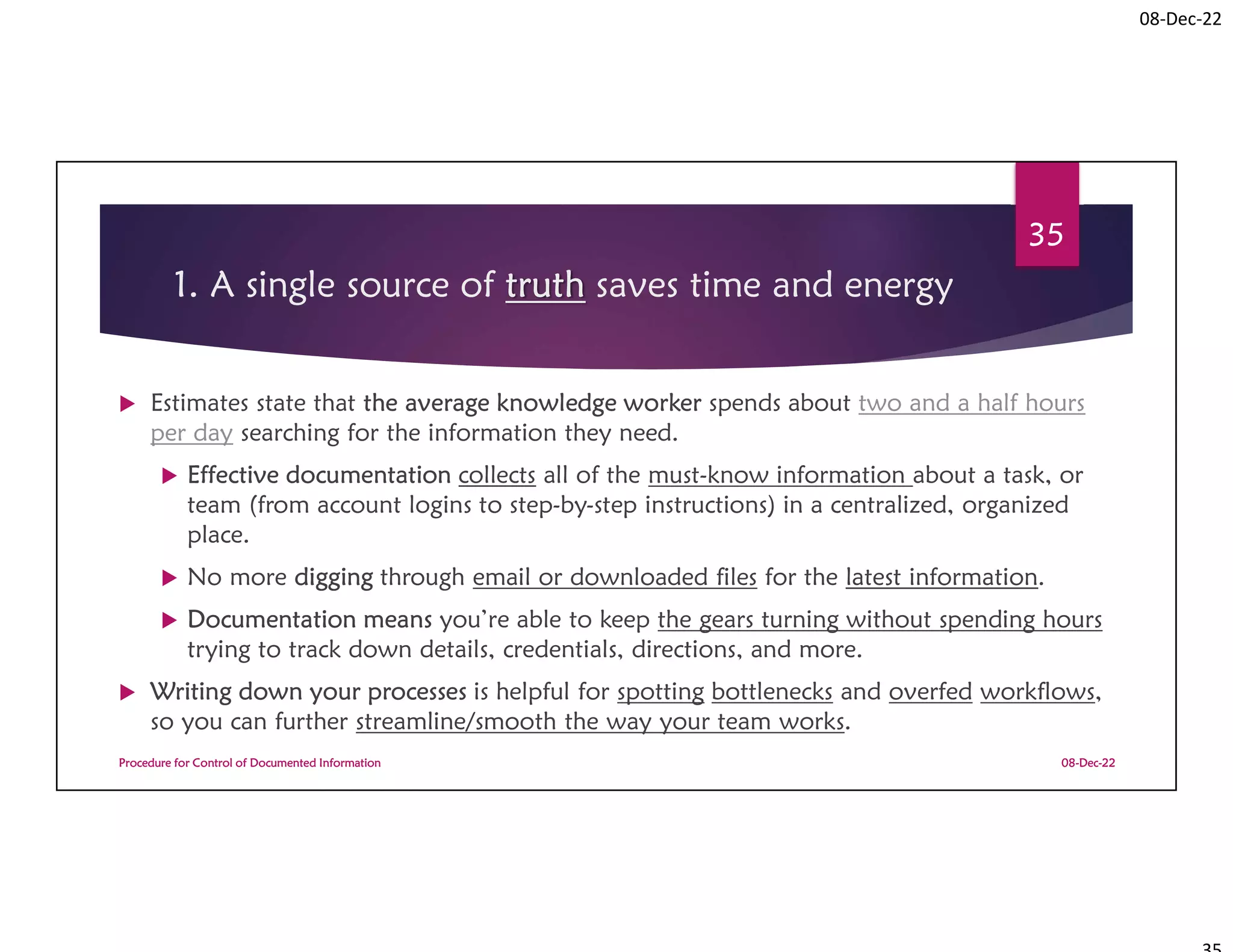
  • 79.
    08-Dec-22 Group Work 1. Dowe need documenting our process 2. What is your documenting experiences in work place Illustrate your Weakness and strength 08-Dec-22 Procedure for Control of Documented Information 79
  • 80.
    08-Dec-22 ISO 9001:2015 required clauseto comply CLAUSE 7- SUPPORT 7.5 Documented information what requirements entails? 7.5.1 GENERAL 7.5.2 CREATING AND UPDATING 7.5.3 CONTROL OF DOCUMENTED INFORMATION 08-Dec-22 Procedure for Control of Documented Information 80
  • 81.
    08-Dec-22 CLAUSE 7- SUPPORT 7.5Documented information what requirements entails? 7.5.1 General 7.5.2 Creating and Updating 7.5.3 Control of Documented Information 08-Dec-22 Procedure for Control of Documented Information 81
  • 82.
    08-Dec-22 CLAUSE 7- SUPPORT 7.5Documented information  7.5.1 General  The organization’s quality management system shall include: a) documented information required by this International Standard; b) documented information determined by the organization as being necessary for the Effectiveness of the quality management system  NOTE: The extent of documented information for a quality management system can differ from one organization to another due to:  the size of organization and its type of activities, processes, products and services;  the complexity of processes and their interactions;  the competence of persons. 08-Dec-22 Procedure for Control of Documented Information 82
  • 83.
    08-Dec-22 7.5.1 General definition  Arobust/strong document control process lies at the heart of a quality management system;  almost every aspect of auditing and compliance verification is determined through the scrutiny (critical observation or examination) of documented evidence.  An organization must control the documentation required by the quality management system and that a suitable document control procedure must be implemented  to define the controls needed to; approve, review, update, identify changes, identify revision status and provide access.  The document control procedure must clearly define the scope, purpose, method and responsibilities required to implement these parameters. 08-Dec-22 Procedure for Control of Documented Information 83
  • 84.
    08-Dec-22 7.5.1 General what tomust understand and communicate  In order to comply with the document control clause, it is essential that all personnel understand:  what type of documents should be controlled  how this control should be exercised  To get the most out of your document control procedure it must communicate the steps necessary  to ensure that staff and other users of the organization’s documentation understand what they must do in order to manage that information effectively and efficiently. 08-Dec-22 Procedure for Control of Documented Information 84
  • 85.
    08-Dec-22 7.5.1 General who isresponsible for documentation  Departmental managers should always be responsible  for promoting good document and record management practices in their area  whilst supporting overall compliance to the document control procedure.  Individuals and their line managers should be responsible  for the documents and records that they create, as well as being responsible  for their retention and disposal in line with legislative requirements and organizational procedures and practices. 08-Dec-22 Procedure for Control of Documented Information 85
  • 86.
    08-Dec-22 7.5.1 General required, identifieddocument information by the NCSC  It should be noted that there is no need to maintain a documented procedure but organizations may still chose to operate one.  Ensure that the organization’s management system  includes documented information required to be maintained and retained by ISO 9001:2015,  and the documented information identified by the organization to demonstrate the effective operation of its QMS as defined below.  Operational procedures, work instructions, flow charts, process maps, signs, placards, container markings, labels etc. are all examples of ‘documented information’. 08-Dec-22 Procedure for Control of Documented Information 86
  • 87.
    08-Dec-22 7.5.1 General level ofdocument information by the NCSC  Documented information can be in any format and media and from any source.  The organization needs to determine the level of documented information necessary to control its QMS.  ‘Access’ can imply a decision regarding the permission to view the documented information only, or the permission and authority to view and change the documented information. 08-Dec-22 Procedure for Control of Documented Information 87
  • 88.
    08-Dec-22 CLAUSE 7-SUPPORT  7.5.2Creating and updating  When creating and updating documented information, the organization shall ensure appropriate: a) identification and description b) format c) review and approval 08-Dec-22 Procedure for Control of Documented Information 88
  • 89.
    08-Dec-22 7.5.2 Creating andUpdating control of documents  You should seek to confirm that when documented information is created or updated,  your organization has ensured that it is appropriately identified and described (e.g. title, date, author, reference number).  It must be in an appropriate format (e.g. language, software version, graphics) and on appropriate media (e.g. paper, electronic).  Confirm that documented information is reviewed and approved for suitability and adequacy. 08-Dec-22 Procedure for Control of Documented Information 89
  • 90.
    08-Dec-22 7.5.2 Creating andUpdating control of documents  Documents that you use as a business should have clear document control.  You will already be used to doing this. It also expects a clear format and for it to be approved.  This is to prevent anyone just using documents that they see fit. እንደተመቸው መጠቀም  It seems slightly unnecessary when you are a SME (small-to-medium enterprise) as there may be a very small team or even one of you.  For larger businesses this is really important so that documents are used properly and  changes that have been incorporated for the good don’t get lost when someone else doesn’t understand them or removes them. 08-Dec-22 Procedure for Control of Documented Information 90
  • 91.
    08-Dec-22 CLAUSE 7-SUPPORT  7.5.3Control of documented information  7.5.3.1 Documented information required by the quality management system and by ISO 9001:2015 shall be controlled to ensure:  it is available and suitable for use, where and when it is needed;  it is adequately protected (e.g. from loss of confidentiality, improper use, or loss of integrity).  7.5.3.2 For the control of documented information, the organization shall address the following activities, as applicable:  a) distribution, access, retrieval and use;  b) storage and preservation, including preservation of legibility;  c) control of changes (e.g. version control);  d) retention and disposition. 08-Dec-22 Procedure for Control of Documented Information 91
  • 92.
    08-Dec-22 7.5.3 Control ofDocumented Information  A robust/strong document control process invariably/always lies at the heart of any compliant management system;  almost every aspect of auditing and compliance verification is determined through the scrutiny of documented information.  With this in mind, it becomes apparent/clear that the on-going maintenance of an efficient document management system must not be overlooked/ignored.  Your organization must control the documented information required by the QMS.  A suitable process must be implemented to define the controls needed to; approve, review, update, identify changes, identify revision status and provide access.  The documented information process should define the scope, purpose, method and responsibilities required to implement these parameters. 08-Dec-22 Procedure for Control of Documented Information 92
  • 93.
    08-Dec-22 7.5.3 Control ofDocumented Information  In order to comply/obey with the documented information requirements,  it is essential that all personnel understand  what types of information that should be controlled and  more importantly, how this control should be exercised. 08-Dec-22 Procedure for Control of Documented Information 93
  • 94.
    08-Dec-22 7.5.3 Control ofDocumented Information  Demonstrate the organization's arrangements for controlling documented information required by ISO 9001 and your organizations own requirements, including: 1. Availability e.g. document accessibility (hard copy, electronic media), readily available at the point of use; 2. Suitability e.g. format, media suitable to the environment, ease of understanding, language, interpretation; 3. Protection e.g. document authentication, document markings (official, secret, restricted, confidential, private, sensitive, classified, unclassified), access controls (individual, role specific), 4. Physical security (master documents, server rooms, libraries) IT security (User ID, password, servers, download, back up, encryption, ‘read only’, ‘read/write’), protection from corruption and unintended alterations. 08-Dec-22 Procedure for Control of Documented Information 94
  • 95.
    08-Dec-22 7.5.3 Control ofDocumented Information  Demonstrate the organization's arrangements for document retention  e.g. organization/legal/contractual retention periods, storage, preservation, back up, retention of knowledge, disposal, obsolescence  e.g. withdrawal, replacement, legacy archive and suitable identification ‘for information only’, ‘not to be used after….’, ‘uncontrolled copy’, ‘for reference purposes only’, etc. 08-Dec-22 Procedure for Control of Documented Information 95
  • 96.
    08-Dec-22 7.5.3 Control ofDocumented Information  Describe how the organization protect electronic data, e.g. security policy, system access profiles, password rules, storage and back-up policy including protection from loss, unauthorized changes, unintended alteration, corruption, physical damage  Access can imply a decision regarding the permission to view the documented information only,  or the permission and authority to view and change the documented information. 08-Dec-22 Procedure for Control of Documented Information 96
  • 97.
    08-Dec-22 NCSC ISO 9001:2015 Quality Manual whatentails? SECTION – 7 SUPPORT 7.5 DOCUMENTED INFORMATION 7.5.1 GENERAL 08-Dec-22 Procedure for Control of Documented Information 97
  • 98.
    08-Dec-22 7.5 Documented Information 7.5.1General The quality management system documented information includes:  Documented statements of a quality policy and quality objectives.  This quality manual.  Documented information as required by the ISO 9001:2015 standard  Documents needed by NCSC that ensure effective planning, operation and control of processes  Other externally generated documents, legislation and codes of practices The overall quality management system documented information is based on a three-level quality system, namely: 1) Quality Manual, 2) System Level Procedures, and 3) Work Instructions. 08-Dec-22 Procedure for Control of Documented Information 98
  • 99.
    08-Dec-22 7.5 Documented Information 7.5.1General Quality Manual (QM), level one Documented Information:-  The Quality Manual (designated as QM) is our first-level company document.  It contains company Quality policy, major responsibilities, main process and process interactions, procedures regarding the requirements of ISO 9001.  It also provides organizational structure and details how each company department or function is organized and interacted to meet its quality objectives, which serve as a road map of our company. 08-Dec-22 Procedure for Control of Documented Information 99
  • 100.
    08-Dec-22 7.5 Documented Information 7.5.1General Quality System (QS) Procedures, Level two Documented Information:-  The Quality System Procedures is the second-level company document.  It contains detailed information on specific procedures including the purpose and scope of the procedure; individual responsibilities.  These documents define the processes operated by the NCSC  to satisfy customer needs and  to address the requirements of ISO 9001. 08-Dec-22 Procedure for Control of Documented Information 100
  • 101.
    08-Dec-22 7.5 Documented Information 7.5.1General  Operational Procedures, Work Instructions & Records, Level Three Documented Information:-  The company’s third Level of documentation includes, but is not limited to, any and all work documentation including quality plans, work orders, work instruction, records, and inspection reports.  Such routine documentation is used to analyze results and performance of processes and production for the purpose of meeting or exceeding predetermined quality objectives.  Generally, any relevant records, which are generated as a result of using the quality management system, shall be regarded as quality records. 08-Dec-22 Procedure for Control of Documented Information 101
  • 102.
    08-Dec-22 Procedure for Control ofDocumented Information OP/NCSC/01 ISO 9001:2015 QMS REQUIREMENT 08-Dec-22 Procedure for Control of Documented Information 102
  • 103.
    08-Dec-22 1. PURPOSE This proceduredefines the controls needed:  To prove documents adequacy prior to issue,  To review and update and re-approve documents,  To ensure changes, and the current version status of documents are identified,  To ensure appropriate versions of applicable documents are available at the points of use,  To ensure documents remain legible and readily identifiable,  To ensure documents of external origins are identified and their distribution is controlled,  To prevent unintentional use of obsolete documents, and  To apply suitable identification to them if they are retained for any purpose,  To establish the method of how quality records are identified, collected, indexed, accessed, filed, retained, protected, stored and disposed properly. 08-Dec-22 Procedure for Control of Documented Information 103
  • 104.
    08-Dec-22 SCOPE, PROCESS OWNER,INVOLVED 2. SCOPE  This procedure applies:  To all quality system documents in NCSC, including documents of external origin.  To the designated records and others to come by in Table- of this document. 3. PROCESS OWNER  Management Representative 4. INVOLVED  All Departments, Services & Document and records holders. 08-Dec-22 Procedure for Control of Documented Information 104
  • 105.
    08-Dec-22 5. DEFINITIONS ANDABBREVIATIONS: 5.1 Definitions  Document: Series of instructions or requirements that provides guidance/directions for performing work which affect quality.  A document can be in the form of hard copy, film, drawing, computer program etc.  Document Holder: Individuals to whom documents are issued.  Internal Documents: Documents developed by NCSC personnel. Examples of internal documents are programs/criteria, procedures, work instructions, etc.  External Documents: Documents not developed by personnel of NCSC or on its behalf. Examples- Equipment manufacturer’s manual, laws, software, drawings etc.  Document Control: Continuous maintenance of documents in valid state in all processes of NCSC;  Company Wide Document: A document the scope or application of which covers two or more Departments or Services. 08-Dec-22 Procedure for Control of Documented Information 105
  • 106.
    08-Dec-22 5. DEFINITIONS ANDABBREVIATIONS: 5.1 Definitions  Quality records custodian: Individual assigned to control and maintain Quality Records.  File: An organized unit of documents accumulated during current use and kept together because they deal with the same subject, activity or transaction and which may or may not be fastened together.  Indexing: The process of establishing and applying terms or codes to records, to be used to retrieve them and to search for and analyze information in records across classifications or categories.  Non- paper records:  Photographic prints  Motion picture films  Sound records  Electronics records (CD - ROM, Discs, etc.,) 08-Dec-22 Procedure for Control of Documented Information 106
  • 107.
    08-Dec-22 5. DEFINITIONS ANDABBREVIATIONS: 5.2 Abbreviations  NCSC - National Cement Share Company  DOCM - Document  DCC - Document controlling center  CRD – Criteria Document  WI- work instruction 08-Dec-22 Procedure for Control of Documented Information 107
  • 108.
    08-Dec-22 6.1 Document Creation,Updating, And Distribution 1. Request may be raised from any Department/Service using form OF/NCSC/03 describing the reasons for document creation and/or change. 2. Upon approval of the request the relevant Department or Service Head or the designated person (head of document originator), will assign an author to write or change the document. 08-Dec-22 Procedure for Control of Documented Information 108
  • 109.
    08-Dec-22 6.1 Document Creation,Updating, And Distribution 3. The main reasons for rejection of document creation and/or change request are the following.  3.1. When there is already a document for the job in question.  3.2. When there is no existing process/activity to be defined by the proposed document.  3.3. When the process for which document creation or change is requested has no impact on quality in relation to the product/service delivered.  For what so ever reason, when document creation or change request is rejected, the reasons for rejection shall be recorded and retained by document controller. 4. The assigned author shall request document number from document controller if Number has not been already assigned, 08-Dec-22 Procedure for Control of Documented Information 109
  • 110.
    08-Dec-22 6.1 DOCUMENT CREATION,UPDATING, AND DISTRIBUTION 5. Document controller shall maintain a master record of all document numbers issued.  The document controller person must make sure the absence of double provision of the same number for different documents. 6. During document preparation, the author(s) must ensure the involvement of concerned employees. 7. All final draft documents shall be reviewed and approved for clarity, completeness and adequacy by the CEO/ or his delegate in the case of company wide documents and those documents which have customer interface. 08-Dec-22 Procedure for Control of Documented Information 110
  • 111.
    08-Dec-22 6.1 DOCUMENT CREATION,UPDATING, AND DISTRIBUTION  Based on Distribution list of the Document Registration Form and/or diffusion requirement,  Document controller:  Shall make required copies of document for issuing;  Shall file the original copy of document;  Using a stamp shall indicate on all document:- Date of Issue, Copy Number and Registration Number;  Release documents to the respective Department/Service Heads and/or the CEO/DCEO;  Holder of the document shall acknowledge by signing on the Document Release Note and returning it to document controller. 08-Dec-22 Procedure for Control of Documented Information 111
  • 112.
    08-Dec-22 6.1 DOCUMENT CREATION,UPDATING, AND DISTRIBUTION 8. Based on the notification from the Head of Document Originator, documents shall be distributed to the Department/Service/Division managers and/or the CEO/DCEO.  Department/Service Heads and/or the CEO/DCEOs have the responsibilities to implement the documents in their respective functions and to ensure that the workers are using the original documents issued by document controller. 9. Obsolete documents shall be recalled by document controller while the current version is distributed.  If obsolete documents are retained for any purpose, shall be stamped “OBSOLETE” for better identification and to avoid inadvertent/ unintended use. 08-Dec-22 Procedure for Control of Documented Information 112
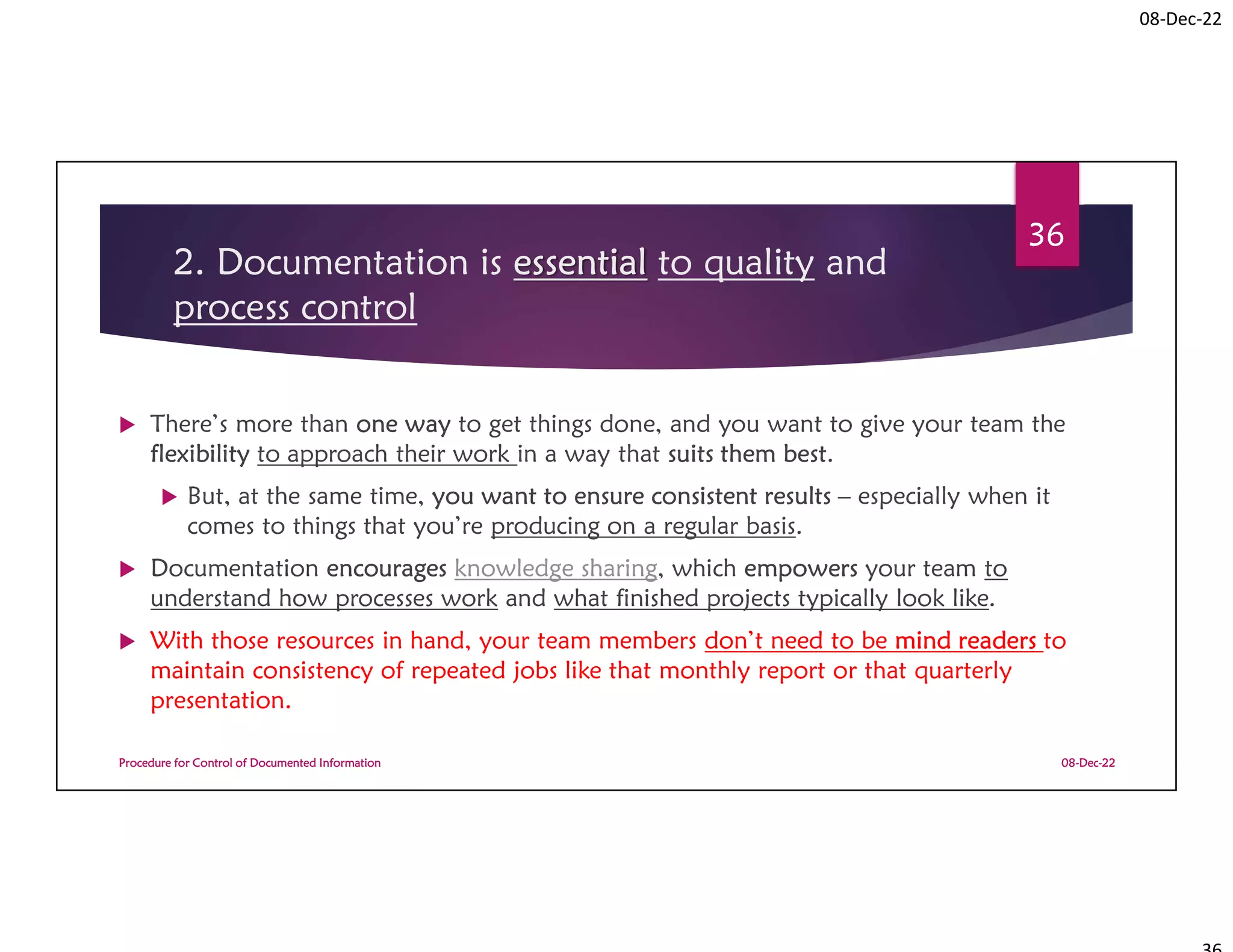
  • 113.
    08-Dec-22 6.2 Record control 1.All collected quality records shall be checked for legibility, cleanness and completeness.  Incoming records shall be registered.  Outgoing records shall be registered.  All externally incoming and outgoing records to and from NCSC are received and registered by concerned.  Inter departmental correspondence via inter office memo shall be registered by departments 08-Dec-22 Procedure for Control of Documented Information 113
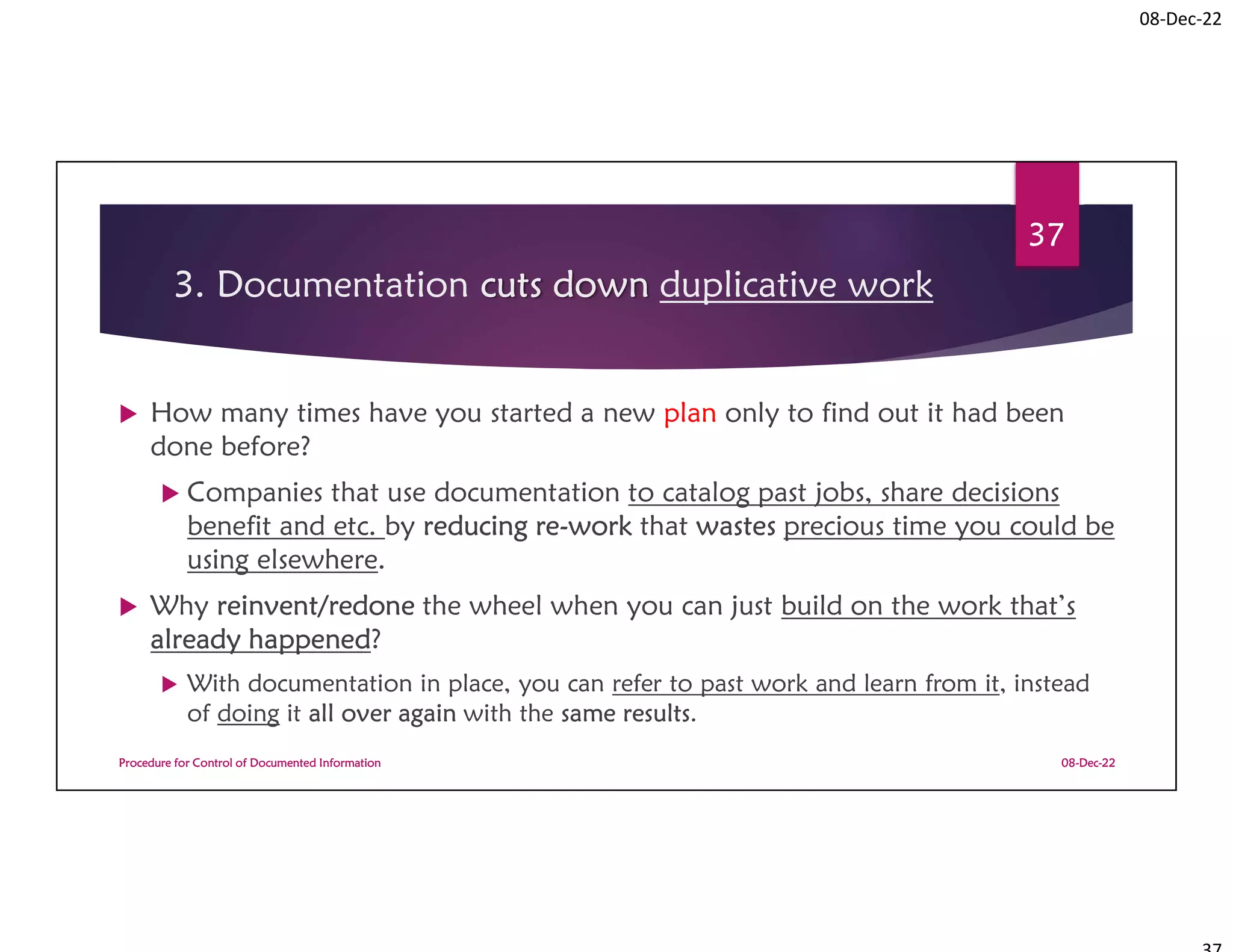
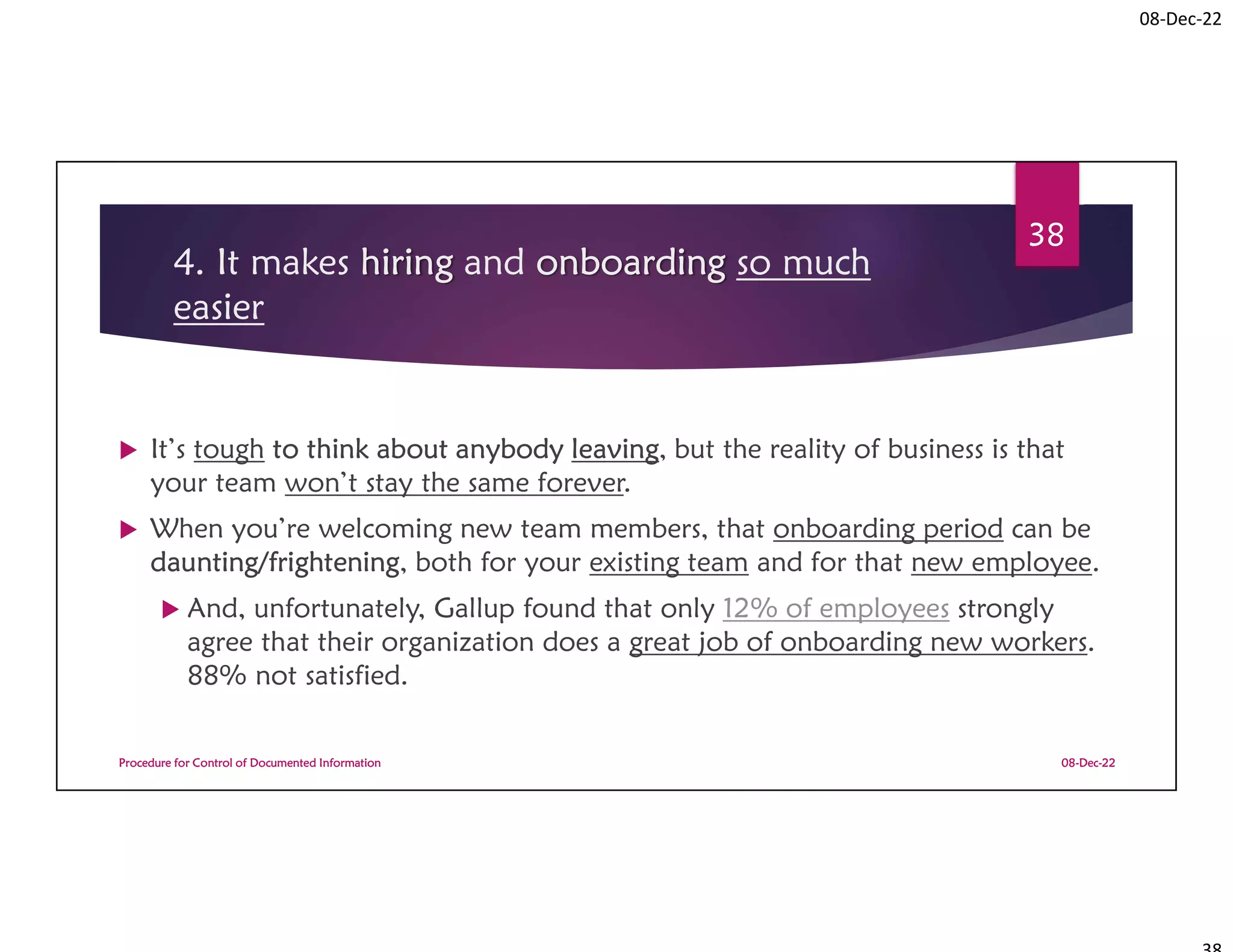
  • 114.
    08-Dec-22 6.2 Record control 2.If previous file is not existing, a file shall be constructed as follows:  Allocate classification, titling and indexing to the record;  Allocate file number;  Physically construct the file;  Each third level category of process has its own number sequence that ranges from 01 to 99.  Indicate the year of creation 08-Dec-22 Procedure for Control of Documented Information 114
  • 115.
    08-Dec-22 6.2 Record control 3.All records shall be filed and stored in an office environment unless specific media and/or special environmental control are specified to prevent damage, deterioration, or loss and allow access control.  The original of an outgoing record shall bear the seal and delivered to the addressee as soon as possible.  Only authorized personnel are allowed to sign on outgoing letters. For out of company correspondence delivery confirmation shall be filled in by the messenger.  If the records received are incoming, the record shall be received by way of a register. 08-Dec-22 Procedure for Control of Documented Information 115
  • 116.
    08-Dec-22 6.3 General supplements There are two document numbering systems in NCSC:  Document numbering system according to 6.3.1 below for documents of internal origin  Document numbering system for documents of external origin 6.3.1 Document numbering system  The generic Document Numbering is as follows. 6.3.1.1. Documents of Internal origin  The Company code is designated by characters. These characters indicate the company in which the document is originated. Sequence of document number (code)  The sequence of companywide PROCEDURES, WORK INSTRUCTIONS, FORMS & CRITERIA DOCUMENT code runs as follow. 08-Dec-22 Procedure for Control of Documented Information 116
  • 117.
    08-Dec-22 Operating Procedures 08-Dec-22 Procedure forControl of Documented Information 117 • OP - (Operating Procedure) • NCSC - (Company Name: National Cement SC) • 01 - (Procedure serial number) OP/NCSC/01 • Department/Service name documents according to first level category coding. • Example the Procedure for Mining and Crushing Operation could be named as OP/QAG/01 Note:
  • 118.
    08-Dec-22 CRITERIA DOCUMENT •CRD -(Criteria Documents) •NCSC - (Company Name: National Cement SC) •01 - (Procedure serial number) CRD/NCSC/01 •CRDs are set of documentation where procedural steps are not required to be followed but results are expected in some form. •Some examples are Quality policy, stated quality objectives, various plans of the company, non-procedural manuals and guidelines, etc. . Note: 08-Dec-22 Procedure for Control of Documented Information 118
  • 119.
    08-Dec-22 WORK INSTRUCTIONS • WI- (Work Instruction) • NCSC - (Company Name: National Cement SC) • 01 - (Work instruction serial number) WI/NCSC/01 • Work instructions are the most detailed and company-specific of all ISO 9001 documents: they describe in detail how particular tasks must be performed and are typically written by the people who perform the actual work. Note 08-Dec-22 Procedure for Control of Documented Information 119
  • 120.
    08-Dec-22 OPERATING FORMS • OF- (Operating Forms) • NCSC - (Company Name: National Cement SC) • 01 - (Form serial number) OF/NCSC/01 • first form originating in the mining department could be named as OF/QAG/01. • Production departments’ first record could also be named OF/PRD/01 following similar patterns. • Note also that checklists when filled out are forms of that specific activity. Note: 08-Dec-22 Procedure for Control of Documented Information 120
  • 121.
    08-Dec-22 6.3 General supplements 6.3.1.2. DOCUMENTS OF EXTERNAL ORIGIN  Document numbering systems for documents of external origin are adopted as they are, if possible.  In all cases the external documents are identified uniquely based on date of registration and registration number. 08-Dec-22 Procedure for Control of Documented Information 121
  • 122.
    08-Dec-22 6.3.2 GENERAL FORMATFOR PROCEDURES, AND WORK INSTRUCTIONS: A) PROCEDURES:- THE GENERAL FORMATS FOR PROCEDURES ARE AS FOLLOWS:-  Issue history: List all issues of the procedure from initial release to current issue. Description of the change shall be a summary of change made.  Reference documents: List reference documents by their control number and title (this does not include forms).  EXAMPLE: ISO 9001: 2015, Quality Management Systems- Requirements.  Contents: Contents of the document with its page number shall be described.  Purpose: Describe the area or subject where the procedure is applicable.  Scope: State the applicability and limits to which the procedure shall be used.  EXAMPLE: This procedure applies to both internal and external customer complaints handling. 08-Dec-22 Procedure for Control of Documented Information 122
  • 123.
    08-Dec-22 6.3.2 GENERAL FORMATFOR PROCEDURES, AND WORK INSTRUCTIONS: A) PROCEDURES:- THE GENERAL FORMATS FOR PROCEDURES ARE AS FOLLOWS:-  Processes owner: Describe the overall owner of the process.  EXAMPLE: The CEO is the owner of customers’ complaints handling process.  Definitions and abbreviations: Clarify (if applicable) abbreviation and/or terms used in the procedure.  Procedure: Describe the process clearly and adequately.  Records OF: List the quality records that must be generated and maintained to show that the requirements of the procedure have been fulfilled.  Related Documents: List all related documents applicable to the procedure. 08-Dec-22 Procedure for Control of Documented Information 123
  • 124.
    08-Dec-22 6.3.2 GENERAL FORMATFOR PROCEDURES, AND WORK INSTRUCTIONS: B) WORK INSTRUCTIONS  Issue History: List all issues of the work instruction from initial release to current issue.  Description of the change shall be a summary of changes made.  Purpose  Scope  Work instruction  Responsibility  Operator prescription  Reference document  Diffusion 08-Dec-22 Procedure for Control of Documented Information 124
  • 125.
    08-Dec-22 6.3.3 GENERAL PAGELAYOUT OF DOCUMENT WRITING AT NCSC  In order to ensure legibility and consistency, documents shall possibly be prepared with the following layout  15 mm (0.6 inches) left and right margins.  15 mm (0.6 inches) top and bottom margins.  FORMAT TYPOGRAPHICAL SPECIFICATIONS  The following specifications are all typographical matters: 08-Dec-22 Procedure for Control of Documented Information 125
  • 126.
    08-Dec-22 6.3.3 GENERAL PAGELAYOUT OF DOCUMENT WRITING AT NCSC Fonts  a. Headers & Footer  NCSC – MAIANDRA GD, 12-point, UPPERCASE and bold.  Document number – Maiandra GD, 11-point, UPPERCASE and normal.  Issue number፡ Maiandra GD, 11-point, UPPERCASE and normal.  Page number, issue date, approved by፡ Maiandra GD, 11-point and normal.  Title – Maiandra GD, 12-point, Title case and bold. 08-Dec-22 Procedure for Control of Documented Information 126 NATIONAL CEMENT SHARE COMPANY DOCUMENT NO: OP/NCSC/01 Title: Procedure for control of Documented Information ISSUE NO. 1 Page 5 of 15
  • 127.
    08-Dec-22 6.3.3 GENERAL PAGELAYOUT OF DOCUMENT WRITING AT NCSC  b. Main Headings – Maiandra GD, 11-point, uppercase and bold.  c. Sub-headings – Maiandra GD 11-point, Sentence case and bold.  d. Body Text – Maiandra GD 11-point and normal.  e. In the cases of Graphics and tables body text may be 6-11-points, bold or normal. 08-Dec-22 Procedure for Control of Documented Information 127
  • 128.
    08-Dec-22 6.3.4 GENERAL FORMATFOR DEVELOPING FORMS  All forms generated in NCSC shall be according to Form No. OF/XYZ/01.  XYZ stands for individual department within the organogram or according to the first level categorization.  QUALITY DOCUMENTS SHALL ADDRESS THE FOLLOWING REQUIREMENTS  a) New documents and data and changes to existing documents and data are reviewed and approved for adequacy by the responsible person before release.  b) Any document with a document number and revision level that does not match the current version as designated on the Master List and /or master document is considered invalid or obsolete.  Invalid or obsolete documents and data may be kept separately for historical reference or knowledge preservation purposes. 08-Dec-22 Procedure for Control of Documented Information 128
  • 129.
    08-Dec-22 6.3.4 GENERAL FORMATFOR DEVELOPING FORMS  c) Master Lists of all documents shall be kept with Document controller.  d) External documents shall be reviewed and approved for adequacy before use.  e) External documents shall be properly identified and distributed for users and removed from service when obsolete.  A separate master list and /or document shall also be prepared and maintained by Document controller.  f) The latest approved NCSC policies, regulations and directives shall be properly identified and available to users.  g) Electronically handled documentation shall be managed in close consultation with the IT department 08-Dec-22 Procedure for Control of Documented Information 129
  • 130.
    08-Dec-22 6.3.5 Additional descriptionto the Records control A) Records retention time 08-Dec-22 Procedure for Control of Documented Information 130 SN Records On Site (Short term) Retention Time in years Long Term Retention Time in years 1  Calibration Records  Inspection & Test records  wastage and lose records 5 12 2 Management Review records 3 10 3 Contract review records 5 10 4 Product identification & traceability 3 3 5 Work orders 3 7 6 operation control records 2 5 7 Employees’ records including personal files As long as the employee exists in the organization 25 years After resigning 8 Meeting Records (Minutes) 3 10 9 Performance Reports 3 10 10 Procurement Records 3 10 11 Fixed Asset and Financial Records 5 10 12 Financial Audit Report 3 As long as the organization exists 13 Project Document 3 years as from project completion date Knowledge preservation 14 Others 3 5
  • 131.
    08-Dec-22 6.3.5 Additional descriptionto the Records control A) Records retention time  As soon as the short-term retention time expires, records shall be transferred to the long term storage room.  Records under legal case shall be retained until the case is finalized even if the long-term retention time has been expired.  Records may be retained after the long-term retention time if they are required to preserve knowledge.  If the above records are available in an electronic media the backups shall be properly labelled and retained longer time. 08-Dec-22 Procedure for Control of Documented Information 131
  • 132.
    08-Dec-22 6.3.5 Additional descriptionto the Records control B) Disposal of quality records  Records shall be disposed of as soon as their retention time is expired.  Head of the Records Custodian has the responsibility to dispose of the records up on approval by the management representative and/or the Chief Executive Officer. C) Main Official record retention sites  Production/ QC/ Maintenance/store  CEO office  Finance  HR  Marketing  Procurement 08-Dec-22 Procedure for Control of Documented Information 132
  • 133.
    08-Dec-22 6.3.5 Additional descriptionto the Records control d) Storage of files  All quality management system records shall be filed and stored in an office environment unless specific media and/or special environmental control are specified to prevent damage, deterioration, or loss and allow access control.  All quality records shall be physically or electronically filed by a method which enhances accessibility and retrieval by a user.  If electronic files are used a back-up system or other suitable measures shall be used to prevent record loss. e) Attaching records to files  Records shall be attached to files after the respective function or person(s) has taken the actions (post-action attachment). 08-Dec-22 Procedure for Control of Documented Information 133
  • 134.
    08-Dec-22 6.3.5 Additional descriptionto the Records control f) Issuance of records (files) upon request  Access controlled records shall only be issued when the request is approved by an authorized person g) Access control  All confidential records shall be handled and stored confidentially. The access to such records shall be approved by the CEO  A person who wants to have an access to confidential records shall raise a request clearly describing his/her reasons and he/she may have an access to such records only when he/she has adequate reasons and the CEO or other authorized person approves the request.  Access controlled records shall be stored in an area where their confidentiality is secured i.e. in locked filing cabinets and/or in separate rooms where entry of unauthorized individuals is restricted. 08-Dec-22 Procedure for Control of Documented Information 134
  • 135.
    08-Dec-22 Access control files 08-Dec-22 Procedurefor Control of Documented Information 135 S.N. Access Controlled Records Reasons for Access Controlled Location Authorized Persons 1 Marketing Research (needs, satisfactions etc.) records, Marketing strategy & tactics  To protect from alteration and loss  Not to give access to competitors CEO & DCEO/ Marketing Departments CEO 2 Contract document For legal reasons CEO/DCEO/legal service/ HR/Finance Specified by the CEO 3 Personal Records  Medical reports  Personnel appraisal records  records of disciplinary action  Biographic data  Employment records To protect personal information CEO & DCEO- support, HRM Specified by the CEO 4 Financial Records  Receipts  Journal Voucher  Asset Registers  Payment Voucher  Ledgers To protect from alteration and loss CFO / Finance Department Specified by the CEO 5 Product development and formulation To protect company product formulation data CEO As per decisions by CEO 6 Others The CEO can decide on other records/ or documented information to be access-controlled as needed.
  • 136.
    08-Dec-22 6.3.5 Additional descriptionto the Records control h) Structure of a file system  File categories  All files shall be organized into logical groups, which relate to the functions and activities of the company.  Records in a filing system shall be categorized as follow: 1) First level category: Name of department/process 2) Second level category: type of records 08-Dec-22 Procedure for Control of Documented Information 136
  • 137.
    08-Dec-22 08-Dec-22 Procedure for Controlof Documented Information 137 File Box File holder numbering record system
  • 138.
    08-Dec-22 6.3.5 Additional descriptionto the Records control 1) First level category Categorize the records based on the specific Department/Service and these are designated by two to six UPPERCASE English Alphabets as Follows. 08-Dec-22 Procedure for Control of Documented Information 138
  • 139.
    08-Dec-22 6.3.5 ADDITIONAL DESCRIPTIONTO THE RECORDS CONTROL 1) FIRST LEVEL CATEGORY: The First Level Category Code Department/Processes CEO Chief Executive Office ADV Advisor To CEO MR Management Representative IAS Internal Audit Service DCC Document Control Centre PMS Planning & Monitoring Service LS Legal Services KPM KOKA Plant Manager 500TPD 500TPD Plant PR Public Relations AASS Addis Ababa Support Service 08-Dec-22 Procedure for Control of Documented Information 139
  • 140.
    08-Dec-22 6.3.5 ADDITIONAL DESCRIPTIONTO THE RECORDS CONTROL 1) FIRST LEVEL CATEGORY: The First Level Category Code Department/Processes DCP Deputy CEO, Plant Operations SAH Safety & Health Service PRD Production Department QAG Quarry and Auto Garage Department QC Quality Control Department ELEC Electrical Maintenance Department MECH Mechanical Maintenance Department ENG Engineering Department CFO Chief Financial Officer FIN Finance & Accounting ICT Information & Communication Technology Service 08-Dec-22 Procedure for Control of Documented Information 140
  • 141.
    08-Dec-22 6.3.5 ADDITIONAL DESCRIPTIONTO THE RECORDS CONTROL 1) FIRST LEVEL CATEGORY: The First Level Category Code Department/Processes DCM Deputy CEO, Marketing, Sales & Fleet Operation ESD Eastern Sales & Distribution CSD Central Sales & Distribution EMD Export Marketing Department FOM Fleet Operation Management Department DCS Deputy CEO, Support Services HRM Human Resource Management Department SCH Supply Chains GSS General Service & Security Department 08-Dec-22 Procedure for Control of Documented Information 141
  • 142.
    08-Dec-22 6.3.5 Additional descriptionto the Records control 2) Second level category: type of documents and records  Two digit numerical codes starting from 01 to 99 shall be assigned to each process/activity identified in each Second level category.  Examples are depicted hereunder and departments could use the codes as they are or create their own.  However the external index could be clearly posted and communicated to the MR. 08-Dec-22 Procedure for Control of Documented Information 142
  • 143.
    08-Dec-22 6.3.5 Additional descriptionto the Records control 2) Second level category: TYPE OF RECORDS Code Records Title 1 Management review & other Minutes of meetings (incl. meetings for system updating) 2 contractual agreement 3 Organization records (organizational structure, job description, salary scale, job grading and specification, etc...) 4 Training Records (Training records could be training attendance, training evaluation, training needs, COC etc.) 5 Employee Personal records 6 Nonconformance records incorporating. withdrawal & recall 7 Maintenance records 8 Operational records 9 Performance Reports of processes including performance of outsourced processes 10 Sales records including distributors, agents, projects or outlet owners 08-Dec-22 Procedure for Control of Documented Information 143
  • 144.
    08-Dec-22 6.3.5 Additional descriptionto the Records control 2) Second level category Code Records Title 11 Customer requirement 12 Work Order & execution records 13 Procurement records incorporating records of out sourced processes; and control of externally provided products/services (supplier evaluation records) 14 Document Control Records 15 System Documents includes policies; manuals; procedures; work instructions; checklists, External documents ; and organizational knowledge gained 16 Plans incorporating production or other plans of company processes; objectives; strategic plans dealing with context of the company, and requirements of interested parties; risks and opportunities 17 Non Paper (CD’s , Photographs..) records including flow diagrams, charts, etc 18 Market Research, customer needs/satisfaction assessment/complaint records 08-Dec-22 Procedure for Control of Documented Information 144
  • 145.
    08-Dec-22 6.3.5 Additional descriptionto the Records control 2) Second level category Code Records Title 19 Regulatory & statutory records 20 Supplier Records 21 Calibration records incl. software validation records 22 Audit reports 23 Inspection & Test records 24 Wastage, lose & damage records 25 nonconformance reports (NCRs) out of audit activity 26 Corrective & preventive action reports (CARs) 27 Internal Correspondence Incoming & outgoing letters 28 external Correspondence Incoming & outgoing letters 08-Dec-22 Procedure for Control of Documented Information 145 Note: In the case of files at the Finance Department a filing system that facilitates the activities of the department could be put in place.
  • 146.
    08-Dec-22 6.3.5 Additional descriptionto the Records control 3) Third level Category: File serial number  Unique Number for Each File within Each Third Category  Two digit numerical codes starting from 01 to 99 shall be assigned to each process/activity identified in each third level category.  Every file shall be allocated a file number clearly identifying the year of creation  File Numbering Template 08-Dec-22 Procedure for Control of Documented Information 146
  • 147.
    08-Dec-22 6.3.5 Additional descriptionto the Records control 4) Fourth level Category: Additional unique Identification marks (String or nominal) can be used at demand. 08-Dec-22 Procedure for Control of Documented Information 147
  • 148.
    08-Dec-22 File holder numberingrecord system Example of File Numbering System: Company Logo 1st level category PRD Production Department 2nd level category Font size 65 9 Performance Reports of processes including performance of outsourced processes 3rd level category Font size 65 01 File Serial Number Unique Number for Each File within Each Third Category 4th level category DAILY REPORT Additional unique Identification marks (String or nominal) can be used at demand. Up to 15 characters Year Font size 60 2022 Calendar Year the File is created 08-Dec-22 Procedure for Control of Documented Information 148
  • 149.
    08-Dec-22 08-Dec-22 Procedure for Controlof Documented Information 149 File Box File holder numbering record system
  • 150.
    08-Dec-22 Multiple attachments ofrecords  Photocopy the original ensuring enough copies for all subjects represented in the original.  Attach copies to the appropriate files.  Note on copies where the original record is located.  Register each copy of the records to the file to which it has been attached, and note that it is a copy. 08-Dec-22 Procedure for Control of Documented Information 150
  • 151.
    08-Dec-22 7. RECORDS  TheCEO/DCEOs and all departments/services have the responsibility to maintain all records received.  Document controller has the responsibility to record and retain the following records.  Document creation and change request  Master List of Documents  Documents Distribution List 08-Dec-22 Procedure for Control of Documented Information 151
  • 152.
    08-Dec-22 All process ownersrole and responsibility based on ISO 9001:2015 08-Dec-22 Procedure for Control of Documented Information 152
  • 153.
    08-Dec-22 Department/process owner role& responsibility on ISO 9001:2015 QMS implementation  Prepare and review/revise work unit process operational procedures, formats documents  Implement accordingly the approved own operational procedures, formats  Generate plan and report annually and monthly  Arrangements and set in order of all generated reports documents  Documentation of all generated annual, monthly and daily plan and progressive reports according to documentation procedure system  Monitor and coach documentation process for easy document retrieval  Implement ISO QMS principal  Use inter office memo when ever communicating inter department 08-Dec-22 Procedure for Control of Documented Information 153
  • 154.