Internal Auditors
Training Course on QMS
as per ISO 9001:2015
Management Systems Training
Welcomes Delegates to this Course
Welcome !
2
3
Delegate Introductions
• Name
• Job role
• ISO 9001:2015 understanding (1 to 10)
• Understanding of Quality function (1 to 10)
• Course expectations
4
Course Aim
• Understanding the working with ISO
9001:2015 system.
• Acquiring knowledge and skills to carry out
internal audits for the quality management
system.
Key Concept 1: Quality Management Principles
Customer
Focus
Leadership
Engagement
of People
Process
Approach
Improvement
Evidence
based
decision
making
Relationship
Management
Key Concept 2: PDCA structure of standard
6
Leadership
(5)
Support and
Operation
( 7,8)
Improvement
(10)
Planning (6)
Performance
evaluation (9)
Plan Do
Check
Act
Quality Management System (4)
Organization and
its context (4)
Customer
requirements
Needs and
expectations
of relevant
interested
parties (4)
Customer
satisfaction
Products and
services
Results of
the QMS
Key Concept 3: Leadership and commitment
7
Key Concept 4: Customer focus
8
Key Concept 5: Risk based thinking
9
Key Concept 6: Process approach
10
With what?
Resources
Outputs
To whom/
where
What results?
Performance
indicators
Inputs
From
whom/
where
How done?
Methods/
Documentation
With Who?
Personnel
Process
(specific value-
added activities)
Key Concept 7: Organizational knowledge
11
Desing and Development
12
User
Needs
Design
Inputs
Design
Output
Designed
Product
Design
Process
Review
meetings
Verification
Validation
The Audit Process: ISO 19011:2018
Why do we do audit
• Purpose of auditing
• We can’t audit our own activities
• Auditor and auditee have a common goal
• Auditor cannot add personally to the requirements
• Auditor does not provide solution but aids auditee
to discover solution
14
15
Auditing systems
Why do we assess systems?
• Conformance
• Effectiveness
• Improvement
Find & Compare
What is
supposed to be
happening
What is
actually
happening
Know it before
the audit
Get to know
during the audit
Fulfillment is compliance
Gaps are the non-conformities
17
Definition
Audit
Systematic, independent and documented process
for obtaining audit evidence and evaluating it
objectively to determine the extent to which audit
criteria are fulfilled.
18
Types of audits
• First Party
• Second Party
• Third Party
Internal Audit -
on own
organisation
Organisation
External
on another eg
supplier
Organisation
Third Party -
independent
19
Auditing standard – ISO 19011
• ISO 19011 – Guidelines for auditing management
systems
• The principles of auditing
• Guidance on managing audit programmes
• Guidance on conducting audits
• Guidance on the competence needed by an auditor
Principles of auditing
• Integrity: the foundation of professionalism
• Fair presentation: the obligation to report truthfully and accurately
• Due professional care: the application of diligence and judgement
in auditing
• Confidentiality: security of information
• Independence: the basis for the impartiality of the audit and
objectivity of the audit conclusions
• Evidence-based approach: the rational method for reaching reliable
and reproducible audit conclusions in a systematic audit process
• Risk based auditing
20
21
Audit Scheduling
• Scheduling the audit programme is the
responsibility of the person leading the audit
process (the program manager)
• Audits are required to be scheduled based on
 The results of risk assessments
 The results of previous audits
 Changes in operations/ activities
22
Planning Audit Schedule
• When planning audits schedule, the following
needs to be considered
 Scope – the departments, processes, activities
 Criteria – the requirements
 Objective – the audit purpose
 Date & Duration – timing of audit areas
 Method – vertical (process), horizontal (theme)
 Competence – auditor experience, skills, knowledge
 Risk – areas of potential concern/high importance
ISO 19011 Audit Process
6.3 Preparing audit activities
6.2 Initiating audit
6.5 Preparing and distributing audit report
6.4 Conducting audit activities
6.6 Completing audit
6.7 Conducting audit follow-up
6.2.1 General (audit Team Leader responsibility)
6.2.2 Establishing contact with auditee
6.2.3 Determining feasibility of audit
6.3.1 Performing review of documented information
6.3.2 Audit planning
6.3.2.1 Risk-based approach to planning
6.3.2.2 Audit planning details
6.3.3 Assigning work to audit team
6.3.4 Preparing documented information for audit
6.4.1 General (sequence may be varied)
6.4.2 Assigning roles and responsibilities of guides and observers
6.4.3 Conducting opening meeting
6.4.4 Communicating during audit
6.4.5 Audit information availability and access
6.4.6 Reviewing documented information while conducting audit
6.4.7 Collecting and verifying information
6.4.8 Generating audit findings
6.4.9 Determining audit conclusions
6.4.9.1 Preparation for closing meeting
6.4.9.2 Content of audit conclusions
6.4.10 Conducting closing meeting
6.5.1 Preparing audit report
6.5.2 Distributing audit report
NOTE:
Subclause numbering
refers to the relevant
subclauses of this
International Standard.
Audit Process
6.2 Initiating the audit
• 6.2.1 General (audit Team Leader responsibility)
• 6.2.2 Establishing contact with auditee
• 6.2.3 Determining feasibility of audit
24
Audit Process
6.3 Preparing audit activities
• 6.3.1 Performing review of documented information
• 6.3.2 Audit planning
• 6.3.2.1 Risk-based approach to planning
• 6.3.2.2 Audit planning details
• 6.3.3 Assigning work to audit team
• 6.3.4 Preparing documented information for audit
25
Audit Process
6.4 Conducting the audit activities
• 6.4.1 General (sequence may be varied)
• 6.4.2 Assigning roles and responsibilities of guides and observers
• 6.4.3 Conducting opening meeting
• 6.4.4 Communicating during audit
• 6.4.5 Audit information availability and access
• 6.4.6 Reviewing documented information while conducting audit
• 6.4.7 Collecting and verifying information
• 6.4.8 Generating audit findings
• 6.4.9 Determining audit conclusions
• 6.4.9.1 Preparation for closing meeting
• 6.4.9.2 Content of audit conclusions
• 6.4.10 Conducting closing meeting
26
Audit Process
6.5 Preparing and distributing the audit report
• 6.5.1 Preparing audit report
• 6.5.2 Distributing audit report
27
Audit Process
6.6 Completing the audit
6.7 Conducting audit follow-up
(if specified in the audit plan)
28
29
P. E. R. C.
• Plan
• Execute
• Report
• Close out
Plan
Execute
Report
Close out
Identifying Requirements
31
Audit Planning
• From the schedule, audits need to be planned to
ensure that they are carried out effectively making
efficient use of time
• Flexibility should be designed into an audit plan to
ensure audit trails can be followed to ensure
effective depth of the audit
Document Review
32
33
Requirements (Criteria)
• Requirements come from
 ISO 9001:2015
 Legislations
 Design documents, codes of practices, guidance documents
 Management priority
 Business requirements
 The documented management system
 Product/service/customer requirements
 Other related standards, e.g., IS standards
 Other requirements, e.g., voluntary commitments
What else ?
34
Audit Planning
• Avoiding problems
 Plan the audit carefully, based on scope and criteria
 Communicate the plan before the audit
 Keep the plan flexible (build in flex)
 Copy in department management
 Ensure importance of audit is understood
 Ensure objective of audit is understood
 Ensure plan is focussed on risk
Internal Audit Plan
Purpose of audit.....................................................................................................................
Date of audit:.........................................................................................................................
Department to be audited......................................................................................................
Name of auditor/s: ...............................................................................................................
Criteria of audit.....................................................................................................................
Prepared by auditor...............................................................................................................
35
Duration
(from..to)
Area, Process, Activity to be audited Comments (sup.
To be available)
Name of auditor
Group Exercise 1
Make an audit plan for the department and within
allotted time which your group would be auditing
36
30 minutes
37
Checklists
• The output of the plan is preparation of audit
checklists
• Checklists are used
 As a memory aid
 For structure
 As a means of recording findings
38
Checklists
• Checklists can be prepared in a variety of styles
 Bullet points
 List of questions
 List of requirements
 Mind maps/spider diagrams
• Checklists should form a logical flow as an aid to
memory to ensue all important elements are
covered during the audit
Work documents example
Requirement Source of
information
Evidence Notes on
how to
follow up
1 ISO 9001
requirement
What to
‘look at’
What to
‘look for’
How to
follow up
2 Process
requirement
3 Other
requirement
4
39
40
Group Exercise: 2
Prepare a checklist for an audit of the department
you have been asked to audit.
Group 1
Group 3
Group 5
Group 2
Group 4
30 minutes
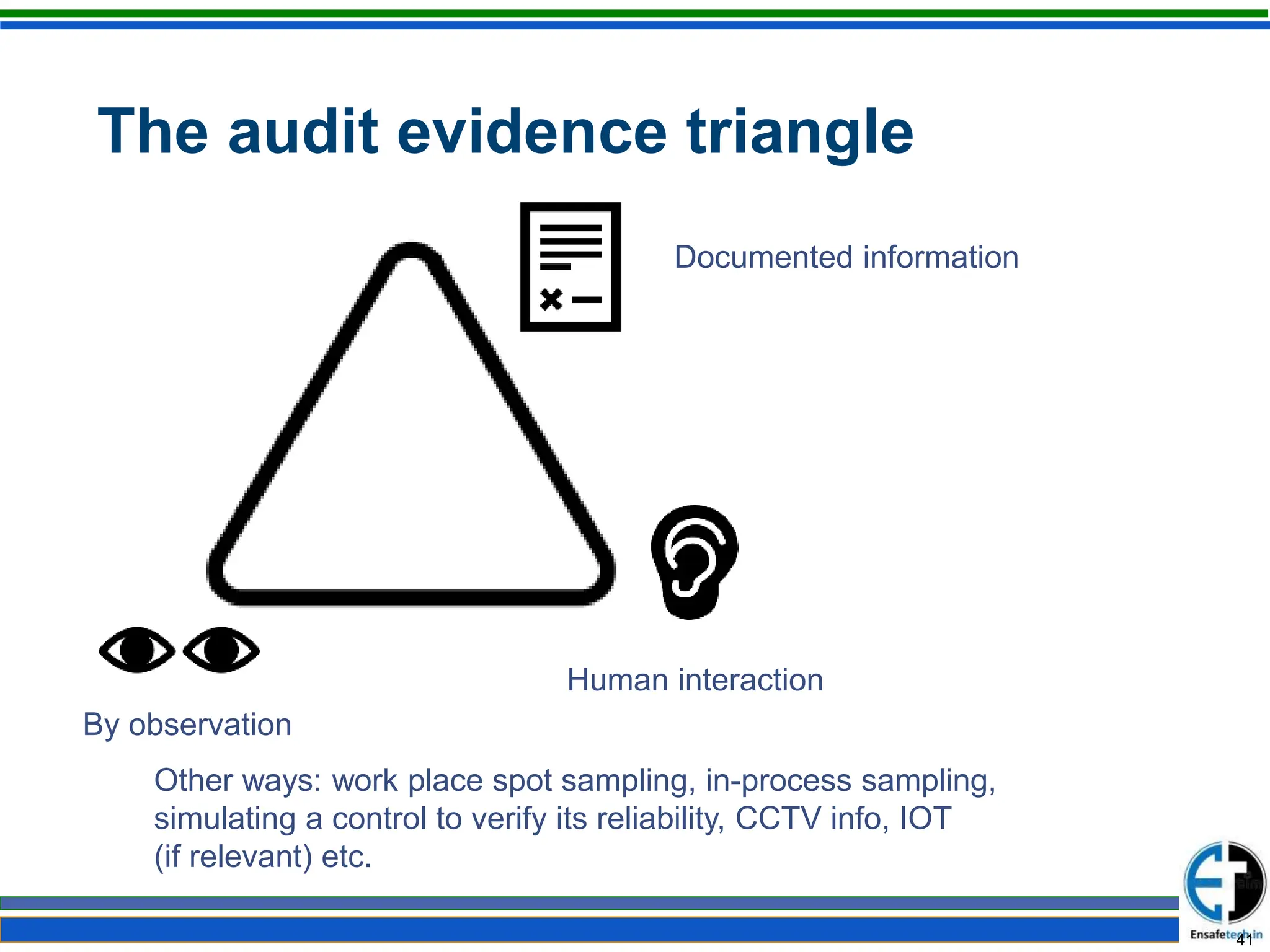
The audit evidence triangle
41
Documented information
Human interaction
By observation
Other ways: work place spot sampling, in-process sampling,
simulating a control to verify its reliability, CCTV info, IOT
(if relevant) etc.
Audit Evidence
42
Documented info
Observation
Verbal
Objective evidence
- Coming from
outside to person
Subjective
evidence
- Coming from within
or getting modified
with auditor’s past
mental impressions
Interpretated by
auditor’s past
experience
Assumptions
Presumptions
Prejudices
43
Audit Method
Vertical Process
Horizontal
Themed
Audit Methodology
44
Presence at site
Auditee
Presence
Auditor at site
Auditee Present with him
Auditor at site
Auditee not present
Auditor not at site
Auditee Present with him
Auditor not at site
Auditee not present
45
Sampling
• Sampling is undertaken as we cannot assess
every aspect of all activities
• Samples are taken from numbers of
 Personnel
 Records, documents
 Plant, equipment
 Areas, locations etc
46
Sampling
• The extent of samples is determined through a
process of identifying
 Risk
 Extent
 Importance
 Findings
47
Audit Trails
• Logical audit trails develop from the responses to
initial ‘trigger’ questions
• Audit trails are the questions auditors ask to
determine
 Conformity
 Effectiveness
 Control
 Competence
Collecting and verifying information
Audit conclusion
Reviewing
Audit findings
Evaluating against audit criteria
Verification to ensure true audit evidence
Collection by appropriate sampling
Source of information
48
49
Group Exercise 3
1. What key personal attributes does an auditor
need to conduct an effective audit?
2. What key personal skills does an auditor need?
3. What knowledge does an auditor need to
assess a QMS?
4. How could an auditor develop their level of
competence?
25 minutes
Auditors Responsibilities
50
Time keeping
Confidentiality
Objective
and
Ethical
Support
the
audit team
Work
documents
Inform auditee
of audit process
Document and
support findings
Keep auditee
informed
Safeguard
all
documents
Prepare the
audit report
Group discussion
• Please go through the Internal Audit procedure of
your site and discuss with other participants on
understanding, agreement or comments if any
51
20 minutes
Communicating during Audit
53
Questioning
Some basic points
 Ask the right person
 Recognize the individual
 Understand why you are asking the question
 Ask simple questions
 Give time to answer
 Don’t be judgemental
54
Questioning
Tell the auditee
 What you are going to do
 Why you are there
 What you are asking
 What your findings may be
 And then, what your findings are
Type of questions
 Open ended - starting with a ‘who, what, where, when, why, or
how
 Specific
 Leading
 Closed ended
 Hypothetical
 Probing
 Reflective - can I just confirm
 Rhetorical
55
56
Questioning – Funnel Approach
OPEN
CLOSED
Gathering
Probing
Verifying
Finding
Parroting
57
Communication model
• Communication is not simply logical - it is
psychological
• It is what we do to give and get understanding
58
Communication Rules
The sender is
responsible for
accurate
communication
It is not important
what A says, but
what B
understands You cannot not
communicate
59
Keys to active listening
Show open
body language
Use commenting
words/expressions
Keep eye
contact
Use
paraphrasing
……showing you are interested and
want to understand
60
Listening
• Hear – hear the ‘raw’ data
• Listen – focus attention on the speaker
• Understand – assign a meaning
• Evaluate – begin to analyse
• Respond – feedback to auditee
61
Listening
Listen
Understand
Evaluate
Respond
Hear
What's your body telling you
62
Body language: The gestures, poses, movements,
and expressions that a person uses to
communicate.
• 7 % VERBAL (Conveyed through words)
• 38 % VOCAL (intonation , pitch, pauses , etc)
• 55 % NON VERBAL (body language)
Rubbing Hands
63
Positive
expectation
&
Closed Attitude Open Attitude
Evaluation
Boredom
Improving the personal effect
Specific
Situation
Posture
Expression
Gesture
Appearance
Voice
Eye-Contact
Information
Language
A good rapport can be built through reaction and similarity in:
Friendly nature
1. What makes a person most likeable is sincere
interest in others.
2. A warm, genuine smile attracts other to you
3. Be an open up person. People when they are
uncomfortable have a tendency to close off
4. Use your eyes.
5. What your body is projecting
6. Approach others
67
Perceptual Positions
The art of seeing events through
the eyes of others
• ‘the way I see it’
• ‘If I were you I would’
• ‘taking into account both views
it seems like this'
Overcoming negativeness
• Persist in your positive-ness
• Be strong in your positive-ness
• Assert your positive-ness
• Ask the auditee to consider the positive side of
logic
• Persevere if required
• Never give in
• You would succeed – partially or fully
69
How to influence positively
• Bring awareness
• Show an example
• Generate imagination of positive results
• Encourage in right efforts
• Col-laborate
70
Group Exercise 4
• Discuss in your group – how one can enhance
auditor’s personal attribute of being diplomatic
• First 3 minutes – think alone
• Next 3 minutes – think 2 together
• Next 9 minutes – think all together
71
15 minutes
Managing difficult situations
1. Auditor own HOD does not make him fully free to do
job with focused attention
2. Senior auditee ignore you
3. Frequent interruptions such that auditee is not
available. Time is wasted.
4. Coordinators only answers all the questions
72
Managing difficult situations
5. Activity which you wanted to observe is not
happening on the day. Or the person you
wanted to meet is not available that day.
6. Auditor is insulted by group of auditees and
coerced to not write certain findings.
7. Auditees does not accept genuine findings –
opposes
73
74
Opening Meeting
• All audits commence with an opening meeting,
either
 Formal or
 Informal
75
Group Exercise 5
• Conducting the audit
120 minutes
Audit Findings and Reporting
77
Audit Findings
• Audit findings can be classified into four main areas
 Positive – areas working well that could be used as best-
practice improvements elsewhere
 Conformity – the process(es) assessed conform(s) to
requirements and is effective
 Nonconformity – there is a deviation from a requirement
 Observation – the process(es) is/are conforming but could
be improved to become more effective
78
Nonconformity
A nonconformity should be
• CLEAR – No ambiguities
• FACTUAL – Based on facts from the audit
• ACCURATE – Include the correct information
• COMPLETE – Including all identifiers/references
A nonconformity needs two elements
• A requirement
• A deficiency
79
NC categorization
Minor
An isolated deviation from requirements(s) not
resulting in a significant impact on the organisation
Major
A deviation from requirement(s) resulting in a
significant impact on the organisation (potential or
actual), or a number of linked minor NCs
Audit Scenario
You are auditing the design and development process in an organisation that
designs and manufactures industrial equipment. They are currently dealing with
a serious customer complaint relating to faulty safety mechanisms. They have
sent engineers to this customer to repair some equipment they designed,
manufactured and supplied two years earlier for contract number A123. You find
a recent note on file that states that the engineers are currently having difficulty
in repairing the equipment. They have been issued with the latest drawings for
the equipment (serial number X134, revision 3). The drawings do not contain a
modification to the safety mechanism that was made prior to delivery and
installation of the equipment. You confirm with the Design Manager that revision
3 is the current version of the drawings and that revision 3 does not include the
change to the safety mechanism. You ask the Design Manager why the
modification to safety mechanism was not made to the drawing and he replies
that the change was reviewed and considered to be minor with no impact on the
equipment and it didn’t affect the customer’s contract specification.
80
NC Statement
The organization has not adequately conducted a review before
committing to supply products to a customer, to include requirements
not stated by the customer, but necessary for the specified or
intended use, when known.
Evidence - Drawings, X 134 revision 3, supplied with contract A123
and found to the final version, do not show changes to the electronic
safety mechanisms made prior to delivery and installation of the
equipment.
Clause No. 8.2.3.1
81
Group Exercise 6
• Delegate to write NC’s, as identified by them
during audit conduct on the NC format
82
30 minutes
83
Closing Meeting
• As with the opening meeting, the closing meeting
can be either informal or formal
84
Reporting
• Audit reports should include
 Summary – objective, scope, criteria, overview
 Findings – positive findings, conformity, NC,
observations
 Action – summary of agreed actions required, including
timescales/responsibilities
85
Corrective Action Plan (CAP)
• Timely and effective action is needed for all
nonconformities
• Actions should be planned by auditee
• Proposed actions should investigate to the root
cause and address the same
• Auditor should approve CAP
• Actions should be implemented by auditee
• Action should be evaluated by auditee
• Action should be verified by auditor
Close out of Audit
• A non-conformity can be closed if the corrective
actions planned have been implemented and it is
working effectively.
• Auditor needs to check whether corrective action plan
addresses all the root causes.
• Evidences to be seen for authorization, and
implementation.
• If implantation required changes in documentation
or/and training to concerned persons – these have
been imparted satisfactorily.
86
87
thanks you for your participation
Website: https://ensafetech.in/
Email: ensafetech@gmail.com
Mobile: +91 9871292020, +91 9871191114
Ensafe Technologies
B-503, Palm Court Apartments
Sector 19 B, Plot No. 3, Dwarka
New Delhi – 110075. India

Internal Auditor Training Course QMS.pptx

  • 1.
    Internal Auditors Training Courseon QMS as per ISO 9001:2015 Management Systems Training Welcomes Delegates to this Course
  • 2.
  • 3.
    3 Delegate Introductions Delegate Introductions •Name • Job role • ISO 9001:2015 understanding (1 to 10) • Understanding of Quality function (1 to 10) • Course expectations
  • 4.
    4 Course Aim • Understandingthe working with ISO 9001:2015 system. • Acquiring knowledge and skills to carry out internal audits for the quality management system.
  • 5.
    Key Concept 1:Quality Management Principles Customer Focus Leadership Engagement of People Process Approach Improvement Evidence based decision making Relationship Management
  • 6.
    Key Concept 2:PDCA structure of standard 6 Leadership (5) Support and Operation ( 7,8) Improvement (10) Planning (6) Performance evaluation (9) Plan Do Check Act Quality Management System (4) Organization and its context (4) Customer requirements Needs and expectations of relevant interested parties (4) Customer satisfaction Products and services Results of the QMS
  • 7.
    Key Concept 3:Leadership and commitment 7
  • 8.
    Key Concept 4:Customer focus 8
  • 9.
    Key Concept 5:Risk based thinking 9
  • 10.
    Key Concept 6:Process approach 10 With what? Resources Outputs To whom/ where What results? Performance indicators Inputs From whom/ where How done? Methods/ Documentation With Who? Personnel Process (specific value- added activities)
  • 11.
    Key Concept 7:Organizational knowledge 11
  • 12.
  • 13.
    The Audit Process:ISO 19011:2018
  • 14.
    Why do wedo audit • Purpose of auditing • We can’t audit our own activities • Auditor and auditee have a common goal • Auditor cannot add personally to the requirements • Auditor does not provide solution but aids auditee to discover solution 14
  • 15.
    15 Auditing systems Why dowe assess systems? • Conformance • Effectiveness • Improvement
  • 16.
    Find & Compare Whatis supposed to be happening What is actually happening Know it before the audit Get to know during the audit Fulfillment is compliance Gaps are the non-conformities
  • 17.
    17 Definition Audit Systematic, independent anddocumented process for obtaining audit evidence and evaluating it objectively to determine the extent to which audit criteria are fulfilled.
  • 18.
    18 Types of audits •First Party • Second Party • Third Party Internal Audit - on own organisation Organisation External on another eg supplier Organisation Third Party - independent
  • 19.
    19 Auditing standard –ISO 19011 • ISO 19011 – Guidelines for auditing management systems • The principles of auditing • Guidance on managing audit programmes • Guidance on conducting audits • Guidance on the competence needed by an auditor
  • 20.
    Principles of auditing •Integrity: the foundation of professionalism • Fair presentation: the obligation to report truthfully and accurately • Due professional care: the application of diligence and judgement in auditing • Confidentiality: security of information • Independence: the basis for the impartiality of the audit and objectivity of the audit conclusions • Evidence-based approach: the rational method for reaching reliable and reproducible audit conclusions in a systematic audit process • Risk based auditing 20
  • 21.
    21 Audit Scheduling • Schedulingthe audit programme is the responsibility of the person leading the audit process (the program manager) • Audits are required to be scheduled based on  The results of risk assessments  The results of previous audits  Changes in operations/ activities
  • 22.
    22 Planning Audit Schedule •When planning audits schedule, the following needs to be considered  Scope – the departments, processes, activities  Criteria – the requirements  Objective – the audit purpose  Date & Duration – timing of audit areas  Method – vertical (process), horizontal (theme)  Competence – auditor experience, skills, knowledge  Risk – areas of potential concern/high importance
  • 23.
    ISO 19011 AuditProcess 6.3 Preparing audit activities 6.2 Initiating audit 6.5 Preparing and distributing audit report 6.4 Conducting audit activities 6.6 Completing audit 6.7 Conducting audit follow-up 6.2.1 General (audit Team Leader responsibility) 6.2.2 Establishing contact with auditee 6.2.3 Determining feasibility of audit 6.3.1 Performing review of documented information 6.3.2 Audit planning 6.3.2.1 Risk-based approach to planning 6.3.2.2 Audit planning details 6.3.3 Assigning work to audit team 6.3.4 Preparing documented information for audit 6.4.1 General (sequence may be varied) 6.4.2 Assigning roles and responsibilities of guides and observers 6.4.3 Conducting opening meeting 6.4.4 Communicating during audit 6.4.5 Audit information availability and access 6.4.6 Reviewing documented information while conducting audit 6.4.7 Collecting and verifying information 6.4.8 Generating audit findings 6.4.9 Determining audit conclusions 6.4.9.1 Preparation for closing meeting 6.4.9.2 Content of audit conclusions 6.4.10 Conducting closing meeting 6.5.1 Preparing audit report 6.5.2 Distributing audit report NOTE: Subclause numbering refers to the relevant subclauses of this International Standard.
  • 24.
    Audit Process 6.2 Initiatingthe audit • 6.2.1 General (audit Team Leader responsibility) • 6.2.2 Establishing contact with auditee • 6.2.3 Determining feasibility of audit 24
  • 25.
    Audit Process 6.3 Preparingaudit activities • 6.3.1 Performing review of documented information • 6.3.2 Audit planning • 6.3.2.1 Risk-based approach to planning • 6.3.2.2 Audit planning details • 6.3.3 Assigning work to audit team • 6.3.4 Preparing documented information for audit 25
  • 26.
    Audit Process 6.4 Conductingthe audit activities • 6.4.1 General (sequence may be varied) • 6.4.2 Assigning roles and responsibilities of guides and observers • 6.4.3 Conducting opening meeting • 6.4.4 Communicating during audit • 6.4.5 Audit information availability and access • 6.4.6 Reviewing documented information while conducting audit • 6.4.7 Collecting and verifying information • 6.4.8 Generating audit findings • 6.4.9 Determining audit conclusions • 6.4.9.1 Preparation for closing meeting • 6.4.9.2 Content of audit conclusions • 6.4.10 Conducting closing meeting 26
  • 27.
    Audit Process 6.5 Preparingand distributing the audit report • 6.5.1 Preparing audit report • 6.5.2 Distributing audit report 27
  • 28.
    Audit Process 6.6 Completingthe audit 6.7 Conducting audit follow-up (if specified in the audit plan) 28
  • 29.
    29 P. E. R.C. • Plan • Execute • Report • Close out Plan Execute Report Close out
  • 30.
  • 31.
    31 Audit Planning • Fromthe schedule, audits need to be planned to ensure that they are carried out effectively making efficient use of time • Flexibility should be designed into an audit plan to ensure audit trails can be followed to ensure effective depth of the audit
  • 32.
  • 33.
    33 Requirements (Criteria) • Requirementscome from  ISO 9001:2015  Legislations  Design documents, codes of practices, guidance documents  Management priority  Business requirements  The documented management system  Product/service/customer requirements  Other related standards, e.g., IS standards  Other requirements, e.g., voluntary commitments What else ?
  • 34.
    34 Audit Planning • Avoidingproblems  Plan the audit carefully, based on scope and criteria  Communicate the plan before the audit  Keep the plan flexible (build in flex)  Copy in department management  Ensure importance of audit is understood  Ensure objective of audit is understood  Ensure plan is focussed on risk
  • 35.
    Internal Audit Plan Purposeof audit..................................................................................................................... Date of audit:......................................................................................................................... Department to be audited...................................................................................................... Name of auditor/s: ............................................................................................................... Criteria of audit..................................................................................................................... Prepared by auditor............................................................................................................... 35 Duration (from..to) Area, Process, Activity to be audited Comments (sup. To be available) Name of auditor
  • 36.
    Group Exercise 1 Makean audit plan for the department and within allotted time which your group would be auditing 36 30 minutes
  • 37.
    37 Checklists • The outputof the plan is preparation of audit checklists • Checklists are used  As a memory aid  For structure  As a means of recording findings
  • 38.
    38 Checklists • Checklists canbe prepared in a variety of styles  Bullet points  List of questions  List of requirements  Mind maps/spider diagrams • Checklists should form a logical flow as an aid to memory to ensue all important elements are covered during the audit
  • 39.
    Work documents example RequirementSource of information Evidence Notes on how to follow up 1 ISO 9001 requirement What to ‘look at’ What to ‘look for’ How to follow up 2 Process requirement 3 Other requirement 4 39
  • 40.
    40 Group Exercise: 2 Preparea checklist for an audit of the department you have been asked to audit. Group 1 Group 3 Group 5 Group 2 Group 4 30 minutes
  • 41.
    The audit evidencetriangle 41 Documented information Human interaction By observation Other ways: work place spot sampling, in-process sampling, simulating a control to verify its reliability, CCTV info, IOT (if relevant) etc.
  • 42.
    Audit Evidence 42 Documented info Observation Verbal Objectiveevidence - Coming from outside to person Subjective evidence - Coming from within or getting modified with auditor’s past mental impressions Interpretated by auditor’s past experience Assumptions Presumptions Prejudices
  • 43.
  • 44.
    Audit Methodology 44 Presence atsite Auditee Presence Auditor at site Auditee Present with him Auditor at site Auditee not present Auditor not at site Auditee Present with him Auditor not at site Auditee not present
  • 45.
    45 Sampling • Sampling isundertaken as we cannot assess every aspect of all activities • Samples are taken from numbers of  Personnel  Records, documents  Plant, equipment  Areas, locations etc
  • 46.
    46 Sampling • The extentof samples is determined through a process of identifying  Risk  Extent  Importance  Findings
  • 47.
    47 Audit Trails • Logicalaudit trails develop from the responses to initial ‘trigger’ questions • Audit trails are the questions auditors ask to determine  Conformity  Effectiveness  Control  Competence
  • 48.
    Collecting and verifyinginformation Audit conclusion Reviewing Audit findings Evaluating against audit criteria Verification to ensure true audit evidence Collection by appropriate sampling Source of information 48
  • 49.
    49 Group Exercise 3 1.What key personal attributes does an auditor need to conduct an effective audit? 2. What key personal skills does an auditor need? 3. What knowledge does an auditor need to assess a QMS? 4. How could an auditor develop their level of competence? 25 minutes
  • 50.
    Auditors Responsibilities 50 Time keeping Confidentiality Objective and Ethical Support the auditteam Work documents Inform auditee of audit process Document and support findings Keep auditee informed Safeguard all documents Prepare the audit report
  • 51.
    Group discussion • Pleasego through the Internal Audit procedure of your site and discuss with other participants on understanding, agreement or comments if any 51 20 minutes
  • 52.
  • 53.
    53 Questioning Some basic points Ask the right person  Recognize the individual  Understand why you are asking the question  Ask simple questions  Give time to answer  Don’t be judgemental
  • 54.
    54 Questioning Tell the auditee What you are going to do  Why you are there  What you are asking  What your findings may be  And then, what your findings are
  • 55.
    Type of questions Open ended - starting with a ‘who, what, where, when, why, or how  Specific  Leading  Closed ended  Hypothetical  Probing  Reflective - can I just confirm  Rhetorical 55
  • 56.
    56 Questioning – FunnelApproach OPEN CLOSED Gathering Probing Verifying Finding Parroting
  • 57.
    57 Communication model • Communicationis not simply logical - it is psychological • It is what we do to give and get understanding
  • 58.
    58 Communication Rules The senderis responsible for accurate communication It is not important what A says, but what B understands You cannot not communicate
  • 59.
    59 Keys to activelistening Show open body language Use commenting words/expressions Keep eye contact Use paraphrasing ……showing you are interested and want to understand
  • 60.
    60 Listening • Hear –hear the ‘raw’ data • Listen – focus attention on the speaker • Understand – assign a meaning • Evaluate – begin to analyse • Respond – feedback to auditee
  • 61.
  • 62.
    What's your bodytelling you 62 Body language: The gestures, poses, movements, and expressions that a person uses to communicate. • 7 % VERBAL (Conveyed through words) • 38 % VOCAL (intonation , pitch, pauses , etc) • 55 % NON VERBAL (body language)
  • 63.
  • 64.
  • 65.
  • 66.
    Improving the personaleffect Specific Situation Posture Expression Gesture Appearance Voice Eye-Contact Information Language A good rapport can be built through reaction and similarity in:
  • 67.
    Friendly nature 1. Whatmakes a person most likeable is sincere interest in others. 2. A warm, genuine smile attracts other to you 3. Be an open up person. People when they are uncomfortable have a tendency to close off 4. Use your eyes. 5. What your body is projecting 6. Approach others 67
  • 68.
    Perceptual Positions The artof seeing events through the eyes of others • ‘the way I see it’ • ‘If I were you I would’ • ‘taking into account both views it seems like this'
  • 69.
    Overcoming negativeness • Persistin your positive-ness • Be strong in your positive-ness • Assert your positive-ness • Ask the auditee to consider the positive side of logic • Persevere if required • Never give in • You would succeed – partially or fully 69
  • 70.
    How to influencepositively • Bring awareness • Show an example • Generate imagination of positive results • Encourage in right efforts • Col-laborate 70
  • 71.
    Group Exercise 4 •Discuss in your group – how one can enhance auditor’s personal attribute of being diplomatic • First 3 minutes – think alone • Next 3 minutes – think 2 together • Next 9 minutes – think all together 71 15 minutes
  • 72.
    Managing difficult situations 1.Auditor own HOD does not make him fully free to do job with focused attention 2. Senior auditee ignore you 3. Frequent interruptions such that auditee is not available. Time is wasted. 4. Coordinators only answers all the questions 72
  • 73.
    Managing difficult situations 5.Activity which you wanted to observe is not happening on the day. Or the person you wanted to meet is not available that day. 6. Auditor is insulted by group of auditees and coerced to not write certain findings. 7. Auditees does not accept genuine findings – opposes 73
  • 74.
    74 Opening Meeting • Allaudits commence with an opening meeting, either  Formal or  Informal
  • 75.
    75 Group Exercise 5 •Conducting the audit 120 minutes
  • 76.
  • 77.
    77 Audit Findings • Auditfindings can be classified into four main areas  Positive – areas working well that could be used as best- practice improvements elsewhere  Conformity – the process(es) assessed conform(s) to requirements and is effective  Nonconformity – there is a deviation from a requirement  Observation – the process(es) is/are conforming but could be improved to become more effective
  • 78.
    78 Nonconformity A nonconformity shouldbe • CLEAR – No ambiguities • FACTUAL – Based on facts from the audit • ACCURATE – Include the correct information • COMPLETE – Including all identifiers/references A nonconformity needs two elements • A requirement • A deficiency
  • 79.
    79 NC categorization Minor An isolateddeviation from requirements(s) not resulting in a significant impact on the organisation Major A deviation from requirement(s) resulting in a significant impact on the organisation (potential or actual), or a number of linked minor NCs
  • 80.
    Audit Scenario You areauditing the design and development process in an organisation that designs and manufactures industrial equipment. They are currently dealing with a serious customer complaint relating to faulty safety mechanisms. They have sent engineers to this customer to repair some equipment they designed, manufactured and supplied two years earlier for contract number A123. You find a recent note on file that states that the engineers are currently having difficulty in repairing the equipment. They have been issued with the latest drawings for the equipment (serial number X134, revision 3). The drawings do not contain a modification to the safety mechanism that was made prior to delivery and installation of the equipment. You confirm with the Design Manager that revision 3 is the current version of the drawings and that revision 3 does not include the change to the safety mechanism. You ask the Design Manager why the modification to safety mechanism was not made to the drawing and he replies that the change was reviewed and considered to be minor with no impact on the equipment and it didn’t affect the customer’s contract specification. 80
  • 81.
    NC Statement The organizationhas not adequately conducted a review before committing to supply products to a customer, to include requirements not stated by the customer, but necessary for the specified or intended use, when known. Evidence - Drawings, X 134 revision 3, supplied with contract A123 and found to the final version, do not show changes to the electronic safety mechanisms made prior to delivery and installation of the equipment. Clause No. 8.2.3.1 81
  • 82.
    Group Exercise 6 •Delegate to write NC’s, as identified by them during audit conduct on the NC format 82 30 minutes
  • 83.
    83 Closing Meeting • Aswith the opening meeting, the closing meeting can be either informal or formal
  • 84.
    84 Reporting • Audit reportsshould include  Summary – objective, scope, criteria, overview  Findings – positive findings, conformity, NC, observations  Action – summary of agreed actions required, including timescales/responsibilities
  • 85.
    85 Corrective Action Plan(CAP) • Timely and effective action is needed for all nonconformities • Actions should be planned by auditee • Proposed actions should investigate to the root cause and address the same • Auditor should approve CAP • Actions should be implemented by auditee • Action should be evaluated by auditee • Action should be verified by auditor
  • 86.
    Close out ofAudit • A non-conformity can be closed if the corrective actions planned have been implemented and it is working effectively. • Auditor needs to check whether corrective action plan addresses all the root causes. • Evidences to be seen for authorization, and implementation. • If implantation required changes in documentation or/and training to concerned persons – these have been imparted satisfactorily. 86
  • 87.
    87 thanks you foryour participation Website: https://ensafetech.in/ Email: ensafetech@gmail.com Mobile: +91 9871292020, +91 9871191114 Ensafe Technologies B-503, Palm Court Apartments Sector 19 B, Plot No. 3, Dwarka New Delhi – 110075. India

Editor's Notes

  • #2 Welcome delegates Organize seating arrangements
  • #4 Understanding expectations of delegates is vital to the success of the course – ensure expectations are documented for each delegate and ensure they understand the scope of the course (and that they are not expecting too much, refer to web flyer/JIs if this is the case) Ask the delegates to introduce themselves, (or each other), the name of their company and it’s product(s). Their system responsibilities within that organization and their knowledge of systems. Finally, what their hobbies or interests are. The learning point here is that auditors do not rely on memory, but take notes. Delegates: name - check spelling for certificate. company - product or service they provide. position in the company and experience. ISO knowledge to help tutors in group selection 1 = Very little knowledge. 3 = Can understand parts of the standard. 7+= Has worked in QA etc.. Hobbies to put delegates at ease
  • #5 Introduce aim of course – content and objectives after
  • #14 Overview This module goes through the audit process from start to end Audit process Scheduling and planning Conducting the audit Reporting the audit Close-out of findings Objectives
  • #16 General discussion. Ensure the delegates understand what each of the bullet points means.
  • #18 Auditing is a management activity and therefore must be planned. The plan must be implemented in a systematic manner.
  • #19 All Management system auditing should be carried out in accordance with ISO 19001. Internal audits must be carried out by trained auditors who are independent of those having direct responsibility for the activity being audited. Second party audits are becoming less common as organisations are becoming more confident in the ISO certification process. Second party auditing must be against defined criteria which need not necessarily be ISO. Second party auditing is just one method that can be used to evaluate suppliers. In the UK, not all registration bodies are accredited by UKAS (United Kingdom Accreditation Services). Those who are accredited have to comply with 17021. Accreditation gives more credibility to the registration body.
  • #20 Introduce 19011.
  • #22 This session should emphasise that audit scheduling is a requirement, and that is should be ‘risk and result’ based. Audit scheduling is covered in more depth on a Lead Auditor course – this is a précis for internal auditors. There are many types of schedule: Annual diagonal - very poor practice, unless it is flexible to add in additional audits based on risk and findings Comprehensive – detailing risk levels and allocating time to the real areas of perceived risk Forward planned – the audit schedule DOES NOT have to be annual, it can be over a longer period of time.
  • #23 Refer to audit plan of Mac Fuels Ltd in delegate workbook for discussion Method discussed on next slide ….
  • #24 The tutor will direct the class to ISO 19011 Clause 6, and also refer the class to the Terms and definitions for: ‘3.1 Audit’ definition‘. For clarification: The tutor will also refer the class to the definition of an ‘audit plan’: By reference to ISO 19011 3.6, and what an ‘audit programme’ is defined as: By reference to ISO 19011 3.4. These will be covered in more depth later in the course, when you will be auditing a supplier’s audit programme. Please note that particular attention always needs to be paid to the design, planning and validation of an audit programme in the case of multiple locations/sites or where important functions are outsourced. ……………………………………………………………………………………………………………………………………………………………………………………………………………………………………………………………………………………………………………………………………………………………………………………………………………………………………………………………………………………………………………………………………………………………………………………………………………………………………………………………………………………………………………………………………………………………………………………………………………………………………………………………………………………………………………………………………………………………………………………………………………………………………………………………………………………………………………………………………………………………………………………………………………………………………………………………………… ………………………………………………………………………………………………………………………………………………………………………………………………………………………………………………………………………………………………………………………………………………………………………………………………………………………………………………………………………………………………………………………………………………………………
  • #30 Introduce the 4 phases of an audit as the PERC acronym.
  • #31 Overview Objectives
  • #34 This list is not exhaustive, draw out further criteria requirements from the delegates, ensure they understand that they are actually covering the ‘management’ of health and safety
  • #39 Demonstrate to delegates a couple of different styles of checklist – lists, mind-map etc Ensure delegate understanding that checklists should be prepared for each individual audit, checklists can be developed from standard templates, but should be related directly to the criteria, scope and objectives.
  • #41 Delegates to group, and identify a topic – prepare a checklist of questions in a logical flow 30 mins in groups
  • #44 Explain vertical and horizontal auditing methods Vertical = process (upstream and downstream) Horizontal = themed (possibly against legislation, compliance etc)
  • #47 Ensure delegates understand that you cannot assess everything, therefore sampling must be done to determine conformity/nonconformity of the samples taken. Therefore during an audit, NCs may be present but not identified due to sampling. Sample points and sizes must be determined by: Risk – level of residual risk within the activities (results of risk assessment), higher risk = greater samples Extent – the range/pool size to sample from, the higher the pool size, the more samples may be needed Importance – if the activities are very important to the success of the process/system, increase sample size; less important, reduce Findings so far – if you identify potential problems, increase the sample size to reflect your perception of the potential level of conformity Demonstrate sampling though a practical example – for example; equipment maintenance, training records etc. Ask delegates how many they would check, and what criteria they would use for selection, i.e. job numbers, area, plant number, plant usage, risk levels (from risk assessment), accident rates etc etc
  • #48 Ensure at this stage that delegate understand the difference between ‘INSPECTION’ and ‘AUDIT’
  • #50 30 minutes in groups, output onto flips – + 30 mins plenary discussion Tenacious, Decisive, Self-reliant, Ethical, Open-minded, Diplomatic, Observant, Perceptive etc etc (ensure observation is drawn from the discussions as this is used in the next exercise). Communication, reporting, observation, ‘BS detector’ etc etc 18001, legislation, business requirements, product/process requirements, business processes, DMS, audit procedure etc etc CPD, training, experience, mentoring etc etc In feedback from this exercise – introduce delegates to: Skills Knowledge Ability / Attitude Training Experience Groups to be split: >5 delegates = 1 group, 1 procedure 6 to 10 delegates = 2 groups, 2 procedures 11 to 15 delegates = 3 groups, 2 procedures (1 for one group, 1 for the other two) 16 to 20 delegates = 4 groups, 2 procedures
  • #53 Overview Objectives
  • #54 Ask the right person – identify the right person for the right question Recognize the individual – understand personal abilities and differences Understand why you are asking the question – know what you want to achieve from asking the question Ask simple questions – one question at a time, simple to-the-point language Give time to answer – don’t hurry for an answer, let the auditee talk (not for too long though) Don’t be judgemental – don’t ask questions about the person, it is about the process
  • #55 What you are going to do – outline the audit objectives to ensure that auditees understand the reason and importance of the audit (the opening meeting) What you are asking – outline the topic area before asking the question, e.g. I am now going to ask about …….. What you findings may be – positive, improvement need, NC, classify the findings that may go into a report Why you are there – top management involvement/direction, need to assess conformity, may identify areas to improve/make more efficient/effective What your findings are – tell the auditee your findings before you leave them do they can confirm/discuss findings (informal closing meeting)
  • #57 Open questioning to start – who, what, where, when, why, how; following the funnel approach to closed questioning – show me Gathering – open questioning to determine who does what, when done etc Probing – further developing on gathering to delve a bit deeper Verifying – to begin to confirm, ask the same question again Parroting – repeat the information back to the auditee for full confirmation (and take notes) Finding – confirm compliance or non-compliance
  • #61 Hear – hear the ‘raw’ data, all of the words that are being spoken Listen – focus attention on the speaker, concentrate on all of the speaker’s words Understand – assign a meaning to the words, assimilate to the topic being discussed Evaluate – begin to analyze the responses to the criteria (requirements) Respond – feedback to auditee, parrot back the information to gauge understanding and correctness
  • #62 The listening cycle – adapted from work by Terrence A. Doyle, Ph. D, Northern Virginia Community College
  • #75 Discuss the differences between formal and informal – internal audits more likely to be informal. All audits start with an opening meeting to set the scene – this should be done with each auditee (briefly) to ensure thy understand the audit process and reason. Ask delegates to come up with agenda points for both types of open meeting – record on flips
  • #76 Delegates to read procedure before breaking for lunch in preparation for questioning after. Groups to be split: >5 delegates = 1 group, 1 procedure (time as required) 6 to 10 delegates = 2 groups, 2 procedures (30 mins each or as required) 11 to 15 delegates = 3 groups, 2 procedures (1 for one group, 1 for the other two) (20 mins each) 16 to 20 delegates = 4 groups, 2 procedures (15 mins each) Ensure delegates understand that when the audit is complete they will need to review the audit schedule as a part of the CHECK and ACT of P.D.C.A.
  • #77 Overview Objectives
  • #78 Discuss with delegates that these are the main findings, however they can call them what they like
  • #80 The definitions come from BSIs definitions of Major and Minor (adapted) – delegates should understand that they can use these or their own, but they should be classified (in their own procedures) to ensure they focus on the right level of NC and that they can demonstrate why they have identified as Major or Minor to the auditee/management At this point, delegates are to prepare one (or two) nonconformities from the previous exercise and classify them according to risk. If none were identified, tutor to identify one for them. Ensure delegates understand that NCs should be: Foolproof – easy to understand Accurate – no interpreted information, only the facts Complete – include all of the identifiers, where, when, what etc True – a factual representation of the audit finding
  • #84 As with the opening meeting, discuss with delegates the key points for an closing meeting (both formal and informal) and discuss the audience for both types. Also ensure delegate understanding that they should do a ‘mini-closing-meeting’ with all auditees before leaving them.
  • #85 Ensure delegates understand that actions are NOT THIER RESPONSIBILITY but the responsibility of others (management of area, process owner), they can however help with defining actions An example of an audit report is included in the delegate folder. Review this and answer any questions they may have. Ask delegate to review their own reports (if they are already auditing in their organisations) to see any comparisons/omissions.
  • #86 Actions should be assigned to a responsible person – the manager of the department, the process owner etc Timely and effective action is needed for all nonconformities raised during an audit, timescales need to be determined and agreed with al parties Proposed actions should investigate the root cause of the problem to prevent recurrence, the 5 whys Action should be evaluated to ensure it is effective and complete to prevent recurrence, re-audited to ensure effectiveness.