ISO 9001:2015
Quality Management System
Introduction
QMS Structure and Style
Documenting the QMS
Controlling the QMS
Learning Objectives
a.Understand the documentation requirements
of ISO 9001:2015;
b.Know the structure of QMS documentation;
c. Know the different types of QMS documents;
d.Understand the requirements for controlling
Documented Information of the QMS
SECTION I
INTRODUCTION
What is Quality Management System?
A formalized system that documents
processes, procedures, and
responsibilities for achieving quality
policies and objectives.
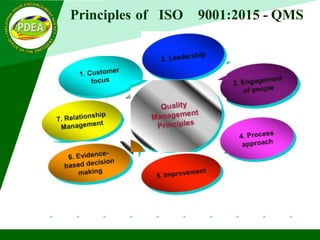
Principles of ISO 9001:2015 - QMS
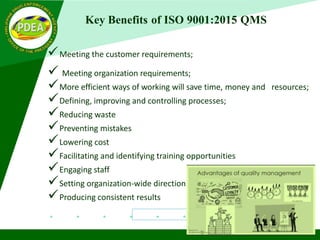
Key Benefits of ISO 9001:2015 QMS
Meeting the customer requirements;
 Meeting organization requirements;
More efficient ways of working will save time, money and resources;
Defining, improving and controlling processes;
Reducing waste
Preventing mistakes
Lowering cost
Facilitating and identifying training opportunities
Engaging staff
Setting organization-wide direction
Producing consistent results
operational performance will cut errors and increase
ISO 9001:2015 Documentation Requirements
The ISO 9001:2015 documents basic
requirements for an organization to:
Establish;
Document;
Implement; and
maintain
a quality management system and
continually improve its effectiveness in
accordance with the requirements of the
International Standard.
ISO 9001:2015 Documentation Requirements
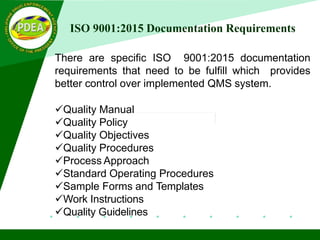
There are specific ISO 9001:2015 documentation
requirements that need to be fulfill which provides
better control over implemented QMS system.
Quality Manual
Quality Policy
Quality Objectives
Quality Procedures
Process Approach
Standard Operating Procedures
Sample Forms and Templates
Work Instructions
Quality Guidelines
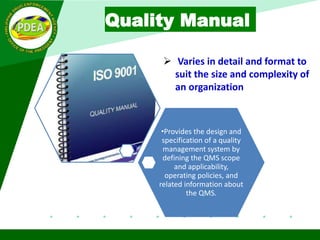
•Provides the design and
specification of a quality
management system by
defining the QMS scope
and applicability,
operating policies, and
related information about
the QMS.
Quality Manual
 Varies in detail and format to
suit the size and complexity of
an organization
Contents of the Quality
Manual
0 - Preliminary Information
 Approval
 Users Guide
 Table of Contents
1 - Introduction (e.g. About the organization)
2 - Overview of the QMS (Scope, Applicability, Business
Process Map, Table of Organization
3 - Terms and Definitions (Terms and acronyms used in
the QMS; List of applicable legal requirements)
4 to10 - Operating Policies Annexes (essential supporting
information about the QMS)
Quality Objectives
• Result to be achieved related
to quality
• Aim, goal, or target
• Intended outcome
• Specified for relevant
functions, levels and
processes
Procedure: Describes the process.
Work Instructions: Tells how to perform the process.
Forms, Tables, etc.: Places to record the results of
tests, audits, etc.
Guidelines: Specifies general rules, instructions,
recommendations, directions, regulation, rule, guiding
principles, principles, or suggestions; sometimes
contextually appearing as Do’s and Dont’s. Unlike
procedure or work instruction, not structured as a
process flow
Procedures describe an overall process such as "Purchasing", where as
work instructions would describe a more detailed portion of the
procedure such as "Completing a PO" or "Ordering supplies".
Section 2
QMS Structure and Style
• QMS Scope
The major activities and outputs
around which the Quality
Management System is established
• Applicability
An evaluation and declaration of the
requirements that apply and does
not apply to the QMS.
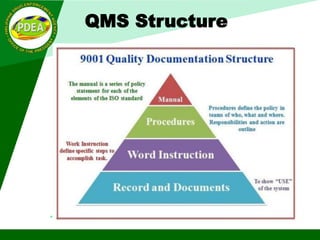
• There are many QMS documents.
• The QMS structure provides a hierarchy
or system of establishing and
controlling the QMS documents
• Usually consist of 3-4 levels – the higher
level the document is, the lesser
amount of documentation there are
QMS Structure
QMS Structure
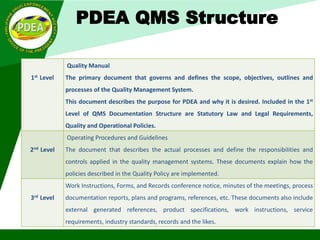
PDEA QMS Structure
1st Level
Quality Manual
The primary document that governs and defines the scope, objectives, outlines and
processes of the Quality Management System.
This document describes the purpose for PDEA and why it is desired. Included in the 1st
Level of QMS Documentation Structure are Statutory Law and Legal Requirements,
Quality and Operational Policies.
2nd Level
Operating Procedures and Guidelines
The document that describes the actual processes and define the responsibilities and
controls applied in the quality management systems. These documents explain how the
policies described in the Quality Policy are implemented.
3rd Level
Work Instructions, Forms, and Records conference notice, minutes of the meetings, process
documentation reports, plans and programs, references, etc. These documents also include
external generated references, product specifications, work instructions, service
requirements, industry standards, records and the likes.
Section 3
Documenting the QMS
1) Communicate information
2) Evidence conformity
3) Share knowledge
4) Disseminate and preserve lessons
learned.
QMS documentation refers to documented information
maintained and retained in a Quality Management System
(QMS).
Objectives of QMS Documentation
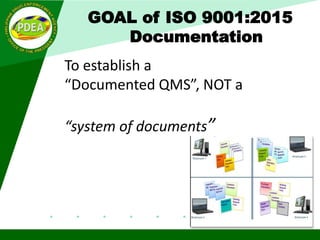
GOAL of ISO 9001:2015
Documentation
To establish a
“Documented QMS”, NOT a
“system of documents”
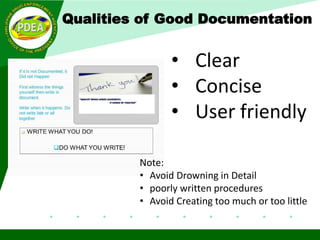
Qualities of Good Documentation
• Clear
• Concise
• User friendly
Note:
• Avoid Drowning in Detail
• poorly written procedures
• Avoid Creating too much or too little
The KISS Principle
• Keep It Short and Simple !
• Short words, sentences and paragraphs
• Avoid jargon that is not easily understood
• Use easy-to-understand, direct, frank, straight
words
• Simplify, where practicable! Take advantage of
using pictures, flow charts, pictograms, and
cartoons to clarify ideas, concepts, reminders,
and instructions!
Section 4
Controlling the QMS
Documented Information
Clause 7.5
Documented Information – information
required to be controlled, maintained and
retained by an organization and the medium
on which it is contained.
Note: Documented information generically represent
“document”, ”documented procedure” and “record” in the
2015 version of ISO 9001.
Documented Information
Documented Information – used to describe all
QMS document and record requirements
Documents – shall be “maintained” (procedures
“controlled” with versions)
Records – shall be “retained”; evidence of activity
Note: documents maybe retained if prior versions
are required to be kept/archived.
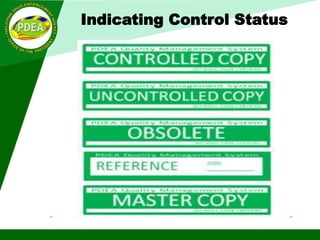
Indicating Control Status
a. distribution, access, retrieval and use;
b. Storage and preservation, including preservation
of eligibility;
c. Control of changes (version control); and
d. Retention and disposition
Documented Information
Creating and updating
• Identification and Description
• Format
• Review and approval for
suitability and adequacy
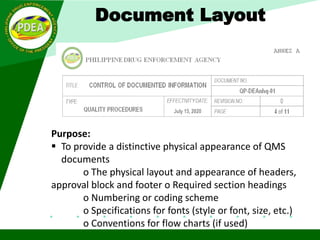
Document Layout
Purpose:
 To provide a distinctive physical appearance of QMS
documents
o The physical layout and appearance of headers,
approval block and footer o Required section headings
o Numbering or coding scheme
o Specifications for fonts (style or font, size, etc.)
o Conventions for flow charts (if used)
Approving and Organizing
QMS Documentation
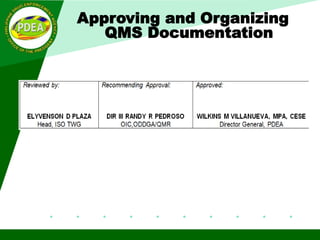
Establish:
Reviewing and approving authorities
Purpose of document review:
-confirmation of adequacy of document
Purpose of document approval:
-authorization for use or application
Approving and Organizing
QMS Documentation
Indicating Control Status
Changes to documents are requested
by completing ‘Document Request
Form (DRF).
Revised documents shall
accompany by an
accomplished revision history
form.
Document Control
Mechanism
• A documented system procedure •
Managed by a document controller
(Controller of Documented Information) •
Covers control of creation, revision, deletion
/ cancellation, and superseded (obsolete)
documents
One person is designated as the Document Control Coordinator.
This person – keeps the master list up-to-date – Makes
revisions to documents – Distributes revised documents –
Collects the outdated documents
Thank you!

Documentation ppt mal 2 [repaired]

  • 1.
  • 2.
    Introduction QMS Structure andStyle Documenting the QMS Controlling the QMS
  • 3.
    Learning Objectives a.Understand thedocumentation requirements of ISO 9001:2015; b.Know the structure of QMS documentation; c. Know the different types of QMS documents; d.Understand the requirements for controlling Documented Information of the QMS
  • 4.
  • 5.
    What is QualityManagement System? A formalized system that documents processes, procedures, and responsibilities for achieving quality policies and objectives.
  • 6.
    Principles of ISO9001:2015 - QMS
  • 7.
    Key Benefits ofISO 9001:2015 QMS Meeting the customer requirements;  Meeting organization requirements; More efficient ways of working will save time, money and resources; Defining, improving and controlling processes; Reducing waste Preventing mistakes Lowering cost Facilitating and identifying training opportunities Engaging staff Setting organization-wide direction Producing consistent results operational performance will cut errors and increase
  • 8.
    ISO 9001:2015 DocumentationRequirements The ISO 9001:2015 documents basic requirements for an organization to: Establish; Document; Implement; and maintain a quality management system and continually improve its effectiveness in accordance with the requirements of the International Standard.
  • 9.
    ISO 9001:2015 DocumentationRequirements There are specific ISO 9001:2015 documentation requirements that need to be fulfill which provides better control over implemented QMS system. Quality Manual Quality Policy Quality Objectives Quality Procedures Process Approach Standard Operating Procedures Sample Forms and Templates Work Instructions Quality Guidelines
  • 10.
    •Provides the designand specification of a quality management system by defining the QMS scope and applicability, operating policies, and related information about the QMS. Quality Manual  Varies in detail and format to suit the size and complexity of an organization
  • 11.
    Contents of theQuality Manual 0 - Preliminary Information  Approval  Users Guide  Table of Contents 1 - Introduction (e.g. About the organization) 2 - Overview of the QMS (Scope, Applicability, Business Process Map, Table of Organization 3 - Terms and Definitions (Terms and acronyms used in the QMS; List of applicable legal requirements) 4 to10 - Operating Policies Annexes (essential supporting information about the QMS)
  • 12.
    Quality Objectives • Resultto be achieved related to quality • Aim, goal, or target • Intended outcome • Specified for relevant functions, levels and processes
  • 13.
    Procedure: Describes theprocess. Work Instructions: Tells how to perform the process. Forms, Tables, etc.: Places to record the results of tests, audits, etc. Guidelines: Specifies general rules, instructions, recommendations, directions, regulation, rule, guiding principles, principles, or suggestions; sometimes contextually appearing as Do’s and Dont’s. Unlike procedure or work instruction, not structured as a process flow Procedures describe an overall process such as "Purchasing", where as work instructions would describe a more detailed portion of the procedure such as "Completing a PO" or "Ordering supplies".
  • 14.
  • 15.
    • QMS Scope Themajor activities and outputs around which the Quality Management System is established • Applicability An evaluation and declaration of the requirements that apply and does not apply to the QMS.
  • 16.
    • There aremany QMS documents. • The QMS structure provides a hierarchy or system of establishing and controlling the QMS documents • Usually consist of 3-4 levels – the higher level the document is, the lesser amount of documentation there are QMS Structure
  • 17.
  • 18.
    PDEA QMS Structure 1stLevel Quality Manual The primary document that governs and defines the scope, objectives, outlines and processes of the Quality Management System. This document describes the purpose for PDEA and why it is desired. Included in the 1st Level of QMS Documentation Structure are Statutory Law and Legal Requirements, Quality and Operational Policies. 2nd Level Operating Procedures and Guidelines The document that describes the actual processes and define the responsibilities and controls applied in the quality management systems. These documents explain how the policies described in the Quality Policy are implemented. 3rd Level Work Instructions, Forms, and Records conference notice, minutes of the meetings, process documentation reports, plans and programs, references, etc. These documents also include external generated references, product specifications, work instructions, service requirements, industry standards, records and the likes.
  • 19.
  • 20.
    1) Communicate information 2)Evidence conformity 3) Share knowledge 4) Disseminate and preserve lessons learned. QMS documentation refers to documented information maintained and retained in a Quality Management System (QMS). Objectives of QMS Documentation
  • 21.
    GOAL of ISO9001:2015 Documentation To establish a “Documented QMS”, NOT a “system of documents”
  • 22.
    Qualities of GoodDocumentation • Clear • Concise • User friendly Note: • Avoid Drowning in Detail • poorly written procedures • Avoid Creating too much or too little
  • 23.
    The KISS Principle •Keep It Short and Simple ! • Short words, sentences and paragraphs • Avoid jargon that is not easily understood • Use easy-to-understand, direct, frank, straight words • Simplify, where practicable! Take advantage of using pictures, flow charts, pictograms, and cartoons to clarify ideas, concepts, reminders, and instructions!
  • 24.
  • 25.
    Documented Information Clause 7.5 DocumentedInformation – information required to be controlled, maintained and retained by an organization and the medium on which it is contained. Note: Documented information generically represent “document”, ”documented procedure” and “record” in the 2015 version of ISO 9001.
  • 26.
    Documented Information Documented Information– used to describe all QMS document and record requirements Documents – shall be “maintained” (procedures “controlled” with versions) Records – shall be “retained”; evidence of activity Note: documents maybe retained if prior versions are required to be kept/archived.
  • 27.
    Indicating Control Status a.distribution, access, retrieval and use; b. Storage and preservation, including preservation of eligibility; c. Control of changes (version control); and d. Retention and disposition
  • 28.
    Documented Information Creating andupdating • Identification and Description • Format • Review and approval for suitability and adequacy
  • 29.
    Document Layout Purpose:  Toprovide a distinctive physical appearance of QMS documents o The physical layout and appearance of headers, approval block and footer o Required section headings o Numbering or coding scheme o Specifications for fonts (style or font, size, etc.) o Conventions for flow charts (if used)
  • 30.
    Approving and Organizing QMSDocumentation Establish: Reviewing and approving authorities Purpose of document review: -confirmation of adequacy of document Purpose of document approval: -authorization for use or application
  • 31.
  • 32.
  • 33.
    Indicating Control Status Changesto documents are requested by completing ‘Document Request Form (DRF). Revised documents shall accompany by an accomplished revision history form.
  • 34.
    Document Control Mechanism • Adocumented system procedure • Managed by a document controller (Controller of Documented Information) • Covers control of creation, revision, deletion / cancellation, and superseded (obsolete) documents One person is designated as the Document Control Coordinator. This person – keeps the master list up-to-date – Makes revisions to documents – Distributes revised documents – Collects the outdated documents
  • 35.

Editor's Notes

  • #6 A quality management system is a management technique used to communicate to employees what is required to produce the desired quality of products and services and to influence employee actions to complete tasks according to the quality specifications. ISO 9001:2015 specifies the requirements for a quality management system. Organizations use the ISO 9001:2015 standard to specify the ability to consistently provide products and services that meet customer and regulatory requirements. It is the most popular standard in the ISO 9000 and the only standard of the series to which organizations can be certified. A quality management system (QMS) is defined as a formalized system that documents processes, procedures, and responsibilities for achieving quality policies and objectives. A QMS helps coordinate and direct an organization’s activities to meet customer and regulatory requirements and improve its effectiveness and efficiency on a continuous basis. ISO 9001:2015, the international standard specifying requirements for quality management systems, is the most prominent approach to quality management systems. While some use the term "QMS" to describe the ISO 9001 standard or the group of documents detailing the QMS, it actually refers to the entirety of the system. The documents only serve to describe the system.
  • #7 1. Engagement of People Getting your team involved in the management system Openly discussing issues and sharing knowledge and experience with your team is critical to benefiting from ISO 9001 implementation. It is essential that everyone in the company understands their role and feels valued for their contribution to its success. This will not only help you achieve certification but will also demonstrate your organisation’s commitment to improving quality. 2. Customer focus Focus on your customer and their needs Developing a strong customer focus is an excellent way of demonstrating your commitment to quality. As well as satisfying customers, your business should consider the interests of other stakeholders, whether owners, employees, suppliers, investors or the wider community. 3. Leadership Develop a strong management team Strong leadership means you have a clear vision of your company’s future. Communicating this vision effectively will ensure your whole team works towards the same objectives. This shared sense of purpose can help increase employee motivation and productivity. 4. Process Approach Create a process culture The Plan Do Check Act (PDCA) principle of the ISO 9001 standard will help you promote a process driven culture across your organisation. This is a proven way of ensuring you plan, resource and manage your processes and their interactions effectively. By managing the different areas in your business together, as a unified and interlinked system, you will find that you encourage more effective processes, making it easier to achieve your objectives. Measuring and evaluating these interrelated processes will also help you to identify areas for improvement. 5. Improvement Embrace continual improvement Continual improvement is essential to the ISO 9001 Quality Management System and should be your organisation’s core objective. Following the standard’s mandatory procedures will enable you to react quickly and efficiently to opportunities, giving you a competitive advantage and leading to sustained success. 6. Evidence-based decision making Base your decisions on facts Accurate and reliable data is essential for making informed decisions. You should make such information available to all who need it in the organisation. This will improve communications, drive continual improvement and help you reach your business objectives. 7. Relationship management Develop mutually beneficial relationships with suppliers Your suppliers can be a source of competitive advantage but it requires a relationship built on trust. Creating such lasting relationships with suppliers and other interested parties means balancing short-term financial gains with long-term, mutually beneficial strategies.
  • #8 Meeting the customer’s requirements, which helps to instill confidence in the organization, in turn leading to more customers, more sales, and more repeat business Meeting the organization's requirements, which ensures compliance with regulations and provision of products and services in the most cost- and resource-efficient manner, creating room for expansion, growth, and profit These benefits offer additional advantages, including: Defining, improving, and controlling processes Reducing waste Preventing mistakes Lowering costs Facilitating and identifying training opportunities Engaging staff Setting organization-wide direction Communicating a readiness to produce consistent results
  • #9 The ISO 9001:2015 documents basic requirements for an organization to establish, document, implement, and maintain a quality management system and continually improve its effectiveness in accordance with the requirements of this International Standard. There are specific ISO 9001:2015 documentation requirements that need to be fulfill which provides better control over implemented QMS system. List of such requirements for better understanding quality system as per ISO 9001:2015 are as below: Quality Manual Quality Procedures Process Approach Standard Operating Procedures Exhibits Sample Forms and Templates ISO 9001:2015 Audit Checklist
  • #10 The ISO 9001:2015 documents basic requirements for an organization to establish, document, implement, and maintain a quality management system and continually improve its effectiveness in accordance with the requirements of this International Standard. There are specific ISO 9001:2015 documentation requirements that need to be fulfill which provides better control over implemented QMS system. List of such requirements for better understanding quality system as per ISO 9001:2015 are as below: Quality Manual Quality Procedures Process Approach Standard Operating Procedures Exhibits Sample Forms and Templates ISO 9001:2015 Audit Checklist
  • #14 A specified way to carry out an activity or a process ü Local (departmental) or global (system) in coverage ü Prepared by the process owner in consultation with interfaced functions; consider: • Who performs what action • What tasks in what sequence should be followed, when, how • What control criteria must be met
  • #16 The Scope of the QMS defines how the Quality Management system works within the company operations. It also confirms which elements are excluded and gives justifications for these decisions.  The scope will define what the QMS covers in any organisation and how it impacts each area.   As part of the old ISO 9001:2008 there was already requirement to determine the scope of the Quality Management System.  So now that the standard has been updated and there is additional information required.   More clarity is required from organisations to satisfy the new requirements.
  • #22 A document management system (DMS) is a system used to receive, track, manage and store documents and reduce paper. Most are capable of keeping a record of the various versions created and modified by different users (history tracking).
  • #23 Why use ten words when one will do? Make procedures user friendly Use short sentences starting with a verb. Avoid using the passive voice. Make it clear who is performing the task. Use white space for easy reading. Avoid Creating too much: Work instructions written for virtually everything Overlap and repetition - Including a process in more than one work instruction. Too little: Lack of work instructions where the process affects the quality of the product. Employees have their own way of performing processes There is variation in the process because it is not well documented