
















University Network Workshop
Oslo, 26 September 2019
IMPLEMENTING THE NEW COMPETENCE
DEVELOPMENT MODEL FOR SCHOOLS
OECD Directorate for Education and Skills
Policy Implementation Support
Beatriz PONT Claire SHEWBRIDGE
Pierre GOUËDARD Rien ROUW
THE OECD SUPPORT:
HOW TO IMPLEMENT
EDUCATION POLICIES?
3
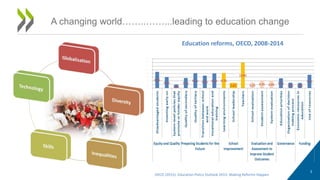
A changing world……..……...leading to education change
Education reforms, OECD, 2008-2014
OECD (2015): Education Policy Outlook 2015: Making Reforms Happen
Education policy implementation is a purposeful and multidirectional change
process aiming to put a specific policy into practice and which may affect a given
education system on several levels.
How to ensure policies reach schools, students and classrooms?
4
5
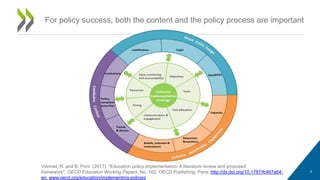
For policy success, both the content and the policy process are important
Viennet, R. and B. Pont (2017), "Education policy implementation: A literature review and proposed
framework", OECD Education Working Papers, No. 162, OECD Publishing, Paris. http://dx.doi.org/10.1787/fc467a64-
en; www.oecd.org/education/implementing-policies
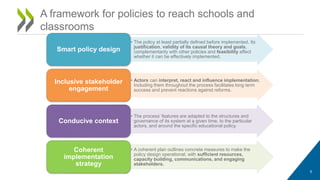
• The policy at least partially defined before implemented. Its
justification, validity of its causal theory and goals,
complementarity with other policies and feasibility affect
whether it can be effectively implemented.
Smart policy design
• Actors can interpret, react and influence implementation.
Including them throughout the process facilitates long term
success and prevent reactions against reforms.
Inclusive stakeholder
engagement
• The process’ features are adapted to the structures and
governance of its system at a given time, to the particular
actors, and around the specific educational policy.
Conducive context
• A coherent plan outlines concrete measures to make the
policy design operational, with sufficient resources,
capacity building, communications, and engaging
stakeholders.
Coherent
implementation
strategy
6
A framework for policies to reach schools and
classrooms
7
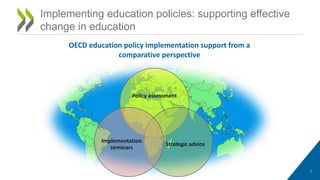
Implementing education policies: supporting effective
change in education
Policy assessment
Strategic advice
Implementation
seminars
OECD education policy implementation support from a
comparative perspective
8
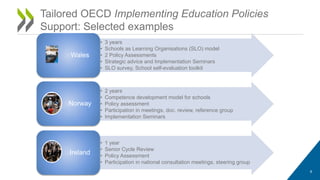
Tailored OECD Implementing Education Policies
Support: Selected examples
• 3 years
• Schools as Learning Organisations (SLO) model
• 2 Policy Assessments
• Strategic advice and Implementation Seminars
• SLO survey, School self-evaluation toolkit
Wales
• 2 years
• Competence development model for schools
• Policy assessment
• Participation in meetings, doc. review, reference group
• Implementation Seminars
Norway
• 1 year
• Senior Cycle Review
• Policy Assessment
• Participation in national consultation meetings, steering group
Ireland
DISCUSSING THE OECD FINDINGS:
IMPROVING SCHOOL QUALITY IN NORWAY
THE NEW COMPETENCE DEVELOPMENT MODEL
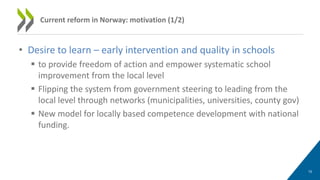
• Desire to learn – early intervention and quality in schools
 to provide freedom of action and empower systematic school
improvement from the local level
 Flipping the system from government steering to leading from the
local level through networks (municipalities, universities, county gov)
 New model for locally based competence development with national
funding.
10
Current reform in Norway: motivation (1/2)
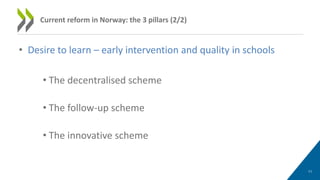
• Desire to learn – early intervention and quality in schools
• The decentralised scheme
• The follow-up scheme
• The innovative scheme
11
Current reform in Norway: the 3 pillars (2/2)
12
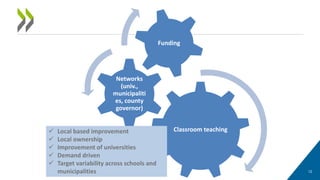
Classroom teaching
Networks
(univ.,
municipaliti
es, county
governor)
Funding
 Local based improvement
 Local ownership
 Improvement of universities
 Demand driven
 Target variability across schools and
municipalities
13
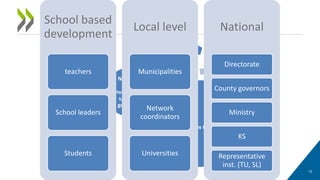
Classroom teaching
Networks
(univ.,
municipalitie
s, county
governor)
Funding
School based
development
teachers
School leaders
Students
Local level
Municipalities
Network
coordinators
Universities
National
Directorate
County governors
Ministry
KS
Representative
inst. (TU, SL)
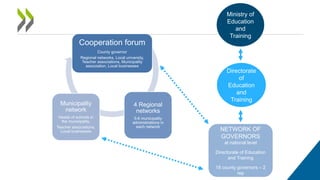
Cooperation forum
County governor
Regional networks, Local university,
Teacher associations, Municipality
association, Local businesses
4 Regional
networks
5-6 municipality
administrations in
each network
Municipality
network
Heads of schools in
the municipality,
Teacher associations,
Local businesses NETWORK OF
GOVERNORS
at national level
Directorate of Education
and Training
18 county governors – 2
rep
Directorate
of
Education
and
Training
Ministry of
Education
and
Training
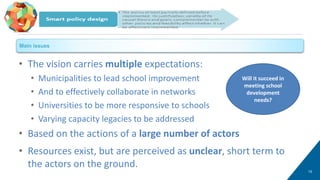
• The vision carries multiple expectations:
• Municipalities to lead school improvement
• And to effectively collaborate in networks
• Universities to be more responsive to schools
• Varying capacity legacies to be addressed
• Based on the actions of a large number of actors
• Resources exist, but are perceived as unclear, short term to
the actors on the ground.
15
Smart policy design (2/2)
Will it succeed in
meeting school
development
needs?
Main issues
• Hone the vision in operational terms and clarify the long term
availability of the resources to boost take up.
• Strategically prioritise the new model; define and clarify the
roles, and communicate at all levels to build momentum.
• Evaluate, assess, and monitor quality of the new model
16
Smart policy design (2/2)
Recommendations
• The vision carries multiple
expectations
• Based on the actions of a
large number of actors
• Resources exist, but are
perceived as unclear, short
term to the actors on the
ground.
17
Smart policy design (2/2)
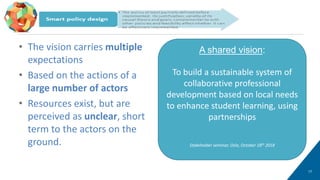
A shared vision:
To build a sustainable system of
collaborative professional
development based on local needs
to enhance student learning, using
partnerships
Stakeholder seminar, Oslo, October 18th 2018
Some interesting developments the OECD witnessed since the launch of the new
model:
• Objectives are defined at the local level, according to some core principles
established collaboratively:
– Professional development should be school based,
– Professional development delivery should be based on local needs analysis,
– Objectives imply partnership between schools and universities.
• The follow-up scheme keeps on being strengthened:
– Improve the identification of schools in need
– Develop the role of the CG,
– Extend from 2 to 3 years the programme 18
Smart policy design (2/2)
19
Classroom
practice
Ministries
Regional
bodies
Universitie
s
School
owners
School
leaders
Teachers
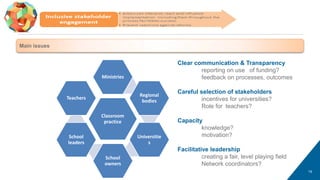
Clear communication & Transparency
reporting on use of funding?
feedback on processes, outcomes
Careful selection of stakeholders
incentives for universities?
Role for teachers?
Capacity
knowledge?
motivation?
Facilitative leadership
creating a fair, level playing field
Network coordinators?
Main issues
20
A highly decentralised decisional system, EAG 2012
• Clarify and discuss the expectations of roles and responsibilities to
reach a common understanding with stakeholders.
• Develop capacity for participation and collaborative decision-making.
• Enhance transparency about the available resources and their
deployment.
Recommendations
21
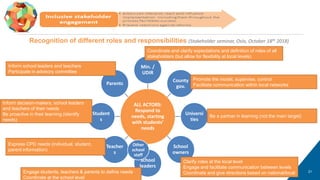
ALL ACTORS:
Respond to
needs, starting
with students’
needs
Min. /
UDIR
County
gov.
Universi
ties
School
owners
School
leaders
Teacher
s
Student
s
Parents
Recognition of different roles and responsibilities (Stakeholder seminar, Oslo, October 18th 2018)
Express CPD needs (individual, student,
parent information)
Engage students, teachers & parents to define needs
Coordinate at the school level
Clarify roles at the local level
Engage and facilitate communication between levels
Coordinate and give directions based on national/local
Be a partner in learning (not the main target)
Promote the model, supervise, control
Facilitate communication within local networks
Coordinate and clarify expectations and definition of roles of all
stakeholders (but allow for flexibility at local levels)
Inform school leaders and teachers
Participate in advisory committee
Inform decision-makers, school leaders
and teachers of their needs
Be proactive in their learning (identify
needs)
Other
school
staff
22
A highly decentralised decisional system, EAG 2012
Some interesting developments the OECD witnessed since the launch of the new
model:
• Some counties are actively engaging teachers, and inviting them at the decision
making tables:
– But there is regional variation in the participation of teachers
– Are all stakeholders well aware of the model?
– Who should lead decision-making?
• Universities see the value of forging partnerships with schools:
– How to ensure partnerships are flexible enough to follow the dynamic of schools needs?
– Do you feel the mindset is evolving from the “demand-delivery”-relationship between
municipalities and universities?
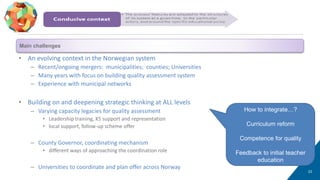
• An evolving context in the Norwegian system
– Recent/ongoing mergers: municipalities; counties; Universities
– Many years with focus on building quality assessment system
– Experience with municipal networks
• Building on and deepening strategic thinking at ALL levels
– Varying capacity legacies for quality assessment
• Leadership training, KS support and representation
• local support, follow-up scheme offer
– County Governor, coordinating mechanism
• different ways of approaching the coordination role
– Universities to coordinate and plan offer across Norway
23
Conducive context
How to integrate…?
Curriculum reform
Competence for quality
Feedback to initial teacher
education
Main challenges
• Foster conditions for a long-term perspective and strategic planning of
continuous professional development.
• Strengthen the whole-of-system approach in the county collaboration
forum.
• Increase responsiveness to schools with identified capacity needs.
24
Conducive context
Recommendations
25
Smart policy design (2/2)
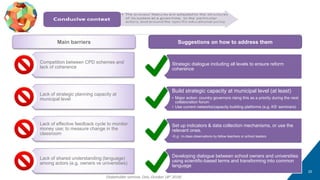
Strategic dialogue including all levels to ensure reform
coherence
Build strategic capacity at municipal level (at least)
• Major action: country governors rising this as a priority during the next
collaboration forum
• Use current networks/capacity building platforms (e.g. KS’ seminars)
Set up indicators & data collection mechanisms, or use the
relevant ones.
•E.g.: in-class observations by fellow teachers or school leaders
Developing dialogue between school owners and universities
using scientific-based terms and transforming into common
language
Suggestions on how to address them
Competition between CPD schemes and
lack of coherence
Lack of strategic planning capacity at
municipal level
Lack of effective feedback cycle to monitor
money use; to measure change in the
classroom
Lack of shared understanding (language)
among actors (e.g. owners vs universities)
Main barriers
(Stakeholder seminar, Oslo, October 18th 2018)
26
Smart policy design (2/2)
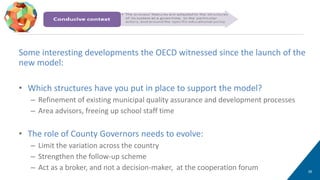
Some interesting developments the OECD witnessed since the launch of the
new model:
• Which structures have you put in place to support the model?
– Refinement of existing municipal quality assurance and development processes
– Area advisors, freeing up school staff time
• The role of County Governors needs to evolve:
– Limit the variation across the country
– Strengthen the follow-up scheme
– Act as a broker, and not a decision-maker, at the cooperation forum
TOWARDS AN EFFECTIVE
IMPLEMENTATION STRATEGY
28
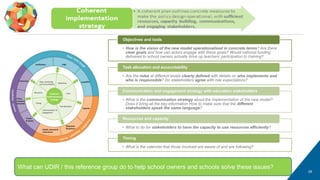
• How is the vision of the new model operationalised in concrete terms? Are there
clear goals and how can actors engage with these goals? Would national funding
delivered to school owners actually drive up teachers’ participation to training?
Objectives and tools
• Are the roles at different levels clearly defined with details on who implements and
who is responsible? Do stakeholders agree with role expectations?
Task allocation and accountability
• What is the communication strategy about the implementation of the new model?
Does it bring all the key information How to make sure that the different
stakeholders speak the same language?
Communication and engagement strategy with education stakeholders
• What to do for stakeholders to have the capacity to use resources efficiently?
Resources and capacity
• What is the calendar that those involved are aware of and are following?
Timing
What can UDIR / this reference group do to help school owners and schools solve these issues?
Objective:
Raise teacher quality
by empowering school
owners with
professional
development
Review and align policy tools
• Review individual incentives to maximise the take-up, and impact
of the new model.
• Improve transparency and accountability of schools owners for
the use of the money from the CDMS, or consider earmarked
grants as fund transfers to stakeholders.
• Consider making the follow-up scheme mandatory, and updating
the practices of the Advisory Team towards actions taking place in
the classroom.
• Clarify the position of the new model compared to other
professional development strategies and the new curriculum.
Gather data for monitoring and focus evaluation and assessment tools
• Translate objectives into indicators.
• Monitor teachers’ satisfaction with surveys.
• Review teacher appraisal so that it informs the needs for professional
development.
• Include the decentralised scheme in the school owners’ quality
improvement framework as part of the school evaluation.
• Ensure local data are fed back to the Directorate to pilot education
quality from the system level.
• Foster transparency at every level by publicly releasing information
on the funding and the processes (at this stage) of the model .
Clarify collaboratively roles and responsibilities
• Clarify collectively the responsibilities of the different
stakeholders
• Reflect on ways to safeguard the full participation of
municipalities with limited capacity.
• Rethink accountability mechanisms
Secure financial and human resources
• Ensure long term resources visibility.
• Consider a mechanism to lift the co-funding requirement for the
most deprived municipalities.
• Foster capacity development at every level, and in particular for
participation and decision-making in networks.
Objective
• Develop collaboratively a clear vision and associated operational
objectives with all the stakeholders, and different networks.
Communication
• Design a targeted communication strategy to the different
stakeholders that aligns to the agreed role expectations.
• Organise feedback loops to foster ownership of the model among
the different stakeholders.
• Include in the communication strategy information on
accountability relationships, on data and indicators to measure
progress and on the evaluation of the model.
What progresses have you seen?
Which challenges have you faced?
TAKK!
DESCRIPTION OF THE TASKS FOR TABLE
DISCUSSION
• Getting to know each other
– As a professional, how do you best learn?
32
Description of the tasks for table discussion
• Take a moment to nominate at each table:
– A moderator
– A note taker to fill in the padlet.
• Discussions can be held in Norwegian, but the padlet needs to be
filled in English.
• Remember to take 10 minutes at the end of each session for the
note taker to summarise in the padlet the 2-3 key points / take
away messages.
33
Description of the tasks for table discussion
SESSION 1:
WHAT DO WE MEAN BY
QUALITY?
• Improved learning experience for students
• Improved capacity of teachers
• Strengthened relationship between university and schools
• Improved capacity of teachers’ educators
35
What do we mean by quality?
Task: Discuss and agree on maximum 2 dimensions per table to write in the
padlet.
You will be interviewed by the newspaper. What would you
tell the journalist of what this model would improve?
36
What do we mean by quality?
LUNCH BREAK
SESSION 2
HOW DO WE KNOW WE ARE MOVING
FORWARD, AND IN THE RIGHT DIRECTION?
• What kind of indicators can help monitor the implementation and the
impact of the new model?
• Teachers’ needs being met;
• The number of joint R&D projects between universities and schools;
• Changes in teachers’ and teacher trainers’ practices, beliefs, attitudes (such as the shift
from individual to collective orientation).
• Is there an existing evaluation framework to integrate such indicators?
• How communication should use these indicators for transparency purpose?
39
How do we know we are moving forward, and in the right direction?
Task: Discuss and agree on 2 indicators and how to measure them.
A new government arrives and cuts funding, what would
you do to demonstrate the utility of the new model and the
importance to maintain it?
40
How do we know we are moving forward, and in the right direction?
COFFEE BREAK
PLENARY DISCUSSION
WRAP-UP SESSION
44
Wrap-up session
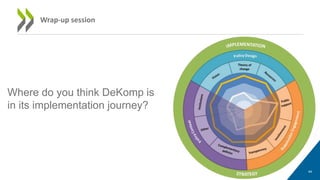
Where do you think DeKomp is
in its implementation journey?
TAKK!
46
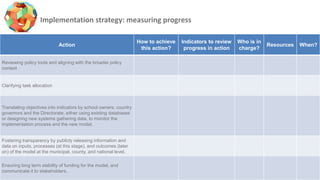
Implementation strategy: measuring progress
Action
How to achieve
this action?
Indicators to review
progress in action
Who is in
charge?
Resources When?
Reviewing policy tools and aligning with the broader policy
context
Clarifying task allocation
Translating objectives into indicators by school owners, country
governors and the Directorate, either using existing databases
or designing new systems gathering data, to monitor the
implementation process and the new model.
Fostering transparency by publicly releasing information and
data on inputs, processes (at this stage), and outcomes (later
on) of the model at the municipal, county, and national level.
Ensuring long term stability of funding for the model, and
communicate it to stakeholders.

Implementing the new competence development model for schools: University Network Workshop

  • 1.
    University Network Workshop Oslo,26 September 2019 IMPLEMENTING THE NEW COMPETENCE DEVELOPMENT MODEL FOR SCHOOLS OECD Directorate for Education and Skills Policy Implementation Support Beatriz PONT Claire SHEWBRIDGE Pierre GOUËDARD Rien ROUW
  • 2.
    THE OECD SUPPORT: HOWTO IMPLEMENT EDUCATION POLICIES?
  • 3.
    3 A changing world……..……...leadingto education change Education reforms, OECD, 2008-2014 OECD (2015): Education Policy Outlook 2015: Making Reforms Happen
  • 4.
    Education policy implementationis a purposeful and multidirectional change process aiming to put a specific policy into practice and which may affect a given education system on several levels. How to ensure policies reach schools, students and classrooms? 4
  • 5.
    5 For policy success,both the content and the policy process are important Viennet, R. and B. Pont (2017), "Education policy implementation: A literature review and proposed framework", OECD Education Working Papers, No. 162, OECD Publishing, Paris. http://dx.doi.org/10.1787/fc467a64- en; www.oecd.org/education/implementing-policies
  • 6.
    • The policyat least partially defined before implemented. Its justification, validity of its causal theory and goals, complementarity with other policies and feasibility affect whether it can be effectively implemented. Smart policy design • Actors can interpret, react and influence implementation. Including them throughout the process facilitates long term success and prevent reactions against reforms. Inclusive stakeholder engagement • The process’ features are adapted to the structures and governance of its system at a given time, to the particular actors, and around the specific educational policy. Conducive context • A coherent plan outlines concrete measures to make the policy design operational, with sufficient resources, capacity building, communications, and engaging stakeholders. Coherent implementation strategy 6 A framework for policies to reach schools and classrooms
  • 7.
    7 Implementing education policies:supporting effective change in education Policy assessment Strategic advice Implementation seminars OECD education policy implementation support from a comparative perspective
  • 8.
    8 Tailored OECD ImplementingEducation Policies Support: Selected examples • 3 years • Schools as Learning Organisations (SLO) model • 2 Policy Assessments • Strategic advice and Implementation Seminars • SLO survey, School self-evaluation toolkit Wales • 2 years • Competence development model for schools • Policy assessment • Participation in meetings, doc. review, reference group • Implementation Seminars Norway • 1 year • Senior Cycle Review • Policy Assessment • Participation in national consultation meetings, steering group Ireland
  • 9.
    DISCUSSING THE OECDFINDINGS: IMPROVING SCHOOL QUALITY IN NORWAY THE NEW COMPETENCE DEVELOPMENT MODEL
  • 10.
    • Desire tolearn – early intervention and quality in schools  to provide freedom of action and empower systematic school improvement from the local level  Flipping the system from government steering to leading from the local level through networks (municipalities, universities, county gov)  New model for locally based competence development with national funding. 10 Current reform in Norway: motivation (1/2)
  • 11.
    • Desire tolearn – early intervention and quality in schools • The decentralised scheme • The follow-up scheme • The innovative scheme 11 Current reform in Norway: the 3 pillars (2/2)
  • 12.
    12 Classroom teaching Networks (univ., municipaliti es, county governor) Funding Local based improvement  Local ownership  Improvement of universities  Demand driven  Target variability across schools and municipalities
  • 13.
    13 Classroom teaching Networks (univ., municipalitie s, county governor) Funding Schoolbased development teachers School leaders Students Local level Municipalities Network coordinators Universities National Directorate County governors Ministry KS Representative inst. (TU, SL)
  • 14.
    Cooperation forum County governor Regionalnetworks, Local university, Teacher associations, Municipality association, Local businesses 4 Regional networks 5-6 municipality administrations in each network Municipality network Heads of schools in the municipality, Teacher associations, Local businesses NETWORK OF GOVERNORS at national level Directorate of Education and Training 18 county governors – 2 rep Directorate of Education and Training Ministry of Education and Training
  • 15.
    • The visioncarries multiple expectations: • Municipalities to lead school improvement • And to effectively collaborate in networks • Universities to be more responsive to schools • Varying capacity legacies to be addressed • Based on the actions of a large number of actors • Resources exist, but are perceived as unclear, short term to the actors on the ground. 15 Smart policy design (2/2) Will it succeed in meeting school development needs? Main issues
  • 16.
    • Hone thevision in operational terms and clarify the long term availability of the resources to boost take up. • Strategically prioritise the new model; define and clarify the roles, and communicate at all levels to build momentum. • Evaluate, assess, and monitor quality of the new model 16 Smart policy design (2/2) Recommendations
  • 17.
    • The visioncarries multiple expectations • Based on the actions of a large number of actors • Resources exist, but are perceived as unclear, short term to the actors on the ground. 17 Smart policy design (2/2) A shared vision: To build a sustainable system of collaborative professional development based on local needs to enhance student learning, using partnerships Stakeholder seminar, Oslo, October 18th 2018
  • 18.
    Some interesting developmentsthe OECD witnessed since the launch of the new model: • Objectives are defined at the local level, according to some core principles established collaboratively: – Professional development should be school based, – Professional development delivery should be based on local needs analysis, – Objectives imply partnership between schools and universities. • The follow-up scheme keeps on being strengthened: – Improve the identification of schools in need – Develop the role of the CG, – Extend from 2 to 3 years the programme 18 Smart policy design (2/2)
  • 19.
    19 Classroom practice Ministries Regional bodies Universitie s School owners School leaders Teachers Clear communication &Transparency reporting on use of funding? feedback on processes, outcomes Careful selection of stakeholders incentives for universities? Role for teachers? Capacity knowledge? motivation? Facilitative leadership creating a fair, level playing field Network coordinators? Main issues
  • 20.
    20 A highly decentraliseddecisional system, EAG 2012 • Clarify and discuss the expectations of roles and responsibilities to reach a common understanding with stakeholders. • Develop capacity for participation and collaborative decision-making. • Enhance transparency about the available resources and their deployment. Recommendations
  • 21.
    21 ALL ACTORS: Respond to needs,starting with students’ needs Min. / UDIR County gov. Universi ties School owners School leaders Teacher s Student s Parents Recognition of different roles and responsibilities (Stakeholder seminar, Oslo, October 18th 2018) Express CPD needs (individual, student, parent information) Engage students, teachers & parents to define needs Coordinate at the school level Clarify roles at the local level Engage and facilitate communication between levels Coordinate and give directions based on national/local Be a partner in learning (not the main target) Promote the model, supervise, control Facilitate communication within local networks Coordinate and clarify expectations and definition of roles of all stakeholders (but allow for flexibility at local levels) Inform school leaders and teachers Participate in advisory committee Inform decision-makers, school leaders and teachers of their needs Be proactive in their learning (identify needs) Other school staff
  • 22.
    22 A highly decentraliseddecisional system, EAG 2012 Some interesting developments the OECD witnessed since the launch of the new model: • Some counties are actively engaging teachers, and inviting them at the decision making tables: – But there is regional variation in the participation of teachers – Are all stakeholders well aware of the model? – Who should lead decision-making? • Universities see the value of forging partnerships with schools: – How to ensure partnerships are flexible enough to follow the dynamic of schools needs? – Do you feel the mindset is evolving from the “demand-delivery”-relationship between municipalities and universities?
  • 23.
    • An evolvingcontext in the Norwegian system – Recent/ongoing mergers: municipalities; counties; Universities – Many years with focus on building quality assessment system – Experience with municipal networks • Building on and deepening strategic thinking at ALL levels – Varying capacity legacies for quality assessment • Leadership training, KS support and representation • local support, follow-up scheme offer – County Governor, coordinating mechanism • different ways of approaching the coordination role – Universities to coordinate and plan offer across Norway 23 Conducive context How to integrate…? Curriculum reform Competence for quality Feedback to initial teacher education Main challenges
  • 24.
    • Foster conditionsfor a long-term perspective and strategic planning of continuous professional development. • Strengthen the whole-of-system approach in the county collaboration forum. • Increase responsiveness to schools with identified capacity needs. 24 Conducive context Recommendations
  • 25.
    25 Smart policy design(2/2) Strategic dialogue including all levels to ensure reform coherence Build strategic capacity at municipal level (at least) • Major action: country governors rising this as a priority during the next collaboration forum • Use current networks/capacity building platforms (e.g. KS’ seminars) Set up indicators & data collection mechanisms, or use the relevant ones. •E.g.: in-class observations by fellow teachers or school leaders Developing dialogue between school owners and universities using scientific-based terms and transforming into common language Suggestions on how to address them Competition between CPD schemes and lack of coherence Lack of strategic planning capacity at municipal level Lack of effective feedback cycle to monitor money use; to measure change in the classroom Lack of shared understanding (language) among actors (e.g. owners vs universities) Main barriers (Stakeholder seminar, Oslo, October 18th 2018)
  • 26.
    26 Smart policy design(2/2) Some interesting developments the OECD witnessed since the launch of the new model: • Which structures have you put in place to support the model? – Refinement of existing municipal quality assurance and development processes – Area advisors, freeing up school staff time • The role of County Governors needs to evolve: – Limit the variation across the country – Strengthen the follow-up scheme – Act as a broker, and not a decision-maker, at the cooperation forum
  • 27.
  • 28.
    28 • How isthe vision of the new model operationalised in concrete terms? Are there clear goals and how can actors engage with these goals? Would national funding delivered to school owners actually drive up teachers’ participation to training? Objectives and tools • Are the roles at different levels clearly defined with details on who implements and who is responsible? Do stakeholders agree with role expectations? Task allocation and accountability • What is the communication strategy about the implementation of the new model? Does it bring all the key information How to make sure that the different stakeholders speak the same language? Communication and engagement strategy with education stakeholders • What to do for stakeholders to have the capacity to use resources efficiently? Resources and capacity • What is the calendar that those involved are aware of and are following? Timing What can UDIR / this reference group do to help school owners and schools solve these issues?
  • 29.
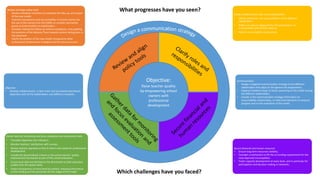
    Objective: Raise teacher quality byempowering school owners with professional development Review and align policy tools • Review individual incentives to maximise the take-up, and impact of the new model. • Improve transparency and accountability of schools owners for the use of the money from the CDMS, or consider earmarked grants as fund transfers to stakeholders. • Consider making the follow-up scheme mandatory, and updating the practices of the Advisory Team towards actions taking place in the classroom. • Clarify the position of the new model compared to other professional development strategies and the new curriculum. Gather data for monitoring and focus evaluation and assessment tools • Translate objectives into indicators. • Monitor teachers’ satisfaction with surveys. • Review teacher appraisal so that it informs the needs for professional development. • Include the decentralised scheme in the school owners’ quality improvement framework as part of the school evaluation. • Ensure local data are fed back to the Directorate to pilot education quality from the system level. • Foster transparency at every level by publicly releasing information on the funding and the processes (at this stage) of the model . Clarify collaboratively roles and responsibilities • Clarify collectively the responsibilities of the different stakeholders • Reflect on ways to safeguard the full participation of municipalities with limited capacity. • Rethink accountability mechanisms Secure financial and human resources • Ensure long term resources visibility. • Consider a mechanism to lift the co-funding requirement for the most deprived municipalities. • Foster capacity development at every level, and in particular for participation and decision-making in networks. Objective • Develop collaboratively a clear vision and associated operational objectives with all the stakeholders, and different networks. Communication • Design a targeted communication strategy to the different stakeholders that aligns to the agreed role expectations. • Organise feedback loops to foster ownership of the model among the different stakeholders. • Include in the communication strategy information on accountability relationships, on data and indicators to measure progress and on the evaluation of the model. What progresses have you seen? Which challenges have you faced?
  • 30.
  • 31.
    DESCRIPTION OF THETASKS FOR TABLE DISCUSSION
  • 32.
    • Getting toknow each other – As a professional, how do you best learn? 32 Description of the tasks for table discussion
  • 33.
    • Take amoment to nominate at each table: – A moderator – A note taker to fill in the padlet. • Discussions can be held in Norwegian, but the padlet needs to be filled in English. • Remember to take 10 minutes at the end of each session for the note taker to summarise in the padlet the 2-3 key points / take away messages. 33 Description of the tasks for table discussion
  • 34.
    SESSION 1: WHAT DOWE MEAN BY QUALITY?
  • 35.
    • Improved learningexperience for students • Improved capacity of teachers • Strengthened relationship between university and schools • Improved capacity of teachers’ educators 35 What do we mean by quality? Task: Discuss and agree on maximum 2 dimensions per table to write in the padlet.
  • 36.
    You will beinterviewed by the newspaper. What would you tell the journalist of what this model would improve? 36 What do we mean by quality?
  • 37.
  • 38.
    SESSION 2 HOW DOWE KNOW WE ARE MOVING FORWARD, AND IN THE RIGHT DIRECTION?
  • 39.
    • What kindof indicators can help monitor the implementation and the impact of the new model? • Teachers’ needs being met; • The number of joint R&D projects between universities and schools; • Changes in teachers’ and teacher trainers’ practices, beliefs, attitudes (such as the shift from individual to collective orientation). • Is there an existing evaluation framework to integrate such indicators? • How communication should use these indicators for transparency purpose? 39 How do we know we are moving forward, and in the right direction? Task: Discuss and agree on 2 indicators and how to measure them.
  • 40.
    A new governmentarrives and cuts funding, what would you do to demonstrate the utility of the new model and the importance to maintain it? 40 How do we know we are moving forward, and in the right direction?
  • 41.
  • 42.
  • 43.
  • 44.
    44 Wrap-up session Where doyou think DeKomp is in its implementation journey?
  • 45.
  • 46.
    46 Implementation strategy: measuringprogress Action How to achieve this action? Indicators to review progress in action Who is in charge? Resources When? Reviewing policy tools and aligning with the broader policy context Clarifying task allocation Translating objectives into indicators by school owners, country governors and the Directorate, either using existing databases or designing new systems gathering data, to monitor the implementation process and the new model. Fostering transparency by publicly releasing information and data on inputs, processes (at this stage), and outcomes (later on) of the model at the municipal, county, and national level. Ensuring long term stability of funding for the model, and communicate it to stakeholders.

Editor's Notes

  • #4 Our populations are evolving: migration is a reality not only across European Union, but across the world, influencing schooling but also influencing our societies. Families are also changing: more monoparental, more women in the workforce: and more elderly in our populations. An increased demand for effectiveness, equity and quality in education to meet economic and social challenges. Equity/Quality: Skills are increasing in some countries more than others, but there are still many countries where there is not enough equity with quality. Looking for school improvement.
  • #36 Enhanced collaboration between different actors Transparency about resources and actions undertook by different actors Growing trust between different actors Tailored professional development for teachers Capacity of Universities to meet local needs Flexibility of the partnerships to quickly adapt to a changing environment Ability of CGs to spot and offer support to the weakest schools All schools participate in the decentralised scheme
  • #40 Improvement of teacher training; The number of joint R&D projects between universities and schools; New knowledge being developed; Changes in teachers’ and teacher trainers’ practices, beliefs, attitudes (such as the shift from individual to collective orientation); Increased collaboration in schools and between schools; Use of theory and research in teaching; Increased understanding; Teachers’ needs being met; Student results.