Problem-Based Learning (PBL) Scenario: Amazing Coffee
Houses (ACHs)
Company Biography
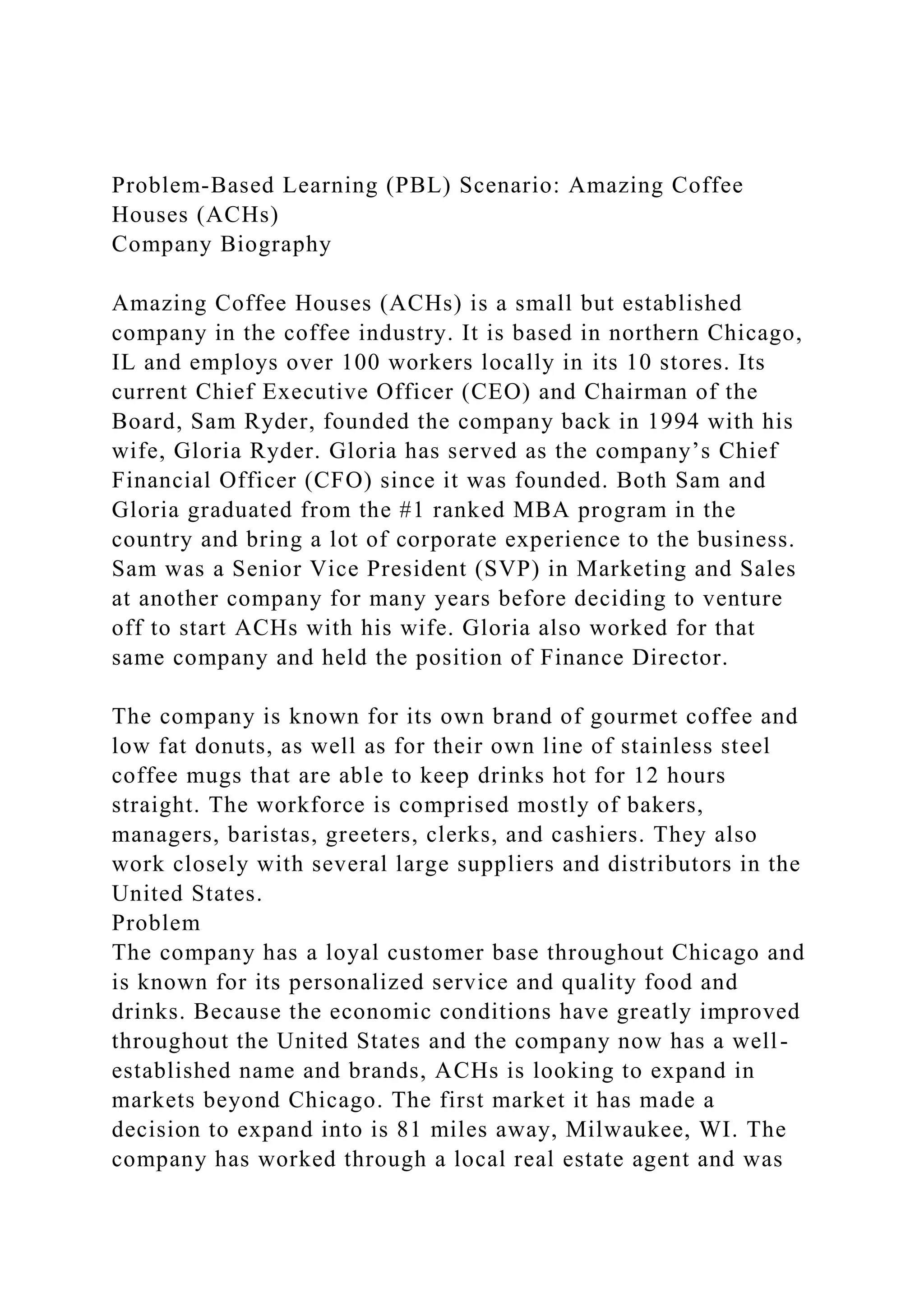
Amazing Coffee Houses (ACHs) is a small but established
company in the coffee industry. It is based in northern Chicago,
IL and employs over 100 workers locally in its 10 stores. Its
current Chief Executive Officer (CEO) and Chairman of the
Board, Sam Ryder, founded the company back in 1994 with his
wife, Gloria Ryder. Gloria has served as the company’s Chief
Financial Officer (CFO) since it was founded. Both Sam and
Gloria graduated from the #1 ranked MBA program in the
country and bring a lot of corporate experience to the business.
Sam was a Senior Vice President (SVP) in Marketing and Sales
at another company for many years before deciding to venture
off to start ACHs with his wife. Gloria also worked for that
same company and held the position of Finance Director.
The company is known for its own brand of gourmet coffee and
low fat donuts, as well as for their own line of stainless steel
coffee mugs that are able to keep drinks hot for 12 hours
straight. The workforce is comprised mostly of bakers,
managers, baristas, greeters, clerks, and cashiers. They also
work closely with several large suppliers and distributors in the
United States.
Problem
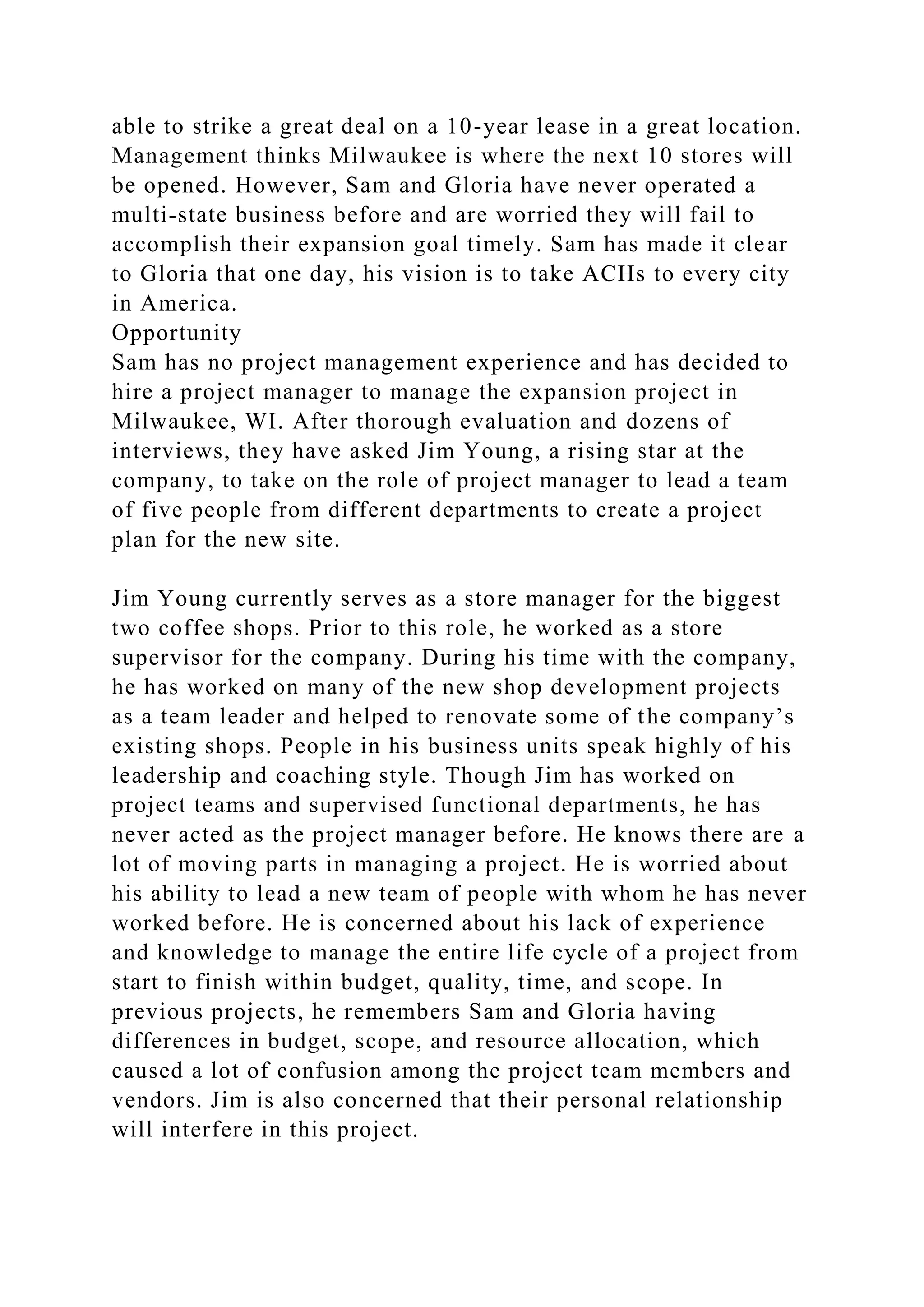
The company has a loyal customer base throughout Chicago and
is known for its personalized service and quality food and
drinks. Because the economic conditions have greatly improved
throughout the United States and the company now has a well-
established name and brands, ACHs is looking to expand in
markets beyond Chicago. The first market it has made a
decision to expand into is 81 miles away, Milwaukee, WI. The
company has worked through a local real estate agent and was
able to strike a great deal on a 10-year lease in a great location.
Management thinks Milwaukee is where the next 10 stores will
be opened. However, Sam and Gloria have never operated a
multi-state business before and are worried they will fail to
accomplish their expansion goal timely. Sam has made it clear
to Gloria that one day, his vision is to take ACHs to every city
in America.
Opportunity
Sam has no project management experience and has decided to
hire a project manager to manage the expansion project in
Milwaukee, WI. After thorough evaluation and dozens of
interviews, they have asked Jim Young, a rising star at the
company, to take on the role of project manager to lead a team
of five people from different departments to create a project
plan for the new site.
Jim Young currently serves as a store manager for the biggest
two coffee shops. Prior to this role, he worked as a store
supervisor for the company. During his time with the company,
he has worked on many of the new shop development projects
as a team leader and helped to renovate some of the company’s
existing shops. People in his business units speak highly of his
leadership and coaching style. Though Jim has worked on
project teams and supervised functional departments, he has
never acted as the project manager before. He knows there are a
lot of moving parts in managing a project. He is worried about
his ability to lead a new team of people with whom he has never
worked before. He is concerned about his lack of experience
and knowledge to manage the entire life cycle of a project from
start to finish within budget, quality, time, and scope. In
previous projects, he remembers Sam and Gloria having
differences in budget, scope, and resource allocation, which
caused a lot of confusion among the project team members and
vendors. Jim is also concerned that their personal relationship
will interfere in this project.
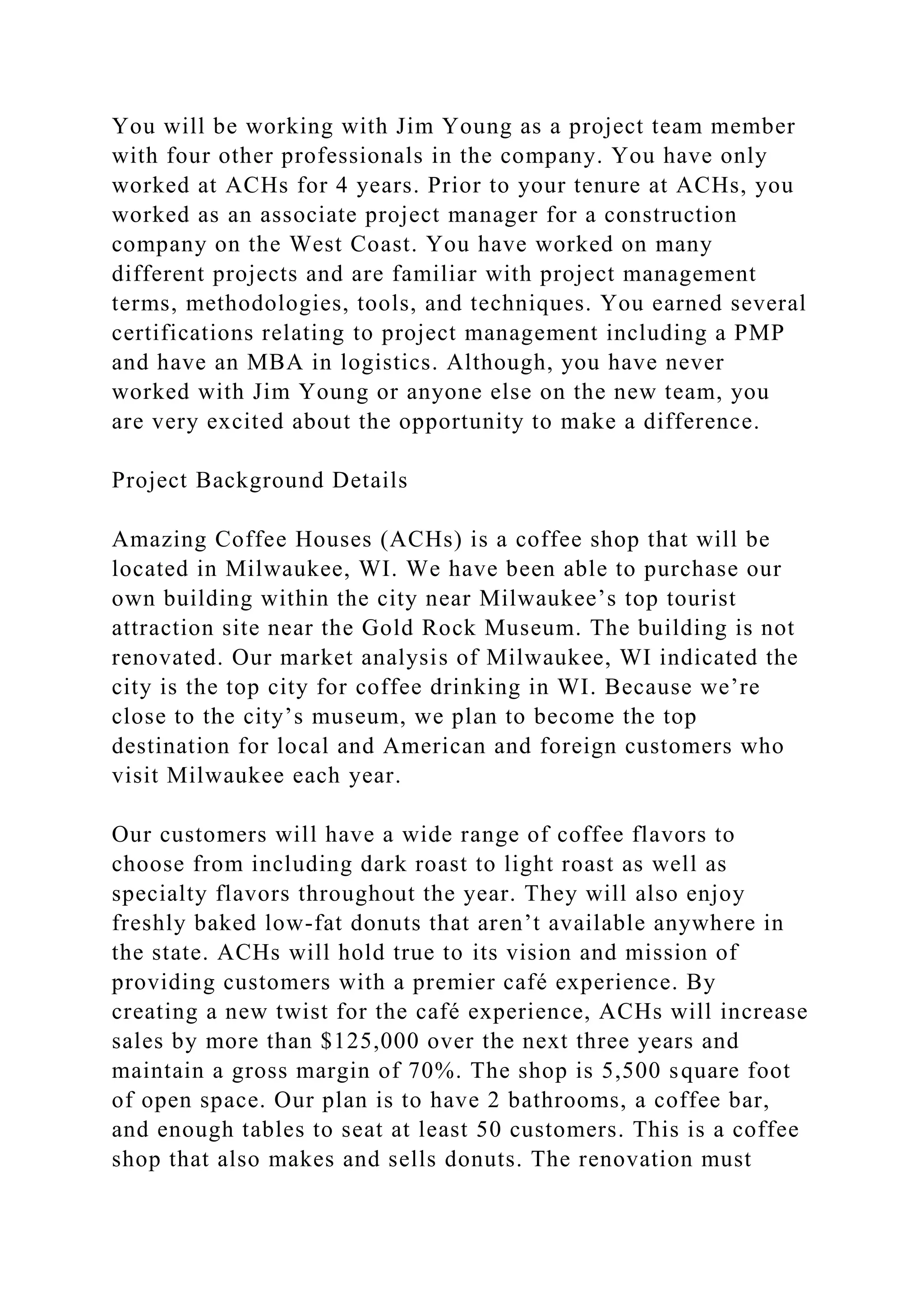
You will be working with Jim Young as a project team member
with four other professionals in the company. You have only
worked at ACHs for 4 years. Prior to your tenure at ACHs, you
worked as an associate project manager for a construction
company on the West Coast. You have worked on many
different projects and are familiar with project management
terms, methodologies, tools, and techniques. You earned several
certifications relating to project management including a PMP
and have an MBA in logistics. Although, you have never
worked with Jim Young or anyone else on the new team, you
are very excited about the opportunity to make a difference.
Project Background Details
Amazing Coffee Houses (ACHs) is a coffee shop that will be
located in Milwaukee, WI. We have been able to purchase our
own building within the city near Milwaukee’s top tourist
attraction site near the Gold Rock Museum. The building is not
renovated. Our market analysis of Milwaukee, WI indicated the
city is the top city for coffee drinking in WI. Because we’re
close to the city’s museum, we plan to become the top
destination for local and American and foreign customers who
visit Milwaukee each year.
Our customers will have a wide range of coffee flavors to
choose from including dark roast to light roast as well as
specialty flavors throughout the year. They will also enjoy
freshly baked low-fat donuts that aren’t available anywhere in
the state. ACHs will hold true to its vision and mission of
providing customers with a premier café experience. By
creating a new twist for the café experience, ACHs will increase
sales by more than $125,000 over the next three years and
maintain a gross margin of 70%. The shop is 5,500 square foot
of open space. Our plan is to have 2 bathrooms, a coffee bar,
and enough tables to seat at least 50 customers. This is a coffee
shop that also makes and sells donuts. The renovation must
account for all that is needed to get the shop ready for both
coffee and donuts. The project has an initial budget of
$650,000. It is now January and Sam and Gloria would like the
new location to be up and running no later on July 4th.
Note: The example companies, organizations, products, people,
and events depicted herein are fictitious. No association with
any real company, organization, product, person, or event is
intended or should be inferred.
Running Head: SCHEDULE BASELINE 1
SCHEDULE BASELINE 2
SCHEDULE BASELINE
Name
Date
SCHEDULE BASELINE AND WORK BREAKDOWN
STRUCTURE
The WBS for the new coffee shop in Milwaukee is made of the
work packages that were initiated through close interaction
among the project team stakeholders and members with reliable
input from the mangers as well as the research carried out in the
previous projects. The WBS defines the work packages relating
to the Amazing Coffee Houses Company (Zareei, 2018). The
definition comprises resources, tasks, and deliverables. Each
work package in this WBS is explained in the WBS dictionary
that will assist in task completion, resource planning, as well as
monitoring that the deliverables achieve the project needs.
The Amazing Coffee House Company Project schedule was
generated from the project Charter with diverse inputs from the
project group members. The project schedule was reviewed,
completed by the sponsors of the project, as well as base-lined
and approved. For any composed changes that happened on the
schedule will then follow the TSIs transformation management
procedure. In case it is constructed, boundary controls might be
exceeded, a transformation requirement will be taken to the
manager of the project (Zareei, 2018). The manager of the
project, along with the team, will identify the impacts of the
transformation on the project schedule, risks, scope, costs, and
resources. If the effects exceed the set boundary conditions,
then the transformation will be taken to the project sponsor to
review and do the approval. The conditions are
CPI less than 0.9 or greater than 1.2
SPI less than 0.9 or greater than 1.2
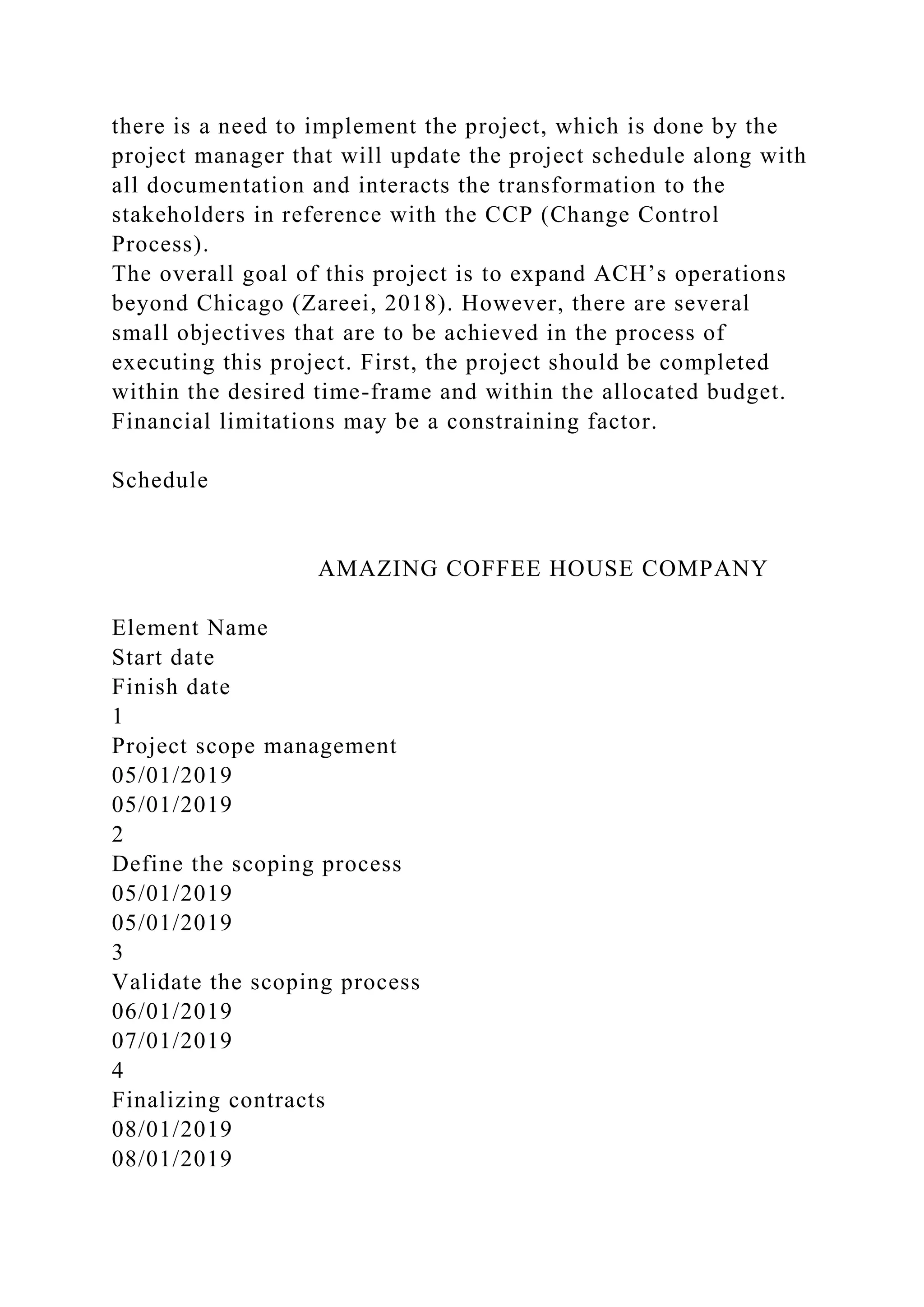
In case the change is accepted by the project sponsor, then
there is a need to implement the project, which is done by the
project manager that will update the project schedule along with
all documentation and interacts the transformation to the
stakeholders in reference with the CCP (Change Control
Process).
The overall goal of this project is to expand ACH’s operations
beyond Chicago (Zareei, 2018). However, there are several
small objectives that are to be achieved in the process of
executing this project. First, the project should be completed
within the desired time-frame and within the allocated budget.
Financial limitations may be a constraining factor.
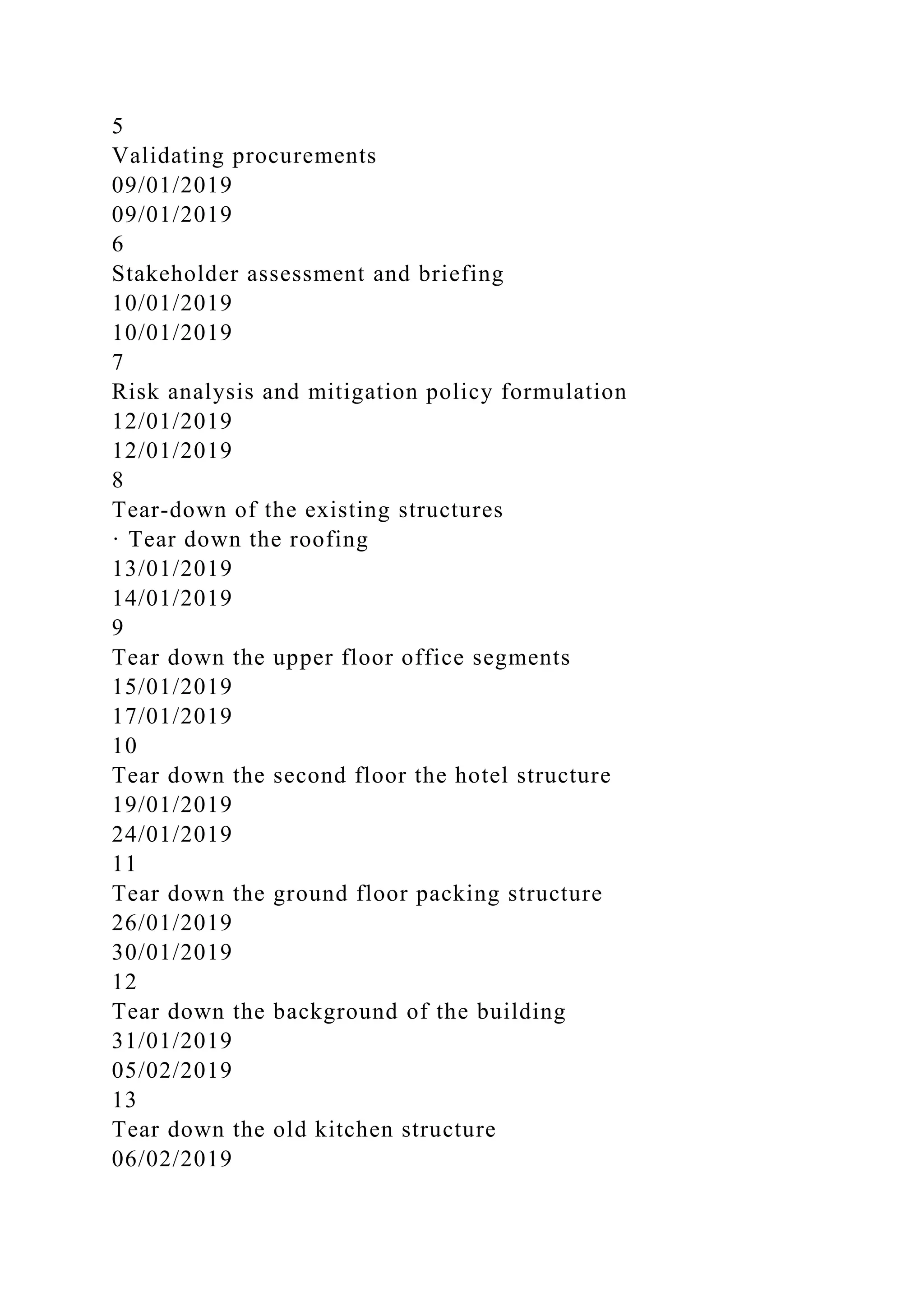
Schedule
AMAZING COFFEE HOUSE COMPANY
Element Name
Start date
Finish date
1
Project scope management
05/01/2019
05/01/2019
2
Define the scoping process
05/01/2019
05/01/2019
3
Validate the scoping process
06/01/2019
07/01/2019
4
Finalizing contracts
08/01/2019
08/01/2019
5
Validating procurements
09/01/2019
09/01/2019
6
Stakeholder assessment and briefing
10/01/2019
10/01/2019
7
Risk analysis and mitigation policy formulation
12/01/2019
12/01/2019
8
Tear-down of the existing structures
· Tear down the roofing
13/01/2019
14/01/2019
9
Tear down the upper floor office segments
15/01/2019
17/01/2019
10
Tear down the second floor the hotel structure
19/01/2019
24/01/2019
11
Tear down the ground floor packing structure
26/01/2019
30/01/2019
12
Tear down the background of the building
31/01/2019
05/02/2019
13
Tear down the old kitchen structure
06/02/2019
15/02/2019
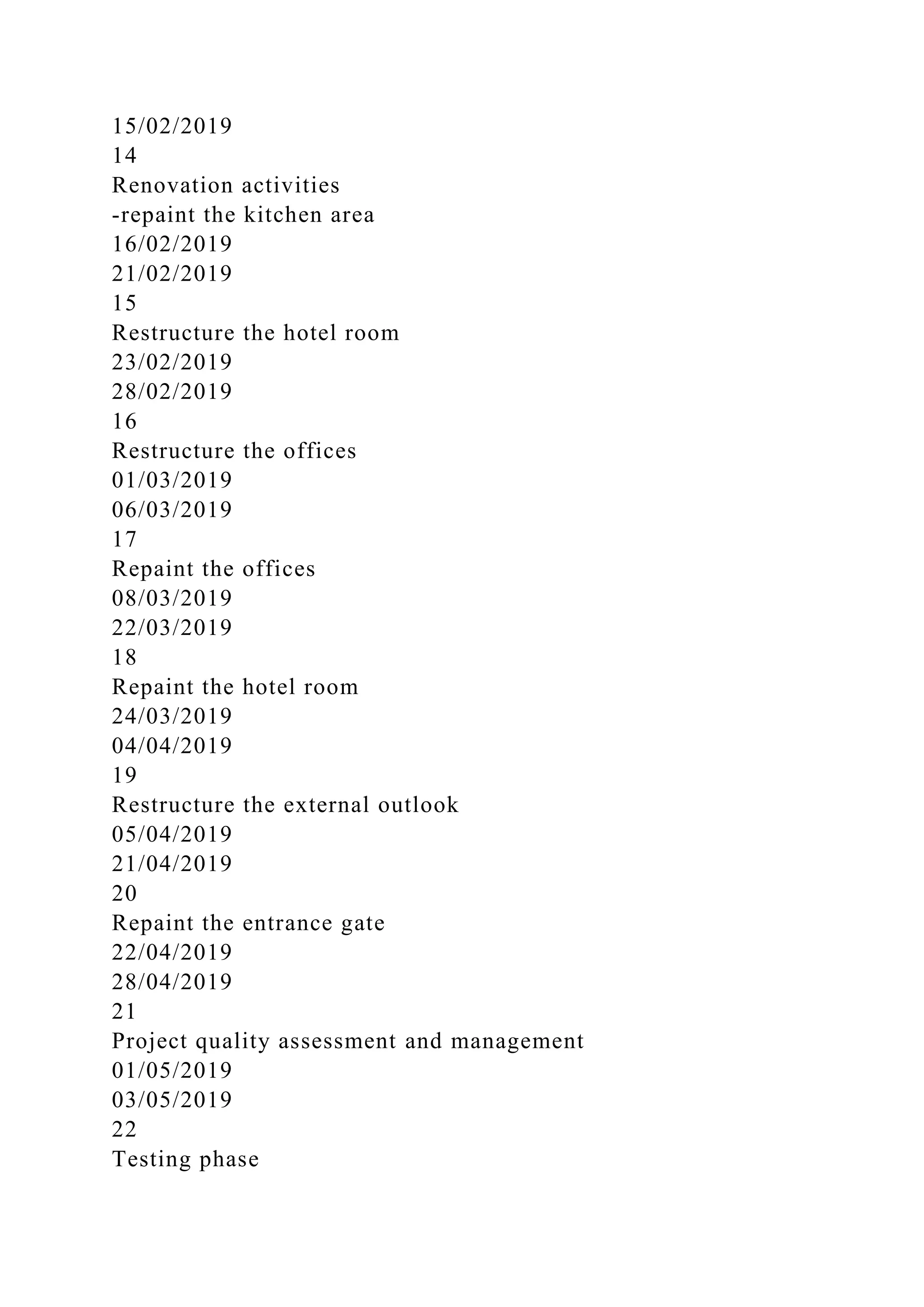
14
Renovation activities
-repaint the kitchen area
16/02/2019
21/02/2019
15
Restructure the hotel room
23/02/2019
28/02/2019
16
Restructure the offices
01/03/2019
06/03/2019
17
Repaint the offices
08/03/2019
22/03/2019
18
Repaint the hotel room
24/03/2019
04/04/2019
19
Restructure the external outlook
05/04/2019
21/04/2019
20
Repaint the entrance gate
22/04/2019
28/04/2019
21
Project quality assessment and management
01/05/2019
03/05/2019
22
Testing phase
04/05/2019
06/05/2019
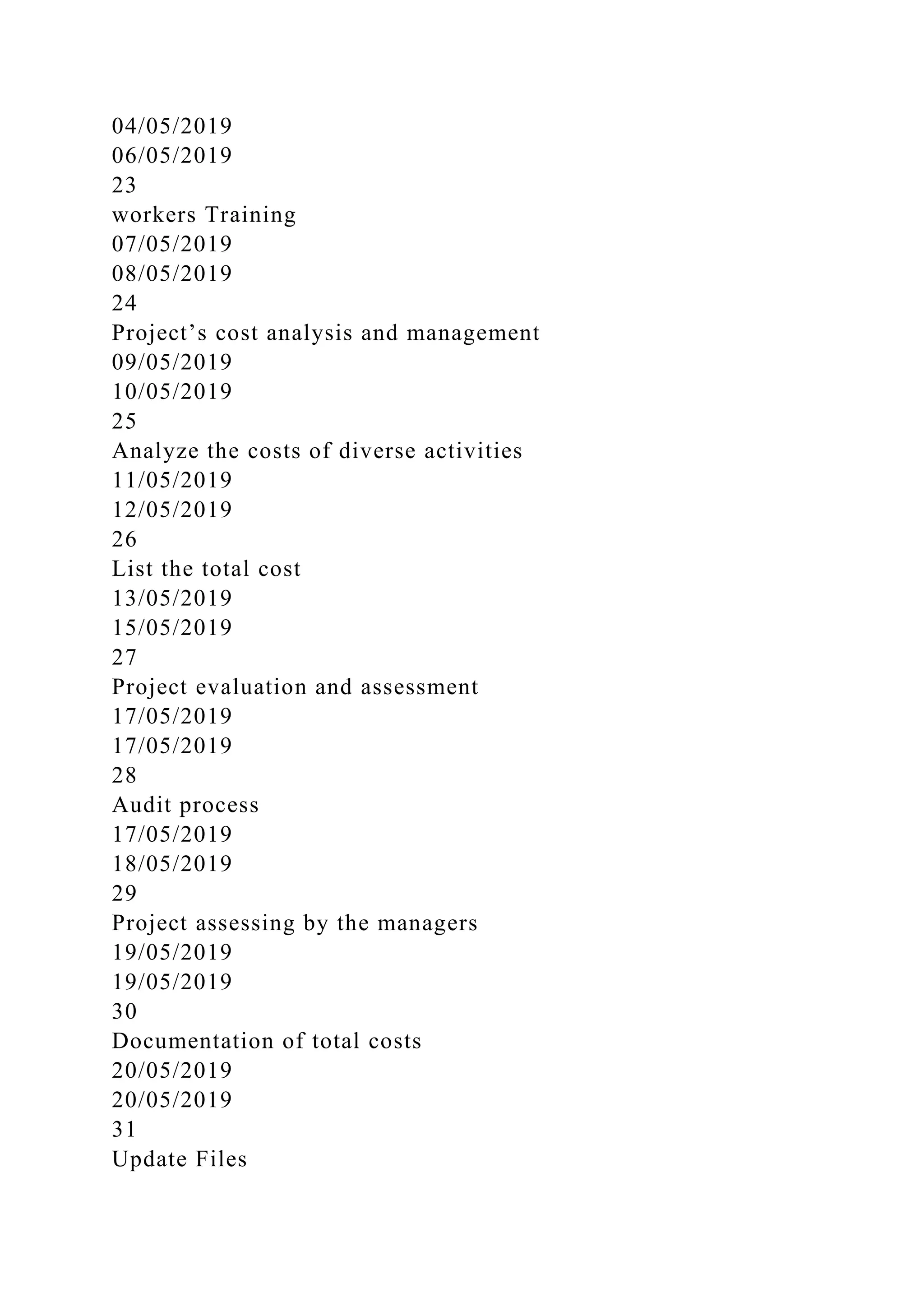
23
workers Training
07/05/2019
08/05/2019
24
Project’s cost analysis and management
09/05/2019
10/05/2019
25
Analyze the costs of diverse activities
11/05/2019
12/05/2019
26
List the total cost
13/05/2019
15/05/2019
27
Project evaluation and assessment
17/05/2019
17/05/2019
28
Audit process
17/05/2019
18/05/2019
29
Project assessing by the managers
19/05/2019
19/05/2019
30
Documentation of total costs
20/05/2019
20/05/2019
31
Update Files
21/05/2019
21/05/2019
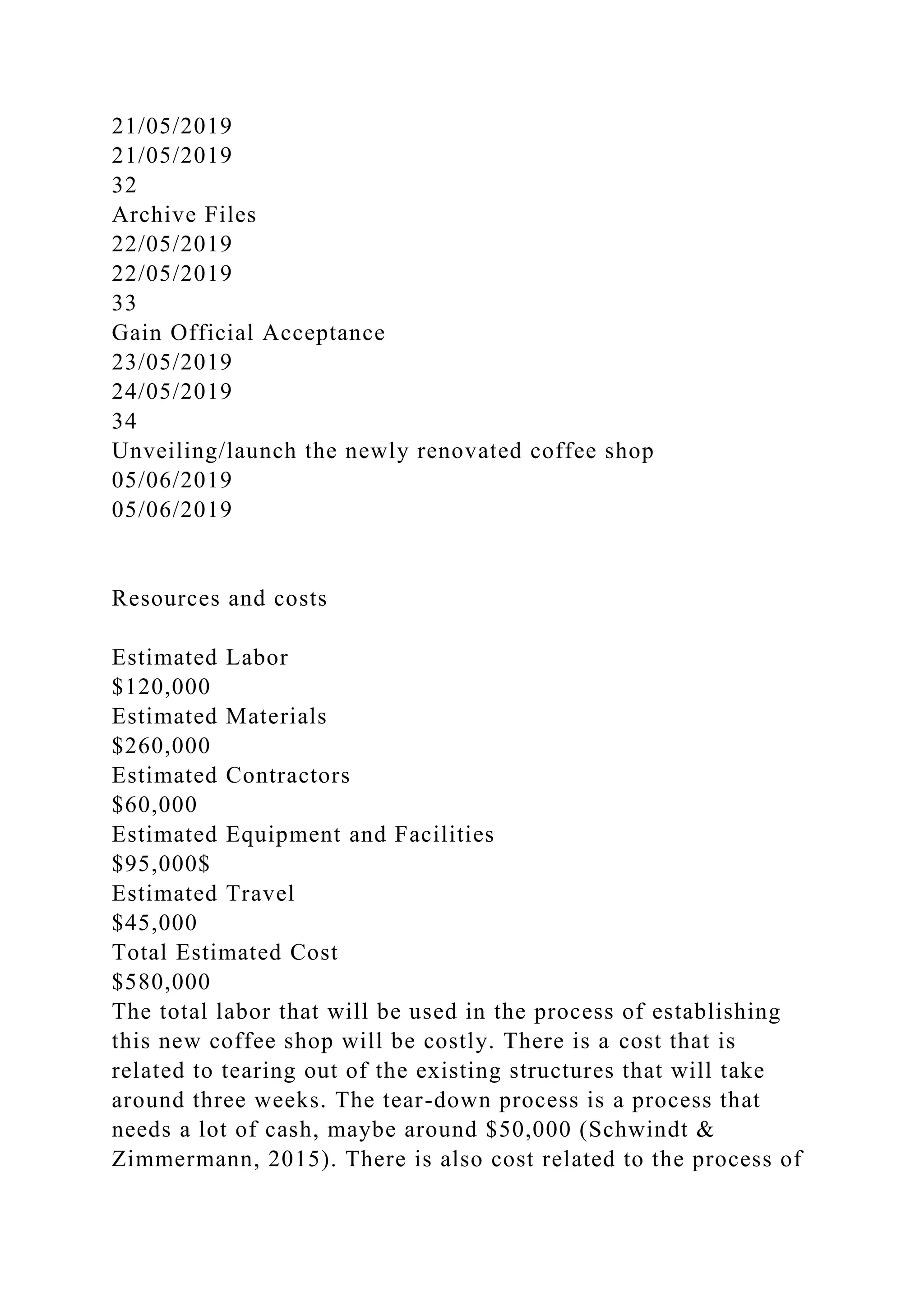
32
Archive Files
22/05/2019
22/05/2019
33
Gain Official Acceptance
23/05/2019
24/05/2019
34
Unveiling/launch the newly renovated coffee shop
05/06/2019
05/06/2019
Resources and costs
Estimated Labor
$120,000
Estimated Materials
$260,000
Estimated Contractors
$60,000
Estimated Equipment and Facilities
$95,000$
Estimated Travel
$45,000
Total Estimated Cost
$580,000
The total labor that will be used in the process of establishing
this new coffee shop will be costly. There is a cost that is
related to tearing out of the existing structures that will take
around three weeks. The tear-down process is a process that
needs a lot of cash, maybe around $50,000 (Schwindt &
Zimmermann, 2015). There is also cost related to the process of
renovation. The cost will be about $40,000. There is also some
cost for paying the auditor who will evaluate the organization's
new structures and documents of original entry. The cost is
around $5,000. The total labor cost of setting up the place for
the launching that will take place that will also need too much
labor. The cost will be around $10,000. The additional labor
cost will is estimated to around $15,000. The total labor cost is
estimated at around $120, 000.
The materials that will be used are diverse. Some of the
materials to be used in this project include paints and other
painting equipment that will cost around $5,000. The other
materials include the advanced kitchen equipment that will cost
around $80,000. There will be a need for cash to set up the hotel
room that will be accommodating the customers that will cost
around 100,000 (Mubarak, 2015). The cost of setting up the
offices will be around $60, 000. The additional cost of material
is around $ 15,000.
There is also some cost that will be set aside for the contractors,
the architectures, and the designers (Kadri & Boctor, 2018). The
contractor will need around $20,000. The designer will have a
lot of work in designing the interior look of the whole area that
will cost us around $20,000. There will be an additional cost of
around $20,000 for paying the architecture who will help in
portioning of the whole region to the desire of the team
members.
Some cash will be set aside to facilitate the provision of
equipment and facilities for running the organization. The
purchase of computers, the creation of a website, and other
equipment for making coffee (Lamas & Demeulemeester, 2016).
There will be a purchase of other small office equipment like
mobile phones, among others and also the purchase of other
equipment like brooms, containers, plate cups, among others.
The total cost of this equipment has been estimated to be around
$95,000.
There will be a lot of traveling in this whole project. The cost
of the project will be around $45,000. The traveling of the cost
will include the cost of carrying materials meant for the
renovation (Boctor & Kadri, 2016). The cost of carrying
equipment from the supplier to the construction cost by Lorries.
This means that the whole project will cost about $580,000. The
whole project will incur a lot of expenses, but it is worth it
since it is expected that the company sales will be increased by
$125,000 in the long run, bringing the gross margins to 70%.
References
Boctor, F. F., & Kadri, R. L. (2016). The Generalized Resource
Allocation and Leveling Problem in Project Scheduling.
CIRRELT, Centre interuniversitaire de recherche sur les réseaux
d'entreprise, la logistique et le transport= Interuniversity
Research Centre on Enterprise Networks, Logistics, and
Transportation. Retrieved from
https://www.cirrelt.ca/DocumentsTravail/CIRRELT-2016-40.pdf
Kadri, R. L., & Boctor, F. F. (2018). An efficient genetic
algorithm to solve the resource-constrained project scheduling
problem with transfer times: The single-mode case. European
Journal of Operational Research, 265(2), 454-462.retrieved
from
https://www.sciencedirect.com/science/article/abs/pii/S0377221
717306549
Kannimuthu, M., Raphael, B., Palaneeswaran, E., &
Kuppuswamy, A. (2019). Optimizing time, cost, and quality in
multi-mode resource-constrained project scheduling. Built
Environment Project and Asset Management, 9(1), 44-
63.retrieved from
https://www.emerald.com/insight/content/doi/10.1108/BEPAM-
04-2018-0075/full/html
Kolisch, R., Demeulemeester, E., Garcia, R. R., T’Kindt, V., &
Węglarz, J. (2016). Editorial “Project Management and
Scheduling”.retrieved from
https://link.springer.com/article/10.1007/s00291-016-0438-y
Lamas, P., & Demeulemeester, E. (2016). A purely proactive
scheduling procedure for the resource-constrained project
scheduling problem with stochastic activity durations. Journal
of Scheduling, 19(4), 409-428. Retrieved
fromhttps://link.springer.com/article/10.1007/s10951-015-0423-
3
Mubarak, S. A. (2015). Construction project scheduling and
control. John Wiley & Sons. Retrieved from
https://books.google.co.ke/books?hl=en&lr=&id=kSu9BgAAQB
AJ&oi=fnd&pg=PR9&dq=project+scheduling&ots=PHshgYPxK
5&sig=qR4YlwW22v1snHc0yYFBE4bXeYo&redir_esc=y
Schwindt, C., & Zimmermann, J. (2015). Handbook on project
management and scheduling Vol. 1. Handbook on Project
Management and Scheduling Vol, 2(2), 1-1406.retrieved from
https://link.springer.com/book/10.1007%2F978-3-319-05915-0
Tao, S., Wu, C., Sheng, Z., & Wang, X. (2018). Space-time
repetitive project scheduling, considering location, and
congestion. Journal of Computing in Civil Engineering, 32(3),
04018017.retrieved from
https://ascelibrary.org/doi/abs/10.1061/%28ASCE%29CP.1943-
5487.0000745
Wauters, T., Kinable, J., Smet, P., Vancroonenburg, W.,
Berghe, G. V., & Verstichel, J. (2016). The multi-mode
resource-constrained multi-project scheduling problem. Journal
of Scheduling, 19(3), 271-283.retrieved from
https://link.springer.com/article/10.1007/s10951-014-0402-0
Zareei, S. (2018). Project scheduling for constructing biogas
plants using the critical path method. Renewable and
Sustainable Energy Reviews, 81, 756-759. Retrieved from
https://www.sciencedirect.com/science/article/abs/pii/S1364032
117311693
At the next meeting, you and the team had a very productive
discussion on your findings related to the identification of all of
the project activities that must happen to start and finish your
project. You even took a step further in working with your team
members to estimate resources and cost for each of the
activities. Everyone feels that it is time to present your findings
to Sam and Gloria and provide them with a baseline estimate of
how long this project will most likely cost in terms of time and
dollars.
"Thanks for educating us on the schedule development
planning," says Jerry to you. "We have some great information
here, but I think it is too much detail to present to Sam and
Gloria."
"I agree," says Melissa. "Does anyone have any ideas on how
best to present this information?"
"We should go ahead and plug this information into a project
schedule that both Sam and Gloria know and will appreciate.
We ought to establish a project baseline at this time. We should
define the tasks, start and finish dates, durations, predecessors
(sequence of activities), resource names, and possibly cost,"
says Sara.
"The project schedule should account for all of the activities
that must happen. It must not be less than 30–50 activities and
subactivities," you say.
"Oh, that's great!" says Jim. "Do you think you can prepare it
for the team by next week?"
Assignment
Tips: Start by looking at the WBS activities that you defined
last week. Think about how you could decompose your work
packages into activities and subactivities to complete this coffee
house project. You should use all of the project artifacts
(deliverables) you produced so far and the given project
scenario to identify all of the activities that are needed.
You should be able to come up with 30–100 activities easily for
your schedule baseline. Once those activities have been
identified, finish your schedule by plugging in start and finish
dates, durations, predecessor relationships, and adding cost and
resource names. Resource names and cost can be added in the
main summary page or directly in the resource sheet. Your
project name must go in the first row, and all other activates
should be indented under it. You should link all activities to
summary tasks and subactivities to the main activity. You may
make assumptions for any of this work, and estimates do not
need to be real.

Problem-Based Learning (PBL) Scenario Amazing Coffee Houses (ACHs.docx

  • 1.
    Problem-Based Learning (PBL)Scenario: Amazing Coffee Houses (ACHs) Company Biography Amazing Coffee Houses (ACHs) is a small but established company in the coffee industry. It is based in northern Chicago, IL and employs over 100 workers locally in its 10 stores. Its current Chief Executive Officer (CEO) and Chairman of the Board, Sam Ryder, founded the company back in 1994 with his wife, Gloria Ryder. Gloria has served as the company’s Chief Financial Officer (CFO) since it was founded. Both Sam and Gloria graduated from the #1 ranked MBA program in the country and bring a lot of corporate experience to the business. Sam was a Senior Vice President (SVP) in Marketing and Sales at another company for many years before deciding to venture off to start ACHs with his wife. Gloria also worked for that same company and held the position of Finance Director. The company is known for its own brand of gourmet coffee and low fat donuts, as well as for their own line of stainless steel coffee mugs that are able to keep drinks hot for 12 hours straight. The workforce is comprised mostly of bakers, managers, baristas, greeters, clerks, and cashiers. They also work closely with several large suppliers and distributors in the United States. Problem The company has a loyal customer base throughout Chicago and is known for its personalized service and quality food and drinks. Because the economic conditions have greatly improved throughout the United States and the company now has a well- established name and brands, ACHs is looking to expand in markets beyond Chicago. The first market it has made a decision to expand into is 81 miles away, Milwaukee, WI. The company has worked through a local real estate agent and was
  • 2.
    able to strikea great deal on a 10-year lease in a great location. Management thinks Milwaukee is where the next 10 stores will be opened. However, Sam and Gloria have never operated a multi-state business before and are worried they will fail to accomplish their expansion goal timely. Sam has made it clear to Gloria that one day, his vision is to take ACHs to every city in America. Opportunity Sam has no project management experience and has decided to hire a project manager to manage the expansion project in Milwaukee, WI. After thorough evaluation and dozens of interviews, they have asked Jim Young, a rising star at the company, to take on the role of project manager to lead a team of five people from different departments to create a project plan for the new site. Jim Young currently serves as a store manager for the biggest two coffee shops. Prior to this role, he worked as a store supervisor for the company. During his time with the company, he has worked on many of the new shop development projects as a team leader and helped to renovate some of the company’s existing shops. People in his business units speak highly of his leadership and coaching style. Though Jim has worked on project teams and supervised functional departments, he has never acted as the project manager before. He knows there are a lot of moving parts in managing a project. He is worried about his ability to lead a new team of people with whom he has never worked before. He is concerned about his lack of experience and knowledge to manage the entire life cycle of a project from start to finish within budget, quality, time, and scope. In previous projects, he remembers Sam and Gloria having differences in budget, scope, and resource allocation, which caused a lot of confusion among the project team members and vendors. Jim is also concerned that their personal relationship will interfere in this project.
  • 3.
    You will beworking with Jim Young as a project team member with four other professionals in the company. You have only worked at ACHs for 4 years. Prior to your tenure at ACHs, you worked as an associate project manager for a construction company on the West Coast. You have worked on many different projects and are familiar with project management terms, methodologies, tools, and techniques. You earned several certifications relating to project management including a PMP and have an MBA in logistics. Although, you have never worked with Jim Young or anyone else on the new team, you are very excited about the opportunity to make a difference. Project Background Details Amazing Coffee Houses (ACHs) is a coffee shop that will be located in Milwaukee, WI. We have been able to purchase our own building within the city near Milwaukee’s top tourist attraction site near the Gold Rock Museum. The building is not renovated. Our market analysis of Milwaukee, WI indicated the city is the top city for coffee drinking in WI. Because we’re close to the city’s museum, we plan to become the top destination for local and American and foreign customers who visit Milwaukee each year. Our customers will have a wide range of coffee flavors to choose from including dark roast to light roast as well as specialty flavors throughout the year. They will also enjoy freshly baked low-fat donuts that aren’t available anywhere in the state. ACHs will hold true to its vision and mission of providing customers with a premier café experience. By creating a new twist for the café experience, ACHs will increase sales by more than $125,000 over the next three years and maintain a gross margin of 70%. The shop is 5,500 square foot of open space. Our plan is to have 2 bathrooms, a coffee bar, and enough tables to seat at least 50 customers. This is a coffee shop that also makes and sells donuts. The renovation must
  • 4.
    account for allthat is needed to get the shop ready for both coffee and donuts. The project has an initial budget of $650,000. It is now January and Sam and Gloria would like the new location to be up and running no later on July 4th. Note: The example companies, organizations, products, people, and events depicted herein are fictitious. No association with any real company, organization, product, person, or event is intended or should be inferred. Running Head: SCHEDULE BASELINE 1 SCHEDULE BASELINE 2 SCHEDULE BASELINE Name Date
  • 5.
    SCHEDULE BASELINE ANDWORK BREAKDOWN STRUCTURE The WBS for the new coffee shop in Milwaukee is made of the work packages that were initiated through close interaction among the project team stakeholders and members with reliable input from the mangers as well as the research carried out in the previous projects. The WBS defines the work packages relating to the Amazing Coffee Houses Company (Zareei, 2018). The definition comprises resources, tasks, and deliverables. Each work package in this WBS is explained in the WBS dictionary that will assist in task completion, resource planning, as well as monitoring that the deliverables achieve the project needs. The Amazing Coffee House Company Project schedule was generated from the project Charter with diverse inputs from the project group members. The project schedule was reviewed, completed by the sponsors of the project, as well as base-lined and approved. For any composed changes that happened on the schedule will then follow the TSIs transformation management procedure. In case it is constructed, boundary controls might be exceeded, a transformation requirement will be taken to the manager of the project (Zareei, 2018). The manager of the project, along with the team, will identify the impacts of the transformation on the project schedule, risks, scope, costs, and resources. If the effects exceed the set boundary conditions, then the transformation will be taken to the project sponsor to review and do the approval. The conditions are CPI less than 0.9 or greater than 1.2 SPI less than 0.9 or greater than 1.2 In case the change is accepted by the project sponsor, then
  • 6.
    there is aneed to implement the project, which is done by the project manager that will update the project schedule along with all documentation and interacts the transformation to the stakeholders in reference with the CCP (Change Control Process). The overall goal of this project is to expand ACH’s operations beyond Chicago (Zareei, 2018). However, there are several small objectives that are to be achieved in the process of executing this project. First, the project should be completed within the desired time-frame and within the allocated budget. Financial limitations may be a constraining factor. Schedule AMAZING COFFEE HOUSE COMPANY Element Name Start date Finish date 1 Project scope management 05/01/2019 05/01/2019 2 Define the scoping process 05/01/2019 05/01/2019 3 Validate the scoping process 06/01/2019 07/01/2019 4 Finalizing contracts 08/01/2019 08/01/2019
  • 7.
    5 Validating procurements 09/01/2019 09/01/2019 6 Stakeholder assessmentand briefing 10/01/2019 10/01/2019 7 Risk analysis and mitigation policy formulation 12/01/2019 12/01/2019 8 Tear-down of the existing structures · Tear down the roofing 13/01/2019 14/01/2019 9 Tear down the upper floor office segments 15/01/2019 17/01/2019 10 Tear down the second floor the hotel structure 19/01/2019 24/01/2019 11 Tear down the ground floor packing structure 26/01/2019 30/01/2019 12 Tear down the background of the building 31/01/2019 05/02/2019 13 Tear down the old kitchen structure 06/02/2019
  • 8.
    15/02/2019 14 Renovation activities -repaint thekitchen area 16/02/2019 21/02/2019 15 Restructure the hotel room 23/02/2019 28/02/2019 16 Restructure the offices 01/03/2019 06/03/2019 17 Repaint the offices 08/03/2019 22/03/2019 18 Repaint the hotel room 24/03/2019 04/04/2019 19 Restructure the external outlook 05/04/2019 21/04/2019 20 Repaint the entrance gate 22/04/2019 28/04/2019 21 Project quality assessment and management 01/05/2019 03/05/2019 22 Testing phase
  • 9.
    04/05/2019 06/05/2019 23 workers Training 07/05/2019 08/05/2019 24 Project’s costanalysis and management 09/05/2019 10/05/2019 25 Analyze the costs of diverse activities 11/05/2019 12/05/2019 26 List the total cost 13/05/2019 15/05/2019 27 Project evaluation and assessment 17/05/2019 17/05/2019 28 Audit process 17/05/2019 18/05/2019 29 Project assessing by the managers 19/05/2019 19/05/2019 30 Documentation of total costs 20/05/2019 20/05/2019 31 Update Files
  • 10.
    21/05/2019 21/05/2019 32 Archive Files 22/05/2019 22/05/2019 33 Gain OfficialAcceptance 23/05/2019 24/05/2019 34 Unveiling/launch the newly renovated coffee shop 05/06/2019 05/06/2019 Resources and costs Estimated Labor $120,000 Estimated Materials $260,000 Estimated Contractors $60,000 Estimated Equipment and Facilities $95,000$ Estimated Travel $45,000 Total Estimated Cost $580,000 The total labor that will be used in the process of establishing this new coffee shop will be costly. There is a cost that is related to tearing out of the existing structures that will take around three weeks. The tear-down process is a process that needs a lot of cash, maybe around $50,000 (Schwindt & Zimmermann, 2015). There is also cost related to the process of
  • 11.
    renovation. The costwill be about $40,000. There is also some cost for paying the auditor who will evaluate the organization's new structures and documents of original entry. The cost is around $5,000. The total labor cost of setting up the place for the launching that will take place that will also need too much labor. The cost will be around $10,000. The additional labor cost will is estimated to around $15,000. The total labor cost is estimated at around $120, 000. The materials that will be used are diverse. Some of the materials to be used in this project include paints and other painting equipment that will cost around $5,000. The other materials include the advanced kitchen equipment that will cost around $80,000. There will be a need for cash to set up the hotel room that will be accommodating the customers that will cost around 100,000 (Mubarak, 2015). The cost of setting up the offices will be around $60, 000. The additional cost of material is around $ 15,000. There is also some cost that will be set aside for the contractors, the architectures, and the designers (Kadri & Boctor, 2018). The contractor will need around $20,000. The designer will have a lot of work in designing the interior look of the whole area that will cost us around $20,000. There will be an additional cost of around $20,000 for paying the architecture who will help in portioning of the whole region to the desire of the team members. Some cash will be set aside to facilitate the provision of equipment and facilities for running the organization. The purchase of computers, the creation of a website, and other equipment for making coffee (Lamas & Demeulemeester, 2016). There will be a purchase of other small office equipment like mobile phones, among others and also the purchase of other equipment like brooms, containers, plate cups, among others. The total cost of this equipment has been estimated to be around $95,000. There will be a lot of traveling in this whole project. The cost of the project will be around $45,000. The traveling of the cost
  • 12.
    will include thecost of carrying materials meant for the renovation (Boctor & Kadri, 2016). The cost of carrying equipment from the supplier to the construction cost by Lorries. This means that the whole project will cost about $580,000. The whole project will incur a lot of expenses, but it is worth it since it is expected that the company sales will be increased by $125,000 in the long run, bringing the gross margins to 70%. References Boctor, F. F., & Kadri, R. L. (2016). The Generalized Resource Allocation and Leveling Problem in Project Scheduling. CIRRELT, Centre interuniversitaire de recherche sur les réseaux d'entreprise, la logistique et le transport= Interuniversity Research Centre on Enterprise Networks, Logistics, and Transportation. Retrieved from https://www.cirrelt.ca/DocumentsTravail/CIRRELT-2016-40.pdf Kadri, R. L., & Boctor, F. F. (2018). An efficient genetic algorithm to solve the resource-constrained project scheduling problem with transfer times: The single-mode case. European Journal of Operational Research, 265(2), 454-462.retrieved from https://www.sciencedirect.com/science/article/abs/pii/S0377221 717306549 Kannimuthu, M., Raphael, B., Palaneeswaran, E., & Kuppuswamy, A. (2019). Optimizing time, cost, and quality in multi-mode resource-constrained project scheduling. Built Environment Project and Asset Management, 9(1), 44- 63.retrieved from https://www.emerald.com/insight/content/doi/10.1108/BEPAM- 04-2018-0075/full/html Kolisch, R., Demeulemeester, E., Garcia, R. R., T’Kindt, V., & Węglarz, J. (2016). Editorial “Project Management and Scheduling”.retrieved from https://link.springer.com/article/10.1007/s00291-016-0438-y Lamas, P., & Demeulemeester, E. (2016). A purely proactive scheduling procedure for the resource-constrained project
  • 13.
    scheduling problem withstochastic activity durations. Journal of Scheduling, 19(4), 409-428. Retrieved fromhttps://link.springer.com/article/10.1007/s10951-015-0423- 3 Mubarak, S. A. (2015). Construction project scheduling and control. John Wiley & Sons. Retrieved from https://books.google.co.ke/books?hl=en&lr=&id=kSu9BgAAQB AJ&oi=fnd&pg=PR9&dq=project+scheduling&ots=PHshgYPxK 5&sig=qR4YlwW22v1snHc0yYFBE4bXeYo&redir_esc=y Schwindt, C., & Zimmermann, J. (2015). Handbook on project management and scheduling Vol. 1. Handbook on Project Management and Scheduling Vol, 2(2), 1-1406.retrieved from https://link.springer.com/book/10.1007%2F978-3-319-05915-0 Tao, S., Wu, C., Sheng, Z., & Wang, X. (2018). Space-time repetitive project scheduling, considering location, and congestion. Journal of Computing in Civil Engineering, 32(3), 04018017.retrieved from https://ascelibrary.org/doi/abs/10.1061/%28ASCE%29CP.1943- 5487.0000745 Wauters, T., Kinable, J., Smet, P., Vancroonenburg, W., Berghe, G. V., & Verstichel, J. (2016). The multi-mode resource-constrained multi-project scheduling problem. Journal of Scheduling, 19(3), 271-283.retrieved from https://link.springer.com/article/10.1007/s10951-014-0402-0 Zareei, S. (2018). Project scheduling for constructing biogas plants using the critical path method. Renewable and Sustainable Energy Reviews, 81, 756-759. Retrieved from https://www.sciencedirect.com/science/article/abs/pii/S1364032 117311693 At the next meeting, you and the team had a very productive discussion on your findings related to the identification of all of the project activities that must happen to start and finish your project. You even took a step further in working with your team
  • 14.
    members to estimateresources and cost for each of the activities. Everyone feels that it is time to present your findings to Sam and Gloria and provide them with a baseline estimate of how long this project will most likely cost in terms of time and dollars. "Thanks for educating us on the schedule development planning," says Jerry to you. "We have some great information here, but I think it is too much detail to present to Sam and Gloria." "I agree," says Melissa. "Does anyone have any ideas on how best to present this information?" "We should go ahead and plug this information into a project schedule that both Sam and Gloria know and will appreciate. We ought to establish a project baseline at this time. We should define the tasks, start and finish dates, durations, predecessors (sequence of activities), resource names, and possibly cost," says Sara. "The project schedule should account for all of the activities that must happen. It must not be less than 30–50 activities and subactivities," you say. "Oh, that's great!" says Jim. "Do you think you can prepare it for the team by next week?" Assignment Tips: Start by looking at the WBS activities that you defined last week. Think about how you could decompose your work packages into activities and subactivities to complete this coffee house project. You should use all of the project artifacts (deliverables) you produced so far and the given project scenario to identify all of the activities that are needed. You should be able to come up with 30–100 activities easily for your schedule baseline. Once those activities have been identified, finish your schedule by plugging in start and finish dates, durations, predecessor relationships, and adding cost and resource names. Resource names and cost can be added in the main summary page or directly in the resource sheet. Your project name must go in the first row, and all other activates
  • 15.
    should be indentedunder it. You should link all activities to summary tasks and subactivities to the main activity. You may make assumptions for any of this work, and estimates do not need to be real.