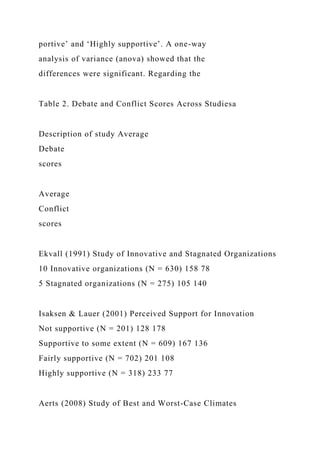
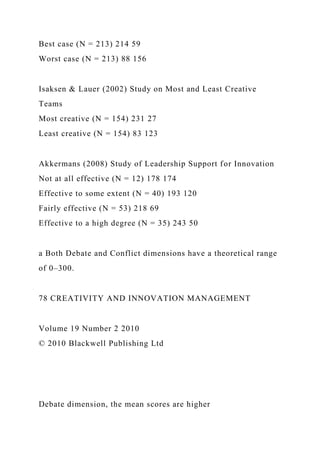
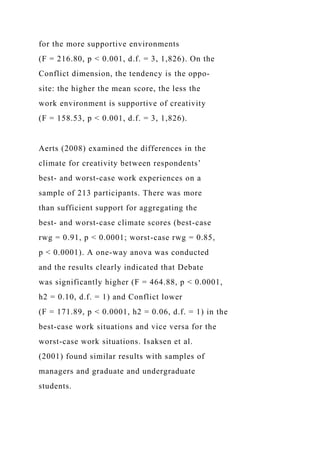
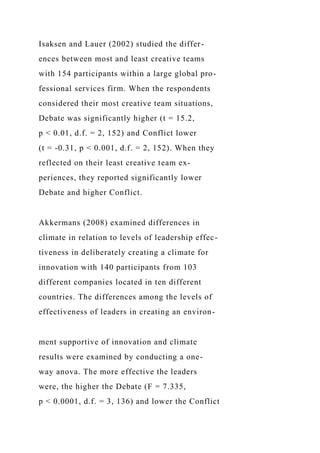
Running head: HOUSE BUILDING PROJECT PLAN
1
HOUSE BUILDING PROJECT PLAN
8
TITLE PAGE
House Building Project Plan
After years of hard working, the Simpsons, Julia and Bob,
decided to construct their own high-quality, custom home that
fits their needs and those of their two kids. The following
project plan is to build their dream house of 2,900-square-foot,
3-bath, 4-bedroom, and an exquisite yard within a budget of
$550,000. The project management company believes that
effective project management is heavily dependent on utilizing
the available powerful set of tools to improves their ability to
plan, implement, and manage activities to accomplish specific
customer objectives. Additionally, the company understands
that the primary function of project management is to balance
the trade-offs between time, cost, and performance while
ensuring customer satisfaction (Larson & Gray, 2014).
Therefore, this project plan is designed to build the Simpsons’
dream house with all the needed and agreed on amenities within
the specified budget of $500,000 and a duration of 7 months.
The project plan provides detailed project scope, objectives,
work Breakdown Structure (WBS), Responsibility Matrix,
goals, milestones, and project budget in addition to any
limitations and exclusions to keep the project within budget and
time frame.
Project Scope Details
To set the stage for developing a successful project plan, a
project scope statement is needed to define the end result or
mission of the project. A project scope states project
deliverables as clearly as possible to the customers, which is
fundamental and essential to focus the project plan. A poorly
defined scope or mission is the most frequently well-known
barrier to project success (Larson & Gray, 2014). The project
manager is responsible for making sure that there is a
documented agreement with the owners on project objectives,
deliverables at each stage of the project, like technical
requirements, specifications, and exclusions.
Project Objective
To construct a high-quality, custom home with a 2,900-square-
foot, 3-bath, 4-bedroom, and a backyard. The project should be
completed within 7 months at a cost not to exceed $ 550,000. A
project objective is the first step in setting a clear project scope
and it is designed to answer the questions of what, when, and
how much (Larson & Gray, 2014).
Deliverables
· A 2,900-square-foot, 3-bath, 4-bedroom, and a backyard,
finished home.
· A 600-square-foot finished garage with insulation,
sheetrocked walls, and motor operated door.
· Kitchen cabinets with sink and granite counter top.
· Kitchen appliances include a gas range, an oven, a
microwave, and a dishwasher.
· High-efficiency gas furnace with programmable thermostat.
The above is a list of specifications representing the major
deliverables that are expected and measurable outputs over the
life of the project. Additionally, these deliverables are
requirements specified by the customer. The 2,900-square-foot,
3-bath, and 4-bedroom house will be built based on the
construction blueprints provided by the customer and approved
by the construction permit. The company will build a 600-
square-foot finished garage and install insulation (as described
in technical requirements), sheetrocked walls and motor
operated door that has 2 years warranty. Kitchen cabinets,
granite, sink, faucet, and the specified appliances are to be
selected by the customer from the Home Depot within a budget
not exceeding $7000.
Milestones
1. File Building Permit Application - April 5, 2018
2. Excavate for foundation – April 14, 2018.
3. Rough Carpentry – May 3, 2018.
4. Plumbing and Electrical Rough-in – June 10, 2018.
5. Kitchen installation - July 15, 2018.
6. Paint - August 6, 2018.
7. Final Walk-through – September 15, 2018.
8. Move-in - September 19, 2018.
The above milestones are representing the significant events in
the project with their occurrence time. The milestone list above
shows rough-cut estimates of time for the major segments of
project work. Additionally, these milestones are using the
deliverables as a platform to identify major segments of the
work and the end date. The selection of these milestones is
based on the ease of their recognition by all project
stakeholders as natural, important control points in the project
life cycle (Larson & Gray, 2014).
Technical Requirements
1. Home must meet local building codes.
2. All windows and doors must pass the National Fenestration
Rating Council (NFRC) class 40 energy ratings.
3. Exterior wall insulation must meet an “A” factor of 21.
4. Ceiling insulation must meet an “R” factor of 38.
5. Floor insulation must meet an “R” factor of 25.
6. Garage will have a motor operated door that has 2 years
warranty.
7. Structure must pass seismic stability codes.
The above listed technical requirements are specifics to ensure
proper performance. They are listed with the intention of
clarifying the deliverables and defining performance
specifications (Larson & Gray, 2014). The house must meet all
California’s building codes of safety and energy saving
requirements.
Limits and Exclusions
1. The home will be built to the specifications and design of the
customer provided blueprints.
2. Owner is responsible for landscaping.
3. Refrigerator is not included among kitchen appliances.
4. Air conditioning is not included; but, prewiring is included.
5. Contractor reserves the right to contract out services
(outsourcing).
6. Contractor responsible for subcontracted work.
7. Site work is limited to Monday through Friday, 8:00 A.M. to
6:00 P.M.
The above list of project limits and exclusions defines the
agreed upon project scope. The limits are listed to set the
specific expectations and to avoid scope creep while the project
is in progress. Scope creep, which is a change to the baseline
scope, can affect several areas of the project from deliverables
to deadlines. The exclusions are listed to clearly define the
exact boundary of the project and clearly state what is not
included in the project (Larson & Gray, 2014).
Outsourcing, on the other hand, is the process of dedicating
specific project parts to an outside provider. Outsourcing has
the advantages of cost reduction, faster project completion, high
level of expertise, and flexibility (Larson & Gray, 2014). The
project management company is responsible for contracting and
supervising the outside venders to ensure they are meeting
project deliverables and specification.
Customer Review
Julia and Bob Simpson
This section is added here to specify who is/ are the project’s
costumer(s) responsible for the completion of the scope
checklist. Additionally, it provides an acknowledgment that the
customer(s) understand and agree on project expectations,
making sure the customers are getting what they desire in the
project deliverables within the specified budget and time frame
(Larson & Gray, 2014).
Conclusions
Project management is key to the success of any project
regardless of it complexity. Small projects, like going on a trip
require proper planning and management, as well as large
projects, like constructing a house. Project managers (PMs)
with their extensive experience can envision the end product
(mission or objective) of a project and break down the project
into smaller work packages that are more manageable and
trackable. These activities are detailed in the project’s baseline
plan. The project plan specifies the project’s scope, listing
objectives, Work Breakdown Structure (WBS), responsibility
matrix, goals, milestones, and project budget in addition to any
limitations and exclusions to keep the project within budget and
time frame. Additionally, the main objective of project
management is to ensure serving the specific needs of the
customer. The project plan serves as a great document to
specify the project’s scope and deliverables avoiding any
miscommunicated requirement that could lead to project delay
or cancelation.
References
Larson, E., & Gray, C. (2014). Project management: The
managerial process. (6th ed.). New York, NY: McGraw-Hill.
ARTWORK Damián Ortega
Controller of the Universe, 2007
found tools and wire, 285 x 405 x 455 cm
Spotlight
100 Harvard Business Review January–February 2011
SPOTLIGHT ON BUSINESS MODEL INNOVATION
1568 JanFeb11 Casadesus-Masanell.indd 1001568 JanFeb11
Casadesus-Masanell.indd 100 12/3/10 3:52:19 PM12/3/10
3:52:19 PM
Joan E. Ricart ([email protected]
edu) is the Carl Schroder
Professor of Strategic Man-
agement and Economics
at IESE Business School in
Barcelona.
Ramon Casadesus-
Masanell ([email protected]
gmail.com) is an associate
professor at Harvard Busi-
ness School in Boston.
How to Design
A Winning
Business Model
Smart companies’ business models generate
cycles that, over time, make them operate
more eff ectively. by Ramon Casadesus-Masanell
and Joan E. Ricart
STRATEGY HAS been the primary building block of
competitiveness over the past three decades, but
in the future, the quest for sustainable advantage
may well begin with the business model. While the
convergence of information and communication
technologies in the 1990s resulted in a short-lived
fascination with business models, forces such as de-
regulation, technological change, globalization, and
sustainability have rekindled interest in the concept
today. Since 2006, the IBM Institute for Business
Value’s biannual Global CEO Study has reported that
senior executives across industries regard develop-
ing innovative business models as a major priority.
A 2009 follow-up study reveals that seven out of 10
companies are engaging in business-model innova-
tion, and an incredible 98% are modifying their busi-
ness models to some extent. Business model innova-
tion is undoubtedly here to stay.
That isn’t surprising. The pressure to crack open
markets in developing countries, particularly those
at the middle and bottom of the pyramid, is driving
a surge in business-model innovation. The economic
slowdown in the developed world is forcing compa-
nies to modify their business models or create new
ones. In addition, the rise of new technology-based
and low-cost rivals is threatening incumbents, re-
shaping industries, and redistributing profi ts. Indeed,
S
STRATEGY HAS been the primen the p
competitiveness over the pacompetitiveness over the
in the future, the quest for sin the future, the quest fo
may well begin with the businmay well begin with the b
convergence of informationconvergence of inform
technologies in the 1990s restechnologies in the 1990s
fascination with business mofascination with business mo
regulation, technological chanregulation, technological chan
sustainability have rekindled sustainability have rekindled
today. Since 2006, the IBM Itoday. Since 2006, the IBM I
Value’s biannual Global CEO Siannual Global CEO S
senior executives across induves across ind
ing innovative business modbusiness m
A 2009 follow-up study revea-up study
companies are engaging in bucompanies are eng
PH
O
TO
G
R
A
PH
Y:
S
TE
PH
EN
W
H
IT
E,
C
O
U
RT
ES
Y
W
H
IT
E
C
U
BE
HBR.ORG
January–February 2011 Harvard Business Review 101
1568 JanFeb11 Casadesus-Masanell.indd 1011568 JanFeb11
Casadesus-Masanell.indd 101 12/3/10 3:52:32 PM12/3/10
3:52:32 PM
1122111 33222
the ways by which companies create and capture
value through their business models is undergoing
a radical transformation worldwide.
Yet most enterprises haven’t fully come to grips
with how to compete through business models. Our
studies over the past seven years show that much of
the problem lies in companies’ unwavering focus on
creating innovative models and evaluating their ef-
fi cacy in isolation—just as engineers test new tech-
nologies or products. However, the success or fail-
ure of a company’s business model depends largely
on how it interacts with models of other players in
the industry. (Almost any business model will per-
form brilliantly if a company is lucky enough to be
the only one in a market.) Because companies build
them without thinking about the competition, they
routinely deploy doomed business models.
Our research also shows that when enterprises
compete using business models that diff er from one
another, the outcomes are diffi cult to predict. One
business model may appear superior to others when
analyzed in isolation but create less value than the
others when interactions are considered. Or rivals
may end up becoming partners in value creation.
Appraising models in a stand-alone fashion leads
to faulty assessments of their strengths and weak-
nesses and bad decision making. This is a big reason
why so many new business models fail.
Three Characteristics of a Good Business Model
How can you tell if a business model will be eff ective? A good
one will meet three criteria.
Is it aligned with
company goals?
The choices made while designing a busi-
ness model should deliver consequences
that enable an organization to achieve its
goals. This may seem obvious until you
consider a counterexample. In the 1970s,
Xerox set up Xerox PARC, which spawned
technological innovations such as laser
printing, Ethernet, the graphical user
interface, and very large scale integration
for semiconductors. However, Xerox PARC
was notoriously unable to spawn new
businesses or capture value from its inno-
vations for the parent due to a distressing
lack of alignment with Xerox’s goals.
Is it self-reinforcing?
The choices that executives make while
creating a business model should comple-
ment one another; there must be internal
consistency. If, ceteris paribus, a low-cost
airline were to decide to provide a level
of comfort comparable to that off ered by
a full-fare carrier such as British Airways,
the change would require reducing the
number of seats on each plane and off er-
ing food and coff ee. These choices would
undermine the airline’s low-cost structure
and wreck its profi ts. When there’s a lack
of reinforcement, it’s possible to refi ne
the business model by abandoning some
choices and making new ones.
Is it robust?
A good business model should be able to
sustain its eff ectiveness over time by fend-
ing off four threats, identifi ed by Pankaj
Ghemawat. They are imitation (can com-
petitors replicate your business model?);
holdup (can customers, suppliers, or
other players capture the value you create
by fl exing their bargaining power?); slack
(organizational complacency); and sub-
stitution (can new products decrease the
value customers perceive in your products
or services?). Although the period of eff ec-
tiveness may be shorter nowadays than
it once was, robustness is still a critical
parameter.
Moreover, the propensity to ignore the dynamic
elements of business models results in many compa-
nies failing to use them to their full potential. Few ex-
ecutives realize that they can design business mod-
els to generate winner-take-all eff ects that resemble
the network externalities that high-tech companies
such as Microsoft, eBay, and Facebook have created.
Whereas network eff ects are an exogenous feature
of technologies, winner-take-all eff ects can be trig-
gered by companies if they make the right choices
in developing their business models. Good business
models create virtuous cycles that, over time, result
in competitive advantage. Smart companies know
how to strengthen their virtuous cycles, weaken
those of rivals, and even use their virtuous cycles to
turn competitors’ strengths into weaknesses.
“Isn’t that strategy?” we’re often asked. It isn’t—
and unless managers learn to understand the dis-
tinct realms of business models, strategy, and tactics,
while taking into account how they interact, they
will never fi nd the most eff ective ways to compete.
What Is a Business Model, Really?
Everyone agrees that executives must know how
business models work if their organizations are to
thrive, yet there continues to be little agreement on
an operating definition. Management writer Joan
Magretta defi ned a business model as “the story that
102 Harvard Business Review January–February 2011
SPOTLIGHT ON BUSINESS MODEL INNOVATION
1568 JanFeb11 Casadesus-Masanell.indd 1021568 JanFeb11
Casadesus-Masanell.indd 102 12/3/10 3:52:40 PM12/3/10
3:52:40 PM
explains how an enterprise works,” harking back
to Peter Drucker, who described it as the answer to
the questions: Who is your customer, what does the
customer value, and how do you deliver value at an
appropriate cost?
Other experts defi ne a business model by speci-
fying the main characteristics of a good one. For ex-
ample, Harvard Business School’s Clay Christensen
suggests that a business model should consist of
four elements: a customer value proposition, a profi t
formula, key resources, and key processes. Such de-
scriptions undoubtedly help executives evaluate
business models, but they impose preconceptions
about what they should look like and may constrain
the development of radically diff erent ones.
Our studies suggest that one component of a busi-
ness model must be the choices that executives make
about how the organization should operate—choices
such as compensation practices, procurement con-
tracts, location of facilities, extent of vertical inte-
gration, sales and marketing initiatives, and so on.
Managerial choices, of course, have consequences.
For instance, pricing (a choice) aff ects sales volume,
which, in turn, shapes the company’s scale econo-
mies and bargaining power (both consequences).
These consequences infl uence the company’s logic
of value creation and value capture, so they too must
have a place in the defi nition. In its simplest concep-
tualization, therefore, a business model consists of a
set of managerial choices and the consequences of
those choices.
Companies make three types of choices when cre-
ating business models. Policy choices determine the
actions an organization takes across all its operations
(such as using nonunion workers, locating plants in
rural areas, or encouraging employees to fl y coach
class). Asset choices pertain to the tangible resources
a company deploys (manufacturing facilities or sat-
ellite communication systems, for instance). And
governance choices refer to how a company arranges
decision-making rights over the other two (should
we own or lease machinery?). Seemingly innocuous
diff erences in the governance of policies and assets
infl uence their eff ectiveness a great deal.
Consequences can be either flexible or rigid. A
fl exible consequence is one that responds quickly
when the underlying choice changes. For example,
choosing to increase prices will immediately result
in lower volumes. By contrast, a company’s culture
of frugality—built over time through policies that
oblige employees to fl y economy class, share hotel
rooms, and work out of Spartan offi ces—is unlikely
to disappear immediately even when those choices
change, making it a rigid consequence. These dis-
tinctions are important because they aff ect competi-
tiveness. Unlike fl exible consequences, rigid ones
are diffi cult to imitate because companies need time
to build them.
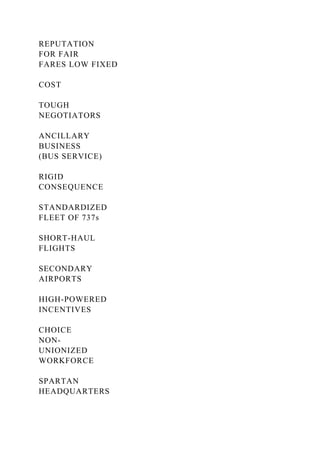
Take, for instance, Ryanair, which switched in
the early 1990s from a traditional business model to
a low-cost one. The Irish airline eliminated all frills,
cut costs, and slashed prices to unheard-of levels.
The choices the company made included offering
low fares, fl ying out of only secondary airports, ca-
tering to only one class of passenger, charging for all
additional services, serving no meals, making only
short-haul fl ights, and utilizing a standardized fl eet
of Boeing 737s. It also chose to use a nonunionized
workforce, offer high-powered incentives to em-
ployees, operate out of a lean headquarters, and so
on. The consequences of those choices were high
volumes, low variable and fi xed costs, a reputation
for reasonable fares, and an aggressive management
team, to name a few. (See “Ryanair’s Business Model
Then and Now.”) The result is a business model that
enables Ryanair to off er a decent level of service at a
low cost without radically lowering customers’ will-
ingness to pay for its tickets.
Idea in Brief
There has never been as much
interest in business models
as there is today; seven out
of 10 companies are trying to
create innovative business
models, and 98% are modify-
ing existing ones, according
to a recent survey.
However, most companies
still create and evaluate
business models in isola-
tion, without considering the
implications of how they will
interact with rivals’ business
models. This narrow view
dooms many to failure.
Moreover, companies
often don’t realize that busi-
ness models can be designed
so that they generate virtu-
ous cycles—similar to the
powerful eff ects high-tech
fi rms such as Facebook, eBay,
and Microsoft enjoy. These
cycles, when aligned with
company goals, reinforce
competitive advantage.
By making the right
choices, companies can
strengthen their business
models’ virtuous cycles,
weaken those of rivals, and
even use the cycles to turn
competitors into comple-
mentary players.
This is neither strategy nor
tactics; it’s using business
models to gain competitive
advantage. Indeed, com-
panies fare poorly partly
because they don’t recognize
the diff erences between
strategy, tactics, and busi-
ness models.
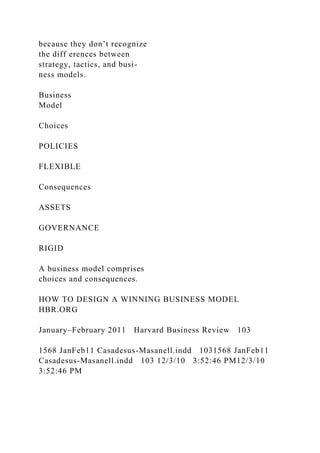
Business
Model
Choices
POLICIES
FLEXIBLE
Consequences
ASSETS
GOVERNANCE
RIGID
A business model comprises
choices and consequences.
HOW TO DESIGN A WINNING BUSINESS MODEL
HBR.ORG
January–February 2011 Harvard Business Review 103
1568 JanFeb11 Casadesus-Masanell.indd 1031568 JanFeb11
Casadesus-Masanell.indd 103 12/3/10 3:52:46 PM12/3/10
3:52:46 PM
How Business Models Generate
Virtuous Cycles
Not all business models work equally well, of course.
Good ones share certain characteristics: They align
with the company’s goals, are self-reinforcing, and
are robust. (See the sidebar “Three Characteristics
of a Good Business Model.”) Above all, successful
business models generate virtuous cycles, or feed-
back loops, that are self-reinforcing. This is the most
powerful and neglected aspect of business models.
Our studies show that the competitive advan-
tage of high-tech companies such as Apple, Micro-
soft, and Intel stems largely from their accumulated
assets—an installed base of iPods, Xboxes, or PCs,
for instance. The leaders gathered those assets not
by buying them but by making smart choices about
pricing, royalties, product range, and so on. In other
words, they’re consequences of business model
choices. Any enterprise can make choices that allow
it to build assets or resources—be they project man-
agement skills, production experience, reputation,
asset utilization, trust, or bargaining power—that
make a diff erence in its sector.
The consequences enable further choices, and so
on. This process generates virtuous cycles that con-
tinuously strengthen the business model, creating
a dynamic that’s similar to that of network eff ects.
As the cycles spin, stocks of the company’s key as-
sets (or resources) grow, enhancing the enterprise’s
competitive advantage. Smart companies design
business models to trigger virtuous cycles that, over
time, expand both value creation and capture.
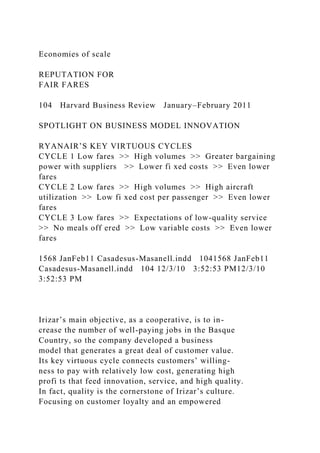
For example, Ryanair’s business model creates
several virtuous cycles that maximize its profits
through increasingly low costs and prices. (See
the exhibit “Ryanair’s Key Virtuous Cycles.”) All of
the cycles result in reduced costs, which allow for
lower prices that grow sales and ultimately lead to
increased profi ts. Its competitive advantage keeps
growing as long as the virtuous cycles generated by
its business model spin. Just as a fast-moving body
is hard to stop because of kinetic energy, it’s tough to
halt well-functioning virtuous cycles.
However, they don’t go on forever. They usually
reach a limit and trigger counterbalancing cycles, or
they slow down because of their interactions with
other business models. In fact, when interrupted,
the synergies work in the opposite direction and
erode competitive advantage. For example, one of
Ryanair’s cycles could become vicious if its employ-
ees unionized and demanded higher wages, and the
airline could no longer off er the lowest fares. It would
then lose volume, and aircraft utilization would fall.
Since Ryanair’s investment in its fleet assumes a
very high rate of utilization, this change would have
a magnifi ed eff ect on profi tability.
It’s easy to see that virtuous cycles can be cre-
ated by a low-cost, no-frills player, but a diff erentia-
tor may also create virtuous cycles. Take the case of
Irizar, a Spanish manufacturer of bodies for luxury
motor coaches, which posted large losses after a
series of ill-conceived moves in the 1980s. Irizar’s
leadership changed twice in 1990 and morale hit an
all-time low, prompting the new head of the compa-
ny’s steering team, Koldo Saratxaga, to make major
changes. He transformed the organization’s busi-
ness model by making choices that yielded three
rigid consequences: employees’ tremendous sense
of ownership, feelings of accomplishment, and trust.
The choices included eliminating hierarchy, decen-
tralizing decision making, focusing on teams to get
work done, and having workers own the assets. (See
the exhibit “Irizar’s Novel Business Model.”)
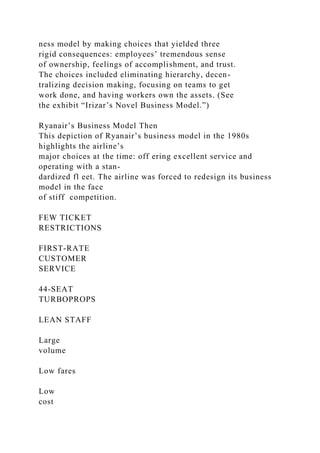
Ryanair’s Business Model Then
This depiction of Ryanair’s business model in the 1980s
highlights the airline’s
major choices at the time: off ering excellent service and
operating with a stan-
dardized fl eet. The airline was forced to redesign its business
model in the face
of stiff competition.
FEW TICKET
RESTRICTIONS
FIRST-RATE
CUSTOMER
SERVICE
44-SEAT
TURBOPROPS
LEAN STAFF
Large
volume
Low fares
Low
cost
Economies of scale
REPUTATION FOR
FAIR FARES
104 Harvard Business Review January–February 2011
SPOTLIGHT ON BUSINESS MODEL INNOVATION
RYANAIR’S KEY VIRTUOUS CYCLES
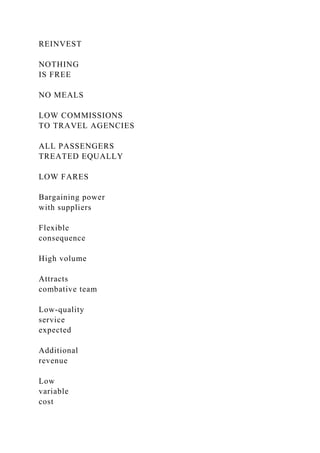
CYCLE 1 Low fares >> High volumes >> Greater bargaining
power with suppliers >> Lower fi xed costs >> Even lower
fares
CYCLE 2 Low fares >> High volumes >> High aircraft
utilization >> Low fi xed cost per passenger >> Even lower
fares
CYCLE 3 Low fares >> Expectations of low-quality service
>> No meals off ered >> Low variable costs >> Even lower
fares
1568 JanFeb11 Casadesus-Masanell.indd 1041568 JanFeb11
Casadesus-Masanell.indd 104 12/3/10 3:52:53 PM12/3/10
3:52:53 PM
Irizar’s main objective, as a cooperative, is to in-
crease the number of well-paying jobs in the Basque
Country, so the company developed a business
model that generates a great deal of customer value.
Its key virtuous cycle connects customers’ willing-
ness to pay with relatively low cost, generating high
profi ts that feed innovation, service, and high quality.
In fact, quality is the cornerstone of Irizar’s culture.
Focusing on customer loyalty and an empowered
workforce, the company enjoyed a 23.9% compound
annual growth rate over the 14 years that Saratxaga
was CEO. Producing 4,000 coaches in 2010 and gen-
erating revenues of about €400 million, Irizar is an
example of a radically diff erent business model that
generates virtuous cycles.
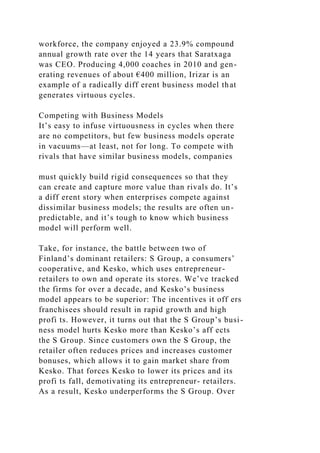
Competing with Business Models
It’s easy to infuse virtuousness in cycles when there
are no competitors, but few business models operate
in vacuums—at least, not for long. To compete with
rivals that have similar business models, companies
must quickly build rigid consequences so that they
can create and capture more value than rivals do. It’s
a diff erent story when enterprises compete against
dissimilar business models; the results are often un-
predictable, and it’s tough to know which business
model will perform well.
Take, for instance, the battle between two of
Finland’s dominant retailers: S Group, a consumers’
cooperative, and Kesko, which uses entrepreneur-
retailers to own and operate its stores. We’ve tracked
the firms for over a decade, and Kesko’s business
model appears to be superior: The incentives it off ers
franchisees should result in rapid growth and high
profi ts. However, it turns out that the S Group’s busi-
ness model hurts Kesko more than Kesko’s aff ects
the S Group. Since customers own the S Group, the
retailer often reduces prices and increases customer
bonuses, which allows it to gain market share from
Kesko. That forces Kesko to lower its prices and its
profi ts fall, demotivating its entrepreneur- retailers.
As a result, Kesko underperforms the S Group. Over
REPUTATION
FOR FAIR
FARES LOW FIXED
COST
TOUGH
NEGOTIATORS
ANCILLARY
BUSINESS
(BUS SERVICE)
RIGID
CONSEQUENCE
STANDARDIZED
FLEET OF 737s
SHORT-HAUL
FLIGHTS
SECONDARY
AIRPORTS
HIGH-POWERED
INCENTIVES
CHOICE
NON-
UNIONIZED
WORKFORCE
SPARTAN
HEADQUARTERS
REINVEST
NOTHING
IS FREE
NO MEALS
LOW COMMISSIONS
TO TRAVEL AGENCIES
ALL PASSENGERS
TREATED EQUALLY
LOW FARES
Bargaining power
with suppliers
Flexible
consequence
High volume
Attracts
combative team
Low-quality
service
expected
Additional
revenue
Low
variable
cost
High profi t
YOUNG AND
LEISURE
TRAVELERS
WORD-OF-
MOUTH
ADVERTISING
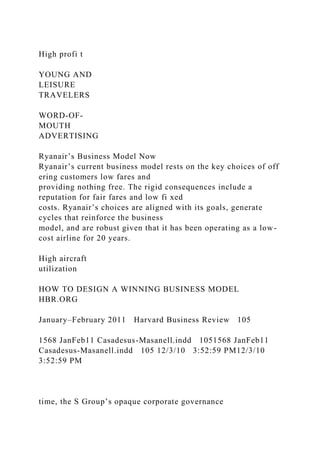
Ryanair’s Business Model Now
Ryanair’s current business model rests on the key choices of off
ering customers low fares and
providing nothing free. The rigid consequences include a
reputation for fair fares and low fi xed
costs. Ryanair’s choices are aligned with its goals, generate
cycles that reinforce the business
model, and are robust given that it has been operating as a low-
cost airline for 20 years.
High aircraft
utilization
HOW TO DESIGN A WINNING BUSINESS MODEL
HBR.ORG
January–February 2011 Harvard Business Review 105
1568 JanFeb11 Casadesus-Masanell.indd 1051568 JanFeb11
Casadesus-Masanell.indd 105 12/3/10 3:52:59 PM12/3/10
3:52:59 PM
time, the S Group’s opaque corporate governance
system allows slack to creep into the system, and
it is forced to hike prices. This allows Kesko to also
increase prices and improve profi tability, drive its
entrepreneur-retailers, and win back more custom-
ers through its superior shopping experience. That
sparks another cycle of rivalry.
Companies can compete through business mod-
els in three ways: They can strengthen their own vir-
tuous cycles, block or destroy the cycles of rivals, or
build complementarities with rivals’ cycles, which
results in substitutes mutating into complements.
Strengthen your virtuous cycle. Companies
can modify their business models to generate new
virtuous cycles that enable them to compete more
eff ectively with rivals. These cycles often have con-
sequences that strengthen cycles elsewhere in the
business model. Until recently, Boeing and Airbus
competed using essentially the same virtuous cycles.
Airbus matched Boeing’s off erings in every segment,
the exception being the very large commercial trans-
port segment where Boeing had launched the 747 in
1969. Given the lumpiness of demand for aircraft,
their big-ticket nature, and cyclicality, price compe-
tition has been intense.
Historically, Boeing held the upper hand because
its 747 enjoyed a monopoly, and it could reinvest
those profi ts to strengthen its position in other seg-
ments. Analysts estimate that the 747 contributed 70
cents to every dollar of Boeing’s profi ts by the early
1990s. Since R&D investment is the most important
driver of customers’ willingness to pay, Airbus was
at a disadvantage. It stayed afl oat by obtaining low-
interest loans from European governments. Without
the subsidies, Airbus’s cycle would have become
vicious.
With the subsidies likely to dry up, Airbus modi-
fi ed its business model by developing a very large
commercial transport, the 380. To dissuade Airbus,
Boeing announced a stretch version of the 747. How-
ever, that aircraft would cut into the 747’s profi ts, so
it seems unlikely that Boeing will ever launch it. Not
only does the 380 help maintain the virtuousness of
Airbus’s cycle in small and midsize planes, but also
it helps decelerate the virtuousness of Boeing’s cy-
cle. The increase in rivalry suggests that the 747 will
become less of a money-spinner for Boeing. That’s
why it is trying to strengthen its position in midsize
aircraft, where competition is likely to become even
tougher when sales of the 380 take off , by develop-
ing the 787.
Weaken competitors’ cycles. Some compa-
nies get ahead by using the rigid consequences of
their choices to weaken new entrants’ virtuous cy-
cles. Whether a new technology disrupts an industry
or not depends not only on the intrinsic benefi ts of
that technology but also on interactions with other
players. Consider, for instance, the battle between
Microsoft and Linux, which feeds its virtuous cycle
by being free of charge and allowing users to contrib-
ute code improvements. Unlike Airbus, Microsoft
has focused on weakening its competitor’s virtu-
ous cycle. It uses its relationship with OEMs to have
Windows preinstalled on PCs and laptops so that it
can prevent Linux from growing its customer base. It
discourages people from taking advantage of Linux’s
free operating system and applications by spreading
fear, uncertainty, and doubt about the products.
In the future, Microsoft could raise Windows’
value by learning more from users and off ering spe-
cial prices to increase sales in the education sector, or
decrease Linux’s value by undercutting purchases by
strategic buyers and preventing Windows applica-
tions from running on Linux. Linux’s value creation
potential may theoretically be greater than that of
Windows, but its installed base will never eclipse
that of Microsoft as long as the software giant suc-
ceeds in disrupting its key virtuous cycles.
Turn competitors into complements. Rivals
with different business models can also become
partners in value creation. In 1999, Betfair, an online
betting exchange, took on British bookmakers such
as Ladbrokes and William Hill by enabling people to
anonymously place bets against one another. Un-
like traditional bookmakers who only offer odds,
Betfair is a two-sided internet-based platform that
allows customers to both place bets and off er odds
to others. One-sided and two-sided businesses have
diff erent virtuous cycles: While bookmakers create
value by managing risk and capture it through the
odds they off er, betting exchanges themselves bear
no risk. They create value by matching the two sides
of the market and capture it by taking a cut of the net
winnings.
Over the past decade, Ladbrokes’ and William
Hill’s gross winnings have declined, so Betfair has
hurt them, but not as much as expected. Because
Betfair has improved odds in general, gamblers lose
less money. They then place more wagers, and when
bookies pay out, bettors gamble again, feeding a vir-
tuous cycle. This has expanded the British gambling
market by a larger proportion than just the improve-
When Irizar—a Spanish
cooperative that manu-
factures luxury motor
coach bodies—created
a radically diff erent busi-
ness model, it made sev-
eral innovative choices.
SHARED
OWNERSHIP
> Workers own assets
and contribute fi nan-
cially to join Irizar
> Teams set their own
goals and choose
leaders
> No bosses, only
coordinators
> Flat hierarchy, with only
three levels
> No overtime pay
TRUST
> Decentralized decision
making
> Shared information and
transparency about
performance
> No walls inside plants
or offi ces; no assigned
parking spaces
> Tenure after three years
of probation; no evalua-
tion or fi rings thereafter
> No clocking in and out
QUALITY
> Only one product for all
markets
> Most repetitive tasks
outsourced
ACCOMPLISHMENT
> Relatively high product
prices
> Pay scale ratio of just
3:1
> Some profi t (or loss)
sharing every year
These choices have led to
innovation, high quality,
and excellent service,
generating high sales vol-
ume as well as customer
loyalty.
Irizar’s Novel
Business Model
106 Harvard Business Review January–February 2011
SPOTLIGHT ON BUSINESS MODEL INNOVATION
1568 JanFeb11 Casadesus-Masanell.indd 1061568 JanFeb11
Casadesus-Masanell.indd 106 12/3/10 3:53:05 PM12/3/10
3:53:05 PM
ment of odds might suggest. The better odds Betfair
off ers also help traditional bookmakers gauge mar-
ket sentiment more accurately and hedge their ex-
posures at a lower cost. When a new business model
creates complementarities between competitors, it is
less likely that incumbents will respond aggressively.
The initial …
Long Range Planning 43 (2010) 123e141
http://www.elsevier.com/locate/lrp
Collaborative Strategies in
Design-intensive Industries:
Knowledge Diversity and
Innovation
Claudio Dell’Era and Roberto Verganti
Customers are paying increasing attention to product design,
whether the aesthetic,
symbolic or emotional meanings of products. Designers can
support companies in
exploring customers’ needs and the appropriate signs (such as
form, colours, materials, etc)
that give meaning to products. Managing collaborations with
designers is therefore
a critical issue for companies that operate in design-intensive
industries. This paper
analyses how a company may develop a proper collaborative
strategy by identifying an
effective portfolio of designers. It shows that companies that
innovate collaborate with
a broad range of external designers. Most important,
innovativeness does not depend on
diversity brought by an individual designer, but on diversity
brought by the entire portfolio
of designers of a firm. The implication is that companies should
not focus only on the
characteristics of single external parties when developing a
collaborative innovation
strategy, but, rather, manage carefully a balanced portfolio of
collaborators.
� 2009 Elsevier Ltd. All rights reserved.
Introduction
Design is increasingly viewed as an important strategic asset,
both in the business and academic
arenas. This growing attention to design has led scholars and
executives to investigate and under-
stand the link between design and company performance.1
Several studies demonstrate the fact that
consumers increasingly make brand choices on the basis of the
aesthetic and symbolic value of
0024-6301/$ - see front matter � 2009 Elsevier Ltd. All rights
reserved.
doi:10.1016/j.lrp.2009.10.006
http://www.elsevier.com/locate/lrp
products and services.2 The role of the ‘‘look and feel’’ of
people, places and things demonstrates
that the aesthetic and symbolic dimensions of a product are
increasingly relevant in many
industries.3
As design becomes increasingly relevant, executives are looking
for ways to improve their capa-
bility to manage design processes and resources. A major
challenge is how to identify the right tal-
ent to participate in design processes. Many industries
collaborate with external designers, to source
fresh insights, creativity and knowledge.4 This perspective is in
line with a general tendency towards
open innovation and the development of business ecosystems,
where companies recognise that
most of the valuable knowledge for innovation resides outside
their boundaries.5 To be innovative,
therefore, requires finding ways of accessing that knowledge.6
Recent studies have underlined the
importance of external designers in the innovation process to
the point that some of them are con-
sidered ‘‘superstars’’:7 Jacob Jensen and David Lewis for Bang
& Olufsen, Michael Graves for Target,
Philippe Starck for several furniture companies, as well as for
Nike and Puma.8 Case studies includ-
ing Alessi, Apple, Bang & Olufsen, Kartell, Philips, Sony and
Swatch, demonstrate how designers are
becoming key actors in terms of product innovation and
strategic renewal.9 In the 1990s, Kartell’s
strategy and economic results were revitalised by collaborations
with designers such as Philippe
Starck and Ron Arad. The Italian company revamped its brand
image and introduced iconic prod-
ucts such as Bookworm (a library designed by Ron Arad in
1994) and La Marie (a chair designed by
Philippe Starck in 1999). The increasing relevance of design is
also demonstrated by the corporate
roles of designers in certain leading companies. In 1990,
Nokia’s corporate strategy emphasised the
relevance of design through the appointment of chief designer
Frank Nuovo as vice-president for
design.
However, the success of companies seems not necessarily
related to the choice of a specific de-
signer, but rather to the capability to identify and manage an
articulated portfolio of designers (in-
terpreted as a set of creative competencies accessed by
companies). Alessi, a leading Italian
kitchenware manufacturer, has a network of more than 200
external designers, indicating that its
innovativeness cannot be traced to an individual external talent,
but to the company’s capability
in building such a complex portfolio. Similarly, single designers
that work with Alessi seem not
to provide an analogous value when working with other
companies.10 Rather than an individual
spark of creativity, the value of the contribution of each
designer is hardly identifiable if not
seen within the context of the knowledge sourced from the array
of external collaborators. And
vice versa, knowledge developed through the collaboration with
a specific designer can be exploited
in several projects (eventually developed with other designers).
In other words, the value of a single
collaboration benefits from externalities generated by other
collaborations. The innovation litera-
ture lacks an empirical analysis of the nature of designer
portfolios and their impact on company
innovation. The purpose of this article is to provide insights,
through an empirical analysis, on ef-
fective practices to manage the designer portfolio: which
characteristics of designer portfolios allow
companies to be more innovative? In particular, given that
access to external designers is justified by
the need to appropriate new knowledge, how can the diversity
of designer portfolios affect innova-
tion performance? Do parameters of diversity, such as number
of designers in the portfolio, and
their combined educational and cultural backgrounds, impact
company innovation?
The value of a single collaboration benefits from externalities
generated by other collaborations
In the following section, we synthesise the literature’s main
contributions concerning the role of
creative resources in innovation processes. We also introduce
our research questions. After describ-
ing our research method, we present the empirical results.
Finally, we discuss the principal mana-
gerial implications, underlying limits and directions for future
research.
124 Collaborative Strategies in Design-intensive Industries
Literature review
The contribution of creative resources in the development of
design-driven innovations is crucial,
but largely unexplored. While technology management literature
provides frameworks and tools
that support companies in the identification and collaboration
processes with key partners and
technology suppliers, research about the collaboration with
designers has still significant conun-
drums.11 Although designers provide access to a particular type
of knowledge d that on product
languages and meanings d design in fact deals with the
meanings ascribed to products and with the
language that can be used to convey those meanings.12 Each
product, alongside its functionality and
performance, has a meaning, which is the deep reason why
people buy it. This meaning is related to
symbolic and emotional values; product signs and languages
allow products to speak and convey
precise meanings.13 The contribution of creative resources in
the development of design-driven
innovations is particularly crucial, but largely unexplored.
While technology management literature
provides frameworks and tools that support companies in the
identification and collaboration pro-
cesses with key partners and technology suppliers, research
about the collaboration with designers
can be improved.
In design-intensive industries, the diffusion and success of
product signs and meanings are influ-
enced by phenomena emerging in society and depend on
interactions between several stakeholders:
users, companies, products, media, cultural centres, schools and
artists.14 Knowledge of the subtle
and unexpressed dynamics of socio-cultural models, and
therefore of product meanings, is distrib-
uted and tacit, rather than codified in books or in sociological
scenarios. Thanks to their capability
to investigate user needs and the evolution of socio-cultural
models, designers typically support
companies in identifying and interpreting ‘‘weak signals’’ that
have the potential to become future
trends. In addition, thanks to their knowledge of technologies
and processes, they propose new
meanings by embedding their insights on the changing culture
of consumers into new products.
The involvement of designers in the innovation process is a
channel through which a company
can gain knowledge about its customers and their needs.
Designers can interpret different cultures;
they may in fact be regarded as cultural gatekeepers.
Internal designers, though familiar with the company’s approach
and products, tend to become
complacent and, in turn, less innovative.15 By contrast, external
design consultants tend to provide
fresh and more innovative concepts. Recent studies on the role
of gatekeepers in the introduction of
technological innovations demonstrate that lone inventors are
the real sources of technological
breakthrough.16 The opportunity to collaborate with companies
on different categories of products
(i.e., chairs, kitchens, sofas, lamps, etc.) and in different
industries allows designers to transfer lan-
guages from one sector to another.17 In fact, product signs and
languages are not industry-specific.
The nature of product languages and their abstractions favour
the transfer of a language from one
product typology to another or from one industry to another.
From a managerial perspective, this
property implies great innovative and creative stimulus. There
are many examples of how product
languages have moved across industries. For example, Alessi’s
product line ‘‘Family Follows
Fiction’’ launched in 1993 uses similar materials and colours as
several products developed by Kar-
tell in the 1990s and Apple’s iMac introduced in 1998. By
capturing, recombining and integrating
knowledge about socio-cultural models and product semantics
in different social and industry set-
tings, designers act as brokers of design language and creators
of breakthrough product meanings.
The designer must translate abstract knowledge into ideas and
concepts. Unfortunately, obstacles
can arise as design language is not well understood in a
theoretical sense. How human needs can
be translated into products and then interpreted by users has not
been formalised.18 However, styl-
ing elements can be used to accentuate a product’s performance
or to make sure that original qual-
ities are noticed. Product signs are connected to specific
meanings according to the culture in which
people live.19 Designers of different nationalities can provide
different viewpoints and support com-
panies in the interpretation of product meanings to match the
social and cultural needs of people in
different countries. Just like technology brokers, designers are
able to transfer product languages
and meanings across industries, exploiting their connections and
networks.20
Long Range Planning, vol 43 2010 125
Building a network requires maximising the proportion of
bridges (i.e., non-redundant contacts)
to total contacts in the network.21 In fact, a company’s
innovation is significantly affected by the
diversity of its direct contacts. Several studies on networks
suggest that a company’s portfolio of
partners may be as influential as the dyadic characteristics of
those alliances.22 A lack of redundancy
in a network allows the company to acquire new capabilities
(interpreted as a proxy for innova-
tion).23 Scientists who maintained contacts with colleagues that
operate outside their areas of
expertise performed better.24 The recognition of the
relationship between diversity and innovative-
ness has stimulated some academics and practitioners to search
for factors to activate creative pro-
cesses in individuals and teams.25 The debate about the
relationship between diversity and
competitive advantage is characterised by different
perspectives.26 Diversity in terms of ethnicity,
age, gender, personality and educational background promotes
creativity and problem-solving
capabilities.27 Diverse project teams should collectively
manage a wider range of knowledge. Diverse
teams will benefit from a variety of perspectives in a way that
homogeneous teams will not, and will
thus be able to make better collective decisions and produce
more creative work.28 In collaborating
with heterogeneous partners, a company cannot only increase its
recombination possibilities, but
can recognise opportunities ahead of competitors. Collaboration
with heterogeneous partners
may lead to constructive conflict, increasing a company’s
problemsolving capabilities and
approaching new opportunities through new frameworks.29
Exposure to heterogeneous knowledge
should improve managers’ innovation performance; the variety
of knowledge to which a manager
is exposed has a positive impact on both overall managerial
performance and on innovation
performance.30 In this sense, creative leaps can be interpreted
as a connection between two or
more disparate ideas within a unique concept.31 Recent studies
describe a curvilinear relationship
between diversity and innovation. Diversity stimulates
elaboration and enhances performance up
to a point, beyond which more no longer benefits performance
and might even be detrimental
(i.e., an inverted, U-shaped curve).32
Diverse project teams should collectively manage a wider range
of
knowledge
We hypothesise that the knowledge diversity in the portfolio of
creative collaborators increases
the innovation of design-intensive companies. In order to
investigate knowledge diversity, we con-
sider designers’ backgrounds and careers. In the first case, we
analyse the country of origin and the
educational background. In the second case, we point out the
variety of projects in a given industry
and the number of industries in which the designer operates.
Research method
This paper focuses on the Italian furniture industry for several
reasons. First, furniture companies
develop numerous innovations. The furniture sector is a basic
industry in most industrialised coun-
tries. According to the European Association of Furniture
Manufacturers, it represents between 2
per cent and 4 per cent of the production value of the
manufacturing sector, around 2 per cent
of the GDP and 2.2 per cent of the total European workforce.
The furniture industry is one of
the largest manufacturing industries in the EU with total
turnover of V120bn in 2005. As
a labour-intensive industry, it employs around 1.4m people.
Germany is the largest furniture-
producing country, representing more than 27 per cent of total
EU production, followed by Italy
(21.6 per cent), France (13.5 per cent) and the UK (10.4 per
cent). Italy is one of the leading
furniture-producing countries in the world. Until 2002, Italy
was the top world exporter (18.6
per cent in 1984, 17.7 per cent in 1994 and 14.8 per cent in
2004). Italian manufacturers exported
$11.34bn worth of furniture in 2004.
126 Collaborative Strategies in Design-intensive Industries
This paper relies on Webmobili (an internet spin-off of
Federmobili, the Italian Association of
Furniture Manufacturers). The internet database
(www.webmobili.it) developed by Webmobili is
particularly well-suited for our research objectives. It contains
more than 19,000 products, divided
into 16 subsectors. It is considered a good representation of the
Italian furniture industry’s offerings
because it features data about every company using an industrial
structure. All the products in the
Webmobili database are on the market, and each listing includes
the name of the product, pro-
ducer, designer, production year, materials, price range and
awards. According to the Webmobili
experts, we have identified the furniture subsectors that show
medium-high levels of innovation
(in terms of new products launched per year): lamps, tables,
chairs and sofas.33 In particular, the
lighting subsector is considered one of most innovative and
dynamic. At the time of sample selec-
tion (January 2006), the Webmobili database contained 575
lamps, 906 tables, 982 chairs and 1,571
sofas. For each typology, we consider products developed in the
last 16 years (1990-2005) in order
to identify recent phenomena among companies with at least
five products in the database. In this
way, we obtained a final sample composed of 1,792 products
developed by 98 companies through
658 different collaborations.
Analysing designer portfolios
In order to discuss different collaborative strategies, we propose
a model to analyse the designer port-
folios (for further detail, see Appendix). We define the Osmosis
dimension as the percentage of prod-
ucts developed by a company in collaboration with external
designers. The Balanced Breadth measures
the numerousness of collaborations with external designers and
verifies whether a company prefers to
develop the great part of its product portfolio in collaboration
with a few designers or to exploit a broad
range of creative resources equally. As previously mentioned,
the socio-cultural context has a funda-
mental impact on the companies and the designers.34 Even
though nationality only partially influences
the socio-cultural frameworks adopted by designers, we define
the Foreign Background dimension as
the percentage of products developed in collaboration with
foreign designers.35 After collecting data
on the educational background of each designer, we analysed
the composition of the designer portfolio
of each company. We classified each designer according to the
following categories of educational
degree: industrial design (product design, communication
design, service design), architecture, engi-
neering, high school and other. Considering designers to be
brokers of languages (an interpretation
that is very close to the concepts of boundary-spanners or
cultural intermediaries), we believe that
experiences in different industries or across several categories
of products can be valuable aspects of
a designer’s innovative capabilities.36 Industry Brokering is
defined as the percentage of products
developed in collaboration with ‘‘cross-industrial’’ designers.
Finally, the Subsector Brokering dimen-
sion represents the average number of sub-sectors in which
designers who collaborate with a company
operate.37 Table 1 synthetically reports the descriptive
statistics for the six dimensions described.
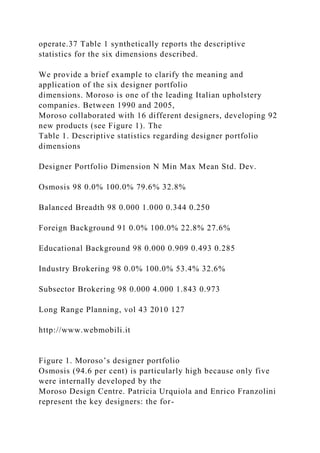
We provide a brief example to clarify the meaning and
application of the six designer portfolio
dimensions. Moroso is one of the leading Italian upholstery
companies. Between 1990 and 2005,
Moroso collaborated with 16 different designers, developing 92
new products (see Figure 1). The
Table 1. Descriptive statistics regarding designer portfolio
dimensions
Designer Portfolio Dimension N Min Max Mean Std. Dev.
Osmosis 98 0.0% 100.0% 79.6% 32.8%
Balanced Breadth 98 0.000 1.000 0.344 0.250
Foreign Background 91 0.0% 100.0% 22.8% 27.6%
Educational Background 98 0.000 0.909 0.493 0.285
Industry Brokering 98 0.0% 100.0% 53.4% 32.6%
Subsector Brokering 98 0.000 4.000 1.843 0.973
Long Range Planning, vol 43 2010 127
http://www.webmobili.it
Figure 1. Moroso’s designer portfolio
Osmosis (94.6 per cent) is particularly high because only five
were internally developed by the
Moroso Design Centre. Patricia Urquiola and Enrico Franzolini
represent the key designers: the for-
mer developed 23 products and the latter 18, consequently the
Balanced Breadth is low (0.166). The
Foreign Background is particularly high (55.4 per cent) because
more than half of the product port-
folio was developed in collaboration with foreign designers.
Moroso collaborated with creative re-
sources from different educational backgrounds showing a high
level of Educational Background
(0.826): 40.2 per cent of the product portfolio was created with
industrial designers; 39.1 per
cent with architects; 14.2 per cent with designers who had a
high school degree; and 6.5 per cent
with designers of a different educational background. More than
half of the product portfolio
was developed in collaboration with ‘‘cross-industrial’’
designers (Industry Brokering ¼ 58.7 per
cent). Finally, the Subsector Brokering is particularly high
(2.736) because designers who collaborate
with Moroso operate in an average of two to three subsectors.
Identifying innovative companies
In order to analyse the innovativeness of each company, we
examined the ‘‘Compasso d’Oro
Award’’, the most prestigious honour for design, products,
research and merit. The award, estab-
lished in 1954, is adjudicated by the ADI (Association for
Industrial Design) and is assigned to
products that are considered particularly innovative. It includes
a pre-selection process managed
by the Permanent Design Observatory, where a panel of design
language experts (critics, historians,
journalists, designers, architects and professors) collect
information, evaluates it and select the best
128 Collaborative Strategies in Design-intensive Industries
products. The jury is international, consisting of more than five
members randomly selected from
a pool of qualified researchers and experts from several
industries. We divided our sample into two
groups of companies: innovators and imitators. Some 21
manufacturers (21.4 per cent) are ‘‘Inno-
vators’’ because they have received (or have been selected for)
at least one ‘‘Compasso d’Oro
Award’’, while 77 companies (78.6 per cent) are ‘‘Imitators’’.
Some innovators have received just
one prize, while others have received several. For example,
Artemide has received four ‘‘Compasso
d’Oro Awards’’ and has been shortlisted three times. Kartell has
won one and has been shortlisted
five times.38 We believe that prizewinning products exploit the
accumulated knowledge developed
through the collaboration with several designers in several
previous projects. For this reason, we
consider the awards to be best associated with the companies
rather than with specific products
and, consequently, specific collaborations.
Results
As mentioned, this article aims to analyse the relationships
between the characteristics of a designer
portfolio that contribute to knowledge diversity and company
innovation. We adopt the t test to
compare the means for two groups of cases. More specifically,
we split our sample into innovators
and imitators in order to identify the distinctive characteristics
of creative collaborators.
Table 2 shows that innovators are characterised by Osmosis to a
significantly greater extent than
others. Innovators tend to rely on external designers to a greater
extent than their competitors. A
large part of their product portfolio is developed in
collaboration with external designers. In this
way, they can access knowledge about different socio-cultural
contexts and maintain a fresh prod-
uct offering. Innovators such as B&B Italia, Cassina, Edra,
Flos, Kartell and Zanotta have developed
the entire product portfolio in collaboration with external
designers.
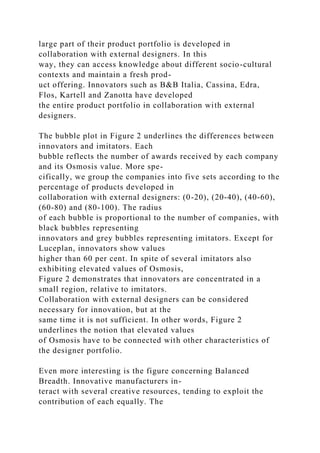
The bubble plot in Figure 2 underlines the differences between
innovators and imitators. Each
bubble reflects the number of awards received by each company
and its Osmosis value. More spe-
cifically, we group the companies into five sets according to the
percentage of products developed in
collaboration with external designers: (0-20), (20-40), (40-60),
(60-80) and (80-100). The radius
of each bubble is proportional to the number of companies, with
black bubbles representing
innovators and grey bubbles representing imitators. Except for
Luceplan, innovators show values
higher than 60 per cent. In spite of several imitators also
exhibiting elevated values of Osmosis,
Figure 2 demonstrates that innovators are concentrated in a
small region, relative to imitators.
Collaboration with external designers can be considered
necessary for innovation, but at the
same time it is not sufficient. In other words, Figure 2
underlines the notion that elevated values
of Osmosis have to be connected with other characteristics of
the designer portfolio.
Even more interesting is the figure concerning Balanced
Breadth. Innovative manufacturers in-
teract with several creative resources, tending to exploit the
contribution of each equally. The
Table 2. Designer portfolios - t test: Innovators vs. Imitators
Innovators Imitators T df
N 21 77
Osmosis 90.5% 76.6% �2.528* 69.328
Balanced Breadth 0.457 0.313 �2.973** 46.119
Foreign Backgrounda 45.7% 16.0% �4.847*** 89.000
Educational Background 0.716 0.432 �6.059*** 59.291
Industry Brokering 61.9% 51.1% �1.857 59.030
Subsector Brokering 2.234 1.736 �2.115* 96.000
*p < 0,05; **p < 0,01; ***p < 0,001.
a Including 70 imitators; 7 companies also have divisions
outside of Italy.
Long Range Planning, vol 43 2010 129
Figure 2. Osmosis e Innovators vs Imitators [radius is
proportional to the number of companies]
average number of external designers belonging to innovators’
portfolios is impressively higher than
that of the imitators’ portfolios (11.9 vs 4.4). For example,
innovators such as Artemide, Driade,
FontanaArte, Magis and Moroso collaborate with more than 15
freelance designers. Also, consid-
ering the ratio between the number of external designers and
number of products, innovators’
values are significantly higher than imitators’ metrics. As
mentioned in the Appendix, we have con-
sidered the contribution of the Gini dispersion index in the
definition of Balanced Breadth. This is
used to verify whether a company prefers to develop the
majority of its product portfolio in col-
laboration with a few designers or to engage with a broad range
of creative resources. Table 2 shows
that innovators’ Balanced Breadth is significantly higher than
that of imitators (0.457 vs 0.313).
Besides Osmosis and Balanced Breadth, the relationship
between knowledge diversity of creative
collaborators and company innovation is analysed in terms of
Foreign Background, Educational
Background, Subsector Brokering and Industry Brokering (see
Table 2). Innovators tend to develop
about half of their product portfolio in collaboration with
foreign designers (45.7 per cent), while
imitators show significantly lower values (16 per cent) for the
Foreign Background metric. The
empirical results show a curvilinear relationship between
innovation and the percentage of products
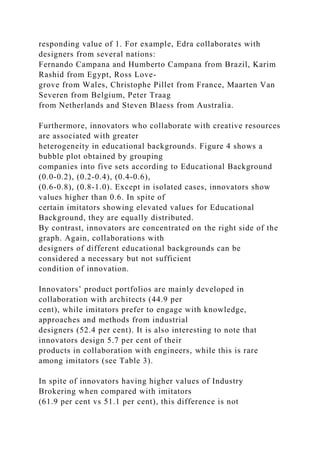
developed in collaboration with foreign designers. The bubble
plot for Foreign Background in
Figure 3 shows an inverted U-shaped curve: 42.6 per cent of
innovators belong to the central set
Figure 3. Foreign Background e Innovators vs Imitators [radius
is proportional to the number of
companies]
130 Collaborative Strategies in Design-intensive Industries
(40-60 per cent). Knowledge exchange driven by creative
resources from different countries allows
innovators to access new semantic contexts and to propose
innovations in product sign and mean-
ing. Innovators collaborate with designers from 5.3 different
nations, whereas imitators have a cor-
responding value of 1. For example, Edra collaborates with
designers from several nations:
Fernando Campana and Humberto Campana from Brazil, Karim
Rashid from Egypt, Ross Love-
grove from Wales, Christophe Pillet from France, Maarten Van
Severen from Belgium, Peter Traag
from Netherlands and Steven Blaess from Australia.
Furthermore, innovators who collaborate with creative resources
are associated with greater
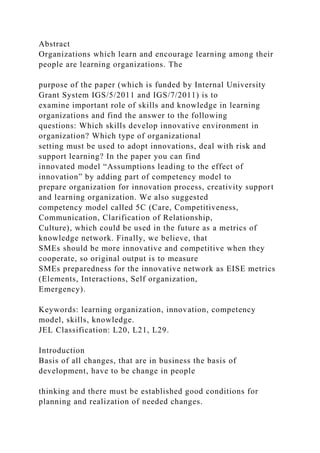
heterogeneity in educational backgrounds. Figure 4 shows a
bubble plot obtained by grouping
companies into five sets according to Educational Background
(0.0-0.2), (0.2-0.4), (0.4-0.6),
(0.6-0.8), (0.8-1.0). Except in isolated cases, innovators show
values higher than 0.6. In spite of
certain imitators showing elevated values for Educational
Background, they are equally distributed.
By contrast, innovators are concentrated on the right side of the
graph. Again, collaborations with
designers of different educational backgrounds can be
considered a necessary but not sufficient
condition of innovation.
Innovators’ product portfolios are mainly developed in
collaboration with architects (44.9 per
cent), while imitators prefer to engage with knowledge,
approaches and methods from industrial
designers (52.4 per cent). It is also interesting to note that
innovators design 5.7 per cent of their
products in collaboration with engineers, while this is rare
among imitators (see Table 3).
In spite of innovators having higher values of Industry
Brokering when compared with imitators
(61.9 per cent vs 51.1 per cent), this difference is not
statistically significant. Figure 5 shows a bubble
plot obtained by grouping the companies into five sets
according to their Industry Brokering values:
(0-20 per cent), (20-40), (40-60), (60-80) and (80-100).
Similarly to Foreign Background also
Industry Brokering shows an inverted U-shaped: innovators are
concentrated in a central set d 47.6
per cent of innovators belongs to the (60-80) group. Few
innovative companies, such as Driade,
Flos and FontanaArte develop more than 80 per cent of their
products in collaboration with
designers who operate across several industries. At the same
time, other innovators, such as B&B
Italia, Foscarini and Luceplan, show values lower than 40 per
cent. Future research could
explore this further by analysing whether specific industries can
significantly …
ISSN 1822-6515 ISSN 1822-6515
EKONOMIKA IR VADYBA: 2011. 16 ECONOMICS AND
MANAGEMENT: 2011. 16
954
COMPETENCIES AND INNOVATION WITHIN LEARNING
ORGANIZATION
Jarmila Šebestová1, Žaneta Rylková2
1Silesian University, Karvina, Czech Republic,
[email protected]
2Silesian University, Karvina, Czech Republic,
[email protected]
Abstract
Organizations which learn and encourage learning among their
people are learning organizations. The
purpose of the paper (which is funded by Internal University
Grant System IGS/5/2011 and IGS/7/2011) is to
examine important role of skills and knowledge in learning
organizations and find the answer to the following
questions: Which skills develop innovative environment in
organization? Which type of organizational
setting must be used to adopt innovations, deal with risk and
support learning? In the paper you can find
innovated model “Assumptions leading to the effect of
innovation” by adding part of competency model to
prepare organization for innovation process, creativity support
and learning organization. We also suggested
competency model called 5C (Care, Competitiveness,
Communication, Clarification of Relationship,
Culture), which could be used in the future as a metrics of
knowledge network. Finally, we believe, that
SMEs should be more innovative and competitive when they
cooperate, so original output is to measure
SMEs preparedness for the innovative network as EISE metrics
(Elements, Interactions, Self organization,
Emergency).
Keywords: learning organization, innovation, competency
model, skills, knowledge.
JEL Classification: L20, L21, L29.
Introduction
Basis of all changes, that are in business the basis of
development, have to be change in people
thinking and there must be established good conditions for
planning and realization of needed changes.
Already today we generally work with conception of standard
minimum level of knowledge and skills. It is
necessary to learn that human capital is the main asset of each
company, motive power for enterprise. In the
long term a sustainable high position in performance of
companies is getting currently into jeopardy
(entrepreneurship risk) and only human capital is the bottom
line for its overcoming.
Nowadays we are meeting with changes, which are managed,
that means with innovations, which
assume creative and untraditional thinking. New ideas and
vision formation, acceptation of all ideas,
formation of model situations – that all form the basis of change
command. Most frequently we are finding
the conception – systematic innovation - because innovations
play basic role in actual economics and social
transformation. Above mentioned produces a very flexible and
opened organization where people will accept
and adapt to new ideas and change through shared vision.
Building a learning organization is a means to
become an innovative company.
Learning Organization
By authors Senge (1990); Pedler, Burgoyne, Boydell (1991);
Garvin (1993), we define a learning
organization as an organization that is committed to learning.
By committed, we mean that the organization
is ready to change the way it does things by combining existing
knowledge or incorporating new knowledge.
Thus, organizational learning processes are neither necessary
nor sufficient conditions for a learning
organization. But, the existence of organizational learning
processes will help the organization to learn. We
define organizational learning as the organizational processes
aimed at adding value to the knowledge
acquired and communicated throughout the firm. As such,
organizational learning processes encompass the
acceptance and the assimilation of knowledge. We can say that
organizational learning is the process that
should lead to the building of firm´s competencies and that a
valuable learning experience will lead to firm-
specific, distinctive competencies.
Organizational learning is a strategic process and a learning
organization is the output of this process
that will allow the development of new or regenerated core
competencies and products. Many studies of
learning organizations have attempted to diagnose the
characteristics of learning organization. Although
different authors stress different elements, the characteristics of
the learning organization incorporated in this
study have been proposed important features: open
communications, risk taking, support and recognition for
mailto:[email protected]
ISSN 1822-6515 ISSN 1822-6515
EKONOMIKA IR VADYBA: 2011. 16 ECONOMICS AND
MANAGEMENT: 2011. 16
955
learning, resources to perform the job, teams, rewards for
learning, training and learning environment,
knowledge management.
Innovation and Learning
As for innovation, learning may occur at the individual, group,
organization and industry levels
(Shrivastava, 1993). As new outputs, innovations may come
from new knowledge as well as from the
combination of existing knowledge to create innovations
(Henderson and Clark, 1990), using combinative
capabilities. Learning means integrating new knowledge or
mixing existing knowledge in different ways,
learning leads to newness, and thus to innovation. Innovation
will be the by-product of a learning
organization. A learning organization is a innovative
organization. Organizational learning should be
positively related to innovation. If a company is good at
acquiring new knowledge and articulating existing
knowledge with new knowledge or existing knowledge in a
different way, this company should be good at
producing innovations (product or process). Furthermore, the
better the organizational learning process sis,
the greater the capacity to develop radical innovations (product
or process) will be.
It is important to know, that organizational learning is not
necessarily related to innovation´s success.
Innovation and innovation´s success are two different
dimensions. A successful learning organization leads
to the capacity to innovate (Burns and Stalker, 1961), which is
the ability of the organization to adopt or
implement new ideas, processes, or products successfully
(Hurley and Hult, 1998). There is important
strategy because if the innovation is not in line with the strategy
and the environment of the firm, the
innovation may fail and thus the learning-innovation link will
not be related to performance. Learning more
or faster does not imply that you learn that you have to in order
to perform better than your competitors.
Learning must be customized to the circumstances of an
organization and the work it conducts. Each
organization is different, but the work styles of any
organization fall under four models: process, systems,
network, and competence. Figure 1 highlights the characteristics
of particular work settings and hints thereby
at learning needs of each. In brief, the process and systems
models correspond to work settings that are
routine and require little interpretation. What is needed to
perform tasks is know-how, learning takes place
through generalized learning and development training with the
help of how-to guides. Evaluation and other
reports can help as well. However, the network and competence
models call for much higher levels of
judgment and depend on deeper understanding and insight as
well as an ability to improvise. Work on
policies, strategies, programs, and projects fits in these
domains.
Figure 1. Work Style Matrices (Serrat, 2009)
Competency Evaluation – Linkage for Innovation Thinking
Traditional models of skills cover only few variables like
structure of organization, climate, processes
and leadership without dynamic points such as behaviour of
elements (Damanpour, 1991; Kimberly and
Cook, 2008; Burke and Litwin, 1992). The research on the
influence of competency attributes on adoption
ISSN 1822-6515 ISSN 1822-6515
EKONOMIKA IR VADYBA: 2011. 16 ECONOMICS AND
MANAGEMENT: 2011. 16
956
and use of innovation usually suffers from variety of measured
issues. In these types of organizations there
are highly skilled people, but the outcome of learning by
innovation or knowledge activities is very limited
(Edmondson and Tucker, 2003). On the other hand, many
learning activities and innovative projects are
made as an answer on the market demand to support business
competitiveness. Under this point of view, it
could be mentioned, that many innovations are mostly presented
as “regional innovations”. Small businesses
offer their new services and products on the local market,
inspired by original global product, so they mostly
offer cheaper, home-made imitation of some innovation activity
(Pichlak, 2008).
In many case studies, firms between 10 to 49 employees are
proactive in the process of on-going
learning and innovative process. They are still under the
pressure from the market to offer unique product or
service to survive and to be competitive. There are existing
qualitative and quantitative barriers to support
innovative climate within organization based on owner´s
personality, financial sources and others
competencies which could cause low innovative activity (Ćwik,
2007).
The purpose of author’s practical research is to examine how
important role play skills and
knowledge in learning organizations and find the answer to the
following questions mainly theoretically
defined by Kimberly and Cook (2008) - (1) Which skills
develop innovative environment in organization?
(2) Which type of organizational setting must be used to adopt
innovations, deal with risk and support
learning? According to the review of literature that was carried
out in advance of any primary research
being undertaken, nobody has yet tried to combine this wide
area of skills to compare, represented by 120
qualitative items based on methodology of Scroggins and Rozell
(2007). A sustainable competitive
advantage is an advantage over competition that can be
maintained over a long time. To build a sustainable
advantage, company typically don´t rely on a single approach
such as low cost or excellent service. They
need multiple approaches to build their position (Zapletalová,
2008). This multiple approach based on
literature review, we managed research goals as follows:
• To innovate Practical model “Assumptions leading to the
effect of innovation” (2009) by adding
part of competency model to prepare organization for
innovation process, creativity support and
learning organization (600 active respondents).
• According this want to suggest competency model called as 5
C (Care, Competitiveness,
Communication, Clarification of Relationship, Culture), which
could be used in the future as a
metrics of knowledge network from pre-test phase of the
research.
• Finally, we believe, that SMEs should be more innovative and
competitive when they cooperate,
so original output is to measure SMEs preparedness for the
innovative network as EISE metrics
based on four pillars (Elements, Interactions, Self organization,
Emergency), which finally answer
the question of ongoing learning by doing and knowledge
sharing under networking process in
case of innovation oriented entrepreneurs.
Competency Model Structure
The on-line questionnaire collected data from 608 active
respondents in the Czech Republic, (during
period of July to December 2010; pre-test phase off-line 120
respondents June to September 2009), who
identify main competencies needed for business success.
Research sample was formed from people who in
the past provided their own business in the role of business
owners (22.2 %) and 77.8 % in the role of
employee (current situation: employees 82.6% active business
owners 17.4%). Respondents described their
current company as very small (up to 9 employees in 25.8%),
then as small (10 to 49 employees; 31.4%),
medium company (50-250 employees; 20.6%) and final group of
respondents reached their job in the large
company (250+ employees; 22.2%).
The analysis is based on statistic data analysis multidimensional
statistic methods in qualitative
research area, using Principal Components Analysis (PCA). All
collected data were processed in SPSS for
Windows, ver. 18. To get more sophisticated results and to
identify dominant tendencies, we used PCA with
a VARIMAX rotation (factor loading minimization);
applicability of data was examined by the Bartlett’s test
of sphericity with the values of the presented results being
under P<0.05 and for all the data we used the
Kaiser-Meyer-Olkin Measure of Sampling Adequacy (KMO)
with a recommended minimum value of 0.6
(Sharma, 1996). We used only factors with inter-factor
correlation coefficient value more than 0.5 and
accounted their share on the total competence model as 100%.
Secondly, the research sample was divided
into two groups by the gender to compare preferences within
examined groups (see illustration below).
ISSN 1822-6515 ISSN 1822-6515
EKONOMIKA IR VADYBA: 2011. 16 ECONOMICS AND
MANAGEMENT: 2011. 16
957
Figure 2. ProInno Skills & Behaviour
In comparison, it could be seen significant differences between
business behaviour in the behavioural
model (Pawliczek, 2006). It seems that small businessman
understood that not only basic managerial
knowledge and procedures like organising, analysing are the
way for the success, but you need some other
special skills for the position of the innovator as a part of the
model maximizing effect of innovations.
Competency Model for Sharing Knowledge
Due to comparison between primary data and existing
cooperative structures analysis, some extra
value added occasion could be mentioned as an advantage of
synergy effect of clustering businesses, who
share the knowledge. After that we should suggest mix of
qualitative variables, which have influence on
competency development at the second stage of the learning
organization and are significant for innovations
and learning organizations as well.
Figure 3. 5 “C” Sharing knowledge value pyramid
In the figure 3, these simple values mean: (1) Care –
development of “database of knowledge”, shared
by network members, (2) Competitiveness – network has
synergy effect and better money allocation, (3)
Communication - effective level between network members,
negotiation skills development, (4) Clarification
of Relationship - this supports all sequences of cooperation in
service providing and new methods transfer
(5) Culture – education building, cooperation spirit support.
EISE Metrics for Networking
The best solution, how to explain current situation in the area of
building learning organizations for
innovation is to provide practical case study in high knowledge
intensive services. In order to understand the
ISSN 1822-6515 ISSN 1822-6515
EKONOMIKA IR VADYBA: 2011. 16 ECONOMICS AND
MANAGEMENT: 2011. 16
958
behaviour of physicians as entrepreneurs we must prepare a
questionnaire as a primary data source to
describe the integrating behaviour in general for hospitals,
physicians, pharmacies and other business units,
which were in the sector of health care service in 2009 with two
basic hypotheses in area of 160 active
respondents in the Moravian-Silesian Region.
Two research were follows: Hypothesis H1 “Cooperation will be
based mainly on informal
relationships and knowledge networking will be a useful output
of cooperation”. This hypothesis is valid
only for businesses of up to 100 employees. After that the
situation changes, the relationship is mainly
formal, the stakeholders and managers do not concentrate on
cooperation in knowledge sharing and
emergency knowledge network building.
Hypothesis H2 “Cooperation is considered to be primary in the
clinical chain”. This is based on two
types of knowledge chains in these organizations (1) Clinical
chain based on highly educated people and
experience, because this work requires a high level of cognitive
knowledge (2) Health care supply chain
which covers the relationship with suppliers like laboratories,
pharmacies and other suppliers of services,
equipment covered by the full service (mainly outsourced
service). This hypothesis was not verified. Every
business unit is primarily concerned with cutting costs, so the
first stage of cooperation is in the health care
supply chain. Because of this there is now room for
recommendations about cooperation in knowledge
management in small businesses.
For the integration model McDaniel and Driebe’s (2001)
suggestion was used and it was
accommodated in the conditions of the local environment. If we
want to integrate these special types of
organizations, we have to accept that in emergency situations
they may need a different type of knowledge.
Some of them need knowledge about business, some about
nursing, some about new drugs or helpful
information about problems and diseases of patients. Market
forces provide an ideal environment for creating
vertical cooperation structures with virtual (IT) support. There
are multiple strategies and ways how to
coordinate health services to provide managed care in a
multidimensional business environment.
Figure 4. EISE metrics
We must count on the following main parts of the system:
• Elements - benefits: practical on any level, could help
assessments, enhance behaviour, could be
one general practitioner unit, or a department as a part of the
Emergency Knowledge Network.
For preparedness to postpone non-formal to formal cooperation
Florence index of specialization.
• Interactions - dynamic, maximizing potential shows that the
system is still generating new ideas,
creates added value.
• Self organization - independently creates an informal
relationship between members and could
help to develop some other “part” of the network.
• Emergency unit – help line or practice cases suggests more
focus on decisions, running
continuous learning, this is an output of cooperation, it is
fundamental, not just a powerful
analytical technique.
All of the network members must believe in common values for
knowledge management in this field:
(1) Everything we do must make sense – in an emergency
situation it is important to support a collective
mindset and pay attention to business survival, we must also
interpret the events around the situation. (2)
Continuous learning-dynamic model to prevent errors or failing
to provide the service. (3) Thinking about
the future – generating knowledge about processes,
opportunities, payers, interactions. (4) Being active and
dealing with unforeseen events, because is it based on a
community of practice – work in the same branch,
learn faster, conversation, new introduction.
ISSN 1822-6515 ISSN 1822-6515
EKONOMIKA IR VADYBA: 2011. 16 ECONOMICS AND
MANAGEMENT: 2011. 16
959
Discussion
Our work suggests that learning is a key to addressing these
challenges successfully. Companies need
to demonstrate that learning leads to innovation and bottom line
results. A learning organization has than a
culture that supports learning and innovations both by
individuals and by the organization itself. We can say
that the concepts of the learning organization and knowledge
management are increasingly seen as two sides
of the same coin – as you learn you gain knowledge which you
apply and learn more. Figure 5 shows the
assumptions leading to the effect of innovation. The figure
shows that company is operating in external
environment which encourages and supports or not supports
development. The company itself produces
products or services and solve problems such as where to obtain
funds, information, competencies,
customers, knowledge etc. The behaviour of the company
influences the market. Influence of the market is
much difficult than before, therefore it is necessary to establish
new forms of cooperation and to pay
attention for building the learning organization. Moreover, all
these have to be taken into account in
development strategy of company, which is necessary to
formulate and implement. Development strategies
should include prerequisites for innovation, organizational
learning and should lead to achieving an effect.
Figure 5. Expectations Influencing the Effect of Innovation
The effect should be connected with measurability, it is
necessary to collect not only quantitative but
also qualitative criteria, to monitor market position and build
innovative culture which should be in close
conjunction with the learning organization. We can´t have
innovation without organizational learning. The
organizations that will truly excel in the future will be the
organizations that will truly tap people´s
commitment and capacity to learn at all levels in an
organization. Organizational learning, competencies and
knowledge management have a purpose insofar they contribute
to the success of a company and its
competitive advantage. In a short term the contribution may by
direct, in the long term it can only be
achieved through learning and innovation. Leaders of companies
that will bring value to their stakeholders
now and in the future have to lead their knowledge workers in
their learning efforts and provide guidelines
for change. They also need to realize that knowledge is product
of learning, a process that requires
management and consideration equal to any other most
important activity of company. Organizational
learning has to be viewed as the core corporate resource that has
to be organized and maintained. It´s
production never can be limited or restricted to any one topic
but it has to have a purpose and be evaluated
for its contribution to value creation. Innovations have become
important determinant, but also necessity.
ISSN 1822-6515 ISSN 1822-6515
EKONOMIKA IR VADYBA: 2011. 16 ECONOMICS AND
MANAGEMENT: 2011. 16
960
Their economical and business importance predestines
developmental tendency and performance growth in
economics of states and companies. In management of
innovation there is purposeful to understand under
innovation a creative human activity, which developed positive
change in structure of entrepreneurial
subjects and which has results in required and expected positive
effect.
Conclusion
The challenge facing managers today is to make the effort
needed to learn some of the new skills and
techniques, and to put in processes that engage their workforce
in programmes of continuous capability
development. Learning should be integrated into the doing, as
part and parcel of everyday work. It should
also be energising, stimulating and fun. Getting the best out of
everybody, including yourself to meet the
challenges ahead. In today´s conditions of uncertainty and rapid
change, many organizations need to reassess
focus and direction quickly, rethink how people work together
and learn for innovation.
References
1. Burke, W. W., Litwin, G. H.: A causal model of
organizational performance and change. “Journal of
Management”,1992, vol.18, pp. 523–545.
2. Ćwik, K.: Elastyczność i innowacyjność a zachowania
strategiczne przedsiębiorstw, „Zarządzanie” No. 5 Prace
Naukowe Akademii Ekonomicznej We Wrocławiu Wydawnictwo
Akademii Ekonomicznej im. Oskara Langego
we Wrocławiu Wrocław 2007 [in Polish].
3. Damanpour, F.: Organizational innovation: A meta-analysis
of effects of determinants and moderators. “Academy
of Management Journal”, 1991 vol.34, pp.555–590.
4. Edmondson, A. C., Tucker, A. L.: Why hospitals don't learn
from failures: organizational and psychological
dynamics that inhibit system change. “California Management
Review”, 2003 Vol. 45, No. 2. p. 55-72.
5. Henderson R. M., Clark K.C.: Architectural Innovation: the
Reconfiguration of Existing Product Technologies and
the Failure of Established Frims. [in:] Administrative Science
Quarterly, 35.
6. Hurley, R. F., Hult G. T.: Innovation, Market Orientation,
and Organizational Learning: an Integration and
Empirical Examination. [in:] Journal of Marketing, 62.
7. Ilangovan, A., Scroggins, W.A. Rozell, E.J. Managerial
Perspectives on Emotional Intelligence Differences
Between India and the United States: The Development of
Research Propositions. “International journal of
Management” 24/3 , 2007 541-549
8. Kimberly, J.,Cook, J. M. Organizational Measurement and
the Implementation of Innovations in Mental Health
Services. “Administration and Policy in Mental Health and
Mental Health Services Research” ,2008, vol. 35,
pp.11-20.
9. Lehman, W. E. K., Greener, J. M., Simpson, D. : Assessing
organizational readiness for change. “Journal of
Substance Abuse Treatment”, 2002, pp.197–209.
10. McDaniel, R.R., Driebe, D. J. : Complexity Science and
Health Care Management. [in:] John D. Blair, Myron D.
Fottler and Grant T. Savage, (Eds.) Advances in Health Care
Management, Stamford, CN: JAI Press, 2001, volume
2, pp. 11-36.
11. Pawliczek, A. : Podnikání ve výzkumu a vývoji, inovace a
start-up (spin-off). Distanční studijní opora ke kurzu v
projektu ESF CZ.04.1.03/3.215.1/0103. 87 s. Ostrava, 2006 [in
Czech].
12. Pedler M., Boydell T., Burgoyne P.: Towards the Learning
Company, [in:] Management Education and
Development, Vol.20, No.1, 1989.
13. Pichlak, M.: Finansowe aspekty innowacyjności
przedsiębiorstw w województwie śląskim. „Organizacja i
Zarządzanie”. Kwartalnik Naukowy nr. 2/2008. 5-16 [in Polish].
14. Senge P. M.: The Fifth Discipline: the Art of Organizational
Learning Systems. Currence Doubleday, 1990. ISBN
0-385-26095-4.
15. Serrat, O.: Dimensions of the Learning Organization, 2009
[in:]
http://www.adb.org/Documents/Information/Knowledge-
Solution
s/Dimensions-Learning-Organization.pdf.
16. Sharma, S.: Applied Multivariate Techniques. New York:
John Wiley & Sons, 1996.
17. Tichá I.: Učící se organizace, Alfa Publishing, 2005. ISBN
80-86851-19-2. [in Czech].
18. Vlček R.: Hodnota pro zákazníka, Management Press, 2002.
ISBN 80-7261-068-6. [in Czech].
19. Zapletalová, Š. : The Influence of Globalization Process on
the Business Management of Entrepreneurial Subjects
in Central and Eastern Europe. “Current Issues of Business and
Law”, 2008. pp. 167-173.
Copyright of Economics & Management is the property of
Kaunas University of Technology, Faculty of
Economics & Management and its content may not be copied or
emailed to multiple sites or posted to a listserv
without the copyright holder's express written permission.
However, users may print, download, or email
articles for individual use.
Managing for Innovation: The Two
Faces of Tension in Creative Climates
Scott G. Isaksen and Göran Ekvall
Part of managing for innovation is creating the appropriate
climate so that people can share
and build upon each other’s ideas and suggestions. Yet, there
are increasing pressures and
potential unproductive levels of tension within organizations.
This article points out the
distinction between two forms of tension that appear within the
research on organizational
climates for creativity as well as the conflict management
literature. The Debate dimension is
described as reflecting a more productive idea tension and the
Conflict dimension suggests a
more non-productive personal tension. A series of studies,
across multiple levels of analysis,
are summarized and a new study is reported in order to
highlight the finding that relatively
higher levels of Debate, and lower levels of Conflict are more
conducive to organizational
creativity and innovation. A practical model for the constructive
use of differences is shared,
along with a few strategies for reducing the negative tension
associated with Conflict and
increasing the positive aspects associated with Debate.caim_558
73..88
Introduction
The deliberate management of a climatesupportive of innovation
is a key challenge
for those who lead and manage organizations.
There is no question that these times reflect
clear demands for dealing with the increasing
pace of change, daunting levels of complexity
and broadening competitive pressures. In
addition to these sources of tension within
organizations, we see increasingly high expec-
tations for improved performance by stock-
holders and stakeholders, increased pressure
to cut costs, particularly through downsizing;
doing more with less, or doing everything
better, faster and cheaper. In this rather stress-
ful context, it is increasingly challenging for
people to get along with each other (Fløistad,
2000) and keep meeting the innovation chal-
lenge on the strategic agenda (Isaksen & Tidd,
2006).
The first purpose of this article is to offer
insights to those who manage the creative
tension within organizations. There is suffi-
cient theoretical support for the notion that
creativity involves tension (Arieti, 1976). Cre-
ative tension results from the inherent differ-
ence between current reality and some desired
new future (Fritz, 1991). It also results from the
epistemological nature of the concept itself
(Hausman, 1984). Creativity is often conceived
as relating to something that is new, novel or
original; and useful, relevant and valuable.
Useful newness implies a conceptual overlay
that often includes a synthesis of opposites
and a resolution of creative tension (Rothen-
berg & Hausman, 1976; Rothenberg, 1979).
How this creative tension is perceived and
managed can make a meaningful difference in
whether or not its resolution results in innova-
tion – the implementation or use of new ideas
and solutions. Further, although creativity is
distinct from the concept of innovation
(Shalley & Gilson, 2004), it is often conceived
as either a prerequisite or necessary condition
for innovation (West, 2002).
Second, this article explores the potential
relationship the creativity literature may make
to an area within the management literature.
Xu and Rickards (2007) asserted that: ‘creativ-
ity and management studies remain domains
which have failed to become harmonized to
mutual benefit’ (p. 217). Two parallel, yet dis-
tinct, streams of research have yet to be harmo-
nized. The first is within the domain of
creativity research and includes a focus on the
climate for creativity and innovation. The
second is within the domain of manage-
ment and organizational studies that deals
with the management of conflict – and
TWO FACES OF TENSION IN CREATIVE CLIMATES 73
Volume 19 Number 2 2010
doi:10.1111/j.1467-8691.2010.00558.x
© 2010 Blackwell Publishing Ltd
particularly whether or not conflict can be
productive.
The issues addressed in this article fit within
the broader domain of literature regarding the
importance of how a sense of positive engage-
ment and well-being, at an individual and
organizational level of analysis, affect creativ-
ity and innovation. It has been argued that
setting appropriate conditions for creativity
and innovation results in higher levels of orga-
nizational creativity and innovation, as well as
better individual psychological well-being
(Rasulzada & Dackert, 2009).
Theory, and some empirical evidence,
suggest that when people experience positive
interaction, lower levels of stress, and feel
valued, they are more likely to engage in cre-
ative behaviours, generate creative ideas, and
solve problems creatively (Fredrickson, 2001;
Cohen-Meiter, Carmeli & Waldman, 2009).
When employees feel a deeper sense of
engagement and experience a climate condu-
cive to creativity, numerous business benefits
result, including higher levels of innovation
(Harter, Schmidt & Keyes, 2002; Vincent,
Bharadwaj & Challagalla, 2004).
The opposing condition results from unpro-
ductive manifestations of tension and is evi-
denced by high levels of occupational stress
(Johnson et al., 2005), bullying in the work-
place (Lutgen-Sandvik, Tracey & Alberts,
2007) and workplace incivility (Pearson &
Porath, 2005). It is difficult, at best, to maintain
a focus on creativity – the making and com-
municating of meaningful new connections –
within a workplace environment filled with
unproductive tension (Ekvall, 1997). The many
forms of negative tension that exist in work-
places today serve as a barrier and distraction
to effectively meeting the innovation chal-
lenges organizations face.
The final purpose of this article is to provide
a model for the constructive use of differences
and outline some practical ways leaders and
managers can manage the two faces of tension
in order to provide an improved climate for
creativity and innovation.
Conflict in the Conflict Management
Literature
Conflict in organizations is a core tension that
arises naturally when people experience inter-
dependencies, and they are embedded in
structures and systems that attempt to con-
strain or control their behaviour (Gelfand,
Leslie & Keller, 2008; Jaffee, 2008). Within the
conflict stream of research, some studies point
out the positive effects of conflict (e.g., Tjos-
vold, 2008) and others assert that conflict
yields more negative and non-productive
effects in the work environment (De Dreu,
2008).
The literature differentiates three types of
conflict. The first is called task conflict and
refers to disagreements focused on work
content and includes differences in view-
points, ideas and opinions. Some studies have
found that this type of conflict can produce
positive outcomes (Amason, 1996; De Dreu,
2006). Other studies have demonstrated that
task conflict has a debilitating effect on
employee performance (Kahn, Afzal &
Rehman, 2009). Still other studies have argued
for a curvilinear relationship between task
conflict and organizational outcomes such as
innovation (DeDreu, 2006; Jehn, 1995).
The second type is referred to as emotional,
relationship or affective conflict and is charac-
terized by anger, aggression, frustration or
hostility among or between individuals on a
personal level. This type of conflict has been
consistently associated with harmful effects on
task performance and satisfaction (Janssen,
Van de Vliert & Veenstra, 1999; De Dreu &
Weingart, 2003).
The third type is called process conflict and
refers to disagreements over the approach to
the task, the desired group processes, and the
method the group chooses to follow. Process
conflict, like affective or emotional conflict, has
generally been linked to numerous negative
effects (Jehn & Mannix, 2001). Some studies
have found that high performing groups have
moderately high levels of task conflict and
little or no process conflict (Jehn, 1997). These
different types of conflict have been shown to
coexist within organizations (De Dreu & Wein-
gart, 2003; Tidd, McIntyre & Friedman, 2004).
Conflict appears to be an inevitable part of
the work environment. A recent global survey
found that 85 per cent of employees across
levels in organizations experience conflict to
some degree (CPP, 2008). According to this
same survey, US employees spent 2.8 hours
per week dealing with conflict at an estimated
cost of $359 billion in paid hours for 2008.
One of the challenges within the conflict lit-
erature is the argument about whether or not,
and under what conditions, conflict can be
positive and productive (DeChurch, Hamilton
& Haas, 2007; Behfar et al., 2008), or dis-
tinguishing between the constructive and
destructive aspects of conflict (Deutsch, 1973).
Tjosvold (2008) argued that since conflict is
both inevitable and potentially constructive,
organizations should become ‘conflict posi-
tive’. This position is based on establishing
conditions in which conflict can be managed
co-operatively and workers can discuss their
differences openly. De Dreu’s (2008) position
74 CREATIVITY AND INNOVATION MANAGEMENT
Volume 19 Number 2 2010
© 2010 Blackwell Publishing Ltd
was that conflict generally hinders, rather than
helps, individuals and teams, and that con-
structive controversy and integrative negotia-
tion are critically needed to mitigate the
negative effects of workplace conflict.
Gelfand, Leslie and Keller (2008) offer
support for the need to improve our under-
standing of the features within organizations
that constrain or enable appropriate conflict
management – to understand how best to
manage conflict in organizations. They argue
that conflict management processes must be
intricately linked to the organizational context.
The distinctions being drawn within the con-
flict management literature appear to have par-
allels with the creative climate literature. The
next section will highlight our approach to
understanding and assessing the climate for
creativity and innovation.
The Climate for Creativity and
Innovation
Research and inquiry into the quality of the
work environment has become a compelling
and vibrant area of scholarship and applica-
tion (Kuenzi & Schminke, 2009). The question
of climate in organizations and work groups
that support creativity and innovation, as one
facet of the larger work environment litera-
ture, has been the subject of studies and theory
construction for several decades (Johns, 2006).
In a recently published meta-analysis and
review of 42 such studies including data from
14,490 participants, climate assessments were
found to evidence sizable, non-trivial relation-
ships with creative achievement across studies
(Hunter, Bedell & Mumford, 2007). The study
concluded that ‘all the dimensions commonly
examined in the climate studies produced
sizeable effects with respect to measures of
creativity and innovation’ (p. 76).
Questionnaires with rating scales for
recording the organization members’ percep-
tions of climate conditions have been applied
in several research programmes concerning
the creative climate. Often, the climate concept
has been considered ‘objectivistic’ (Ekvall,
1987), implying that the climate is conceived as
an organizational reality, a property of the
organization containing recurrent patterns of
behaviour, attitudes and feelings that charac-
terize life in the organization. Aggregated
values of the ratings, usually mean scores of
the climate dimensions identified in the
ratings, allow for the measurement of climate.
Organizational climate, in this sense, is distinct
from organizational culture, which reflects the
deeper and more stable aspects of values, tra-
ditions, rituals and history (Denison, 1996).
Research on organizational culture has typi-
cally focused on the underlying assumptions
and values of the organization that are deeply
embedded and can often be subconscious,
hidden and taken for granted (Schein, 2004).
Climate, on the other hand, is seen as a collec-
tive perceptual construct reflecting a lower
level of abstraction based on observed patterns
of interaction and behaviour (Schneider, 2000).
Two co-ordinated research programmes,
one in Scandinavia (Ekvall, 1996, 1997) and one
in the US (Isaksen & Ekvall, 2007), have iden-
tified two distinct kinds of tension in organi-
zational climate that have an impact on
creative and innovative outcomes.
The questionnaire measuring climate in
Scandinavia is called the Creative Climate
Questionnaire (CCQ) and the questionnaire
applied in the US studies is designated the
Situational Outlook Questionnaire (SOQ). The
CCQ and SOQ have been shown to have
adequate levels of internal reliability (Cron-
bach’s alphas ranging from 0.69 to 0.92) and
stability over time (Isaksen & Ekvall, 2007). As
a result of a series of exploratory factor analy-
ses using a variety of extraction and rotation
approaches, the dimensions of both measures
have shown a coherent internal factor struc-
ture reflecting the dimensions they are
designed to measure (Isaksen, 2007a). The
results from these studies consistently show
that the dimensions are factorially indepen-
dent. Confirmatory factor analysis on 225
samples of convenience including 7,345
respondents to the SOQ items resulted in a
goodness of fit index (GFI) of 0.88, an adjusted
goodness-of-fit index (AGFI) of 0.87, a
normed-fit-index (NFI) of 0.89, and a root-
mean-square error of approximation (RMSEA)
of 0.047, indicating an adequate fit of the nine-
dimensional model. Given the relatively large
and diverse sample, these results are likely a
conservative estimate of fit (Cheung & Rens-
vold, 2002).
The climate dimensions of both measures
have supportive evidence of their relationship
to other variables and measures. For example,
the climate dimensions correlate significantly,
and in expected directions, with the Survey of
Creative and Innovative Performance (Puccio,
Treffinger & Talbot, 1995) and the Work Envi-
ronment Inventory, an earlier version of KEYS
(an assessment of the work environment
for creativity; Ryhammer, 1996). The climate
dimensions are described in Table 1.
The climate dimensions have shown posi-
tive relationships to a number of outcome vari-
ables including higher sales volume, market
share, productivity and profitability, reported
greater impact from implementing new social
and technical systems (like self-managed
TWO FACES OF TENSION IN CREATIVE CLIMATES 75
Volume 19 Number 2 2010
© 2010 Blackwell Publishing Ltd
teams), and improved ability to implement
more complex work designs (Firenze, 1998).
Davis (2000) conducted a global innovation
survey and found that those organizations
with better scores on the climate dimensions
had higher levels of growth in market capitali-
zation, revenues and profitability.
The climate dimensions have been able to
discriminate between best- and worst-case
work environments (Isaksen et al., 2001), most
and least creative teams (Isaksen & Lauer,
2002), and levels of perceived support for
innovation (Isaksen & Lauer, 2001). The climate
dimensions have also been shown to discrimi-
nate working environments that are more
stress free and have higher levels of job
satisfaction (Talbot, Cooper & Barrow, 1992;
Turnipseed, 1994; Ślusarczyk, 2005). Thus,
establishing a climate for creativity may
mitigate many of the sources of tension out-
lined above.
The Two Faces of Tension in the
Creative Climate
Ekvall initially developed the CCQ based on
his practical experiences studying idea sug-
gestion systems and the implementation of
new management practices within Swedish
industry (Ekvall, 1967, 1971). His experiences
and research led him to observe that the suc-
cessful implementation of these systems was
dependent, in large part, on the working atmo-
sphere within the organization. Within the
early work on developing the CCQ, tension
was conceived and measured as a single
dimension (Ekvall, 1983; Ekvall, Arvonen &
Table 1. The Creative Climate Dimensions
Dimension Definition
Challenge/Involvement The degree to which people are involved
in daily operations,
long-term goals, and visions. High Challenge/Involvement
implies
better levels of engagement, commitment and motivation.
Freedom The degree of independence shown by the people in
the
organization. High levels of Freedom imply more perceived
autonomy and ability for individual discretion.
Trust/Openness The emotional safety in relationships. In high
Trust/Openness
situations, people feel more comfortable sharing ideas and being
frank and honest with each other.
Idea-Time The amount of time people can, and do, use for
elaborating new
ideas. When Idea-Time is high, people can explore and develop
new
ideas that may not have been included in the original task.
Playfulness/Humour The spontaneity and ease displayed within
the workplace.
Good-natured joking and laughter and a relaxed atmosphere
(lower
stress) are indicators of higher levels of Playfulness and
Humour.
Conflict The presence of personal and emotional tensions (a
negative
dimension – in contrast to the Debate dimension). When
Conflict is
high, people engage in interpersonal warfare, slander and
gossip, and
even plot against each other.
Idea-Support The way new ideas are treated. In a high Idea-
Support situation,
people receive ideas and suggestions in an attentive and
professional
manner. People listen generously to each other.
Debate The occurrence and open disagreement between
viewpoints, ideas,
experiences and knowledge. In the Debating situation, many
different
voices and points of view are exchanged and encouraged.
Risk-Taking The tolerance of uncertainty and ambiguity. In a
high Risk-Taking
climate, people can make decisions even when they do not have
certainty and all the information desired. People can and do ‘go
out
on a limb’ to put new ideas forward.
76 CREATIVITY AND INNOVATION MANAGEMENT
Volume 19 Number 2 2010
© 2010 Blackwell Publishing Ltd
Waldenström-Lindblad, 1983). Later, it became
apparent that there were two very different
kinds of tension within the climate. One
appeared to be more healthy and supportive
of creativity within the workplace focusing on
idea or intellectual tension, and the other
seemed to be more negative and suppressed
creativity focusing on personal tension.
These two different forms of tension were
labelled Debate and Conflict. From a purely
conceptual standpoint, debate means the
exchange of different or opposing points of
view. A debate implies a regulated discus-
sion during which opposing arguments are
exchanged and considered. The conflict
concept is usually defined as disagreement as
well, but also carries a more negative and per-
sonal meaning. Conflict implies emotional and
personal tension resulting from incompatible
inner needs or drives and is synonymous with
war and battle (Jehn, 1997). When applying
these concepts to the task of defining climate
dimensions – patterns of behaviour that char-
acterize life in a workplace – the following
descriptions result.
The Debate Climate Dimension
Debate within the climate is the occurrence of
encounters and disagreements between view-
points, ideas and differing experiences and
knowledge (Isaksen & Ekvall, 2007). In the
debating organization, many voices are heard
and people are keen on putting forward their
ideas for consideration and review. People can
often be seen discussing opposing opinions
and sharing a diversity of perspectives. Where
debates are missing, people follow autho-
ritarian patterns without question (a = 0.883;
Isaksen & Ekvall, 2007).
Examples of Debate items with manifest
factor loadings include: ‘many different points
of view are shared here during discussion’
(0.92), ‘differences of opinion are frequently
expressed here’ (0.86), ‘people here often
exchange opposing viewpoints’ (0.81), and ‘a
wide variety of viewpoints are expressed here’
(0.78).
The Debate aspect of the creative climate has
been touched upon in other research pro-
grammes and theories. Hunter, Bedell and
Mumford (2007) presented a general tax-
onomy of 14 climate dimensions that encom-
passed 90 per cent of the climate variables
appearing in prior research. One of these was
labelled Intellectual Stimulation and defined
as perception that debate and discussion of
ideas (not persons) was encouraged and sup-
ported in the organization. Anderson and
West (1998) described the Team Climate
Inventory and the four-factor model of work
group innovation and indicated the impor-
tance of ‘exploration of opposing opinions’.
Further support for the importance of debate
comes from the domains of constructive con-
troversy (Deutsch, 1949; Tjosvold, Wedley &
Field, 1986) and procedural justice (Tyler &
Blader, 2000). Studies have indicated that
co-operation tends to promote greater produc-
tivity and more positive relationships, but
some have argued that competition can be
constructive as well. For example, Tjosvold
et al. (2006) found that when competition is
fun, engaging, and the actions of people
involved are perceived as fair, tension can be
productive.
Further support for the construct of Debate
is found in the literature on creative leader-
ship. For example, Mumford et al. (2002)
found that one of the key elements in creating
a climate for creativity was the role that leaders
and managers play in establishing an en-
vironment that supports the generation and
exchange of diverse ideas.
The Conflict Climate Dimension
Conflict, from a climate perspective, is
defined as the presence of personal and emo-
tional tensions in the organization (Isaksen &
Ekvall, 2007). When the level of conflict is
high, groups and individuals dislike and may
even hate each other. The climate can be char-
acterized by ‘interpersonal warfare’. Plots,
traps and power or territory struggles are
usual elements in the life of the organization.
Personal differences yield gossip, slander and
backstabbing. In the opposite case, people
behave with much less negative affect; they
have psychological insight and control of
their impulses. Also, people accept and deal
effectively with diversity (a = 0.856; Isaksen
& Ekvall, 2007).
Examples of Conflict items with manifest
factor loadings include: ‘there is a great deal of
personal tension here’ (0.84), ‘there are quite a
few people here who cannot tolerate each
other’ (0.81), ‘it is common here to have people
plot against each other’ (0.81), and ‘there are
power and territory struggles here’ (0.76).
Conflict can manifest from high levels of
occupational stress, in which employees and
colleagues perceive so much pressure that
they fail to control their impulses or behave in
a mature manner having a detrimental effect
on creativity (Talbot, Cooper & Barrow, 1992).
Conflict can also be seen through the occur-
rence of bullying or incivility in the workplace
(Pearson & Porath, 2005). Conflict can produce
lower levels of job satisfaction and a decreased
sense of well-being (Turnipseed, 1994).
TWO FACES OF TENSION IN CREATIVE CLIMATES 77
Volume 19 Number 2 2010
© 2010 Blackwell Publishing Ltd
Results from Previous Climate
Studies on Debate and Conflict
The Scandinavian studies with the CCQ, and
the US studies with the SOQ, present informa-
tion about the two tension dimensions that
might be of importance for leadership and
organizational policy concerning innovation
and development. The distinction made
between idea tension in the Debate dimension
and personal tension within the Conflict
dimension may provide an additional concep-
tual lens within the scientific argument for and
against conflict (De Dreu, 2008; Tjosvold,
2008).
The following summaries are presented to
illustrate the clear difference between Conflict
and Debate across cultures, and on a variety of
levels of analysis. The original cited sources
provide more detail on the purposes, methods,
sampling and results. It should be noted that
these studies are descriptive in nature, and that
we cannot be sure if the climate affects innova-
tion, or if it is the other way around. Perhaps the
higher levels of innovation impact the climate.
Further research will be required to establish
the causal nature of the relationships.
Ekvall (1991) studied the innovative capacity
of 30 small Swedish companies (no more than
200 employees each). Ten of the companies
were distinctly innovative in developing new
products and services to meet changes in the
market, whereas five of them had not suc-
ceeded in doing that; they had performed
innovatively earlier, but lost those capacities
and stagnated. Table 2 presents mean scores on
the Debate and Conflict dimensions of the
companies, as well as the means for the other
studies summarized in this article. People in
the innovative companies perceive consider-
ably more Debate (x2 = 0.52, p < 0.01) and less
Conflict than people in the stagnated compa-
nies (x2 = -0.61, p < 0.001).
Perceived support for innovation has been
identified as an important element within the
working environment that supports creativity
(Amabile et al., 2004). Isaksen and Lauer
(2001) studied the level of support for innova-
tion of 1,830 individuals and compared their
climate results for four groups: ‘Not support-
ive’, ‘Supportive to some extent’, ‘Fairly sup-
portive’ and ‘Highly supportive’. A one-way
analysis of variance (anova) showed that the
differences were significant. Regarding the
Table 2. Debate and Conflict Scores Across Studiesa
Description of study Average
Debate
scores
Average
Conflict
scores
Ekvall (1991) Study of Innovative and Stagnated Organizations
10 Innovative organizations (N = 630) 158 78
5 Stagnated organizations (N = 275) 105 140
Isaksen & Lauer (2001) Perceived Support for Innovation
Not supportive (N = 201) 128 178
Supportive to some extent (N = 609) 167 136
Fairly supportive (N = 702) 201 108
Highly supportive (N = 318) 233 77
Aerts (2008) Study of Best and Worst-Case Climates
Best case (N = 213) 214 59
Worst case (N = 213) 88 156
Isaksen & Lauer (2002) Study on Most and Least Creative
Teams
Most creative (N = 154) 231 27
Least creative (N = 154) 83 123
Akkermans (2008) Study of Leadership Support for Innovation
Not at all effective (N = 12) 178 174
Effective to some extent (N = 40) 193 120
Fairly effective (N = 53) 218 69
Effective to a high degree (N = 35) 243 50
a Both Debate and Conflict dimensions have a theoretical range
of 0–300.
78 CREATIVITY AND INNOVATION MANAGEMENT
Volume 19 Number 2 2010
© 2010 Blackwell Publishing Ltd
Debate dimension, the mean scores are higher
for the more supportive environments
(F = 216.80, p < 0.001, d.f. = 3, 1,826). On the
Conflict dimension, the tendency is the oppo-
site: the higher the mean score, the less the
work environment is supportive of creativity
(F = 158.53, p < 0.001, d.f. = 3, 1,826).
Aerts (2008) examined the differences in the
climate for creativity between respondents’
best- and worst-case work experiences on a
sample of 213 participants. There was more
than sufficient support for aggregating the
best- and worst-case climate scores (best-case
rwg = 0.91, p < 0.0001; worst-case rwg = 0.85,
p < 0.0001). A one-way anova was conducted
and the results clearly indicated that Debate
was significantly higher (F = 464.88, p < 0.0001,
h2 = 0.10, d.f. = 1) and Conflict lower
(F = 171.89, p < 0.0001, h2 = 0.06, d.f. = 1) in the
best-case work situations and vice versa for the
worst-case work situations. Isaksen et al.
(2001) found similar results with samples of
managers and graduate and undergraduate
students.
Isaksen and Lauer (2002) studied the differ-
ences between most and least creative teams
with 154 participants within a large global pro-
fessional services firm. When the respondents
considered their most creative team situations,
Debate was significantly higher (t = 15.2,
p < 0.01, d.f. = 2, 152) and Conflict lower
(t = -0.31, p < 0.001, d.f. = 2, 152). When they
reflected on their least creative team ex-
periences, they reported significantly lower
Debate and higher Conflict.
Akkermans (2008) examined differences in
climate in relation to levels of leadership effec-
tiveness in deliberately creating a climate for
innovation with 140 participants from 103
different companies located in ten different
countries. The differences among the levels of
effectiveness of leaders in creating an environ-
ment supportive of innovation and climate
results were examined by conducting a one-
way anova. The more effective the leaders
were, the higher the Debate (F = 7.335,
p < 0.0001, d.f. = 3, 136) and lower the Conflict
scores (F = 18.33, p < 0.0001, d.f. = 3, 136).
The Current Study: The
Relationship between Debate and
Conflict in Climate for Innovation
These consistent, albeit descriptive, findings
clearly demonstrate that tension can be viewed
positively as Debate and negatively as Conflict
across multiple levels of analysis, yet another
question that emerges is the exact nature of
the relationship between these two dimen-
sions when considering level of innovation.
Although the dimensions of the SOQ are
factorially independent, and the nine-
dimensional model represents a good fit to the
data, we would expect some inter-correlation
among the dimensions. The correlation matrix
for the nine dimensions is given in Table 3.
Conflict relates negatively to all other climate
variables, and has a relatively small, yet …
CALIFORNIA MANAGEMENT REVIEW VOL. 53, NO. 2
WINTER 2011 CMR.BERKELEY.EDU6
Agile Innovation:
A FOOTPRINT BALANCING
DISTANCE AND IMMERSION
Keeley Wilson
Yves L. Doz
F
or most companies, innovation is a critical activity upon which
current and future prosperity hinge. From Ford’s assembly line
to
Intel’s processors to Easyjet’s low-cost airline, innovation in
pro-
cesses, products, and business models has long been the engine
driv-
ing differentiation and competitive advantage. Yet vital
innovation capabilities at
many companies are now under threat because firms’ innovation
footprints are
simply not purposeful. To meet the demands of globalization,
companies need
to be able to continually and rapidly access, absorb, and
integrate knowledge for
innovation from around the world at the lowest possible cost, in
terms of capital
investment, headcount, and management co-ordination.
Although companies
have long recognized the competitive benefits that accrue from
adopting flex-
ible supply chain management and manufacturing systems, few
have begun to
implement strategies designed to deliver the equivalent
flexibility and efficien-
cies to their global innovation activities.1
The aim of this article is to propose a model for “agile
innovation” in
which companies achieve the optimal efficiency and
effectiveness from their
global innovation activities. Instead of defining an innovation
footprint in terms
of locations at which an organization has “bricks-and-mortar”
sites, an agile
innovation model differentiates between the need for a
permanent presence
in a given location and the ability to access knowledge from
that location at a
distance, without costly investments on the ground.
Understanding that not
all knowledge needs to be accessed in situ and adopting a
systematic process to
define how knowledge in any given location should be accessed,
absorbed, and
integrated will give companies the ability to manage their
global innovation
footprint more dynamically, resulting in much greater flexibility
in deploying
The authors are grateful to Steven Veldhoen, at Booz &
Company, for being an intellectual sparring
partner.
Agile Innovation: A Footprint Balancing Distance and
Immersion
CALIFORNIA MANAGEMENT REVIEW VOL. 53, NO. 2
WINTER 2011 CMR.BERKELEY.EDU 7
their innovation resources more widely and rapidly as well as
retrenching from
less-useful locations more readily. As global competition
increases, an agile inno-
vation model will become increasingly paramount to success.
The reality in most industries is that while there are increasing
oppor-
tunities for the development of innovative products, services,
and solutions, at
the same time innovation is actually becoming more difficult
and much riskier.
That isn’t to say that companies haven’t had to overcome
significant shifts in
their operating environments in the past—even a cursory glance
at the historical
record shows that successful companies have had to adapt to
wars, the energy
crisis, and the advent of disruptive technologies.2 The
challenges facing compa-
nies today differ in nature, in that a confluence of external
shifts (as outlined in
Figure 1) have begun to lead to greater knowledge diffusion and
diversity which
call for a change in firms’ approach to innovation.
Large new consumer markets are emerging in developing
economies
where customer requirements, particularly at the “bottom of the
pyramid”3 dif-
fer radically from those in mature markets. Increasing
knowledge convergence
across industries and technology complexity are challenging
many industries
to extend their capabilities into new arenas that are located
away from tradi-
tional locations or clusters.4 Demographic changes are leading
to a shift in the
locus of brain-power to emerging economies, fuelled by a
combination of the
baby boom generation reaching retirement and declining
numbers of science
and technology graduates in the West, countered by increasing
numbers in
developing economies. External pressures, including
environmental issues, are
challenging business models in some industries and also leading
to varying regu-
latory responses that seek innovative solutions. Technology
transfer is leading
to strong competencies being developed in unexpected places.
Finally, offshore
The Old Reality The New Reality
Traditional consumer markets in developed economies Large
new consumer markets opening in emerging
economies
Specialisation within industries based on discrete
knowledge elements
Increasing technology complexity and industry
convergence
Locus on brain-power in US, Japan and Western
Europe
Changing demographics driving a migration of brain-
power to emerging economies
External pressures limited to low impact local
regulations and standards in some industries
Growing external pressures such as environmental
concerns, resulting in varied local regulations
Home-centric innovation competencies Technology transfer
leading to dispersed pockets of
competencies
R&D and innovation kept largely in-house or with
trusted local suppliers
Offshore outsourcing across the value chain leading to
the migration of capabilities
FIGURE 1. Radical Shifts Leading to Greater Knowledge
Dispersion
Agile Innovation: A Footprint Balancing Distance and
Immersion
UNIVERSITY OF CALIFORNIA, BERKELEY VOL. 53, NO. 2
WINTER 2011 CMR.BERKELEY.EDU8
outsourcing is resulting in the migration and then development
of capabilities in
new locations across the value chain.
In addition to the powerful forces shaping greater knowledge
dispersion,
as competition intensifies, many different industries are
witnessing a contraction
of cycle times putting immense pressure on companies to
innovate more rapidly.
At the same time as more resources are needed to meet the
demands for innova-
tion, economies around the world have worsened and with the
inevitable drop
in consumer spending and confidence there has been mounting
pressure to cut
costs across the board.
Once predominantly a home-based function, over the last three
decades
innovation has become undoubtedly more international, as many
companies
have sought advantage from accessing dispersed knowledge. A
global survey
of 187 major companies representing an annual R&D spend of
$76.4 billion
suggested that by 2004, over two-thirds of their total R&D was
being carried out
at company-owned R&D sites abroad.5 While this
internationalization had ini-
tially been focused on Japan, the U.S., and Western Europe, in
the last decade,
India and China emerged to take an increasing share of foreign-
owned innova-
tion activity, up from a combined 5.8 percent at the beginning
of the period to
14 percent by the end. Given the growing importance of these
markets both in
terms of sales and as centers for engineering, technical, and
scientific capabilities,
this growth is not surprising. What is perhaps surprising is that
many companies
have spent the last thirty years expanding their bricks-and-
mortar networks
without a serious strategic review of where their innovation
activities really
need to be. In other words, companies seem more adept at
opening new sites
than at reviewing and culling existing ones.
An innovation strategy that focuses purely on the expansion of a
global
bricks-and-mortar footprint creates more problems than it
solves. In conversa-
tion with the CEO of a global electrical equipment
manufacturer, one of the
authors was told that the firm’s ability to innovate was being
compromised by
the size of its innovation network. Over the years, a
combination of acquisitions
and organic growth had resulted in 160 innovation centers
around the world.
These centers brought high management and
co-ordination costs, but few of the expected
benefits of a broad footprint. Instead of leverag-
ing the rich tapestry of local knowledge they
had access to, the network was inefficient as
duplication was rife and centers tended to com-
pete rather than collaborate. Although this is perhaps one of the
more extreme
cases, for many companies the problems will be familiar ones.
At the other end of the spectrum to large bricks-and-mortar
footprints,
companies that rely on a home-centric approach to innovation
face different,
yet equally serious challenges. While they aren’t encumbered
with costly, wide-
spread innovation footprints, they do miss out on accessing the
type of rich,
complex knowledge from around the world that can truly
differentiate a prod-
uct or service or even allow a company to create a new market.6
As the forces
Keeley Wilson is a Senior Research Fellow at
INSEAD.
Yves Doz is the Timken Chaired Professor of
Global Technology and Innovation at INSEAD.
Agile Innovation: A Footprint Balancing Distance and
Immersion
CALIFORNIA MANAGEMENT REVIEW VOL. 53, NO. 2
WINTER 2011 CMR.BERKELEY.EDU 9
driving knowledge dispersion are more likely to intensify than
dissipate, the
lack of a global innovation footprint will increasingly hamper a
firm’s ability to
innovate. Many companies that have failed to establish
innovation centers out-
side their home base have tried to redress these shortcomings by
relying on a
“virtual” network to access dispersed knowledge. However,
virtual networks are
limited to accessing the type of simple, codified, modular pieces
of knowledge
that competitors will also have access to. They deliver little
competitive advan-
tage if any.
A home-centric approach to innovation also fails to position
companies
to compete effectively at the genuinely creative, low-cost, high-
value innovation
in high-growth economies.7 Together, the BRIC countries alone
(Brazil, Russia,
India, and China) have populations of close to three billion and
an annual aver-
age GDP growth rate from 2009 to 2013 forecast at 4.9 percent,
much higher
than the expected growth of the U.S., Japan, and Europe’s four
largest econo-
mies (France, Germany, Italy, and the UK) over the same
period.8 Yet to exploit
the potential of emerging economies requires having innovation
centers on the
ground to understand consumer needs and local limitations.
Take the example of
the development of low-cost cars. When Renault developed the
$5,000 “Logan”
car, it used components from existing and previous Renault
models added to a
simpler, cheaper chassis. It could be argued that the Logan was
more a product
of re-engineering than innovation. In contrast, India’s Tata
Corporation ignored
the orthodoxies of established auto manufacturers, focusing
instead on the
needs of its potential customers, India’s vast and growing
middle class, currently
estimated at over 100 million households with PPP of between
$2,000 to $3,000.
The result was the truly innovative, fuel-efficient “Nano” car,
for which Tata
filed over 40 patents and put on the market at a starting price of
$2,000.9
Knowledge Requirements Shaping an Agile Model
At the basis of an agile innovation model lies an understanding
that inno-
vation needs to be organized and managed based on the nature
of the knowl-
edge being sought from any given location. Different types of
knowledge require
different modes of access and integration. Furthermore, as the
knowledge
needed for innovation changes rapidly and the number of
potential knowledge
sources increases, a company needs to react to these continually
shifting knowl-
edge requirements.
While experts have defined numerous categories of knowledge,
for
the purposes of building an agile innovation organization, we
have used three
broad categories that the knowledge being sought can fall into:
explicit knowledge,
which is codified, definable, and transferable via common
language or processes;
embedded knowledge, which is context-related, observable,
loosely definable, and
is accessed by “seeing through different eyes”; and finally,
existential knowledge,
which is context dependent, systemic, exists in behavior and
norms, and can
only be “learned by doing.”10 As illustrated in Figure 2, each of
these knowl-
edge types corresponds with a different approach: from
accessing dispersed
Agile Innovation: A Footprint Balancing Distance and
Immersion
UNIVERSITY OF CALIFORNIA, BERKELEY VOL. 53, NO. 2
WINTER 2011 CMR.BERKELEY.EDU10
knowledge virtually from a distance at one extreme, to being
fully involved with
a bricks-and-mortar site at the other:
Attracting—When the knowledge needed is explicit (codified,
modular,
and self-contained), ranging from well-defined scientific
discoveries to
programming code, blueprints, and CADs, it can be attracted by
a company
in a virtual environment. Explicit, codified, and modular
knowledge can
move from its location of origin to the attractor company via the
Internet
and other mediated communication tools without losing its
integrity or
meaning.11
Foraying—When the knowledge is technological but embedded
in a local
context, it should be accessed in situ (i.e., there is a need to
understand
user behavior or some facet of how the technology was created
and used
effectively). This does not necessarily require a full-time
innovation cen-
ter being set up. Instead, small teams can embark on foraying
expeditions
to see and understand the knowledge in its original context
before trans-
lating it for use elsewhere.
Experiencing—When the knowledge is existential (systemic,
locally
rooted, and is impossible to attribute to a specific owner—either
an indi-
vidual or entity), it needs to be accessed via a long-term
presence on the
ground in the form of a bricks-and-mortar innovation center.
Attracting, foraying, and experiencing are not mutually
exclusive but are
constituent parts of an agile innovation organization. It is
unlikely that a com-
pany could build an effective innovation model by focusing
exclusively on only
FIGURE 2. A Model for Agile Innovation
Accessing Absorbing
Existential
Embedded
Explicit
T
yp
e
o
f
K
n
o
w
le
d
ge
Bi-cultural
Bridges and
Business Pull
Relays,
Prototypes,
and Visits
Internal
Expert
Assessment
Experiencing
Foraying
Attracting
Full
Immersion
Distance
Agile Innovation: A Footprint Balancing Distance and
Immersion
CALIFORNIA MANAGEMENT REVIEW VOL. 53, NO. 2
WINTER 2011 CMR.BERKELEY.EDU 11
one of the approaches we outline, as this would imply a need to
access only one
type of knowledge, be it simple and codified or context
dependent. Take the
example of Nokia. Anssi Vanjoki, a member of Nokia’s Group
Executive Board,
recently explained that after years of an inward-looking
approach to innova-
tion, Nokia now has an agile global innovation model.12 Nokia
attracts large
quantities of codified knowledge. Nokia used foraying when
seeking out loosely
defined embedded knowledge about technologies in China and
how customers
use services and applications. However, when it came to
learning about enter-
prise applications, multimedia, and entertainment, it adopted an
experiencing
approach and immersed itself in locations such as Vancouver,
where it could
learn about and absorb the subtle nuances of how consumers and
entrepreneur-
ial companies behaved in relation to “new media” products and
services.
By aligning the mode of access to the nature of the knowledge
being
sought, an agile model has the power on the one hand to
transform a hodge-
podge of disparate sites around the world into a strategic
function that deliv-
ers value, and on the other to enable companies to establish a
global footprint
without incurring the costs and long lead times of a purely
bricks-and-mortar
network. Whatever a company’s starting point, an agile
innovation model will
deliver efficiency and effectiveness.
The vertical axis of Figure 2 outlines the nature of the
knowledge being
sought, and aligns the three different approaches of attracting,
foraying, and
experiencing against these. However, using the most appropriate
approach to
access new knowledge from around the world is only half of an
effective agile
innovation model. To realize value from dispersed knowledge it
needs to be
absorbed, integrated, and combined with a company’s existing
knowledge base13
or new knowledge acquired from other sources. The horizontal
axis of Figure 2
captures this two-stage process, illustrating that different modes
of access require
new processes and capabilities to support the absorption and
integration of new
knowledge.
Attracting: Being a Magnet for Knowledge
A direct result of the forces driving greater knowledge
dispersion is that
new technologies are just as likely to be developed in one of the
emerging hot-
spots around the world as in more conventional locations. It is
obviously unfea-
sible for companies to cover all eventualities by having an
innovation presence
in every market. Thus, attracting provides a solution to access
explicit knowledge
in the form of complementary technologies and innovative ideas
from around
the world by encouraging the holders of that knowledge to seek
out the recipi-
ent company. Depending upon whether a company is looking for
answers to
a well-defined problem or looking more broadly for ill-defined
yet potentially
interesting knowledge, there are two different attracting
approaches that can
be undertaken: “focused attracting” and “broad attracting.”
What we refer to as “focused attracting,” is often discussed
under the
banner of “open innovation,”14 but in essence it is a way to
extend a firm’s
boundaries beyond its current pool of employees and partners to
solve specific
Agile Innovation: A Footprint Balancing Distance and
Immersion
UNIVERSITY OF CALIFORNIA, BERKELEY VOL. 53, NO. 2
WINTER 2011 CMR.BERKELEY.EDU12
innovation or R&D problems. There are a number of firms (such
as Innocen-
tive, YourEncore, and NineSigma) that act as intermediaries
between companies
and a wide network of potential problem solvers (which can
include retired
scientists, entrepreneurs, university labs, and government
research centers).
These firms create a virtual marketplace for very focused and
well-defined prob-
lems to be solved. Procter & Gamble, for instance, regularly
seeks solutions to
innovation problems by focused attracting as part of its
“connect and develop”
strategy. By 2006, it had completed over 100 projects through
NineSigma tech-
nology briefs and had over a third of the R&D problems it
posted on Innocentive
solved.15 Critical to the success of focused attracting is having
a very well-
defined knowledge gap for which for a company “knows what it
doesn’t know.”
In contrast, “broad attracting,” provides much greater latitude
for dis-
covery. Instead of posting specific problems for a wide
audience of knowledge
holders to solve, in broad attracting, the knowledge holders seek
out firms
they believe could be interested in their innovations or ideas.
To stimulate an
inflow of knowledge, the recipient firm can publish general
research themes it
is interested in, and this will also help to focus the flow of
incoming knowledge.
However, the idea is to search for “diamonds in the sand”—
innovative ideas,
components, and solutions from around the world that it would
otherwise be
difficult to access. For very little cost, both in terms of
resources and time, broad
attracting allows a huge quantity of new technologies and ideas
to be accessed
and assessed.
Nokia is a good example of a company that uses broad
attracting to boost
its corporate research activities by attracting university research
and entrepre-
neurial ideas from around the world. Each year, Nokia defines
its general inno-
vation interests and posts them on the Internet. In 2007, for
example, these
included (among others) enterprise services, consumer and
community services,
human interface, content, and search and platform architectures.
Researchers
from anywhere in the world at universities, companies, and
research institu-
tions can then contact Nokia to describe their own research and
propose a
research project within one of the specified domains. As a direct
result of this
broad attracting activity, Nokia currently has several dozen
significant collabora-
tive projects underway around the world. From Nokia’s
perspective, adopting
a broad attracting approach to innovation means that they can
cast a wider net
than would otherwise be possible and tap into research that they
would not
otherwise know about. From the perspective of the researchers
who approach
Nokia with their ideas, they are seeking the opportunity to see
their innovations
commercialized by the industry leader and work with Nokia’s
own researchers.
Any company—large, small, well known, or relatively
unknown—can
engage the services of one of the knowledge intermediary firms
to drive and
support focused attracting activities, but not every company
possesses the attri-
butes required to engage in broad attracting. It is critical that
knowledge hold-
ers aspire to work with companies engaged in broad attracting
and trust that
these firms have the means and skills to make effective and
profitable use of the
knowledge they are able to contribute. This type of pre-
relational trust can only
Agile Innovation: A Footprint Balancing Distance and
Immersion
CALIFORNIA MANAGEMENT REVIEW VOL. 53, NO. 2
WINTER 2011 CMR.BERKELEY.EDU 13
exist if the attracting company possesses the following
distinctive reinforcing
attributes:
A Respected Brand and Technology or Industry Leadership—
Knowledge holders
will aspire to see their ideas or innovations adopted by
companies they
and their peer group admire. Companies that represent the
pinnacle of
innovation in their industry will obviously be able to attract the
best and
brightest new ideas. Nokia has continually leveraged its strong
brand and
credibility as a leading innovator to attract around 3,500 small
companies
to work with it. In other industries, companies with strong,
prestigious
brands such as BMW and Procter & Gamble are the first port of
call for
many knowledge holders.
Leading Market Share—Knowledge holders will want to see
their ideas as
widely implemented as possible and will consequently gravitate
towards
companies that have strong market share.
A Good Reputation for Working with Other Companies—A
company that has
a reputation for “hoovering” its partners to capture a
disproportionate
gain from knowledge contributions will find it difficult to
attract new
knowledge.
There are significant benefits to using “attracting” to access
explicit
knowledge as part of an agile innovation model. Companies are
able to access
a vast quantity and continual flow of knowledge from a very
wide canvas by
using mechanisms and processes that allow knowledge holders
to seek them
out instead of having to continually chase new knowledge. The
costs related
to attracting are much lower than those associated with building
and running
a bricks-and-mortar site. Efficiency is improved as a small
number of people can
filter and assess the incoming flow of new knowledge, freeing
up other innova-
tion resources to focus on accessing more complex, locally
rooted knowledge. By
“broad attracting,” Nokia was able to get an option on nearly
every new technol-
ogy related to core GSM mobile phones and at the same time
focus its limited
local bricks-and-mortar resources to accessing locally rooted
knowledge related
to design, multi-media trends, and fashion.
There are limitations to “attracting.” As we have already
discussed, com-
panies are constrained to accessing complementary and codified
knowledge,
even if they sponsor its creation. The parameters that define the
type of knowl-
edge most suitable for attracting are:
Codified—Attracting is best suited to technical or scientific
knowledge that
can be transmitted fully in blueprints, drawings, computer
databases, and
programs, manuals, or prototypes. The knowledge has to be able
to travel
independent of the environment or context in which it was
created. Prob-
lems can arise when incoming knowledge is assumed to be
context-free,
but is later found to be context-dependent when its absorption
and inte-
gration fail.
Owned—Knowledge that can be attracted has to be owned and
held by
someone or some entity, and it is therefore much more likely to
be tech-
nical or scientific knowledge used in subsystems or systems.
Technologies
Agile Innovation: A Footprint Balancing Distance and
Immersion
UNIVERSITY OF CALIFORNIA, BERKELEY VOL. 53, NO. 2
WINTER 2011 CMR.BERKELEY.EDU14
with strong intellectual property rights and content, which can
be
licensed or easily used as a stand-alone input, are much more
effective.
Close/Complementary to Core Knowledge Base—Attracting is
only effec-
tive when the incoming knowledge is closely related to a firm’s
existing
knowledge base. If the knowledge is too distant, assessing and
evaluat-
ing its potential will be extremely difficult. Absorbing and
integrating it
into products or services will likely fail, as building interfaces
with unfa-
miliar knowledge requires a deep understanding of all the
constituent
knowledge.
Foraying: Scouting with a Mission
Foraying is a flexible approach to finding and accessing
embedded knowl-
edge. It involves learning expeditions being mounted that
identify embedded
knowledge in as many or as few locations as necessary and for
however long is
deemed appropriate. It provides a much more effective and
efficient method for
accessing embedded knowledge than relying on a bricks-and-
mortar network.
Many companies have used this lightweight approach to reach
for new knowl-
edge beyond familiar territory and to bring innovations to
market before their
larger and more powerful competitors. Take the example of
KPN. Although only
a mid-sized player, its foraying activities in Japan enabled the
Dutch Telecom
operator to be the first in Europe to introduce i-mode (an
innovative suite of
Smartphone services) and it went on to play a leading role in
the multi-operator
i-mode alliance.
Having a small team of people or “scouts” who act as relays
between the
source of new knowledge and their own organization is
essentially how foraying
works. These scouts go on learning expeditions to find and
access new knowl-
edge as it exists or operates in its original context and are then
responsible for
devising methods and processes to decontextualize and transfer
the relevant
knowledge back to their home base.
When Japanese mobile telecoms operator NTT DoCoMo
acquired a
minority stake in KPN in 2000, the Dutch firm sent a small
survey team to Japan
from its product innovation department to scan the market and
DoCoMo’s offer-
ings to see if anything would be transferable to Europe.
However, KPN recog-
nized that the real value in learning from Japan wasn’t just
about benefiting
from pure technologies that would provide enhanced features
such as color dis-
plays and multiple ring tones. The way Japanese consumers
used mobile services
was very different from that of their European counterparts.
DoCoMo’s i-mode
provided a platform that gave its customers mobile access to a
wide range of
content providers and services at a time when data services
were embryonic in
Europe. To be able to transfer i-mode to Europe as a suite of
Smartphone ser-
vices based on a common platform required experiencing why,
how, where, and
when the Japanese used it. Understanding the social
phenomenon was critical
and this was something that could only be done by being on the
ground.
The KPN scouting team consisted of young people, all between
26 and 28
years of age. They were encouraged to spend evenings out-and-
about enjoying
Agile Innovation: A Footprint Balancing Distance and
Immersion
CALIFORNIA MANAGEMENT REVIEW VOL. 53, NO. 2
WINTER 2011 CMR.BERKELEY.EDU 15
Tokyo’s nightlife as this gave them much greater exposure to
what i-mode was
really about. Without understanding the different social and
cultural context
within which i-mode had been born and was used, KPN would
not have been
able to translate it for its European markets. In 2001, KPN
launched i-mode in
the Netherlands, Germany, and Belgium. By 2007, its customer
base for i-mode
in these markets had grown to 3.3 million. Foraying had enabled
KPN to rapidly
and effectively access new knowledge from the other side of the
world and bring
an innovation to its European markets.
There are clear benefits to engaging in foraying as an
alternative to a
permanent presence when the knowledge being sought is
embedded. Foraying
provides a high level of flexibility and a focused use of
resources. However, there
are clear knowledge parameters that define when foraying is a
feasible option:
Close to Core Knowledge Base, with Some Overlaps—No
matter how expe-
rienced scouts are, they will only succeed if there is a high
enough
knowledge overlap between the new knowledge being sought
and the
firm’s existing knowledge base. In other words, they need to
understand
enough about the new knowledge to both grasp how it operates
in its
original context, what needs to be transferred, and how the
knowledge
will be recreated and put to use in the firm’s home context. For
example,
the French aerospace company, SNECMA sent a team of scouts
to Mos-
cow in the 1990s …
The Signature Assignment provides an opportunity for you to
demonstrate your understanding of the principles covered in this
course and to apply what you have learned to a project of your
choice.
The project you choose should ideally be from a past, present,
or future work situation. If this is not feasible, choose a project
you would like to do that will allow you to demonstrate all the
tools and principles covered. You may choose a large project
and use a sub-project within it for this assignment.
Extra points are given for creativity and for projects that
demonstrate your understanding of the total project management
information system. Some “doctoring” of your project may be
necessary to allow you to demonstrate use of the tools. The
paper should follow the processes outlined in the class
materials.
Part 1: Submit preliminary information for the project you have
chosen. Your paper must include the following, and follow APA
formatting and citation. Your paper must be 3-5 pages,
excluding Title and References pages.
1. Title page
2. Introduce your project/project topic
3. Define your project:
. Project Scope Details (Provide a descriptive paragraph after
each of the following items)
3.
2. Identify the project objective.
2. List and describe the project deliverables.
2. List and describe project milestones.
2. List all technical requirements.
2. List and describe limits and exclusions.
. Conclusion – Summarize the project and project delivery in a
closing paragraph
· References page
Recommendation: begin creating the following items for an
"Appendix" section which you will use for Part 2 (due next
week.)
·
. Project Schedule
. Budget Table (table or diagram showing project costs)
. AON (Activity on Network Diagram)
. WBS (Work Breakdown Structure)
Your textbook may be used as a reference. The APA format for
your text is as follows:
Larson, E., & Gray, C. (2014). Project management: The
managerial process (6th ed.). New York, NY: McGraw-Hill.
Part II: Submit a 3- to 5-page paper, excluding the Title and
References pages and the Appendix section. This paper will
provide additional project information for the project you
identified last week in Part 1. Your paper must include the
following and follow APA formatting and citation.
1. Title page
2. Describe the project:
. Goals and milestones
. Describe the following, explaining their purpose in project
management:
2.
3. Work Breakdown Structure (WBS)
3. Project Scheduling
2. Phases
2. Establishing project priorities
. Resource Allocation (include information on your project, as
well as a Responsibility Matrix table)
. Communication Plan (include information on your project in
the description)
. References page
. "Appendix" section for your project
· Project Schedule (you can use the table in the example paper
below, inserting your project information)
· Budget Table (table or diagram showing project costs)
· AON (Activity on Network Diagram)
· WBS (Work Breakdown Structure) Diagram

Running head HOUSE BUILDING PROJECT PLAN .docx

  • 1.
    Running head: HOUSEBUILDING PROJECT PLAN 1 HOUSE BUILDING PROJECT PLAN 8 TITLE PAGE House Building Project Plan After years of hard working, the Simpsons, Julia and Bob, decided to construct their own high-quality, custom home that fits their needs and those of their two kids. The following project plan is to build their dream house of 2,900-square-foot, 3-bath, 4-bedroom, and an exquisite yard within a budget of $550,000. The project management company believes that effective project management is heavily dependent on utilizing the available powerful set of tools to improves their ability to
  • 2.
    plan, implement, andmanage activities to accomplish specific customer objectives. Additionally, the company understands that the primary function of project management is to balance the trade-offs between time, cost, and performance while ensuring customer satisfaction (Larson & Gray, 2014). Therefore, this project plan is designed to build the Simpsons’ dream house with all the needed and agreed on amenities within the specified budget of $500,000 and a duration of 7 months. The project plan provides detailed project scope, objectives, work Breakdown Structure (WBS), Responsibility Matrix, goals, milestones, and project budget in addition to any limitations and exclusions to keep the project within budget and time frame. Project Scope Details To set the stage for developing a successful project plan, a project scope statement is needed to define the end result or mission of the project. A project scope states project deliverables as clearly as possible to the customers, which is fundamental and essential to focus the project plan. A poorly defined scope or mission is the most frequently well-known barrier to project success (Larson & Gray, 2014). The project manager is responsible for making sure that there is a documented agreement with the owners on project objectives, deliverables at each stage of the project, like technical requirements, specifications, and exclusions. Project Objective To construct a high-quality, custom home with a 2,900-square- foot, 3-bath, 4-bedroom, and a backyard. The project should be completed within 7 months at a cost not to exceed $ 550,000. A project objective is the first step in setting a clear project scope and it is designed to answer the questions of what, when, and how much (Larson & Gray, 2014). Deliverables · A 2,900-square-foot, 3-bath, 4-bedroom, and a backyard, finished home. · A 600-square-foot finished garage with insulation,
  • 3.
    sheetrocked walls, andmotor operated door. · Kitchen cabinets with sink and granite counter top. · Kitchen appliances include a gas range, an oven, a microwave, and a dishwasher. · High-efficiency gas furnace with programmable thermostat. The above is a list of specifications representing the major deliverables that are expected and measurable outputs over the life of the project. Additionally, these deliverables are requirements specified by the customer. The 2,900-square-foot, 3-bath, and 4-bedroom house will be built based on the construction blueprints provided by the customer and approved by the construction permit. The company will build a 600- square-foot finished garage and install insulation (as described in technical requirements), sheetrocked walls and motor operated door that has 2 years warranty. Kitchen cabinets, granite, sink, faucet, and the specified appliances are to be selected by the customer from the Home Depot within a budget not exceeding $7000. Milestones 1. File Building Permit Application - April 5, 2018 2. Excavate for foundation – April 14, 2018. 3. Rough Carpentry – May 3, 2018. 4. Plumbing and Electrical Rough-in – June 10, 2018. 5. Kitchen installation - July 15, 2018. 6. Paint - August 6, 2018. 7. Final Walk-through – September 15, 2018. 8. Move-in - September 19, 2018. The above milestones are representing the significant events in the project with their occurrence time. The milestone list above shows rough-cut estimates of time for the major segments of project work. Additionally, these milestones are using the deliverables as a platform to identify major segments of the work and the end date. The selection of these milestones is based on the ease of their recognition by all project
  • 4.
    stakeholders as natural,important control points in the project life cycle (Larson & Gray, 2014). Technical Requirements 1. Home must meet local building codes. 2. All windows and doors must pass the National Fenestration Rating Council (NFRC) class 40 energy ratings. 3. Exterior wall insulation must meet an “A” factor of 21. 4. Ceiling insulation must meet an “R” factor of 38. 5. Floor insulation must meet an “R” factor of 25. 6. Garage will have a motor operated door that has 2 years warranty. 7. Structure must pass seismic stability codes. The above listed technical requirements are specifics to ensure proper performance. They are listed with the intention of clarifying the deliverables and defining performance specifications (Larson & Gray, 2014). The house must meet all California’s building codes of safety and energy saving requirements. Limits and Exclusions 1. The home will be built to the specifications and design of the customer provided blueprints. 2. Owner is responsible for landscaping. 3. Refrigerator is not included among kitchen appliances. 4. Air conditioning is not included; but, prewiring is included. 5. Contractor reserves the right to contract out services (outsourcing). 6. Contractor responsible for subcontracted work. 7. Site work is limited to Monday through Friday, 8:00 A.M. to 6:00 P.M. The above list of project limits and exclusions defines the agreed upon project scope. The limits are listed to set the specific expectations and to avoid scope creep while the project is in progress. Scope creep, which is a change to the baseline scope, can affect several areas of the project from deliverables to deadlines. The exclusions are listed to clearly define the exact boundary of the project and clearly state what is not
  • 5.
    included in theproject (Larson & Gray, 2014). Outsourcing, on the other hand, is the process of dedicating specific project parts to an outside provider. Outsourcing has the advantages of cost reduction, faster project completion, high level of expertise, and flexibility (Larson & Gray, 2014). The project management company is responsible for contracting and supervising the outside venders to ensure they are meeting project deliverables and specification. Customer Review Julia and Bob Simpson This section is added here to specify who is/ are the project’s costumer(s) responsible for the completion of the scope checklist. Additionally, it provides an acknowledgment that the customer(s) understand and agree on project expectations, making sure the customers are getting what they desire in the project deliverables within the specified budget and time frame (Larson & Gray, 2014). Conclusions Project management is key to the success of any project regardless of it complexity. Small projects, like going on a trip require proper planning and management, as well as large projects, like constructing a house. Project managers (PMs) with their extensive experience can envision the end product (mission or objective) of a project and break down the project into smaller work packages that are more manageable and trackable. These activities are detailed in the project’s baseline plan. The project plan specifies the project’s scope, listing objectives, Work Breakdown Structure (WBS), responsibility matrix, goals, milestones, and project budget in addition to any limitations and exclusions to keep the project within budget and time frame. Additionally, the main objective of project management is to ensure serving the specific needs of the customer. The project plan serves as a great document to specify the project’s scope and deliverables avoiding any miscommunicated requirement that could lead to project delay or cancelation.
  • 6.
    References Larson, E., &Gray, C. (2014). Project management: The managerial process. (6th ed.). New York, NY: McGraw-Hill. ARTWORK Damián Ortega
  • 7.
    Controller of theUniverse, 2007 found tools and wire, 285 x 405 x 455 cm Spotlight 100 Harvard Business Review January–February 2011 SPOTLIGHT ON BUSINESS MODEL INNOVATION 1568 JanFeb11 Casadesus-Masanell.indd 1001568 JanFeb11 Casadesus-Masanell.indd 100 12/3/10 3:52:19 PM12/3/10 3:52:19 PM Joan E. Ricart ([email protected] edu) is the Carl Schroder Professor of Strategic Man- agement and Economics at IESE Business School in Barcelona. Ramon Casadesus- Masanell ([email protected] gmail.com) is an associate professor at Harvard Busi- ness School in Boston. How to Design A Winning Business Model Smart companies’ business models generate cycles that, over time, make them operate more eff ectively. by Ramon Casadesus-Masanell and Joan E. Ricart
  • 8.
    STRATEGY HAS beenthe primary building block of competitiveness over the past three decades, but in the future, the quest for sustainable advantage may well begin with the business model. While the convergence of information and communication technologies in the 1990s resulted in a short-lived fascination with business models, forces such as de- regulation, technological change, globalization, and sustainability have rekindled interest in the concept today. Since 2006, the IBM Institute for Business Value’s biannual Global CEO Study has reported that senior executives across industries regard develop- ing innovative business models as a major priority. A 2009 follow-up study reveals that seven out of 10 companies are engaging in business-model innova- tion, and an incredible 98% are modifying their busi- ness models to some extent. Business model innova- tion is undoubtedly here to stay. That isn’t surprising. The pressure to crack open markets in developing countries, particularly those at the middle and bottom of the pyramid, is driving a surge in business-model innovation. The economic slowdown in the developed world is forcing compa- nies to modify their business models or create new ones. In addition, the rise of new technology-based and low-cost rivals is threatening incumbents, re- shaping industries, and redistributing profi ts. Indeed, S STRATEGY HAS been the primen the p competitiveness over the pacompetitiveness over the in the future, the quest for sin the future, the quest fo may well begin with the businmay well begin with the b convergence of informationconvergence of inform technologies in the 1990s restechnologies in the 1990s
  • 9.
    fascination with businessmofascination with business mo regulation, technological chanregulation, technological chan sustainability have rekindled sustainability have rekindled today. Since 2006, the IBM Itoday. Since 2006, the IBM I Value’s biannual Global CEO Siannual Global CEO S senior executives across induves across ind ing innovative business modbusiness m A 2009 follow-up study revea-up study companies are engaging in bucompanies are eng PH O TO G R A PH Y: S TE PH EN W H IT E, C O
  • 10.
    U RT ES Y W H IT E C U BE HBR.ORG January–February 2011 HarvardBusiness Review 101 1568 JanFeb11 Casadesus-Masanell.indd 1011568 JanFeb11 Casadesus-Masanell.indd 101 12/3/10 3:52:32 PM12/3/10 3:52:32 PM 1122111 33222 the ways by which companies create and capture value through their business models is undergoing a radical transformation worldwide. Yet most enterprises haven’t fully come to grips with how to compete through business models. Our
  • 11.
    studies over thepast seven years show that much of the problem lies in companies’ unwavering focus on creating innovative models and evaluating their ef- fi cacy in isolation—just as engineers test new tech- nologies or products. However, the success or fail- ure of a company’s business model depends largely on how it interacts with models of other players in the industry. (Almost any business model will per- form brilliantly if a company is lucky enough to be the only one in a market.) Because companies build them without thinking about the competition, they routinely deploy doomed business models. Our research also shows that when enterprises compete using business models that diff er from one another, the outcomes are diffi cult to predict. One business model may appear superior to others when analyzed in isolation but create less value than the others when interactions are considered. Or rivals may end up becoming partners in value creation. Appraising models in a stand-alone fashion leads to faulty assessments of their strengths and weak- nesses and bad decision making. This is a big reason why so many new business models fail. Three Characteristics of a Good Business Model How can you tell if a business model will be eff ective? A good one will meet three criteria. Is it aligned with company goals? The choices made while designing a busi- ness model should deliver consequences that enable an organization to achieve its goals. This may seem obvious until you consider a counterexample. In the 1970s,
  • 12.
    Xerox set upXerox PARC, which spawned technological innovations such as laser printing, Ethernet, the graphical user interface, and very large scale integration for semiconductors. However, Xerox PARC was notoriously unable to spawn new businesses or capture value from its inno- vations for the parent due to a distressing lack of alignment with Xerox’s goals. Is it self-reinforcing? The choices that executives make while creating a business model should comple- ment one another; there must be internal consistency. If, ceteris paribus, a low-cost airline were to decide to provide a level of comfort comparable to that off ered by a full-fare carrier such as British Airways, the change would require reducing the number of seats on each plane and off er- ing food and coff ee. These choices would undermine the airline’s low-cost structure and wreck its profi ts. When there’s a lack of reinforcement, it’s possible to refi ne the business model by abandoning some choices and making new ones. Is it robust? A good business model should be able to sustain its eff ectiveness over time by fend- ing off four threats, identifi ed by Pankaj Ghemawat. They are imitation (can com- petitors replicate your business model?); holdup (can customers, suppliers, or other players capture the value you create by fl exing their bargaining power?); slack
  • 13.
    (organizational complacency); andsub- stitution (can new products decrease the value customers perceive in your products or services?). Although the period of eff ec- tiveness may be shorter nowadays than it once was, robustness is still a critical parameter. Moreover, the propensity to ignore the dynamic elements of business models results in many compa- nies failing to use them to their full potential. Few ex- ecutives realize that they can design business mod- els to generate winner-take-all eff ects that resemble the network externalities that high-tech companies such as Microsoft, eBay, and Facebook have created. Whereas network eff ects are an exogenous feature of technologies, winner-take-all eff ects can be trig- gered by companies if they make the right choices in developing their business models. Good business models create virtuous cycles that, over time, result in competitive advantage. Smart companies know how to strengthen their virtuous cycles, weaken those of rivals, and even use their virtuous cycles to turn competitors’ strengths into weaknesses. “Isn’t that strategy?” we’re often asked. It isn’t— and unless managers learn to understand the dis- tinct realms of business models, strategy, and tactics, while taking into account how they interact, they will never fi nd the most eff ective ways to compete. What Is a Business Model, Really? Everyone agrees that executives must know how business models work if their organizations are to thrive, yet there continues to be little agreement on an operating definition. Management writer Joan
  • 14.
    Magretta defi neda business model as “the story that 102 Harvard Business Review January–February 2011 SPOTLIGHT ON BUSINESS MODEL INNOVATION 1568 JanFeb11 Casadesus-Masanell.indd 1021568 JanFeb11 Casadesus-Masanell.indd 102 12/3/10 3:52:40 PM12/3/10 3:52:40 PM explains how an enterprise works,” harking back to Peter Drucker, who described it as the answer to the questions: Who is your customer, what does the customer value, and how do you deliver value at an appropriate cost? Other experts defi ne a business model by speci- fying the main characteristics of a good one. For ex- ample, Harvard Business School’s Clay Christensen suggests that a business model should consist of four elements: a customer value proposition, a profi t formula, key resources, and key processes. Such de- scriptions undoubtedly help executives evaluate business models, but they impose preconceptions about what they should look like and may constrain the development of radically diff erent ones. Our studies suggest that one component of a busi- ness model must be the choices that executives make about how the organization should operate—choices such as compensation practices, procurement con- tracts, location of facilities, extent of vertical inte- gration, sales and marketing initiatives, and so on. Managerial choices, of course, have consequences.
  • 15.
    For instance, pricing(a choice) aff ects sales volume, which, in turn, shapes the company’s scale econo- mies and bargaining power (both consequences). These consequences infl uence the company’s logic of value creation and value capture, so they too must have a place in the defi nition. In its simplest concep- tualization, therefore, a business model consists of a set of managerial choices and the consequences of those choices. Companies make three types of choices when cre- ating business models. Policy choices determine the actions an organization takes across all its operations (such as using nonunion workers, locating plants in rural areas, or encouraging employees to fl y coach class). Asset choices pertain to the tangible resources a company deploys (manufacturing facilities or sat- ellite communication systems, for instance). And governance choices refer to how a company arranges decision-making rights over the other two (should we own or lease machinery?). Seemingly innocuous diff erences in the governance of policies and assets infl uence their eff ectiveness a great deal. Consequences can be either flexible or rigid. A fl exible consequence is one that responds quickly when the underlying choice changes. For example, choosing to increase prices will immediately result in lower volumes. By contrast, a company’s culture of frugality—built over time through policies that oblige employees to fl y economy class, share hotel rooms, and work out of Spartan offi ces—is unlikely to disappear immediately even when those choices change, making it a rigid consequence. These dis- tinctions are important because they aff ect competi-
  • 16.
    tiveness. Unlike flexible consequences, rigid ones are diffi cult to imitate because companies need time to build them. Take, for instance, Ryanair, which switched in the early 1990s from a traditional business model to a low-cost one. The Irish airline eliminated all frills, cut costs, and slashed prices to unheard-of levels. The choices the company made included offering low fares, fl ying out of only secondary airports, ca- tering to only one class of passenger, charging for all additional services, serving no meals, making only short-haul fl ights, and utilizing a standardized fl eet of Boeing 737s. It also chose to use a nonunionized workforce, offer high-powered incentives to em- ployees, operate out of a lean headquarters, and so on. The consequences of those choices were high volumes, low variable and fi xed costs, a reputation for reasonable fares, and an aggressive management team, to name a few. (See “Ryanair’s Business Model Then and Now.”) The result is a business model that enables Ryanair to off er a decent level of service at a low cost without radically lowering customers’ will- ingness to pay for its tickets. Idea in Brief There has never been as much interest in business models as there is today; seven out of 10 companies are trying to create innovative business models, and 98% are modify- ing existing ones, according to a recent survey. However, most companies
  • 17.
    still create andevaluate business models in isola- tion, without considering the implications of how they will interact with rivals’ business models. This narrow view dooms many to failure. Moreover, companies often don’t realize that busi- ness models can be designed so that they generate virtu- ous cycles—similar to the powerful eff ects high-tech fi rms such as Facebook, eBay, and Microsoft enjoy. These cycles, when aligned with company goals, reinforce competitive advantage. By making the right choices, companies can strengthen their business models’ virtuous cycles, weaken those of rivals, and even use the cycles to turn competitors into comple- mentary players. This is neither strategy nor tactics; it’s using business models to gain competitive advantage. Indeed, com- panies fare poorly partly
  • 18.
    because they don’trecognize the diff erences between strategy, tactics, and busi- ness models. Business Model Choices POLICIES FLEXIBLE Consequences ASSETS GOVERNANCE RIGID A business model comprises choices and consequences. HOW TO DESIGN A WINNING BUSINESS MODEL HBR.ORG January–February 2011 Harvard Business Review 103 1568 JanFeb11 Casadesus-Masanell.indd 1031568 JanFeb11 Casadesus-Masanell.indd 103 12/3/10 3:52:46 PM12/3/10 3:52:46 PM
  • 19.
    How Business ModelsGenerate Virtuous Cycles Not all business models work equally well, of course. Good ones share certain characteristics: They align with the company’s goals, are self-reinforcing, and are robust. (See the sidebar “Three Characteristics of a Good Business Model.”) Above all, successful business models generate virtuous cycles, or feed- back loops, that are self-reinforcing. This is the most powerful and neglected aspect of business models. Our studies show that the competitive advan- tage of high-tech companies such as Apple, Micro- soft, and Intel stems largely from their accumulated assets—an installed base of iPods, Xboxes, or PCs, for instance. The leaders gathered those assets not by buying them but by making smart choices about pricing, royalties, product range, and so on. In other words, they’re consequences of business model choices. Any enterprise can make choices that allow it to build assets or resources—be they project man- agement skills, production experience, reputation, asset utilization, trust, or bargaining power—that make a diff erence in its sector. The consequences enable further choices, and so on. This process generates virtuous cycles that con- tinuously strengthen the business model, creating a dynamic that’s similar to that of network eff ects. As the cycles spin, stocks of the company’s key as- sets (or resources) grow, enhancing the enterprise’s competitive advantage. Smart companies design business models to trigger virtuous cycles that, over time, expand both value creation and capture. For example, Ryanair’s business model creates
  • 20.
    several virtuous cyclesthat maximize its profits through increasingly low costs and prices. (See the exhibit “Ryanair’s Key Virtuous Cycles.”) All of the cycles result in reduced costs, which allow for lower prices that grow sales and ultimately lead to increased profi ts. Its competitive advantage keeps growing as long as the virtuous cycles generated by its business model spin. Just as a fast-moving body is hard to stop because of kinetic energy, it’s tough to halt well-functioning virtuous cycles. However, they don’t go on forever. They usually reach a limit and trigger counterbalancing cycles, or they slow down because of their interactions with other business models. In fact, when interrupted, the synergies work in the opposite direction and erode competitive advantage. For example, one of Ryanair’s cycles could become vicious if its employ- ees unionized and demanded higher wages, and the airline could no longer off er the lowest fares. It would then lose volume, and aircraft utilization would fall. Since Ryanair’s investment in its fleet assumes a very high rate of utilization, this change would have a magnifi ed eff ect on profi tability. It’s easy to see that virtuous cycles can be cre- ated by a low-cost, no-frills player, but a diff erentia- tor may also create virtuous cycles. Take the case of Irizar, a Spanish manufacturer of bodies for luxury motor coaches, which posted large losses after a series of ill-conceived moves in the 1980s. Irizar’s leadership changed twice in 1990 and morale hit an all-time low, prompting the new head of the compa- ny’s steering team, Koldo Saratxaga, to make major changes. He transformed the organization’s busi-
  • 21.
    ness model bymaking choices that yielded three rigid consequences: employees’ tremendous sense of ownership, feelings of accomplishment, and trust. The choices included eliminating hierarchy, decen- tralizing decision making, focusing on teams to get work done, and having workers own the assets. (See the exhibit “Irizar’s Novel Business Model.”) Ryanair’s Business Model Then This depiction of Ryanair’s business model in the 1980s highlights the airline’s major choices at the time: off ering excellent service and operating with a stan- dardized fl eet. The airline was forced to redesign its business model in the face of stiff competition. FEW TICKET RESTRICTIONS FIRST-RATE CUSTOMER SERVICE 44-SEAT TURBOPROPS LEAN STAFF Large volume Low fares Low cost
  • 22.
    Economies of scale REPUTATIONFOR FAIR FARES 104 Harvard Business Review January–February 2011 SPOTLIGHT ON BUSINESS MODEL INNOVATION RYANAIR’S KEY VIRTUOUS CYCLES CYCLE 1 Low fares >> High volumes >> Greater bargaining power with suppliers >> Lower fi xed costs >> Even lower fares CYCLE 2 Low fares >> High volumes >> High aircraft utilization >> Low fi xed cost per passenger >> Even lower fares CYCLE 3 Low fares >> Expectations of low-quality service >> No meals off ered >> Low variable costs >> Even lower fares 1568 JanFeb11 Casadesus-Masanell.indd 1041568 JanFeb11 Casadesus-Masanell.indd 104 12/3/10 3:52:53 PM12/3/10 3:52:53 PM Irizar’s main objective, as a cooperative, is to in- crease the number of well-paying jobs in the Basque Country, so the company developed a business model that generates a great deal of customer value. Its key virtuous cycle connects customers’ willing- ness to pay with relatively low cost, generating high profi ts that feed innovation, service, and high quality. In fact, quality is the cornerstone of Irizar’s culture. Focusing on customer loyalty and an empowered
  • 23.
    workforce, the companyenjoyed a 23.9% compound annual growth rate over the 14 years that Saratxaga was CEO. Producing 4,000 coaches in 2010 and gen- erating revenues of about €400 million, Irizar is an example of a radically diff erent business model that generates virtuous cycles. Competing with Business Models It’s easy to infuse virtuousness in cycles when there are no competitors, but few business models operate in vacuums—at least, not for long. To compete with rivals that have similar business models, companies must quickly build rigid consequences so that they can create and capture more value than rivals do. It’s a diff erent story when enterprises compete against dissimilar business models; the results are often un- predictable, and it’s tough to know which business model will perform well. Take, for instance, the battle between two of Finland’s dominant retailers: S Group, a consumers’ cooperative, and Kesko, which uses entrepreneur- retailers to own and operate its stores. We’ve tracked the firms for over a decade, and Kesko’s business model appears to be superior: The incentives it off ers franchisees should result in rapid growth and high profi ts. However, it turns out that the S Group’s busi- ness model hurts Kesko more than Kesko’s aff ects the S Group. Since customers own the S Group, the retailer often reduces prices and increases customer bonuses, which allows it to gain market share from Kesko. That forces Kesko to lower its prices and its profi ts fall, demotivating its entrepreneur- retailers. As a result, Kesko underperforms the S Group. Over
  • 24.
    REPUTATION FOR FAIR FARES LOWFIXED COST TOUGH NEGOTIATORS ANCILLARY BUSINESS (BUS SERVICE) RIGID CONSEQUENCE STANDARDIZED FLEET OF 737s SHORT-HAUL FLIGHTS SECONDARY AIRPORTS HIGH-POWERED INCENTIVES CHOICE NON- UNIONIZED WORKFORCE SPARTAN HEADQUARTERS
  • 25.
    REINVEST NOTHING IS FREE NO MEALS LOWCOMMISSIONS TO TRAVEL AGENCIES ALL PASSENGERS TREATED EQUALLY LOW FARES Bargaining power with suppliers Flexible consequence High volume Attracts combative team Low-quality service expected Additional revenue Low variable cost
  • 26.
    High profi t YOUNGAND LEISURE TRAVELERS WORD-OF- MOUTH ADVERTISING Ryanair’s Business Model Now Ryanair’s current business model rests on the key choices of off ering customers low fares and providing nothing free. The rigid consequences include a reputation for fair fares and low fi xed costs. Ryanair’s choices are aligned with its goals, generate cycles that reinforce the business model, and are robust given that it has been operating as a low- cost airline for 20 years. High aircraft utilization HOW TO DESIGN A WINNING BUSINESS MODEL HBR.ORG January–February 2011 Harvard Business Review 105 1568 JanFeb11 Casadesus-Masanell.indd 1051568 JanFeb11 Casadesus-Masanell.indd 105 12/3/10 3:52:59 PM12/3/10 3:52:59 PM time, the S Group’s opaque corporate governance
  • 27.
    system allows slackto creep into the system, and it is forced to hike prices. This allows Kesko to also increase prices and improve profi tability, drive its entrepreneur-retailers, and win back more custom- ers through its superior shopping experience. That sparks another cycle of rivalry. Companies can compete through business mod- els in three ways: They can strengthen their own vir- tuous cycles, block or destroy the cycles of rivals, or build complementarities with rivals’ cycles, which results in substitutes mutating into complements. Strengthen your virtuous cycle. Companies can modify their business models to generate new virtuous cycles that enable them to compete more eff ectively with rivals. These cycles often have con- sequences that strengthen cycles elsewhere in the business model. Until recently, Boeing and Airbus competed using essentially the same virtuous cycles. Airbus matched Boeing’s off erings in every segment, the exception being the very large commercial trans- port segment where Boeing had launched the 747 in 1969. Given the lumpiness of demand for aircraft, their big-ticket nature, and cyclicality, price compe- tition has been intense. Historically, Boeing held the upper hand because its 747 enjoyed a monopoly, and it could reinvest those profi ts to strengthen its position in other seg- ments. Analysts estimate that the 747 contributed 70 cents to every dollar of Boeing’s profi ts by the early 1990s. Since R&D investment is the most important driver of customers’ willingness to pay, Airbus was at a disadvantage. It stayed afl oat by obtaining low- interest loans from European governments. Without
  • 28.
    the subsidies, Airbus’scycle would have become vicious. With the subsidies likely to dry up, Airbus modi- fi ed its business model by developing a very large commercial transport, the 380. To dissuade Airbus, Boeing announced a stretch version of the 747. How- ever, that aircraft would cut into the 747’s profi ts, so it seems unlikely that Boeing will ever launch it. Not only does the 380 help maintain the virtuousness of Airbus’s cycle in small and midsize planes, but also it helps decelerate the virtuousness of Boeing’s cy- cle. The increase in rivalry suggests that the 747 will become less of a money-spinner for Boeing. That’s why it is trying to strengthen its position in midsize aircraft, where competition is likely to become even tougher when sales of the 380 take off , by develop- ing the 787. Weaken competitors’ cycles. Some compa- nies get ahead by using the rigid consequences of their choices to weaken new entrants’ virtuous cy- cles. Whether a new technology disrupts an industry or not depends not only on the intrinsic benefi ts of that technology but also on interactions with other players. Consider, for instance, the battle between Microsoft and Linux, which feeds its virtuous cycle by being free of charge and allowing users to contrib- ute code improvements. Unlike Airbus, Microsoft has focused on weakening its competitor’s virtu- ous cycle. It uses its relationship with OEMs to have Windows preinstalled on PCs and laptops so that it can prevent Linux from growing its customer base. It discourages people from taking advantage of Linux’s free operating system and applications by spreading fear, uncertainty, and doubt about the products.
  • 29.
    In the future,Microsoft could raise Windows’ value by learning more from users and off ering spe- cial prices to increase sales in the education sector, or decrease Linux’s value by undercutting purchases by strategic buyers and preventing Windows applica- tions from running on Linux. Linux’s value creation potential may theoretically be greater than that of Windows, but its installed base will never eclipse that of Microsoft as long as the software giant suc- ceeds in disrupting its key virtuous cycles. Turn competitors into complements. Rivals with different business models can also become partners in value creation. In 1999, Betfair, an online betting exchange, took on British bookmakers such as Ladbrokes and William Hill by enabling people to anonymously place bets against one another. Un- like traditional bookmakers who only offer odds, Betfair is a two-sided internet-based platform that allows customers to both place bets and off er odds to others. One-sided and two-sided businesses have diff erent virtuous cycles: While bookmakers create value by managing risk and capture it through the odds they off er, betting exchanges themselves bear no risk. They create value by matching the two sides of the market and capture it by taking a cut of the net winnings. Over the past decade, Ladbrokes’ and William Hill’s gross winnings have declined, so Betfair has hurt them, but not as much as expected. Because Betfair has improved odds in general, gamblers lose less money. They then place more wagers, and when bookies pay out, bettors gamble again, feeding a vir- tuous cycle. This has expanded the British gambling
  • 30.
    market by alarger proportion than just the improve- When Irizar—a Spanish cooperative that manu- factures luxury motor coach bodies—created a radically diff erent busi- ness model, it made sev- eral innovative choices. SHARED OWNERSHIP > Workers own assets and contribute fi nan- cially to join Irizar > Teams set their own goals and choose leaders > No bosses, only coordinators > Flat hierarchy, with only three levels > No overtime pay TRUST > Decentralized decision making > Shared information and transparency about
  • 31.
    performance > No wallsinside plants or offi ces; no assigned parking spaces > Tenure after three years of probation; no evalua- tion or fi rings thereafter > No clocking in and out QUALITY > Only one product for all markets > Most repetitive tasks outsourced ACCOMPLISHMENT > Relatively high product prices > Pay scale ratio of just 3:1 > Some profi t (or loss) sharing every year These choices have led to innovation, high quality, and excellent service, generating high sales vol- ume as well as customer
  • 32.
    loyalty. Irizar’s Novel Business Model 106Harvard Business Review January–February 2011 SPOTLIGHT ON BUSINESS MODEL INNOVATION 1568 JanFeb11 Casadesus-Masanell.indd 1061568 JanFeb11 Casadesus-Masanell.indd 106 12/3/10 3:53:05 PM12/3/10 3:53:05 PM ment of odds might suggest. The better odds Betfair off ers also help traditional bookmakers gauge mar- ket sentiment more accurately and hedge their ex- posures at a lower cost. When a new business model creates complementarities between competitors, it is less likely that incumbents will respond aggressively. The initial … Long Range Planning 43 (2010) 123e141 http://www.elsevier.com/locate/lrp Collaborative Strategies in Design-intensive Industries: Knowledge Diversity and Innovation Claudio Dell’Era and Roberto Verganti Customers are paying increasing attention to product design, whether the aesthetic, symbolic or emotional meanings of products. Designers can support companies in
  • 33.
    exploring customers’ needsand the appropriate signs (such as form, colours, materials, etc) that give meaning to products. Managing collaborations with designers is therefore a critical issue for companies that operate in design-intensive industries. This paper analyses how a company may develop a proper collaborative strategy by identifying an effective portfolio of designers. It shows that companies that innovate collaborate with a broad range of external designers. Most important, innovativeness does not depend on diversity brought by an individual designer, but on diversity brought by the entire portfolio of designers of a firm. The implication is that companies should not focus only on the characteristics of single external parties when developing a collaborative innovation strategy, but, rather, manage carefully a balanced portfolio of collaborators. � 2009 Elsevier Ltd. All rights reserved. Introduction Design is increasingly viewed as an important strategic asset, both in the business and academic arenas. This growing attention to design has led scholars and executives to investigate and under- stand the link between design and company performance.1 Several studies demonstrate the fact that consumers increasingly make brand choices on the basis of the aesthetic and symbolic value of 0024-6301/$ - see front matter � 2009 Elsevier Ltd. All rights reserved. doi:10.1016/j.lrp.2009.10.006 http://www.elsevier.com/locate/lrp
  • 34.
    products and services.2The role of the ‘‘look and feel’’ of people, places and things demonstrates that the aesthetic and symbolic dimensions of a product are increasingly relevant in many industries.3 As design becomes increasingly relevant, executives are looking for ways to improve their capa- bility to manage design processes and resources. A major challenge is how to identify the right tal- ent to participate in design processes. Many industries collaborate with external designers, to source fresh insights, creativity and knowledge.4 This perspective is in line with a general tendency towards open innovation and the development of business ecosystems, where companies recognise that most of the valuable knowledge for innovation resides outside their boundaries.5 To be innovative, therefore, requires finding ways of accessing that knowledge.6 Recent studies have underlined the importance of external designers in the innovation process to the point that some of them are con- sidered ‘‘superstars’’:7 Jacob Jensen and David Lewis for Bang & Olufsen, Michael Graves for Target, Philippe Starck for several furniture companies, as well as for Nike and Puma.8 Case studies includ- ing Alessi, Apple, Bang & Olufsen, Kartell, Philips, Sony and Swatch, demonstrate how designers are becoming key actors in terms of product innovation and strategic renewal.9 In the 1990s, Kartell’s strategy and economic results were revitalised by collaborations with designers such as Philippe Starck and Ron Arad. The Italian company revamped its brand image and introduced iconic prod- ucts such as Bookworm (a library designed by Ron Arad in
  • 35.
    1994) and LaMarie (a chair designed by Philippe Starck in 1999). The increasing relevance of design is also demonstrated by the corporate roles of designers in certain leading companies. In 1990, Nokia’s corporate strategy emphasised the relevance of design through the appointment of chief designer Frank Nuovo as vice-president for design. However, the success of companies seems not necessarily related to the choice of a specific de- signer, but rather to the capability to identify and manage an articulated portfolio of designers (in- terpreted as a set of creative competencies accessed by companies). Alessi, a leading Italian kitchenware manufacturer, has a network of more than 200 external designers, indicating that its innovativeness cannot be traced to an individual external talent, but to the company’s capability in building such a complex portfolio. Similarly, single designers that work with Alessi seem not to provide an analogous value when working with other companies.10 Rather than an individual spark of creativity, the value of the contribution of each designer is hardly identifiable if not seen within the context of the knowledge sourced from the array of external collaborators. And vice versa, knowledge developed through the collaboration with a specific designer can be exploited in several projects (eventually developed with other designers). In other words, the value of a single collaboration benefits from externalities generated by other collaborations. The innovation litera- ture lacks an empirical analysis of the nature of designer portfolios and their impact on company innovation. The purpose of this article is to provide insights,
  • 36.
    through an empiricalanalysis, on ef- fective practices to manage the designer portfolio: which characteristics of designer portfolios allow companies to be more innovative? In particular, given that access to external designers is justified by the need to appropriate new knowledge, how can the diversity of designer portfolios affect innova- tion performance? Do parameters of diversity, such as number of designers in the portfolio, and their combined educational and cultural backgrounds, impact company innovation? The value of a single collaboration benefits from externalities generated by other collaborations In the following section, we synthesise the literature’s main contributions concerning the role of creative resources in innovation processes. We also introduce our research questions. After describ- ing our research method, we present the empirical results. Finally, we discuss the principal mana- gerial implications, underlying limits and directions for future research. 124 Collaborative Strategies in Design-intensive Industries Literature review The contribution of creative resources in the development of design-driven innovations is crucial, but largely unexplored. While technology management literature provides frameworks and tools that support companies in the identification and collaboration processes with key partners and technology suppliers, research about the collaboration with designers has still significant conun- drums.11 Although designers provide access to a particular type
  • 37.
    of knowledge dthat on product languages and meanings d design in fact deals with the meanings ascribed to products and with the language that can be used to convey those meanings.12 Each product, alongside its functionality and performance, has a meaning, which is the deep reason why people buy it. This meaning is related to symbolic and emotional values; product signs and languages allow products to speak and convey precise meanings.13 The contribution of creative resources in the development of design-driven innovations is particularly crucial, but largely unexplored. While technology management literature provides frameworks and tools that support companies in the identification and collaboration pro- cesses with key partners and technology suppliers, research about the collaboration with designers can be improved. In design-intensive industries, the diffusion and success of product signs and meanings are influ- enced by phenomena emerging in society and depend on interactions between several stakeholders: users, companies, products, media, cultural centres, schools and artists.14 Knowledge of the subtle and unexpressed dynamics of socio-cultural models, and therefore of product meanings, is distrib- uted and tacit, rather than codified in books or in sociological scenarios. Thanks to their capability to investigate user needs and the evolution of socio-cultural models, designers typically support companies in identifying and interpreting ‘‘weak signals’’ that have the potential to become future trends. In addition, thanks to their knowledge of technologies and processes, they propose new meanings by embedding their insights on the changing culture
  • 38.
    of consumers intonew products. The involvement of designers in the innovation process is a channel through which a company can gain knowledge about its customers and their needs. Designers can interpret different cultures; they may in fact be regarded as cultural gatekeepers. Internal designers, though familiar with the company’s approach and products, tend to become complacent and, in turn, less innovative.15 By contrast, external design consultants tend to provide fresh and more innovative concepts. Recent studies on the role of gatekeepers in the introduction of technological innovations demonstrate that lone inventors are the real sources of technological breakthrough.16 The opportunity to collaborate with companies on different categories of products (i.e., chairs, kitchens, sofas, lamps, etc.) and in different industries allows designers to transfer lan- guages from one sector to another.17 In fact, product signs and languages are not industry-specific. The nature of product languages and their abstractions favour the transfer of a language from one product typology to another or from one industry to another. From a managerial perspective, this property implies great innovative and creative stimulus. There are many examples of how product languages have moved across industries. For example, Alessi’s product line ‘‘Family Follows Fiction’’ launched in 1993 uses similar materials and colours as several products developed by Kar- tell in the 1990s and Apple’s iMac introduced in 1998. By capturing, recombining and integrating knowledge about socio-cultural models and product semantics in different social and industry set- tings, designers act as brokers of design language and creators
  • 39.
    of breakthrough productmeanings. The designer must translate abstract knowledge into ideas and concepts. Unfortunately, obstacles can arise as design language is not well understood in a theoretical sense. How human needs can be translated into products and then interpreted by users has not been formalised.18 However, styl- ing elements can be used to accentuate a product’s performance or to make sure that original qual- ities are noticed. Product signs are connected to specific meanings according to the culture in which people live.19 Designers of different nationalities can provide different viewpoints and support com- panies in the interpretation of product meanings to match the social and cultural needs of people in different countries. Just like technology brokers, designers are able to transfer product languages and meanings across industries, exploiting their connections and networks.20 Long Range Planning, vol 43 2010 125 Building a network requires maximising the proportion of bridges (i.e., non-redundant contacts) to total contacts in the network.21 In fact, a company’s innovation is significantly affected by the diversity of its direct contacts. Several studies on networks suggest that a company’s portfolio of partners may be as influential as the dyadic characteristics of those alliances.22 A lack of redundancy in a network allows the company to acquire new capabilities (interpreted as a proxy for innova- tion).23 Scientists who maintained contacts with colleagues that operate outside their areas of expertise performed better.24 The recognition of the
  • 40.
    relationship between diversityand innovative- ness has stimulated some academics and practitioners to search for factors to activate creative pro- cesses in individuals and teams.25 The debate about the relationship between diversity and competitive advantage is characterised by different perspectives.26 Diversity in terms of ethnicity, age, gender, personality and educational background promotes creativity and problem-solving capabilities.27 Diverse project teams should collectively manage a wider range of knowledge. Diverse teams will benefit from a variety of perspectives in a way that homogeneous teams will not, and will thus be able to make better collective decisions and produce more creative work.28 In collaborating with heterogeneous partners, a company cannot only increase its recombination possibilities, but can recognise opportunities ahead of competitors. Collaboration with heterogeneous partners may lead to constructive conflict, increasing a company’s problemsolving capabilities and approaching new opportunities through new frameworks.29 Exposure to heterogeneous knowledge should improve managers’ innovation performance; the variety of knowledge to which a manager is exposed has a positive impact on both overall managerial performance and on innovation performance.30 In this sense, creative leaps can be interpreted as a connection between two or more disparate ideas within a unique concept.31 Recent studies describe a curvilinear relationship between diversity and innovation. Diversity stimulates elaboration and enhances performance up to a point, beyond which more no longer benefits performance and might even be detrimental (i.e., an inverted, U-shaped curve).32
  • 41.
    Diverse project teamsshould collectively manage a wider range of knowledge We hypothesise that the knowledge diversity in the portfolio of creative collaborators increases the innovation of design-intensive companies. In order to investigate knowledge diversity, we con- sider designers’ backgrounds and careers. In the first case, we analyse the country of origin and the educational background. In the second case, we point out the variety of projects in a given industry and the number of industries in which the designer operates. Research method This paper focuses on the Italian furniture industry for several reasons. First, furniture companies develop numerous innovations. The furniture sector is a basic industry in most industrialised coun- tries. According to the European Association of Furniture Manufacturers, it represents between 2 per cent and 4 per cent of the production value of the manufacturing sector, around 2 per cent of the GDP and 2.2 per cent of the total European workforce. The furniture industry is one of the largest manufacturing industries in the EU with total turnover of V120bn in 2005. As a labour-intensive industry, it employs around 1.4m people. Germany is the largest furniture- producing country, representing more than 27 per cent of total EU production, followed by Italy (21.6 per cent), France (13.5 per cent) and the UK (10.4 per cent). Italy is one of the leading furniture-producing countries in the world. Until 2002, Italy was the top world exporter (18.6 per cent in 1984, 17.7 per cent in 1994 and 14.8 per cent in 2004). Italian manufacturers exported
  • 42.
    $11.34bn worth offurniture in 2004. 126 Collaborative Strategies in Design-intensive Industries This paper relies on Webmobili (an internet spin-off of Federmobili, the Italian Association of Furniture Manufacturers). The internet database (www.webmobili.it) developed by Webmobili is particularly well-suited for our research objectives. It contains more than 19,000 products, divided into 16 subsectors. It is considered a good representation of the Italian furniture industry’s offerings because it features data about every company using an industrial structure. All the products in the Webmobili database are on the market, and each listing includes the name of the product, pro- ducer, designer, production year, materials, price range and awards. According to the Webmobili experts, we have identified the furniture subsectors that show medium-high levels of innovation (in terms of new products launched per year): lamps, tables, chairs and sofas.33 In particular, the lighting subsector is considered one of most innovative and dynamic. At the time of sample selec- tion (January 2006), the Webmobili database contained 575 lamps, 906 tables, 982 chairs and 1,571 sofas. For each typology, we consider products developed in the last 16 years (1990-2005) in order to identify recent phenomena among companies with at least five products in the database. In this way, we obtained a final sample composed of 1,792 products developed by 98 companies through 658 different collaborations. Analysing designer portfolios
  • 43.
    In order todiscuss different collaborative strategies, we propose a model to analyse the designer port- folios (for further detail, see Appendix). We define the Osmosis dimension as the percentage of prod- ucts developed by a company in collaboration with external designers. The Balanced Breadth measures the numerousness of collaborations with external designers and verifies whether a company prefers to develop the great part of its product portfolio in collaboration with a few designers or to exploit a broad range of creative resources equally. As previously mentioned, the socio-cultural context has a funda- mental impact on the companies and the designers.34 Even though nationality only partially influences the socio-cultural frameworks adopted by designers, we define the Foreign Background dimension as the percentage of products developed in collaboration with foreign designers.35 After collecting data on the educational background of each designer, we analysed the composition of the designer portfolio of each company. We classified each designer according to the following categories of educational degree: industrial design (product design, communication design, service design), architecture, engi- neering, high school and other. Considering designers to be brokers of languages (an interpretation that is very close to the concepts of boundary-spanners or cultural intermediaries), we believe that experiences in different industries or across several categories of products can be valuable aspects of a designer’s innovative capabilities.36 Industry Brokering is defined as the percentage of products developed in collaboration with ‘‘cross-industrial’’ designers. Finally, the Subsector Brokering dimen- sion represents the average number of sub-sectors in which designers who collaborate with a company
  • 44.
    operate.37 Table 1synthetically reports the descriptive statistics for the six dimensions described. We provide a brief example to clarify the meaning and application of the six designer portfolio dimensions. Moroso is one of the leading Italian upholstery companies. Between 1990 and 2005, Moroso collaborated with 16 different designers, developing 92 new products (see Figure 1). The Table 1. Descriptive statistics regarding designer portfolio dimensions Designer Portfolio Dimension N Min Max Mean Std. Dev. Osmosis 98 0.0% 100.0% 79.6% 32.8% Balanced Breadth 98 0.000 1.000 0.344 0.250 Foreign Background 91 0.0% 100.0% 22.8% 27.6% Educational Background 98 0.000 0.909 0.493 0.285 Industry Brokering 98 0.0% 100.0% 53.4% 32.6% Subsector Brokering 98 0.000 4.000 1.843 0.973 Long Range Planning, vol 43 2010 127 http://www.webmobili.it Figure 1. Moroso’s designer portfolio Osmosis (94.6 per cent) is particularly high because only five were internally developed by the Moroso Design Centre. Patricia Urquiola and Enrico Franzolini represent the key designers: the for-
  • 45.
    mer developed 23products and the latter 18, consequently the Balanced Breadth is low (0.166). The Foreign Background is particularly high (55.4 per cent) because more than half of the product port- folio was developed in collaboration with foreign designers. Moroso collaborated with creative re- sources from different educational backgrounds showing a high level of Educational Background (0.826): 40.2 per cent of the product portfolio was created with industrial designers; 39.1 per cent with architects; 14.2 per cent with designers who had a high school degree; and 6.5 per cent with designers of a different educational background. More than half of the product portfolio was developed in collaboration with ‘‘cross-industrial’’ designers (Industry Brokering ¼ 58.7 per cent). Finally, the Subsector Brokering is particularly high (2.736) because designers who collaborate with Moroso operate in an average of two to three subsectors. Identifying innovative companies In order to analyse the innovativeness of each company, we examined the ‘‘Compasso d’Oro Award’’, the most prestigious honour for design, products, research and merit. The award, estab- lished in 1954, is adjudicated by the ADI (Association for Industrial Design) and is assigned to products that are considered particularly innovative. It includes a pre-selection process managed by the Permanent Design Observatory, where a panel of design language experts (critics, historians, journalists, designers, architects and professors) collect information, evaluates it and select the best 128 Collaborative Strategies in Design-intensive Industries
  • 46.
    products. The juryis international, consisting of more than five members randomly selected from a pool of qualified researchers and experts from several industries. We divided our sample into two groups of companies: innovators and imitators. Some 21 manufacturers (21.4 per cent) are ‘‘Inno- vators’’ because they have received (or have been selected for) at least one ‘‘Compasso d’Oro Award’’, while 77 companies (78.6 per cent) are ‘‘Imitators’’. Some innovators have received just one prize, while others have received several. For example, Artemide has received four ‘‘Compasso d’Oro Awards’’ and has been shortlisted three times. Kartell has won one and has been shortlisted five times.38 We believe that prizewinning products exploit the accumulated knowledge developed through the collaboration with several designers in several previous projects. For this reason, we consider the awards to be best associated with the companies rather than with specific products and, consequently, specific collaborations. Results As mentioned, this article aims to analyse the relationships between the characteristics of a designer portfolio that contribute to knowledge diversity and company innovation. We adopt the t test to compare the means for two groups of cases. More specifically, we split our sample into innovators and imitators in order to identify the distinctive characteristics of creative collaborators. Table 2 shows that innovators are characterised by Osmosis to a significantly greater extent than others. Innovators tend to rely on external designers to a greater extent than their competitors. A
  • 47.
    large part oftheir product portfolio is developed in collaboration with external designers. In this way, they can access knowledge about different socio-cultural contexts and maintain a fresh prod- uct offering. Innovators such as B&B Italia, Cassina, Edra, Flos, Kartell and Zanotta have developed the entire product portfolio in collaboration with external designers. The bubble plot in Figure 2 underlines the differences between innovators and imitators. Each bubble reflects the number of awards received by each company and its Osmosis value. More spe- cifically, we group the companies into five sets according to the percentage of products developed in collaboration with external designers: (0-20), (20-40), (40-60), (60-80) and (80-100). The radius of each bubble is proportional to the number of companies, with black bubbles representing innovators and grey bubbles representing imitators. Except for Luceplan, innovators show values higher than 60 per cent. In spite of several imitators also exhibiting elevated values of Osmosis, Figure 2 demonstrates that innovators are concentrated in a small region, relative to imitators. Collaboration with external designers can be considered necessary for innovation, but at the same time it is not sufficient. In other words, Figure 2 underlines the notion that elevated values of Osmosis have to be connected with other characteristics of the designer portfolio. Even more interesting is the figure concerning Balanced Breadth. Innovative manufacturers in- teract with several creative resources, tending to exploit the contribution of each equally. The
  • 48.
    Table 2. Designerportfolios - t test: Innovators vs. Imitators Innovators Imitators T df N 21 77 Osmosis 90.5% 76.6% �2.528* 69.328 Balanced Breadth 0.457 0.313 �2.973** 46.119 Foreign Backgrounda 45.7% 16.0% �4.847*** 89.000 Educational Background 0.716 0.432 �6.059*** 59.291 Industry Brokering 61.9% 51.1% �1.857 59.030 Subsector Brokering 2.234 1.736 �2.115* 96.000 *p < 0,05; **p < 0,01; ***p < 0,001. a Including 70 imitators; 7 companies also have divisions outside of Italy. Long Range Planning, vol 43 2010 129 Figure 2. Osmosis e Innovators vs Imitators [radius is proportional to the number of companies] average number of external designers belonging to innovators’ portfolios is impressively higher than that of the imitators’ portfolios (11.9 vs 4.4). For example, innovators such as Artemide, Driade, FontanaArte, Magis and Moroso collaborate with more than 15 freelance designers. Also, consid- ering the ratio between the number of external designers and number of products, innovators’ values are significantly higher than imitators’ metrics. As mentioned in the Appendix, we have con- sidered the contribution of the Gini dispersion index in the definition of Balanced Breadth. This is used to verify whether a company prefers to develop the
  • 49.
    majority of itsproduct portfolio in col- laboration with a few designers or to engage with a broad range of creative resources. Table 2 shows that innovators’ Balanced Breadth is significantly higher than that of imitators (0.457 vs 0.313). Besides Osmosis and Balanced Breadth, the relationship between knowledge diversity of creative collaborators and company innovation is analysed in terms of Foreign Background, Educational Background, Subsector Brokering and Industry Brokering (see Table 2). Innovators tend to develop about half of their product portfolio in collaboration with foreign designers (45.7 per cent), while imitators show significantly lower values (16 per cent) for the Foreign Background metric. The empirical results show a curvilinear relationship between innovation and the percentage of products developed in collaboration with foreign designers. The bubble plot for Foreign Background in Figure 3 shows an inverted U-shaped curve: 42.6 per cent of innovators belong to the central set Figure 3. Foreign Background e Innovators vs Imitators [radius is proportional to the number of companies] 130 Collaborative Strategies in Design-intensive Industries (40-60 per cent). Knowledge exchange driven by creative resources from different countries allows innovators to access new semantic contexts and to propose innovations in product sign and mean- ing. Innovators collaborate with designers from 5.3 different nations, whereas imitators have a cor-
  • 50.
    responding value of1. For example, Edra collaborates with designers from several nations: Fernando Campana and Humberto Campana from Brazil, Karim Rashid from Egypt, Ross Love- grove from Wales, Christophe Pillet from France, Maarten Van Severen from Belgium, Peter Traag from Netherlands and Steven Blaess from Australia. Furthermore, innovators who collaborate with creative resources are associated with greater heterogeneity in educational backgrounds. Figure 4 shows a bubble plot obtained by grouping companies into five sets according to Educational Background (0.0-0.2), (0.2-0.4), (0.4-0.6), (0.6-0.8), (0.8-1.0). Except in isolated cases, innovators show values higher than 0.6. In spite of certain imitators showing elevated values for Educational Background, they are equally distributed. By contrast, innovators are concentrated on the right side of the graph. Again, collaborations with designers of different educational backgrounds can be considered a necessary but not sufficient condition of innovation. Innovators’ product portfolios are mainly developed in collaboration with architects (44.9 per cent), while imitators prefer to engage with knowledge, approaches and methods from industrial designers (52.4 per cent). It is also interesting to note that innovators design 5.7 per cent of their products in collaboration with engineers, while this is rare among imitators (see Table 3). In spite of innovators having higher values of Industry Brokering when compared with imitators (61.9 per cent vs 51.1 per cent), this difference is not
  • 51.
    statistically significant. Figure5 shows a bubble plot obtained by grouping the companies into five sets according to their Industry Brokering values: (0-20 per cent), (20-40), (40-60), (60-80) and (80-100). Similarly to Foreign Background also Industry Brokering shows an inverted U-shaped: innovators are concentrated in a central set d 47.6 per cent of innovators belongs to the (60-80) group. Few innovative companies, such as Driade, Flos and FontanaArte develop more than 80 per cent of their products in collaboration with designers who operate across several industries. At the same time, other innovators, such as B&B Italia, Foscarini and Luceplan, show values lower than 40 per cent. Future research could explore this further by analysing whether specific industries can significantly … ISSN 1822-6515 ISSN 1822-6515 EKONOMIKA IR VADYBA: 2011. 16 ECONOMICS AND MANAGEMENT: 2011. 16 954 COMPETENCIES AND INNOVATION WITHIN LEARNING ORGANIZATION Jarmila Šebestová1, Žaneta Rylková2 1Silesian University, Karvina, Czech Republic, [email protected] 2Silesian University, Karvina, Czech Republic, [email protected]
  • 52.
    Abstract Organizations which learnand encourage learning among their people are learning organizations. The purpose of the paper (which is funded by Internal University Grant System IGS/5/2011 and IGS/7/2011) is to examine important role of skills and knowledge in learning organizations and find the answer to the following questions: Which skills develop innovative environment in organization? Which type of organizational setting must be used to adopt innovations, deal with risk and support learning? In the paper you can find innovated model “Assumptions leading to the effect of innovation” by adding part of competency model to prepare organization for innovation process, creativity support and learning organization. We also suggested competency model called 5C (Care, Competitiveness, Communication, Clarification of Relationship, Culture), which could be used in the future as a metrics of knowledge network. Finally, we believe, that SMEs should be more innovative and competitive when they cooperate, so original output is to measure SMEs preparedness for the innovative network as EISE metrics (Elements, Interactions, Self organization, Emergency). Keywords: learning organization, innovation, competency model, skills, knowledge. JEL Classification: L20, L21, L29. Introduction Basis of all changes, that are in business the basis of development, have to be change in people thinking and there must be established good conditions for planning and realization of needed changes.
  • 53.
    Already today wegenerally work with conception of standard minimum level of knowledge and skills. It is necessary to learn that human capital is the main asset of each company, motive power for enterprise. In the long term a sustainable high position in performance of companies is getting currently into jeopardy (entrepreneurship risk) and only human capital is the bottom line for its overcoming. Nowadays we are meeting with changes, which are managed, that means with innovations, which assume creative and untraditional thinking. New ideas and vision formation, acceptation of all ideas, formation of model situations – that all form the basis of change command. Most frequently we are finding the conception – systematic innovation - because innovations play basic role in actual economics and social transformation. Above mentioned produces a very flexible and opened organization where people will accept and adapt to new ideas and change through shared vision. Building a learning organization is a means to become an innovative company. Learning Organization By authors Senge (1990); Pedler, Burgoyne, Boydell (1991); Garvin (1993), we define a learning organization as an organization that is committed to learning. By committed, we mean that the organization is ready to change the way it does things by combining existing knowledge or incorporating new knowledge. Thus, organizational learning processes are neither necessary nor sufficient conditions for a learning organization. But, the existence of organizational learning processes will help the organization to learn. We define organizational learning as the organizational processes
  • 54.
    aimed at addingvalue to the knowledge acquired and communicated throughout the firm. As such, organizational learning processes encompass the acceptance and the assimilation of knowledge. We can say that organizational learning is the process that should lead to the building of firm´s competencies and that a valuable learning experience will lead to firm- specific, distinctive competencies. Organizational learning is a strategic process and a learning organization is the output of this process that will allow the development of new or regenerated core competencies and products. Many studies of learning organizations have attempted to diagnose the characteristics of learning organization. Although different authors stress different elements, the characteristics of the learning organization incorporated in this study have been proposed important features: open communications, risk taking, support and recognition for mailto:[email protected] ISSN 1822-6515 ISSN 1822-6515 EKONOMIKA IR VADYBA: 2011. 16 ECONOMICS AND MANAGEMENT: 2011. 16 955 learning, resources to perform the job, teams, rewards for learning, training and learning environment, knowledge management. Innovation and Learning
  • 55.
    As for innovation,learning may occur at the individual, group, organization and industry levels (Shrivastava, 1993). As new outputs, innovations may come from new knowledge as well as from the combination of existing knowledge to create innovations (Henderson and Clark, 1990), using combinative capabilities. Learning means integrating new knowledge or mixing existing knowledge in different ways, learning leads to newness, and thus to innovation. Innovation will be the by-product of a learning organization. A learning organization is a innovative organization. Organizational learning should be positively related to innovation. If a company is good at acquiring new knowledge and articulating existing knowledge with new knowledge or existing knowledge in a different way, this company should be good at producing innovations (product or process). Furthermore, the better the organizational learning process sis, the greater the capacity to develop radical innovations (product or process) will be. It is important to know, that organizational learning is not necessarily related to innovation´s success. Innovation and innovation´s success are two different dimensions. A successful learning organization leads to the capacity to innovate (Burns and Stalker, 1961), which is the ability of the organization to adopt or implement new ideas, processes, or products successfully (Hurley and Hult, 1998). There is important strategy because if the innovation is not in line with the strategy and the environment of the firm, the innovation may fail and thus the learning-innovation link will not be related to performance. Learning more or faster does not imply that you learn that you have to in order to perform better than your competitors.
  • 56.
    Learning must becustomized to the circumstances of an organization and the work it conducts. Each organization is different, but the work styles of any organization fall under four models: process, systems, network, and competence. Figure 1 highlights the characteristics of particular work settings and hints thereby at learning needs of each. In brief, the process and systems models correspond to work settings that are routine and require little interpretation. What is needed to perform tasks is know-how, learning takes place through generalized learning and development training with the help of how-to guides. Evaluation and other reports can help as well. However, the network and competence models call for much higher levels of judgment and depend on deeper understanding and insight as well as an ability to improvise. Work on policies, strategies, programs, and projects fits in these domains. Figure 1. Work Style Matrices (Serrat, 2009) Competency Evaluation – Linkage for Innovation Thinking Traditional models of skills cover only few variables like structure of organization, climate, processes and leadership without dynamic points such as behaviour of elements (Damanpour, 1991; Kimberly and Cook, 2008; Burke and Litwin, 1992). The research on the influence of competency attributes on adoption ISSN 1822-6515 ISSN 1822-6515
  • 57.
    EKONOMIKA IR VADYBA:2011. 16 ECONOMICS AND MANAGEMENT: 2011. 16 956 and use of innovation usually suffers from variety of measured issues. In these types of organizations there are highly skilled people, but the outcome of learning by innovation or knowledge activities is very limited (Edmondson and Tucker, 2003). On the other hand, many learning activities and innovative projects are made as an answer on the market demand to support business competitiveness. Under this point of view, it could be mentioned, that many innovations are mostly presented as “regional innovations”. Small businesses offer their new services and products on the local market, inspired by original global product, so they mostly offer cheaper, home-made imitation of some innovation activity (Pichlak, 2008). In many case studies, firms between 10 to 49 employees are proactive in the process of on-going learning and innovative process. They are still under the pressure from the market to offer unique product or service to survive and to be competitive. There are existing qualitative and quantitative barriers to support innovative climate within organization based on owner´s personality, financial sources and others competencies which could cause low innovative activity (Ćwik, 2007). The purpose of author’s practical research is to examine how important role play skills and knowledge in learning organizations and find the answer to the
  • 58.
    following questions mainlytheoretically defined by Kimberly and Cook (2008) - (1) Which skills develop innovative environment in organization? (2) Which type of organizational setting must be used to adopt innovations, deal with risk and support learning? According to the review of literature that was carried out in advance of any primary research being undertaken, nobody has yet tried to combine this wide area of skills to compare, represented by 120 qualitative items based on methodology of Scroggins and Rozell (2007). A sustainable competitive advantage is an advantage over competition that can be maintained over a long time. To build a sustainable advantage, company typically don´t rely on a single approach such as low cost or excellent service. They need multiple approaches to build their position (Zapletalová, 2008). This multiple approach based on literature review, we managed research goals as follows: • To innovate Practical model “Assumptions leading to the effect of innovation” (2009) by adding part of competency model to prepare organization for innovation process, creativity support and learning organization (600 active respondents). • According this want to suggest competency model called as 5 C (Care, Competitiveness, Communication, Clarification of Relationship, Culture), which could be used in the future as a metrics of knowledge network from pre-test phase of the research. • Finally, we believe, that SMEs should be more innovative and competitive when they cooperate, so original output is to measure SMEs preparedness for the innovative network as EISE metrics
  • 59.
    based on fourpillars (Elements, Interactions, Self organization, Emergency), which finally answer the question of ongoing learning by doing and knowledge sharing under networking process in case of innovation oriented entrepreneurs. Competency Model Structure The on-line questionnaire collected data from 608 active respondents in the Czech Republic, (during period of July to December 2010; pre-test phase off-line 120 respondents June to September 2009), who identify main competencies needed for business success. Research sample was formed from people who in the past provided their own business in the role of business owners (22.2 %) and 77.8 % in the role of employee (current situation: employees 82.6% active business owners 17.4%). Respondents described their current company as very small (up to 9 employees in 25.8%), then as small (10 to 49 employees; 31.4%), medium company (50-250 employees; 20.6%) and final group of respondents reached their job in the large company (250+ employees; 22.2%). The analysis is based on statistic data analysis multidimensional statistic methods in qualitative research area, using Principal Components Analysis (PCA). All collected data were processed in SPSS for Windows, ver. 18. To get more sophisticated results and to identify dominant tendencies, we used PCA with a VARIMAX rotation (factor loading minimization); applicability of data was examined by the Bartlett’s test of sphericity with the values of the presented results being under P<0.05 and for all the data we used the Kaiser-Meyer-Olkin Measure of Sampling Adequacy (KMO) with a recommended minimum value of 0.6
  • 60.
    (Sharma, 1996). Weused only factors with inter-factor correlation coefficient value more than 0.5 and accounted their share on the total competence model as 100%. Secondly, the research sample was divided into two groups by the gender to compare preferences within examined groups (see illustration below). ISSN 1822-6515 ISSN 1822-6515 EKONOMIKA IR VADYBA: 2011. 16 ECONOMICS AND MANAGEMENT: 2011. 16 957 Figure 2. ProInno Skills & Behaviour In comparison, it could be seen significant differences between business behaviour in the behavioural model (Pawliczek, 2006). It seems that small businessman understood that not only basic managerial knowledge and procedures like organising, analysing are the way for the success, but you need some other special skills for the position of the innovator as a part of the model maximizing effect of innovations. Competency Model for Sharing Knowledge Due to comparison between primary data and existing cooperative structures analysis, some extra value added occasion could be mentioned as an advantage of
  • 61.
    synergy effect ofclustering businesses, who share the knowledge. After that we should suggest mix of qualitative variables, which have influence on competency development at the second stage of the learning organization and are significant for innovations and learning organizations as well. Figure 3. 5 “C” Sharing knowledge value pyramid In the figure 3, these simple values mean: (1) Care – development of “database of knowledge”, shared by network members, (2) Competitiveness – network has synergy effect and better money allocation, (3) Communication - effective level between network members, negotiation skills development, (4) Clarification of Relationship - this supports all sequences of cooperation in service providing and new methods transfer (5) Culture – education building, cooperation spirit support. EISE Metrics for Networking The best solution, how to explain current situation in the area of building learning organizations for innovation is to provide practical case study in high knowledge intensive services. In order to understand the ISSN 1822-6515 ISSN 1822-6515
  • 62.
    EKONOMIKA IR VADYBA:2011. 16 ECONOMICS AND MANAGEMENT: 2011. 16 958 behaviour of physicians as entrepreneurs we must prepare a questionnaire as a primary data source to describe the integrating behaviour in general for hospitals, physicians, pharmacies and other business units, which were in the sector of health care service in 2009 with two basic hypotheses in area of 160 active respondents in the Moravian-Silesian Region. Two research were follows: Hypothesis H1 “Cooperation will be based mainly on informal relationships and knowledge networking will be a useful output of cooperation”. This hypothesis is valid only for businesses of up to 100 employees. After that the situation changes, the relationship is mainly formal, the stakeholders and managers do not concentrate on cooperation in knowledge sharing and emergency knowledge network building. Hypothesis H2 “Cooperation is considered to be primary in the clinical chain”. This is based on two types of knowledge chains in these organizations (1) Clinical chain based on highly educated people and experience, because this work requires a high level of cognitive knowledge (2) Health care supply chain which covers the relationship with suppliers like laboratories, pharmacies and other suppliers of services, equipment covered by the full service (mainly outsourced service). This hypothesis was not verified. Every business unit is primarily concerned with cutting costs, so the
  • 63.
    first stage ofcooperation is in the health care supply chain. Because of this there is now room for recommendations about cooperation in knowledge management in small businesses. For the integration model McDaniel and Driebe’s (2001) suggestion was used and it was accommodated in the conditions of the local environment. If we want to integrate these special types of organizations, we have to accept that in emergency situations they may need a different type of knowledge. Some of them need knowledge about business, some about nursing, some about new drugs or helpful information about problems and diseases of patients. Market forces provide an ideal environment for creating vertical cooperation structures with virtual (IT) support. There are multiple strategies and ways how to coordinate health services to provide managed care in a multidimensional business environment. Figure 4. EISE metrics We must count on the following main parts of the system: • Elements - benefits: practical on any level, could help assessments, enhance behaviour, could be one general practitioner unit, or a department as a part of the Emergency Knowledge Network. For preparedness to postpone non-formal to formal cooperation Florence index of specialization. • Interactions - dynamic, maximizing potential shows that the system is still generating new ideas,
  • 64.
    creates added value. •Self organization - independently creates an informal relationship between members and could help to develop some other “part” of the network. • Emergency unit – help line or practice cases suggests more focus on decisions, running continuous learning, this is an output of cooperation, it is fundamental, not just a powerful analytical technique. All of the network members must believe in common values for knowledge management in this field: (1) Everything we do must make sense – in an emergency situation it is important to support a collective mindset and pay attention to business survival, we must also interpret the events around the situation. (2) Continuous learning-dynamic model to prevent errors or failing to provide the service. (3) Thinking about the future – generating knowledge about processes, opportunities, payers, interactions. (4) Being active and dealing with unforeseen events, because is it based on a community of practice – work in the same branch, learn faster, conversation, new introduction. ISSN 1822-6515 ISSN 1822-6515 EKONOMIKA IR VADYBA: 2011. 16 ECONOMICS AND MANAGEMENT: 2011. 16 959
  • 65.
    Discussion Our work suggeststhat learning is a key to addressing these challenges successfully. Companies need to demonstrate that learning leads to innovation and bottom line results. A learning organization has than a culture that supports learning and innovations both by individuals and by the organization itself. We can say that the concepts of the learning organization and knowledge management are increasingly seen as two sides of the same coin – as you learn you gain knowledge which you apply and learn more. Figure 5 shows the assumptions leading to the effect of innovation. The figure shows that company is operating in external environment which encourages and supports or not supports development. The company itself produces products or services and solve problems such as where to obtain funds, information, competencies, customers, knowledge etc. The behaviour of the company influences the market. Influence of the market is much difficult than before, therefore it is necessary to establish new forms of cooperation and to pay attention for building the learning organization. Moreover, all these have to be taken into account in development strategy of company, which is necessary to formulate and implement. Development strategies should include prerequisites for innovation, organizational learning and should lead to achieving an effect. Figure 5. Expectations Influencing the Effect of Innovation The effect should be connected with measurability, it is necessary to collect not only quantitative but also qualitative criteria, to monitor market position and build
  • 66.
    innovative culture whichshould be in close conjunction with the learning organization. We can´t have innovation without organizational learning. The organizations that will truly excel in the future will be the organizations that will truly tap people´s commitment and capacity to learn at all levels in an organization. Organizational learning, competencies and knowledge management have a purpose insofar they contribute to the success of a company and its competitive advantage. In a short term the contribution may by direct, in the long term it can only be achieved through learning and innovation. Leaders of companies that will bring value to their stakeholders now and in the future have to lead their knowledge workers in their learning efforts and provide guidelines for change. They also need to realize that knowledge is product of learning, a process that requires management and consideration equal to any other most important activity of company. Organizational learning has to be viewed as the core corporate resource that has to be organized and maintained. It´s production never can be limited or restricted to any one topic but it has to have a purpose and be evaluated for its contribution to value creation. Innovations have become important determinant, but also necessity. ISSN 1822-6515 ISSN 1822-6515 EKONOMIKA IR VADYBA: 2011. 16 ECONOMICS AND MANAGEMENT: 2011. 16 960
  • 67.
    Their economical andbusiness importance predestines developmental tendency and performance growth in economics of states and companies. In management of innovation there is purposeful to understand under innovation a creative human activity, which developed positive change in structure of entrepreneurial subjects and which has results in required and expected positive effect. Conclusion The challenge facing managers today is to make the effort needed to learn some of the new skills and techniques, and to put in processes that engage their workforce in programmes of continuous capability development. Learning should be integrated into the doing, as part and parcel of everyday work. It should also be energising, stimulating and fun. Getting the best out of everybody, including yourself to meet the challenges ahead. In today´s conditions of uncertainty and rapid change, many organizations need to reassess focus and direction quickly, rethink how people work together and learn for innovation. References 1. Burke, W. W., Litwin, G. H.: A causal model of organizational performance and change. “Journal of Management”,1992, vol.18, pp. 523–545. 2. Ćwik, K.: Elastyczność i innowacyjność a zachowania strategiczne przedsiębiorstw, „Zarządzanie” No. 5 Prace Naukowe Akademii Ekonomicznej We Wrocławiu Wydawnictwo Akademii Ekonomicznej im. Oskara Langego we Wrocławiu Wrocław 2007 [in Polish].
  • 68.
    3. Damanpour, F.:Organizational innovation: A meta-analysis of effects of determinants and moderators. “Academy of Management Journal”, 1991 vol.34, pp.555–590. 4. Edmondson, A. C., Tucker, A. L.: Why hospitals don't learn from failures: organizational and psychological dynamics that inhibit system change. “California Management Review”, 2003 Vol. 45, No. 2. p. 55-72. 5. Henderson R. M., Clark K.C.: Architectural Innovation: the Reconfiguration of Existing Product Technologies and the Failure of Established Frims. [in:] Administrative Science Quarterly, 35. 6. Hurley, R. F., Hult G. T.: Innovation, Market Orientation, and Organizational Learning: an Integration and Empirical Examination. [in:] Journal of Marketing, 62. 7. Ilangovan, A., Scroggins, W.A. Rozell, E.J. Managerial Perspectives on Emotional Intelligence Differences Between India and the United States: The Development of Research Propositions. “International journal of Management” 24/3 , 2007 541-549 8. Kimberly, J.,Cook, J. M. Organizational Measurement and the Implementation of Innovations in Mental Health Services. “Administration and Policy in Mental Health and Mental Health Services Research” ,2008, vol. 35, pp.11-20. 9. Lehman, W. E. K., Greener, J. M., Simpson, D. : Assessing organizational readiness for change. “Journal of Substance Abuse Treatment”, 2002, pp.197–209. 10. McDaniel, R.R., Driebe, D. J. : Complexity Science and Health Care Management. [in:] John D. Blair, Myron D.
  • 69.
    Fottler and GrantT. Savage, (Eds.) Advances in Health Care Management, Stamford, CN: JAI Press, 2001, volume 2, pp. 11-36. 11. Pawliczek, A. : Podnikání ve výzkumu a vývoji, inovace a start-up (spin-off). Distanční studijní opora ke kurzu v projektu ESF CZ.04.1.03/3.215.1/0103. 87 s. Ostrava, 2006 [in Czech]. 12. Pedler M., Boydell T., Burgoyne P.: Towards the Learning Company, [in:] Management Education and Development, Vol.20, No.1, 1989. 13. Pichlak, M.: Finansowe aspekty innowacyjności przedsiębiorstw w województwie śląskim. „Organizacja i Zarządzanie”. Kwartalnik Naukowy nr. 2/2008. 5-16 [in Polish]. 14. Senge P. M.: The Fifth Discipline: the Art of Organizational Learning Systems. Currence Doubleday, 1990. ISBN 0-385-26095-4. 15. Serrat, O.: Dimensions of the Learning Organization, 2009 [in:] http://www.adb.org/Documents/Information/Knowledge- Solution s/Dimensions-Learning-Organization.pdf. 16. Sharma, S.: Applied Multivariate Techniques. New York: John Wiley & Sons, 1996. 17. Tichá I.: Učící se organizace, Alfa Publishing, 2005. ISBN
  • 70.
    80-86851-19-2. [in Czech]. 18.Vlček R.: Hodnota pro zákazníka, Management Press, 2002. ISBN 80-7261-068-6. [in Czech]. 19. Zapletalová, Š. : The Influence of Globalization Process on the Business Management of Entrepreneurial Subjects in Central and Eastern Europe. “Current Issues of Business and Law”, 2008. pp. 167-173. Copyright of Economics & Management is the property of Kaunas University of Technology, Faculty of Economics & Management and its content may not be copied or emailed to multiple sites or posted to a listserv without the copyright holder's express written permission. However, users may print, download, or email articles for individual use.
  • 71.
    Managing for Innovation:The Two Faces of Tension in Creative Climates Scott G. Isaksen and Göran Ekvall Part of managing for innovation is creating the appropriate climate so that people can share and build upon each other’s ideas and suggestions. Yet, there are increasing pressures and potential unproductive levels of tension within organizations. This article points out the distinction between two forms of tension that appear within the research on organizational climates for creativity as well as the conflict management literature. The Debate dimension is described as reflecting a more productive idea tension and the Conflict dimension suggests a more non-productive personal tension. A series of studies, across multiple levels of analysis, are summarized and a new study is reported in order to highlight the finding that relatively higher levels of Debate, and lower levels of Conflict are more conducive to organizational creativity and innovation. A practical model for the constructive use of differences is shared,
  • 72.
    along with afew strategies for reducing the negative tension associated with Conflict and increasing the positive aspects associated with Debate.caim_558 73..88 Introduction The deliberate management of a climatesupportive of innovation is a key challenge for those who lead and manage organizations. There is no question that these times reflect clear demands for dealing with the increasing pace of change, daunting levels of complexity and broadening competitive pressures. In addition to these sources of tension within organizations, we see increasingly high expec- tations for improved performance by stock- holders and stakeholders, increased pressure to cut costs, particularly through downsizing; doing more with less, or doing everything better, faster and cheaper. In this rather stress- ful context, it is increasingly challenging for people to get along with each other (Fløistad, 2000) and keep meeting the innovation chal- lenge on the strategic agenda (Isaksen & Tidd,
  • 73.
    2006). The first purposeof this article is to offer insights to those who manage the creative tension within organizations. There is suffi- cient theoretical support for the notion that creativity involves tension (Arieti, 1976). Cre- ative tension results from the inherent differ- ence between current reality and some desired new future (Fritz, 1991). It also results from the epistemological nature of the concept itself (Hausman, 1984). Creativity is often conceived as relating to something that is new, novel or original; and useful, relevant and valuable. Useful newness implies a conceptual overlay that often includes a synthesis of opposites and a resolution of creative tension (Rothen- berg & Hausman, 1976; Rothenberg, 1979). How this creative tension is perceived and managed can make a meaningful difference in whether or not its resolution results in innova- tion – the implementation or use of new ideas and solutions. Further, although creativity is distinct from the concept of innovation
  • 74.
    (Shalley & Gilson,2004), it is often conceived as either a prerequisite or necessary condition for innovation (West, 2002). Second, this article explores the potential relationship the creativity literature may make to an area within the management literature. Xu and Rickards (2007) asserted that: ‘creativ- ity and management studies remain domains which have failed to become harmonized to mutual benefit’ (p. 217). Two parallel, yet dis- tinct, streams of research have yet to be harmo- nized. The first is within the domain of creativity research and includes a focus on the climate for creativity and innovation. The second is within the domain of manage- ment and organizational studies that deals with the management of conflict – and TWO FACES OF TENSION IN CREATIVE CLIMATES 73 Volume 19 Number 2 2010 doi:10.1111/j.1467-8691.2010.00558.x © 2010 Blackwell Publishing Ltd
  • 75.
    particularly whether ornot conflict can be productive. The issues addressed in this article fit within the broader domain of literature regarding the importance of how a sense of positive engage- ment and well-being, at an individual and organizational level of analysis, affect creativ- ity and innovation. It has been argued that setting appropriate conditions for creativity and innovation results in higher levels of orga- nizational creativity and innovation, as well as better individual psychological well-being (Rasulzada & Dackert, 2009). Theory, and some empirical evidence, suggest that when people experience positive interaction, lower levels of stress, and feel valued, they are more likely to engage in cre- ative behaviours, generate creative ideas, and solve problems creatively (Fredrickson, 2001; Cohen-Meiter, Carmeli & Waldman, 2009).
  • 76.
    When employees feela deeper sense of engagement and experience a climate condu- cive to creativity, numerous business benefits result, including higher levels of innovation (Harter, Schmidt & Keyes, 2002; Vincent, Bharadwaj & Challagalla, 2004). The opposing condition results from unpro- ductive manifestations of tension and is evi- denced by high levels of occupational stress (Johnson et al., 2005), bullying in the work- place (Lutgen-Sandvik, Tracey & Alberts, 2007) and workplace incivility (Pearson & Porath, 2005). It is difficult, at best, to maintain a focus on creativity – the making and com- municating of meaningful new connections – within a workplace environment filled with unproductive tension (Ekvall, 1997). The many forms of negative tension that exist in work- places today serve as a barrier and distraction to effectively meeting the innovation chal- lenges organizations face. The final purpose of this article is to provide a model for the constructive use of differences
  • 77.
    and outline somepractical ways leaders and managers can manage the two faces of tension in order to provide an improved climate for creativity and innovation. Conflict in the Conflict Management Literature Conflict in organizations is a core tension that arises naturally when people experience inter- dependencies, and they are embedded in structures and systems that attempt to con- strain or control their behaviour (Gelfand, Leslie & Keller, 2008; Jaffee, 2008). Within the conflict stream of research, some studies point out the positive effects of conflict (e.g., Tjos- vold, 2008) and others assert that conflict yields more negative and non-productive effects in the work environment (De Dreu, 2008). The literature differentiates three types of conflict. The first is called task conflict and refers to disagreements focused on work
  • 78.
    content and includesdifferences in view- points, ideas and opinions. Some studies have found that this type of conflict can produce positive outcomes (Amason, 1996; De Dreu, 2006). Other studies have demonstrated that task conflict has a debilitating effect on employee performance (Kahn, Afzal & Rehman, 2009). Still other studies have argued for a curvilinear relationship between task conflict and organizational outcomes such as innovation (DeDreu, 2006; Jehn, 1995). The second type is referred to as emotional, relationship or affective conflict and is charac- terized by anger, aggression, frustration or hostility among or between individuals on a personal level. This type of conflict has been consistently associated with harmful effects on task performance and satisfaction (Janssen, Van de Vliert & Veenstra, 1999; De Dreu & Weingart, 2003). The third type is called process conflict and refers to disagreements over the approach to the task, the desired group processes, and the
  • 79.
    method the groupchooses to follow. Process conflict, like affective or emotional conflict, has generally been linked to numerous negative effects (Jehn & Mannix, 2001). Some studies have found that high performing groups have moderately high levels of task conflict and little or no process conflict (Jehn, 1997). These different types of conflict have been shown to coexist within organizations (De Dreu & Wein- gart, 2003; Tidd, McIntyre & Friedman, 2004). Conflict appears to be an inevitable part of the work environment. A recent global survey found that 85 per cent of employees across levels in organizations experience conflict to some degree (CPP, 2008). According to this same survey, US employees spent 2.8 hours per week dealing with conflict at an estimated cost of $359 billion in paid hours for 2008. One of the challenges within the conflict lit- erature is the argument about whether or not, and under what conditions, conflict can be positive and productive (DeChurch, Hamilton & Haas, 2007; Behfar et al., 2008), or dis-
  • 80.
    tinguishing between theconstructive and destructive aspects of conflict (Deutsch, 1973). Tjosvold (2008) argued that since conflict is both inevitable and potentially constructive, organizations should become ‘conflict posi- tive’. This position is based on establishing conditions in which conflict can be managed co-operatively and workers can discuss their differences openly. De Dreu’s (2008) position 74 CREATIVITY AND INNOVATION MANAGEMENT Volume 19 Number 2 2010 © 2010 Blackwell Publishing Ltd was that conflict generally hinders, rather than helps, individuals and teams, and that con- structive controversy and integrative negotia- tion are critically needed to mitigate the negative effects of workplace conflict. Gelfand, Leslie and Keller (2008) offer support for the need to improve our under-
  • 81.
    standing of thefeatures within organizations that constrain or enable appropriate conflict management – to understand how best to manage conflict in organizations. They argue that conflict management processes must be intricately linked to the organizational context. The distinctions being drawn within the con- flict management literature appear to have par- allels with the creative climate literature. The next section will highlight our approach to understanding and assessing the climate for creativity and innovation. The Climate for Creativity and Innovation Research and inquiry into the quality of the work environment has become a compelling and vibrant area of scholarship and applica- tion (Kuenzi & Schminke, 2009). The question of climate in organizations and work groups that support creativity and innovation, as one facet of the larger work environment litera- ture, has been the subject of studies and theory construction for several decades (Johns, 2006).
  • 82.
    In a recentlypublished meta-analysis and review of 42 such studies including data from 14,490 participants, climate assessments were found to evidence sizable, non-trivial relation- ships with creative achievement across studies (Hunter, Bedell & Mumford, 2007). The study concluded that ‘all the dimensions commonly examined in the climate studies produced sizeable effects with respect to measures of creativity and innovation’ (p. 76). Questionnaires with rating scales for recording the organization members’ percep- tions of climate conditions have been applied in several research programmes concerning the creative climate. Often, the climate concept has been considered ‘objectivistic’ (Ekvall, 1987), implying that the climate is conceived as an organizational reality, a property of the organization containing recurrent patterns of behaviour, attitudes and feelings that charac- terize life in the organization. Aggregated values of the ratings, usually mean scores of the climate dimensions identified in the ratings, allow for the measurement of climate.
  • 83.
    Organizational climate, inthis sense, is distinct from organizational culture, which reflects the deeper and more stable aspects of values, tra- ditions, rituals and history (Denison, 1996). Research on organizational culture has typi- cally focused on the underlying assumptions and values of the organization that are deeply embedded and can often be subconscious, hidden and taken for granted (Schein, 2004). Climate, on the other hand, is seen as a collec- tive perceptual construct reflecting a lower level of abstraction based on observed patterns of interaction and behaviour (Schneider, 2000). Two co-ordinated research programmes, one in Scandinavia (Ekvall, 1996, 1997) and one in the US (Isaksen & Ekvall, 2007), have iden- tified two distinct kinds of tension in organi- zational climate that have an impact on creative and innovative outcomes. The questionnaire measuring climate in Scandinavia is called the Creative Climate Questionnaire (CCQ) and the questionnaire
  • 84.
    applied in theUS studies is designated the Situational Outlook Questionnaire (SOQ). The CCQ and SOQ have been shown to have adequate levels of internal reliability (Cron- bach’s alphas ranging from 0.69 to 0.92) and stability over time (Isaksen & Ekvall, 2007). As a result of a series of exploratory factor analy- ses using a variety of extraction and rotation approaches, the dimensions of both measures have shown a coherent internal factor struc- ture reflecting the dimensions they are designed to measure (Isaksen, 2007a). The results from these studies consistently show that the dimensions are factorially indepen- dent. Confirmatory factor analysis on 225 samples of convenience including 7,345 respondents to the SOQ items resulted in a goodness of fit index (GFI) of 0.88, an adjusted goodness-of-fit index (AGFI) of 0.87, a normed-fit-index (NFI) of 0.89, and a root- mean-square error of approximation (RMSEA) of 0.047, indicating an adequate fit of the nine- dimensional model. Given the relatively large and diverse sample, these results are likely a conservative estimate of fit (Cheung & Rens-
  • 85.
    vold, 2002). The climatedimensions of both measures have supportive evidence of their relationship to other variables and measures. For example, the climate dimensions correlate significantly, and in expected directions, with the Survey of Creative and Innovative Performance (Puccio, Treffinger & Talbot, 1995) and the Work Envi- ronment Inventory, an earlier version of KEYS (an assessment of the work environment for creativity; Ryhammer, 1996). The climate dimensions are described in Table 1. The climate dimensions have shown posi- tive relationships to a number of outcome vari- ables including higher sales volume, market share, productivity and profitability, reported greater impact from implementing new social and technical systems (like self-managed TWO FACES OF TENSION IN CREATIVE CLIMATES 75 Volume 19 Number 2 2010 © 2010 Blackwell Publishing Ltd
  • 86.
    teams), and improvedability to implement more complex work designs (Firenze, 1998). Davis (2000) conducted a global innovation survey and found that those organizations with better scores on the climate dimensions had higher levels of growth in market capitali- zation, revenues and profitability. The climate dimensions have been able to discriminate between best- and worst-case work environments (Isaksen et al., 2001), most and least creative teams (Isaksen & Lauer, 2002), and levels of perceived support for innovation (Isaksen & Lauer, 2001). The climate dimensions have also been shown to discrimi- nate working environments that are more stress free and have higher levels of job satisfaction (Talbot, Cooper & Barrow, 1992; Turnipseed, 1994; Ślusarczyk, 2005). Thus, establishing a climate for creativity may mitigate many of the sources of tension out-
  • 87.
    lined above. The TwoFaces of Tension in the Creative Climate Ekvall initially developed the CCQ based on his practical experiences studying idea sug- gestion systems and the implementation of new management practices within Swedish industry (Ekvall, 1967, 1971). His experiences and research led him to observe that the suc- cessful implementation of these systems was dependent, in large part, on the working atmo- sphere within the organization. Within the early work on developing the CCQ, tension was conceived and measured as a single dimension (Ekvall, 1983; Ekvall, Arvonen & Table 1. The Creative Climate Dimensions Dimension Definition Challenge/Involvement The degree to which people are involved in daily operations, long-term goals, and visions. High Challenge/Involvement
  • 88.
    implies better levels ofengagement, commitment and motivation. Freedom The degree of independence shown by the people in the organization. High levels of Freedom imply more perceived autonomy and ability for individual discretion. Trust/Openness The emotional safety in relationships. In high Trust/Openness situations, people feel more comfortable sharing ideas and being frank and honest with each other. Idea-Time The amount of time people can, and do, use for elaborating new ideas. When Idea-Time is high, people can explore and develop new ideas that may not have been included in the original task. Playfulness/Humour The spontaneity and ease displayed within the workplace. Good-natured joking and laughter and a relaxed atmosphere (lower stress) are indicators of higher levels of Playfulness and Humour.
  • 89.
    Conflict The presenceof personal and emotional tensions (a negative dimension – in contrast to the Debate dimension). When Conflict is high, people engage in interpersonal warfare, slander and gossip, and even plot against each other. Idea-Support The way new ideas are treated. In a high Idea- Support situation, people receive ideas and suggestions in an attentive and professional manner. People listen generously to each other. Debate The occurrence and open disagreement between viewpoints, ideas, experiences and knowledge. In the Debating situation, many different voices and points of view are exchanged and encouraged. Risk-Taking The tolerance of uncertainty and ambiguity. In a high Risk-Taking climate, people can make decisions even when they do not have certainty and all the information desired. People can and do ‘go
  • 90.
    out on a limb’to put new ideas forward. 76 CREATIVITY AND INNOVATION MANAGEMENT Volume 19 Number 2 2010 © 2010 Blackwell Publishing Ltd Waldenström-Lindblad, 1983). Later, it became apparent that there were two very different kinds of tension within the climate. One appeared to be more healthy and supportive of creativity within the workplace focusing on idea or intellectual tension, and the other seemed to be more negative and suppressed creativity focusing on personal tension. These two different forms of tension were labelled Debate and Conflict. From a purely conceptual standpoint, debate means the exchange of different or opposing points of view. A debate implies a regulated discus- sion during which opposing arguments are
  • 91.
    exchanged and considered.The conflict concept is usually defined as disagreement as well, but also carries a more negative and per- sonal meaning. Conflict implies emotional and personal tension resulting from incompatible inner needs or drives and is synonymous with war and battle (Jehn, 1997). When applying these concepts to the task of defining climate dimensions – patterns of behaviour that char- acterize life in a workplace – the following descriptions result. The Debate Climate Dimension Debate within the climate is the occurrence of encounters and disagreements between view- points, ideas and differing experiences and knowledge (Isaksen & Ekvall, 2007). In the debating organization, many voices are heard and people are keen on putting forward their ideas for consideration and review. People can often be seen discussing opposing opinions and sharing a diversity of perspectives. Where debates are missing, people follow autho- ritarian patterns without question (a = 0.883;
  • 92.
    Isaksen & Ekvall,2007). Examples of Debate items with manifest factor loadings include: ‘many different points of view are shared here during discussion’ (0.92), ‘differences of opinion are frequently expressed here’ (0.86), ‘people here often exchange opposing viewpoints’ (0.81), and ‘a wide variety of viewpoints are expressed here’ (0.78). The Debate aspect of the creative climate has been touched upon in other research pro- grammes and theories. Hunter, Bedell and Mumford (2007) presented a general tax- onomy of 14 climate dimensions that encom- passed 90 per cent of the climate variables appearing in prior research. One of these was labelled Intellectual Stimulation and defined as perception that debate and discussion of ideas (not persons) was encouraged and sup- ported in the organization. Anderson and West (1998) described the Team Climate Inventory and the four-factor model of work
  • 93.
    group innovation andindicated the impor- tance of ‘exploration of opposing opinions’. Further support for the importance of debate comes from the domains of constructive con- troversy (Deutsch, 1949; Tjosvold, Wedley & Field, 1986) and procedural justice (Tyler & Blader, 2000). Studies have indicated that co-operation tends to promote greater produc- tivity and more positive relationships, but some have argued that competition can be constructive as well. For example, Tjosvold et al. (2006) found that when competition is fun, engaging, and the actions of people involved are perceived as fair, tension can be productive. Further support for the construct of Debate is found in the literature on creative leader- ship. For example, Mumford et al. (2002) found that one of the key elements in creating a climate for creativity was the role that leaders and managers play in establishing an en- vironment that supports the generation and exchange of diverse ideas.
  • 94.
    The Conflict ClimateDimension Conflict, from a climate perspective, is defined as the presence of personal and emo- tional tensions in the organization (Isaksen & Ekvall, 2007). When the level of conflict is high, groups and individuals dislike and may even hate each other. The climate can be char- acterized by ‘interpersonal warfare’. Plots, traps and power or territory struggles are usual elements in the life of the organization. Personal differences yield gossip, slander and backstabbing. In the opposite case, people behave with much less negative affect; they have psychological insight and control of their impulses. Also, people accept and deal effectively with diversity (a = 0.856; Isaksen & Ekvall, 2007). Examples of Conflict items with manifest factor loadings include: ‘there is a great deal of personal tension here’ (0.84), ‘there are quite a few people here who cannot tolerate each other’ (0.81), ‘it is common here to have people plot against each other’ (0.81), and ‘there are
  • 95.
    power and territorystruggles here’ (0.76). Conflict can manifest from high levels of occupational stress, in which employees and colleagues perceive so much pressure that they fail to control their impulses or behave in a mature manner having a detrimental effect on creativity (Talbot, Cooper & Barrow, 1992). Conflict can also be seen through the occur- rence of bullying or incivility in the workplace (Pearson & Porath, 2005). Conflict can produce lower levels of job satisfaction and a decreased sense of well-being (Turnipseed, 1994). TWO FACES OF TENSION IN CREATIVE CLIMATES 77 Volume 19 Number 2 2010 © 2010 Blackwell Publishing Ltd Results from Previous Climate Studies on Debate and Conflict The Scandinavian studies with the CCQ, and
  • 96.
    the US studieswith the SOQ, present informa- tion about the two tension dimensions that might be of importance for leadership and organizational policy concerning innovation and development. The distinction made between idea tension in the Debate dimension and personal tension within the Conflict dimension may provide an additional concep- tual lens within the scientific argument for and against conflict (De Dreu, 2008; Tjosvold, 2008). The following summaries are presented to illustrate the clear difference between Conflict and Debate across cultures, and on a variety of levels of analysis. The original cited sources provide more detail on the purposes, methods, sampling and results. It should be noted that these studies are descriptive in nature, and that we cannot be sure if the climate affects innova- tion, or if it is the other way around. Perhaps the higher levels of innovation impact the climate. Further research will be required to establish the causal nature of the relationships.
  • 97.
    Ekvall (1991) studiedthe innovative capacity of 30 small Swedish companies (no more than 200 employees each). Ten of the companies were distinctly innovative in developing new products and services to meet changes in the market, whereas five of them had not suc- ceeded in doing that; they had performed innovatively earlier, but lost those capacities and stagnated. Table 2 presents mean scores on the Debate and Conflict dimensions of the companies, as well as the means for the other studies summarized in this article. People in the innovative companies perceive consider- ably more Debate (x2 = 0.52, p < 0.01) and less Conflict than people in the stagnated compa- nies (x2 = -0.61, p < 0.001). Perceived support for innovation has been identified as an important element within the working environment that supports creativity (Amabile et al., 2004). Isaksen and Lauer (2001) studied the level of support for innova- tion of 1,830 individuals and compared their climate results for four groups: ‘Not support- ive’, ‘Supportive to some extent’, ‘Fairly sup-
  • 98.
    portive’ and ‘Highlysupportive’. A one-way analysis of variance (anova) showed that the differences were significant. Regarding the Table 2. Debate and Conflict Scores Across Studiesa Description of study Average Debate scores Average Conflict scores Ekvall (1991) Study of Innovative and Stagnated Organizations 10 Innovative organizations (N = 630) 158 78 5 Stagnated organizations (N = 275) 105 140 Isaksen & Lauer (2001) Perceived Support for Innovation Not supportive (N = 201) 128 178 Supportive to some extent (N = 609) 167 136 Fairly supportive (N = 702) 201 108 Highly supportive (N = 318) 233 77 Aerts (2008) Study of Best and Worst-Case Climates
  • 99.
    Best case (N= 213) 214 59 Worst case (N = 213) 88 156 Isaksen & Lauer (2002) Study on Most and Least Creative Teams Most creative (N = 154) 231 27 Least creative (N = 154) 83 123 Akkermans (2008) Study of Leadership Support for Innovation Not at all effective (N = 12) 178 174 Effective to some extent (N = 40) 193 120 Fairly effective (N = 53) 218 69 Effective to a high degree (N = 35) 243 50 a Both Debate and Conflict dimensions have a theoretical range of 0–300. 78 CREATIVITY AND INNOVATION MANAGEMENT Volume 19 Number 2 2010 © 2010 Blackwell Publishing Ltd Debate dimension, the mean scores are higher
  • 100.
    for the moresupportive environments (F = 216.80, p < 0.001, d.f. = 3, 1,826). On the Conflict dimension, the tendency is the oppo- site: the higher the mean score, the less the work environment is supportive of creativity (F = 158.53, p < 0.001, d.f. = 3, 1,826). Aerts (2008) examined the differences in the climate for creativity between respondents’ best- and worst-case work experiences on a sample of 213 participants. There was more than sufficient support for aggregating the best- and worst-case climate scores (best-case rwg = 0.91, p < 0.0001; worst-case rwg = 0.85, p < 0.0001). A one-way anova was conducted and the results clearly indicated that Debate was significantly higher (F = 464.88, p < 0.0001, h2 = 0.10, d.f. = 1) and Conflict lower (F = 171.89, p < 0.0001, h2 = 0.06, d.f. = 1) in the best-case work situations and vice versa for the worst-case work situations. Isaksen et al. (2001) found similar results with samples of managers and graduate and undergraduate students.
  • 101.
    Isaksen and Lauer(2002) studied the differ- ences between most and least creative teams with 154 participants within a large global pro- fessional services firm. When the respondents considered their most creative team situations, Debate was significantly higher (t = 15.2, p < 0.01, d.f. = 2, 152) and Conflict lower (t = -0.31, p < 0.001, d.f. = 2, 152). When they reflected on their least creative team ex- periences, they reported significantly lower Debate and higher Conflict. Akkermans (2008) examined differences in climate in relation to levels of leadership effec- tiveness in deliberately creating a climate for innovation with 140 participants from 103 different companies located in ten different countries. The differences among the levels of effectiveness of leaders in creating an environ- ment supportive of innovation and climate results were examined by conducting a one- way anova. The more effective the leaders were, the higher the Debate (F = 7.335, p < 0.0001, d.f. = 3, 136) and lower the Conflict
  • 102.
    scores (F =18.33, p < 0.0001, d.f. = 3, 136). The Current Study: The Relationship between Debate and Conflict in Climate for Innovation These consistent, albeit descriptive, findings clearly demonstrate that tension can be viewed positively as Debate and negatively as Conflict across multiple levels of analysis, yet another question that emerges is the exact nature of the relationship between these two dimen- sions when considering level of innovation. Although the dimensions of the SOQ are factorially independent, and the nine- dimensional model represents a good fit to the data, we would expect some inter-correlation among the dimensions. The correlation matrix for the nine dimensions is given in Table 3. Conflict relates negatively to all other climate variables, and has a relatively small, yet … CALIFORNIA MANAGEMENT REVIEW VOL. 53, NO. 2
  • 103.
    WINTER 2011 CMR.BERKELEY.EDU6 AgileInnovation: A FOOTPRINT BALANCING DISTANCE AND IMMERSION Keeley Wilson Yves L. Doz F or most companies, innovation is a critical activity upon which current and future prosperity hinge. From Ford’s assembly line to Intel’s processors to Easyjet’s low-cost airline, innovation in pro- cesses, products, and business models has long been the engine driv- ing differentiation and competitive advantage. Yet vital innovation capabilities at many companies are now under threat because firms’ innovation footprints are simply not purposeful. To meet the demands of globalization, companies need to be able to continually and rapidly access, absorb, and
  • 104.
    integrate knowledge for innovationfrom around the world at the lowest possible cost, in terms of capital investment, headcount, and management co-ordination. Although companies have long recognized the competitive benefits that accrue from adopting flex- ible supply chain management and manufacturing systems, few have begun to implement strategies designed to deliver the equivalent flexibility and efficien- cies to their global innovation activities.1 The aim of this article is to propose a model for “agile innovation” in which companies achieve the optimal efficiency and effectiveness from their global innovation activities. Instead of defining an innovation footprint in terms of locations at which an organization has “bricks-and-mortar” sites, an agile innovation model differentiates between the need for a permanent presence in a given location and the ability to access knowledge from that location at a
  • 105.
    distance, without costlyinvestments on the ground. Understanding that not all knowledge needs to be accessed in situ and adopting a systematic process to define how knowledge in any given location should be accessed, absorbed, and integrated will give companies the ability to manage their global innovation footprint more dynamically, resulting in much greater flexibility in deploying The authors are grateful to Steven Veldhoen, at Booz & Company, for being an intellectual sparring partner. Agile Innovation: A Footprint Balancing Distance and Immersion CALIFORNIA MANAGEMENT REVIEW VOL. 53, NO. 2 WINTER 2011 CMR.BERKELEY.EDU 7 their innovation resources more widely and rapidly as well as retrenching from
  • 106.
    less-useful locations morereadily. As global competition increases, an agile inno- vation model will become increasingly paramount to success. The reality in most industries is that while there are increasing oppor- tunities for the development of innovative products, services, and solutions, at the same time innovation is actually becoming more difficult and much riskier. That isn’t to say that companies haven’t had to overcome significant shifts in their operating environments in the past—even a cursory glance at the historical record shows that successful companies have had to adapt to wars, the energy crisis, and the advent of disruptive technologies.2 The challenges facing compa- nies today differ in nature, in that a confluence of external shifts (as outlined in Figure 1) have begun to lead to greater knowledge diffusion and diversity which call for a change in firms’ approach to innovation. Large new consumer markets are emerging in developing
  • 107.
    economies where customer requirements,particularly at the “bottom of the pyramid”3 dif- fer radically from those in mature markets. Increasing knowledge convergence across industries and technology complexity are challenging many industries to extend their capabilities into new arenas that are located away from tradi- tional locations or clusters.4 Demographic changes are leading to a shift in the locus of brain-power to emerging economies, fuelled by a combination of the baby boom generation reaching retirement and declining numbers of science and technology graduates in the West, countered by increasing numbers in developing economies. External pressures, including environmental issues, are challenging business models in some industries and also leading to varying regu- latory responses that seek innovative solutions. Technology transfer is leading to strong competencies being developed in unexpected places. Finally, offshore
  • 108.
    The Old RealityThe New Reality Traditional consumer markets in developed economies Large new consumer markets opening in emerging economies Specialisation within industries based on discrete knowledge elements Increasing technology complexity and industry convergence Locus on brain-power in US, Japan and Western Europe Changing demographics driving a migration of brain- power to emerging economies External pressures limited to low impact local regulations and standards in some industries Growing external pressures such as environmental concerns, resulting in varied local regulations
  • 109.
    Home-centric innovation competenciesTechnology transfer leading to dispersed pockets of competencies R&D and innovation kept largely in-house or with trusted local suppliers Offshore outsourcing across the value chain leading to the migration of capabilities FIGURE 1. Radical Shifts Leading to Greater Knowledge Dispersion Agile Innovation: A Footprint Balancing Distance and Immersion UNIVERSITY OF CALIFORNIA, BERKELEY VOL. 53, NO. 2 WINTER 2011 CMR.BERKELEY.EDU8 outsourcing is resulting in the migration and then development of capabilities in new locations across the value chain.
  • 110.
    In addition tothe powerful forces shaping greater knowledge dispersion, as competition intensifies, many different industries are witnessing a contraction of cycle times putting immense pressure on companies to innovate more rapidly. At the same time as more resources are needed to meet the demands for innova- tion, economies around the world have worsened and with the inevitable drop in consumer spending and confidence there has been mounting pressure to cut costs across the board. Once predominantly a home-based function, over the last three decades innovation has become undoubtedly more international, as many companies have sought advantage from accessing dispersed knowledge. A global survey of 187 major companies representing an annual R&D spend of $76.4 billion suggested that by 2004, over two-thirds of their total R&D was being carried out at company-owned R&D sites abroad.5 While this
  • 111.
    internationalization had ini- tiallybeen focused on Japan, the U.S., and Western Europe, in the last decade, India and China emerged to take an increasing share of foreign- owned innova- tion activity, up from a combined 5.8 percent at the beginning of the period to 14 percent by the end. Given the growing importance of these markets both in terms of sales and as centers for engineering, technical, and scientific capabilities, this growth is not surprising. What is perhaps surprising is that many companies have spent the last thirty years expanding their bricks-and- mortar networks without a serious strategic review of where their innovation activities really need to be. In other words, companies seem more adept at opening new sites than at reviewing and culling existing ones. An innovation strategy that focuses purely on the expansion of a global bricks-and-mortar footprint creates more problems than it solves. In conversa-
  • 112.
    tion with theCEO of a global electrical equipment manufacturer, one of the authors was told that the firm’s ability to innovate was being compromised by the size of its innovation network. Over the years, a combination of acquisitions and organic growth had resulted in 160 innovation centers around the world. These centers brought high management and co-ordination costs, but few of the expected benefits of a broad footprint. Instead of leverag- ing the rich tapestry of local knowledge they had access to, the network was inefficient as duplication was rife and centers tended to com- pete rather than collaborate. Although this is perhaps one of the more extreme cases, for many companies the problems will be familiar ones. At the other end of the spectrum to large bricks-and-mortar footprints, companies that rely on a home-centric approach to innovation face different, yet equally serious challenges. While they aren’t encumbered
  • 113.
    with costly, wide- spreadinnovation footprints, they do miss out on accessing the type of rich, complex knowledge from around the world that can truly differentiate a prod- uct or service or even allow a company to create a new market.6 As the forces Keeley Wilson is a Senior Research Fellow at INSEAD. Yves Doz is the Timken Chaired Professor of Global Technology and Innovation at INSEAD. Agile Innovation: A Footprint Balancing Distance and Immersion CALIFORNIA MANAGEMENT REVIEW VOL. 53, NO. 2 WINTER 2011 CMR.BERKELEY.EDU 9 driving knowledge dispersion are more likely to intensify than dissipate, the lack of a global innovation footprint will increasingly hamper a
  • 114.
    firm’s ability to innovate.Many companies that have failed to establish innovation centers out- side their home base have tried to redress these shortcomings by relying on a “virtual” network to access dispersed knowledge. However, virtual networks are limited to accessing the type of simple, codified, modular pieces of knowledge that competitors will also have access to. They deliver little competitive advan- tage if any. A home-centric approach to innovation also fails to position companies to compete effectively at the genuinely creative, low-cost, high- value innovation in high-growth economies.7 Together, the BRIC countries alone (Brazil, Russia, India, and China) have populations of close to three billion and an annual aver- age GDP growth rate from 2009 to 2013 forecast at 4.9 percent, much higher than the expected growth of the U.S., Japan, and Europe’s four largest econo-
  • 115.
    mies (France, Germany,Italy, and the UK) over the same period.8 Yet to exploit the potential of emerging economies requires having innovation centers on the ground to understand consumer needs and local limitations. Take the example of the development of low-cost cars. When Renault developed the $5,000 “Logan” car, it used components from existing and previous Renault models added to a simpler, cheaper chassis. It could be argued that the Logan was more a product of re-engineering than innovation. In contrast, India’s Tata Corporation ignored the orthodoxies of established auto manufacturers, focusing instead on the needs of its potential customers, India’s vast and growing middle class, currently estimated at over 100 million households with PPP of between $2,000 to $3,000. The result was the truly innovative, fuel-efficient “Nano” car, for which Tata filed over 40 patents and put on the market at a starting price of $2,000.9
  • 116.
    Knowledge Requirements Shapingan Agile Model At the basis of an agile innovation model lies an understanding that inno- vation needs to be organized and managed based on the nature of the knowl- edge being sought from any given location. Different types of knowledge require different modes of access and integration. Furthermore, as the knowledge needed for innovation changes rapidly and the number of potential knowledge sources increases, a company needs to react to these continually shifting knowl- edge requirements. While experts have defined numerous categories of knowledge, for the purposes of building an agile innovation organization, we have used three broad categories that the knowledge being sought can fall into: explicit knowledge, which is codified, definable, and transferable via common language or processes; embedded knowledge, which is context-related, observable,
  • 117.
    loosely definable, and isaccessed by “seeing through different eyes”; and finally, existential knowledge, which is context dependent, systemic, exists in behavior and norms, and can only be “learned by doing.”10 As illustrated in Figure 2, each of these knowl- edge types corresponds with a different approach: from accessing dispersed Agile Innovation: A Footprint Balancing Distance and Immersion UNIVERSITY OF CALIFORNIA, BERKELEY VOL. 53, NO. 2 WINTER 2011 CMR.BERKELEY.EDU10 knowledge virtually from a distance at one extreme, to being fully involved with a bricks-and-mortar site at the other: Attracting—When the knowledge needed is explicit (codified, modular, and self-contained), ranging from well-defined scientific
  • 118.
    discoveries to programming code,blueprints, and CADs, it can be attracted by a company in a virtual environment. Explicit, codified, and modular knowledge can move from its location of origin to the attractor company via the Internet and other mediated communication tools without losing its integrity or meaning.11 Foraying—When the knowledge is technological but embedded in a local context, it should be accessed in situ (i.e., there is a need to understand user behavior or some facet of how the technology was created and used effectively). This does not necessarily require a full-time innovation cen- ter being set up. Instead, small teams can embark on foraying expeditions to see and understand the knowledge in its original context before trans- lating it for use elsewhere.
  • 119.
    Experiencing—When the knowledgeis existential (systemic, locally rooted, and is impossible to attribute to a specific owner—either an indi- vidual or entity), it needs to be accessed via a long-term presence on the ground in the form of a bricks-and-mortar innovation center. Attracting, foraying, and experiencing are not mutually exclusive but are constituent parts of an agile innovation organization. It is unlikely that a com- pany could build an effective innovation model by focusing exclusively on only FIGURE 2. A Model for Agile Innovation Accessing Absorbing Existential Embedded Explicit
  • 120.
  • 121.
    and Visits Internal Expert Assessment Experiencing Foraying Attracting Full Immersion Distance Agile Innovation:A Footprint Balancing Distance and Immersion CALIFORNIA MANAGEMENT REVIEW VOL. 53, NO. 2
  • 122.
    WINTER 2011 CMR.BERKELEY.EDU11 one of the approaches we outline, as this would imply a need to access only one type of knowledge, be it simple and codified or context dependent. Take the example of Nokia. Anssi Vanjoki, a member of Nokia’s Group Executive Board, recently explained that after years of an inward-looking approach to innova- tion, Nokia now has an agile global innovation model.12 Nokia attracts large quantities of codified knowledge. Nokia used foraying when seeking out loosely defined embedded knowledge about technologies in China and how customers use services and applications. However, when it came to learning about enter- prise applications, multimedia, and entertainment, it adopted an experiencing approach and immersed itself in locations such as Vancouver, where it could learn about and absorb the subtle nuances of how consumers and entrepreneur- ial companies behaved in relation to “new media” products and
  • 123.
    services. By aligning themode of access to the nature of the knowledge being sought, an agile model has the power on the one hand to transform a hodge- podge of disparate sites around the world into a strategic function that deliv- ers value, and on the other to enable companies to establish a global footprint without incurring the costs and long lead times of a purely bricks-and-mortar network. Whatever a company’s starting point, an agile innovation model will deliver efficiency and effectiveness. The vertical axis of Figure 2 outlines the nature of the knowledge being sought, and aligns the three different approaches of attracting, foraying, and experiencing against these. However, using the most appropriate approach to access new knowledge from around the world is only half of an effective agile innovation model. To realize value from dispersed knowledge it
  • 124.
    needs to be absorbed,integrated, and combined with a company’s existing knowledge base13 or new knowledge acquired from other sources. The horizontal axis of Figure 2 captures this two-stage process, illustrating that different modes of access require new processes and capabilities to support the absorption and integration of new knowledge. Attracting: Being a Magnet for Knowledge A direct result of the forces driving greater knowledge dispersion is that new technologies are just as likely to be developed in one of the emerging hot- spots around the world as in more conventional locations. It is obviously unfea- sible for companies to cover all eventualities by having an innovation presence in every market. Thus, attracting provides a solution to access explicit knowledge in the form of complementary technologies and innovative ideas
  • 125.
    from around the worldby encouraging the holders of that knowledge to seek out the recipi- ent company. Depending upon whether a company is looking for answers to a well-defined problem or looking more broadly for ill-defined yet potentially interesting knowledge, there are two different attracting approaches that can be undertaken: “focused attracting” and “broad attracting.” What we refer to as “focused attracting,” is often discussed under the banner of “open innovation,”14 but in essence it is a way to extend a firm’s boundaries beyond its current pool of employees and partners to solve specific Agile Innovation: A Footprint Balancing Distance and Immersion UNIVERSITY OF CALIFORNIA, BERKELEY VOL. 53, NO. 2 WINTER 2011 CMR.BERKELEY.EDU12
  • 126.
    innovation or R&Dproblems. There are a number of firms (such as Innocen- tive, YourEncore, and NineSigma) that act as intermediaries between companies and a wide network of potential problem solvers (which can include retired scientists, entrepreneurs, university labs, and government research centers). These firms create a virtual marketplace for very focused and well-defined prob- lems to be solved. Procter & Gamble, for instance, regularly seeks solutions to innovation problems by focused attracting as part of its “connect and develop” strategy. By 2006, it had completed over 100 projects through NineSigma tech- nology briefs and had over a third of the R&D problems it posted on Innocentive solved.15 Critical to the success of focused attracting is having a very well- defined knowledge gap for which for a company “knows what it doesn’t know.” In contrast, “broad attracting,” provides much greater latitude
  • 127.
    for dis- covery. Insteadof posting specific problems for a wide audience of knowledge holders to solve, in broad attracting, the knowledge holders seek out firms they believe could be interested in their innovations or ideas. To stimulate an inflow of knowledge, the recipient firm can publish general research themes it is interested in, and this will also help to focus the flow of incoming knowledge. However, the idea is to search for “diamonds in the sand”— innovative ideas, components, and solutions from around the world that it would otherwise be difficult to access. For very little cost, both in terms of resources and time, broad attracting allows a huge quantity of new technologies and ideas to be accessed and assessed. Nokia is a good example of a company that uses broad attracting to boost its corporate research activities by attracting university research and entrepre-
  • 128.
    neurial ideas fromaround the world. Each year, Nokia defines its general inno- vation interests and posts them on the Internet. In 2007, for example, these included (among others) enterprise services, consumer and community services, human interface, content, and search and platform architectures. Researchers from anywhere in the world at universities, companies, and research institu- tions can then contact Nokia to describe their own research and propose a research project within one of the specified domains. As a direct result of this broad attracting activity, Nokia currently has several dozen significant collabora- tive projects underway around the world. From Nokia’s perspective, adopting a broad attracting approach to innovation means that they can cast a wider net than would otherwise be possible and tap into research that they would not otherwise know about. From the perspective of the researchers who approach Nokia with their ideas, they are seeking the opportunity to see
  • 129.
    their innovations commercialized bythe industry leader and work with Nokia’s own researchers. Any company—large, small, well known, or relatively unknown—can engage the services of one of the knowledge intermediary firms to drive and support focused attracting activities, but not every company possesses the attri- butes required to engage in broad attracting. It is critical that knowledge hold- ers aspire to work with companies engaged in broad attracting and trust that these firms have the means and skills to make effective and profitable use of the knowledge they are able to contribute. This type of pre- relational trust can only Agile Innovation: A Footprint Balancing Distance and Immersion CALIFORNIA MANAGEMENT REVIEW VOL. 53, NO. 2
  • 130.
    WINTER 2011 CMR.BERKELEY.EDU13 exist if the attracting company possesses the following distinctive reinforcing attributes: A Respected Brand and Technology or Industry Leadership— Knowledge holders will aspire to see their ideas or innovations adopted by companies they and their peer group admire. Companies that represent the pinnacle of innovation in their industry will obviously be able to attract the best and brightest new ideas. Nokia has continually leveraged its strong brand and credibility as a leading innovator to attract around 3,500 small companies to work with it. In other industries, companies with strong, prestigious brands such as BMW and Procter & Gamble are the first port of call for many knowledge holders. Leading Market Share—Knowledge holders will want to see
  • 131.
    their ideas as widelyimplemented as possible and will consequently gravitate towards companies that have strong market share. A Good Reputation for Working with Other Companies—A company that has a reputation for “hoovering” its partners to capture a disproportionate gain from knowledge contributions will find it difficult to attract new knowledge. There are significant benefits to using “attracting” to access explicit knowledge as part of an agile innovation model. Companies are able to access a vast quantity and continual flow of knowledge from a very wide canvas by using mechanisms and processes that allow knowledge holders to seek them out instead of having to continually chase new knowledge. The costs related to attracting are much lower than those associated with building and running
  • 132.
    a bricks-and-mortar site.Efficiency is improved as a small number of people can filter and assess the incoming flow of new knowledge, freeing up other innova- tion resources to focus on accessing more complex, locally rooted knowledge. By “broad attracting,” Nokia was able to get an option on nearly every new technol- ogy related to core GSM mobile phones and at the same time focus its limited local bricks-and-mortar resources to accessing locally rooted knowledge related to design, multi-media trends, and fashion. There are limitations to “attracting.” As we have already discussed, com- panies are constrained to accessing complementary and codified knowledge, even if they sponsor its creation. The parameters that define the type of knowl- edge most suitable for attracting are: Codified—Attracting is best suited to technical or scientific knowledge that can be transmitted fully in blueprints, drawings, computer
  • 133.
    databases, and programs, manuals,or prototypes. The knowledge has to be able to travel independent of the environment or context in which it was created. Prob- lems can arise when incoming knowledge is assumed to be context-free, but is later found to be context-dependent when its absorption and inte- gration fail. Owned—Knowledge that can be attracted has to be owned and held by someone or some entity, and it is therefore much more likely to be tech- nical or scientific knowledge used in subsystems or systems. Technologies Agile Innovation: A Footprint Balancing Distance and Immersion UNIVERSITY OF CALIFORNIA, BERKELEY VOL. 53, NO. 2 WINTER 2011 CMR.BERKELEY.EDU14
  • 134.
    with strong intellectualproperty rights and content, which can be licensed or easily used as a stand-alone input, are much more effective. Close/Complementary to Core Knowledge Base—Attracting is only effec- tive when the incoming knowledge is closely related to a firm’s existing knowledge base. If the knowledge is too distant, assessing and evaluat- ing its potential will be extremely difficult. Absorbing and integrating it into products or services will likely fail, as building interfaces with unfa- miliar knowledge requires a deep understanding of all the constituent knowledge. Foraying: Scouting with a Mission Foraying is a flexible approach to finding and accessing embedded knowl- edge. It involves learning expeditions being mounted that
  • 135.
    identify embedded knowledge inas many or as few locations as necessary and for however long is deemed appropriate. It provides a much more effective and efficient method for accessing embedded knowledge than relying on a bricks-and- mortar network. Many companies have used this lightweight approach to reach for new knowl- edge beyond familiar territory and to bring innovations to market before their larger and more powerful competitors. Take the example of KPN. Although only a mid-sized player, its foraying activities in Japan enabled the Dutch Telecom operator to be the first in Europe to introduce i-mode (an innovative suite of Smartphone services) and it went on to play a leading role in the multi-operator i-mode alliance. Having a small team of people or “scouts” who act as relays between the source of new knowledge and their own organization is essentially how foraying
  • 136.
    works. These scoutsgo on learning expeditions to find and access new knowl- edge as it exists or operates in its original context and are then responsible for devising methods and processes to decontextualize and transfer the relevant knowledge back to their home base. When Japanese mobile telecoms operator NTT DoCoMo acquired a minority stake in KPN in 2000, the Dutch firm sent a small survey team to Japan from its product innovation department to scan the market and DoCoMo’s offer- ings to see if anything would be transferable to Europe. However, KPN recog- nized that the real value in learning from Japan wasn’t just about benefiting from pure technologies that would provide enhanced features such as color dis- plays and multiple ring tones. The way Japanese consumers used mobile services was very different from that of their European counterparts. DoCoMo’s i-mode provided a platform that gave its customers mobile access to a
  • 137.
    wide range of contentproviders and services at a time when data services were embryonic in Europe. To be able to transfer i-mode to Europe as a suite of Smartphone ser- vices based on a common platform required experiencing why, how, where, and when the Japanese used it. Understanding the social phenomenon was critical and this was something that could only be done by being on the ground. The KPN scouting team consisted of young people, all between 26 and 28 years of age. They were encouraged to spend evenings out-and- about enjoying Agile Innovation: A Footprint Balancing Distance and Immersion CALIFORNIA MANAGEMENT REVIEW VOL. 53, NO. 2 WINTER 2011 CMR.BERKELEY.EDU 15
  • 138.
    Tokyo’s nightlife asthis gave them much greater exposure to what i-mode was really about. Without understanding the different social and cultural context within which i-mode had been born and was used, KPN would not have been able to translate it for its European markets. In 2001, KPN launched i-mode in the Netherlands, Germany, and Belgium. By 2007, its customer base for i-mode in these markets had grown to 3.3 million. Foraying had enabled KPN to rapidly and effectively access new knowledge from the other side of the world and bring an innovation to its European markets. There are clear benefits to engaging in foraying as an alternative to a permanent presence when the knowledge being sought is embedded. Foraying provides a high level of flexibility and a focused use of resources. However, there are clear knowledge parameters that define when foraying is a feasible option:
  • 139.
    Close to CoreKnowledge Base, with Some Overlaps—No matter how expe- rienced scouts are, they will only succeed if there is a high enough knowledge overlap between the new knowledge being sought and the firm’s existing knowledge base. In other words, they need to understand enough about the new knowledge to both grasp how it operates in its original context, what needs to be transferred, and how the knowledge will be recreated and put to use in the firm’s home context. For example, the French aerospace company, SNECMA sent a team of scouts to Mos- cow in the 1990s … The Signature Assignment provides an opportunity for you to demonstrate your understanding of the principles covered in this course and to apply what you have learned to a project of your choice. The project you choose should ideally be from a past, present, or future work situation. If this is not feasible, choose a project
  • 140.
    you would liketo do that will allow you to demonstrate all the tools and principles covered. You may choose a large project and use a sub-project within it for this assignment. Extra points are given for creativity and for projects that demonstrate your understanding of the total project management information system. Some “doctoring” of your project may be necessary to allow you to demonstrate use of the tools. The paper should follow the processes outlined in the class materials. Part 1: Submit preliminary information for the project you have chosen. Your paper must include the following, and follow APA formatting and citation. Your paper must be 3-5 pages, excluding Title and References pages. 1. Title page 2. Introduce your project/project topic 3. Define your project: . Project Scope Details (Provide a descriptive paragraph after each of the following items) 3. 2. Identify the project objective. 2. List and describe the project deliverables. 2. List and describe project milestones. 2. List all technical requirements. 2. List and describe limits and exclusions. . Conclusion – Summarize the project and project delivery in a
  • 141.
    closing paragraph · Referencespage Recommendation: begin creating the following items for an "Appendix" section which you will use for Part 2 (due next week.) · . Project Schedule . Budget Table (table or diagram showing project costs) . AON (Activity on Network Diagram) . WBS (Work Breakdown Structure) Your textbook may be used as a reference. The APA format for your text is as follows: Larson, E., & Gray, C. (2014). Project management: The managerial process (6th ed.). New York, NY: McGraw-Hill. Part II: Submit a 3- to 5-page paper, excluding the Title and References pages and the Appendix section. This paper will provide additional project information for the project you identified last week in Part 1. Your paper must include the following and follow APA formatting and citation. 1. Title page 2. Describe the project: . Goals and milestones . Describe the following, explaining their purpose in project management:
  • 142.
    2. 3. Work BreakdownStructure (WBS) 3. Project Scheduling 2. Phases 2. Establishing project priorities . Resource Allocation (include information on your project, as well as a Responsibility Matrix table) . Communication Plan (include information on your project in the description) . References page . "Appendix" section for your project · Project Schedule (you can use the table in the example paper below, inserting your project information) · Budget Table (table or diagram showing project costs) · AON (Activity on Network Diagram) · WBS (Work Breakdown Structure) Diagram