Shubhra Shukla
 Problem solving depends on the use of
strategies, or specific methods for approaching
problems.
 One strategy is to break down a complex
problem into a number of smaller, more easily
solved sub-goals.
 Sub-goals are intermediate steps toward a
solution.
 For some problems, you may work backward
from the goal you have set. Mystery writers
often use this method: They decide how to end
the story (“who did it”) and then devise a plot
leading to this conclusion
 Another problem may require you to examine
various ways of reaching a desired goal.
 To determine which strategy to use, most of us
analyze the problem to see if it resembles a
situation we have experienced in the past.
 A strategy that worked in the past is likely to
work again. We tend to do things the way we
have done them before, and often, we shy away
from new situations that call for new strategies.
 The more unusual the problem, the more
difficult it is to devise a strategy for dealing with
it.
a) The presence of a problem
b) A definition of the problem, involving the
arousal of relevant concepts
c) A weighing of relevance or probabilities
and
d) verification
 Algorithms: An algorithm is a fixed set of
procedures that, if followed correctly, will
lead to a solution. Mathematical and
scientific formulas are algorithms.
 Heuristics: While algorithms can be useful
in finding solutions, they are a time-
consuming method. People often use
shortcuts to solve problems, and these
shortcuts are called heuristics.
 Heuristics are experimental strategies, or
rules of thumb, that simplify a problem,
allowing one to solve problems quickly and
easily.
 Insight
 Trial and Error
 Availability Heuristic: We rely on information that
is more prominent or easily recalled and overlook
information that is available but less prominent.
 Representativeness Heuristic: We tend to assume
that if an item is similar to members of a particular
category, it is probably a member of that category,
too.
 Anchoring Heuristic: We make decisions based on
certain ideas, or standards, that are important to us.
Example: In my family, everyone gets up by 8:00 A.M
every day, including week-ends. I believe that only
lazy people sleep past 8:00 A.M. (I formed a
judgment about other people based on a standard in
my family.)
 “Critical Thinking is reasonable reflective
thinking focused on deciding what to
believe or do.”
 “Critical Thinking is best understood as the
ability of thinkers to take charge of their
own thinking.”
 Critical Thinking is the three-sided mirror of
decision making; letting you look at all the
angles to make the best possible choice.
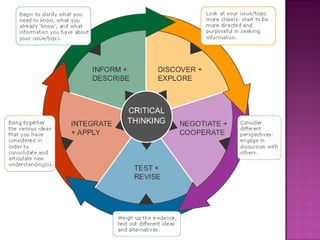
 Inform & Describe
 Discover & Explore
 Negotiate & Cooperate
 Test & Revise
 Integrate & Apply
Inform & Describe:
 Clarify
 What you need to know
 What you already know
 Information you have about the issue
Discover & Explore:
 Look at your issue more closely
 Start to be more directed and purposeful in
seeking information
Negotiate & Cooperate
 Consider different perspectives
 Engage in discussion
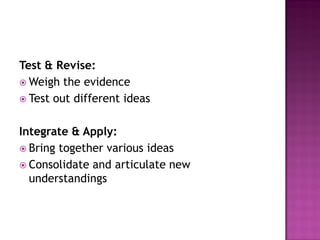
Test & Revise:
 Weigh the evidence
 Test out different ideas
Integrate & Apply:
 Bring together various ideas
 Consolidate and articulate new
understandings
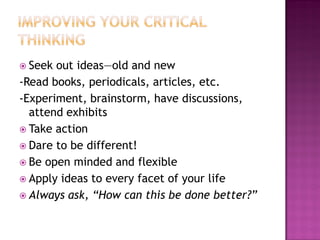
 Seek out ideas—old and new
-Read books, periodicals, articles, etc.
-Experiment, brainstorm, have discussions,
attend exhibits
 Take action
 Dare to be different!
 Be open minded and flexible
 Apply ideas to every facet of your life
 Always ask, “How can this be done better?”
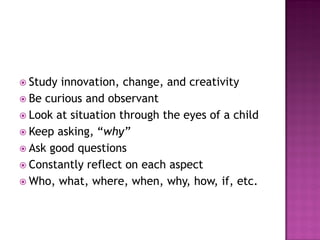
 Study innovation, change, and creativity
 Be curious and observant
 Look at situation through the eyes of a child
 Keep asking, “why”
 Ask good questions
 Constantly reflect on each aspect
 Who, what, where, when, why, how, if, etc.
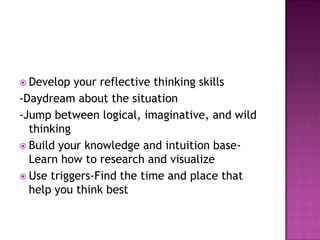
 Develop your reflective thinking skills
-Daydream about the situation
-Jump between logical, imaginative, and wild
thinking
 Build your knowledge and intuition base-
Learn how to research and visualize
 Use triggers-Find the time and place that
help you think best

Problem solving and critical thinking 1

  • 1.
  • 2.
     Problem solvingdepends on the use of strategies, or specific methods for approaching problems.  One strategy is to break down a complex problem into a number of smaller, more easily solved sub-goals.  Sub-goals are intermediate steps toward a solution.  For some problems, you may work backward from the goal you have set. Mystery writers often use this method: They decide how to end the story (“who did it”) and then devise a plot leading to this conclusion
  • 3.
     Another problemmay require you to examine various ways of reaching a desired goal.  To determine which strategy to use, most of us analyze the problem to see if it resembles a situation we have experienced in the past.  A strategy that worked in the past is likely to work again. We tend to do things the way we have done them before, and often, we shy away from new situations that call for new strategies.  The more unusual the problem, the more difficult it is to devise a strategy for dealing with it.
  • 4.
    a) The presenceof a problem b) A definition of the problem, involving the arousal of relevant concepts c) A weighing of relevance or probabilities and d) verification
  • 5.
     Algorithms: Analgorithm is a fixed set of procedures that, if followed correctly, will lead to a solution. Mathematical and scientific formulas are algorithms.  Heuristics: While algorithms can be useful in finding solutions, they are a time- consuming method. People often use shortcuts to solve problems, and these shortcuts are called heuristics.
  • 6.
     Heuristics areexperimental strategies, or rules of thumb, that simplify a problem, allowing one to solve problems quickly and easily.  Insight  Trial and Error
  • 7.
     Availability Heuristic:We rely on information that is more prominent or easily recalled and overlook information that is available but less prominent.  Representativeness Heuristic: We tend to assume that if an item is similar to members of a particular category, it is probably a member of that category, too.  Anchoring Heuristic: We make decisions based on certain ideas, or standards, that are important to us. Example: In my family, everyone gets up by 8:00 A.M every day, including week-ends. I believe that only lazy people sleep past 8:00 A.M. (I formed a judgment about other people based on a standard in my family.)
  • 8.
     “Critical Thinkingis reasonable reflective thinking focused on deciding what to believe or do.”  “Critical Thinking is best understood as the ability of thinkers to take charge of their own thinking.”  Critical Thinking is the three-sided mirror of decision making; letting you look at all the angles to make the best possible choice.
  • 9.
     Inform &Describe  Discover & Explore  Negotiate & Cooperate  Test & Revise  Integrate & Apply
  • 11.
    Inform & Describe: Clarify  What you need to know  What you already know  Information you have about the issue
  • 12.
    Discover & Explore: Look at your issue more closely  Start to be more directed and purposeful in seeking information Negotiate & Cooperate  Consider different perspectives  Engage in discussion
  • 13.
    Test & Revise: Weigh the evidence  Test out different ideas Integrate & Apply:  Bring together various ideas  Consolidate and articulate new understandings
  • 14.
     Seek outideas—old and new -Read books, periodicals, articles, etc. -Experiment, brainstorm, have discussions, attend exhibits  Take action  Dare to be different!  Be open minded and flexible  Apply ideas to every facet of your life  Always ask, “How can this be done better?”
  • 15.
     Study innovation,change, and creativity  Be curious and observant  Look at situation through the eyes of a child  Keep asking, “why”  Ask good questions  Constantly reflect on each aspect  Who, what, where, when, why, how, if, etc.
  • 16.
     Develop yourreflective thinking skills -Daydream about the situation -Jump between logical, imaginative, and wild thinking  Build your knowledge and intuition base- Learn how to research and visualize  Use triggers-Find the time and place that help you think best