
18 October 2019 Prod. Engg., SVL
Problem Solving Through
QC –7 Step Approach
Production Engineering 4t h April 07
18 October 2019 Prod. Engg., SVL
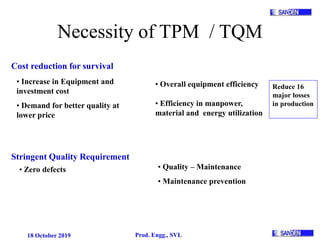
Necessity of TPM / TQM
Cost reduction for survival
• Increase in Equipment and
investment cost
• Demand for better quality at
lower price
• Overall equipment efficiency
• Efficiency in manpower,
material and energy utilization
Reduce 16
major losses
in production
Stringent Quality Requirement
• Zero defects • Quality – Maintenance
• Maintenance prevention
18 October 2019 Prod. Engg., SVL
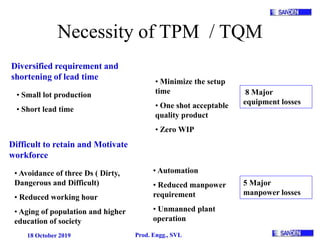
Necessity of TPM / TQM
Diversified requirement and
shortening of lead time
• Small lot production
• Short lead time
8 Major
equipment losses
Difficult to retain and Motivate
workforce
• Avoidance of three Ds ( Dirty,
Dangerous and Difficult)
• Reduced working hour
• Aging of population and higher
education of society
• Automation
• Reduced manpower
requirement
• Unmanned plant
operation
5 Major
manpower losses
• Minimize the setup
time
• One shot acceptable
quality product
• Zero WIP
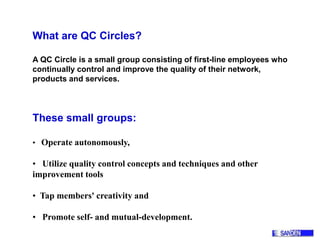
What are QC Circles?
A QC Circle is a small group consisting of first-line employees who
continually control and improve the quality of their network,
products and services.
These small groups:
• Operate autonomously,
• Utilize quality control concepts and techniques and other
improvement tools
• Tap members' creativity and
• Promote self- and mutual-development.
18 October 2019 Prod. Engg., SVL
About QC Circle
It was April 1962, when QC Circle Activities began in Japan.
Then the activities spread over rapidly in subsequent years.
In Japan, the activities have been practiced more throughout
industry from manufacturing to services, and in the world more than
70 countries and territories have introduced and promoted QC
Circles.
The QC Circle Headquarters of Japan is located within Union of
Japanese Scientists and Engineers (JUSE), and there are 9 branch
offices throughout Japan to facilitate and assist QC Circle activities
as follows.
18 October 2019 Prod. Engg., SVL
QC Circle activities aim to:
Develop members' capabilities and achieve self-
actualization,
Make the workplace more pleasant, vital and satisfying,
Improve customer satisfaction and
Contribute to society.
18 October 2019 Prod. Engg., SVL
Problem Solving
The QC Seven –step Problem-solving Formula is the
established strategy for solving problems in workplace.
The QC Seven-step Formula is the basic procedure for
Solving problems scientifically, rationally, efficiently
and effectively.
It allows any individual or group to solve even difficult
problems rationally and scientifically.
18 October 2019 Prod. Engg., SVL
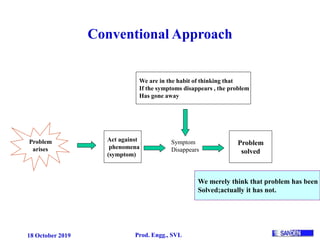
Problem
arises
Act against
phenomena
(symptom)
Symptom
Disappears
Problem
solved
We merely think that problem has been
Solved;actually it has not.
We are in the habit of thinking that
If the symptoms disappears , the problem
Has gone away
Conventional Approach
18 October 2019 Prod. Engg., SVL
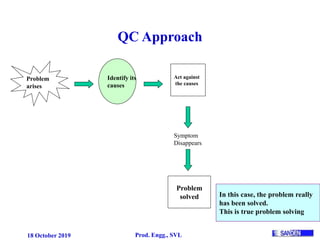
Problem
arises
Act against
the causes
Symptom
Disappears
Problem
solved In this case, the problem really
has been solved.
This is true problem solving
Identify its
causes
QC Approach
18 October 2019 Prod. Engg., SVL
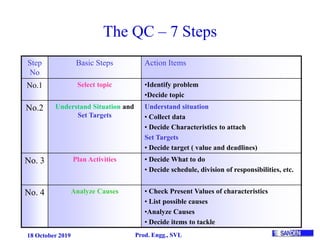
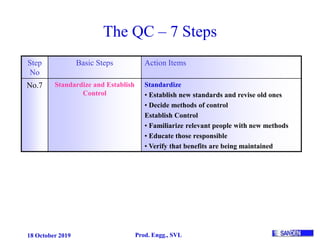
Step
No
Basic Steps Action Items
No.1 Select topic •Identify problem
•Decide topic
No.2 Understand Situation and
Set Targets
Understand situation
• Collect data
• Decide Characteristics to attach
Set Targets
• Decide target ( value and deadlines)
No. 3 Plan Activities • Decide What to do
• Decide schedule, division of responsibilities, etc.
No. 4 Analyze Causes • Check Present Values of characteristics
• List possible causes
•Analyze Causes
• Decide items to tackle
The QC – 7 Steps
18 October 2019 Prod. Engg., SVL
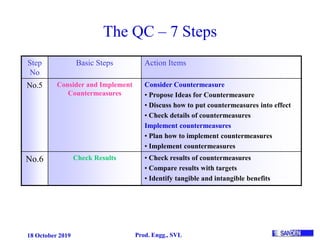
Step
No
Basic Steps Action Items
No.5 Consider and Implement
Countermeasures
Consider Countermeasure
• Propose Ideas for Countermeasure
• Discuss how to put countermeasures into effect
• Check details of countermeasures
Implement countermeasures
• Plan how to implement countermeasures
• Implement countermeasures
No.6 Check Results • Check results of countermeasures
• Compare results with targets
• Identify tangible and intangible benefits
The QC – 7 Steps
18 October 2019 Prod. Engg., SVL
Step
No
Basic Steps Action Items
No.7 Standardize and Establish
Control
Standardize
• Establish new standards and revise old ones
• Decide methods of control
Establish Control
• Familiarize relevant people with new methods
• Educate those responsible
• Verify that benefits are being maintained
The QC – 7 Steps
18 October 2019 Prod. Engg., SVL
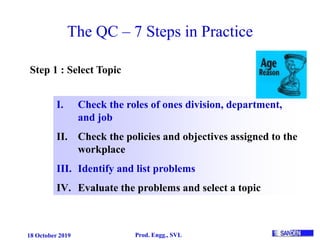
The QC – 7 Steps in Practice
Step 1 : Select Topic
I. Check the roles of ones division, department,
and job
II. Check the policies and objectives assigned to the
workplace
III. Identify and list problems
IV. Evaluate the problems and select a topic
18 October 2019 Prod. Engg., SVL
The QC – 7 Steps in Practice
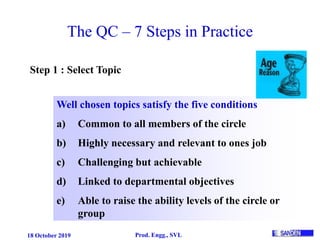
Step 1 : Select Topic
Well chosen topics satisfy the five conditions
a) Common to all members of the circle
b) Highly necessary and relevant to ones job
c) Challenging but achievable
d) Linked to departmental objectives
e) Able to raise the ability levels of the circle or
group
18 October 2019 Prod. Engg., SVL
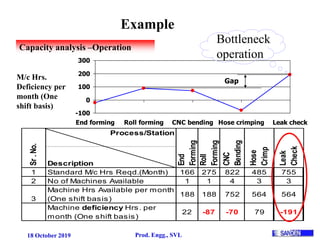
Capacity analysis –Operation
Process/Station
Description
1 Standard M/c Hrs Reqd.(Month) 166 275 822 485 755
2 No of Machines Available 1 1 4 3 3
3
Machine Hrs Available per month
(One shift basis)
188 188 752 564 564
Machine deficiency Hrs. per
month (One shift basis)
22 -87 -70 79 -191
Leak
Check
Sr.No.
End
Forming
Roll
Forming
CNC
Bending
Hose
Crimp
-100
0
100
200
300
End forming Roll forming CNC bending Hose crimping Leak check
M/c Hrs.
Deficiency per
month (One
shift basis)
Gap
Bottleneck
operation
Example
18 October 2019 Prod. Engg., SVL
The QC – 7 Steps in Practice
Step 2 : Understand situation and Set Targets
I. Decide on the characteristics to be addressed
II. Understand the situation
III. Decide on the targets and the time limits for
their achievements
18 October 2019 Prod. Engg., SVL
The QC – 7 Steps in Practice
Step 2 : Understand situation and Set Targets
a) Check past data concerning the characteristics
values and collect fresh data to ensure that the
problem can be expressed numerically
b) Investigate the flow of work and the state of the
process
c) Examine the situation over a period of time and
find out what sorts of changes have occurred
Key points in understanding the situation
18 October 2019 Prod. Engg., SVL
The QC – 7 Steps in Practice
Step 2 : Understand situation and Set Targets
d) Analyze the problems from different angle
(place, person, machine, material, methods, etc.)
e) Pay attention to dispersion and deviation
f) Be priority – oriented and narrow down the
priorities
g) Utilize the Seven QC Tools
Key points in understanding the situation
18 October 2019 Prod. Engg., SVL
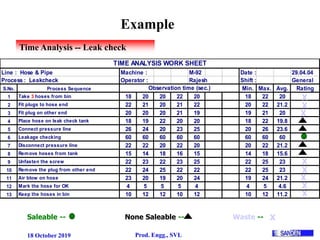
Line : Hose & Pipe Machine : M-92 Date : 29.04.04
Process : Leakcheck Operator : Rajesh Shift : General
S.No. Process Sequence Min. Max. Avg. Rating
1 Take 3 hoses from bin 18 20 20 22 20 18 22 20
2 Fit plugs to hose end 22 21 20 21 22 20 22 21.2
3 Fit plug on other end 20 20 20 21 19 19 21 20
4 Place hose on leak check tank 18 19 22 20 20 18 22 19.8
5 Connect pressure line 26 24 20 23 25 20 26 23.6
6 Leakage checking 60 60 60 60 60 60 60 60
7 Disconnect pressure line 22 22 20 22 20 20 22 21.2
8 Remove hoses from tank 15 14 18 16 15 14 18 15.6
9 Unfasten the screw 22 23 22 23 25 22 25 23
10 Remove the plug from other end 22 24 25 22 22 22 25 23
11 Air blow on hose 23 20 19 20 24 19 24 21.2
12 Mark the hose for OK 4 5 5 5 4 4 5 4.6
13 Keep the hoses in bin 10 12 12 10 12 10 12 11.2
Observation time (sec.)
TIME ANALYSIS WORK SHEET
X
X
X
X
X
X
Time Analysis -- Leak check
X
X
Saleable -- None Saleable -- Waste -- X
Example
18 October 2019 Prod. Engg., SVL
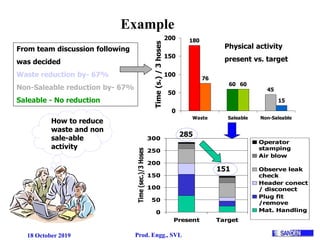
285
151
From team discussion following
was decided
Waste reduction by- 67%
Non-Saleable reduction by- 67%
Saleable - No reduction
Physical activity
present vs. target
How to reduce
waste and non
sale-able
activity
Time(s.)/3hoses
0
50
100
150
200
250
300
Present Target
Time(sec.)/3Hoses Operator
stamping
Air blow
Observe leak
check
Header conect
/ disconect
Plug fit
/remove
Mat. Handling
180
60
45
76
60
15
0
50
100
150
200
Waste Saleable Non-Saleable
Example
18 October 2019 Prod. Engg., SVL
The QC – 7 Steps in Practice
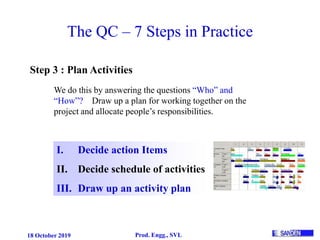
Step 3 : Plan Activities
I. Decide action Items
II. Decide schedule of activities
III. Draw up an activity plan
We do this by answering the questions “Who” and
“How”? Draw up a plan for working together on the
project and allocate people’s responsibilities.
18 October 2019 Prod. Engg., SVL
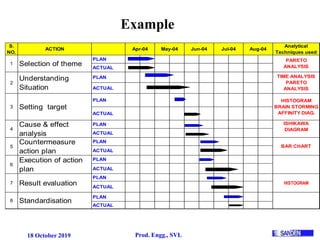
S.
NO.
Analytical
Techniques used
PLAN
ACTUAL
PLAN
ACTUAL
PLAN
ACTUAL
PLAN
ACTUAL
PLAN
ACTUAL
PLAN
ACTUAL
PLAN
ACTUAL
PLAN
ACTUAL
Aug-04ACTION
1 Selection of theme
Apr-04 May-04 Jun-04 Jul-04
2
Understanding
Situation
3 Setting target
4
Cause & effect
analysis
BAR CHART
HISTOGRAM
5
Countermeasure
action plan
6
Execution of action
plan
PARETO
ANALYSIS
TIME ANALYSIS
PARETO
ANALYSIS
HISTOGRAM
BRAIN STORMING
AFFINITY DIAG.
ISHIKAWA
DIAGRAM
8 Standardisation
7 Result evaluation
Example
18 October 2019 Prod. Engg., SVL
The QC – 7 Steps in Practice
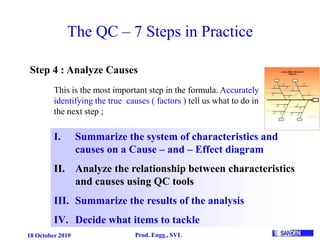
Step 4 : Analyze Causes
I. Summarize the system of characteristics and
causes on a Cause – and – Effect diagram
II. Analyze the relationship between characteristics
and causes using QC tools
III. Summarize the results of the analysis
IV. Decide what items to tackle
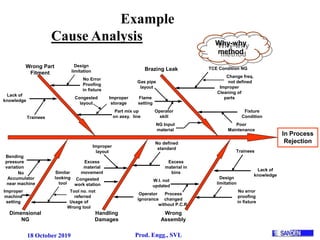
This is the most important step in the formula. Accurately
identifying the true causes ( factors ) tell us what to do in
the next step ;
18 October 2019 Prod. Engg., SVL
Cause Analysis
In Process
Rejection
Wrong Part
Fitment
Dimensional
NG
Handling
Damages
Wrong
Assembly
Brazing Leak
Improper
Cleaning of
parts
TCE Condition NG
Change freq.
not defined
Fixture
Condition
Poor
Maintenance
Flame
setting
Operator
skill
Gas pipe
layout
Lack of
knowledge
Trainees
No Error
Proofing
in fixture
Design
limitation
Part mix up
on assy. line
Improper
storage
Congested
layout
Lack of
knowledge
Trainees
W.I. not
updated
No error
proofing
in fixture
Design
limitation
Excess
material in
bins
No defined
standard
Operator
ignorance
Excess
material
movement
Improper
layout
Congested
work station
Usage of
Wrong tool
Similar
looking
tool
Tool no. not
referred
Bending
pressure
variation
No
Accumulator
near machine
Improper
machine
setting
Process
changed
without P.C.R.
NG Input
material
Why-why
method
Example
18 October 2019 Prod. Engg., SVL
Wrong Part
Fitment
Dimensional
NG
Handling
Damages
Wrong
Assembly
Brazing Leak
Improper
Cleaning of
parts
TCE Condition NG
Change freq.
not defined
Fixture
Condition
Poor
Maintenance
Flame
setting
Operator
skill
Gas pipe
layout
Lack of
knowledge
Trainees
No Error
Proofing
in fixture
Design
limitation
Part mix up
on assy. line
Improper
storage
In Process
Rejection
Congested
layout
Lack of
knowledge
Trainees
W.I. not
updated
No error
proofing
in fixture
Design
limitation
Excess
material in
bins
No defined
standard
Operator
ignorance
Excess
material
movement
Improper
layout
Congested
work station
Usage of
Wrong tool
Similar
looking
tool
Tool no. not
referred
Bending
pressure
variation
No
Accumulator
near machine
Improper
machine
setting
Process
changed
without P.C.R.
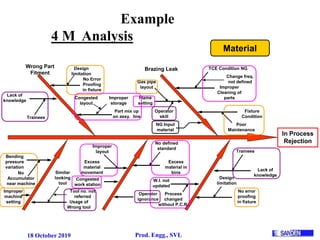
MachineMethod
NG Input
material
ManMaterial
4 M Analysis
Example
18 October 2019 Prod. Engg., SVL
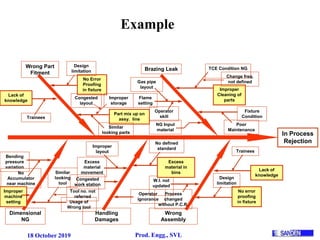
Major Causes
Wrong Part
Fitment
Dimensional
NG
Handling
Damages
Wrong
Assembly
Brazing Leak
Improper
Cleaning of
parts
TCE Condition NG
Change freq.
not defined
Fixture
Condition
Poor
Maintenance
Flame
setting
Operator
skill
Gas pipe
layout
Lack of
knowledge
Trainees
No Error
Proofing
in fixture
Design
limitation
Part mix up on
assy. line
Improper
storage
In Process
Rejection
Congested
layout
Lack of
knowledge
Trainees
W.I. not
updated
No error
proofing
in fixture
Design
limitation
Excess
material in
bins
No defined
standard
Operator
ignorance
Excess
material
movement
Improper
layout
Congested
work station
Usage of
Wrong tool
Similar
looking
tool
Tool no. not
referred
Bending
pressure
variation
No
Accumulator
near machine
Improper
machine
setting
Process
changed
without P.C.R.
NG Input
material
Similar
looking parts
Example
18 October 2019 Prod. Engg., SVL
The QC – 7 Steps in Practice
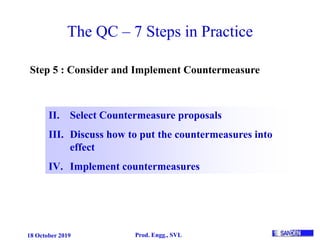
Step 5 : Consider and Implement Countermeasure
I. Propose ideas for countermeasures
* Consider the problem from all angles.
* Collect the ideas from superiors and people
from upstream and downstream process
* Do not judge the idea at the creation stage
* Use lateral thinking
To find out what kind of countermeasures will be effective
in eliminating the causes, we pool the ideas of the circle
members. Evaluate these ideas and then draw up the
actions plan.
18 October 2019 Prod. Engg., SVL
The QC – 7 Steps in Practice
Step 5 : Consider and Implement Countermeasure
II. Select Countermeasure proposals
III. Discuss how to put the countermeasures into
effect
IV. Implement countermeasures
18 October 2019 Prod. Engg., SVL
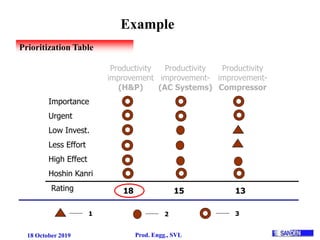
1 2 3
Productivity
improvement
(H&P)
Importance
Urgent
Low Invest.
Less Effort
High Effect
Hoshin Kanri
Rating 18 15 13
Prioritization Table
Productivity
improvement-
(AC Systems)
Productivity
improvement-
Compressor
Example
18 October 2019 Prod. Engg., SVL
The QC – 7 Steps in Practice
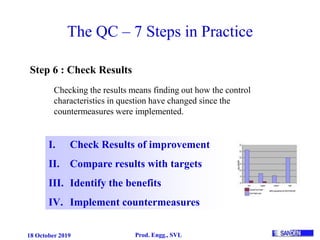
Step 6 : Check Results
I. Check Results of improvement
II. Compare results with targets
III. Identify the benefits
IV. Implement countermeasures
Checking the results means finding out how the control
characteristics in question have changed since the
countermeasures were implemented.
18 October 2019 Prod. Engg., SVL
The QC – 7 Steps in Practice
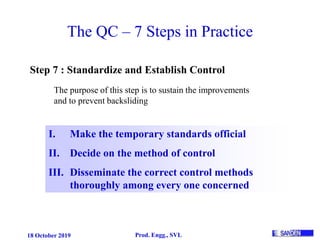
Step 7 : Standardize and Establish Control
I. Make the temporary standards official
II. Decide on the method of control
III. Disseminate the correct control methods
thoroughly among every one concerned
The purpose of this step is to sustain the improvements
and to prevent backsliding
18 October 2019 Prod. Engg., SVL
The QC – 7 Steps in Practice
Step 7 : Standardize and Establish Control
IV. Educate and train those responsible in the new
working methods
V. Check whether the benefits are being
maintained
18 October 2019 Prod. Engg., SVL
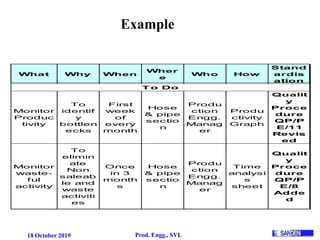
What Why When
Wher
e
Who How
Stand
ardis
ation
Monitor
Produc
tivity
To
identif
y
bottlen
ecks
First
week
of
every
month
Hose
& pipe
sectio
n
Produ
ction
Engg.
Manag
er
Produ
ctivity
Graph
Qualit
y
Proce
dure
QP/P
E/11
Revis
ed
Monitor
waste-
ful
activity
To
elimin
ate
Non
saleab
le and
waste
activiti
es
Once
in 3
month
s
Hose
& pipe
sectio
n
Produ
ction
Engg.
Manag
er
Time
analysi
s
sheet
Qualit
y
Proce
dure
QP/P
E/8
Adde
d
T o Do
Example
18 October 2019 Prod. Engg., SVL
The QC Story
Whenever a QC circle, or a QC team, or other
workplace group carries out improvement
activities, they should always prepare a written
report of these activities.
QC Story is the Format which should be
followed to report the results of the
improvement or problem-solving activities
18 October 2019 Prod. Engg., SVL
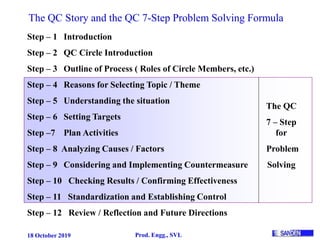
The QC Story and the QC 7-Step Problem Solving Formula
Step – 1 Introduction
Step – 2 QC Circle Introduction
Step – 3 Outline of Process ( Roles of Circle Members, etc.)
Step – 4 Reasons for Selecting Topic / Theme
Step – 5 Understanding the situation
Step – 6 Setting Targets
Step –7 Plan Activities
Step – 8 Analyzing Causes / Factors
Step – 9 Considering and Implementing Countermeasure
Step – 10 Checking Results / Confirming Effectiveness
Step – 11 Standardization and Establishing Control
Step – 12 Review / Reflection and Future Directions
The QC
7 – Step
for
Problem
Solving
18 October 2019 Prod. Engg., SVL
Thanks
…. Let us make things Better

Problem solving thru qc circle (1)

  • 1.
    18 October 2019Prod. Engg., SVL Problem Solving Through QC –7 Step Approach Production Engineering 4t h April 07
  • 2.
    18 October 2019Prod. Engg., SVL Necessity of TPM / TQM Cost reduction for survival • Increase in Equipment and investment cost • Demand for better quality at lower price • Overall equipment efficiency • Efficiency in manpower, material and energy utilization Reduce 16 major losses in production Stringent Quality Requirement • Zero defects • Quality – Maintenance • Maintenance prevention
  • 3.
    18 October 2019Prod. Engg., SVL Necessity of TPM / TQM Diversified requirement and shortening of lead time • Small lot production • Short lead time 8 Major equipment losses Difficult to retain and Motivate workforce • Avoidance of three Ds ( Dirty, Dangerous and Difficult) • Reduced working hour • Aging of population and higher education of society • Automation • Reduced manpower requirement • Unmanned plant operation 5 Major manpower losses • Minimize the setup time • One shot acceptable quality product • Zero WIP
  • 4.
    What are QCCircles? A QC Circle is a small group consisting of first-line employees who continually control and improve the quality of their network, products and services. These small groups: • Operate autonomously, • Utilize quality control concepts and techniques and other improvement tools • Tap members' creativity and • Promote self- and mutual-development.
  • 5.
    18 October 2019Prod. Engg., SVL About QC Circle It was April 1962, when QC Circle Activities began in Japan. Then the activities spread over rapidly in subsequent years. In Japan, the activities have been practiced more throughout industry from manufacturing to services, and in the world more than 70 countries and territories have introduced and promoted QC Circles. The QC Circle Headquarters of Japan is located within Union of Japanese Scientists and Engineers (JUSE), and there are 9 branch offices throughout Japan to facilitate and assist QC Circle activities as follows.
  • 6.
    18 October 2019Prod. Engg., SVL QC Circle activities aim to: Develop members' capabilities and achieve self- actualization, Make the workplace more pleasant, vital and satisfying, Improve customer satisfaction and Contribute to society.
  • 7.
    18 October 2019Prod. Engg., SVL Problem Solving The QC Seven –step Problem-solving Formula is the established strategy for solving problems in workplace. The QC Seven-step Formula is the basic procedure for Solving problems scientifically, rationally, efficiently and effectively. It allows any individual or group to solve even difficult problems rationally and scientifically.
  • 8.
    18 October 2019Prod. Engg., SVL Problem arises Act against phenomena (symptom) Symptom Disappears Problem solved We merely think that problem has been Solved;actually it has not. We are in the habit of thinking that If the symptoms disappears , the problem Has gone away Conventional Approach
  • 9.
    18 October 2019Prod. Engg., SVL Problem arises Act against the causes Symptom Disappears Problem solved In this case, the problem really has been solved. This is true problem solving Identify its causes QC Approach
  • 10.
    18 October 2019Prod. Engg., SVL Step No Basic Steps Action Items No.1 Select topic •Identify problem •Decide topic No.2 Understand Situation and Set Targets Understand situation • Collect data • Decide Characteristics to attach Set Targets • Decide target ( value and deadlines) No. 3 Plan Activities • Decide What to do • Decide schedule, division of responsibilities, etc. No. 4 Analyze Causes • Check Present Values of characteristics • List possible causes •Analyze Causes • Decide items to tackle The QC – 7 Steps
  • 11.
    18 October 2019Prod. Engg., SVL Step No Basic Steps Action Items No.5 Consider and Implement Countermeasures Consider Countermeasure • Propose Ideas for Countermeasure • Discuss how to put countermeasures into effect • Check details of countermeasures Implement countermeasures • Plan how to implement countermeasures • Implement countermeasures No.6 Check Results • Check results of countermeasures • Compare results with targets • Identify tangible and intangible benefits The QC – 7 Steps
  • 12.
    18 October 2019Prod. Engg., SVL Step No Basic Steps Action Items No.7 Standardize and Establish Control Standardize • Establish new standards and revise old ones • Decide methods of control Establish Control • Familiarize relevant people with new methods • Educate those responsible • Verify that benefits are being maintained The QC – 7 Steps
  • 13.
    18 October 2019Prod. Engg., SVL The QC – 7 Steps in Practice Step 1 : Select Topic I. Check the roles of ones division, department, and job II. Check the policies and objectives assigned to the workplace III. Identify and list problems IV. Evaluate the problems and select a topic
  • 14.
    18 October 2019Prod. Engg., SVL The QC – 7 Steps in Practice Step 1 : Select Topic Well chosen topics satisfy the five conditions a) Common to all members of the circle b) Highly necessary and relevant to ones job c) Challenging but achievable d) Linked to departmental objectives e) Able to raise the ability levels of the circle or group
  • 15.
    18 October 2019Prod. Engg., SVL Capacity analysis –Operation Process/Station Description 1 Standard M/c Hrs Reqd.(Month) 166 275 822 485 755 2 No of Machines Available 1 1 4 3 3 3 Machine Hrs Available per month (One shift basis) 188 188 752 564 564 Machine deficiency Hrs. per month (One shift basis) 22 -87 -70 79 -191 Leak Check Sr.No. End Forming Roll Forming CNC Bending Hose Crimp -100 0 100 200 300 End forming Roll forming CNC bending Hose crimping Leak check M/c Hrs. Deficiency per month (One shift basis) Gap Bottleneck operation Example
  • 16.
    18 October 2019Prod. Engg., SVL The QC – 7 Steps in Practice Step 2 : Understand situation and Set Targets I. Decide on the characteristics to be addressed II. Understand the situation III. Decide on the targets and the time limits for their achievements
  • 17.
    18 October 2019Prod. Engg., SVL The QC – 7 Steps in Practice Step 2 : Understand situation and Set Targets a) Check past data concerning the characteristics values and collect fresh data to ensure that the problem can be expressed numerically b) Investigate the flow of work and the state of the process c) Examine the situation over a period of time and find out what sorts of changes have occurred Key points in understanding the situation
  • 18.
    18 October 2019Prod. Engg., SVL The QC – 7 Steps in Practice Step 2 : Understand situation and Set Targets d) Analyze the problems from different angle (place, person, machine, material, methods, etc.) e) Pay attention to dispersion and deviation f) Be priority – oriented and narrow down the priorities g) Utilize the Seven QC Tools Key points in understanding the situation
  • 19.
    18 October 2019Prod. Engg., SVL Line : Hose & Pipe Machine : M-92 Date : 29.04.04 Process : Leakcheck Operator : Rajesh Shift : General S.No. Process Sequence Min. Max. Avg. Rating 1 Take 3 hoses from bin 18 20 20 22 20 18 22 20 2 Fit plugs to hose end 22 21 20 21 22 20 22 21.2 3 Fit plug on other end 20 20 20 21 19 19 21 20 4 Place hose on leak check tank 18 19 22 20 20 18 22 19.8 5 Connect pressure line 26 24 20 23 25 20 26 23.6 6 Leakage checking 60 60 60 60 60 60 60 60 7 Disconnect pressure line 22 22 20 22 20 20 22 21.2 8 Remove hoses from tank 15 14 18 16 15 14 18 15.6 9 Unfasten the screw 22 23 22 23 25 22 25 23 10 Remove the plug from other end 22 24 25 22 22 22 25 23 11 Air blow on hose 23 20 19 20 24 19 24 21.2 12 Mark the hose for OK 4 5 5 5 4 4 5 4.6 13 Keep the hoses in bin 10 12 12 10 12 10 12 11.2 Observation time (sec.) TIME ANALYSIS WORK SHEET X X X X X X Time Analysis -- Leak check X X Saleable -- None Saleable -- Waste -- X Example
  • 20.
    18 October 2019Prod. Engg., SVL 285 151 From team discussion following was decided Waste reduction by- 67% Non-Saleable reduction by- 67% Saleable - No reduction Physical activity present vs. target How to reduce waste and non sale-able activity Time(s.)/3hoses 0 50 100 150 200 250 300 Present Target Time(sec.)/3Hoses Operator stamping Air blow Observe leak check Header conect / disconect Plug fit /remove Mat. Handling 180 60 45 76 60 15 0 50 100 150 200 Waste Saleable Non-Saleable Example
  • 21.
    18 October 2019Prod. Engg., SVL The QC – 7 Steps in Practice Step 3 : Plan Activities I. Decide action Items II. Decide schedule of activities III. Draw up an activity plan We do this by answering the questions “Who” and “How”? Draw up a plan for working together on the project and allocate people’s responsibilities.
  • 22.
    18 October 2019Prod. Engg., SVL S. NO. Analytical Techniques used PLAN ACTUAL PLAN ACTUAL PLAN ACTUAL PLAN ACTUAL PLAN ACTUAL PLAN ACTUAL PLAN ACTUAL PLAN ACTUAL Aug-04ACTION 1 Selection of theme Apr-04 May-04 Jun-04 Jul-04 2 Understanding Situation 3 Setting target 4 Cause & effect analysis BAR CHART HISTOGRAM 5 Countermeasure action plan 6 Execution of action plan PARETO ANALYSIS TIME ANALYSIS PARETO ANALYSIS HISTOGRAM BRAIN STORMING AFFINITY DIAG. ISHIKAWA DIAGRAM 8 Standardisation 7 Result evaluation Example
  • 23.
    18 October 2019Prod. Engg., SVL The QC – 7 Steps in Practice Step 4 : Analyze Causes I. Summarize the system of characteristics and causes on a Cause – and – Effect diagram II. Analyze the relationship between characteristics and causes using QC tools III. Summarize the results of the analysis IV. Decide what items to tackle This is the most important step in the formula. Accurately identifying the true causes ( factors ) tell us what to do in the next step ;
  • 24.
    18 October 2019Prod. Engg., SVL Cause Analysis In Process Rejection Wrong Part Fitment Dimensional NG Handling Damages Wrong Assembly Brazing Leak Improper Cleaning of parts TCE Condition NG Change freq. not defined Fixture Condition Poor Maintenance Flame setting Operator skill Gas pipe layout Lack of knowledge Trainees No Error Proofing in fixture Design limitation Part mix up on assy. line Improper storage Congested layout Lack of knowledge Trainees W.I. not updated No error proofing in fixture Design limitation Excess material in bins No defined standard Operator ignorance Excess material movement Improper layout Congested work station Usage of Wrong tool Similar looking tool Tool no. not referred Bending pressure variation No Accumulator near machine Improper machine setting Process changed without P.C.R. NG Input material Why-why method Example
  • 25.
    18 October 2019Prod. Engg., SVL Wrong Part Fitment Dimensional NG Handling Damages Wrong Assembly Brazing Leak Improper Cleaning of parts TCE Condition NG Change freq. not defined Fixture Condition Poor Maintenance Flame setting Operator skill Gas pipe layout Lack of knowledge Trainees No Error Proofing in fixture Design limitation Part mix up on assy. line Improper storage In Process Rejection Congested layout Lack of knowledge Trainees W.I. not updated No error proofing in fixture Design limitation Excess material in bins No defined standard Operator ignorance Excess material movement Improper layout Congested work station Usage of Wrong tool Similar looking tool Tool no. not referred Bending pressure variation No Accumulator near machine Improper machine setting Process changed without P.C.R. MachineMethod NG Input material ManMaterial 4 M Analysis Example
  • 26.
    18 October 2019Prod. Engg., SVL Major Causes Wrong Part Fitment Dimensional NG Handling Damages Wrong Assembly Brazing Leak Improper Cleaning of parts TCE Condition NG Change freq. not defined Fixture Condition Poor Maintenance Flame setting Operator skill Gas pipe layout Lack of knowledge Trainees No Error Proofing in fixture Design limitation Part mix up on assy. line Improper storage In Process Rejection Congested layout Lack of knowledge Trainees W.I. not updated No error proofing in fixture Design limitation Excess material in bins No defined standard Operator ignorance Excess material movement Improper layout Congested work station Usage of Wrong tool Similar looking tool Tool no. not referred Bending pressure variation No Accumulator near machine Improper machine setting Process changed without P.C.R. NG Input material Similar looking parts Example
  • 27.
    18 October 2019Prod. Engg., SVL The QC – 7 Steps in Practice Step 5 : Consider and Implement Countermeasure I. Propose ideas for countermeasures * Consider the problem from all angles. * Collect the ideas from superiors and people from upstream and downstream process * Do not judge the idea at the creation stage * Use lateral thinking To find out what kind of countermeasures will be effective in eliminating the causes, we pool the ideas of the circle members. Evaluate these ideas and then draw up the actions plan.
  • 28.
    18 October 2019Prod. Engg., SVL The QC – 7 Steps in Practice Step 5 : Consider and Implement Countermeasure II. Select Countermeasure proposals III. Discuss how to put the countermeasures into effect IV. Implement countermeasures
  • 29.
    18 October 2019Prod. Engg., SVL 1 2 3 Productivity improvement (H&P) Importance Urgent Low Invest. Less Effort High Effect Hoshin Kanri Rating 18 15 13 Prioritization Table Productivity improvement- (AC Systems) Productivity improvement- Compressor Example
  • 30.
    18 October 2019Prod. Engg., SVL The QC – 7 Steps in Practice Step 6 : Check Results I. Check Results of improvement II. Compare results with targets III. Identify the benefits IV. Implement countermeasures Checking the results means finding out how the control characteristics in question have changed since the countermeasures were implemented.
  • 31.
    18 October 2019Prod. Engg., SVL The QC – 7 Steps in Practice Step 7 : Standardize and Establish Control I. Make the temporary standards official II. Decide on the method of control III. Disseminate the correct control methods thoroughly among every one concerned The purpose of this step is to sustain the improvements and to prevent backsliding
  • 32.
    18 October 2019Prod. Engg., SVL The QC – 7 Steps in Practice Step 7 : Standardize and Establish Control IV. Educate and train those responsible in the new working methods V. Check whether the benefits are being maintained
  • 33.
    18 October 2019Prod. Engg., SVL What Why When Wher e Who How Stand ardis ation Monitor Produc tivity To identif y bottlen ecks First week of every month Hose & pipe sectio n Produ ction Engg. Manag er Produ ctivity Graph Qualit y Proce dure QP/P E/11 Revis ed Monitor waste- ful activity To elimin ate Non saleab le and waste activiti es Once in 3 month s Hose & pipe sectio n Produ ction Engg. Manag er Time analysi s sheet Qualit y Proce dure QP/P E/8 Adde d T o Do Example
  • 34.
    18 October 2019Prod. Engg., SVL The QC Story Whenever a QC circle, or a QC team, or other workplace group carries out improvement activities, they should always prepare a written report of these activities. QC Story is the Format which should be followed to report the results of the improvement or problem-solving activities
  • 35.
    18 October 2019Prod. Engg., SVL The QC Story and the QC 7-Step Problem Solving Formula Step – 1 Introduction Step – 2 QC Circle Introduction Step – 3 Outline of Process ( Roles of Circle Members, etc.) Step – 4 Reasons for Selecting Topic / Theme Step – 5 Understanding the situation Step – 6 Setting Targets Step –7 Plan Activities Step – 8 Analyzing Causes / Factors Step – 9 Considering and Implementing Countermeasure Step – 10 Checking Results / Confirming Effectiveness Step – 11 Standardization and Establishing Control Step – 12 Review / Reflection and Future Directions The QC 7 – Step for Problem Solving
  • 36.
    18 October 2019Prod. Engg., SVL Thanks …. Let us make things Better