Quality Circles: Concept & Working
04.02.2023
Rajesh Tiwari
Quality?
“Quality is about meeting the needs and expectations of
customers”
Key aspects of quality for the customer include:
• Good design – looks and style
• Good functionality – it does the job well
• Reliable – acceptable level of breakdowns/ failure
• Consistency in performance
• Durable – lasts as long as it should
• Good after sales service
• Value for money
Circle?
Nov 1930 : Mahatma Gandhi-First
Round Table Conference in London
All members in Quality Circle enjoy
equal rights
Leader is just to merely maintain
orderly proceedings
No interruptions while other
member is speaking
No counter or criticism
Genesis
Defeat of Japan in 2nd World war
Socio- Economics reconstruction
Severe Constraints of high population density, Lack of natural
resources, compulsorily dependent on import of fuel, food, energy and
raw materials required for industries.
Solution was only to ‘Export’
For Export, you need superior quality
Superior Quality comes through high technological investment
Superior Quality also comes through small but continuous ways of
improved working (Kaizen)
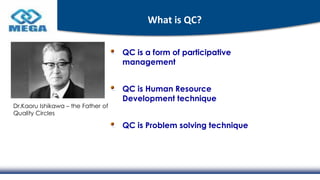
What is QC?
QC is a form of participative
management
QC is Human Resource
Development technique
QC is Problem solving technique
Dr.Kaoru Ishikawa – the Father of
Quality Circles
Scope of QC
QCs are applicable, where there is scope
for group based solutions of work related
problems
Scope of QCs is not limited to Industry or
manufacturing firms only but are relevant for
any other organizations, schools, hospitals,
Universities, Banks, Research Institutes, Govt.
Office, Homes etc..
Not limited to the narrow definition of
Quality Check but is concerned with Total
Customer Satisfaction
Definition
Quality Circle is a small group of 6 to 12 employees doing similar work
who voluntarily meet together on a regular basis to identify
improvements in their respective work areas using various techniques
for analyzing and solving work related problems coming in the way of
achieving and sustaining excellence leading to mutual upliftment of
employees as well as the organization.
It is a way of capturing the creative and innovative power that lies within
the work force
Definition
Voluntary groups of employees who work on
similar tasks or share an area of responsibility
They agree to meet on a regular basis to discuss
& solve problems related to work.
They operate on the principle that employee
participation in decision-making and problem-
solving improves the quality of work
Basic Assumptions
Employees want to do good job.
Employees want to be recognized as
intelligent and interested and like to
participate in problem solving.
Employees want to be better informed
about organizational goals and problems.
Employees want recognition, responsibility
and a feeling of self esteem
Human Beings are basically human beings
where ever they are.
Objectives achieved
a) Change in Attitude: From "I don’t care" to "I do care"
Continuous improvement in quality of work life through humanization of work.
b) Self Development: Bring out ‘Hidden Potential’ of people (People get to learn
additional skills)
c) Development of Team Spirit: Eliminate inter departmental conflicts.
d) Improved Organizational Culture: Positive working environment. Total
involvement of people at all levels.
e) Higher motivational level.
Basic Characteristics
Volunteers set rules & priorities
Decision are made by consensus
Use of organized approaches to problem
solving.
Members of QC need to be trained
Members need to be empowered
Members need to have the support of Senior
Management.
Advantages
Boosts organizational morale
Inspires effective team work
Promotes involvement to address issues
Creates problem solving capability
Promotes personal & leadership development
Improves communication gap within the
organization
Brings cost reduction
Better motivation among employees
Changes from negative environment to the
positive one
Basic Problem solving Technique
Brian Storming.
Pareto Diagrams.
Cause and Effect Analysis.
Data Collection.
Data Analysis. The tools used for data analysis are:
Tables
Bar charts
Histograms
Circle graphs
Line graphs
Control charts
Basic steps in QC
Problem Identification
Problem Solution
Data collection & analysis
Generate Alternative Solution
Select the Best solution
Prepare Plan of Action
Present Solution to Management
Implement & Monitor
Which is the best solution?
Which does not involve cost or has the least
cost implications
Which can be executed without dependency
on other unit or agency
Which can be executed in the shortest possible
duration
Which can make use of some waste product or
existing data
Which can fit in the existing rules & policies of
the organisation
Organizational hierarchy
Top Management
Steering Committee
Facilitator
Leader
Members
Recorder
Role of QC Facilitators
Co-ordinate the work of multiple QC’s through leaders.
Serve as a resource to QCs.
Arrange for expertise from other groups/agencies.
Keep QCs on track and enthusiastic.
Arrange for training of QC members.
Provide feed back to the Management and also QCs.
Maintain budgets and keep cost records.
Help QCs to make presentation before the management
Role of QC Leader
Keep the meeting focussed, positive and ensure participation by all
members.
Help in collecting data related to problems.
Transmit QC suggestions to facilitator.
Present solutions/suggestions to management.
Maintain relevant records of meetings.
Ensure implementation of solutions by the group.
Keeping the circles informed about status of previously submitted
suggestions.
Guiding members in group process, use of tools, techniques for
generating ideas/ solutions
Role of QC Members
Focus at all times on organizational problems/ objectives related to the
work.
Do not press for inclusion of personal problems.
Demonstrate mutual respect- no criticism.
Offer views, opinions and ideas freely and voluntarily in problem
solving.
Attend meeting regularly
Contribute to finding solutions to problems & implementing solutions.
Attend training with a receptive attitude to acquire skills to contribute to
the problem solving activities of the QC
How to introduce QC?
Expose middle level executives to the concept and ask
them to identify area under their purview where they
think the climate is conducive to start QC.
Explain the concept to the employees in such identified
areas and invite them to volunteer as members of QC.
Nominate Senior officers as facilitator for each area.
Form a steering committee for directing, establishing
the objectives, policies, activities and composition of
QCs. It may consist of a Chief Executive as the
chairman and the Departmental Heads as members
along with facilitators from each area
Recognize results & spread
How meetings are conducted?
QC meeting are fixed preferably for one hour but every week.
In first meeting, Problem identification session is held
Leader asks every member to state one problem at a time and goes on
sequentially
Recorder writes it and reads to confirm, if the problem statement is
recorded correctly
Each member has to state unique problem faced in the work area
Second & third rounds are held in the similar manner
May be 20 or more unique problems are recorded
How meetings are conducted?
In next meeting, order of priority is decided based on
urgency, quick & ease of execution and cost benefit
analysis.
Problem Titles & Priority Numbers are freezed.
Top priority problem is taken up for solution
Leader asks members (one by one sequentially) to suggest
unique solution to the problem.
Recorder writes it and reads to confirm correctness
Each member has to state unique solution within a
reasonable time, say 3 minutes. No cross talks or suggestions
by other in between.
Second & third rounds are held in the similar manner
May be 20 or more unique solutions are recorded
How meetings are conducted?
Analysis of each solution is taken up with opportunity
to each member to speak on pros & cons
Solutions are arranged in the order of priority
Data is collected and detailed analysis is carried out
for the top priority solution.
Data is collected & detailed analysis is carried out for
next order solutions as alternative solutions
Final action plan is discussed based on certain criteria.
Presentation is prepared & made before the
management for approval
After execution, data is collected again & compared
with the initial one to confirm success
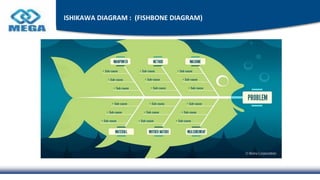
Ishikawa Diagram
ISHIKAWA DIAGRAM Referred to as cause-and effective diagram, tree
diagram, or fishbone diagram
Display factors, which affect a particular quality characteristic,
outcome or problem. Typically result of a brainstorming
The main goal represented by the trunk of the diagram, and primary
factor represented as branches.
ISHIKAWA DIAGRAM : (FISHBONE DIAGRAM)
Limitations
The overall productivity may decrease initially.
A large investment of time and money may be required.
The chance of errors increases initially.
Over-expectation of some employees, who are too excited initially, may turn to
disappointment and drop out.
Quality Circles may threaten traditional authority structure.
Employees, who are habituated to depend on their supervisors for direction and
who have lost their initiative, feel uncomfortable with Quality Circles.
After QC implementation, a period of confusion may arise. This is because
people experiment with new ideas, new skills and new roles.
Changes in system and control may become necessary.
SMART OBJECTIVES:
S: Specific M: Measurable A: Achievable R: Relevant T: Time-bound
Quality Circles Training Program FOR INDUSTRY

Quality Circles Training Program FOR INDUSTRY

  • 1.
    Quality Circles: Concept& Working 04.02.2023 Rajesh Tiwari
  • 2.
    Quality? “Quality is aboutmeeting the needs and expectations of customers” Key aspects of quality for the customer include: • Good design – looks and style • Good functionality – it does the job well • Reliable – acceptable level of breakdowns/ failure • Consistency in performance • Durable – lasts as long as it should • Good after sales service • Value for money
  • 3.
    Circle? Nov 1930 :Mahatma Gandhi-First Round Table Conference in London All members in Quality Circle enjoy equal rights Leader is just to merely maintain orderly proceedings No interruptions while other member is speaking No counter or criticism
  • 4.
    Genesis Defeat of Japanin 2nd World war Socio- Economics reconstruction Severe Constraints of high population density, Lack of natural resources, compulsorily dependent on import of fuel, food, energy and raw materials required for industries. Solution was only to ‘Export’ For Export, you need superior quality Superior Quality comes through high technological investment Superior Quality also comes through small but continuous ways of improved working (Kaizen)
  • 5.
    What is QC? QCis a form of participative management QC is Human Resource Development technique QC is Problem solving technique Dr.Kaoru Ishikawa – the Father of Quality Circles
  • 6.
    Scope of QC QCsare applicable, where there is scope for group based solutions of work related problems Scope of QCs is not limited to Industry or manufacturing firms only but are relevant for any other organizations, schools, hospitals, Universities, Banks, Research Institutes, Govt. Office, Homes etc.. Not limited to the narrow definition of Quality Check but is concerned with Total Customer Satisfaction
  • 7.
    Definition Quality Circle isa small group of 6 to 12 employees doing similar work who voluntarily meet together on a regular basis to identify improvements in their respective work areas using various techniques for analyzing and solving work related problems coming in the way of achieving and sustaining excellence leading to mutual upliftment of employees as well as the organization. It is a way of capturing the creative and innovative power that lies within the work force
  • 8.
    Definition Voluntary groups ofemployees who work on similar tasks or share an area of responsibility They agree to meet on a regular basis to discuss & solve problems related to work. They operate on the principle that employee participation in decision-making and problem- solving improves the quality of work
  • 9.
    Basic Assumptions Employees wantto do good job. Employees want to be recognized as intelligent and interested and like to participate in problem solving. Employees want to be better informed about organizational goals and problems. Employees want recognition, responsibility and a feeling of self esteem Human Beings are basically human beings where ever they are.
  • 10.
    Objectives achieved a) Changein Attitude: From "I don’t care" to "I do care" Continuous improvement in quality of work life through humanization of work. b) Self Development: Bring out ‘Hidden Potential’ of people (People get to learn additional skills) c) Development of Team Spirit: Eliminate inter departmental conflicts. d) Improved Organizational Culture: Positive working environment. Total involvement of people at all levels. e) Higher motivational level.
  • 11.
    Basic Characteristics Volunteers setrules & priorities Decision are made by consensus Use of organized approaches to problem solving. Members of QC need to be trained Members need to be empowered Members need to have the support of Senior Management.
  • 12.
    Advantages Boosts organizational morale Inspireseffective team work Promotes involvement to address issues Creates problem solving capability Promotes personal & leadership development Improves communication gap within the organization Brings cost reduction Better motivation among employees Changes from negative environment to the positive one
  • 13.
    Basic Problem solvingTechnique Brian Storming. Pareto Diagrams. Cause and Effect Analysis. Data Collection. Data Analysis. The tools used for data analysis are: Tables Bar charts Histograms Circle graphs Line graphs Control charts
  • 14.
    Basic steps inQC Problem Identification Problem Solution Data collection & analysis Generate Alternative Solution Select the Best solution Prepare Plan of Action Present Solution to Management Implement & Monitor
  • 15.
    Which is thebest solution? Which does not involve cost or has the least cost implications Which can be executed without dependency on other unit or agency Which can be executed in the shortest possible duration Which can make use of some waste product or existing data Which can fit in the existing rules & policies of the organisation
  • 16.
    Organizational hierarchy Top Management SteeringCommittee Facilitator Leader Members Recorder
  • 17.
    Role of QCFacilitators Co-ordinate the work of multiple QC’s through leaders. Serve as a resource to QCs. Arrange for expertise from other groups/agencies. Keep QCs on track and enthusiastic. Arrange for training of QC members. Provide feed back to the Management and also QCs. Maintain budgets and keep cost records. Help QCs to make presentation before the management
  • 18.
    Role of QCLeader Keep the meeting focussed, positive and ensure participation by all members. Help in collecting data related to problems. Transmit QC suggestions to facilitator. Present solutions/suggestions to management. Maintain relevant records of meetings. Ensure implementation of solutions by the group. Keeping the circles informed about status of previously submitted suggestions. Guiding members in group process, use of tools, techniques for generating ideas/ solutions
  • 19.
    Role of QCMembers Focus at all times on organizational problems/ objectives related to the work. Do not press for inclusion of personal problems. Demonstrate mutual respect- no criticism. Offer views, opinions and ideas freely and voluntarily in problem solving. Attend meeting regularly Contribute to finding solutions to problems & implementing solutions. Attend training with a receptive attitude to acquire skills to contribute to the problem solving activities of the QC
  • 20.
    How to introduceQC? Expose middle level executives to the concept and ask them to identify area under their purview where they think the climate is conducive to start QC. Explain the concept to the employees in such identified areas and invite them to volunteer as members of QC. Nominate Senior officers as facilitator for each area. Form a steering committee for directing, establishing the objectives, policies, activities and composition of QCs. It may consist of a Chief Executive as the chairman and the Departmental Heads as members along with facilitators from each area Recognize results & spread
  • 21.
    How meetings areconducted? QC meeting are fixed preferably for one hour but every week. In first meeting, Problem identification session is held Leader asks every member to state one problem at a time and goes on sequentially Recorder writes it and reads to confirm, if the problem statement is recorded correctly Each member has to state unique problem faced in the work area Second & third rounds are held in the similar manner May be 20 or more unique problems are recorded
  • 22.
    How meetings areconducted? In next meeting, order of priority is decided based on urgency, quick & ease of execution and cost benefit analysis. Problem Titles & Priority Numbers are freezed. Top priority problem is taken up for solution Leader asks members (one by one sequentially) to suggest unique solution to the problem. Recorder writes it and reads to confirm correctness Each member has to state unique solution within a reasonable time, say 3 minutes. No cross talks or suggestions by other in between. Second & third rounds are held in the similar manner May be 20 or more unique solutions are recorded
  • 23.
    How meetings areconducted? Analysis of each solution is taken up with opportunity to each member to speak on pros & cons Solutions are arranged in the order of priority Data is collected and detailed analysis is carried out for the top priority solution. Data is collected & detailed analysis is carried out for next order solutions as alternative solutions Final action plan is discussed based on certain criteria. Presentation is prepared & made before the management for approval After execution, data is collected again & compared with the initial one to confirm success
  • 24.
    Ishikawa Diagram ISHIKAWA DIAGRAMReferred to as cause-and effective diagram, tree diagram, or fishbone diagram Display factors, which affect a particular quality characteristic, outcome or problem. Typically result of a brainstorming The main goal represented by the trunk of the diagram, and primary factor represented as branches.
  • 25.
    ISHIKAWA DIAGRAM :(FISHBONE DIAGRAM)
  • 26.
    Limitations The overall productivitymay decrease initially. A large investment of time and money may be required. The chance of errors increases initially. Over-expectation of some employees, who are too excited initially, may turn to disappointment and drop out. Quality Circles may threaten traditional authority structure. Employees, who are habituated to depend on their supervisors for direction and who have lost their initiative, feel uncomfortable with Quality Circles. After QC implementation, a period of confusion may arise. This is because people experiment with new ideas, new skills and new roles. Changes in system and control may become necessary.
  • 27.
    SMART OBJECTIVES: S: SpecificM: Measurable A: Achievable R: Relevant T: Time-bound