Common CoreCommon Core
PROBLEM-BASED LEARNINGPROBLEM-BASED LEARNING
THE CONNECTIONTHE CONNECTION
Presented by MarilynPresented by Marilyn
PURPOSE OF PRESENTATIONPURPOSE OF PRESENTATION
Overview of Problem-Based LearningOverview of Problem-Based Learning
The “P” in P.B.L.The “P” in P.B.L.
Connect P.B.L. to Common CoreConnect P.B.L. to Common Core
The “P” in PBLThe “P” in PBL
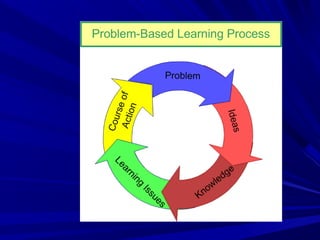
P.B.L. engages students by the design of
real world problems. The process of
problem-solving stimulates meaningful
experiences that build knowledge,
collaboration, shared resources and high
levels of engagement.
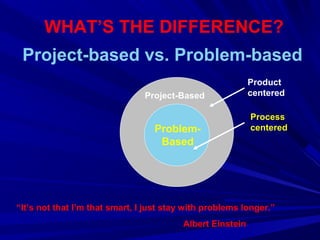
WHAT’S THE DIFFERENCE?
Project-based vs. Problem-based
Problem-
Based
Product
centered
Process
centered
Project-Based
“It’s not that I’m that smart, I just stay with problems longer.”
Albert Einstein
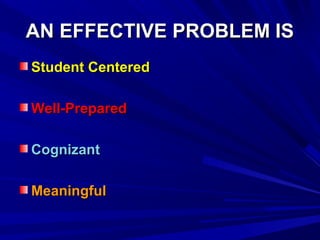
AN EFFECTIVE PROBLEM ISAN EFFECTIVE PROBLEM IS
Student CenteredStudent Centered
Well-PreparedWell-Prepared
CognizantCognizant
MeaningfulMeaningful
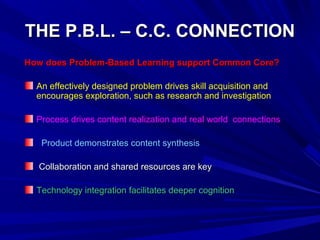
THE P.B.L. – C.C. CONNECTIONTHE P.B.L. – C.C. CONNECTION
How does Problem-Based Learning support Common Core?How does Problem-Based Learning support Common Core?
An effectively designed problem drives skill acquisition and
encourages exploration, such as research and investigation
Process drives content realization and real world connections
Product demonstrates content synthesis
Collaboration and shared resources are keyCollaboration and shared resources are key
Technology integration facilitates deeper cognitionTechnology integration facilitates deeper cognition
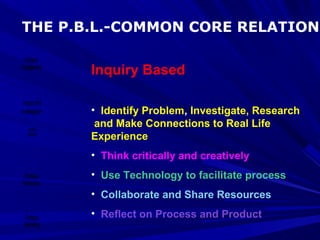
THE P.B.L.-COMMON CORE RELATION
Inquiry Based
• Identify Problem, Investigate, Research
and Make Connections to Real Life
Experience
• Think critically and creatively
• Use Technology to facilitate process
• Collaborate and Share Resources
• Reflect on Process and Product
Problem
Engagement
Inquiryand
Investigation
problem
definition
Problem
Resolution
Problem
Debriefing
Problem
Engagement
Inquiryand
Investigation
problem
definition
Problem
Resolution
Problem
Debriefing
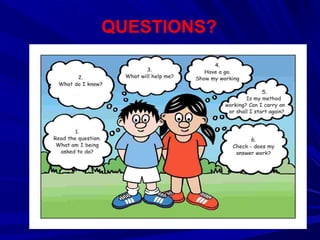
QUESTIONS?
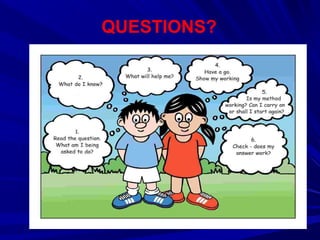
QUESTIONS?

Problem Based Learning by Marilyn

  • 1.
    Common CoreCommon Core PROBLEM-BASEDLEARNINGPROBLEM-BASED LEARNING THE CONNECTIONTHE CONNECTION Presented by MarilynPresented by Marilyn
  • 2.
    PURPOSE OF PRESENTATIONPURPOSEOF PRESENTATION Overview of Problem-Based LearningOverview of Problem-Based Learning The “P” in P.B.L.The “P” in P.B.L. Connect P.B.L. to Common CoreConnect P.B.L. to Common Core
  • 3.
    The “P” inPBLThe “P” in PBL P.B.L. engages students by the design of real world problems. The process of problem-solving stimulates meaningful experiences that build knowledge, collaboration, shared resources and high levels of engagement.
  • 4.
    WHAT’S THE DIFFERENCE? Project-basedvs. Problem-based Problem- Based Product centered Process centered Project-Based “It’s not that I’m that smart, I just stay with problems longer.” Albert Einstein
  • 6.
    AN EFFECTIVE PROBLEMISAN EFFECTIVE PROBLEM IS Student CenteredStudent Centered Well-PreparedWell-Prepared CognizantCognizant MeaningfulMeaningful
  • 7.
    THE P.B.L. –C.C. CONNECTIONTHE P.B.L. – C.C. CONNECTION How does Problem-Based Learning support Common Core?How does Problem-Based Learning support Common Core? An effectively designed problem drives skill acquisition and encourages exploration, such as research and investigation Process drives content realization and real world connections Product demonstrates content synthesis Collaboration and shared resources are keyCollaboration and shared resources are key Technology integration facilitates deeper cognitionTechnology integration facilitates deeper cognition
  • 8.
    THE P.B.L.-COMMON CORERELATION Inquiry Based • Identify Problem, Investigate, Research and Make Connections to Real Life Experience • Think critically and creatively • Use Technology to facilitate process • Collaborate and Share Resources • Reflect on Process and Product Problem Engagement Inquiryand Investigation problem definition Problem Resolution Problem Debriefing Problem Engagement Inquiryand Investigation problem definition Problem Resolution Problem Debriefing
  • 9.
  • 10.

Editor's Notes

  • #5 What is problem-based learning? Though many people use the terms project-based learning and problem-based learning interchangeably, a distinction can be made based on whether the focus is on the product or on the process. Typically, with project-based learning the focus is on the outcome, the product. In problem-based learning the focus is on inquiry and the problem-solving process itself rather than on fashioning a product. The difference lies in the goal of the learning experience. We consider problem-based learning a subset of project-based learning, a particular type of project-based learning with the distinguishing feature of initiating learning with a problem, one that is open-ended, ill-structured, intricate, and then focusing on the complex process of solving it.
  • #9 Why use problem-based learning? It promotes desirable student outcomes. Intentional learning (Bereiter & Scardamalia, 1989) refers to the purposeful construction of knowledge. Goal-setting is an important component as the learner establishes a personal agenda for acquiring knowledge and understanding information. Relational understanding (Skemp, 1978) may be defined as “knowing both what to do and why.” It stands in contrast to instrumental understanding, which is described as “rules without reason.” Also see Niedelman (1991).