Seismic Data Processing
Lecture 3
Approximation Series
Prepared by
Dr. Amin E. Khalil
Today's Agenda
• Complex Numbers
• Vectors
• Linear vector spaces
• Linear systems

• Matrices
•
•
•
•

Determinants
Eigenvalue problems
Singular values
Matrix inversion

• Series
• Taylor
• Fourier
• Delta Function
• Fourier integrals
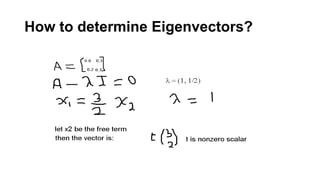
How to determine Eigenvectors?
Matrix aplications
• Stress and strain tensors
• Calculating interpolation or differential operators for finitedifference methods
• Eigenvectors and eigenvalues for deformation and stress problems
(e.g. boreholes)
• Norm: how to compare data with theory
• Matrix inversion: solving for tomographic images
• Measuring strain and rotations
Taylor Series
Many (mildly or wildly nonlinear) physical systems
are transformed to linear systems by using Taylor
series
f (x

dx )

f ( x)

1

f ' dx

2
f
i 1

(i)

( x)

dx

f ' ' dx

2

1

f ' ' ' dx

3

...

6

i

i!

provided that all derivatives of f(x) are continuous and exist in the interval
[x,x+h]
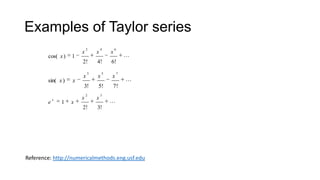
Examples of Taylor series
cos( x )

1

x

2

2!

sin( x )

x

x

3

3!
e

x

1

x

x

2

2!

x

4

4!

x

5

5!
x

x

6



6!

x

7



7!

3



3!

Reference: http://numericalmethods.eng.usf.edu
What does this mean in plain English?
As Archimedes would have said, “Give me the value of the
function at a single point, and the value of all (first, second,
and so on) its derivatives at that single point, and I can give
you the value of the function at any other point”
Example
f 6

Find the value of
f

of

4

30 , f

f x

Solution:

4

6

at x

4

f x

f 4

given that

f 4

h

f x

4
2

f

x h

f

x

h

2

f

h
f 4

6

4

x

f 4 2

f

4

2

2

f

125

74 2

30

2

4

2!
125

341

148

60

8

2

3

3!

2

6

2

3

3!

h

3

3!

2

2!
f 6

74 ,

and all other higher order derivatives
are zero.

2!

x

f 4

125 ,


Fourier Series
Fourier series assume a periodic function …. (here:
symmetric, zero at both ends)
f ( x)

a0

a n sin 2 x
n

a0

an

1
L
2
L

n

n

2L

L

f ( x ) dx
0
L

f ( x ) sin
0

n x
L

dx

1,
What is periodic function?
In mathematics, a periodic function is a function that repeats its values in regular
intervals or periods. The most important examples are the trigonometric
functions, which repeat over intervals of 2π radians. Periodic functions are used
throughout science to describe oscillations, waves, and other phenomena that
exhibit periodicity. Any function which is not periodic is called aperiodic.
The Problem
we are trying to approximate a function f(x) by another function gn(x) which
consists of a sum over N orthogonal functions (x) weighted by some
coefficients an.

N

f ( x)

g N ( x)

ai
i 0

i

( x)
Strategy
... and we are looking for optimal functions in a least squares (l2) sense ...
1/ 2

b

f ( x)

g N ( x)

f ( x)
2

2

g N ( x ) dx

Min !

a

... a good choice for the basis functions (x) are orthogonal functions.
What are orthogonal functions? Two functions f and g are said to be
orthogonal in the interval [a,b] if
b

f ( x ) g ( x ) dx

0

a

How is this related to the more conceivable concept of orthogonal vectors? Let
us look at the original definition of integrals:
Orthogonal Functions
b

N

f ( x ) g ( x ) dx

lim

fi ( x) g i ( x) x

N

i 1

a

... where x0=a and xN=b, and xi-xi-1= x ...
If we interpret f(xi) and g(xi) as the ith components of an N component vector,
then this sum corresponds directly to a scalar product of vectors. The vanishing
of the scalar product is the condition for orthogonality of vectors (or functions).

fi

gi

fi

gi

fi g i
i

0
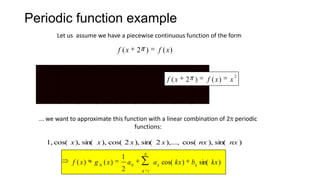
Periodic function example
Let us assume we have a piecewise continuous function of the form

f (x

2 )

f ( x)

40
30

f (x

20

2 )

15

f ( x)

x

2

20

10
0
-1 5

-1 0

-5

0

5

10

... we want to approximate this function with a linear combination of 2 periodic
functions:
1, cos( x ), sin( x ), cos( 2 x ), sin( 2 x ),..., cos( nx ), sin( nx )

f ( x)

g N ( x)

1
2

N

a0

a k cos( kx )
k 1

b k sin( kx )
Fourier Coefficients
optimal functions g(x) are given if
g n ( x)

f ( x)

Min !

2

or

g n ( x)

ak

f ( x)

2

0

... with the definition of g(x) we get ...

ak

g n ( x)

f ( x)

1

2

ak

2

2

2

N

a0

a k cos( kx )
k

b k sin( kx )

1

leading to
g N ( x)

ak

bk

1
2
1

1

N

a0

a k cos( kx )

b k sin( kx )

with

k 1

f ( x ) cos( kx ) dx ,

k

0 ,1,..., N

f ( x ) sin( kx ) dx ,

k

1, 2 ,..., N

f ( x)

dx
... Example ...
f ( x)

x,

x

leads to the Fourier Serie
g ( x)

1

4

2

cos( x )
1

2

cos( 3 x )
3

cos( 5 x )

2

5

2

...

.. and for n<4 g(x) looks like
4
3
2
1
0
-2 0

-1 5

-1 0

-5

0

5

10

15

20
... another Example ...
f ( x)

2

x ,

0

x

2

leads to the Fourier Serie
g N ( x)

2

4
3

N

k

4
k

1

2

cos( kx )

4

sin( kx )

k

.. and for N<11, g(x) looks like
40
30
20
10
0
-1 0
-1 0

-5

0

5

10

15
Importance of Fourier Series
• Any filtering … low-, high-, bandpass
• Generation of random media
• Data analysis for periodic contributions
• Tidal forcing
• Earth’s rotation
• Electromagnetic noise
• Day-night variations
• Pseudospectral methods for function
approximation and derivatives
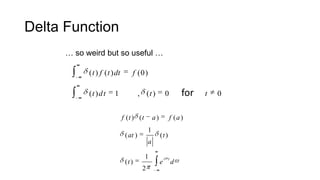
Delta Function
… so weird but so useful …
( t ) f ( t ) dt
(t ) d t

f (0)

1

, (t )
f (t ) (t

a)
1

( at )

für
for

0

f (a )
(t )

a
(t )

1
2

e

i t

d

t

0
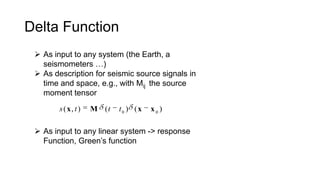
Delta Function
 As input to any system (the Earth, a
seismometers …)
 As description for seismic source signals in
time and space, e.g., with Mij the source
moment tensor
s(x, t )

M (t

t0 ) (x

x0 )

 As input to any linear system -> response
Function, Green’s function
Fourier Integrals
The basis for the spectral analysis (described in the continuous world) is the
transform pair:

f (t )

1

F ( )e

i t

2
F( )

f (t )e

i t

dt

d
Fourier Integral (transform)
• Any filtering … low-, high-, bandpass
• Generation of random media
• Data analysis for periodic contributions
• Tidal forcing
• Earth’s rotation
• Electromagnetic noise
• Day-night variations
• Pseudospectral methods for function
approximation and derivatives
Thank you

Seismic data processing lecture 3

  • 1.
    Seismic Data Processing Lecture3 Approximation Series Prepared by Dr. Amin E. Khalil
  • 2.
    Today's Agenda • ComplexNumbers • Vectors • Linear vector spaces • Linear systems • Matrices • • • • Determinants Eigenvalue problems Singular values Matrix inversion • Series • Taylor • Fourier • Delta Function • Fourier integrals
  • 3.
    How to determineEigenvectors?
  • 4.
    Matrix aplications • Stressand strain tensors • Calculating interpolation or differential operators for finitedifference methods • Eigenvectors and eigenvalues for deformation and stress problems (e.g. boreholes) • Norm: how to compare data with theory • Matrix inversion: solving for tomographic images • Measuring strain and rotations
  • 5.
    Taylor Series Many (mildlyor wildly nonlinear) physical systems are transformed to linear systems by using Taylor series f (x dx ) f ( x) 1 f ' dx 2 f i 1 (i) ( x) dx f ' ' dx 2 1 f ' ' ' dx 3 ... 6 i i! provided that all derivatives of f(x) are continuous and exist in the interval [x,x+h]
  • 6.
    Examples of Taylorseries cos( x ) 1 x 2 2! sin( x ) x x 3 3! e x 1 x x 2 2! x 4 4! x 5 5! x x 6  6! x 7  7! 3  3! Reference: http://numericalmethods.eng.usf.edu
  • 7.
    What does thismean in plain English? As Archimedes would have said, “Give me the value of the function at a single point, and the value of all (first, second, and so on) its derivatives at that single point, and I can give you the value of the function at any other point”
  • 8.
    Example f 6 Find thevalue of f of 4 30 , f f x Solution: 4 6 at x 4 f x f 4 given that f 4 h f x 4 2 f x h f x h 2 f h f 4 6 4 x f 4 2 f 4 2 2 f 125 74 2 30 2 4 2! 125 341 148 60 8 2 3 3! 2 6 2 3 3! h 3 3! 2 2! f 6 74 , and all other higher order derivatives are zero. 2! x f 4 125 , 
  • 9.
    Fourier Series Fourier seriesassume a periodic function …. (here: symmetric, zero at both ends) f ( x) a0 a n sin 2 x n a0 an 1 L 2 L n n 2L L f ( x ) dx 0 L f ( x ) sin 0 n x L dx 1,
  • 10.
    What is periodicfunction? In mathematics, a periodic function is a function that repeats its values in regular intervals or periods. The most important examples are the trigonometric functions, which repeat over intervals of 2π radians. Periodic functions are used throughout science to describe oscillations, waves, and other phenomena that exhibit periodicity. Any function which is not periodic is called aperiodic.
  • 11.
    The Problem we aretrying to approximate a function f(x) by another function gn(x) which consists of a sum over N orthogonal functions (x) weighted by some coefficients an. N f ( x) g N ( x) ai i 0 i ( x)
  • 12.
    Strategy ... and weare looking for optimal functions in a least squares (l2) sense ... 1/ 2 b f ( x) g N ( x) f ( x) 2 2 g N ( x ) dx Min ! a ... a good choice for the basis functions (x) are orthogonal functions. What are orthogonal functions? Two functions f and g are said to be orthogonal in the interval [a,b] if b f ( x ) g ( x ) dx 0 a How is this related to the more conceivable concept of orthogonal vectors? Let us look at the original definition of integrals:
  • 13.
    Orthogonal Functions b N f (x ) g ( x ) dx lim fi ( x) g i ( x) x N i 1 a ... where x0=a and xN=b, and xi-xi-1= x ... If we interpret f(xi) and g(xi) as the ith components of an N component vector, then this sum corresponds directly to a scalar product of vectors. The vanishing of the scalar product is the condition for orthogonality of vectors (or functions). fi gi fi gi fi g i i 0
  • 14.
    Periodic function example Letus assume we have a piecewise continuous function of the form f (x 2 ) f ( x) 40 30 f (x 20 2 ) 15 f ( x) x 2 20 10 0 -1 5 -1 0 -5 0 5 10 ... we want to approximate this function with a linear combination of 2 periodic functions: 1, cos( x ), sin( x ), cos( 2 x ), sin( 2 x ),..., cos( nx ), sin( nx ) f ( x) g N ( x) 1 2 N a0 a k cos( kx ) k 1 b k sin( kx )
  • 15.
    Fourier Coefficients optimal functionsg(x) are given if g n ( x) f ( x) Min ! 2 or g n ( x) ak f ( x) 2 0 ... with the definition of g(x) we get ... ak g n ( x) f ( x) 1 2 ak 2 2 2 N a0 a k cos( kx ) k b k sin( kx ) 1 leading to g N ( x) ak bk 1 2 1 1 N a0 a k cos( kx ) b k sin( kx ) with k 1 f ( x ) cos( kx ) dx , k 0 ,1,..., N f ( x ) sin( kx ) dx , k 1, 2 ,..., N f ( x) dx
  • 16.
    ... Example ... f( x) x, x leads to the Fourier Serie g ( x) 1 4 2 cos( x ) 1 2 cos( 3 x ) 3 cos( 5 x ) 2 5 2 ... .. and for n<4 g(x) looks like 4 3 2 1 0 -2 0 -1 5 -1 0 -5 0 5 10 15 20
  • 17.
    ... another Example... f ( x) 2 x , 0 x 2 leads to the Fourier Serie g N ( x) 2 4 3 N k 4 k 1 2 cos( kx ) 4 sin( kx ) k .. and for N<11, g(x) looks like 40 30 20 10 0 -1 0 -1 0 -5 0 5 10 15
  • 18.
    Importance of FourierSeries • Any filtering … low-, high-, bandpass • Generation of random media • Data analysis for periodic contributions • Tidal forcing • Earth’s rotation • Electromagnetic noise • Day-night variations • Pseudospectral methods for function approximation and derivatives
  • 19.
    Delta Function … soweird but so useful … ( t ) f ( t ) dt (t ) d t f (0) 1 , (t ) f (t ) (t a) 1 ( at ) für for 0 f (a ) (t ) a (t ) 1 2 e i t d t 0
  • 20.
    Delta Function  Asinput to any system (the Earth, a seismometers …)  As description for seismic source signals in time and space, e.g., with Mij the source moment tensor s(x, t ) M (t t0 ) (x x0 )  As input to any linear system -> response Function, Green’s function
  • 21.
    Fourier Integrals The basisfor the spectral analysis (described in the continuous world) is the transform pair: f (t ) 1 F ( )e i t 2 F( ) f (t )e i t dt d
  • 22.
    Fourier Integral (transform) •Any filtering … low-, high-, bandpass • Generation of random media • Data analysis for periodic contributions • Tidal forcing • Earth’s rotation • Electromagnetic noise • Day-night variations • Pseudospectral methods for function approximation and derivatives
  • 23.