Gibbs flow transport for Bayesian inference
Jeremy Heng,
Department of Statistics, Harvard University
Joint work with Arnaud Doucet (Oxford) & Yvo Pokern (UCL)
Computational Statistics and Molecular Simulation:
A Practical Cross-Fertilization
Casa Matem´atica Oaxaca (CMO)
13 November 2018
Jeremy Heng Flow transport 1/ 24
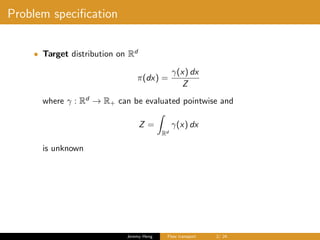
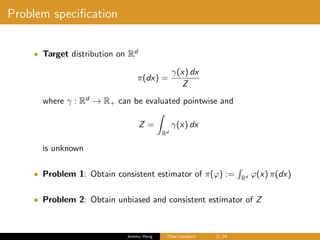
Problem specification
• Target distribution on Rd
π(dx) =
γ(x) dx
Z
where γ : Rd
→ R+ can be evaluated pointwise and
Z =
Rd
γ(x) dx
is unknown
Jeremy Heng Flow transport 2/ 24
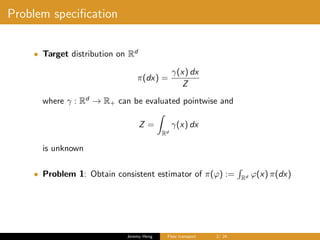
Problem specification
• Target distribution on Rd
π(dx) =
γ(x) dx
Z
where γ : Rd
→ R+ can be evaluated pointwise and
Z =
Rd
γ(x) dx
is unknown
• Problem 1: Obtain consistent estimator of π(ϕ) := Rd ϕ(x) π(dx)
Jeremy Heng Flow transport 2/ 24
Problem specification
• Target distribution on Rd
π(dx) =
γ(x) dx
Z
where γ : Rd
→ R+ can be evaluated pointwise and
Z =
Rd
γ(x) dx
is unknown
• Problem 1: Obtain consistent estimator of π(ϕ) := Rd ϕ(x) π(dx)
• Problem 2: Obtain unbiased and consistent estimator of Z
Jeremy Heng Flow transport 2/ 24
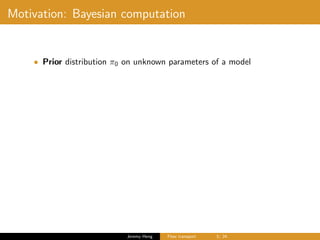
Motivation: Bayesian computation
• Prior distribution π0 on unknown parameters of a model
Jeremy Heng Flow transport 3/ 24
Motivation: Bayesian computation
• Prior distribution π0 on unknown parameters of a model
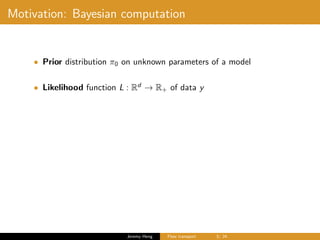
• Likelihood function L : Rd
→ R+ of data y
Jeremy Heng Flow transport 3/ 24
Motivation: Bayesian computation
• Prior distribution π0 on unknown parameters of a model
• Likelihood function L : Rd
→ R+ of data y
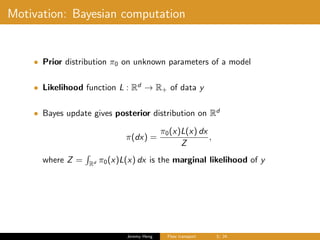
• Bayes update gives posterior distribution on Rd
π(dx) =
π0(x)L(x) dx
Z
,
where Z = Rd π0(x)L(x) dx is the marginal likelihood of y
Jeremy Heng Flow transport 3/ 24
Motivation: Bayesian computation
• Prior distribution π0 on unknown parameters of a model
• Likelihood function L : Rd
→ R+ of data y
• Bayes update gives posterior distribution on Rd
π(dx) =
π0(x)L(x) dx
Z
,
where Z = Rd π0(x)L(x) dx is the marginal likelihood of y
• π(ϕ) and Z are typically intractable
Jeremy Heng Flow transport 3/ 24
Monte Carlo methods
• Typically sampling from π is intractable, so we rely on Markov
chain Monte Carlo (MCMC) methods
Jeremy Heng Flow transport 4/ 24
Monte Carlo methods
• Typically sampling from π is intractable, so we rely on Markov
chain Monte Carlo (MCMC) methods
• MCMC constructs a π-invariant Markov kernel
K : Rd
× B(Rd
) → [0, 1]
Jeremy Heng Flow transport 4/ 24
Monte Carlo methods
• Typically sampling from π is intractable, so we rely on Markov
chain Monte Carlo (MCMC) methods
• MCMC constructs a π-invariant Markov kernel
K : Rd
× B(Rd
) → [0, 1]
• Sample X0 ∼ π0 and iterate Xn ∼ K(Xn−1, ·) until convergence
Jeremy Heng Flow transport 4/ 24
Monte Carlo methods
• Typically sampling from π is intractable, so we rely on Markov
chain Monte Carlo (MCMC) methods
• MCMC constructs a π-invariant Markov kernel
K : Rd
× B(Rd
) → [0, 1]
• Sample X0 ∼ π0 and iterate Xn ∼ K(Xn−1, ·) until convergence
• MCMC can fail in practice, for e.g. when π is highly multi-modal
Jeremy Heng Flow transport 4/ 24
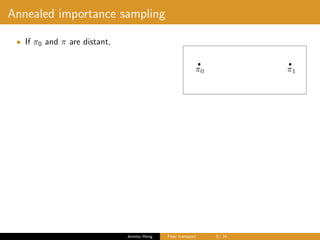
Annealed importance sampling
• If π0 and π are distant,
Jeremy Heng Flow transport 5/ 24
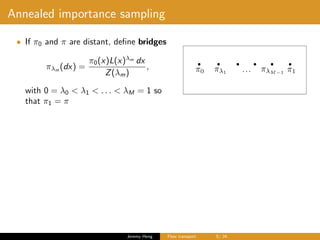
Annealed importance sampling
• If π0 and π are distant, define bridges
πλm
(dx) =
π0(x)L(x)λm
dx
Z(λm)
,
with 0 = λ0 < λ1 < . . . < λM = 1 so
that π1 = π
Jeremy Heng Flow transport 5/ 24
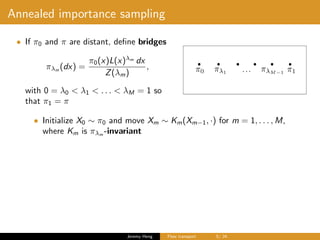
Annealed importance sampling
• If π0 and π are distant, define bridges
πλm
(dx) =
π0(x)L(x)λm
dx
Z(λm)
,
with 0 = λ0 < λ1 < . . . < λM = 1 so
that π1 = π
• Initialize X0 ∼ π0 and move Xm ∼ Km(Xm−1, ·) for m = 1, . . . , M,
where Km is πλm -invariant
Jeremy Heng Flow transport 5/ 24
Annealed importance sampling
• If π0 and π are distant, define bridges
πλm
(dx) =
π0(x)L(x)λm
dx
Z(λm)
,
with 0 = λ0 < λ1 < . . . < λM = 1 so
that π1 = π
• Initialize X0 ∼ π0 and move Xm ∼ Km(Xm−1, ·) for m = 1, . . . , M,
where Km is πλm -invariant
• Annealed importance sampling constructs w : (Rd
)M+1
→ R+ so
that
π(ϕ) =
E [ϕ(XM )w(X0:M )]
E [w(X0:M )]
, Z = E [w(X0:M )]
Jeremy Heng Flow transport 5/ 24
Annealed importance sampling
• If π0 and π are distant, define bridges
πλm
(dx) =
π0(x)L(x)λm
dx
Z(λm)
,
with 0 = λ0 < λ1 < . . . < λM = 1 so
that π1 = π
• Initialize X0 ∼ π0 and move Xm ∼ Km(Xm−1, ·) for m = 1, . . . , M,
where Km is πλm -invariant
• Annealed importance sampling constructs w : (Rd
)M+1
→ R+ so
that
π(ϕ) =
E [ϕ(XM )w(X0:M )]
E [w(X0:M )]
, Z = E [w(X0:M )]
• AIS (Neal, 2001) and SMC samplers (Del Moral et al., 2006) are
considered state-of-the-art in statistics and machine learning
Jeremy Heng Flow transport 5/ 24
Jarzynski nonequilibrium equality
• Consider M → ∞,
Jeremy Heng Flow transport 6/ 24
Jarzynski nonequilibrium equality
• Consider M → ∞, i.e. define the curve
of distribution {πt}t∈[0,1]
Jeremy Heng Flow transport 6/ 24
Jarzynski nonequilibrium equality
• Consider M → ∞, i.e. define the curve
of distribution {πt}t∈[0,1]
πt(dx) =
π0(x)L(x)λ(t)
dx
Z(t)
,
where λ : [0, 1] → [0, 1] is a strictly
increasing C1
function
Jeremy Heng Flow transport 6/ 24
Jarzynski nonequilibrium equality
• Consider M → ∞, i.e. define the curve
of distribution {πt}t∈[0,1]
πt(dx) =
π0(x)L(x)λ(t)
dx
Z(t)
,
where λ : [0, 1] → [0, 1] is a strictly
increasing C1
function
• Initialize X0 ∼ π0 and run time-inhomogenous Langevin dynamics
dXt =
1
2
log πt(Xt)dt + dWt, t ∈ [0, 1]
Jeremy Heng Flow transport 6/ 24
Jarzynski nonequilibrium equality
• Consider M → ∞, i.e. define the curve
of distribution {πt}t∈[0,1]
πt(dx) =
π0(x)L(x)λ(t)
dx
Z(t)
,
where λ : [0, 1] → [0, 1] is a strictly
increasing C1
function
• Initialize X0 ∼ π0 and run time-inhomogenous Langevin dynamics
dXt =
1
2
log πt(Xt)dt + dWt, t ∈ [0, 1]
• Jarzynski equality (Jarzynski, 1997; Crooks, 1998) constructs
w : C([0, 1], Rd
) → R+ so that
π(ϕ) =
E ϕ(X1)w(X[0,1])
E w(X[0,1])
, Z = E w(X[0,1])
Jeremy Heng Flow transport 6/ 24
Jarzynski nonequilibrium equality
• Consider M → ∞, i.e. define the curve
of distribution {πt}t∈[0,1]
πt(dx) =
π0(x)L(x)λ(t)
dx
Z(t)
,
where λ : [0, 1] → [0, 1] is a strictly
increasing C1
function
• Initialize X0 ∼ π0 and run time-inhomogenous Langevin dynamics
dXt =
1
2
log πt(Xt)dt + dWt, t ∈ [0, 1]
• Jarzynski equality (Jarzynski, 1997; Crooks, 1998) constructs
w : C([0, 1], Rd
) → R+ so that
π(ϕ) =
E ϕ(X1)w(X[0,1])
E w(X[0,1])
, Z = E w(X[0,1])
• To what extent is this state-of-the-art in molecular dynamics?
Jeremy Heng Flow transport 6/ 24
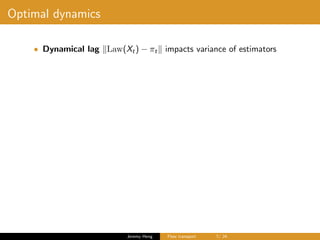
Optimal dynamics
• Dynamical lag Law(Xt) − πt impacts variance of estimators
Jeremy Heng Flow transport 7/ 24
Optimal dynamics
• Dynamical lag Law(Xt) − πt impacts variance of estimators
• Vaikuntanathan & Jarzynski (2011) considered adding drift
f : [0, 1] × Rd
→ Rd
to reduce lag
dXt = f (t, Xt)dt +
1
2
log πt(Xt)dt + dWt, t ∈ [0, 1], X0 ∼ π0
Jeremy Heng Flow transport 7/ 24
Optimal dynamics
• Dynamical lag Law(Xt) − πt impacts variance of estimators
• Vaikuntanathan & Jarzynski (2011) considered adding drift
f : [0, 1] × Rd
→ Rd
to reduce lag
dXt = f (t, Xt)dt +
1
2
log πt(Xt)dt + dWt, t ∈ [0, 1], X0 ∼ π0
• An optimal choice of f results in zero lag, i.e. Xt ∼ πt for t ∈ [0, 1],
and zero variance estimator of Z
Jeremy Heng Flow transport 7/ 24
Optimal dynamics
• Dynamical lag Law(Xt) − πt impacts variance of estimators
• Vaikuntanathan & Jarzynski (2011) considered adding drift
f : [0, 1] × Rd
→ Rd
to reduce lag
dXt = f (t, Xt)dt +
1
2
log πt(Xt)dt + dWt, t ∈ [0, 1], X0 ∼ π0
• An optimal choice of f results in zero lag, i.e. Xt ∼ πt for t ∈ [0, 1],
and zero variance estimator of Z
• Any optimal choice f satisfies Liouville PDE
− · (πt(x)f (t, x)) = ∂tπt(x)
Jeremy Heng Flow transport 7/ 24
Optimal dynamics
• Dynamical lag Law(Xt) − πt impacts variance of estimators
• Vaikuntanathan & Jarzynski (2011) considered adding drift
f : [0, 1] × Rd
→ Rd
to reduce lag
dXt = f (t, Xt)dt +
1
2
log πt(Xt)dt + dWt, t ∈ [0, 1], X0 ∼ π0
• An optimal choice of f results in zero lag, i.e. Xt ∼ πt for t ∈ [0, 1],
and zero variance estimator of Z
• Any optimal choice f satisfies Liouville PDE
− · (πt(x)f (t, x)) = ∂tπt(x)
• Zero lag also achieved by running deterministic dynamics
dXt = f (t, Xt)dt, X0 ∼ π0
Jeremy Heng Flow transport 7/ 24
Time evolution of distributions
• Time evolution of πt is given by
∂tπt(x) = λ (t) (log L(x) − It) πt(x),
where
It =
1
λ (t)
d
dt
log Z(t)
!
= Eπt [log L(Xt)] < ∞
Jeremy Heng Flow transport 8/ 24
Time evolution of distributions
• Time evolution of πt is given by
∂tπt(x) = λ (t) (log L(x) − It) πt(x),
where
It =
1
λ (t)
d
dt
log Z(t)
!
= Eπt [log L(Xt)] < ∞
• Integrating recovers path sampling (Gelman and Meng, 1998) or
thermodynamic integration (Kirkwood, 1935) identity
log
Z(1)
Z(0)
=
1
0
λ (t)It dt.
Jeremy Heng Flow transport 8/ 24
Liouville PDE
• Dynamics governed by ODE
dXt = f (t, Xt)dt, X0 ∼ π0
Jeremy Heng Flow transport 9/ 24
Liouville PDE
• Dynamics governed by ODE
dXt = f (t, Xt)dt, X0 ∼ π0
• For sufficiently regular f , ODE admits a unique solution
t → Xt, t ∈ [0, 1]
Jeremy Heng Flow transport 9/ 24
Liouville PDE
• Dynamics governed by ODE
dXt = f (t, Xt)dt, X0 ∼ π0
• For sufficiently regular f , ODE admits a unique solution
t → Xt, t ∈ [0, 1]
Jeremy Heng Flow transport 9/ 24
Liouville PDE
• Dynamics governed by ODE
dXt = f (t, Xt)dt, X0 ∼ π0
• For sufficiently regular f , ODE admits a unique solution
t → Xt, t ∈ [0, 1]
inducing a curve of distributions
{˜πt := Law(Xt), t ∈ [0, 1]}
Jeremy Heng Flow transport 9/ 24
Liouville PDE
• Dynamics governed by ODE
dXt = f (t, Xt)dt, X0 ∼ π0
• For sufficiently regular f , ODE admits a unique solution
t → Xt, t ∈ [0, 1]
inducing a curve of distributions
{˜πt := Law(Xt), t ∈ [0, 1]}
satisfying Liouville PDE
− · (˜πtf ) = ∂t ˜πt, ˜π0 = π0
Jeremy Heng Flow transport 9/ 24
Defining the flow transport problem
• Set ˜πt = πt, for t ∈ [0, 1] and solve Liouville equation
− · (πtf ) = ∂tπt, (L)
for a drift f ... but not all solutions will work!
Jeremy Heng Flow transport 10/ 24
Defining the flow transport problem
• Set ˜πt = πt, for t ∈ [0, 1] and solve Liouville equation
− · (πtf ) = ∂tπt, (L)
for a drift f ... but not all solutions will work!
• Validity relies on following result:
Jeremy Heng Flow transport 10/ 24
Defining the flow transport problem
• Set ˜πt = πt, for t ∈ [0, 1] and solve Liouville equation
− · (πtf ) = ∂tπt, (L)
for a drift f ... but not all solutions will work!
• Validity relies on following result:
Theorem. Ambrosio et al. (2005)
Under the following assumptions:
Eulerian Liouville PDE ⇐⇒ Lagrangian ODE
Jeremy Heng Flow transport 10/ 24
Defining the flow transport problem
• Set ˜πt = πt, for t ∈ [0, 1] and solve Liouville equation
− · (πtf ) = ∂tπt, (L)
for a drift f ... but not all solutions will work!
• Validity relies on following result:
Theorem. Ambrosio et al. (2005)
Under the following assumptions:
A1 f is locally Lipschitz;
Eulerian Liouville PDE ⇐⇒ Lagrangian ODE
Jeremy Heng Flow transport 10/ 24
Defining the flow transport problem
• Set ˜πt = πt, for t ∈ [0, 1] and solve Liouville equation
− · (πtf ) = ∂tπt, (L)
for a drift f ... but not all solutions will work!
• Validity relies on following result:
Theorem. Ambrosio et al. (2005)
Under the following assumptions:
A1 f is locally Lipschitz;
A2
1
0 Rd |f (t, x)|πt(x) dx dt < ∞;
Eulerian Liouville PDE ⇐⇒ Lagrangian ODE
Jeremy Heng Flow transport 10/ 24
Defining the flow transport problem
• Set ˜πt = πt, for t ∈ [0, 1] and solve Liouville equation
− · (πtf ) = ∂tπt, (L)
for a drift f ... but not all solutions will work!
• Validity relies on following result:
Theorem. Ambrosio et al. (2005)
Under the following assumptions:
A1 f is locally Lipschitz;
A2
1
0 Rd |f (t, x)|πt(x) dx dt < ∞;
Eulerian Liouville PDE ⇐⇒ Lagrangian ODE
• Define flow transport problem as solving Liouville (L) for f that
satisfies [A1] & [A2]
Jeremy Heng Flow transport 10/ 24
Ill-posedness and regularization
• Under-determined: consider πt = N((0, 0) , I2) for t ∈ [0, 1],
f (x1, x2) = (0, 0) and f (x1, x2) = (−x2, x1)
are both solutions
Jeremy Heng Flow transport 11/ 24
Ill-posedness and regularization
• Under-determined: consider πt = N((0, 0) , I2) for t ∈ [0, 1],
f (x1, x2) = (0, 0) and f (x1, x2) = (−x2, x1)
are both solutions
• Regularization: seek minimal kinetic energy solution
argminf
1
0 Rd
|f (t, x)|2
πt(x) dx dt : f solves Liouville
EL
=⇒ f ∗
= ϕ where − · (πt ϕ) = ∂tπt
Jeremy Heng Flow transport 11/ 24
Ill-posedness and regularization
• Under-determined: consider πt = N((0, 0) , I2) for t ∈ [0, 1],
f (x1, x2) = (0, 0) and f (x1, x2) = (−x2, x1)
are both solutions
• Regularization: seek minimal kinetic energy solution
argminf
1
0 Rd
|f (t, x)|2
πt(x) dx dt : f solves Liouville
EL
=⇒ f ∗
= ϕ where − · (πt ϕ) = ∂tπt
• Analytical solution available when distributions are (mixtures of)
Gaussians (Reich, 2012)
Jeremy Heng Flow transport 11/ 24
Flow transport problem on R
• Minimal kinetic energy solution
f (t, x) =
−
x
−∞
∂tπt(u) du
πt(x)
Jeremy Heng Flow transport 12/ 24
Flow transport problem on R
• Minimal kinetic energy solution
f (t, x) =
−
x
−∞
∂tπt(u) du
πt(x)
• Checking Liouville
− · (πtf ) = ∂x
x
−∞
∂tπt(u) du = ∂tπt(x)
Jeremy Heng Flow transport 12/ 24
Flow transport problem on R
• Minimal kinetic energy solution
f (t, x) =
−
x
−∞
∂tπt(u) du
πt(x)
• Checking Liouville
− · (πtf ) = ∂x
x
−∞
∂tπt(u) du = ∂tπt(x)
A1 For f to be locally Lipschitz, assume
π0, L ∈ C1
(R, R+) =⇒ f ∈ C1
([0, 1] × R, R)
Jeremy Heng Flow transport 12/ 24
Flow transport problem on R
• Minimal kinetic energy solution
f (t, x) =
−
x
−∞
∂tπt(u) du
πt(x)
• Checking Liouville
− · (πtf ) = ∂x
x
−∞
∂tπt(u) du = ∂tπt(x)
A1 For f to be locally Lipschitz, assume
π0, L ∈ C1
(R, R+) =⇒ f ∈ C1
([0, 1] × R, R)
A2 For integrability of
1
0 Rd |f (t, x)|πt(x) dx dt < ∞, necessarily
|πtf |(t, x) =
x
−∞
∂tπt(u) du → 0 as |x| → ∞
since
∞
−∞
∂tπt(u) du = 0
Jeremy Heng Flow transport 12/ 24
Flow transport problem on R
• Minimal kinetic energy solution
f (t, x) =
−
x
−∞
∂tπt(u) du
πt(x)
• Checking Liouville
− · (πtf ) = ∂x
x
−∞
∂tπt(u) du = ∂tπt(x)
A1 For f to be locally Lipschitz, assume
π0, L ∈ C1
(R, R+) =⇒ f ∈ C1
([0, 1] × R, R)
A2 For integrability of
1
0 Rd |f (t, x)|πt(x) dx dt < ∞, necessarily
|πtf |(t, x) =
x
−∞
∂tπt(u) du → 0 as |x| → ∞
since
∞
−∞
∂tπt(u) du = 0
• Optimality: f = ϕ holds trivially
Jeremy Heng Flow transport 12/ 24
Flow transport problem on R
• Re-write solution as
f (t, x) =
λ (t)It {Ft(x) − Ix
t /It}
πt(x)
where Ix
t = Eπt
[1(−∞,x] log L(Xt)] and Ft is CDF of πt
Jeremy Heng Flow transport 13/ 24
Flow transport problem on R
• Re-write solution as
f (t, x) =
λ (t)It {Ft(x) − Ix
t /It}
πt(x)
where Ix
t = Eπt
[1(−∞,x] log L(Xt)] and Ft is CDF of πt
• Speed is controlled by λ (t) and πt(x)
Jeremy Heng Flow transport 13/ 24
Flow transport problem on R
• Re-write solution as
f (t, x) =
λ (t)It {Ft(x) − Ix
t /It}
πt(x)
where Ix
t = Eπt
[1(−∞,x] log L(Xt)] and Ft is CDF of πt
• Speed is controlled by λ (t) and πt(x)
• Sign is given by difference between Ft(x) and Ix
t /It ∈ [0, 1]
Jeremy Heng Flow transport 13/ 24
Flow transport problem on Rd
, d ≥ 1
• Multivariate solution for d = 3
(πtf1)(t, x1:3) = −
x1
−∞
∂tπt(u1, x2, x3) du1
+ g1(t, x1)
∞
−∞
∂tπt(u1, x2, x3) du1
(πtf2)(t, x1:3) = − g1(t, x1)
∞
−∞
x2
−∞
∂tπt(u1, u2, x3) du1:2
+ g1(t, x1)g2(t, x2)
∞
−∞
∞
−∞
∂tπt(u1, u2, x3) du1:2
(πtf3)(t, x1:3) = − g1(t, x1)g2(t, x2)
∞
−∞
∞
−∞
x3
−∞
∂tπt(u1, u2, u3) du1:3
where g1, g2 ∈ C2
([0, 1] × R, [0, 1])
Jeremy Heng Flow transport 14/ 24
Flow transport problem on Rd
, d ≥ 1
• Checking Liouville
∂x1 (πtf1)(t, x1:3) = − ∂tπt(x1, x2, x3)
+ g1(t, x1)
∞
−∞
∂tπt(u1, x2, x3) du1
∂x2
(πtf2)(t, x1:3) = − g1(t, x1)
∞
−∞
∂tπt(u1, x2, x3) du1:2
+ g1(t, x1)g2(t, x2)
∞
−∞
∞
−∞
∂tπt(u1, u2, x3) du1:2
∂x3
(πtf3)(t, x1:3) = − g1(t, x1)g2(t, x2)
∞
−∞
∞
−∞
∂tπt(u1, u2, x3) du1:2
Jeremy Heng Flow transport 15/ 24
Flow transport problem on Rd
, d ≥ 1
• Checking Liouville
∂x1 (πtf1)(t, x1:3) = − ∂tπt(x1, x2, x3)
+ g1(t, x1)
∞
−∞
∂tπt(u1, x2, x3) du1
∂x2
(πtf2)(t, x1:3) = − g1(t, x1)
∞
−∞
∂tπt(u1, x2, x3) du1:2
+ g1(t, x1)g2(t, x2)
∞
−∞
∞
−∞
∂tπt(u1, u2, x3) du1:2
∂x3
(πtf3)(t, x1:3) = − g1(t, x1)g2(t, x2)
∞
−∞
∞
−∞
∂tπt(u1, u2, x3) du1:2
• Taking divergence gives telescopic sum
− · (πtf )(t, x1:3) = −
3
i=1
∂xi
(πtfi )(t, x1:3) = ∂tπt(x1:3)
Jeremy Heng Flow transport 15/ 24
Flow transport problem on Rd
, d ≥ 1
A1 For f to be locally Lipschitz, assume
π0, L ∈ C1
(Rd
, R+) =⇒ f ∈ C1
([0, 1] × Rd
, Rd
)
Jeremy Heng Flow transport 16/ 24
Flow transport problem on Rd
, d ≥ 1
A1 For f to be locally Lipschitz, assume
π0, L ∈ C1
(Rd
, R+) =⇒ f ∈ C1
([0, 1] × Rd
, Rd
)
A2 For integrability of
1
0 Rd |f (t, x)|πt(x) dx dt < ∞, necessarily
|πtf |(t, x)| → 0 as |x| → ∞
if {gi } are non-decreasing functions with tail behaviour
gi (t, xi ) → 0 as xi → −∞,
gi (t, xi ) → 1 as xi → ∞
Jeremy Heng Flow transport 16/ 24
Flow transport problem on Rd
, d ≥ 1
A1 For f to be locally Lipschitz, assume
π0, L ∈ C1
(Rd
, R+) =⇒ f ∈ C1
([0, 1] × Rd
, Rd
)
A2 For integrability of
1
0 Rd |f (t, x)|πt(x) dx dt < ∞, necessarily
|πtf |(t, x)| → 0 as |x| → ∞
if {gi } are non-decreasing functions with tail behaviour
gi (t, xi ) → 0 as xi → −∞,
gi (t, xi ) → 1 as xi → ∞
• Choosing gi (t, xi ) = Ft(xi ) as marginal CDF of πt allows f to
decouple if distributions are independent
Jeremy Heng Flow transport 16/ 24
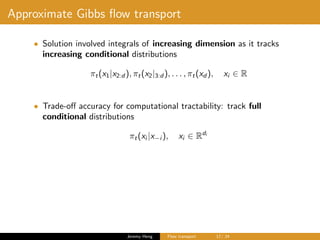
Approximate Gibbs flow transport
• Solution involved integrals of increasing dimension as it tracks
increasing conditional distributions
πt(x1|x2:d ), πt(x2|3:d ), . . . , πt(xd ), xi ∈ R
Jeremy Heng Flow transport 17/ 24
Approximate Gibbs flow transport
• Solution involved integrals of increasing dimension as it tracks
increasing conditional distributions
πt(x1|x2:d ), πt(x2|3:d ), . . . , πt(xd ), xi ∈ R
• Trade-off accuracy for computational tractability: track full
conditional distributions
πt(xi |x−i ), xi ∈ Rdi
Jeremy Heng Flow transport 17/ 24
Approximate Gibbs flow transport
• Solution involved integrals of increasing dimension as it tracks
increasing conditional distributions
πt(x1|x2:d ), πt(x2|3:d ), . . . , πt(xd ), xi ∈ R
• Trade-off accuracy for computational tractability: track full
conditional distributions
πt(xi |x−i ), xi ∈ Rdi
• System of Liouville equations
− xi
· πt(xi |x−i )˜fi (t, x) = ∂tπt(xi |x−i ),
each defined on (0, 1) × Rdi
Jeremy Heng Flow transport 17/ 24
Approximate Gibbs flow transport
• For di = 1, solution is
˜fi (t, x) =
−
xi
−∞
∂tπt(ui |x−i ) dui
πt(xi |x−i )
Jeremy Heng Flow transport 18/ 24
Approximate Gibbs flow transport
• For di = 1, solution is
˜fi (t, x) =
−
xi
−∞
∂tπt(ui |x−i ) dui
πt(xi |x−i )
• If π0, L ∈ C1
(Rd
, R+) and lim|x|→∞ L(x) = 0, the ODE
dXt = ˜f (t, Xt)dt, X0 ∼ π0
admits a unique solution on [0, 1], referred to as Gibbs flow
Jeremy Heng Flow transport 18/ 24
Approximate Gibbs flow transport
• For di = 1, solution is
˜fi (t, x) =
−
xi
−∞
∂tπt(ui |x−i ) dui
πt(xi |x−i )
• If π0, L ∈ C1
(Rd
, R+) and lim|x|→∞ L(x) = 0, the ODE
dXt = ˜f (t, Xt)dt, X0 ∼ π0
admits a unique solution on [0, 1], referred to as Gibbs flow
• For di > 1, can often exploit analytical tractability of πt(xi |x−i ) to
solve for ˜fi (t, x); or apply multivariate extension
Jeremy Heng Flow transport 18/ 24
Approximate Gibbs flow transport
• For di = 1, solution is
˜fi (t, x) =
−
xi
−∞
∂tπt(ui |x−i ) dui
πt(xi |x−i )
• If π0, L ∈ C1
(Rd
, R+) and lim|x|→∞ L(x) = 0, the ODE
dXt = ˜f (t, Xt)dt, X0 ∼ π0
admits a unique solution on [0, 1], referred to as Gibbs flow
• For di > 1, can often exploit analytical tractability of πt(xi |x−i ) to
solve for ˜fi (t, x); or apply multivariate extension
• Otherwise, analogous to Metropolis-within-Gibbs, split into one
dimensional components and apply above
Jeremy Heng Flow transport 18/ 24
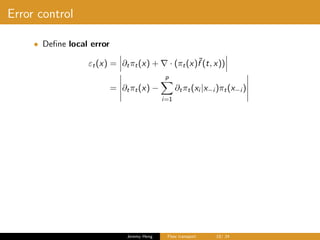
Error control
• Define local error
εt(x) = ∂tπt(x) + · (πt(x)˜f (t, x))
= ∂tπt(x) −
p
i=1
∂tπt(xi |x−i )πt(x−i )
Jeremy Heng Flow transport 19/ 24
Error control
• Define local error
εt(x) = ∂tπt(x) + · (πt(x)˜f (t, x))
= ∂tπt(x) −
p
i=1
∂tπt(xi |x−i )πt(x−i )
• Gibbs flow exploits local independence:
πt(x) =
p
i=1
πt(xi ) =⇒ εt(x) = 0
Jeremy Heng Flow transport 19/ 24
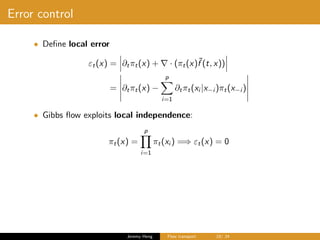
Error control
• Define local error
εt(x) = ∂tπt(x) + · (πt(x)˜f (t, x))
= ∂tπt(x) −
p
i=1
∂tπt(xi |x−i )πt(x−i )
• Gibbs flow exploits local independence:
πt(x) =
p
i=1
πt(xi ) =⇒ εt(x) = 0
• If Gibbs flow induces {˜πt}t∈[0,1] with ˜π0 = π0
˜πt − πt
2
L2 ≤ t
t
0
εu
2
L2 du · exp 1 +
t
0
· ˜f (u, ·) ∞ du
Jeremy Heng Flow transport 19/ 24
Numerical integration of Gibbs flow
• Previously, we considered the forward Euler scheme
Ym = Ym−1 + ∆t ˜f (tm−1, Ym−1) = Φm(Ym−1)
Jeremy Heng Flow transport 20/ 24
Numerical integration of Gibbs flow
• Previously, we considered the forward Euler scheme
Ym = Ym−1 + ∆t ˜f (tm−1, Ym−1) = Φm(Ym−1)
• To get Law(Ym), we need Jacobian determinant of Φm which
typically costs O(d3
) for di = 1
Jeremy Heng Flow transport 20/ 24
Numerical integration of Gibbs flow
• Previously, we considered the forward Euler scheme
Ym = Ym−1 + ∆t ˜f (tm−1, Ym−1) = Φm(Ym−1)
• To get Law(Ym), we need Jacobian determinant of Φm which
typically costs O(d3
) for di = 1
• In contrast, this scheme mimicking a systematic Gibbs scan
Ym[i] = Ym−1[i] + ∆t ˜f (tm−1, Ym[1 : i − 1], Ym−1[i : p])
Ym = Φm,d ◦ · · · ◦ Φm,1(Ym−1)
is also order one, and costs O(d)
Jeremy Heng Flow transport 20/ 24
Mixture modelling example
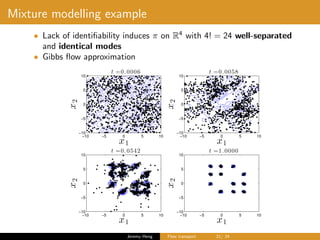
• Lack of identifiability induces π on R4
with 4! = 24 well-separated
and identical modes
Jeremy Heng Flow transport 21/ 24
Mixture modelling example
• Lack of identifiability induces π on R4
with 4! = 24 well-separated
and identical modes
• Gibbs flow approximation
t =0.0006
x1
x2
−10 −5 0 5 10
−10
−5
0
5
10
t =0.0058
x1
x2
−10 −5 0 5 10
−10
−5
0
5
10
t =0.0542
x1
x2
−10 −5 0 5 10
−10
−5
0
5
10
t =1.0000
x1
x2
−10 −5 0 5 10
−10
−5
0
5
10
Jeremy Heng Flow transport 21/ 24
Mixture modelling example
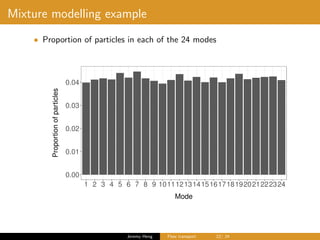
• Proportion of particles in each of the 24 modes
0.00
0.01
0.02
0.03
0.04
1 2 3 4 5 6 7 8 9 101112131415161718192021222324
Mode
Proportionofparticles
Jeremy Heng Flow transport 22/ 24
Mixture modelling example
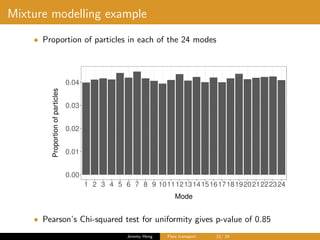
• Proportion of particles in each of the 24 modes
0.00
0.01
0.02
0.03
0.04
1 2 3 4 5 6 7 8 9 101112131415161718192021222324
Mode
Proportionofparticles
• Pearson’s Chi-squared test for uniformity gives p-value of 0.85
Jeremy Heng Flow transport 22/ 24
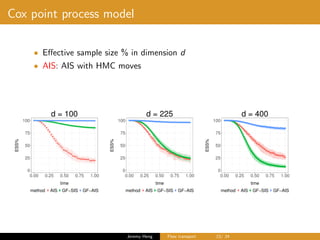
Cox point process model
• Effective sample size % in dimension d
0
25
50
75
100
0.00 0.25 0.50 0.75 1.00
time
ESS%
method AIS GF−SIS GF−AIS
d = 100
0
25
50
75
100
0.00 0.25 0.50 0.75 1.00
time
ESS%
method AIS GF−SIS GF−AIS
d = 225
0
25
50
75
100
0.00 0.25 0.50 0.75 1.00
time
ESS%
method AIS GF−SIS GF−AIS
d = 400
Jeremy Heng Flow transport 23/ 24
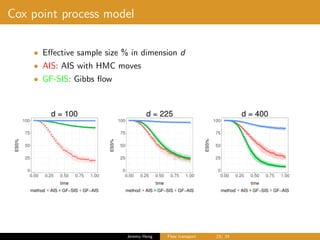
Cox point process model
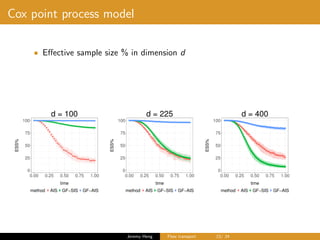
• Effective sample size % in dimension d
• AIS: AIS with HMC moves
0
25
50
75
100
0.00 0.25 0.50 0.75 1.00
time
ESS%
method AIS GF−SIS GF−AIS
d = 100
0
25
50
75
100
0.00 0.25 0.50 0.75 1.00
time
ESS%
method AIS GF−SIS GF−AIS
d = 225
0
25
50
75
100
0.00 0.25 0.50 0.75 1.00
time
ESS%
method AIS GF−SIS GF−AIS
d = 400
Jeremy Heng Flow transport 23/ 24
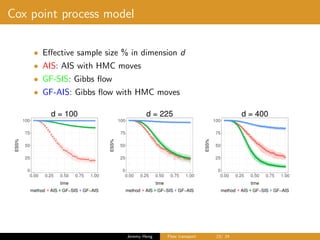
Cox point process model
• Effective sample size % in dimension d
• AIS: AIS with HMC moves
• GF-SIS: Gibbs flow
0
25
50
75
100
0.00 0.25 0.50 0.75 1.00
time
ESS%
method AIS GF−SIS GF−AIS
d = 100
0
25
50
75
100
0.00 0.25 0.50 0.75 1.00
time
ESS%
method AIS GF−SIS GF−AIS
d = 225
0
25
50
75
100
0.00 0.25 0.50 0.75 1.00
time
ESS%
method AIS GF−SIS GF−AIS
d = 400
Jeremy Heng Flow transport 23/ 24
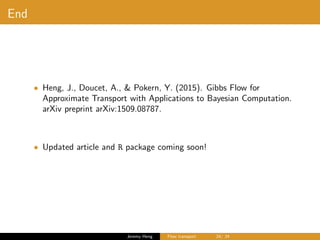
Cox point process model
• Effective sample size % in dimension d
• AIS: AIS with HMC moves
• GF-SIS: Gibbs flow
• GF-AIS: Gibbs flow with HMC moves
0
25
50
75
100
0.00 0.25 0.50 0.75 1.00
time
ESS%
method AIS GF−SIS GF−AIS
d = 100
0
25
50
75
100
0.00 0.25 0.50 0.75 1.00
time
ESS%
method AIS GF−SIS GF−AIS
d = 225
0
25
50
75
100
0.00 0.25 0.50 0.75 1.00
time
ESS%
method AIS GF−SIS GF−AIS
d = 400
Jeremy Heng Flow transport 23/ 24
End
• Heng, J., Doucet, A., & Pokern, Y. (2015). Gibbs Flow for
Approximate Transport with Applications to Bayesian Computation.
arXiv preprint arXiv:1509.08787.
• Updated article and R package coming soon!
Jeremy Heng Flow transport 24/ 24

Gibbs flow transport for Bayesian inference

  • 1.
    Gibbs flow transportfor Bayesian inference Jeremy Heng, Department of Statistics, Harvard University Joint work with Arnaud Doucet (Oxford) & Yvo Pokern (UCL) Computational Statistics and Molecular Simulation: A Practical Cross-Fertilization Casa Matem´atica Oaxaca (CMO) 13 November 2018 Jeremy Heng Flow transport 1/ 24
  • 2.
    Problem specification • Targetdistribution on Rd π(dx) = γ(x) dx Z where γ : Rd → R+ can be evaluated pointwise and Z = Rd γ(x) dx is unknown Jeremy Heng Flow transport 2/ 24
  • 3.
    Problem specification • Targetdistribution on Rd π(dx) = γ(x) dx Z where γ : Rd → R+ can be evaluated pointwise and Z = Rd γ(x) dx is unknown • Problem 1: Obtain consistent estimator of π(ϕ) := Rd ϕ(x) π(dx) Jeremy Heng Flow transport 2/ 24
  • 4.
    Problem specification • Targetdistribution on Rd π(dx) = γ(x) dx Z where γ : Rd → R+ can be evaluated pointwise and Z = Rd γ(x) dx is unknown • Problem 1: Obtain consistent estimator of π(ϕ) := Rd ϕ(x) π(dx) • Problem 2: Obtain unbiased and consistent estimator of Z Jeremy Heng Flow transport 2/ 24
  • 5.
    Motivation: Bayesian computation •Prior distribution π0 on unknown parameters of a model Jeremy Heng Flow transport 3/ 24
  • 6.
    Motivation: Bayesian computation •Prior distribution π0 on unknown parameters of a model • Likelihood function L : Rd → R+ of data y Jeremy Heng Flow transport 3/ 24
  • 7.
    Motivation: Bayesian computation •Prior distribution π0 on unknown parameters of a model • Likelihood function L : Rd → R+ of data y • Bayes update gives posterior distribution on Rd π(dx) = π0(x)L(x) dx Z , where Z = Rd π0(x)L(x) dx is the marginal likelihood of y Jeremy Heng Flow transport 3/ 24
  • 8.
    Motivation: Bayesian computation •Prior distribution π0 on unknown parameters of a model • Likelihood function L : Rd → R+ of data y • Bayes update gives posterior distribution on Rd π(dx) = π0(x)L(x) dx Z , where Z = Rd π0(x)L(x) dx is the marginal likelihood of y • π(ϕ) and Z are typically intractable Jeremy Heng Flow transport 3/ 24
  • 9.
    Monte Carlo methods •Typically sampling from π is intractable, so we rely on Markov chain Monte Carlo (MCMC) methods Jeremy Heng Flow transport 4/ 24
  • 10.
    Monte Carlo methods •Typically sampling from π is intractable, so we rely on Markov chain Monte Carlo (MCMC) methods • MCMC constructs a π-invariant Markov kernel K : Rd × B(Rd ) → [0, 1] Jeremy Heng Flow transport 4/ 24
  • 11.
    Monte Carlo methods •Typically sampling from π is intractable, so we rely on Markov chain Monte Carlo (MCMC) methods • MCMC constructs a π-invariant Markov kernel K : Rd × B(Rd ) → [0, 1] • Sample X0 ∼ π0 and iterate Xn ∼ K(Xn−1, ·) until convergence Jeremy Heng Flow transport 4/ 24
  • 12.
    Monte Carlo methods •Typically sampling from π is intractable, so we rely on Markov chain Monte Carlo (MCMC) methods • MCMC constructs a π-invariant Markov kernel K : Rd × B(Rd ) → [0, 1] • Sample X0 ∼ π0 and iterate Xn ∼ K(Xn−1, ·) until convergence • MCMC can fail in practice, for e.g. when π is highly multi-modal Jeremy Heng Flow transport 4/ 24
  • 13.
    Annealed importance sampling •If π0 and π are distant, Jeremy Heng Flow transport 5/ 24
  • 14.
    Annealed importance sampling •If π0 and π are distant, define bridges πλm (dx) = π0(x)L(x)λm dx Z(λm) , with 0 = λ0 < λ1 < . . . < λM = 1 so that π1 = π Jeremy Heng Flow transport 5/ 24
  • 15.
    Annealed importance sampling •If π0 and π are distant, define bridges πλm (dx) = π0(x)L(x)λm dx Z(λm) , with 0 = λ0 < λ1 < . . . < λM = 1 so that π1 = π • Initialize X0 ∼ π0 and move Xm ∼ Km(Xm−1, ·) for m = 1, . . . , M, where Km is πλm -invariant Jeremy Heng Flow transport 5/ 24
  • 16.
    Annealed importance sampling •If π0 and π are distant, define bridges πλm (dx) = π0(x)L(x)λm dx Z(λm) , with 0 = λ0 < λ1 < . . . < λM = 1 so that π1 = π • Initialize X0 ∼ π0 and move Xm ∼ Km(Xm−1, ·) for m = 1, . . . , M, where Km is πλm -invariant • Annealed importance sampling constructs w : (Rd )M+1 → R+ so that π(ϕ) = E [ϕ(XM )w(X0:M )] E [w(X0:M )] , Z = E [w(X0:M )] Jeremy Heng Flow transport 5/ 24
  • 17.
    Annealed importance sampling •If π0 and π are distant, define bridges πλm (dx) = π0(x)L(x)λm dx Z(λm) , with 0 = λ0 < λ1 < . . . < λM = 1 so that π1 = π • Initialize X0 ∼ π0 and move Xm ∼ Km(Xm−1, ·) for m = 1, . . . , M, where Km is πλm -invariant • Annealed importance sampling constructs w : (Rd )M+1 → R+ so that π(ϕ) = E [ϕ(XM )w(X0:M )] E [w(X0:M )] , Z = E [w(X0:M )] • AIS (Neal, 2001) and SMC samplers (Del Moral et al., 2006) are considered state-of-the-art in statistics and machine learning Jeremy Heng Flow transport 5/ 24
  • 18.
    Jarzynski nonequilibrium equality •Consider M → ∞, Jeremy Heng Flow transport 6/ 24
  • 19.
    Jarzynski nonequilibrium equality •Consider M → ∞, i.e. define the curve of distribution {πt}t∈[0,1] Jeremy Heng Flow transport 6/ 24
  • 20.
    Jarzynski nonequilibrium equality •Consider M → ∞, i.e. define the curve of distribution {πt}t∈[0,1] πt(dx) = π0(x)L(x)λ(t) dx Z(t) , where λ : [0, 1] → [0, 1] is a strictly increasing C1 function Jeremy Heng Flow transport 6/ 24
  • 21.
    Jarzynski nonequilibrium equality •Consider M → ∞, i.e. define the curve of distribution {πt}t∈[0,1] πt(dx) = π0(x)L(x)λ(t) dx Z(t) , where λ : [0, 1] → [0, 1] is a strictly increasing C1 function • Initialize X0 ∼ π0 and run time-inhomogenous Langevin dynamics dXt = 1 2 log πt(Xt)dt + dWt, t ∈ [0, 1] Jeremy Heng Flow transport 6/ 24
  • 22.
    Jarzynski nonequilibrium equality •Consider M → ∞, i.e. define the curve of distribution {πt}t∈[0,1] πt(dx) = π0(x)L(x)λ(t) dx Z(t) , where λ : [0, 1] → [0, 1] is a strictly increasing C1 function • Initialize X0 ∼ π0 and run time-inhomogenous Langevin dynamics dXt = 1 2 log πt(Xt)dt + dWt, t ∈ [0, 1] • Jarzynski equality (Jarzynski, 1997; Crooks, 1998) constructs w : C([0, 1], Rd ) → R+ so that π(ϕ) = E ϕ(X1)w(X[0,1]) E w(X[0,1]) , Z = E w(X[0,1]) Jeremy Heng Flow transport 6/ 24
  • 23.
    Jarzynski nonequilibrium equality •Consider M → ∞, i.e. define the curve of distribution {πt}t∈[0,1] πt(dx) = π0(x)L(x)λ(t) dx Z(t) , where λ : [0, 1] → [0, 1] is a strictly increasing C1 function • Initialize X0 ∼ π0 and run time-inhomogenous Langevin dynamics dXt = 1 2 log πt(Xt)dt + dWt, t ∈ [0, 1] • Jarzynski equality (Jarzynski, 1997; Crooks, 1998) constructs w : C([0, 1], Rd ) → R+ so that π(ϕ) = E ϕ(X1)w(X[0,1]) E w(X[0,1]) , Z = E w(X[0,1]) • To what extent is this state-of-the-art in molecular dynamics? Jeremy Heng Flow transport 6/ 24
  • 24.
    Optimal dynamics • Dynamicallag Law(Xt) − πt impacts variance of estimators Jeremy Heng Flow transport 7/ 24
  • 25.
    Optimal dynamics • Dynamicallag Law(Xt) − πt impacts variance of estimators • Vaikuntanathan & Jarzynski (2011) considered adding drift f : [0, 1] × Rd → Rd to reduce lag dXt = f (t, Xt)dt + 1 2 log πt(Xt)dt + dWt, t ∈ [0, 1], X0 ∼ π0 Jeremy Heng Flow transport 7/ 24
  • 26.
    Optimal dynamics • Dynamicallag Law(Xt) − πt impacts variance of estimators • Vaikuntanathan & Jarzynski (2011) considered adding drift f : [0, 1] × Rd → Rd to reduce lag dXt = f (t, Xt)dt + 1 2 log πt(Xt)dt + dWt, t ∈ [0, 1], X0 ∼ π0 • An optimal choice of f results in zero lag, i.e. Xt ∼ πt for t ∈ [0, 1], and zero variance estimator of Z Jeremy Heng Flow transport 7/ 24
  • 27.
    Optimal dynamics • Dynamicallag Law(Xt) − πt impacts variance of estimators • Vaikuntanathan & Jarzynski (2011) considered adding drift f : [0, 1] × Rd → Rd to reduce lag dXt = f (t, Xt)dt + 1 2 log πt(Xt)dt + dWt, t ∈ [0, 1], X0 ∼ π0 • An optimal choice of f results in zero lag, i.e. Xt ∼ πt for t ∈ [0, 1], and zero variance estimator of Z • Any optimal choice f satisfies Liouville PDE − · (πt(x)f (t, x)) = ∂tπt(x) Jeremy Heng Flow transport 7/ 24
  • 28.
    Optimal dynamics • Dynamicallag Law(Xt) − πt impacts variance of estimators • Vaikuntanathan & Jarzynski (2011) considered adding drift f : [0, 1] × Rd → Rd to reduce lag dXt = f (t, Xt)dt + 1 2 log πt(Xt)dt + dWt, t ∈ [0, 1], X0 ∼ π0 • An optimal choice of f results in zero lag, i.e. Xt ∼ πt for t ∈ [0, 1], and zero variance estimator of Z • Any optimal choice f satisfies Liouville PDE − · (πt(x)f (t, x)) = ∂tπt(x) • Zero lag also achieved by running deterministic dynamics dXt = f (t, Xt)dt, X0 ∼ π0 Jeremy Heng Flow transport 7/ 24
  • 29.
    Time evolution ofdistributions • Time evolution of πt is given by ∂tπt(x) = λ (t) (log L(x) − It) πt(x), where It = 1 λ (t) d dt log Z(t) ! = Eπt [log L(Xt)] < ∞ Jeremy Heng Flow transport 8/ 24
  • 30.
    Time evolution ofdistributions • Time evolution of πt is given by ∂tπt(x) = λ (t) (log L(x) − It) πt(x), where It = 1 λ (t) d dt log Z(t) ! = Eπt [log L(Xt)] < ∞ • Integrating recovers path sampling (Gelman and Meng, 1998) or thermodynamic integration (Kirkwood, 1935) identity log Z(1) Z(0) = 1 0 λ (t)It dt. Jeremy Heng Flow transport 8/ 24
  • 31.
    Liouville PDE • Dynamicsgoverned by ODE dXt = f (t, Xt)dt, X0 ∼ π0 Jeremy Heng Flow transport 9/ 24
  • 32.
    Liouville PDE • Dynamicsgoverned by ODE dXt = f (t, Xt)dt, X0 ∼ π0 • For sufficiently regular f , ODE admits a unique solution t → Xt, t ∈ [0, 1] Jeremy Heng Flow transport 9/ 24
  • 33.
    Liouville PDE • Dynamicsgoverned by ODE dXt = f (t, Xt)dt, X0 ∼ π0 • For sufficiently regular f , ODE admits a unique solution t → Xt, t ∈ [0, 1] Jeremy Heng Flow transport 9/ 24
  • 34.
    Liouville PDE • Dynamicsgoverned by ODE dXt = f (t, Xt)dt, X0 ∼ π0 • For sufficiently regular f , ODE admits a unique solution t → Xt, t ∈ [0, 1] inducing a curve of distributions {˜πt := Law(Xt), t ∈ [0, 1]} Jeremy Heng Flow transport 9/ 24
  • 35.
    Liouville PDE • Dynamicsgoverned by ODE dXt = f (t, Xt)dt, X0 ∼ π0 • For sufficiently regular f , ODE admits a unique solution t → Xt, t ∈ [0, 1] inducing a curve of distributions {˜πt := Law(Xt), t ∈ [0, 1]} satisfying Liouville PDE − · (˜πtf ) = ∂t ˜πt, ˜π0 = π0 Jeremy Heng Flow transport 9/ 24
  • 36.
    Defining the flowtransport problem • Set ˜πt = πt, for t ∈ [0, 1] and solve Liouville equation − · (πtf ) = ∂tπt, (L) for a drift f ... but not all solutions will work! Jeremy Heng Flow transport 10/ 24
  • 37.
    Defining the flowtransport problem • Set ˜πt = πt, for t ∈ [0, 1] and solve Liouville equation − · (πtf ) = ∂tπt, (L) for a drift f ... but not all solutions will work! • Validity relies on following result: Jeremy Heng Flow transport 10/ 24
  • 38.
    Defining the flowtransport problem • Set ˜πt = πt, for t ∈ [0, 1] and solve Liouville equation − · (πtf ) = ∂tπt, (L) for a drift f ... but not all solutions will work! • Validity relies on following result: Theorem. Ambrosio et al. (2005) Under the following assumptions: Eulerian Liouville PDE ⇐⇒ Lagrangian ODE Jeremy Heng Flow transport 10/ 24
  • 39.
    Defining the flowtransport problem • Set ˜πt = πt, for t ∈ [0, 1] and solve Liouville equation − · (πtf ) = ∂tπt, (L) for a drift f ... but not all solutions will work! • Validity relies on following result: Theorem. Ambrosio et al. (2005) Under the following assumptions: A1 f is locally Lipschitz; Eulerian Liouville PDE ⇐⇒ Lagrangian ODE Jeremy Heng Flow transport 10/ 24
  • 40.
    Defining the flowtransport problem • Set ˜πt = πt, for t ∈ [0, 1] and solve Liouville equation − · (πtf ) = ∂tπt, (L) for a drift f ... but not all solutions will work! • Validity relies on following result: Theorem. Ambrosio et al. (2005) Under the following assumptions: A1 f is locally Lipschitz; A2 1 0 Rd |f (t, x)|πt(x) dx dt < ∞; Eulerian Liouville PDE ⇐⇒ Lagrangian ODE Jeremy Heng Flow transport 10/ 24
  • 41.
    Defining the flowtransport problem • Set ˜πt = πt, for t ∈ [0, 1] and solve Liouville equation − · (πtf ) = ∂tπt, (L) for a drift f ... but not all solutions will work! • Validity relies on following result: Theorem. Ambrosio et al. (2005) Under the following assumptions: A1 f is locally Lipschitz; A2 1 0 Rd |f (t, x)|πt(x) dx dt < ∞; Eulerian Liouville PDE ⇐⇒ Lagrangian ODE • Define flow transport problem as solving Liouville (L) for f that satisfies [A1] & [A2] Jeremy Heng Flow transport 10/ 24
  • 42.
    Ill-posedness and regularization •Under-determined: consider πt = N((0, 0) , I2) for t ∈ [0, 1], f (x1, x2) = (0, 0) and f (x1, x2) = (−x2, x1) are both solutions Jeremy Heng Flow transport 11/ 24
  • 43.
    Ill-posedness and regularization •Under-determined: consider πt = N((0, 0) , I2) for t ∈ [0, 1], f (x1, x2) = (0, 0) and f (x1, x2) = (−x2, x1) are both solutions • Regularization: seek minimal kinetic energy solution argminf 1 0 Rd |f (t, x)|2 πt(x) dx dt : f solves Liouville EL =⇒ f ∗ = ϕ where − · (πt ϕ) = ∂tπt Jeremy Heng Flow transport 11/ 24
  • 44.
    Ill-posedness and regularization •Under-determined: consider πt = N((0, 0) , I2) for t ∈ [0, 1], f (x1, x2) = (0, 0) and f (x1, x2) = (−x2, x1) are both solutions • Regularization: seek minimal kinetic energy solution argminf 1 0 Rd |f (t, x)|2 πt(x) dx dt : f solves Liouville EL =⇒ f ∗ = ϕ where − · (πt ϕ) = ∂tπt • Analytical solution available when distributions are (mixtures of) Gaussians (Reich, 2012) Jeremy Heng Flow transport 11/ 24
  • 45.
    Flow transport problemon R • Minimal kinetic energy solution f (t, x) = − x −∞ ∂tπt(u) du πt(x) Jeremy Heng Flow transport 12/ 24
  • 46.
    Flow transport problemon R • Minimal kinetic energy solution f (t, x) = − x −∞ ∂tπt(u) du πt(x) • Checking Liouville − · (πtf ) = ∂x x −∞ ∂tπt(u) du = ∂tπt(x) Jeremy Heng Flow transport 12/ 24
  • 47.
    Flow transport problemon R • Minimal kinetic energy solution f (t, x) = − x −∞ ∂tπt(u) du πt(x) • Checking Liouville − · (πtf ) = ∂x x −∞ ∂tπt(u) du = ∂tπt(x) A1 For f to be locally Lipschitz, assume π0, L ∈ C1 (R, R+) =⇒ f ∈ C1 ([0, 1] × R, R) Jeremy Heng Flow transport 12/ 24
  • 48.
    Flow transport problemon R • Minimal kinetic energy solution f (t, x) = − x −∞ ∂tπt(u) du πt(x) • Checking Liouville − · (πtf ) = ∂x x −∞ ∂tπt(u) du = ∂tπt(x) A1 For f to be locally Lipschitz, assume π0, L ∈ C1 (R, R+) =⇒ f ∈ C1 ([0, 1] × R, R) A2 For integrability of 1 0 Rd |f (t, x)|πt(x) dx dt < ∞, necessarily |πtf |(t, x) = x −∞ ∂tπt(u) du → 0 as |x| → ∞ since ∞ −∞ ∂tπt(u) du = 0 Jeremy Heng Flow transport 12/ 24
  • 49.
    Flow transport problemon R • Minimal kinetic energy solution f (t, x) = − x −∞ ∂tπt(u) du πt(x) • Checking Liouville − · (πtf ) = ∂x x −∞ ∂tπt(u) du = ∂tπt(x) A1 For f to be locally Lipschitz, assume π0, L ∈ C1 (R, R+) =⇒ f ∈ C1 ([0, 1] × R, R) A2 For integrability of 1 0 Rd |f (t, x)|πt(x) dx dt < ∞, necessarily |πtf |(t, x) = x −∞ ∂tπt(u) du → 0 as |x| → ∞ since ∞ −∞ ∂tπt(u) du = 0 • Optimality: f = ϕ holds trivially Jeremy Heng Flow transport 12/ 24
  • 50.
    Flow transport problemon R • Re-write solution as f (t, x) = λ (t)It {Ft(x) − Ix t /It} πt(x) where Ix t = Eπt [1(−∞,x] log L(Xt)] and Ft is CDF of πt Jeremy Heng Flow transport 13/ 24
  • 51.
    Flow transport problemon R • Re-write solution as f (t, x) = λ (t)It {Ft(x) − Ix t /It} πt(x) where Ix t = Eπt [1(−∞,x] log L(Xt)] and Ft is CDF of πt • Speed is controlled by λ (t) and πt(x) Jeremy Heng Flow transport 13/ 24
  • 52.
    Flow transport problemon R • Re-write solution as f (t, x) = λ (t)It {Ft(x) − Ix t /It} πt(x) where Ix t = Eπt [1(−∞,x] log L(Xt)] and Ft is CDF of πt • Speed is controlled by λ (t) and πt(x) • Sign is given by difference between Ft(x) and Ix t /It ∈ [0, 1] Jeremy Heng Flow transport 13/ 24
  • 53.
    Flow transport problemon Rd , d ≥ 1 • Multivariate solution for d = 3 (πtf1)(t, x1:3) = − x1 −∞ ∂tπt(u1, x2, x3) du1 + g1(t, x1) ∞ −∞ ∂tπt(u1, x2, x3) du1 (πtf2)(t, x1:3) = − g1(t, x1) ∞ −∞ x2 −∞ ∂tπt(u1, u2, x3) du1:2 + g1(t, x1)g2(t, x2) ∞ −∞ ∞ −∞ ∂tπt(u1, u2, x3) du1:2 (πtf3)(t, x1:3) = − g1(t, x1)g2(t, x2) ∞ −∞ ∞ −∞ x3 −∞ ∂tπt(u1, u2, u3) du1:3 where g1, g2 ∈ C2 ([0, 1] × R, [0, 1]) Jeremy Heng Flow transport 14/ 24
  • 54.
    Flow transport problemon Rd , d ≥ 1 • Checking Liouville ∂x1 (πtf1)(t, x1:3) = − ∂tπt(x1, x2, x3) + g1(t, x1) ∞ −∞ ∂tπt(u1, x2, x3) du1 ∂x2 (πtf2)(t, x1:3) = − g1(t, x1) ∞ −∞ ∂tπt(u1, x2, x3) du1:2 + g1(t, x1)g2(t, x2) ∞ −∞ ∞ −∞ ∂tπt(u1, u2, x3) du1:2 ∂x3 (πtf3)(t, x1:3) = − g1(t, x1)g2(t, x2) ∞ −∞ ∞ −∞ ∂tπt(u1, u2, x3) du1:2 Jeremy Heng Flow transport 15/ 24
  • 55.
    Flow transport problemon Rd , d ≥ 1 • Checking Liouville ∂x1 (πtf1)(t, x1:3) = − ∂tπt(x1, x2, x3) + g1(t, x1) ∞ −∞ ∂tπt(u1, x2, x3) du1 ∂x2 (πtf2)(t, x1:3) = − g1(t, x1) ∞ −∞ ∂tπt(u1, x2, x3) du1:2 + g1(t, x1)g2(t, x2) ∞ −∞ ∞ −∞ ∂tπt(u1, u2, x3) du1:2 ∂x3 (πtf3)(t, x1:3) = − g1(t, x1)g2(t, x2) ∞ −∞ ∞ −∞ ∂tπt(u1, u2, x3) du1:2 • Taking divergence gives telescopic sum − · (πtf )(t, x1:3) = − 3 i=1 ∂xi (πtfi )(t, x1:3) = ∂tπt(x1:3) Jeremy Heng Flow transport 15/ 24
  • 56.
    Flow transport problemon Rd , d ≥ 1 A1 For f to be locally Lipschitz, assume π0, L ∈ C1 (Rd , R+) =⇒ f ∈ C1 ([0, 1] × Rd , Rd ) Jeremy Heng Flow transport 16/ 24
  • 57.
    Flow transport problemon Rd , d ≥ 1 A1 For f to be locally Lipschitz, assume π0, L ∈ C1 (Rd , R+) =⇒ f ∈ C1 ([0, 1] × Rd , Rd ) A2 For integrability of 1 0 Rd |f (t, x)|πt(x) dx dt < ∞, necessarily |πtf |(t, x)| → 0 as |x| → ∞ if {gi } are non-decreasing functions with tail behaviour gi (t, xi ) → 0 as xi → −∞, gi (t, xi ) → 1 as xi → ∞ Jeremy Heng Flow transport 16/ 24
  • 58.
    Flow transport problemon Rd , d ≥ 1 A1 For f to be locally Lipschitz, assume π0, L ∈ C1 (Rd , R+) =⇒ f ∈ C1 ([0, 1] × Rd , Rd ) A2 For integrability of 1 0 Rd |f (t, x)|πt(x) dx dt < ∞, necessarily |πtf |(t, x)| → 0 as |x| → ∞ if {gi } are non-decreasing functions with tail behaviour gi (t, xi ) → 0 as xi → −∞, gi (t, xi ) → 1 as xi → ∞ • Choosing gi (t, xi ) = Ft(xi ) as marginal CDF of πt allows f to decouple if distributions are independent Jeremy Heng Flow transport 16/ 24
  • 59.
    Approximate Gibbs flowtransport • Solution involved integrals of increasing dimension as it tracks increasing conditional distributions πt(x1|x2:d ), πt(x2|3:d ), . . . , πt(xd ), xi ∈ R Jeremy Heng Flow transport 17/ 24
  • 60.
    Approximate Gibbs flowtransport • Solution involved integrals of increasing dimension as it tracks increasing conditional distributions πt(x1|x2:d ), πt(x2|3:d ), . . . , πt(xd ), xi ∈ R • Trade-off accuracy for computational tractability: track full conditional distributions πt(xi |x−i ), xi ∈ Rdi Jeremy Heng Flow transport 17/ 24
  • 61.
    Approximate Gibbs flowtransport • Solution involved integrals of increasing dimension as it tracks increasing conditional distributions πt(x1|x2:d ), πt(x2|3:d ), . . . , πt(xd ), xi ∈ R • Trade-off accuracy for computational tractability: track full conditional distributions πt(xi |x−i ), xi ∈ Rdi • System of Liouville equations − xi · πt(xi |x−i )˜fi (t, x) = ∂tπt(xi |x−i ), each defined on (0, 1) × Rdi Jeremy Heng Flow transport 17/ 24
  • 62.
    Approximate Gibbs flowtransport • For di = 1, solution is ˜fi (t, x) = − xi −∞ ∂tπt(ui |x−i ) dui πt(xi |x−i ) Jeremy Heng Flow transport 18/ 24
  • 63.
    Approximate Gibbs flowtransport • For di = 1, solution is ˜fi (t, x) = − xi −∞ ∂tπt(ui |x−i ) dui πt(xi |x−i ) • If π0, L ∈ C1 (Rd , R+) and lim|x|→∞ L(x) = 0, the ODE dXt = ˜f (t, Xt)dt, X0 ∼ π0 admits a unique solution on [0, 1], referred to as Gibbs flow Jeremy Heng Flow transport 18/ 24
  • 64.
    Approximate Gibbs flowtransport • For di = 1, solution is ˜fi (t, x) = − xi −∞ ∂tπt(ui |x−i ) dui πt(xi |x−i ) • If π0, L ∈ C1 (Rd , R+) and lim|x|→∞ L(x) = 0, the ODE dXt = ˜f (t, Xt)dt, X0 ∼ π0 admits a unique solution on [0, 1], referred to as Gibbs flow • For di > 1, can often exploit analytical tractability of πt(xi |x−i ) to solve for ˜fi (t, x); or apply multivariate extension Jeremy Heng Flow transport 18/ 24
  • 65.
    Approximate Gibbs flowtransport • For di = 1, solution is ˜fi (t, x) = − xi −∞ ∂tπt(ui |x−i ) dui πt(xi |x−i ) • If π0, L ∈ C1 (Rd , R+) and lim|x|→∞ L(x) = 0, the ODE dXt = ˜f (t, Xt)dt, X0 ∼ π0 admits a unique solution on [0, 1], referred to as Gibbs flow • For di > 1, can often exploit analytical tractability of πt(xi |x−i ) to solve for ˜fi (t, x); or apply multivariate extension • Otherwise, analogous to Metropolis-within-Gibbs, split into one dimensional components and apply above Jeremy Heng Flow transport 18/ 24
  • 66.
    Error control • Definelocal error εt(x) = ∂tπt(x) + · (πt(x)˜f (t, x)) = ∂tπt(x) − p i=1 ∂tπt(xi |x−i )πt(x−i ) Jeremy Heng Flow transport 19/ 24
  • 67.
    Error control • Definelocal error εt(x) = ∂tπt(x) + · (πt(x)˜f (t, x)) = ∂tπt(x) − p i=1 ∂tπt(xi |x−i )πt(x−i ) • Gibbs flow exploits local independence: πt(x) = p i=1 πt(xi ) =⇒ εt(x) = 0 Jeremy Heng Flow transport 19/ 24
  • 68.
    Error control • Definelocal error εt(x) = ∂tπt(x) + · (πt(x)˜f (t, x)) = ∂tπt(x) − p i=1 ∂tπt(xi |x−i )πt(x−i ) • Gibbs flow exploits local independence: πt(x) = p i=1 πt(xi ) =⇒ εt(x) = 0 • If Gibbs flow induces {˜πt}t∈[0,1] with ˜π0 = π0 ˜πt − πt 2 L2 ≤ t t 0 εu 2 L2 du · exp 1 + t 0 · ˜f (u, ·) ∞ du Jeremy Heng Flow transport 19/ 24
  • 69.
    Numerical integration ofGibbs flow • Previously, we considered the forward Euler scheme Ym = Ym−1 + ∆t ˜f (tm−1, Ym−1) = Φm(Ym−1) Jeremy Heng Flow transport 20/ 24
  • 70.
    Numerical integration ofGibbs flow • Previously, we considered the forward Euler scheme Ym = Ym−1 + ∆t ˜f (tm−1, Ym−1) = Φm(Ym−1) • To get Law(Ym), we need Jacobian determinant of Φm which typically costs O(d3 ) for di = 1 Jeremy Heng Flow transport 20/ 24
  • 71.
    Numerical integration ofGibbs flow • Previously, we considered the forward Euler scheme Ym = Ym−1 + ∆t ˜f (tm−1, Ym−1) = Φm(Ym−1) • To get Law(Ym), we need Jacobian determinant of Φm which typically costs O(d3 ) for di = 1 • In contrast, this scheme mimicking a systematic Gibbs scan Ym[i] = Ym−1[i] + ∆t ˜f (tm−1, Ym[1 : i − 1], Ym−1[i : p]) Ym = Φm,d ◦ · · · ◦ Φm,1(Ym−1) is also order one, and costs O(d) Jeremy Heng Flow transport 20/ 24
  • 72.
    Mixture modelling example •Lack of identifiability induces π on R4 with 4! = 24 well-separated and identical modes Jeremy Heng Flow transport 21/ 24
  • 73.
    Mixture modelling example •Lack of identifiability induces π on R4 with 4! = 24 well-separated and identical modes • Gibbs flow approximation t =0.0006 x1 x2 −10 −5 0 5 10 −10 −5 0 5 10 t =0.0058 x1 x2 −10 −5 0 5 10 −10 −5 0 5 10 t =0.0542 x1 x2 −10 −5 0 5 10 −10 −5 0 5 10 t =1.0000 x1 x2 −10 −5 0 5 10 −10 −5 0 5 10 Jeremy Heng Flow transport 21/ 24
  • 74.
    Mixture modelling example •Proportion of particles in each of the 24 modes 0.00 0.01 0.02 0.03 0.04 1 2 3 4 5 6 7 8 9 101112131415161718192021222324 Mode Proportionofparticles Jeremy Heng Flow transport 22/ 24
  • 75.
    Mixture modelling example •Proportion of particles in each of the 24 modes 0.00 0.01 0.02 0.03 0.04 1 2 3 4 5 6 7 8 9 101112131415161718192021222324 Mode Proportionofparticles • Pearson’s Chi-squared test for uniformity gives p-value of 0.85 Jeremy Heng Flow transport 22/ 24
  • 76.
    Cox point processmodel • Effective sample size % in dimension d 0 25 50 75 100 0.00 0.25 0.50 0.75 1.00 time ESS% method AIS GF−SIS GF−AIS d = 100 0 25 50 75 100 0.00 0.25 0.50 0.75 1.00 time ESS% method AIS GF−SIS GF−AIS d = 225 0 25 50 75 100 0.00 0.25 0.50 0.75 1.00 time ESS% method AIS GF−SIS GF−AIS d = 400 Jeremy Heng Flow transport 23/ 24
  • 77.
    Cox point processmodel • Effective sample size % in dimension d • AIS: AIS with HMC moves 0 25 50 75 100 0.00 0.25 0.50 0.75 1.00 time ESS% method AIS GF−SIS GF−AIS d = 100 0 25 50 75 100 0.00 0.25 0.50 0.75 1.00 time ESS% method AIS GF−SIS GF−AIS d = 225 0 25 50 75 100 0.00 0.25 0.50 0.75 1.00 time ESS% method AIS GF−SIS GF−AIS d = 400 Jeremy Heng Flow transport 23/ 24
  • 78.
    Cox point processmodel • Effective sample size % in dimension d • AIS: AIS with HMC moves • GF-SIS: Gibbs flow 0 25 50 75 100 0.00 0.25 0.50 0.75 1.00 time ESS% method AIS GF−SIS GF−AIS d = 100 0 25 50 75 100 0.00 0.25 0.50 0.75 1.00 time ESS% method AIS GF−SIS GF−AIS d = 225 0 25 50 75 100 0.00 0.25 0.50 0.75 1.00 time ESS% method AIS GF−SIS GF−AIS d = 400 Jeremy Heng Flow transport 23/ 24
  • 79.
    Cox point processmodel • Effective sample size % in dimension d • AIS: AIS with HMC moves • GF-SIS: Gibbs flow • GF-AIS: Gibbs flow with HMC moves 0 25 50 75 100 0.00 0.25 0.50 0.75 1.00 time ESS% method AIS GF−SIS GF−AIS d = 100 0 25 50 75 100 0.00 0.25 0.50 0.75 1.00 time ESS% method AIS GF−SIS GF−AIS d = 225 0 25 50 75 100 0.00 0.25 0.50 0.75 1.00 time ESS% method AIS GF−SIS GF−AIS d = 400 Jeremy Heng Flow transport 23/ 24
  • 80.
    End • Heng, J.,Doucet, A., & Pokern, Y. (2015). Gibbs Flow for Approximate Transport with Applications to Bayesian Computation. arXiv preprint arXiv:1509.08787. • Updated article and R package coming soon! Jeremy Heng Flow transport 24/ 24