A N I N T R O D U C T I O N W I T H B A Y E S I A N B E L I E F N E T W O R K S
A D N A N M A S O O D
S C I S . N O V A . E D U / ~ A D N A N
A D N A N @ N O V A . E D U
D O C T O R A L C A N D I D A T E
N O V A S O U T H E A S T E R N U N I V E R S I T Y
Probabilistic Interestingness
Measures
Introduction
 Interestingness measures play an important role in data mining
regardless of the kind of patterns being mined. Good measures
should select and rank patterns according to their potential interest
to the user. Good measures should also reduce the time and space
cost of the mining process. (Geng & Hamilton, 2007)
 Measuring the interestingness of discovered patterns is an active
and important area of data mining research. Although much work
has been conducted in this area, so far there is no widespread
agreement on a formal definition of interestingness in this context.
Based on the diversity of definitions presented to date,
interestingness is perhaps best treated as a very broad concept,
which emphasizes conciseness, coverage, reliability, peculiarity,
diversity, novelty, surprisingness, utility, and actionability. (Geng &
Hamilton, 2007)
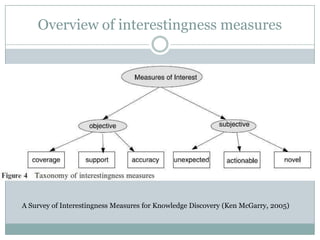
Overview of interestingness measures
A Survey of Interestingness Measures for Knowledge Discovery (Ken McGarry, 2005)
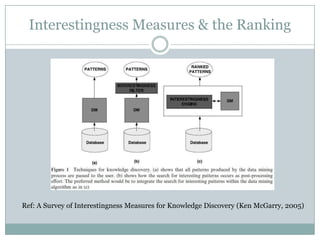
Interestingness Measures & the Ranking
Ref: A Survey of Interestingness Measures for Knowledge Discovery (Ken McGarry, 2005)
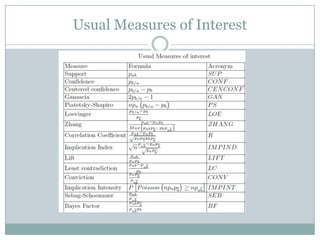
Usual Measures of Interest
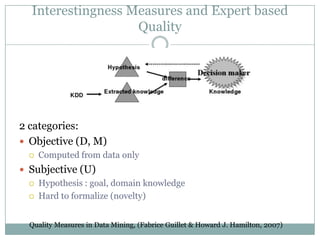
Interestingness Measures and Expert based
Quality
2 categories:
 Objective (D, M)
 Computed from data only
 Subjective (U)
 Hypothesis : goal, domain knowledge
 Hard to formalize (novelty)
Quality Measures in Data Mining, (Fabrice Guillet & Howard J. Hamilton, 2007)
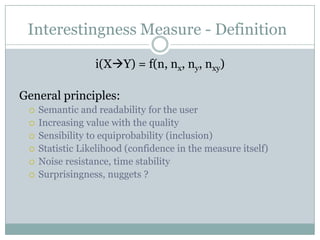
Interestingness Measure - Definition
i(XY) = f(n, nx, ny, nxy)
General principles:
 Semantic and readability for the user
 Increasing value with the quality
 Sensibility to equiprobability (inclusion)
 Statistic Likelihood (confidence in the measure itself)
 Noise resistance, time stability
 Surprisingness, nuggets ?
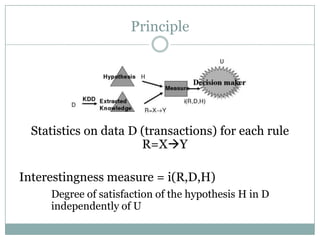
Principle
Statistics on data D (transactions) for each rule
R=XY
Interestingness measure = i(R,D,H)
Degree of satisfaction of the hypothesis H in D
independently of U
Properties in the Literature
Properties of i(XY) = f(n, nx, ny, nxy)
 [Piatetsky-Shapiro 1991] (strong rules):
 (P1) =0 if X and Y are independent
 (P2) increases with examples nxy
 (P3) decreases with premise nx (or conclusion ny)(?)
 [Major & Mangano 1993]:
 (P4) increases with nxy when confidence is constant (nxy/nx)
 [Freitas 1999]:
 (P5) asymmetry (i(XY)/=i(YX))
 Small disjunctions (nuggets)
[Tan et al. 2002], [Hilderman & Hamilton 2001] and [Gras et al. 2004]
Selected Properties
 Inclusion and equiprobability
 0, interval of security
 Independence
 0, interval of security
 Bounded maximum value
 Comparability, global threshold, inclusion
 Non linearity
 Noise Resistance, interval of security for independence and
equiprobability
 Sensibility
 N (nuggets), dilation (likelihood)
 Frequency p(X)  cardinal nx
 Reinforcement by similar rules (contra-positive, negative
rule,…)
[Smyth & Goodman 1991][Kodratoff 2001][Gras et al 2001][Gras et al. 2004]
Interestingness Measure Classifying Criteria
These interestigness measures can be categorized into
three classifications: objective, subjective, and semantics-
based.
 Objective Measure: An objective measure is based
only on the raw data. No knowledge about the user or
application is required. Most objective measures are
based on theories in probability, statistics, or
information theory. Conciseness, generality, reliability,
peculiarity, and diversity depend only on the data and
patterns, and thus can be considered objective.
Interestingness Measure Classifying Criteria
 Subjective Measure: A subjective measure takes into
account both the data and the user of these data. To define a
subjective measure, access to the user’s domain or
background knowledge about the data is required. This access
can be obtained by interacting with the user during the data
mining process or by explicitly representing the user’s
knowledge or expectations. In the latter case, the key issue is
the representation of the user’s knowledge, which has been
addressed by various frameworks and procedures for data
mining [Liu et al. 1997, 1999; Silberschatz and Tuzhilin 1995,
1996; Sahar 1999]. Novelty and surprisingness depend on the
user of the patterns, as well as the data and patterns
themselves, and hence can be considered subjective.
Interestingness Measure Classifying Criteria
 Semantic Measure: A semantic measure considers the semantics and
explanations of the patterns. Because semantic measures involve domain
knowledge from the user, some researchers consider them a special type of
subjective measure [Yao et al. 2006]. Utility and actionability depend on
the semantics of the data, and thus can be considered semantic. Utility-
based measures, where the relevant semantics are the utilities of the
patterns in the domain, are the most common type of semantic measure.
To use a utility-based approach, the user must specify additional
knowledge about the domain. Unlike subjective measures, where the
domain knowledge is about the data itself and is usually represented in a
format similar to that of the discovered pattern, the domain knowledge
required for semantic measures does not relate to the user’s knowledge or
expectations concerning the data. Instead, it represents a utility function
that reflects the user’s goals. This function should be optimized in the
mined results. For example, a store manager might prefer association rules
that relate to high-profit items over those with higher statistical
significance.
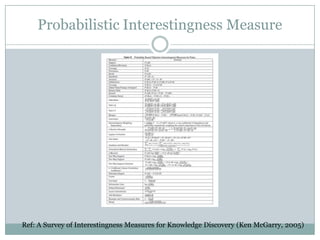
Probabilistic Interestingness Measure
Ref: A Survey of Interestingness Measures for Knowledge Discovery (Ken McGarry, 2005)
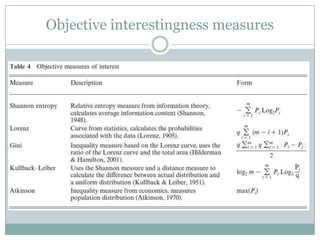
Objective interestingness measures
Conciseness
 A pattern is concise if it contains relatively few
attribute-value pairs, while a set of patterns is
concise if it contains relatively few patterns. A
concise pattern or set of patterns is relatively easy to
understand and remember and thus is added more
easily to the user’s knowledge (set of beliefs).
Accordingly, much research has been conducted to
find a minimum set of patterns, using properties
such as monotonicity [Padmanabhan and Tuzhilin
2000] and confidence invariance [Bastide et al.
2000].
Generality/Coverage
 A pattern is general if it covers a relatively large subset of a dataset.
Generality (or coverage) measures the comprehensiveness of a pattern, that
is, the fraction of all records in the dataset that matches the pattern. If a
pattern characterizes more information in the dataset, it tends to be more
interesting [Agrawal and Srikant 1994; Webb and Brain 2002]. Frequent
itemsets are the most studied general patterns in the data mining literature.
An itemset is a set of items, such as some items from a grocery basket. An
itemset is frequent if its support, the fraction of records in the dataset
containing the itemset, is above a given threshold [Agrawal and Srikant
1994].
The best known algorithm for finding frequent itemsets is the Apriori
algorithm [Agrawal and Srikant 1994]. Some generality measures can form
the bases for pruning strategies; for example, the support measure is used
in the Apriori algorithm as the basis for pruning itemsets. For classification
rules, Webb and Brain [2002] gave an empirical evaluation showing how
generality affects classification results. Generality frequently coincides with
conciseness because concise patterns tend to have greater coverage.
Reliability
 A pattern is reliable if the relationship described by
the pattern occurs in a high percentage of applicable
cases. For example, a classification rule is reliable if
its predictions are highly accurate, and an
association rule is reliable if it has high confidence.
Many measures from probability, statistics, and
information retrieval have been proposed to measure
the reliability of association rules [Ohsaki et al.
2004; Tan et al. 2002].
Peculiarity
 A pattern is peculiar if it is far away from other
discovered patterns according to some distance
measure. Peculiar patterns are generated from
peculiar data (or outliers), which are relatively few in
number and significantly different from the rest of
the data [Knorr et al. 2000; Zhong et al. 2003].
Peculiar patterns may be unknown to the user, hence
interesting.
Diversity
 A pattern is diverse if its elements differ significantly from
each other, while a set of patterns is diverse if the patterns in
the set differ significantly from each other. Diversity is a
common factor for measuring the interestingness of
summaries [Hilderman and Hamilton 2001]. According to a
simple point of view, a summary can be considered diverse if
its probability distribution is far from the uniform
distribution. A diverse summary may be interesting because
in the absence of any relevant knowledge, a user commonly
assumes that the uniform distribution will hold in a summary.
According to this reasoning, the more diverse the summary is,
the more interesting it is. We are unaware of any existing
research on using diversity to measure the interestingness of
classification or association rules.
Novelty
 A pattern is novel to a person if he or she did not know it
before and is not able to infer it from other known patterns.
No known data mining system represents everything that a
user knows, and thus, novelty cannot be measured explicitly
with reference to the user’s knowledge. Similarly, no known
data mining system represents what the user does not know,
and therefore, novelty cannot be measured explicitly with
reference to the user’s ignorance. Instead, novelty is detected
by having the user either explicitly identify a pattern as novel
[Sahar 1999] or notice that a pattern cannot be deduced from
and does not contradict previously discovered patterns. In the
latter case, the discovered patterns are being used as an
approximation to the user’s knowledge.
Surprisingness
 A pattern is surprising (or unexpected) if it contradicts a
person’s existing knowledge or expectations [Liu et al.
1997, 1999; Silberschatz and Tuzhilin 1995, 1996]. A
pattern that is an exception to a more general pattern
which has already been discovered can also be
considered surprising [Bay and Pazzani 1999; Carvalho
and Freitas 2000]. Surprising patterns are interesting
because they identify failings in previous knowledge and
may suggest an aspect of the data that needs further
study. The difference between surprisingness and novelty
is that a novel pattern is new and not contradicted by any
pattern already known to the user, while a surprising
pattern contradicts the user’s previous knowledge or
expectations.
Utility
 A pattern is of utility if its use by a person
contributes to reaching a goal. Different people may
have divergent goals concerning the knowledge that
can be extracted from a dataset. For example, one
person may be interested in finding all sales with
high profit in a transaction dataset, while another
may be interested in finding all transactions with
large increases in gross sales. This kind of
interestingness is based on user-defined utility
functions in addition to the raw data [Chan et al.
2003; Lu et al. 2001; Yao et al. 2004; Yao and
Hamilton 2006].
Actionability
 A pattern is actionable (or applicable) in some
domain if it enables decision making about future
actions in this domain [Ling et al. 2002;Wang et al.
2002]. Actionability is sometimes associated with a
pattern selection strategy. So far, no general method
for measuring actionability has been devised.
Existing measures depend on the applications. For
example, Ling et al. [2002], measured actionability
as the cost of changing the customer’s current
condition to match the objectives, whereas Wang et
al. [2002], measured actionability as the profit that
an association rule can bring.
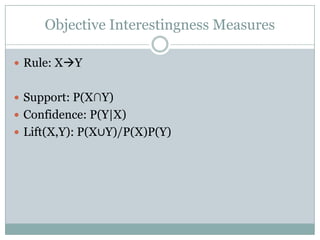
Objective Interestingness Measures
 Rule: XY
 Support: P(X∩Y)
 Confidence: P(Y|X)
 Lift(X,Y): P(X∪Y)/P(X)P(Y)
Objective interestingness measures
 Problems:
 nappies⇒babyfood
 nappies⇒beer
 We can reasonably expect that the sales of baby
food and nappies occur together frequently
Limits of Support
Support: supp(XY) = freq(XUY)
 Generality of the rule
 Minimum support threshold (ex: 10%)
 Reduce the complexity
 Specific rule (low support)
 Valid rule (high confidence)
 High potential of novelty/surprise
Limits of Confidence
Confidence: conf(XY) = P(Y|X) = freq(XUY)/freq(X)
 Validity/logical aspect of the rule (inclusion)
 Minimal confidence threshold (ex: 90%)
 Reduces the amount of extracted rules
 Interestingness /= validity
 No detection of independence
 Independence:
 X and Y are independent: P(Y|X) = P(Y)
 If P(Y) is high => nonsense rule with high support
Ex: Couches  beer (supp=20%, conf=90%) if supp(beer)=90%
[Guillaume et al. 1998], [Lallich et al. 2004]
Limits of the Pair Support-Confidence
In practice:
 High support threshold (10%)
 High confidence threshold (90%)
 Valid and general rules
 Common Sense but not novelty
 Efficient measures but insufficient to capture quality
Subjective interestingness measures
 Unexpected (What’s interesting?):
 Same condition, but different consequences
 Different conditions, but same consequence
Subjective interestingness measures
General impression
gi(<S1, …, Sm>) [support, confidence]
↓
Reasonably precise concept
rpc(<S1, …, Sm → V1, …, Vg>) [support, confidence]
↓
Precise knowledge
pk(<S1, …, Sm → V1, …, Vg>) [support, confidence]
Analyzing the Subjective Interestingness of Association Rules
Bing Liu et al., 2000
Subjective interestingness measures
 Problems:
 Knowledge granularity
 Domain expert required?
 Vague expression
Objective Measures: Examples of Quality Criteria
Criteria of interestingness [Hussein 2000]:
 Objective:
 Generality : (ex: Support)
 Validity: (ex: Confidence)
 Reliability: (ex: High generality and validity)
 Subjective:
 Common Sense: reliable + known yet
 Actionability : utility for decision
 Novelty: previously unknown
 Surprise (Unexpectedness): contradiction ?
Association Rules
Association rules [Agrawal et al. 1993]:
 Market-basket analysis
 Non supervised learning
 Algorithms + 2 measures (support and confidence)
Problems:
 Enormous amount of rules (rough rules)
 Few semantic on support and confidence measures
 Need to help the user select the best rules
Association Rules
Solutions:
 Redundancy reduction
 Structuring (classes, close rules)
 Improve quality measures
 Interactive decision aid (rule mining)
Association Rules
Input : data
 p Boolean attributes (V0, V1, … Vp) (columns)
 n transactions (rows)
Output : Association Rules:
 Implicative tendencies : X  Y
 X and Y (itemsets) ex: V0^V4^V8  V1
 Negative examples
 2 measures:
 Support: supp(XY) = freq(XUY)
 Confidence: conf(XY) = P(Y|X) = freq(XUY)/freq(X)
 Algorithm properties (monotony)
Ex: Couches  beer (supp=20%, conf=90%)
(NB: max nb of rules 3p)
Subjective Measures: Criteria
User-oriented measures (U)
Quality : interestingness:
 Unexpectedness [Silberschatz 1996]
 Unknown or contradictory rule
 Actionability (Usefulness) [Piatesky-shapiro 1994]
 Usefulness for decision making, gain
 Anticipation [Roddick 2001]
 Prediction on temporal dimension
Subjective Measures : Criteria
Unexpectedness and actionability:
 Unexpected + useful = high interestingness
 Expected + non-useful = ?
 Expected + useful = reinforcement
 Unexpected + non-useful = ?
Subjective Measures: Other Subjective Measures
 Projected Savings (KEFIR system’s interestingness)
[Matheus & Piatetsky-Shapiro 1994]
 Fuzzy Matching Interestingness Measure [Lie et al. 1996]
 General Impression [Liu et al. 1997]
 Logical Contradiction [Padmanabhan & Tuzhilin’s 1997]
 Misclassification Costs [Frietas 1999]
 Vague Feelings (Fuzzy General Impressions) [Liu et al.
2000]
 Anticipation [Roddick and rice 2001]
 Interestingness [Shekar & Natarajan’s 2001]
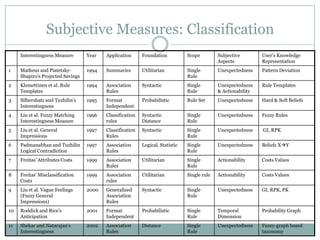
Subjective Measures: Classification
Interestingness Measure Year Application Foundation Scope Subjective
Aspects
User’s Knowledge
Representation
1 Matheus and Piatetsky-
Shapiro’s Projected Savings
1994 Summaries Utilitarian Single
Rule
Unexpectedness Pattern Deviation
2 Klemettinen et al. Rule
Templates
1994 Association
Rules
Syntactic Single
Rule
Unexpectedness
& Actionability
Rule Templates
3 Silbershatz and Tuzhilin’s
Interestingness
1995 Format
Independent
Probabilistic Rule Set Unexpectedness Hard & Soft Beliefs
4 Liu et al. Fuzzy Matching
Interestingness Measure
1996 Classification
rules
Syntactic
Distance
Single
Rule
Unexpectedness Fuzzy Rules
5 Liu et al. General
Impressions
1997 Classification
Rules
Syntactic Single
Rule
Unexpectedness GI, RPK
6 Padmanabhan and Tuzhilin
Logical Contradiction
1997 Association
Rules
Logical, Statistic Single
Rule
Unexpectedness Beliefs XY
7 Freitas’ Attributes Costs 1999 Association
Rules
Utilitarian Single
Rule
Actionability Costs Values
8 Freitas’ Misclassification
Costs
1999 Association
rules
Utilitarian Single rule Actionability Costs Values
9 Liu et al. Vague Feelings
(Fuzzy General
Impressions)
2000 Generalized
Association
Rules
Syntactic Single
Rule
Unexpectedness GI, RPK, PK
10 Roddick and Rice’s
Anticipation
2001 Format
Independent
Probabilistic Single
Rule
Temporal
Dimension
Probability Graph
11 Shekar and Natarajan’s
Interestingness
2002 Association
Rules
Distance Single
Rule
Unexpectedness Fuzzy-graph based
taxonomy
List Of Interestingness Measures (cont)
 Monodimensional e+, e-
 Support [Agrawal et al. 1996]
 Ralambrodrainy [Ralambrodrainy, 1991]
 Bidimensional - Inclusion
 Descriptive-Confirm [Yves Kodratoff, 1999]
 Sebag et Schoenauer [Sebag, Schoenauer, 1991]
 Examples neg examples ratio (*)
 Bidimensional – Inclusion – Conditional Probability
 Confidence [Agrawal et al. 1996]
 Wang index [Wang et al., 1988]
 Laplace (*)
 Bidimensional – Analogous Rules
 Descriptive Confirmed-Confidence [Yves Kodratoff, 1999] (*)
List Of Interestingness Measures (cont.)
 Tridimensional – Analogous Rules
 Causal Support [Kodratoff, 1999]
 Causal Confidence [Kodratoff, 1999] (*)
 Causal Confirmed-Confidence [Kodratoff, 1999]
 Least contradiction [Aze & Kodratoff 2004] (*)
 Tridimensional – Linear - Independent
 Pavillon index [Pavillon, 1991]
 Rule Interest [Piatetsky-Shapiro, 1991] (*)
 Pearl index [Pearl, 1988], [Acid et al., 1991] [Gammerman, Luo, 1991]
 Correlation [Pearson 1996] (*)
 Loevinger index [Loevinger, 1947] (*)
 Certainty factor [Tan & Kumar 2000]
 Rate of connection[Bernard et Charron 1996]
 Interest factor [Brin et al., 1997]
 Top spin(*)
 Cosine [Tan & Kumar 2000] (*)
 Kappa [Tan & Kumar 2000]
List Of Interestingness Measures (cont.)
 Tridimensional – Nonlinear – Independent
 Chi squared distance
 Logarithmic lift [Church & Hanks, 1990] (*)
 Predictive association [Tan & Kumar 2000] (Goodman & Kruskal)
 Conviction [Brin et al., 1997b]
 Odd’s ratio [Tan & Kumar 2000]
 Yule’Q [Tan & Kumar 2000]
 Yule’s Y [Tan & Kumar 2000]
 Jaccard [Tan & Kumar 2000]
 Klosgen [Tan & Kumar 2000]
 Interestingness [Gray & Orlowska, 1998]
 Mutual information ratio (Uncertainty) [Tan et al., 2002]
 J-measure [Smyth & Goodman 1991] [Goodman & Kruskal 1959] (*)
 Gini [Tan et al., 2002]
 General measure of rule interestingness [Jaroszewicz & Simovici, 2001] (*)
List Of Interestingness Measures (cont.)
 Quadridimensional – Linear – independent
 Lerman index of similarity[Lerman, 1981]
 Index of Involvement[Gras, 1996]
 Quadridimensional – likeliness (conditional probability?) of
dependence
 Probability of error of Chi2 (*)
 Intensity of Involvement [Gras, 1996] (*)
 Quadridimensional – Inclusion – dependent – analogous rules
 Entropic intensity of Involvement [Gras, 1996] (*)
 TIC [Blanchard et al., 2004] (*)
 Others
 Surprisingness (*) [Freitas, 1998]
 + rules of exception [Duval et al. 2004]
 + rule distance, similarity [Dong & Li 1998]
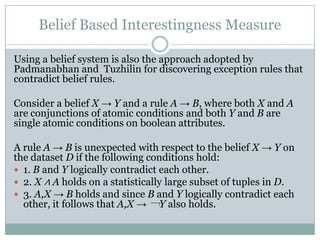
Belief Based Interestingness Measure
Using a belief system is also the approach adopted by
Padmanabhan and Tuzhilin for discovering exception rules that
contradict belief rules.
Consider a belief X → Y and a rule A → B, where both X and A
are conjunctions of atomic conditions and both Y and B are
single atomic conditions on boolean attributes.
A rule A → B is unexpected with respect to the belief X → Y on
the dataset D if the following conditions hold:
 1. B and Y logically contradict each other.
 2. X ∧ A holds on a statistically large subset of tuples in D.
 3. A,X → B holds and since B and Y logically contradict each
other, it follows that A,X → ¬Y also holds.
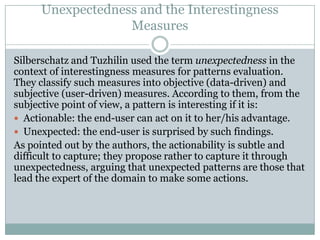
Unexpectedness and the Interestingness
Measures
Silberschatz and Tuzhilin used the term unexpectedness in the
context of interestingness measures for patterns evaluation.
They classify such measures into objective (data-driven) and
subjective (user-driven) measures. According to them, from the
subjective point of view, a pattern is interesting if it is:
 Actionable: the end-user can act on it to her/his advantage.
 Unexpected: the end-user is surprised by such findings.
As pointed out by the authors, the actionability is subtle and
difficult to capture; they propose rather to capture it through
unexpectedness, arguing that unexpected patterns are those that
lead the expert of the domain to make some actions.
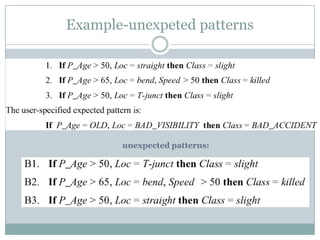
Example-unexpeted patterns
unexpected patterns:
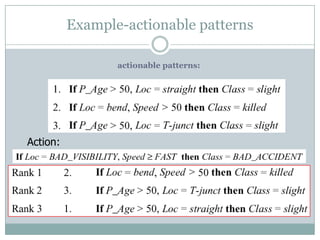
Example-actionable patterns
Action:
actionable patterns:
Interestingness Measures and Bayesian Belief
Network
In the framework presented by Silberschatz and Tuzhilin, evaluating
the unexpectedness of a discovered pattern is done according to a
Belief System that the user has: the more the pattern disagrees with a
belief system, the more unexpected it is.
There are two kinds of beliefs. On one hand, hard beliefs are those
beliefs that are always true and that cannot be changed. In this case,
detecting a contradicting pattern means that something is wrong with
the data used to find this pattern. On the other hand, soft beliefs are
those that the user is willing to change with a new evidence. Each soft
belief is assigned with a degree specifying how the user is confident in
it. In their work, the authors proposed five approaches to affect such
degrees: Bayesian, Dempster-Shafer, Frequency, Cyc’s and Statistical
approaches.
The authors (Silberschatz and Tuzhilin) claim that the
Bayesian one is the most appropriate for defining the degree
of beliefs even if any other approach they have defined can
be used.
Conclusion and Future Work
 Quality is a multidimensional concept
 Subjective (expert opionion)
 Interest = changes with the knowledge of the decision-maker
 Extract knowledge / objective decision-maker
 Objective (data and rules)
 Interest = on the Hypothetical Data: Inclusion, Independence,
Imbalance, nuggets, robustness ...
 What is a good index? (ingredients of quality)
 The “hybrid” interestingness
 Such as paradox detection
 Detecting change over time
 Bayesian belief networks
References & Bibliography
 [Agrawal et al., 1993] R. Agrawal, T. Imielinsky et A. Swami. Mining associations rules between sets of items in large databases. Proc.
of ACM SIGMOD'93, 1993, p. 207-216
 [Azé & Kodratoff, 2001] J. Azé et Y. Kodratoff. Evaluation de la résistance au bruit de quelques mesures d'extraction de règles
d'association. Extraction des connaissances et apprentissage 1(4), 2001, p. 143-154
 [Azé & Kodratoff, 2001] J. Azé et Y. Kodratoff. Extraction de « pépites » de connaissances dans les données : une nouvelle approche et
une étude de sensibilité au bruit. Rapport d’activité du groupe gafoQualité de l’AS GafoDonnées. A paraître dans [Briand et al. 2004].
 [Bayardo & Agrawal, 1999] R.J. Bayardo et R. Agrawal. Mining the most interesting rules. Proc. of the 5th Int. Conf. on Knowledge
Discovery and Data Mining, 1999, p.145-154.
 [Bernadet 2000] M. Bernardet. Basis of a fuzzy knowledge discovery system. Proc. of Principles of Data Mining and Knowledge
Discovery, LNAI 1510, pages 24-33. Springer, 2000.
 [Bernard et Charron 1996] J.-M. Bernard et C. Charron. L’analyse implicative bayésienne, une méthode pour l’étude des dépendances
orientées. I. Données binaires, Revue Mathématique Informatique et Sciences Humaines (MISH), vol. 134, 1996, p. 5-38.
 [Berti-Equille 2004] L. Berti-équille. Etat de l'art sur la qualité des données : un premier pas vers la qualité des connaissances. Rapport
d’activité du groupe gafoQualité de l’AS GafoDonnées. A paraître dans [Briand et al. 2004].
 [Blanchard et al. 2001] J. Blanchard, F. Guillet, et H. Briand. L'intensité d'implication entropique pour la recherche de règles de
prédiction intéressantes dans les séquences de pannes d'ascenseurs. Extraction des Connaissances et Apprentissage (ECA), Hermès
Science Publication, 1(4):77-88, 2002.
 [Blanchard et al. 2003] J. Blanchard, F. Guillet, F. Rantière, H. Briand. Vers une Représentation Graphique en Réalité Virtuelle pour
la Fouille Interactive de Règles d’Association. Extraction des Connaissances et Apprentissage (ECA), vol. 17, n°1-2-3, 105-118, 2003.
Hermès Science Publication. ISSN 0992-499X, ISBN 2-7462-0631-5
 [Blanchard et al. 2003a] J. Blanchard, F. Guillet, H. Briand. Une visualisation orientée qualité pour la fouille anthropocentrée de
règles d’association. In Cognito - Cahiers Romans de Sciences Cognitives. A paraître. ISSN 1267-8015
 [Blanchard et al. 2003b] J. Blanchard, F. Guillet, H. Briand. A User-driven and Quality oriented Visualiation for Mining Association
Rules. In Proc. Of the Third IEEE International Conference on Data Mining, ICDM’2003, Melbourne, Florida, USA, November 19 - 22,
2003.
 [Blanchard et al., 2004] J. Blanchard, F. Guillet, R. Gras, H. Briand. Mesurer la qualité des règles et de leurs contraposées avec le taux
informationnel TIC. EGC2004, RNTI, Cépaduès. 2004 A paraître.
 [Blanchard et al., 2004a] J. Blanchard, F. Guillet, R. Gras, H. Briand. Mesure de la qualité des règles d'association par l'intensité
d'implication entropique. Rapport d’activité du groupe gafoQualité de l’AS GafoDonnées. A paraître dans [Briand et al. 2004].
 [Breiman & al. 1984] L.Breiman, J. Friedman, R. Olshen and C.Stone. Classification and Regression Trees. Chapman & Hall,1984.
 [Briand et al. 2004] H. Briand, M. Sebag, G. Gras et F. Guillet (eds). Mesures de Qualité pour la fouille de données. Revue des
Nouvelles Technologies de l’Information, RNTI, Cépaduès, 2004. A paraître.
 [Brin et al., 1997] S. Brin, R. Motwani and C. Silverstein. Beyond Market Baskets: Generalizing Association Rules to Correlations. In
Proceedings of SIGMOD’97, pages 265-276, AZ, USA, 1997.
 [Brin et al., 1997b] S. Brin, R. Motwani, J. Ullman et S. Tsur. Dynamic itemset counting and implication rules for market basket data.
Proc. of the Int. Conf. on Management of Data, ACM Press, 1997, p. 255-264.
References & Bibliography
 [Church & Hanks, 1990] K. W. Church et P. Hanks. Word association norms, mutual information and lexicography. Computational
Linguistics, 16(1), 22-29, 1990.
 [Clark & Robin 1991] Peter Clark and Robin Boswell: Rule Induction with CN2: Some Recent Improvements. In Proceeding of the
European Working Session on Learning EWSL-91, 1991.
 [Dong & Li, 1998] G. Dong and J. Li. Interestingness of Discovered Association Rules in terms of Neighborhood-Based Unexpectedness.
In X. Wu, R. Kotagiri and K. Korb, editors, Proc. of 2nd Pacific-Asia Conf. on Knowledge Discovery and Data Mining (PAKDD `98),
Melbourne, Australia, April 1998.
 [Duval et al. 2004] B. Duval, A. Salleb, C. Vrain. Méthodes et mesures d’intérêt pour l’extraction de règles d’exception. Rapport
d’activité du groupe gafoQualité de l’AS GafoDonnées. A paraître dans [Briand et al. 2004].
 [Fleury 1996] L. Fleury. Découverte de connaissances pour la gestion des ressources humaines. Thèse de doctorat, Université de Nantes,
1996.
 [Frawley & Piatetsky-Shapiro 1992] Frawley W. Piatetsky-Shapiro G. and Matheus C., « Knowledge discovery in databases: an
overview », AI Magazine, 14(3), 1992, pages 57-70
 [Freitas, 1998] A. A. Freitas. On Objective Measures of Rule Suprisingness. In J. Zytkow and M. Quafafou, editors, Proceedings of the
Second European Conference on the Principles of Data Mining and Knowledge Discovery (PKDD `98), pages 1-9, Nantes, France,
September 1998.
 [Freitas, 1999] A. Freitas. On rule interestingness measures. Knowledge-Based Systems Journal 12(5-6), 1999, p. 309-315.
 [Gago & Bento, 1998 ] P. Gago and C. Bento. A Metric for Selection of the Most Promising Rules. PKDD’98, 1998.
 [Gray & Orlowska, 1998] B. Gray and M. E. Orlowska. Ccaiia: Clustering Categorical Attributes into Interesting Association Rules. In
X. Wu, R. Kotagiri and K. Korb, editors, Proc. of 2nd Pacific-Asia Conf. on Knowledge Discovery and Data Mining (PAKDD `98), pages
132 43, Melbourne, Australia, April 1998.
 [Goodman & Kruskal 1959] L. A. Goodman andW. H. Kruskal. Measures of Association for Cross Classification, ii: Further discussion
and references. Journal of the American Statistical Association, ??? 1959.
 [Gras et al. 1995] R. Gras, H. Briand and P. Peter. Structuration sets with implication intensity. Proc. of the Int. Conf. On Ordinal and
Symbolic Data Analysis - OSDA 95. Springer, 1995.
 [Gras, 1996] R. Gras et coll.. L'implication statistique - Nouvelle méthode exploratoire de données. La pensée sauvage éditions, 1996.
 [Gras et al. 2001] R. Gras, P. Kuntz, et H. Briand. Les fondements de l'analyse statistique implicative et quelques prolongements pour la
fouille de données. Mathématiques et Sciences Humaines : Numéro spécial Analyse statistique implicative, 1(154-155) :9-29, 2001.
 [Gras et al. 2001b] R. Gras, P. Kuntz, R. Couturier, et F. Guillet. Une version entropique de l'intensité d'implication pour les corpus
volumineux. Extraction des Connaissances et Apprentissage (ECA), Hermès Science Publication, 1(1-2) :69-80, 2001.
 [Gras et al. 2002] R. Gras, F. Guillet, et J. Philippe. Réduction des colonnes d'un tableau de données par quasi-équivalence entre
variables. Extraction des Connaissances et Apprentissage (ECA), Hermès Science Publication, 1(4) :197-202, 2002.
 [Gras et al. 2004] R. Gras, R. Couturier, J. Blanchard, H. Briand, P. Kuntz, P. Peter. Quelques critères pour une mesure de la qualité des
règles d’association. Rapport d’activité du groupe gafoQualité de l’AS GafoDonnées. A paraître dans [Briand et al. 2004].
 [Guillaume et al. 1998] S. Guillaume, F. Guillet, J. Philippé. Improving the discovery of associations Rules with Intensity of
implication. Proc. of 2nd European Symposium Principles of data Mining and Knowledge Discovery, LNAI 1510, p 318-327. Springer
1998.
 [Guillaume 2002] S. Guillaume. Discovery of Ordinal Association Rules. M.-S. Cheng, P. S. Yu, B. Liu (Eds.), Proc. Of the 6th Pacific-
sia Conference on Advances in Knowledge Discovery and Data Mining, PAKDD 2002, LNCS 2336, pages 322-327 Springer 2002.
References & Bibliography
 [Guillet et al. 1999] F. Guillet, P. Kuntz, et R. Lehn. A genetic algorithm for visualizing networks of association rules. Proc. the 12th Int.
Conf. On Industrial and Engineering Appl. of AI and Expert Systems, LNCS 1611, pages 145-154. Springer 1999
 [Guillet 2000] F. Guillet. Mesures de qualité de règles d’association. Cours DEA-ECD. Ecole polytechnique de l’université de Nantes.
2000.
 [Hilderman & Hamilton, 1998] R. J. Hilderman and H. J. Hamilton. Knowledge Discovery and Interestingness Measures: A Survey.
(KDD `98), ??? New-York 1998.
 [Hilderman et Hamilton, 2001] R. Hilderman et H. Hamilton. Knowledge discovery and measures of interest. Kluwer Academic
publishers, 2001.
 [Hussain et al. 2001] F. Hussain, H. Liu, E. Suzuki and H. Lu. Exception Rule Mining with a Relative Interestingness Measure. ???
 [Jaroszewicz & Simovici, 2001] S. Jaroszewicz et D.A. Simovici. A general measure of rule interestingness. Proc. of the 7th Int. Conf.
on Knowledge Discovery and Data Mining, L.N.C.S. 2168, Springer, 2001, p. 253-265
 [Klemettinen et al. 1994] M. Klemettinen, H. Mannila, P. Ronkainen, H. Toivonen and A. I. Verkamo. Finding Interesting Rules from
Large Sets of Discovered Association Rules. In N. R. Adam, B. K. Bhargava and Y. Yesha, editors, Proc. of the Third International Conf. on
Information and Knowledge Management``, pages 401-407, Gaitersburg, Maryland, 1994.
 [Kodratoff, 1999] Y. Kodratoff. Comparing Machine Learning and Knowledge Discovery in Databases:An Application to Knowledge
Discovery in Texts. Lecture Notes on AI (LNAI)-Tutorial series. 2000.
 [Kuntz et al. 2000] P.Kuntz, F.Guillet, R.Lehn and H.Briand. A User-Driven Process for Mining Association Rules. In D. Zighed, J.
Komorowski and J.M. Zytkow (Eds.), Principles of Data Mining and Knowledge Discovery (PKDD2000), Lecture Notes in Computer
Science, vol. 1910, pages 483-489, 2000. Springer.
 [Kodratoff, 2001] Y. Kodratoff. Comparing machine learning and knowledge discovery in databases: an application to knowledge
discovery in texts. Machine Learning and Its Applications, Paliouras G., Karkaletsis V., Spyropoulos C.D. (eds.), L.N.C.S. 2049, Springer,
2001, p. 1-21.
 [Kuntz et al. 2001] P. Kuntz, F. Guillet, R. Lehn and H. Briand. A user-driven process for mining association rules. Proc. of Principles of
Data Mining and Knowledge Discovery, LNAI 1510, pages 483-489. Springer, 2000.
 [Kuntz et al. 2001b] P. Kuntz, F. Guillet, R. Lehn, et H. Briand. Vers un processus d'extraction de règles d'association centré sur
l'utilisateur. In Cognito, Revue francophone internationale en sciences cognitives, 1(20) :13-26, 2001.
 [Lallich et al. 2004] S. Lallich et O. Teytaud . Évaluation et validation de l’intérêt des règles d’association. Rapport d’activité du groupe
gafoQualité de l’AS GafoDonnées. A paraître dans [Briand et al. 2004].
 [Lehn et al. 1999] R.Lehn, F.Guillet, P.Kuntz, H.Briand and J. Philippé. Felix : An interactive rule mining interface in a kdd process. In
P. Lenca (editor), Proc. of the 10th Mini-Euro Conference, Human Centered Processes, HCP’99, pages 169-174, Brest, France, September
22-24, 1999.
 [Lenca et al. 2004] P. Lenca, P. Meyer, B. Vaillant, P. Picouet, S. Lallich. Evaluation et analyse multi-critères des mesures de qualité des
règles d’association. Rapport d’activité du groupe gafoQualité de l’AS GafoDonnées. A paraître dans [Briand et al. 2004].
 [Lerman et al. 1981] I. C. Lerman, R. Gras et H. Rostam. Elaboration et évaluation d’un indice d’implication pour les données binaires.
Revue Mathématiques et Sciences Humaines, 75, p. 5-35, 1981.
 [Lerman, 1981] I. C. Lerman. Classification et analyse ordinale des données. Paris, Dunod 1981.
 [Lerman, 1993] I. C. Lerman. Likelihood linkage analysis classification method, Biochimie 75, p. 379-397, 1993.
 [Lerman & Azé 2004] I. C. Lerman et J. Azé.Indidice probabiliste discriminant de vraisemblance du lien pour des données
volumineuses. Rapport d’activité du groupe gafoQualité de l’AS GafoDonnées. A paraître dans [Briand et al. 2004].
References & Bibliography
 [Liu et al., 1999] B. Liu, W. Hsu, L. Mun et H. Lee. Finding interesting patterns using user expectations. IEEE Transactions on
Knowledge and Data Engineering 11, 1999, p. 817-832.
 [Loevinger, 1947] J. Loevinger. A systemic approach to the construction and evaluation of tests of ability. Psychological monographs,
61(4), 1947.
 [Mannila & Pavlov, 1999] H. Mannila and D. Pavlov. Prediction with Local Patterns using Cross-Entropy. Technical Report,
Information and Computer Science, University of California, Irvine, 1999.
 [Matheus & Piatetsky-Shapiro, 1996] C. J. Matheus and G. Piatetsky-Shapiro. Selecting and Reporting what is Interesting: The
KEFIR Application to Healthcare data. In U. M. Fayyad, G. Piatetsky-Shapiro, P.Smyth and R. Uthurusamy (eds), Advances in Knowledge
Discovery and Data Mining, p. 401-419, 1996. AAAI Press/MIT Press. [Meo 2000] R. Meo. Theory of dependence values, ACM
Transactions on Database Systems 5(3), p. 380-406, 2000.
 [Padmanabhan et Tuzhilin, 1998] B. Padmanabhan et A. Tuzhilin. A belief-driven method for discovering unexpected patterns. Proc.
Of the 4th Int. Conf. on Knowledge Discovery and Data Mining, 1998, p. 94-100.
 [Pearson, 1896] K. Pearson. Mathematical contributions to the theory of evolution. III. regression, heredity and panmixia. Philosophical
Transactions of the Royal Society, vol. A, 1896.
 [Piatestsky-Shapiro, 1991] G. Piatestsky-Shapiro. Discovery, analysis, and presentation of strong rules. Knowledge Discovery in
Databases. Piatetsky-Shapiro G., Frawley W.J. (eds.), AAAI/MIT Press, 1991, p. 229-248
 [Popovici, 2003] E. Popovici. Un atelier pour l'évaluation des indices de qualité. Mémoire de D.E.A. E.C.D., IRIN/Université
Lyon2/RACAI Bucarest, Juin 2003
 [Ritschard & al., 1998] G. Ritschard, D. A. Zighed and N. Nicoloyannis. Maximiser l`association par agrégation dans un tableau croisé.
In J. Zytkow and M. Quafafou, editors, Proc. of the Second European Conf. on the Principles of Data Mining and Knowledge Discovery
(PKDD `98), Nantes, France, September 1998.
 [Sebag et Schoenauer, 1988] M. Sebag et M. Schoenauer. Generation of rules with certainty and confidence factors from incomplete
and incoherent learning bases. Proc. of the European Knowledge Acquisition Workshop (EKAW'88), Boose J., Gaines B., Linster M.
(eds.), Gesellschaft für Mathematik und Datenverarbeitung mbH, 1988, p. 28.1-28.20.
 [Shannon & Weaver, 1949] C.E. Shannon et W. Weaver. The mathematical theory of communication. University of Illinois Press,
1949.
 [Silbershatz &Tuzhilin,1995] Avi Silberschatz and Alexander Tuzhilin. On Subjective Measures of Interestingness in Knowledge
Discovery, (KD. & DM. `95) ??? , 1995.
 [Smyth & Goodman, 1991] P. Smyth et R.M. Goodman. Rule induction using information theory. Knowledge Discovery in Databases,
Piatetsky- Shapiro G., Frawley W.J. (eds.), AAAI/MIT Press, 1991, p. 159-176
 [Tan & Kumar 2000] P. Tan, V. Kumar. Interestingness Measures for Association Patterns : A Perspective. Workshop tutorial (KDD
2000).
 [Tan et al., 2002] P. Tan, V. Kumar et J. Srivastava. Selecting the right interestingness measure for association patterns. Proc. of the 8th
Int. Conf. on Knowledge Discovery and Data Mining, 2002, p. 32-41.

Probabilistic Interestingness Measures - An Introduction with Bayesian Belief Networks

  • 1.
    A N IN T R O D U C T I O N W I T H B A Y E S I A N B E L I E F N E T W O R K S A D N A N M A S O O D S C I S . N O V A . E D U / ~ A D N A N A D N A N @ N O V A . E D U D O C T O R A L C A N D I D A T E N O V A S O U T H E A S T E R N U N I V E R S I T Y Probabilistic Interestingness Measures
  • 2.
    Introduction  Interestingness measuresplay an important role in data mining regardless of the kind of patterns being mined. Good measures should select and rank patterns according to their potential interest to the user. Good measures should also reduce the time and space cost of the mining process. (Geng & Hamilton, 2007)  Measuring the interestingness of discovered patterns is an active and important area of data mining research. Although much work has been conducted in this area, so far there is no widespread agreement on a formal definition of interestingness in this context. Based on the diversity of definitions presented to date, interestingness is perhaps best treated as a very broad concept, which emphasizes conciseness, coverage, reliability, peculiarity, diversity, novelty, surprisingness, utility, and actionability. (Geng & Hamilton, 2007)
  • 3.
    Overview of interestingnessmeasures A Survey of Interestingness Measures for Knowledge Discovery (Ken McGarry, 2005)
  • 4.
    Interestingness Measures &the Ranking Ref: A Survey of Interestingness Measures for Knowledge Discovery (Ken McGarry, 2005)
  • 5.
  • 6.
    Interestingness Measures andExpert based Quality 2 categories:  Objective (D, M)  Computed from data only  Subjective (U)  Hypothesis : goal, domain knowledge  Hard to formalize (novelty) Quality Measures in Data Mining, (Fabrice Guillet & Howard J. Hamilton, 2007)
  • 7.
    Interestingness Measure -Definition i(XY) = f(n, nx, ny, nxy) General principles:  Semantic and readability for the user  Increasing value with the quality  Sensibility to equiprobability (inclusion)  Statistic Likelihood (confidence in the measure itself)  Noise resistance, time stability  Surprisingness, nuggets ?
  • 8.
    Principle Statistics on dataD (transactions) for each rule R=XY Interestingness measure = i(R,D,H) Degree of satisfaction of the hypothesis H in D independently of U
  • 9.
    Properties in theLiterature Properties of i(XY) = f(n, nx, ny, nxy)  [Piatetsky-Shapiro 1991] (strong rules):  (P1) =0 if X and Y are independent  (P2) increases with examples nxy  (P3) decreases with premise nx (or conclusion ny)(?)  [Major & Mangano 1993]:  (P4) increases with nxy when confidence is constant (nxy/nx)  [Freitas 1999]:  (P5) asymmetry (i(XY)/=i(YX))  Small disjunctions (nuggets) [Tan et al. 2002], [Hilderman & Hamilton 2001] and [Gras et al. 2004]
  • 10.
    Selected Properties  Inclusionand equiprobability  0, interval of security  Independence  0, interval of security  Bounded maximum value  Comparability, global threshold, inclusion  Non linearity  Noise Resistance, interval of security for independence and equiprobability  Sensibility  N (nuggets), dilation (likelihood)  Frequency p(X)  cardinal nx  Reinforcement by similar rules (contra-positive, negative rule,…) [Smyth & Goodman 1991][Kodratoff 2001][Gras et al 2001][Gras et al. 2004]
  • 11.
    Interestingness Measure ClassifyingCriteria These interestigness measures can be categorized into three classifications: objective, subjective, and semantics- based.  Objective Measure: An objective measure is based only on the raw data. No knowledge about the user or application is required. Most objective measures are based on theories in probability, statistics, or information theory. Conciseness, generality, reliability, peculiarity, and diversity depend only on the data and patterns, and thus can be considered objective.
  • 12.
    Interestingness Measure ClassifyingCriteria  Subjective Measure: A subjective measure takes into account both the data and the user of these data. To define a subjective measure, access to the user’s domain or background knowledge about the data is required. This access can be obtained by interacting with the user during the data mining process or by explicitly representing the user’s knowledge or expectations. In the latter case, the key issue is the representation of the user’s knowledge, which has been addressed by various frameworks and procedures for data mining [Liu et al. 1997, 1999; Silberschatz and Tuzhilin 1995, 1996; Sahar 1999]. Novelty and surprisingness depend on the user of the patterns, as well as the data and patterns themselves, and hence can be considered subjective.
  • 13.
    Interestingness Measure ClassifyingCriteria  Semantic Measure: A semantic measure considers the semantics and explanations of the patterns. Because semantic measures involve domain knowledge from the user, some researchers consider them a special type of subjective measure [Yao et al. 2006]. Utility and actionability depend on the semantics of the data, and thus can be considered semantic. Utility- based measures, where the relevant semantics are the utilities of the patterns in the domain, are the most common type of semantic measure. To use a utility-based approach, the user must specify additional knowledge about the domain. Unlike subjective measures, where the domain knowledge is about the data itself and is usually represented in a format similar to that of the discovered pattern, the domain knowledge required for semantic measures does not relate to the user’s knowledge or expectations concerning the data. Instead, it represents a utility function that reflects the user’s goals. This function should be optimized in the mined results. For example, a store manager might prefer association rules that relate to high-profit items over those with higher statistical significance.
  • 14.
    Probabilistic Interestingness Measure Ref:A Survey of Interestingness Measures for Knowledge Discovery (Ken McGarry, 2005)
  • 15.
  • 16.
    Conciseness  A patternis concise if it contains relatively few attribute-value pairs, while a set of patterns is concise if it contains relatively few patterns. A concise pattern or set of patterns is relatively easy to understand and remember and thus is added more easily to the user’s knowledge (set of beliefs). Accordingly, much research has been conducted to find a minimum set of patterns, using properties such as monotonicity [Padmanabhan and Tuzhilin 2000] and confidence invariance [Bastide et al. 2000].
  • 17.
    Generality/Coverage  A patternis general if it covers a relatively large subset of a dataset. Generality (or coverage) measures the comprehensiveness of a pattern, that is, the fraction of all records in the dataset that matches the pattern. If a pattern characterizes more information in the dataset, it tends to be more interesting [Agrawal and Srikant 1994; Webb and Brain 2002]. Frequent itemsets are the most studied general patterns in the data mining literature. An itemset is a set of items, such as some items from a grocery basket. An itemset is frequent if its support, the fraction of records in the dataset containing the itemset, is above a given threshold [Agrawal and Srikant 1994]. The best known algorithm for finding frequent itemsets is the Apriori algorithm [Agrawal and Srikant 1994]. Some generality measures can form the bases for pruning strategies; for example, the support measure is used in the Apriori algorithm as the basis for pruning itemsets. For classification rules, Webb and Brain [2002] gave an empirical evaluation showing how generality affects classification results. Generality frequently coincides with conciseness because concise patterns tend to have greater coverage.
  • 18.
    Reliability  A patternis reliable if the relationship described by the pattern occurs in a high percentage of applicable cases. For example, a classification rule is reliable if its predictions are highly accurate, and an association rule is reliable if it has high confidence. Many measures from probability, statistics, and information retrieval have been proposed to measure the reliability of association rules [Ohsaki et al. 2004; Tan et al. 2002].
  • 19.
    Peculiarity  A patternis peculiar if it is far away from other discovered patterns according to some distance measure. Peculiar patterns are generated from peculiar data (or outliers), which are relatively few in number and significantly different from the rest of the data [Knorr et al. 2000; Zhong et al. 2003]. Peculiar patterns may be unknown to the user, hence interesting.
  • 20.
    Diversity  A patternis diverse if its elements differ significantly from each other, while a set of patterns is diverse if the patterns in the set differ significantly from each other. Diversity is a common factor for measuring the interestingness of summaries [Hilderman and Hamilton 2001]. According to a simple point of view, a summary can be considered diverse if its probability distribution is far from the uniform distribution. A diverse summary may be interesting because in the absence of any relevant knowledge, a user commonly assumes that the uniform distribution will hold in a summary. According to this reasoning, the more diverse the summary is, the more interesting it is. We are unaware of any existing research on using diversity to measure the interestingness of classification or association rules.
  • 21.
    Novelty  A patternis novel to a person if he or she did not know it before and is not able to infer it from other known patterns. No known data mining system represents everything that a user knows, and thus, novelty cannot be measured explicitly with reference to the user’s knowledge. Similarly, no known data mining system represents what the user does not know, and therefore, novelty cannot be measured explicitly with reference to the user’s ignorance. Instead, novelty is detected by having the user either explicitly identify a pattern as novel [Sahar 1999] or notice that a pattern cannot be deduced from and does not contradict previously discovered patterns. In the latter case, the discovered patterns are being used as an approximation to the user’s knowledge.
  • 22.
    Surprisingness  A patternis surprising (or unexpected) if it contradicts a person’s existing knowledge or expectations [Liu et al. 1997, 1999; Silberschatz and Tuzhilin 1995, 1996]. A pattern that is an exception to a more general pattern which has already been discovered can also be considered surprising [Bay and Pazzani 1999; Carvalho and Freitas 2000]. Surprising patterns are interesting because they identify failings in previous knowledge and may suggest an aspect of the data that needs further study. The difference between surprisingness and novelty is that a novel pattern is new and not contradicted by any pattern already known to the user, while a surprising pattern contradicts the user’s previous knowledge or expectations.
  • 23.
    Utility  A patternis of utility if its use by a person contributes to reaching a goal. Different people may have divergent goals concerning the knowledge that can be extracted from a dataset. For example, one person may be interested in finding all sales with high profit in a transaction dataset, while another may be interested in finding all transactions with large increases in gross sales. This kind of interestingness is based on user-defined utility functions in addition to the raw data [Chan et al. 2003; Lu et al. 2001; Yao et al. 2004; Yao and Hamilton 2006].
  • 24.
    Actionability  A patternis actionable (or applicable) in some domain if it enables decision making about future actions in this domain [Ling et al. 2002;Wang et al. 2002]. Actionability is sometimes associated with a pattern selection strategy. So far, no general method for measuring actionability has been devised. Existing measures depend on the applications. For example, Ling et al. [2002], measured actionability as the cost of changing the customer’s current condition to match the objectives, whereas Wang et al. [2002], measured actionability as the profit that an association rule can bring.
  • 25.
    Objective Interestingness Measures Rule: XY  Support: P(X∩Y)  Confidence: P(Y|X)  Lift(X,Y): P(X∪Y)/P(X)P(Y)
  • 26.
    Objective interestingness measures Problems:  nappies⇒babyfood  nappies⇒beer  We can reasonably expect that the sales of baby food and nappies occur together frequently
  • 27.
    Limits of Support Support:supp(XY) = freq(XUY)  Generality of the rule  Minimum support threshold (ex: 10%)  Reduce the complexity  Specific rule (low support)  Valid rule (high confidence)  High potential of novelty/surprise
  • 28.
    Limits of Confidence Confidence:conf(XY) = P(Y|X) = freq(XUY)/freq(X)  Validity/logical aspect of the rule (inclusion)  Minimal confidence threshold (ex: 90%)  Reduces the amount of extracted rules  Interestingness /= validity  No detection of independence  Independence:  X and Y are independent: P(Y|X) = P(Y)  If P(Y) is high => nonsense rule with high support Ex: Couches  beer (supp=20%, conf=90%) if supp(beer)=90% [Guillaume et al. 1998], [Lallich et al. 2004]
  • 29.
    Limits of thePair Support-Confidence In practice:  High support threshold (10%)  High confidence threshold (90%)  Valid and general rules  Common Sense but not novelty  Efficient measures but insufficient to capture quality
  • 30.
    Subjective interestingness measures Unexpected (What’s interesting?):  Same condition, but different consequences  Different conditions, but same consequence
  • 31.
    Subjective interestingness measures Generalimpression gi(<S1, …, Sm>) [support, confidence] ↓ Reasonably precise concept rpc(<S1, …, Sm → V1, …, Vg>) [support, confidence] ↓ Precise knowledge pk(<S1, …, Sm → V1, …, Vg>) [support, confidence] Analyzing the Subjective Interestingness of Association Rules Bing Liu et al., 2000
  • 32.
    Subjective interestingness measures Problems:  Knowledge granularity  Domain expert required?  Vague expression
  • 33.
    Objective Measures: Examplesof Quality Criteria Criteria of interestingness [Hussein 2000]:  Objective:  Generality : (ex: Support)  Validity: (ex: Confidence)  Reliability: (ex: High generality and validity)  Subjective:  Common Sense: reliable + known yet  Actionability : utility for decision  Novelty: previously unknown  Surprise (Unexpectedness): contradiction ?
  • 34.
    Association Rules Association rules[Agrawal et al. 1993]:  Market-basket analysis  Non supervised learning  Algorithms + 2 measures (support and confidence) Problems:  Enormous amount of rules (rough rules)  Few semantic on support and confidence measures  Need to help the user select the best rules
  • 35.
    Association Rules Solutions:  Redundancyreduction  Structuring (classes, close rules)  Improve quality measures  Interactive decision aid (rule mining)
  • 36.
    Association Rules Input :data  p Boolean attributes (V0, V1, … Vp) (columns)  n transactions (rows) Output : Association Rules:  Implicative tendencies : X  Y  X and Y (itemsets) ex: V0^V4^V8  V1  Negative examples  2 measures:  Support: supp(XY) = freq(XUY)  Confidence: conf(XY) = P(Y|X) = freq(XUY)/freq(X)  Algorithm properties (monotony) Ex: Couches  beer (supp=20%, conf=90%) (NB: max nb of rules 3p)
  • 37.
    Subjective Measures: Criteria User-orientedmeasures (U) Quality : interestingness:  Unexpectedness [Silberschatz 1996]  Unknown or contradictory rule  Actionability (Usefulness) [Piatesky-shapiro 1994]  Usefulness for decision making, gain  Anticipation [Roddick 2001]  Prediction on temporal dimension
  • 38.
    Subjective Measures :Criteria Unexpectedness and actionability:  Unexpected + useful = high interestingness  Expected + non-useful = ?  Expected + useful = reinforcement  Unexpected + non-useful = ?
  • 39.
    Subjective Measures: OtherSubjective Measures  Projected Savings (KEFIR system’s interestingness) [Matheus & Piatetsky-Shapiro 1994]  Fuzzy Matching Interestingness Measure [Lie et al. 1996]  General Impression [Liu et al. 1997]  Logical Contradiction [Padmanabhan & Tuzhilin’s 1997]  Misclassification Costs [Frietas 1999]  Vague Feelings (Fuzzy General Impressions) [Liu et al. 2000]  Anticipation [Roddick and rice 2001]  Interestingness [Shekar & Natarajan’s 2001]
  • 40.
    Subjective Measures: Classification InterestingnessMeasure Year Application Foundation Scope Subjective Aspects User’s Knowledge Representation 1 Matheus and Piatetsky- Shapiro’s Projected Savings 1994 Summaries Utilitarian Single Rule Unexpectedness Pattern Deviation 2 Klemettinen et al. Rule Templates 1994 Association Rules Syntactic Single Rule Unexpectedness & Actionability Rule Templates 3 Silbershatz and Tuzhilin’s Interestingness 1995 Format Independent Probabilistic Rule Set Unexpectedness Hard & Soft Beliefs 4 Liu et al. Fuzzy Matching Interestingness Measure 1996 Classification rules Syntactic Distance Single Rule Unexpectedness Fuzzy Rules 5 Liu et al. General Impressions 1997 Classification Rules Syntactic Single Rule Unexpectedness GI, RPK 6 Padmanabhan and Tuzhilin Logical Contradiction 1997 Association Rules Logical, Statistic Single Rule Unexpectedness Beliefs XY 7 Freitas’ Attributes Costs 1999 Association Rules Utilitarian Single Rule Actionability Costs Values 8 Freitas’ Misclassification Costs 1999 Association rules Utilitarian Single rule Actionability Costs Values 9 Liu et al. Vague Feelings (Fuzzy General Impressions) 2000 Generalized Association Rules Syntactic Single Rule Unexpectedness GI, RPK, PK 10 Roddick and Rice’s Anticipation 2001 Format Independent Probabilistic Single Rule Temporal Dimension Probability Graph 11 Shekar and Natarajan’s Interestingness 2002 Association Rules Distance Single Rule Unexpectedness Fuzzy-graph based taxonomy
  • 41.
    List Of InterestingnessMeasures (cont)  Monodimensional e+, e-  Support [Agrawal et al. 1996]  Ralambrodrainy [Ralambrodrainy, 1991]  Bidimensional - Inclusion  Descriptive-Confirm [Yves Kodratoff, 1999]  Sebag et Schoenauer [Sebag, Schoenauer, 1991]  Examples neg examples ratio (*)  Bidimensional – Inclusion – Conditional Probability  Confidence [Agrawal et al. 1996]  Wang index [Wang et al., 1988]  Laplace (*)  Bidimensional – Analogous Rules  Descriptive Confirmed-Confidence [Yves Kodratoff, 1999] (*)
  • 42.
    List Of InterestingnessMeasures (cont.)  Tridimensional – Analogous Rules  Causal Support [Kodratoff, 1999]  Causal Confidence [Kodratoff, 1999] (*)  Causal Confirmed-Confidence [Kodratoff, 1999]  Least contradiction [Aze & Kodratoff 2004] (*)  Tridimensional – Linear - Independent  Pavillon index [Pavillon, 1991]  Rule Interest [Piatetsky-Shapiro, 1991] (*)  Pearl index [Pearl, 1988], [Acid et al., 1991] [Gammerman, Luo, 1991]  Correlation [Pearson 1996] (*)  Loevinger index [Loevinger, 1947] (*)  Certainty factor [Tan & Kumar 2000]  Rate of connection[Bernard et Charron 1996]  Interest factor [Brin et al., 1997]  Top spin(*)  Cosine [Tan & Kumar 2000] (*)  Kappa [Tan & Kumar 2000]
  • 43.
    List Of InterestingnessMeasures (cont.)  Tridimensional – Nonlinear – Independent  Chi squared distance  Logarithmic lift [Church & Hanks, 1990] (*)  Predictive association [Tan & Kumar 2000] (Goodman & Kruskal)  Conviction [Brin et al., 1997b]  Odd’s ratio [Tan & Kumar 2000]  Yule’Q [Tan & Kumar 2000]  Yule’s Y [Tan & Kumar 2000]  Jaccard [Tan & Kumar 2000]  Klosgen [Tan & Kumar 2000]  Interestingness [Gray & Orlowska, 1998]  Mutual information ratio (Uncertainty) [Tan et al., 2002]  J-measure [Smyth & Goodman 1991] [Goodman & Kruskal 1959] (*)  Gini [Tan et al., 2002]  General measure of rule interestingness [Jaroszewicz & Simovici, 2001] (*)
  • 44.
    List Of InterestingnessMeasures (cont.)  Quadridimensional – Linear – independent  Lerman index of similarity[Lerman, 1981]  Index of Involvement[Gras, 1996]  Quadridimensional – likeliness (conditional probability?) of dependence  Probability of error of Chi2 (*)  Intensity of Involvement [Gras, 1996] (*)  Quadridimensional – Inclusion – dependent – analogous rules  Entropic intensity of Involvement [Gras, 1996] (*)  TIC [Blanchard et al., 2004] (*)  Others  Surprisingness (*) [Freitas, 1998]  + rules of exception [Duval et al. 2004]  + rule distance, similarity [Dong & Li 1998]
  • 45.
    Belief Based InterestingnessMeasure Using a belief system is also the approach adopted by Padmanabhan and Tuzhilin for discovering exception rules that contradict belief rules. Consider a belief X → Y and a rule A → B, where both X and A are conjunctions of atomic conditions and both Y and B are single atomic conditions on boolean attributes. A rule A → B is unexpected with respect to the belief X → Y on the dataset D if the following conditions hold:  1. B and Y logically contradict each other.  2. X ∧ A holds on a statistically large subset of tuples in D.  3. A,X → B holds and since B and Y logically contradict each other, it follows that A,X → ¬Y also holds.
  • 46.
    Unexpectedness and theInterestingness Measures Silberschatz and Tuzhilin used the term unexpectedness in the context of interestingness measures for patterns evaluation. They classify such measures into objective (data-driven) and subjective (user-driven) measures. According to them, from the subjective point of view, a pattern is interesting if it is:  Actionable: the end-user can act on it to her/his advantage.  Unexpected: the end-user is surprised by such findings. As pointed out by the authors, the actionability is subtle and difficult to capture; they propose rather to capture it through unexpectedness, arguing that unexpected patterns are those that lead the expert of the domain to make some actions.
  • 47.
  • 48.
  • 49.
    Interestingness Measures andBayesian Belief Network In the framework presented by Silberschatz and Tuzhilin, evaluating the unexpectedness of a discovered pattern is done according to a Belief System that the user has: the more the pattern disagrees with a belief system, the more unexpected it is. There are two kinds of beliefs. On one hand, hard beliefs are those beliefs that are always true and that cannot be changed. In this case, detecting a contradicting pattern means that something is wrong with the data used to find this pattern. On the other hand, soft beliefs are those that the user is willing to change with a new evidence. Each soft belief is assigned with a degree specifying how the user is confident in it. In their work, the authors proposed five approaches to affect such degrees: Bayesian, Dempster-Shafer, Frequency, Cyc’s and Statistical approaches. The authors (Silberschatz and Tuzhilin) claim that the Bayesian one is the most appropriate for defining the degree of beliefs even if any other approach they have defined can be used.
  • 50.
    Conclusion and FutureWork  Quality is a multidimensional concept  Subjective (expert opionion)  Interest = changes with the knowledge of the decision-maker  Extract knowledge / objective decision-maker  Objective (data and rules)  Interest = on the Hypothetical Data: Inclusion, Independence, Imbalance, nuggets, robustness ...  What is a good index? (ingredients of quality)  The “hybrid” interestingness  Such as paradox detection  Detecting change over time  Bayesian belief networks
  • 51.
    References & Bibliography [Agrawal et al., 1993] R. Agrawal, T. Imielinsky et A. Swami. Mining associations rules between sets of items in large databases. Proc. of ACM SIGMOD'93, 1993, p. 207-216  [Azé & Kodratoff, 2001] J. Azé et Y. Kodratoff. Evaluation de la résistance au bruit de quelques mesures d'extraction de règles d'association. Extraction des connaissances et apprentissage 1(4), 2001, p. 143-154  [Azé & Kodratoff, 2001] J. Azé et Y. Kodratoff. Extraction de « pépites » de connaissances dans les données : une nouvelle approche et une étude de sensibilité au bruit. Rapport d’activité du groupe gafoQualité de l’AS GafoDonnées. A paraître dans [Briand et al. 2004].  [Bayardo & Agrawal, 1999] R.J. Bayardo et R. Agrawal. Mining the most interesting rules. Proc. of the 5th Int. Conf. on Knowledge Discovery and Data Mining, 1999, p.145-154.  [Bernadet 2000] M. Bernardet. Basis of a fuzzy knowledge discovery system. Proc. of Principles of Data Mining and Knowledge Discovery, LNAI 1510, pages 24-33. Springer, 2000.  [Bernard et Charron 1996] J.-M. Bernard et C. Charron. L’analyse implicative bayésienne, une méthode pour l’étude des dépendances orientées. I. Données binaires, Revue Mathématique Informatique et Sciences Humaines (MISH), vol. 134, 1996, p. 5-38.  [Berti-Equille 2004] L. Berti-équille. Etat de l'art sur la qualité des données : un premier pas vers la qualité des connaissances. Rapport d’activité du groupe gafoQualité de l’AS GafoDonnées. A paraître dans [Briand et al. 2004].  [Blanchard et al. 2001] J. Blanchard, F. Guillet, et H. Briand. L'intensité d'implication entropique pour la recherche de règles de prédiction intéressantes dans les séquences de pannes d'ascenseurs. Extraction des Connaissances et Apprentissage (ECA), Hermès Science Publication, 1(4):77-88, 2002.  [Blanchard et al. 2003] J. Blanchard, F. Guillet, F. Rantière, H. Briand. Vers une Représentation Graphique en Réalité Virtuelle pour la Fouille Interactive de Règles d’Association. Extraction des Connaissances et Apprentissage (ECA), vol. 17, n°1-2-3, 105-118, 2003. Hermès Science Publication. ISSN 0992-499X, ISBN 2-7462-0631-5  [Blanchard et al. 2003a] J. Blanchard, F. Guillet, H. Briand. Une visualisation orientée qualité pour la fouille anthropocentrée de règles d’association. In Cognito - Cahiers Romans de Sciences Cognitives. A paraître. ISSN 1267-8015  [Blanchard et al. 2003b] J. Blanchard, F. Guillet, H. Briand. A User-driven and Quality oriented Visualiation for Mining Association Rules. In Proc. Of the Third IEEE International Conference on Data Mining, ICDM’2003, Melbourne, Florida, USA, November 19 - 22, 2003.  [Blanchard et al., 2004] J. Blanchard, F. Guillet, R. Gras, H. Briand. Mesurer la qualité des règles et de leurs contraposées avec le taux informationnel TIC. EGC2004, RNTI, Cépaduès. 2004 A paraître.  [Blanchard et al., 2004a] J. Blanchard, F. Guillet, R. Gras, H. Briand. Mesure de la qualité des règles d'association par l'intensité d'implication entropique. Rapport d’activité du groupe gafoQualité de l’AS GafoDonnées. A paraître dans [Briand et al. 2004].  [Breiman & al. 1984] L.Breiman, J. Friedman, R. Olshen and C.Stone. Classification and Regression Trees. Chapman & Hall,1984.  [Briand et al. 2004] H. Briand, M. Sebag, G. Gras et F. Guillet (eds). Mesures de Qualité pour la fouille de données. Revue des Nouvelles Technologies de l’Information, RNTI, Cépaduès, 2004. A paraître.  [Brin et al., 1997] S. Brin, R. Motwani and C. Silverstein. Beyond Market Baskets: Generalizing Association Rules to Correlations. In Proceedings of SIGMOD’97, pages 265-276, AZ, USA, 1997.  [Brin et al., 1997b] S. Brin, R. Motwani, J. Ullman et S. Tsur. Dynamic itemset counting and implication rules for market basket data. Proc. of the Int. Conf. on Management of Data, ACM Press, 1997, p. 255-264.
  • 52.
    References & Bibliography [Church & Hanks, 1990] K. W. Church et P. Hanks. Word association norms, mutual information and lexicography. Computational Linguistics, 16(1), 22-29, 1990.  [Clark & Robin 1991] Peter Clark and Robin Boswell: Rule Induction with CN2: Some Recent Improvements. In Proceeding of the European Working Session on Learning EWSL-91, 1991.  [Dong & Li, 1998] G. Dong and J. Li. Interestingness of Discovered Association Rules in terms of Neighborhood-Based Unexpectedness. In X. Wu, R. Kotagiri and K. Korb, editors, Proc. of 2nd Pacific-Asia Conf. on Knowledge Discovery and Data Mining (PAKDD `98), Melbourne, Australia, April 1998.  [Duval et al. 2004] B. Duval, A. Salleb, C. Vrain. Méthodes et mesures d’intérêt pour l’extraction de règles d’exception. Rapport d’activité du groupe gafoQualité de l’AS GafoDonnées. A paraître dans [Briand et al. 2004].  [Fleury 1996] L. Fleury. Découverte de connaissances pour la gestion des ressources humaines. Thèse de doctorat, Université de Nantes, 1996.  [Frawley & Piatetsky-Shapiro 1992] Frawley W. Piatetsky-Shapiro G. and Matheus C., « Knowledge discovery in databases: an overview », AI Magazine, 14(3), 1992, pages 57-70  [Freitas, 1998] A. A. Freitas. On Objective Measures of Rule Suprisingness. In J. Zytkow and M. Quafafou, editors, Proceedings of the Second European Conference on the Principles of Data Mining and Knowledge Discovery (PKDD `98), pages 1-9, Nantes, France, September 1998.  [Freitas, 1999] A. Freitas. On rule interestingness measures. Knowledge-Based Systems Journal 12(5-6), 1999, p. 309-315.  [Gago & Bento, 1998 ] P. Gago and C. Bento. A Metric for Selection of the Most Promising Rules. PKDD’98, 1998.  [Gray & Orlowska, 1998] B. Gray and M. E. Orlowska. Ccaiia: Clustering Categorical Attributes into Interesting Association Rules. In X. Wu, R. Kotagiri and K. Korb, editors, Proc. of 2nd Pacific-Asia Conf. on Knowledge Discovery and Data Mining (PAKDD `98), pages 132 43, Melbourne, Australia, April 1998.  [Goodman & Kruskal 1959] L. A. Goodman andW. H. Kruskal. Measures of Association for Cross Classification, ii: Further discussion and references. Journal of the American Statistical Association, ??? 1959.  [Gras et al. 1995] R. Gras, H. Briand and P. Peter. Structuration sets with implication intensity. Proc. of the Int. Conf. On Ordinal and Symbolic Data Analysis - OSDA 95. Springer, 1995.  [Gras, 1996] R. Gras et coll.. L'implication statistique - Nouvelle méthode exploratoire de données. La pensée sauvage éditions, 1996.  [Gras et al. 2001] R. Gras, P. Kuntz, et H. Briand. Les fondements de l'analyse statistique implicative et quelques prolongements pour la fouille de données. Mathématiques et Sciences Humaines : Numéro spécial Analyse statistique implicative, 1(154-155) :9-29, 2001.  [Gras et al. 2001b] R. Gras, P. Kuntz, R. Couturier, et F. Guillet. Une version entropique de l'intensité d'implication pour les corpus volumineux. Extraction des Connaissances et Apprentissage (ECA), Hermès Science Publication, 1(1-2) :69-80, 2001.  [Gras et al. 2002] R. Gras, F. Guillet, et J. Philippe. Réduction des colonnes d'un tableau de données par quasi-équivalence entre variables. Extraction des Connaissances et Apprentissage (ECA), Hermès Science Publication, 1(4) :197-202, 2002.  [Gras et al. 2004] R. Gras, R. Couturier, J. Blanchard, H. Briand, P. Kuntz, P. Peter. Quelques critères pour une mesure de la qualité des règles d’association. Rapport d’activité du groupe gafoQualité de l’AS GafoDonnées. A paraître dans [Briand et al. 2004].  [Guillaume et al. 1998] S. Guillaume, F. Guillet, J. Philippé. Improving the discovery of associations Rules with Intensity of implication. Proc. of 2nd European Symposium Principles of data Mining and Knowledge Discovery, LNAI 1510, p 318-327. Springer 1998.  [Guillaume 2002] S. Guillaume. Discovery of Ordinal Association Rules. M.-S. Cheng, P. S. Yu, B. Liu (Eds.), Proc. Of the 6th Pacific- sia Conference on Advances in Knowledge Discovery and Data Mining, PAKDD 2002, LNCS 2336, pages 322-327 Springer 2002.
  • 53.
    References & Bibliography [Guillet et al. 1999] F. Guillet, P. Kuntz, et R. Lehn. A genetic algorithm for visualizing networks of association rules. Proc. the 12th Int. Conf. On Industrial and Engineering Appl. of AI and Expert Systems, LNCS 1611, pages 145-154. Springer 1999  [Guillet 2000] F. Guillet. Mesures de qualité de règles d’association. Cours DEA-ECD. Ecole polytechnique de l’université de Nantes. 2000.  [Hilderman & Hamilton, 1998] R. J. Hilderman and H. J. Hamilton. Knowledge Discovery and Interestingness Measures: A Survey. (KDD `98), ??? New-York 1998.  [Hilderman et Hamilton, 2001] R. Hilderman et H. Hamilton. Knowledge discovery and measures of interest. Kluwer Academic publishers, 2001.  [Hussain et al. 2001] F. Hussain, H. Liu, E. Suzuki and H. Lu. Exception Rule Mining with a Relative Interestingness Measure. ???  [Jaroszewicz & Simovici, 2001] S. Jaroszewicz et D.A. Simovici. A general measure of rule interestingness. Proc. of the 7th Int. Conf. on Knowledge Discovery and Data Mining, L.N.C.S. 2168, Springer, 2001, p. 253-265  [Klemettinen et al. 1994] M. Klemettinen, H. Mannila, P. Ronkainen, H. Toivonen and A. I. Verkamo. Finding Interesting Rules from Large Sets of Discovered Association Rules. In N. R. Adam, B. K. Bhargava and Y. Yesha, editors, Proc. of the Third International Conf. on Information and Knowledge Management``, pages 401-407, Gaitersburg, Maryland, 1994.  [Kodratoff, 1999] Y. Kodratoff. Comparing Machine Learning and Knowledge Discovery in Databases:An Application to Knowledge Discovery in Texts. Lecture Notes on AI (LNAI)-Tutorial series. 2000.  [Kuntz et al. 2000] P.Kuntz, F.Guillet, R.Lehn and H.Briand. A User-Driven Process for Mining Association Rules. In D. Zighed, J. Komorowski and J.M. Zytkow (Eds.), Principles of Data Mining and Knowledge Discovery (PKDD2000), Lecture Notes in Computer Science, vol. 1910, pages 483-489, 2000. Springer.  [Kodratoff, 2001] Y. Kodratoff. Comparing machine learning and knowledge discovery in databases: an application to knowledge discovery in texts. Machine Learning and Its Applications, Paliouras G., Karkaletsis V., Spyropoulos C.D. (eds.), L.N.C.S. 2049, Springer, 2001, p. 1-21.  [Kuntz et al. 2001] P. Kuntz, F. Guillet, R. Lehn and H. Briand. A user-driven process for mining association rules. Proc. of Principles of Data Mining and Knowledge Discovery, LNAI 1510, pages 483-489. Springer, 2000.  [Kuntz et al. 2001b] P. Kuntz, F. Guillet, R. Lehn, et H. Briand. Vers un processus d'extraction de règles d'association centré sur l'utilisateur. In Cognito, Revue francophone internationale en sciences cognitives, 1(20) :13-26, 2001.  [Lallich et al. 2004] S. Lallich et O. Teytaud . Évaluation et validation de l’intérêt des règles d’association. Rapport d’activité du groupe gafoQualité de l’AS GafoDonnées. A paraître dans [Briand et al. 2004].  [Lehn et al. 1999] R.Lehn, F.Guillet, P.Kuntz, H.Briand and J. Philippé. Felix : An interactive rule mining interface in a kdd process. In P. Lenca (editor), Proc. of the 10th Mini-Euro Conference, Human Centered Processes, HCP’99, pages 169-174, Brest, France, September 22-24, 1999.  [Lenca et al. 2004] P. Lenca, P. Meyer, B. Vaillant, P. Picouet, S. Lallich. Evaluation et analyse multi-critères des mesures de qualité des règles d’association. Rapport d’activité du groupe gafoQualité de l’AS GafoDonnées. A paraître dans [Briand et al. 2004].  [Lerman et al. 1981] I. C. Lerman, R. Gras et H. Rostam. Elaboration et évaluation d’un indice d’implication pour les données binaires. Revue Mathématiques et Sciences Humaines, 75, p. 5-35, 1981.  [Lerman, 1981] I. C. Lerman. Classification et analyse ordinale des données. Paris, Dunod 1981.  [Lerman, 1993] I. C. Lerman. Likelihood linkage analysis classification method, Biochimie 75, p. 379-397, 1993.  [Lerman & Azé 2004] I. C. Lerman et J. Azé.Indidice probabiliste discriminant de vraisemblance du lien pour des données volumineuses. Rapport d’activité du groupe gafoQualité de l’AS GafoDonnées. A paraître dans [Briand et al. 2004].
  • 54.
    References & Bibliography [Liu et al., 1999] B. Liu, W. Hsu, L. Mun et H. Lee. Finding interesting patterns using user expectations. IEEE Transactions on Knowledge and Data Engineering 11, 1999, p. 817-832.  [Loevinger, 1947] J. Loevinger. A systemic approach to the construction and evaluation of tests of ability. Psychological monographs, 61(4), 1947.  [Mannila & Pavlov, 1999] H. Mannila and D. Pavlov. Prediction with Local Patterns using Cross-Entropy. Technical Report, Information and Computer Science, University of California, Irvine, 1999.  [Matheus & Piatetsky-Shapiro, 1996] C. J. Matheus and G. Piatetsky-Shapiro. Selecting and Reporting what is Interesting: The KEFIR Application to Healthcare data. In U. M. Fayyad, G. Piatetsky-Shapiro, P.Smyth and R. Uthurusamy (eds), Advances in Knowledge Discovery and Data Mining, p. 401-419, 1996. AAAI Press/MIT Press. [Meo 2000] R. Meo. Theory of dependence values, ACM Transactions on Database Systems 5(3), p. 380-406, 2000.  [Padmanabhan et Tuzhilin, 1998] B. Padmanabhan et A. Tuzhilin. A belief-driven method for discovering unexpected patterns. Proc. Of the 4th Int. Conf. on Knowledge Discovery and Data Mining, 1998, p. 94-100.  [Pearson, 1896] K. Pearson. Mathematical contributions to the theory of evolution. III. regression, heredity and panmixia. Philosophical Transactions of the Royal Society, vol. A, 1896.  [Piatestsky-Shapiro, 1991] G. Piatestsky-Shapiro. Discovery, analysis, and presentation of strong rules. Knowledge Discovery in Databases. Piatetsky-Shapiro G., Frawley W.J. (eds.), AAAI/MIT Press, 1991, p. 229-248  [Popovici, 2003] E. Popovici. Un atelier pour l'évaluation des indices de qualité. Mémoire de D.E.A. E.C.D., IRIN/Université Lyon2/RACAI Bucarest, Juin 2003  [Ritschard & al., 1998] G. Ritschard, D. A. Zighed and N. Nicoloyannis. Maximiser l`association par agrégation dans un tableau croisé. In J. Zytkow and M. Quafafou, editors, Proc. of the Second European Conf. on the Principles of Data Mining and Knowledge Discovery (PKDD `98), Nantes, France, September 1998.  [Sebag et Schoenauer, 1988] M. Sebag et M. Schoenauer. Generation of rules with certainty and confidence factors from incomplete and incoherent learning bases. Proc. of the European Knowledge Acquisition Workshop (EKAW'88), Boose J., Gaines B., Linster M. (eds.), Gesellschaft für Mathematik und Datenverarbeitung mbH, 1988, p. 28.1-28.20.  [Shannon & Weaver, 1949] C.E. Shannon et W. Weaver. The mathematical theory of communication. University of Illinois Press, 1949.  [Silbershatz &Tuzhilin,1995] Avi Silberschatz and Alexander Tuzhilin. On Subjective Measures of Interestingness in Knowledge Discovery, (KD. & DM. `95) ??? , 1995.  [Smyth & Goodman, 1991] P. Smyth et R.M. Goodman. Rule induction using information theory. Knowledge Discovery in Databases, Piatetsky- Shapiro G., Frawley W.J. (eds.), AAAI/MIT Press, 1991, p. 159-176  [Tan & Kumar 2000] P. Tan, V. Kumar. Interestingness Measures for Association Patterns : A Perspective. Workshop tutorial (KDD 2000).  [Tan et al., 2002] P. Tan, V. Kumar et J. Srivastava. Selecting the right interestingness measure for association patterns. Proc. of the 8th Int. Conf. on Knowledge Discovery and Data Mining, 2002, p. 32-41.