PROACTIVE
VERSUS
REACTIVE
MANAGEMENT
This session has no magic formulas or well
defined steps on how to turn you into
proactive managers.
It is about changing attitudes…
…making you THINK PROACTIVELY.
OBJECTIVES
This session will help you:-
•think
•“work things out for yourself and do only
what YOU consider is right.
•Be inspired to trust your instincts.
PROJECTS
Your job role is made up of many individual
jobs.
Think about these jobs as PROJECTS.
DEALING WITH PROJECTS
The usual way to deal with a project is
“take some customer requirements, add some
resources, crank the handle just the right way
and out pops the finished product.”
In an ideal world brilliant
but one big problem..
HUMAN BEINGS
Humans have an admirable and impressive
capacity to mess things up - even if they are
not really trying.
FACE UP TO THE FACT THAT…
…you are managing very complex,
variable and headstrong creatures
called human beings.
REMEMBER
Human Beings did not evolve to execute well
defined procedures like mindless automata.
They did evolve to operate effectively in a
rapidly changing, uncertain and often unfamiliar
environment.
Everything is achieved by influencing and
communicating with real people.
PLANNING
Proactive managers keep their options open
and free themselves from unnecessary paperwork
Whose benefit is the plan for?
- Largely yours!
The plan is purely a form of organising your
thoughts.
PLANNING
The best managers are those who display
a high degree of strategic flexibility. This
means that they are able to take into account
the features of the situation.
They know when it is best to make detailed
plans or try a more experimental approach.
DON’T TRACK PROGRESS
SET THE PACE OF PROGRESS!
DON’T TRACK PROGRESS
SET THE PACE OF PROGRESS!
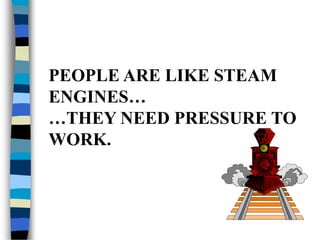
PEOPLE ARE LIKE STEAM
ENGINES…
…THEY NEED PRESSURE TO
WORK.
PROGRESS REPORTS
These are used to explain away problems
instead of solving them.
Instead of reading and writing we would be
better talking to our teams.
Instead of reacting to a report’s findings lets
be proactive and communicate.
Most effective means of motivating teams
is showing that you care by taking an
interest.
MEETING MINUTES
Why bother with action points in meetings?
If you do adhere to them you end up reacting
to only those points assigned as your
responsibility.
Be part of the bigger picture, throw the
points
out of the window and think proactively and
HOLISTICALLY.
QUALITY ASSURANCE
People work round procedures rather than adhering to them,
rather than being viewed as wrong this should be viewed as
professional.
I.e. proactively managing your projects as that they are
effectively and efficiently executed whilst maintaining all
quality standards.
QUALITY ASSURANCE
Instead of trying to prevent people from
thinking we should encourage them to do so.
Sooner or later, there will
be a crisis situation.
The conventional procedures will break
down and people will have to make their own
decisions.
TECHNICAL MATTERS
If you invent or re-invent something you are likely to have a
much better understanding of what it is and what it can do,
than if you just learn about it.
If you think something is your invention then you will try
harder to make a success of it than if you think the credit
belongs to someone else.
GO ON BE PROACTIVE -
RE-INVENT IT TO SUIT YOU!
TECHNICAL MATTERS
An amateur free fall parachutist devised his own method for
packing his drogue.
He said that the conventional method could lead to jamming
in certain situations.
He believed his own method was better.
He was being proactive, changing it to suit himself.
GO ON BE PROACTIVE -
RE-INVENT IT TO SUIT YOU!
SHAKESPEARE
“The course of true love never did run smooth.”
Shakespeare never wrote management handbooks maybe he
should have done as the above is true of customers.
Rather than reacting to conflicts with customers we should
be proactively ensuring that true love does run smooth.
Spending a long time planning is ineffective as you take
away from time that you could be spending on the project.
AUTHORITY AND
RESPONSIBIULITY.
Errors are the inevitable side effect of
learning to do things better,
If you staff are not making errors then they are not
developing their professional competence.
If you kept a baby tied to a chair it would never fall
over or bump its head…but it would never learn to
walk either.
GIVE YOUR STAFF THE FREEDOM TO
MAKE MISTAKES.
CUSTOMERS
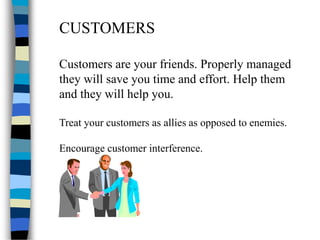
Customers are your friends. Properly managed
they will save you time and effort. Help them
and they will help you.
Treat your customers as allies as opposed to enemies.
Encourage customer interference.
THE PROACTIVE APPROACH
TO PROJECT MANAGEMENT.
•Think for yourself
•Accept imperfection
•Minimise unnecessary work
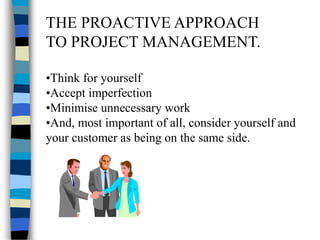
•And, most important of all, consider yourself and
your customer as being on the same side.

Proactive Management Course.ppt

  • 1.
  • 2.
    This session hasno magic formulas or well defined steps on how to turn you into proactive managers. It is about changing attitudes… …making you THINK PROACTIVELY.
  • 3.
    OBJECTIVES This session willhelp you:- •think •“work things out for yourself and do only what YOU consider is right. •Be inspired to trust your instincts.
  • 4.
    PROJECTS Your job roleis made up of many individual jobs. Think about these jobs as PROJECTS.
  • 5.
    DEALING WITH PROJECTS Theusual way to deal with a project is “take some customer requirements, add some resources, crank the handle just the right way and out pops the finished product.” In an ideal world brilliant but one big problem..
  • 6.
    HUMAN BEINGS Humans havean admirable and impressive capacity to mess things up - even if they are not really trying. FACE UP TO THE FACT THAT… …you are managing very complex, variable and headstrong creatures called human beings.
  • 7.
    REMEMBER Human Beings didnot evolve to execute well defined procedures like mindless automata. They did evolve to operate effectively in a rapidly changing, uncertain and often unfamiliar environment. Everything is achieved by influencing and communicating with real people.
  • 8.
    PLANNING Proactive managers keeptheir options open and free themselves from unnecessary paperwork Whose benefit is the plan for? - Largely yours! The plan is purely a form of organising your thoughts.
  • 9.
    PLANNING The best managersare those who display a high degree of strategic flexibility. This means that they are able to take into account the features of the situation. They know when it is best to make detailed plans or try a more experimental approach.
  • 10.
    DON’T TRACK PROGRESS SETTHE PACE OF PROGRESS!
  • 11.
    DON’T TRACK PROGRESS SETTHE PACE OF PROGRESS!
  • 12.
    PEOPLE ARE LIKESTEAM ENGINES… …THEY NEED PRESSURE TO WORK.
  • 13.
    PROGRESS REPORTS These areused to explain away problems instead of solving them. Instead of reading and writing we would be better talking to our teams. Instead of reacting to a report’s findings lets be proactive and communicate.
  • 14.
    Most effective meansof motivating teams is showing that you care by taking an interest.
  • 15.
    MEETING MINUTES Why botherwith action points in meetings? If you do adhere to them you end up reacting to only those points assigned as your responsibility. Be part of the bigger picture, throw the points out of the window and think proactively and HOLISTICALLY.
  • 16.
    QUALITY ASSURANCE People workround procedures rather than adhering to them, rather than being viewed as wrong this should be viewed as professional. I.e. proactively managing your projects as that they are effectively and efficiently executed whilst maintaining all quality standards.
  • 17.
    QUALITY ASSURANCE Instead oftrying to prevent people from thinking we should encourage them to do so. Sooner or later, there will be a crisis situation. The conventional procedures will break down and people will have to make their own decisions.
  • 18.
    TECHNICAL MATTERS If youinvent or re-invent something you are likely to have a much better understanding of what it is and what it can do, than if you just learn about it. If you think something is your invention then you will try harder to make a success of it than if you think the credit belongs to someone else. GO ON BE PROACTIVE - RE-INVENT IT TO SUIT YOU!
  • 19.
    TECHNICAL MATTERS An amateurfree fall parachutist devised his own method for packing his drogue. He said that the conventional method could lead to jamming in certain situations. He believed his own method was better. He was being proactive, changing it to suit himself. GO ON BE PROACTIVE - RE-INVENT IT TO SUIT YOU!
  • 20.
    SHAKESPEARE “The course oftrue love never did run smooth.” Shakespeare never wrote management handbooks maybe he should have done as the above is true of customers. Rather than reacting to conflicts with customers we should be proactively ensuring that true love does run smooth. Spending a long time planning is ineffective as you take away from time that you could be spending on the project.
  • 21.
    AUTHORITY AND RESPONSIBIULITY. Errors arethe inevitable side effect of learning to do things better, If you staff are not making errors then they are not developing their professional competence. If you kept a baby tied to a chair it would never fall over or bump its head…but it would never learn to walk either. GIVE YOUR STAFF THE FREEDOM TO MAKE MISTAKES.
  • 22.
    CUSTOMERS Customers are yourfriends. Properly managed they will save you time and effort. Help them and they will help you. Treat your customers as allies as opposed to enemies. Encourage customer interference.
  • 23.
    THE PROACTIVE APPROACH TOPROJECT MANAGEMENT. •Think for yourself •Accept imperfection •Minimise unnecessary work •And, most important of all, consider yourself and your customer as being on the same side.