1
Planning & Time Management
Session
By
Mr. Devarasu & Mr. Shinoy John
 Time management is straightforwardly defined as the
management of time in order to make the most out of it.
“in 2001 Study confirms that ..
You can't manage time, it just is. So "time management" is a
mislabeled problem, which has little chance of being an
effective approach. What you really manage is your activity
during time, and defining outcomes and physical actions
required is the core process required to manage what you
do”.
2
Definition
3
Contents
 Benefits of Time Management
 Obstacles of Time Management
 Set Goals
 Planning
 Prioritize
 Organize
 Evaluation
 Celebrating success
 Efficient- We will be more efficient to serve Cleanco &
support better
 Successful- We can achieve greater heights
 Healthy-On a personal level, we will certainly feel, more
energetic & generally in better mood.
4
Benefits of Time Management
5
 Unclear Objectives- Its Hard to accomplish
when we aren't specific/clear about our goals
 Interruptions- Many a times we are in
the middle of really important task &
the telephone rings. These calls not
only takes time from our task but
interrupts our thought process too.
Obstacles to effective time
management
 Disorganization – Its easy to see when
our desk is messy but sometimes we
need to step back & ask ourselves if we
are taking an organized approach in
completing all the tasks
6
 Periods of inactivity- As much as we think we are
busy, there are times in our day when we are not
really doing anything. Recognizing & making use of
these times can have positive effect in areas of our
work.
Video On obstacles
7
8
Recognize that obstacles exist. – the hardest thing to do!!
Identify them-Once identified we begin to over come
Employee strategies to overcome- some strategies to follow.
9
Activity
10
Rocks= Your family, your children, health, friends and favorite
passions.
Pebbles= Casual hobbies & spending time with people
Sand=Not important things in life
11
Jar of life
"TO DO LIST“ (Top 3 Priorities today)
Communicate & Clarify Values
Analyze your use of TIME - "80/20“
Do not “REACT” to Urgency
Learn to say two letter word - "NO“
Delegate low Priority Item
12
Planning
S=Specific
M=Measurable
A=Attainable
R=Relevant
T=Time Based
13
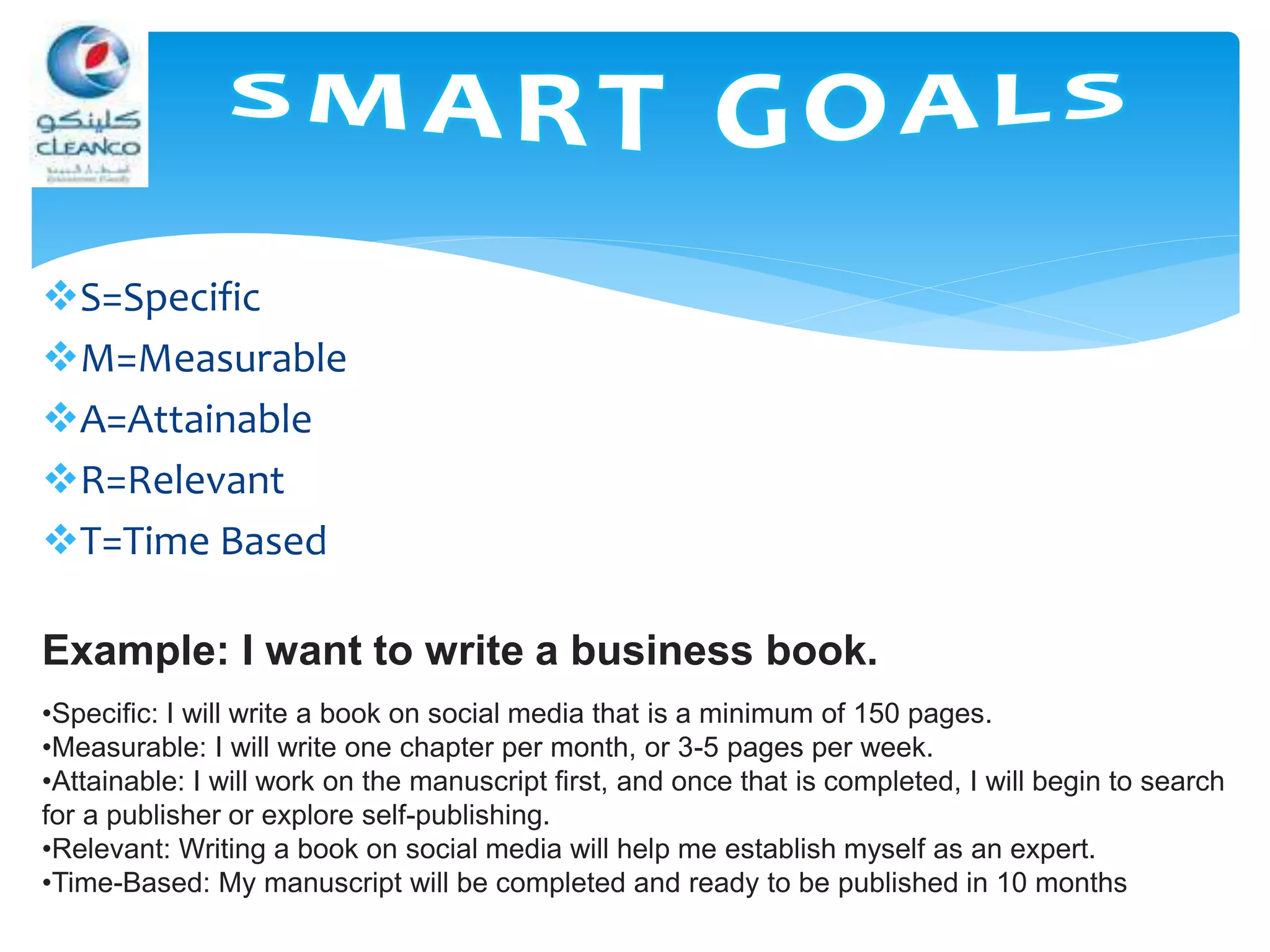
Example: I want to write a business book.
•Specific: I will write a book on social media that is a minimum of 150 pages.
•Measurable: I will write one chapter per month, or 3-5 pages per week.
•Attainable: I will work on the manuscript first, and once that is completed, I will begin to search
for a publisher or explore self-publishing.
•Relevant: Writing a book on social media will help me establish myself as an expert.
•Time-Based: My manuscript will be completed and ready to be published in 10 months
14
 Address the urgent- Taking care of things with short term
consequences as soon as possible
 Accomplish what you can early- Don’t procrastinate
 Attach deadlines to things you delay.
Prioritize
15
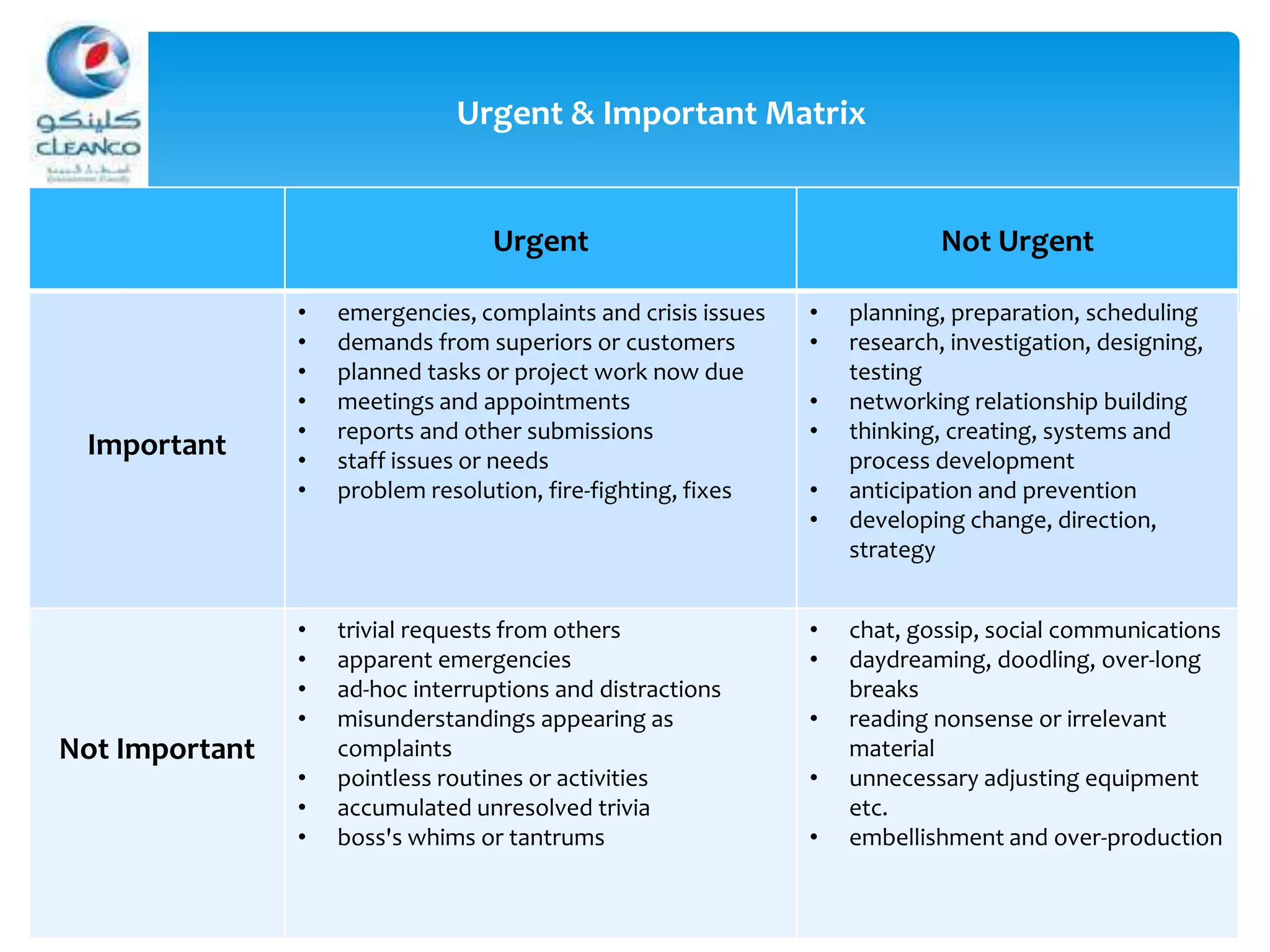
Urgent Not Urgent
Important
• emergencies, complaints and crisis issues
• demands from superiors or customers
• planned tasks or project work now due
• meetings and appointments
• reports and other submissions
• staff issues or needs
• problem resolution, fire-fighting, fixes
• planning, preparation, scheduling
• research, investigation, designing,
testing
• networking relationship building
• thinking, creating, systems and
process development
• anticipation and prevention
• developing change, direction,
strategy
Not Important
• trivial requests from others
• apparent emergencies
• ad-hoc interruptions and distractions
• misunderstandings appearing as
complaints
• pointless routines or activities
• accumulated unresolved trivia
• boss's whims or tantrums
• chat, gossip, social communications
• daydreaming, doodling, over-long
breaks
• reading nonsense or irrelevant
material
• unnecessary adjusting equipment
etc.
• embellishment and over-production
Urgent & Important Matrix
16
Organize
• Planners
• Computers
• PDA-Personal Digital Assistant
 On Public transportation
 At the Doctors office
 Waiting for the flight.
 On hold
 When you are early.
17
Use your waiting time
18
Celebrate the achievement of your goals to maintain a healthy
balance in life between work and play. Reward yourself when
you complete a task or finish a project.
If you worked in a team setting, or delegated some tasks to
others, reward the efforts of all involved.
Celebration is a vital part of all project management. No matter
how tight your schedule looks, this is TIME WELL SPENT!
Celebrate Success
 Benefits of Time Management
 Obstacles of Time Management
 Set Goals
 Planning
 Prioritize
 Organize
 Celebrate Success
19
Review
 Thank You….
“Change is Universal… Change is Permanent….
Be ever willing to Change…..
For, change alone leads you to success and
happiness!!!”
20

Time management ppt

  • 1.
    1 Planning & TimeManagement Session By Mr. Devarasu & Mr. Shinoy John
  • 2.
     Time managementis straightforwardly defined as the management of time in order to make the most out of it. “in 2001 Study confirms that .. You can't manage time, it just is. So "time management" is a mislabeled problem, which has little chance of being an effective approach. What you really manage is your activity during time, and defining outcomes and physical actions required is the core process required to manage what you do”. 2 Definition
  • 3.
    3 Contents  Benefits ofTime Management  Obstacles of Time Management  Set Goals  Planning  Prioritize  Organize  Evaluation  Celebrating success
  • 4.
     Efficient- Wewill be more efficient to serve Cleanco & support better  Successful- We can achieve greater heights  Healthy-On a personal level, we will certainly feel, more energetic & generally in better mood. 4 Benefits of Time Management
  • 5.
    5  Unclear Objectives-Its Hard to accomplish when we aren't specific/clear about our goals  Interruptions- Many a times we are in the middle of really important task & the telephone rings. These calls not only takes time from our task but interrupts our thought process too. Obstacles to effective time management  Disorganization – Its easy to see when our desk is messy but sometimes we need to step back & ask ourselves if we are taking an organized approach in completing all the tasks
  • 6.
    6  Periods ofinactivity- As much as we think we are busy, there are times in our day when we are not really doing anything. Recognizing & making use of these times can have positive effect in areas of our work.
  • 7.
  • 8.
  • 9.
    Recognize that obstaclesexist. – the hardest thing to do!! Identify them-Once identified we begin to over come Employee strategies to overcome- some strategies to follow. 9
  • 10.
  • 11.
    Rocks= Your family,your children, health, friends and favorite passions. Pebbles= Casual hobbies & spending time with people Sand=Not important things in life 11 Jar of life
  • 12.
    "TO DO LIST“(Top 3 Priorities today) Communicate & Clarify Values Analyze your use of TIME - "80/20“ Do not “REACT” to Urgency Learn to say two letter word - "NO“ Delegate low Priority Item 12 Planning
  • 13.
    S=Specific M=Measurable A=Attainable R=Relevant T=Time Based 13 Example: Iwant to write a business book. •Specific: I will write a book on social media that is a minimum of 150 pages. •Measurable: I will write one chapter per month, or 3-5 pages per week. •Attainable: I will work on the manuscript first, and once that is completed, I will begin to search for a publisher or explore self-publishing. •Relevant: Writing a book on social media will help me establish myself as an expert. •Time-Based: My manuscript will be completed and ready to be published in 10 months
  • 14.
    14  Address theurgent- Taking care of things with short term consequences as soon as possible  Accomplish what you can early- Don’t procrastinate  Attach deadlines to things you delay. Prioritize
  • 15.
    15 Urgent Not Urgent Important •emergencies, complaints and crisis issues • demands from superiors or customers • planned tasks or project work now due • meetings and appointments • reports and other submissions • staff issues or needs • problem resolution, fire-fighting, fixes • planning, preparation, scheduling • research, investigation, designing, testing • networking relationship building • thinking, creating, systems and process development • anticipation and prevention • developing change, direction, strategy Not Important • trivial requests from others • apparent emergencies • ad-hoc interruptions and distractions • misunderstandings appearing as complaints • pointless routines or activities • accumulated unresolved trivia • boss's whims or tantrums • chat, gossip, social communications • daydreaming, doodling, over-long breaks • reading nonsense or irrelevant material • unnecessary adjusting equipment etc. • embellishment and over-production Urgent & Important Matrix
  • 16.
    16 Organize • Planners • Computers •PDA-Personal Digital Assistant
  • 17.
     On Publictransportation  At the Doctors office  Waiting for the flight.  On hold  When you are early. 17 Use your waiting time
  • 18.
    18 Celebrate the achievementof your goals to maintain a healthy balance in life between work and play. Reward yourself when you complete a task or finish a project. If you worked in a team setting, or delegated some tasks to others, reward the efforts of all involved. Celebration is a vital part of all project management. No matter how tight your schedule looks, this is TIME WELL SPENT! Celebrate Success
  • 19.
     Benefits ofTime Management  Obstacles of Time Management  Set Goals  Planning  Prioritize  Organize  Celebrate Success 19 Review
  • 20.
     Thank You…. “Changeis Universal… Change is Permanent…. Be ever willing to Change….. For, change alone leads you to success and happiness!!!” 20