


PRJ101XL – Project Libre
Basic
www.ocdatabases.com
slides.1@ocdatabases.com
949-489-1472
Project Libre Basic
Note: The basic outline for this course and
much of the material was adapted from a
similar Microsoft Project course (which we
also offer) by Logical Operations, formerly
Element K.
Project Libre
 Open Source alternative to Microsoft
Project
 Can read and write Microsoft Project
files
PRJ101XL Project Libre Basic
 Introduction (s)
 Facilities
 Course Packet (May vary by course and class)
– Student Questionnaire
– Collaterals (Maps, Catalog, Etc.)
– Copy of PowerPoint slides used
– Evaluation form
– Training certificate
5
Project Libre: Basic
1. Getting started
2. Tasks
3. Task scheduling
4. Resource management
5. Views and tables
6. Filters, groups, and sorting
7. Finalizing the task plan
GETTING STARTED
Topic 1
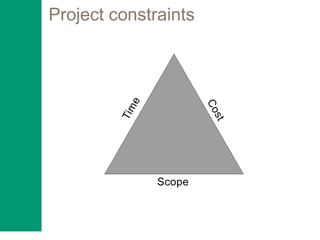
Project constraints
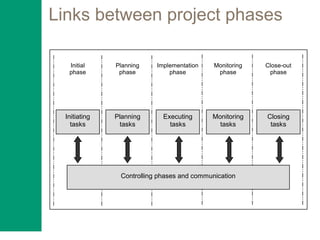
Links between project phases
Initial
phase
Planning
phase
Close-out
phase
Implementation
phase
Monitoring
phase
Initiating
tasks
Planning
tasks
Executing
tasks
Monitoring
tasks
Closing
tasks
Controlling phases and communication
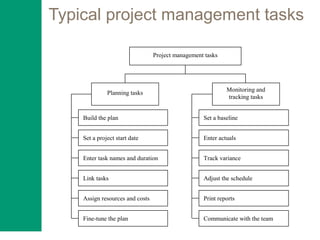
Typical project management tasks
Project management tasks
Planning tasks
Monitoring and
tracking tasks
Build the plan
Fine-tune the plan
Link tasks
Assign resources and costs
Set a project start date
Enter task names and duration
Set a baseline
Communicate with the team
Enter actuals
Track variance
Adjust the schedule
Print reports
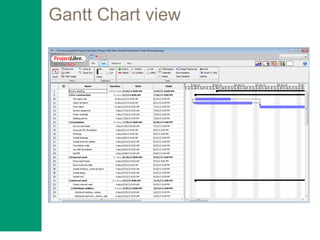
Gantt Chart view
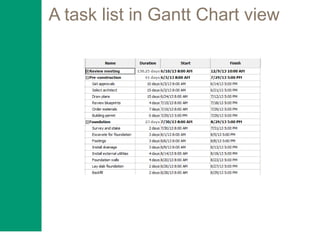
A task list in Gantt Chart view
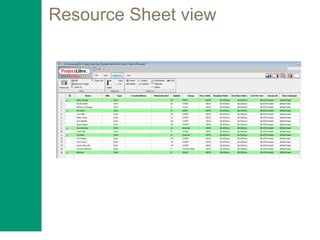
Resource Sheet view
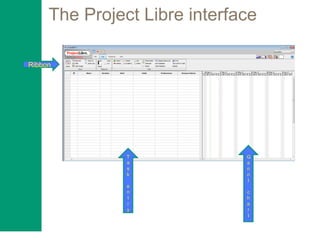
The Project Libre interface
Ribbon
T
a
s
k
e
n
t
r
y
G
a
n
n
t
c
h
a
r
t
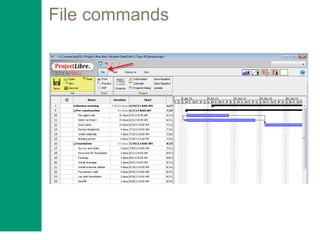
File commands
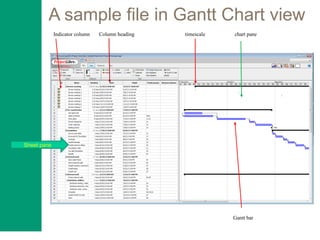
A sample file in Gantt Chart view
Indicator column Column heading chart pane
Sheet pane
timescale
Gantt bar
Open a Project file
1. Click the File Tab
2. Click Open in the ribbon File Group
3. Navigate to and select the Project file
that you want to open
4. Click Open (or double-click the file)
Set the project start date
1. Click the File Tab
2. In the ribbon Project Group, click
Information
3. Set the start date
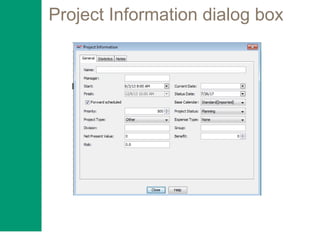
Project Information dialog box
Save a new project file
1. On the ribbon, click the Save button
(or press Ctrl+S)
2. In the Save As dialog box, navigate to
the location where you want to save
the project file
3. Enter a file name
4. Click Save (or press Enter)
TASKS
Topic 2
Add tasks to a task list
1. In the Task Name column, select the
cell below the location where you
want to insert the task
2. On the Task tab, click Insert Task
(Or right-click the cell below where you
want to insert the task and choose New)
3. Type the task information in the new
row
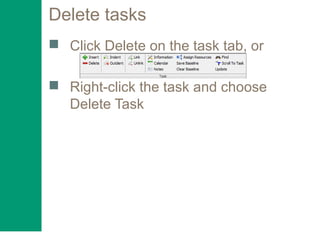
Delete tasks
 Click Delete on the task tab, or
 Right-click the task and choose
Delete Task
Cut and paste a task
1. Click a row number to select the row
2. Click Cut
3. Click the row number below where
you want to insert the cut task
4. Click Paste
Drag selected tasks
1. Click the row number to select the
row, or drag across row numbers to
select sequential tasks
2. Drag the selected rows to a new
position in the task list
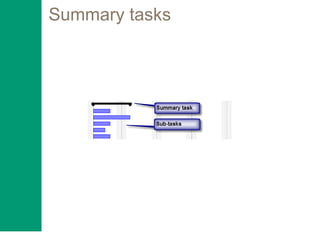
Summary tasks
Convert a task into a milestone
1. In the Sheet pane, double-click the
task to open the Task Information
dialog box
2. Click the Advanced tab
3. Check “Display task as milestone”
4. Click Close
TASK SCHEDULING
Topic 3
When you link tasks:
 Project Libre automatically applies a
Finish-to-Start task dependency
 The start of the second task depends
on the completion of the first task
Linking tasks
1. Select the tasks
2. On the Task tab, click the Link button
Change a task’s predecessor
1. In the Sheet pane, locate the task
whose predecessor you want to
change
2. In the predecessor column, enter the
task ID of the task that you want to
set as the predecessor
Lag time
 A delay that adds time after the
completion of a task
 Example: “Install trim”
– If you add lag time to its predecessor,
“Paint,” the paint will have time to dry
before the trim installation begins
Lead time
 The overlap between dependent tasks
(when a task can start before its
predecessor finishes)
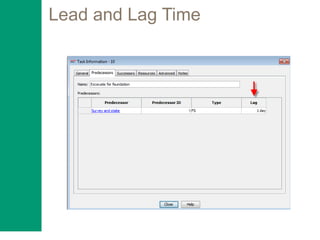
Lead and Lag Time
Apply lead time or lag time
1. Double-click a task in the Sheet pane
2. Click the Predecessors tab
3. To apply lag time, enter a positive
value in the Lag field for the
predecessor
To apply lead time, enter a negative
value
4. Click OK
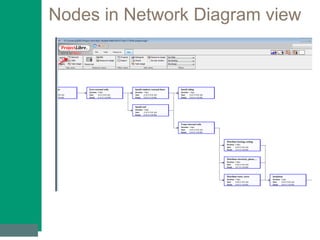
Nodes in Network Diagram view
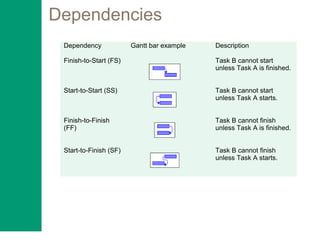
Dependencies
Dependency Gantt bar example Description
Finish-to-Start (FS) Task B cannot start
unless Task A is finished.
Start-to-Start (SS) Task B cannot start
unless Task A starts.
Finish-to-Finish
(FF)
Task B cannot finish
unless Task A is finished.
Start-to-Finish (SF) Task B cannot finish
unless Task A starts.
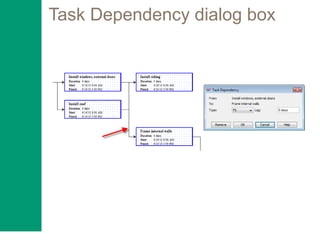
Task Dependency dialog box
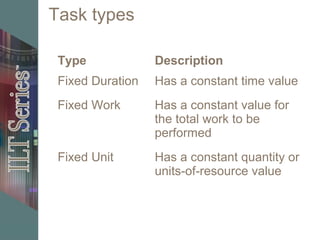
Task types
Type Description
Fixed Duration Has a constant time value
Fixed Work Has a constant value for
the total work to be
performed
Fixed Unit Has a constant quantity or
units-of-resource value
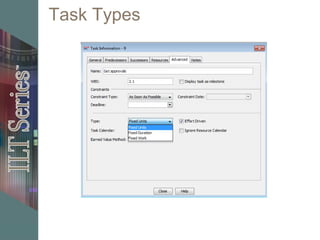
Task Types
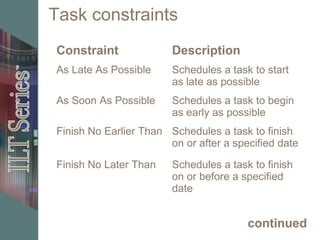
Task constraints
Constraint Description
As Late As Possible Schedules a task to start
as late as possible
As Soon As Possible Schedules a task to begin
as early as possible
Finish No Earlier Than Schedules a task to finish
on or after a specified date
Finish No Later Than Schedules a task to finish
on or before a specified
date
continued
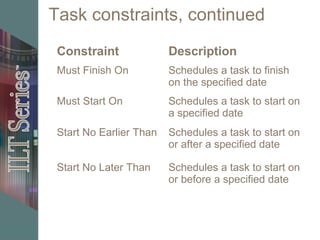
Task constraints, continued
Constraint Description
Must Finish On Schedules a task to finish
on the specified date
Must Start On Schedules a task to start on
a specified date
Start No Earlier Than Schedules a task to start on
or after a specified date
Start No Later Than Schedules a task to start on
or before a specified date
Task Constraints
RESOURCE MANAGEMENT
Topic 4
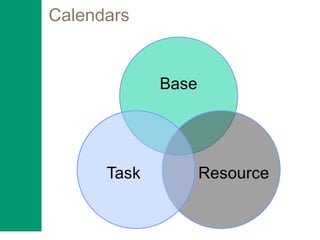
Calendars
Create a base calendar
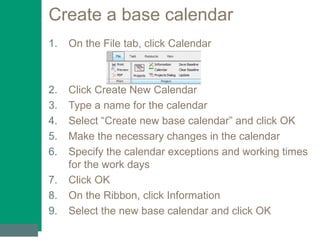
1. On the File tab, click Calendar
2. Click Create New Calendar
3. Type a name for the calendar
4. Select “Create new base calendar” and click OK
5. Make the necessary changes in the calendar
6. Specify the calendar exceptions and working times
for the work days
7. Click OK
8. On the Ribbon, click Information
9. Select the new base calendar and click OK
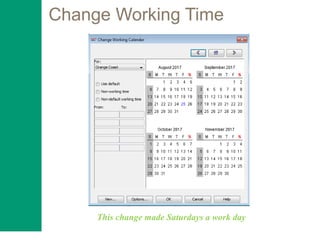
Change Working Time
This change made Saturdays a work day
Resource types
 Work resource
– Performs work on a task
– Examples: people, equipment
 Material resource
– Item used to perform work on a task
– Examples: paint, wood, steel, fuel
Create a resource calendar
1. In Resource Sheet view, in the Name
field, select the resource to which you
want to assign a calendar
2. On the Resource tab, click Calendar
3. Make the necessary changes in the
calendar and click OK
4. Click OK
Assign resources
1. Switch to Gantt Chart view
2. Select the task to which you want to
assign a resource
3. On the Task tab, click Assign
Resources
4. Select a resource and click Assign
5. Click Close
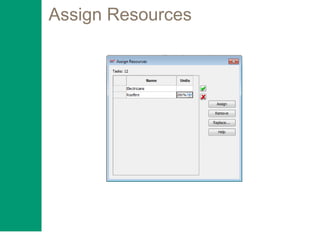
Assign Resources
Assign a resource to multiple tasks
1. Hold down Ctrl and select the tasks
to which you want to assign a
resource
2. Open the Assign Resources dialog
box
(Or open the dialog box first and then
select tasks in the Sheet pane)
3. Select the resource name and click
Assign
4. Click Close
Assign multiple resources to a task
1. Open the Assign Resources dialog
box
2. Select the task to which you want to
assign multiple resources
3. Select the resource you want to
assign
4. Press and hold Ctrl, and select the
other resource name(s) that you want
to assign to the task
5. Click Assign, and then click Close
Task Calendars
 Create a new calendar
 Open Task Information Dialogue
 Assign task calendar under advanced
tab
VIEWS AND TABLES
Topic 5
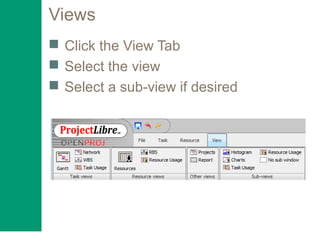
Views
 Click the View Tab
 Select the view
 Select a sub-view if desired
Insert a column
1. Right-click the column heading that’s
to the right of where you want to
insert the column
2. Choose Insert Column
3. Select the column name and click OK
4. Resize the column as needed
FILTERS, GROUPS AND
SORTING
Topic 6
Filter a view
1. Click the View tab
2. From the Filter list, select a filter
3. To return to an unfiltered view,
choose [No Filter] from the Filter list
Find
1. In the Sheet pane right click the
column header
2. Do either of the following:
– Select the field
– Type in the search term and click Find
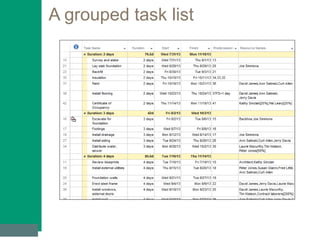
A grouped task list
Grouped Task List
Group a task list
1. Click the View tab
2. Click grouping select list and select a
group option
Sort a task list
1. Click the View tab
2. Click Sorting select list and select a
sort option
FINALIZING THE TASK PLAN
Topic 7
Slack
 The amount of time you can delay
tasks without affecting the project
schedule
– Free slack — The amount of time a task
can be delayed before it delays another
task
– Total slack — The amount of time a task
can slip without delaying the project
completion date
Make a task non-effort-driven:
1. Double-click the task name to open
the Task Information dialog box
2. Click the Advanced tab
3. Clear Effort driven and click OK
Resource Usage view
Options to level resources manually
 Replace the over-allocated resource
with an under-allocated resource
 Assign an additional resource to the
task
 Reduce the work assignments for a
task, and increase the duration for its
completion
 Increase the working time of the
resource
Project Libre Basic
 Please fill out your evaluations and
submit them to your instructor
 Enjoy using Project Libre!
 If you want to know more: PRJ102XL
(Project Libre Advanced - monitoring & tracking
projects)

PRJ101xl Project Libre Basic Training

  • 1.
    PRJ101XL – ProjectLibre Basic www.ocdatabases.com slides.1@ocdatabases.com 949-489-1472
  • 2.
    Project Libre Basic Note:The basic outline for this course and much of the material was adapted from a similar Microsoft Project course (which we also offer) by Logical Operations, formerly Element K.
  • 3.
    Project Libre  OpenSource alternative to Microsoft Project  Can read and write Microsoft Project files
  • 4.
    PRJ101XL Project LibreBasic  Introduction (s)  Facilities  Course Packet (May vary by course and class) – Student Questionnaire – Collaterals (Maps, Catalog, Etc.) – Copy of PowerPoint slides used – Evaluation form – Training certificate
  • 5.
  • 6.
    Project Libre: Basic 1.Getting started 2. Tasks 3. Task scheduling 4. Resource management 5. Views and tables 6. Filters, groups, and sorting 7. Finalizing the task plan
  • 7.
  • 8.
  • 9.
    Links between projectphases Initial phase Planning phase Close-out phase Implementation phase Monitoring phase Initiating tasks Planning tasks Executing tasks Monitoring tasks Closing tasks Controlling phases and communication
  • 10.
    Typical project managementtasks Project management tasks Planning tasks Monitoring and tracking tasks Build the plan Fine-tune the plan Link tasks Assign resources and costs Set a project start date Enter task names and duration Set a baseline Communicate with the team Enter actuals Track variance Adjust the schedule Print reports
  • 11.
  • 12.
    A task listin Gantt Chart view
  • 13.
  • 14.
    The Project Libreinterface Ribbon T a s k e n t r y G a n n t c h a r t
  • 15.
  • 16.
    A sample filein Gantt Chart view Indicator column Column heading chart pane Sheet pane timescale Gantt bar
  • 17.
    Open a Projectfile 1. Click the File Tab 2. Click Open in the ribbon File Group 3. Navigate to and select the Project file that you want to open 4. Click Open (or double-click the file)
  • 18.
    Set the projectstart date 1. Click the File Tab 2. In the ribbon Project Group, click Information 3. Set the start date
  • 19.
  • 20.
    Save a newproject file 1. On the ribbon, click the Save button (or press Ctrl+S) 2. In the Save As dialog box, navigate to the location where you want to save the project file 3. Enter a file name 4. Click Save (or press Enter)
  • 21.
  • 22.
    Add tasks toa task list 1. In the Task Name column, select the cell below the location where you want to insert the task 2. On the Task tab, click Insert Task (Or right-click the cell below where you want to insert the task and choose New) 3. Type the task information in the new row
  • 23.
    Delete tasks  ClickDelete on the task tab, or  Right-click the task and choose Delete Task
  • 24.
    Cut and pastea task 1. Click a row number to select the row 2. Click Cut 3. Click the row number below where you want to insert the cut task 4. Click Paste
  • 25.
    Drag selected tasks 1.Click the row number to select the row, or drag across row numbers to select sequential tasks 2. Drag the selected rows to a new position in the task list
  • 26.
  • 27.
    Convert a taskinto a milestone 1. In the Sheet pane, double-click the task to open the Task Information dialog box 2. Click the Advanced tab 3. Check “Display task as milestone” 4. Click Close
  • 28.
  • 29.
    When you linktasks:  Project Libre automatically applies a Finish-to-Start task dependency  The start of the second task depends on the completion of the first task
  • 30.
    Linking tasks 1. Selectthe tasks 2. On the Task tab, click the Link button
  • 31.
    Change a task’spredecessor 1. In the Sheet pane, locate the task whose predecessor you want to change 2. In the predecessor column, enter the task ID of the task that you want to set as the predecessor
  • 32.
    Lag time  Adelay that adds time after the completion of a task  Example: “Install trim” – If you add lag time to its predecessor, “Paint,” the paint will have time to dry before the trim installation begins Lead time  The overlap between dependent tasks (when a task can start before its predecessor finishes)
  • 33.
  • 34.
    Apply lead timeor lag time 1. Double-click a task in the Sheet pane 2. Click the Predecessors tab 3. To apply lag time, enter a positive value in the Lag field for the predecessor To apply lead time, enter a negative value 4. Click OK
  • 35.
    Nodes in NetworkDiagram view
  • 36.
    Dependencies Dependency Gantt barexample Description Finish-to-Start (FS) Task B cannot start unless Task A is finished. Start-to-Start (SS) Task B cannot start unless Task A starts. Finish-to-Finish (FF) Task B cannot finish unless Task A is finished. Start-to-Finish (SF) Task B cannot finish unless Task A starts.
  • 37.
  • 38.
    Task types Type Description FixedDuration Has a constant time value Fixed Work Has a constant value for the total work to be performed Fixed Unit Has a constant quantity or units-of-resource value
  • 39.
  • 40.
    Task constraints Constraint Description AsLate As Possible Schedules a task to start as late as possible As Soon As Possible Schedules a task to begin as early as possible Finish No Earlier Than Schedules a task to finish on or after a specified date Finish No Later Than Schedules a task to finish on or before a specified date continued
  • 41.
    Task constraints, continued ConstraintDescription Must Finish On Schedules a task to finish on the specified date Must Start On Schedules a task to start on a specified date Start No Earlier Than Schedules a task to start on or after a specified date Start No Later Than Schedules a task to start on or before a specified date
  • 42.
  • 43.
  • 44.
  • 45.
    Create a basecalendar 1. On the File tab, click Calendar 2. Click Create New Calendar 3. Type a name for the calendar 4. Select “Create new base calendar” and click OK 5. Make the necessary changes in the calendar 6. Specify the calendar exceptions and working times for the work days 7. Click OK 8. On the Ribbon, click Information 9. Select the new base calendar and click OK
  • 46.
    Change Working Time Thischange made Saturdays a work day
  • 47.
    Resource types  Workresource – Performs work on a task – Examples: people, equipment  Material resource – Item used to perform work on a task – Examples: paint, wood, steel, fuel
  • 48.
    Create a resourcecalendar 1. In Resource Sheet view, in the Name field, select the resource to which you want to assign a calendar 2. On the Resource tab, click Calendar 3. Make the necessary changes in the calendar and click OK 4. Click OK
  • 49.
    Assign resources 1. Switchto Gantt Chart view 2. Select the task to which you want to assign a resource 3. On the Task tab, click Assign Resources 4. Select a resource and click Assign 5. Click Close
  • 50.
  • 51.
    Assign a resourceto multiple tasks 1. Hold down Ctrl and select the tasks to which you want to assign a resource 2. Open the Assign Resources dialog box (Or open the dialog box first and then select tasks in the Sheet pane) 3. Select the resource name and click Assign 4. Click Close
  • 52.
    Assign multiple resourcesto a task 1. Open the Assign Resources dialog box 2. Select the task to which you want to assign multiple resources 3. Select the resource you want to assign 4. Press and hold Ctrl, and select the other resource name(s) that you want to assign to the task 5. Click Assign, and then click Close
  • 53.
    Task Calendars  Createa new calendar  Open Task Information Dialogue  Assign task calendar under advanced tab
  • 54.
  • 55.
    Views  Click theView Tab  Select the view  Select a sub-view if desired
  • 56.
    Insert a column 1.Right-click the column heading that’s to the right of where you want to insert the column 2. Choose Insert Column 3. Select the column name and click OK 4. Resize the column as needed
  • 57.
  • 58.
    Filter a view 1.Click the View tab 2. From the Filter list, select a filter 3. To return to an unfiltered view, choose [No Filter] from the Filter list
  • 59.
    Find 1. In theSheet pane right click the column header 2. Do either of the following: – Select the field – Type in the search term and click Find
  • 60.
  • 61.
  • 62.
    Group a tasklist 1. Click the View tab 2. Click grouping select list and select a group option
  • 63.
    Sort a tasklist 1. Click the View tab 2. Click Sorting select list and select a sort option
  • 64.
    FINALIZING THE TASKPLAN Topic 7
  • 65.
    Slack  The amountof time you can delay tasks without affecting the project schedule – Free slack — The amount of time a task can be delayed before it delays another task – Total slack — The amount of time a task can slip without delaying the project completion date
  • 66.
    Make a tasknon-effort-driven: 1. Double-click the task name to open the Task Information dialog box 2. Click the Advanced tab 3. Clear Effort driven and click OK
  • 67.
  • 68.
    Options to levelresources manually  Replace the over-allocated resource with an under-allocated resource  Assign an additional resource to the task  Reduce the work assignments for a task, and increase the duration for its completion  Increase the working time of the resource
  • 69.
    Project Libre Basic Please fill out your evaluations and submit them to your instructor  Enjoy using Project Libre!  If you want to know more: PRJ102XL (Project Libre Advanced - monitoring & tracking projects)

Editor's Notes

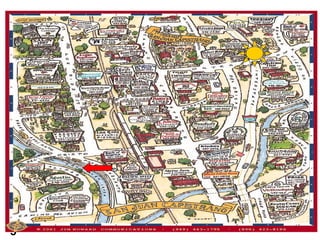
  • #6 The red arrow points to the training center. The yellow sunburst is the intersection of the Ortega Highway and Interstate 5, the route by which most students will reach the us.